Electrical Safety
for Construction
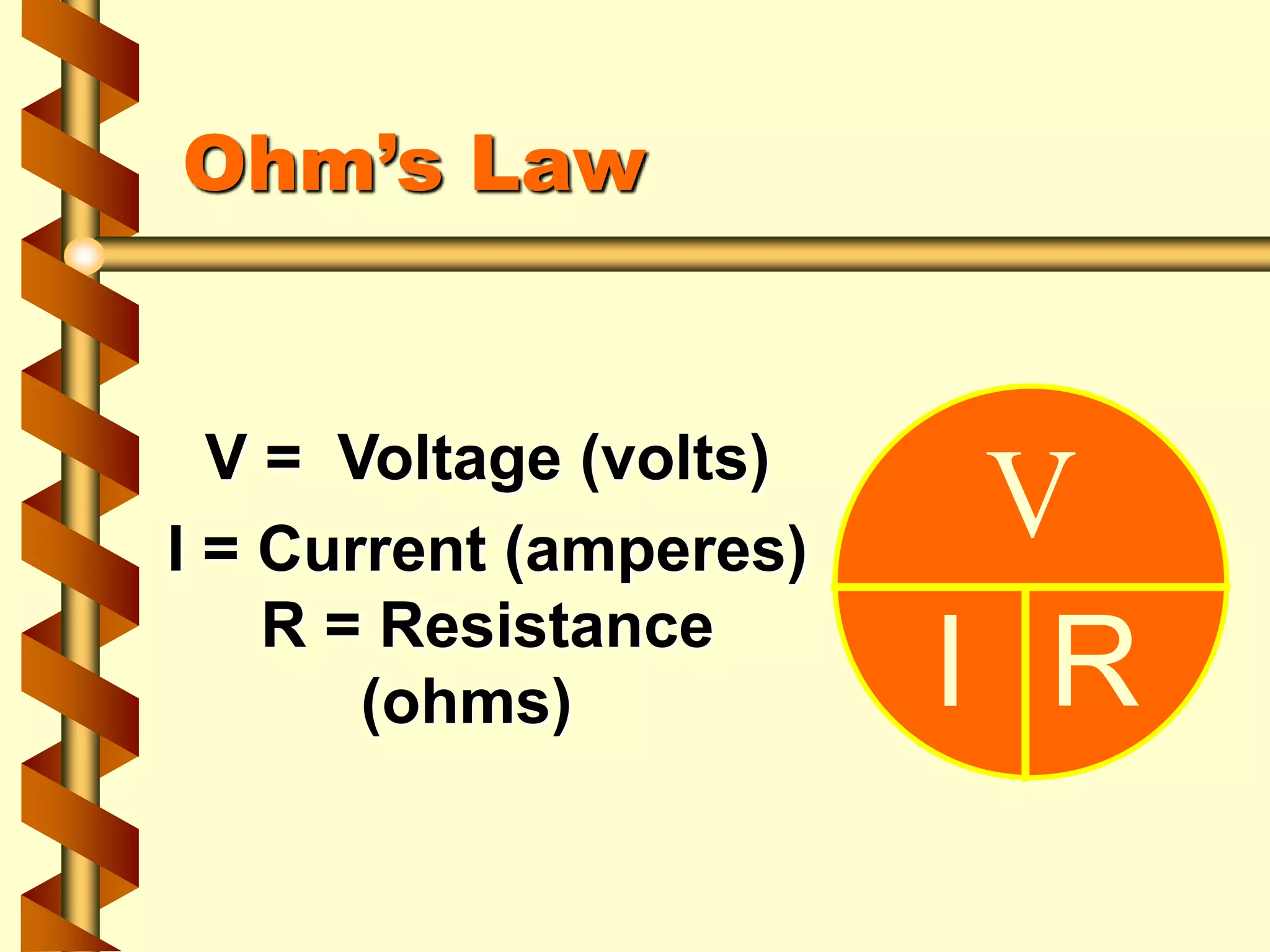
V = Voltage (volts)
I = Current (amperes)
R = Resistance
(ohms)
V
I R
Ohm’s Law
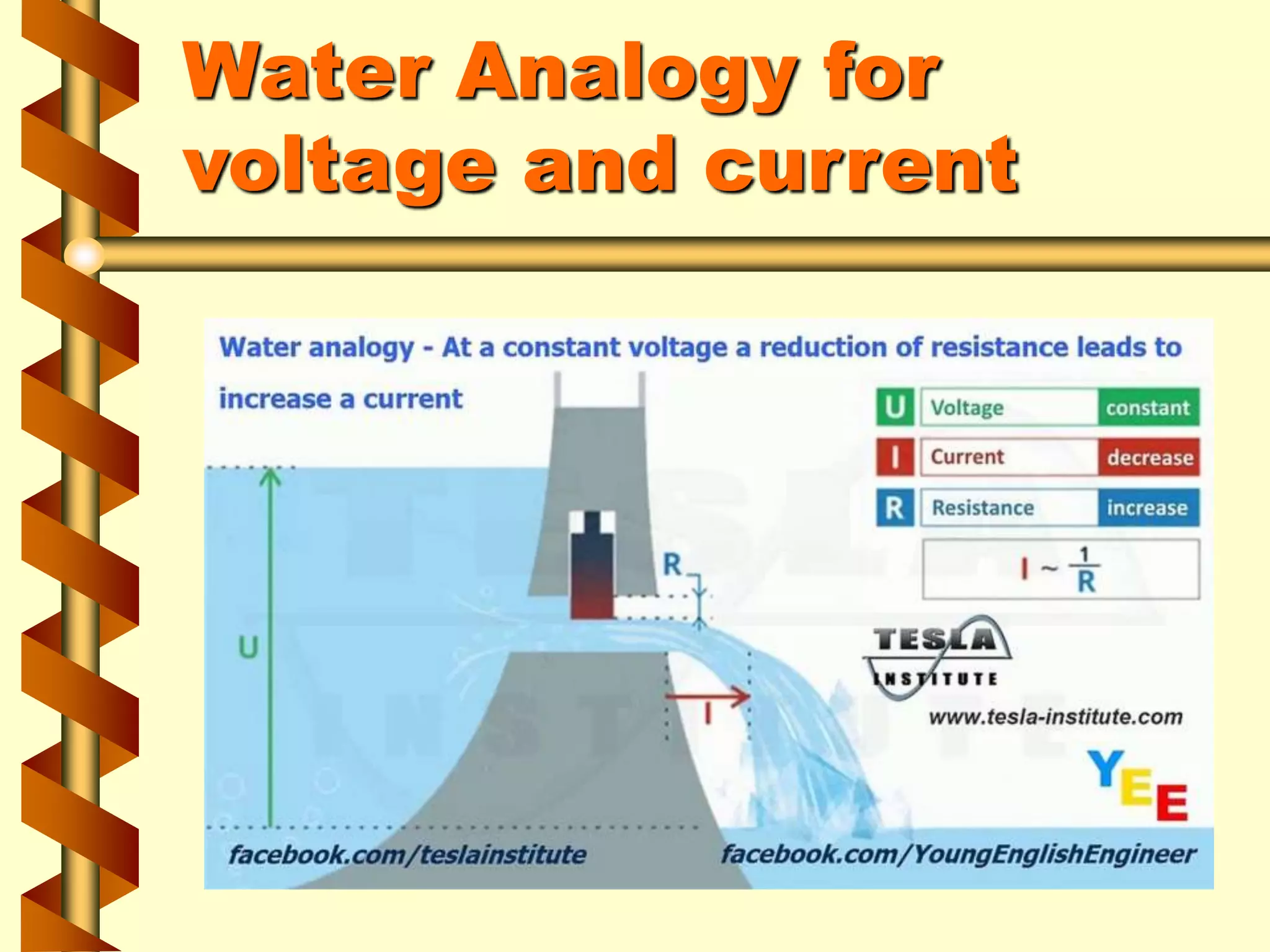
Water Analogy for
voltage and current
Electric shock
 Occurs when current enters the
body at one point and exits at
another
 Shock occurs when you touch:
• both wires of an electric circuit;
• one wire of an energized circuit
and ground; or
• a metallic part that is “hot” or
become “live”
3a
Electric shock
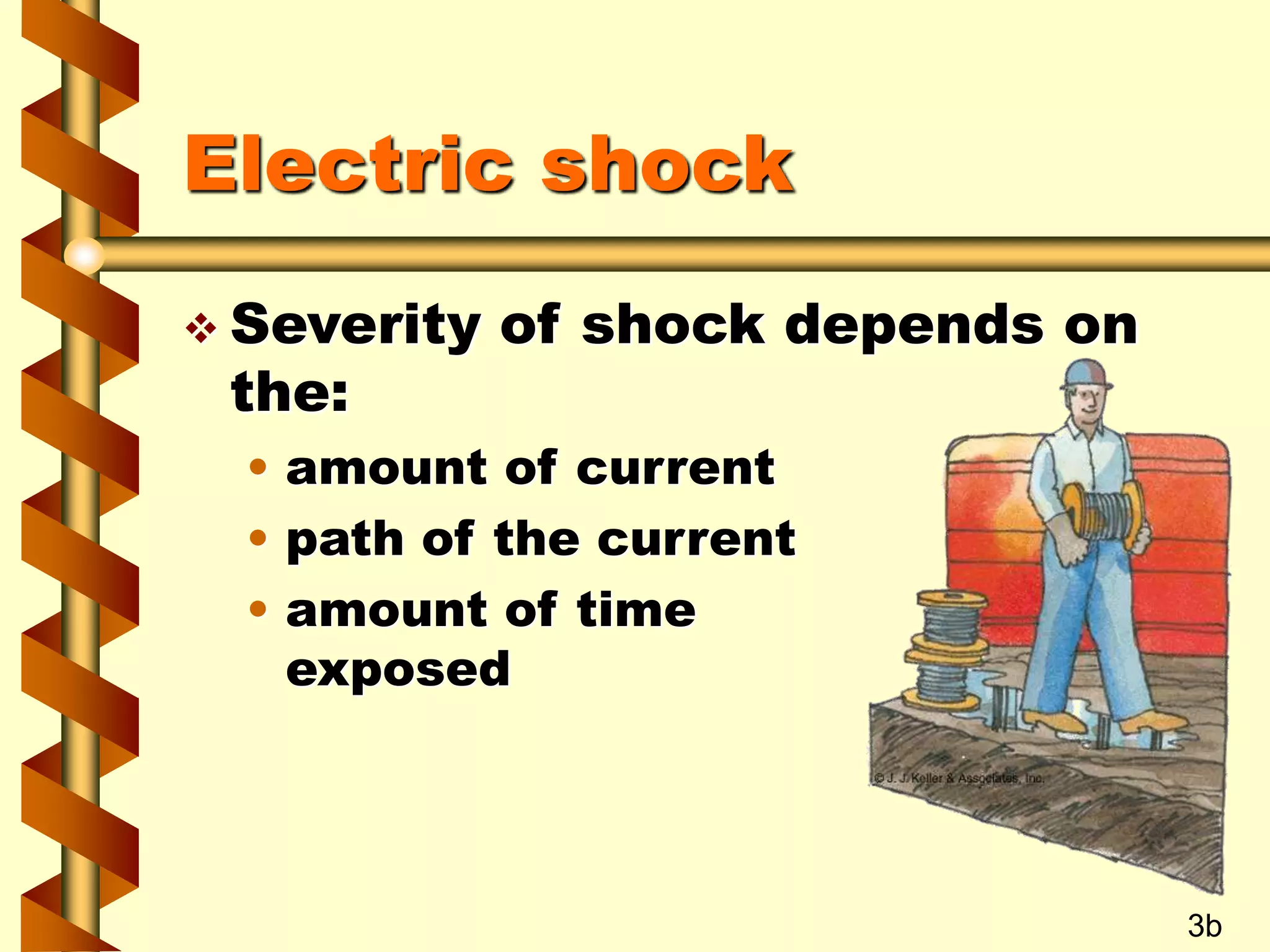
 Severity of shock depends on
the:
• amount of current
• path of the current
• amount of time
exposed
3b
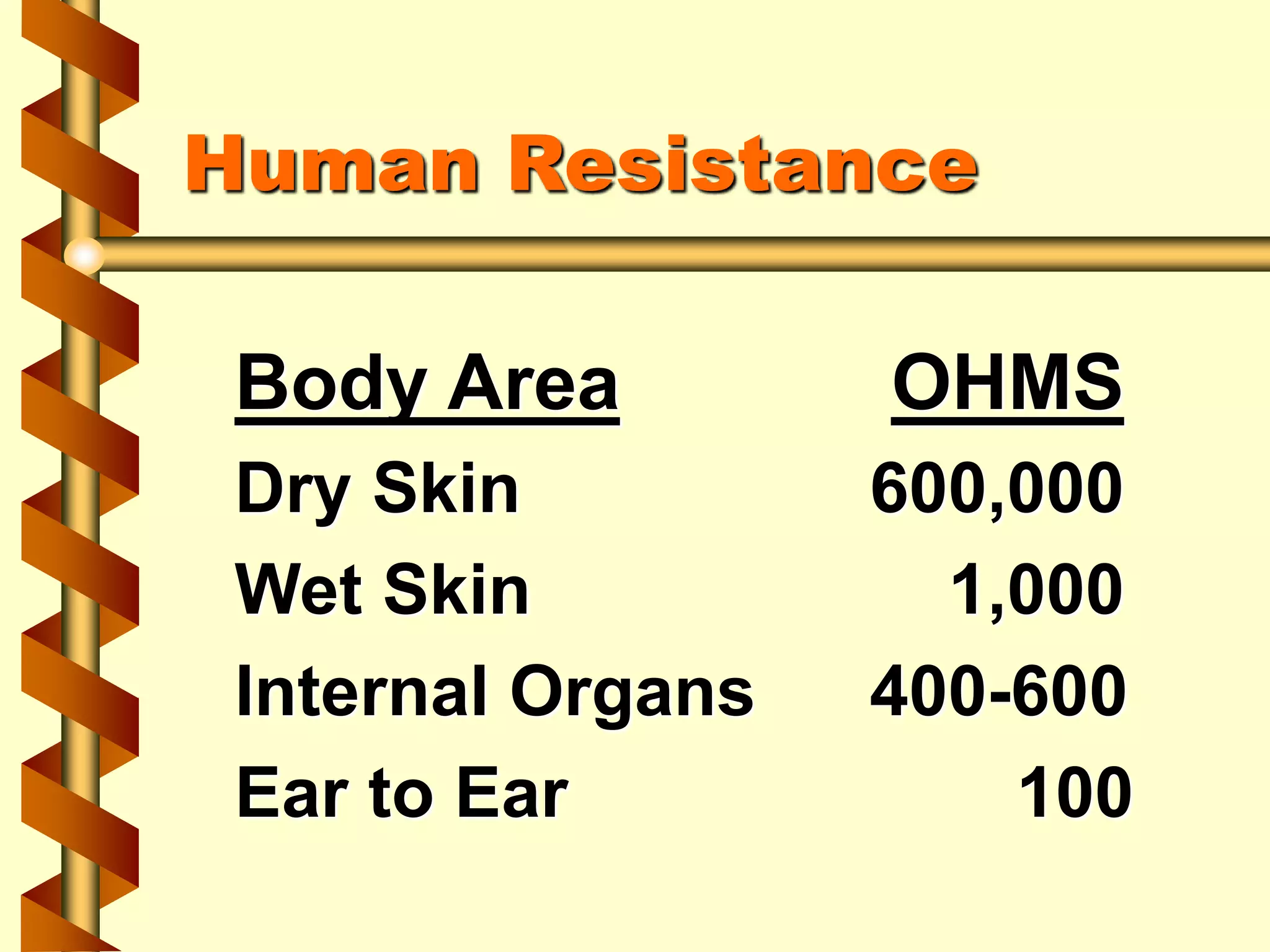
Body Area OHMS
Dry Skin 600,000
Wet Skin 1,000
Internal Organs 400-600
Ear to Ear 100
Human Resistance
Electric shock
 Effects range from
a tingle, to cardiac
arrest, severe
burns, and
probable
death
3c
 1-8 mA = shock, not painful
 8-15 mA = Painful, Curent Threshold
 ------------------------------------------------------------
 15-20 mA = Muscle contraction
 20-100 mA = Severe pain & paralysis
of breathing muscles
 100-1000 mA = Ventricular fibrillation
 (Usually cause death)
 > 1,000 mA = Heart stops
Effects of Current
230 Volts
1,000 OHM = 0.230 amps (230 mA)
Fatalities at 230 Volts
Grounding/Earthing
 Protects you from electrical
shock
 Safeguards
against fire
 Protects electrical equipment
from damage
4a
Grounding
 Two types of
grounding
include:
• Service or system
ground
• Equipment ground
4b
Circuit protective
devices
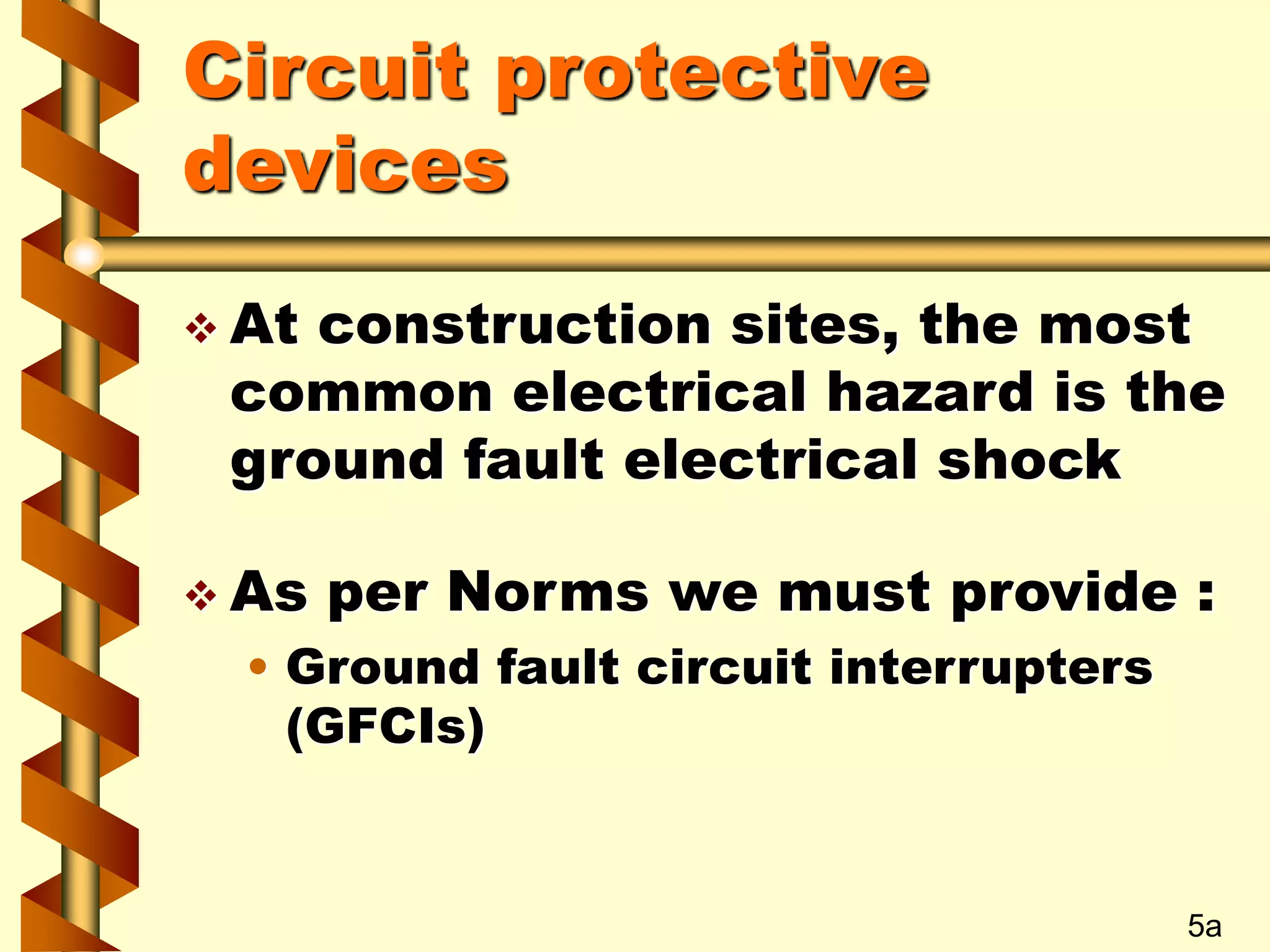
 At construction sites, the most
common electrical hazard is the
ground fault electrical shock
 As per Norms we must provide :
• Ground fault circuit interrupters
(GFCIs)
5a
Ground fault circuit
interrupters
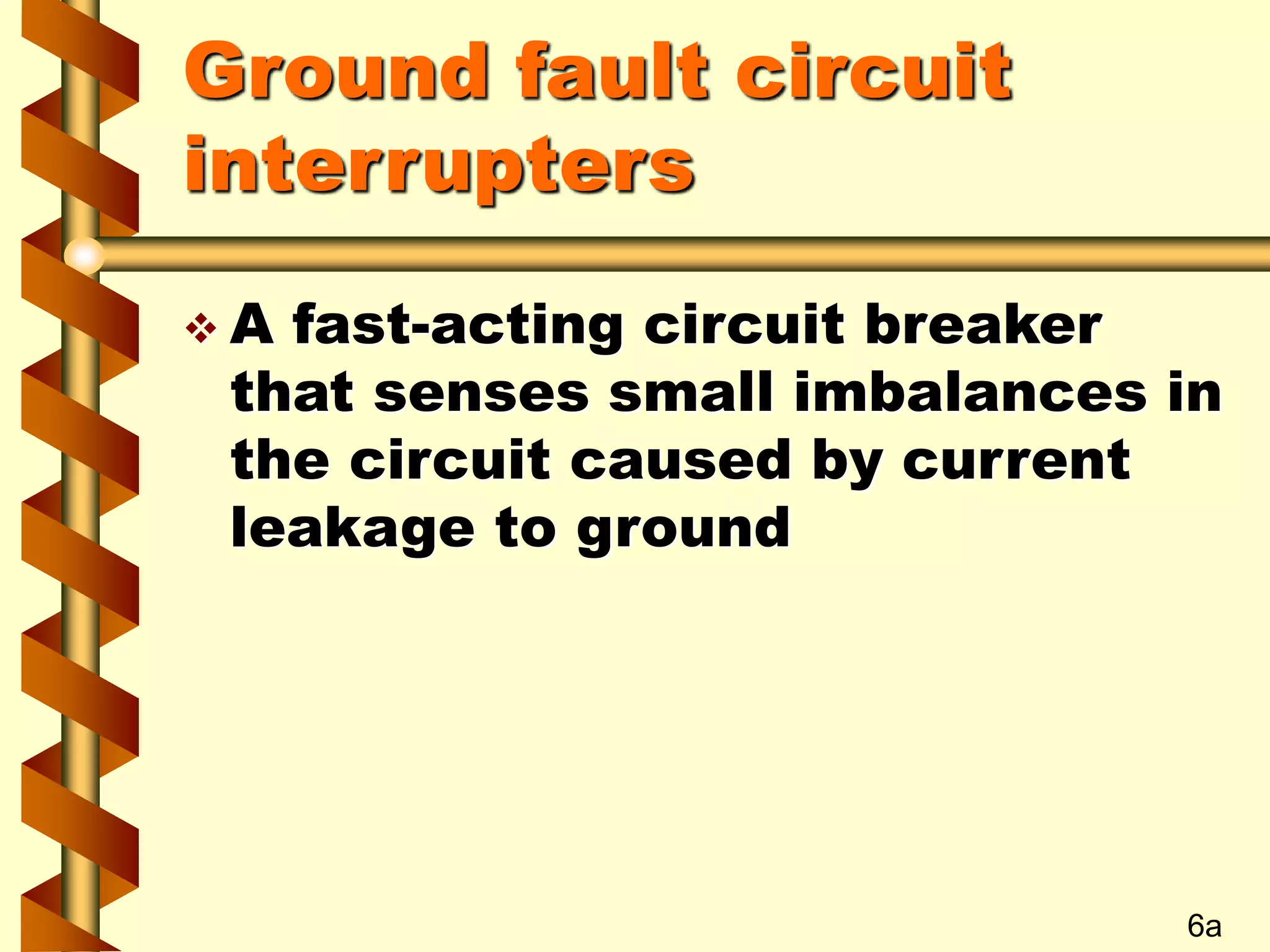
 A fast-acting circuit breaker
that senses small imbalances in
the circuit caused by current
leakage to ground
6a
PLUG
COIL
LOAD
HOT NEUTRAL
1 AMP
1 AMP
1 AMP
PLUG
COIL
LOAD
HOT NEUTRAL
1000 mA
995 mA
5 mA
GROUND
1000 mA
PLUG
COIL
LOAD
HOT NEUTRAL
1000 mA
1 AMP
5 mA
GROUND
995 mA
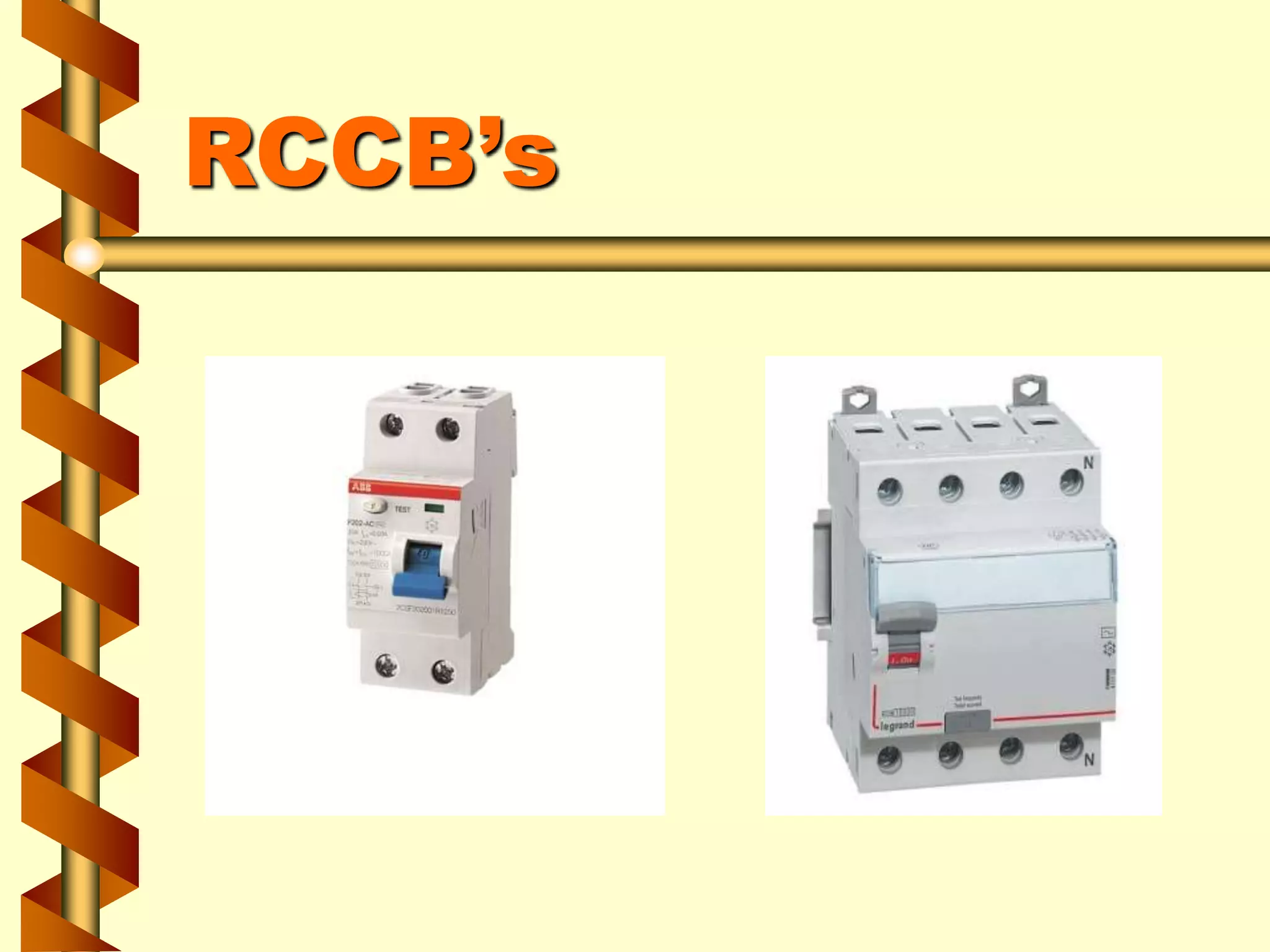
RCCB’s
Rubber mats
 Protects person from Electric shock
during accidental contact with live
conductors or live equipment body.
 Available in different ratings as
below
 3.3 KV : Class A : 2mm thick
 11 KV : Class B : 2.5 mm thick
 33 KV : Class C : 3 mm thick
 66 KV : Class D : 3.5 mm thick
Rubber mats
Rubber mat :
 Few important points:
1. Appropriate rated rubber mat
should be used as per voltage
level
2. Mat should be kept clean
always
3. There should not be any cracks
or holes in the rubber mat
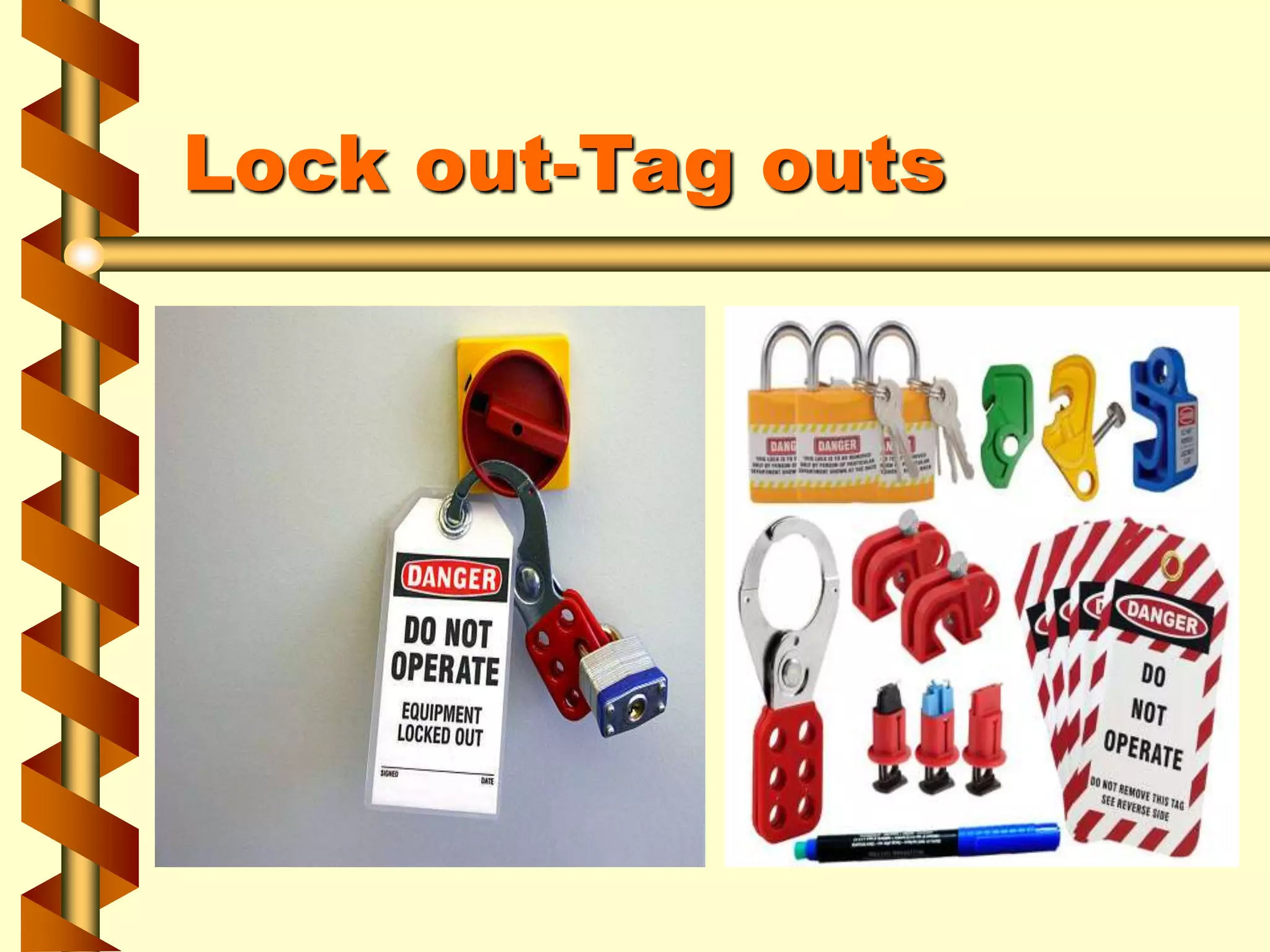
Lockout/Tagout
 Electrical equipment
deactivated for repair must be
locked out and tagged at the
point where it can be energized
 Protects maintenance workers
 Warns others that work is being
performed
8a
Lock out-Tag outs
Lockout/Tagout
 Only the person who
locked/tagged the equipment
can turn it back on
 Before equipment is energized,
a qualified person must conduct
tests and visual inspections
8b
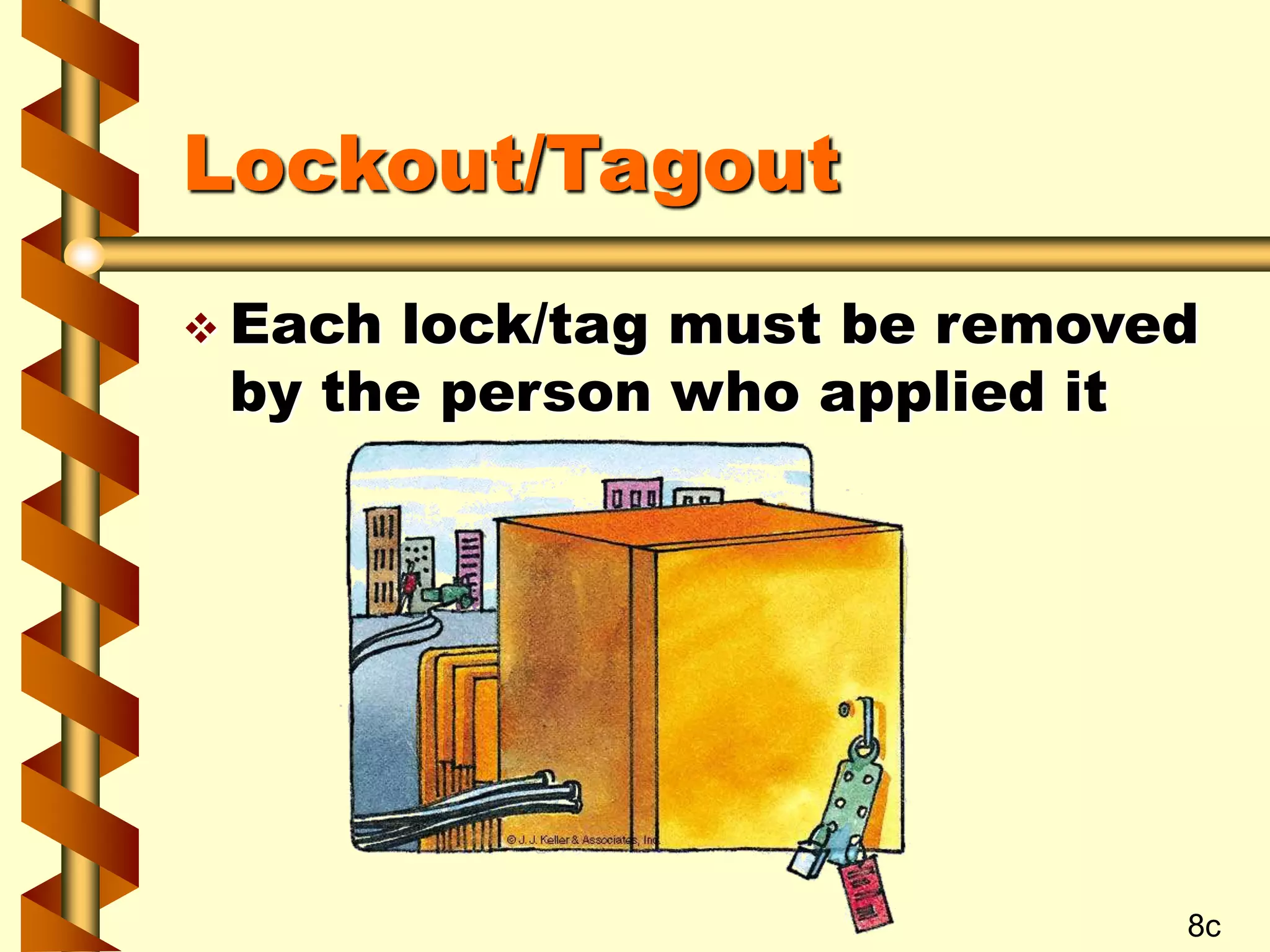
Lockout/Tagout
 Each lock/tag must be removed
by the person who applied it
8c
Lockout/Tagout
 If the employee is absent, the
lock/tag can be removed by a
qualified person if:
• the employee who applied the lock
has left the premises
• it is visually determined that all
employees are clear of the
circuits/equipment
8d
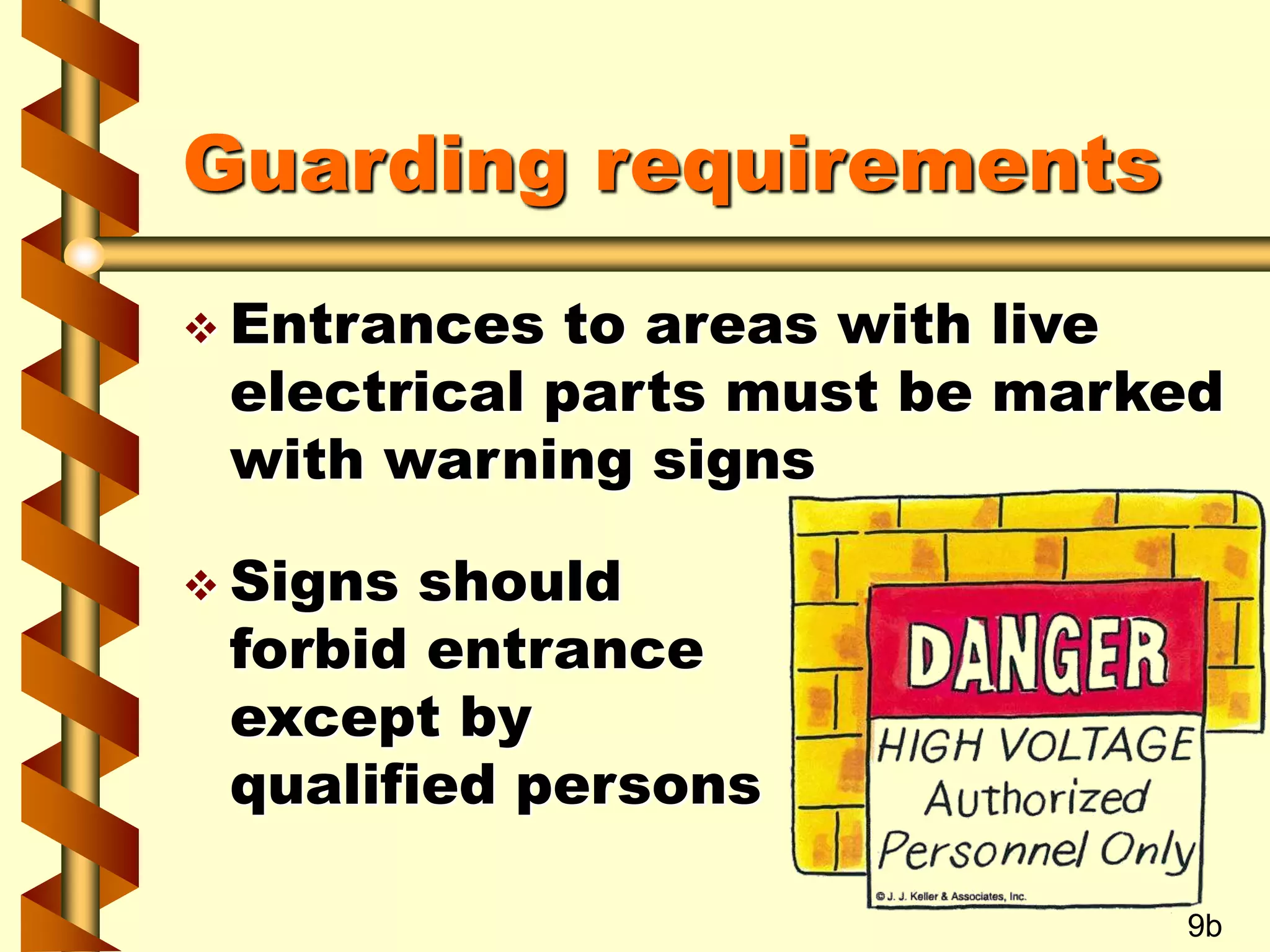
Guarding requirements
 Entrances to areas with live
electrical parts must be marked
with warning signs
 Signs should
forbid entrance
except by
qualified persons
9b
Insulation
 Check equipment daily for
insulation breakdown
 Check for:
• exposed wires
• broken wires
• scuffed insulation on extension
cords
10a
Insulation
 Use non-conducting mats,
shields, or barriers when
necessary
 Use non-
conducting
coatings on
hand tools
10b
Personal protective
equipment
11b
Cable routing safe
practices
What is IP rating ??
 An IP Rating (also known as an Ingress
Protection Rating or International Protection
Rating) is a way of showing the effectiveness of
electrical enclosures in blocking foreign bodies
such as dust, moisture, liquids, and accidental
contact.
IP chart for solids
Lev
el
size
Effective
against
Description
X —
X means there is no data available to specify a protection
rating with regard to this criterion.
0 — No protection against contact and ingress of objects
1
> 50 mm
2.0 in
Any large surface of the body, such as the back of a hand, but
no protection against deliberate contact with a body part
2
> 12.5 mm
0.49 in
Fingers or similar objects
3
> 2.5 mm
0.098 in
Tools, thick wires, etc.
4
> 1 mm
0.039 in
Most wires, slender screws, large ants etc.
5
Dust
protected
Ingress of dust is not entirely prevented, but it must not enter
in sufficient quantity to interfere with the satisfactory
operation of the equipment.
6 Dust-tight
No ingress of dust; complete protection against contact (dust-
tight). A vacuum must be applied. Test duration of up to 8
hours based on airflow.
IP chart for liquids
Level Protection against Effective against
X — Not specified
0 None No protection against water
1 Dripping water Dripping water (vertically falling drops)
2
Dripping water when
tilted at 15°
Vertically dripping water shall have no harmful effect when the enclosure is tilted
at an angle of 15°
3 Spraying water
Water falling as a spray at any angle up to 60° from the vertical shall have no
harmful effect,
4 Splashing of water
Water splashing against the enclosure from any direction shall have no harmful
effect
5 Water jets
Water projected by a nozzle (6.3 mm (0.25 in) against enclosure from any direction
shall have no harmful effects.
6 Powerful water jets
Water projected in powerful jets (12.5 mm (0.49 in)) against the enclosure from any
direction shall have no harmful effects.
7
Immersion, up to 1 meter
(3 ft 3 in) depth
Ingress of water in harmful quantity shall not be possible when the enclosure is
immersed in water under defined conditions of pressure and time (up to 1 meter
(3 ft 3 in) of submersion).
8
Immersion, 1 meter (3 ft
3 in) or more depth
The equipment is suitable for continuous immersion in water under conditions that
shall be specified by the manufacturer. However, with certain types of equipment,
it can mean that water can enter but only in such a manner that it produces no
harmful effects.
Bottom line
 Safety is everyone’s
responsibility and not
just safety officer’s.
 We all must strive to
achieve zero accidents at
our site
Thank you

Electrical Safety in Construction.ppt

  • 1.
  • 2.
    V = Voltage(volts) I = Current (amperes) R = Resistance (ohms) V I R Ohm’s Law
  • 3.
  • 4.
    Electric shock  Occurswhen current enters the body at one point and exits at another  Shock occurs when you touch: • both wires of an electric circuit; • one wire of an energized circuit and ground; or • a metallic part that is “hot” or become “live” 3a
  • 5.
    Electric shock  Severityof shock depends on the: • amount of current • path of the current • amount of time exposed 3b
  • 6.
    Body Area OHMS DrySkin 600,000 Wet Skin 1,000 Internal Organs 400-600 Ear to Ear 100 Human Resistance
  • 7.
    Electric shock  Effectsrange from a tingle, to cardiac arrest, severe burns, and probable death 3c
  • 8.
     1-8 mA= shock, not painful  8-15 mA = Painful, Curent Threshold  ------------------------------------------------------------  15-20 mA = Muscle contraction  20-100 mA = Severe pain & paralysis of breathing muscles  100-1000 mA = Ventricular fibrillation  (Usually cause death)  > 1,000 mA = Heart stops Effects of Current
  • 9.
    230 Volts 1,000 OHM= 0.230 amps (230 mA) Fatalities at 230 Volts
  • 10.
    Grounding/Earthing  Protects youfrom electrical shock  Safeguards against fire  Protects electrical equipment from damage 4a
  • 11.
    Grounding  Two typesof grounding include: • Service or system ground • Equipment ground 4b
  • 12.
    Circuit protective devices  Atconstruction sites, the most common electrical hazard is the ground fault electrical shock  As per Norms we must provide : • Ground fault circuit interrupters (GFCIs) 5a
  • 13.
    Ground fault circuit interrupters A fast-acting circuit breaker that senses small imbalances in the circuit caused by current leakage to ground 6a
  • 14.
    PLUG COIL LOAD HOT NEUTRAL 1 AMP 1AMP 1 AMP PLUG COIL LOAD HOT NEUTRAL 1000 mA 995 mA 5 mA GROUND
  • 15.
    1000 mA PLUG COIL LOAD HOT NEUTRAL 1000mA 1 AMP 5 mA GROUND 995 mA
  • 16.
  • 17.
    Rubber mats  Protectsperson from Electric shock during accidental contact with live conductors or live equipment body.  Available in different ratings as below  3.3 KV : Class A : 2mm thick  11 KV : Class B : 2.5 mm thick  33 KV : Class C : 3 mm thick  66 KV : Class D : 3.5 mm thick
  • 18.
  • 19.
    Rubber mat : Few important points: 1. Appropriate rated rubber mat should be used as per voltage level 2. Mat should be kept clean always 3. There should not be any cracks or holes in the rubber mat
  • 20.
    Lockout/Tagout  Electrical equipment deactivatedfor repair must be locked out and tagged at the point where it can be energized  Protects maintenance workers  Warns others that work is being performed 8a
  • 21.
  • 22.
    Lockout/Tagout  Only theperson who locked/tagged the equipment can turn it back on  Before equipment is energized, a qualified person must conduct tests and visual inspections 8b
  • 23.
    Lockout/Tagout  Each lock/tagmust be removed by the person who applied it 8c
  • 24.
    Lockout/Tagout  If theemployee is absent, the lock/tag can be removed by a qualified person if: • the employee who applied the lock has left the premises • it is visually determined that all employees are clear of the circuits/equipment 8d
  • 25.
    Guarding requirements  Entrancesto areas with live electrical parts must be marked with warning signs  Signs should forbid entrance except by qualified persons 9b
  • 26.
    Insulation  Check equipmentdaily for insulation breakdown  Check for: • exposed wires • broken wires • scuffed insulation on extension cords 10a
  • 27.
    Insulation  Use non-conductingmats, shields, or barriers when necessary  Use non- conducting coatings on hand tools 10b
  • 28.
  • 29.
  • 30.
    What is IPrating ??  An IP Rating (also known as an Ingress Protection Rating or International Protection Rating) is a way of showing the effectiveness of electrical enclosures in blocking foreign bodies such as dust, moisture, liquids, and accidental contact.
  • 31.
    IP chart forsolids Lev el size Effective against Description X — X means there is no data available to specify a protection rating with regard to this criterion. 0 — No protection against contact and ingress of objects 1 > 50 mm 2.0 in Any large surface of the body, such as the back of a hand, but no protection against deliberate contact with a body part 2 > 12.5 mm 0.49 in Fingers or similar objects 3 > 2.5 mm 0.098 in Tools, thick wires, etc. 4 > 1 mm 0.039 in Most wires, slender screws, large ants etc. 5 Dust protected Ingress of dust is not entirely prevented, but it must not enter in sufficient quantity to interfere with the satisfactory operation of the equipment. 6 Dust-tight No ingress of dust; complete protection against contact (dust- tight). A vacuum must be applied. Test duration of up to 8 hours based on airflow.
  • 32.
    IP chart forliquids Level Protection against Effective against X — Not specified 0 None No protection against water 1 Dripping water Dripping water (vertically falling drops) 2 Dripping water when tilted at 15° Vertically dripping water shall have no harmful effect when the enclosure is tilted at an angle of 15° 3 Spraying water Water falling as a spray at any angle up to 60° from the vertical shall have no harmful effect, 4 Splashing of water Water splashing against the enclosure from any direction shall have no harmful effect 5 Water jets Water projected by a nozzle (6.3 mm (0.25 in) against enclosure from any direction shall have no harmful effects. 6 Powerful water jets Water projected in powerful jets (12.5 mm (0.49 in)) against the enclosure from any direction shall have no harmful effects. 7 Immersion, up to 1 meter (3 ft 3 in) depth Ingress of water in harmful quantity shall not be possible when the enclosure is immersed in water under defined conditions of pressure and time (up to 1 meter (3 ft 3 in) of submersion). 8 Immersion, 1 meter (3 ft 3 in) or more depth The equipment is suitable for continuous immersion in water under conditions that shall be specified by the manufacturer. However, with certain types of equipment, it can mean that water can enter but only in such a manner that it produces no harmful effects.
  • 33.
    Bottom line  Safetyis everyone’s responsibility and not just safety officer’s.  We all must strive to achieve zero accidents at our site
  • 34.