Date: 10-Dec 2020
SAFETY OATH
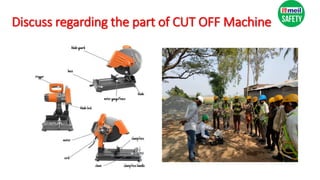
Discuss regarding the part of CUT OFF Machine
Mr. Sai Nath discuss regarding installation
precaution
• Moving parts-
Risk for crushed hands and fingers
 Never check bores or passages with hands or fingers.
 Never clean chips with figure use brushed installation.
• Cutting Blade hazard
A cutting blade may burst and cause personal injury
or death.
 Never use cutting blade with a lower speed rating than
the machine’s.
 Inspect the disc before usage, check that it is not
chipped, cracked or show signs of other defects.
 Check that the cutting blade is fitted correctly and does
not show sign of damage.
 Always ensure that the guard is in place, is in good
condition and correctly fitted before starting the
machine.
 Never use a cutting blade for any other purpose than it
is intended for.
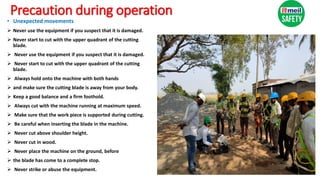
Precaution during operation
• Unexpected movements
 Never use the equipment if you suspect that it is damaged.
 Never start to cut with the upper quadrant of the cutting
blade.
 Never use the equipment if you suspect that it is damaged.
 Never start to cut with the upper quadrant of the cutting
blade.
 Always hold onto the machine with both hands
 and make sure the cutting blade is away from your body.
 Keep a good balance and a firm foothold.
 Always cut with the machine running at maximum speed.
 Make sure that the work piece is supported during cutting.
 Be careful when inserting the blade in the machine.
 Never cut above shoulder height.
 Never cut in wood.
 Never place the machine on the ground, before
 the blade has come to a complete stop.
 Never strike or abuse the equipment.
Dust and fume hazard
Dusts and/or fumes generated or dispersed when
using the machine may cause serious and permanent
respiratory disease, illness, or other bodily injury (for
example, silicosis or other irreversible lung disease
that can be fatal, cancer, birth defects, and/or skin
inflammation).
Some dusts and fumes created by drilling, breaking,
hammering, sawing, grinding and other construction
activities contain substances known to the State of
California and other authorities to cause respiratory
disease, cancer, birth defects, or other reproductive
harm. Some examples of such substances are:
 Crystalline silica, cement, and other masonry
products.
 Arsenic and chromium from chemically-treated
rubber.
 Lead from lead-based paints.
To reduce the risk of exposure to dust and fumes,
do all of the following:
 Perform site-specific risk assessment. The risk
assessment should include dust and fumes
created by the use of the machine and the
potential for disturbing existing dust.
 Use proper engineering controls to minimize the
amount of dust and fumes in the air and to
minimize build-up on equipment, surfaces,
clothing, and body parts.
 Operate and maintain the machine as
recommended in the operating and safety
instructions
 Work in a well ventilated area.
 Avoid eating, drinking, and using tobacco products
in areas where there is dust or fumes.
 Wash your hands and face thoroughly as soon as
possible upon leaving the exposure area, and
always before eating, drinking, using tobacco
products, or making contact with other persons.
Projectile
Failure of the work piece, of accessories, or even of
the machine itself may generate high velocity
projectiles. During operating, splinters or other
particles from the working material may become
projectiles and cause personal injury by striking the
operator or other persons. To reduce these risk:
 Use approved personal protective equipment and
safety helmet, including impact resistant eye
protection with side protection.
 Make sure that no unauthorized persons trespass
into the working zone.
 Keep the workplace free from foreign objects.
 Ensure that the work piece is securely fixed.
Motion Hazard
When using the machine to perform work-related
activities, you may experience discomfort in the
hands, arms, shoulders, neck, or other parts of the
body.
 Adopt a comfortable posture while maintaining
secure footing and avoiding awkward off-balanced
postures.
 Changing posture during extended tasks may help
avoid discomfort and fatigue.
 In case of persistent or recurring symptoms,
consult a qualified health professional.
Trapping Hazard
There is risk of neck ware, hair, gloves and clothes getting
dragged into or caught by a rotating cutting blade or
accessories. This may cause choking,
scalping, lacerations or death. To reduce the risk:
► Never grab or touch a rotating blade.
► Avoid wearing clothing, neck ware or gloves that
may get caught.
► Cover long hair with a hair net.
Grinding Hazard
Using the side of the cutting blade can cause that
the blade jam or break. Pressure from the side can
damage the cutting blade. This can result in personal
injury. To reduce risk:
► Never grind by using the side of the cutting blade.
► Never use the cutting blade if it has been
damaged.
► Never grind over the maximum peripheral speed.
Slipping, Tripping and falling
Hazard
There is a risk of slipping or tripping or falling, for
example tripping on the hoses or on other objects.
Slipping or tripping or falling can cause injury. To
reduce this risk:
► Always make sure that no hose or other object is
in your way or in any other person's way.
► Always make sure you are in a stable position
with
your feet as far apart as your shoulders width and
keeping a balanced body weight.
Electrical Hazard
The machine is not electrically insulated. If the
machine comes into contact with electricity, serious
injuries or death may result.
► Never operate the machine near any electric wire
or other source of electricity.
► Make sure that there are no concealed wires or
other sources of electricity in the working area.
Vibration Hazard
Normal and proper use of the machine exposes the
operator to vibration. Regular and frequent exposure
to vibration may cause, contribute to, or aggravate
injury or disorders to the operator’s fingers, hands,
wrists, arms, shoulders and/or nerves and blood
supply or other body parts, including debilitating
and/or permanent injuries or disorders that may
develop gradually over periods of weeks, months, or
years. Such injuries or disorders may include damage
to the blood circulatory system, damage to the
nervous system, damage to joints, and possibly
damage to other body structures.
The following may help to reduce exposure to
vibration for the operator:
► Let the tool do the job. Use a minimum hand grip
consistent with proper control and safe operation.
► If the machine has vibration absorbing handles,
keep them in a central position, avoid pressing the
handles into the end stops.
► Immediately stop working if the machine suddenly
starts to vibrate strongly. Before resuming the
work, find and remove the cause of the increased
vibrations.
► Never grab, hold or touch the inserted tool when
using the machine.
► Participate in health surveillance or monitoring,
medical exams and training programs offered by
your employer and when required by law.
► When working in cold conditions wear warm
clothing and keep hands warm and dry.
► The exhaust air is strongly chilled and shall not
Noise hazard
High noise levels can cause permanent and disabling
hearing loss and other problems such as tinnitus
(ringing, buzzing, whistling, or humming in the ears).
To reduce risks and prevent an unnecessary increase
in noise levels:
► Risk assessment of these hazards and
implementation of appropriate controls is essential.
► Operate and maintain the machine as
recommended in these instructions.
► Select, maintain and replace the working tool as
recommended in these instructions.
► If the machine has a silencer, check that it is in
place and in good working condition.
► Always use hearing protection.
Start and stop
Starting
1. Connect the hoses and couplings.
2. Mount the cut-off saw in the cart (if a cart is to be
used).
3. Start the power source.
4. Activate the water supply or the dust collector, if
they are being used.
5. Place the cut-off saw at a right angle to the surface
to be cut and activate the trigger.
Stopping
1. Release the trigger. Keep a firm grip on the cut-off
saw, until the cutting blade has come to a complete
stop.
2. It can take up to ten seconds for the cutting blade to
stop completely.
3. Stop the power source.
4. Disconnect the hoses and fit the protective caps to
the quick-release couplings.
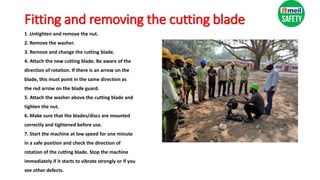
Fitting and removing the cutting blade
1 .Untighten and remove the nut.
2. Remove the washer.
3. Remove and change the cutting blade.
4. Attach the new cutting blade. Be aware of the
direction of rotation. If there is an arrow on the
blade, this must point in the same direction as
the red arrow on the blade guard.
5. Attach the washer above the cutting blade and
tighten the nut.
6. Make sure that the blades/discs are mounted
correctly and tightened before use.
7. Start the machine at low speed for one minute
in a safe position and check the direction of
rotation of the cutting blade. Stop the machine
immediately if it starts to vibrate strongly or if you
see other defects.
Mr. Samit discussed regarding
Personal precautions and qualifications
Only qualified and trained persons may operate or
maintain the machine. They must be physically able
to handle the bulk, weight, and power of the tool.
Personal protective equipment
Always use approved protective equipment.
Operators and all other persons in the working area
must wear protective equipment, including at a
minimum:
● Protective helmet
● Hearing protection
● Impact resistant eye protection with side protection
● Respiratory protection when appropriate
● Protective gloves
● Proper protective boots
● Appropriate work overall or similar clothing (not
loose-fitting) that covers your arms and legs.
Every day
♦ Clean and inspect the machine and its functions
each day before the work commences.
♦ Check if the spindle thread, the guard (the disc
may not touch the guard) and the flange are in
good condition.
♦ Conduct a general inspection for leaks, damage,
and wear.
Change damaged parts immediately.
♦ Replace worn components in good time.
♦ Make sure that all the attached and related
equipment, such as hoses and flow dividers are
properly maintained.
♦ If the machine has been dropped, carefully
examine the disc.
♦ Ensure that the disc dimensions are compatible
and that it fits the spindle.
♦ Always plug hoses and nipples with clean and
tight plugs when dismounting.
♦ Check tightness of nuts, bolts, screws and hose
fittings after the first days of operation and
thereafter in accordance with the maintenance
schedule.
Cut off machine

Cut off machine

  • 1.
  • 2.
  • 3.
    Discuss regarding thepart of CUT OFF Machine
  • 4.
    Mr. Sai Nathdiscuss regarding installation precaution • Moving parts- Risk for crushed hands and fingers  Never check bores or passages with hands or fingers.  Never clean chips with figure use brushed installation. • Cutting Blade hazard A cutting blade may burst and cause personal injury or death.  Never use cutting blade with a lower speed rating than the machine’s.  Inspect the disc before usage, check that it is not chipped, cracked or show signs of other defects.  Check that the cutting blade is fitted correctly and does not show sign of damage.  Always ensure that the guard is in place, is in good condition and correctly fitted before starting the machine.  Never use a cutting blade for any other purpose than it is intended for.
  • 5.
    Precaution during operation •Unexpected movements  Never use the equipment if you suspect that it is damaged.  Never start to cut with the upper quadrant of the cutting blade.  Never use the equipment if you suspect that it is damaged.  Never start to cut with the upper quadrant of the cutting blade.  Always hold onto the machine with both hands  and make sure the cutting blade is away from your body.  Keep a good balance and a firm foothold.  Always cut with the machine running at maximum speed.  Make sure that the work piece is supported during cutting.  Be careful when inserting the blade in the machine.  Never cut above shoulder height.  Never cut in wood.  Never place the machine on the ground, before  the blade has come to a complete stop.  Never strike or abuse the equipment.
  • 6.
    Dust and fumehazard Dusts and/or fumes generated or dispersed when using the machine may cause serious and permanent respiratory disease, illness, or other bodily injury (for example, silicosis or other irreversible lung disease that can be fatal, cancer, birth defects, and/or skin inflammation). Some dusts and fumes created by drilling, breaking, hammering, sawing, grinding and other construction activities contain substances known to the State of California and other authorities to cause respiratory disease, cancer, birth defects, or other reproductive harm. Some examples of such substances are:  Crystalline silica, cement, and other masonry products.  Arsenic and chromium from chemically-treated rubber.  Lead from lead-based paints. To reduce the risk of exposure to dust and fumes, do all of the following:  Perform site-specific risk assessment. The risk assessment should include dust and fumes created by the use of the machine and the potential for disturbing existing dust.  Use proper engineering controls to minimize the amount of dust and fumes in the air and to minimize build-up on equipment, surfaces, clothing, and body parts.  Operate and maintain the machine as recommended in the operating and safety instructions  Work in a well ventilated area.  Avoid eating, drinking, and using tobacco products in areas where there is dust or fumes.  Wash your hands and face thoroughly as soon as possible upon leaving the exposure area, and always before eating, drinking, using tobacco products, or making contact with other persons.
  • 7.
    Projectile Failure of thework piece, of accessories, or even of the machine itself may generate high velocity projectiles. During operating, splinters or other particles from the working material may become projectiles and cause personal injury by striking the operator or other persons. To reduce these risk:  Use approved personal protective equipment and safety helmet, including impact resistant eye protection with side protection.  Make sure that no unauthorized persons trespass into the working zone.  Keep the workplace free from foreign objects.  Ensure that the work piece is securely fixed. Motion Hazard When using the machine to perform work-related activities, you may experience discomfort in the hands, arms, shoulders, neck, or other parts of the body.  Adopt a comfortable posture while maintaining secure footing and avoiding awkward off-balanced postures.  Changing posture during extended tasks may help avoid discomfort and fatigue.  In case of persistent or recurring symptoms, consult a qualified health professional.
  • 8.
    Trapping Hazard There isrisk of neck ware, hair, gloves and clothes getting dragged into or caught by a rotating cutting blade or accessories. This may cause choking, scalping, lacerations or death. To reduce the risk: ► Never grab or touch a rotating blade. ► Avoid wearing clothing, neck ware or gloves that may get caught. ► Cover long hair with a hair net. Grinding Hazard Using the side of the cutting blade can cause that the blade jam or break. Pressure from the side can damage the cutting blade. This can result in personal injury. To reduce risk: ► Never grind by using the side of the cutting blade. ► Never use the cutting blade if it has been damaged. ► Never grind over the maximum peripheral speed.
  • 9.
    Slipping, Tripping andfalling Hazard There is a risk of slipping or tripping or falling, for example tripping on the hoses or on other objects. Slipping or tripping or falling can cause injury. To reduce this risk: ► Always make sure that no hose or other object is in your way or in any other person's way. ► Always make sure you are in a stable position with your feet as far apart as your shoulders width and keeping a balanced body weight. Electrical Hazard The machine is not electrically insulated. If the machine comes into contact with electricity, serious injuries or death may result. ► Never operate the machine near any electric wire or other source of electricity. ► Make sure that there are no concealed wires or other sources of electricity in the working area.
  • 10.
    Vibration Hazard Normal andproper use of the machine exposes the operator to vibration. Regular and frequent exposure to vibration may cause, contribute to, or aggravate injury or disorders to the operator’s fingers, hands, wrists, arms, shoulders and/or nerves and blood supply or other body parts, including debilitating and/or permanent injuries or disorders that may develop gradually over periods of weeks, months, or years. Such injuries or disorders may include damage to the blood circulatory system, damage to the nervous system, damage to joints, and possibly damage to other body structures. The following may help to reduce exposure to vibration for the operator: ► Let the tool do the job. Use a minimum hand grip consistent with proper control and safe operation. ► If the machine has vibration absorbing handles, keep them in a central position, avoid pressing the handles into the end stops. ► Immediately stop working if the machine suddenly starts to vibrate strongly. Before resuming the work, find and remove the cause of the increased vibrations. ► Never grab, hold or touch the inserted tool when using the machine. ► Participate in health surveillance or monitoring, medical exams and training programs offered by your employer and when required by law. ► When working in cold conditions wear warm clothing and keep hands warm and dry. ► The exhaust air is strongly chilled and shall not
  • 11.
    Noise hazard High noiselevels can cause permanent and disabling hearing loss and other problems such as tinnitus (ringing, buzzing, whistling, or humming in the ears). To reduce risks and prevent an unnecessary increase in noise levels: ► Risk assessment of these hazards and implementation of appropriate controls is essential. ► Operate and maintain the machine as recommended in these instructions. ► Select, maintain and replace the working tool as recommended in these instructions. ► If the machine has a silencer, check that it is in place and in good working condition. ► Always use hearing protection.
  • 12.
    Start and stop Starting 1.Connect the hoses and couplings. 2. Mount the cut-off saw in the cart (if a cart is to be used). 3. Start the power source. 4. Activate the water supply or the dust collector, if they are being used. 5. Place the cut-off saw at a right angle to the surface to be cut and activate the trigger. Stopping 1. Release the trigger. Keep a firm grip on the cut-off saw, until the cutting blade has come to a complete stop. 2. It can take up to ten seconds for the cutting blade to stop completely. 3. Stop the power source. 4. Disconnect the hoses and fit the protective caps to the quick-release couplings.
  • 13.
    Fitting and removingthe cutting blade 1 .Untighten and remove the nut. 2. Remove the washer. 3. Remove and change the cutting blade. 4. Attach the new cutting blade. Be aware of the direction of rotation. If there is an arrow on the blade, this must point in the same direction as the red arrow on the blade guard. 5. Attach the washer above the cutting blade and tighten the nut. 6. Make sure that the blades/discs are mounted correctly and tightened before use. 7. Start the machine at low speed for one minute in a safe position and check the direction of rotation of the cutting blade. Stop the machine immediately if it starts to vibrate strongly or if you see other defects.
  • 14.
    Mr. Samit discussedregarding Personal precautions and qualifications Only qualified and trained persons may operate or maintain the machine. They must be physically able to handle the bulk, weight, and power of the tool. Personal protective equipment Always use approved protective equipment. Operators and all other persons in the working area must wear protective equipment, including at a minimum: ● Protective helmet ● Hearing protection ● Impact resistant eye protection with side protection ● Respiratory protection when appropriate ● Protective gloves ● Proper protective boots ● Appropriate work overall or similar clothing (not loose-fitting) that covers your arms and legs.
  • 15.
    Every day ♦ Cleanand inspect the machine and its functions each day before the work commences. ♦ Check if the spindle thread, the guard (the disc may not touch the guard) and the flange are in good condition. ♦ Conduct a general inspection for leaks, damage, and wear. Change damaged parts immediately. ♦ Replace worn components in good time. ♦ Make sure that all the attached and related equipment, such as hoses and flow dividers are properly maintained. ♦ If the machine has been dropped, carefully examine the disc. ♦ Ensure that the disc dimensions are compatible and that it fits the spindle. ♦ Always plug hoses and nipples with clean and tight plugs when dismounting. ♦ Check tightness of nuts, bolts, screws and hose fittings after the first days of operation and thereafter in accordance with the maintenance schedule.