Hand tools are commonly used in workplaces but can pose hazards if not properly maintained and used safely. The Occupational Safety and Health Administration provides five basic safety rules for hand tool use: keep tools in good condition, use the right tool for the job, inspect tools for damage before each use, operate tools according to manufacturer's instructions, and use proper personal protective equipment. Common accidents occur from improper tool selection, misuse, unsafe conditions like defective tools, and lack of protective equipment. Proper maintenance of tools and following basic safety procedures can help prevent injuries.
Hand Tools
Hand toolsare such a common part of our daily work lives that
it is sometimes difficult to remember that they may pose
hazards while in use. Serious incidents can occur before steps
are taken to identify, avoid and eliminate tool-related hazards.
Hand tools Hand tools include screwdriver, wrenches,
hammers, axes – basically, any tool that is powered manually,
and is not powered in some manner with electricity or an
internal combustion engine.
The Main Causes of the tool accidents (Hand Tools / Power
Tools
1. Wrong Selection of tools
2. Improper use
3. Unsafe Conditions (Defective Tools)
4. Improper storage / stacking
5. Improper Carrying
6. No proper earthing to power tools.
7. No PPE used
2.
According to theOccupational Safety and Health
Administration, there are five basic safety rules that can help
prevent hazards when using hand tools:
• Keep all tools in good condition with regular maintenance.
• Use the right tool for the job.
• Examine each tool for damage before use and do not use
damaged tools.
• Operate tools according to the manufacturers’
instructions. Use the tool correctly.
• Provide and use properly the right personal protective
equipment.
• The greatest hazards posed by hand tools result from
improper maintenance and misuse.
• Keep the tool in a safe place
3.
• If achisel is used as a screwdriver, the tip of the chisel may
break and fly off, hitting the user or other employees.
• If a wooden handle on a tool, such as a hammer or an axe, is
loose, splintered, or cracked, the head of the tool may fly off
and strike the user or other employees.
• If the jaws of a wrench are sprung, the wrench might slip.
• If impact tools such as chisels, wedges, or drift pins have
mushroomed heads, the heads might shatter on impact,
sending sharp fragments flying toward the user or other
employees.
4.
When using sawblades, knives or other tools, be aware of the
area around you and direct the tools away from aisle areas and
away from other employees who are working nearby. Knives and
scissors must be sharp. Dull tools can cause more hazards than
sharp ones because of the extra force exerted to use the tools
and the possibility of the tools slipping and stabbing while
overused. Cracked saw blades must be removed from service.
Iron or steel hand tools may produce sparks that can be an
ignition source around flammable substances. Where this
hazard exists, spark-resistant tools made of non-ferrous
materials should be used where flammable gases, highly volatile
liquids, and other explosive substances are stored or used.
5.
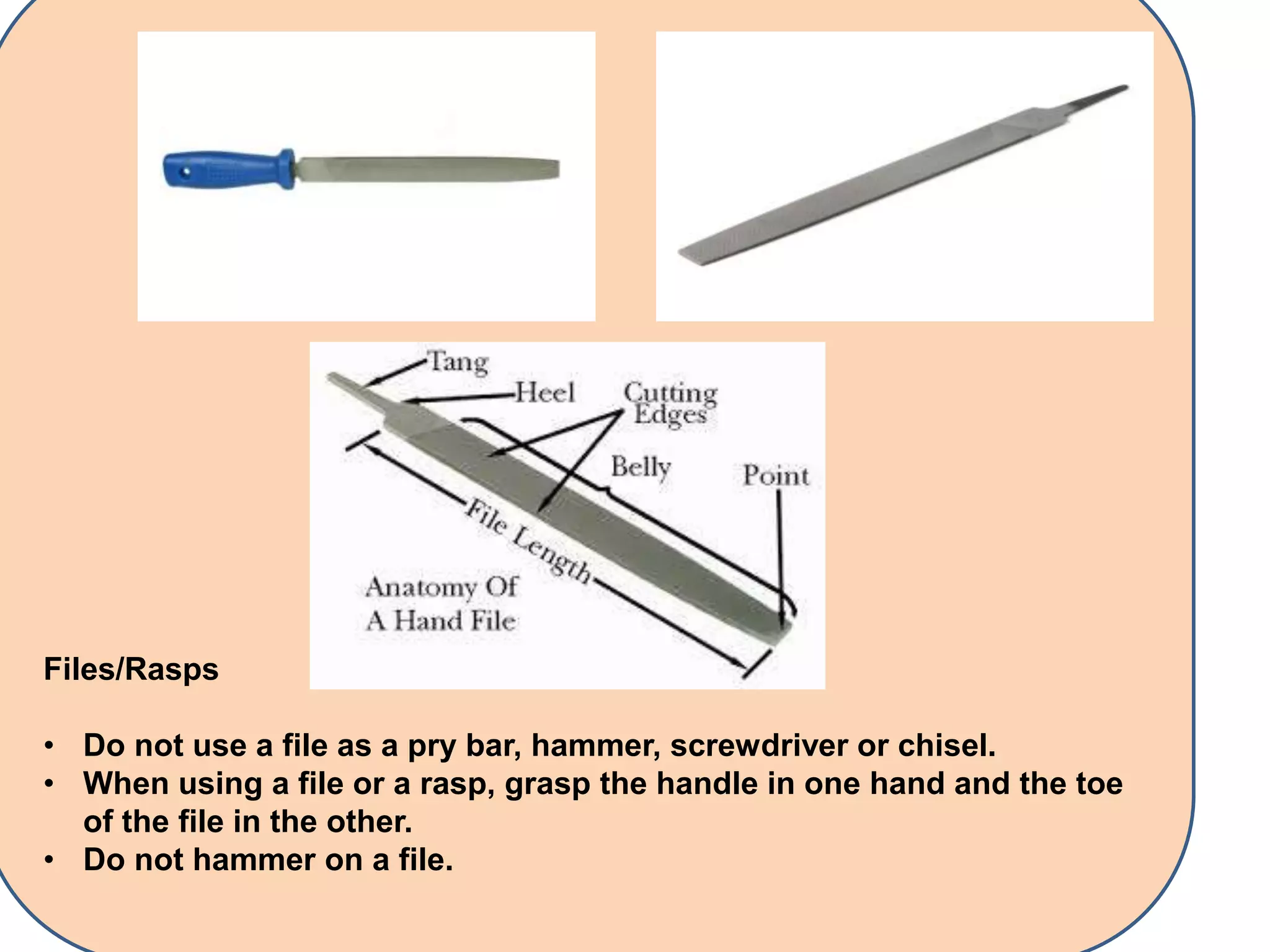
Files/Rasps
• Do notuse a file as a pry bar, hammer, screwdriver or chisel.
• When using a file or a rasp, grasp the handle in one hand and the toe
of the file in the other.
• Do not hammer on a file.
9.
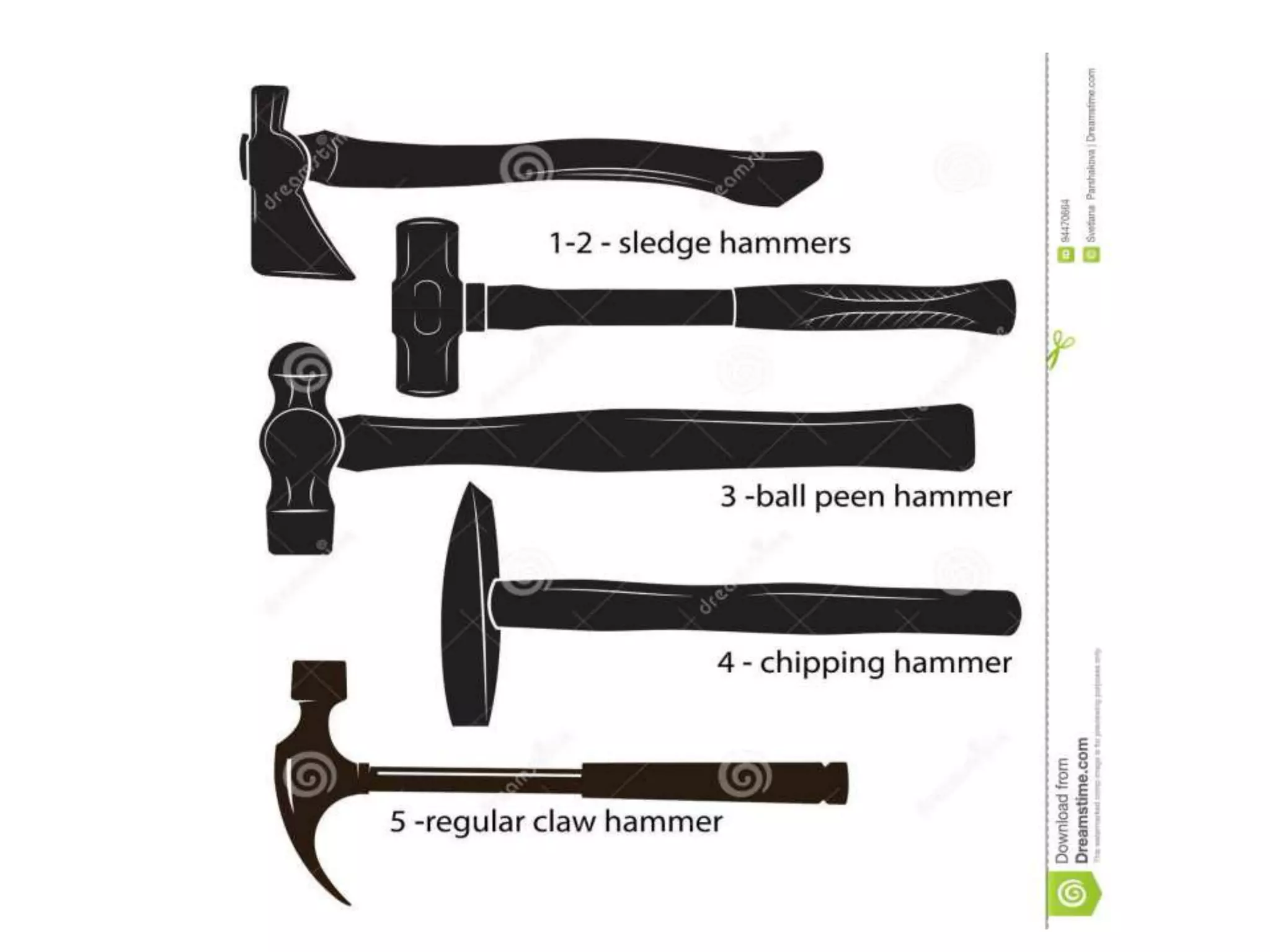
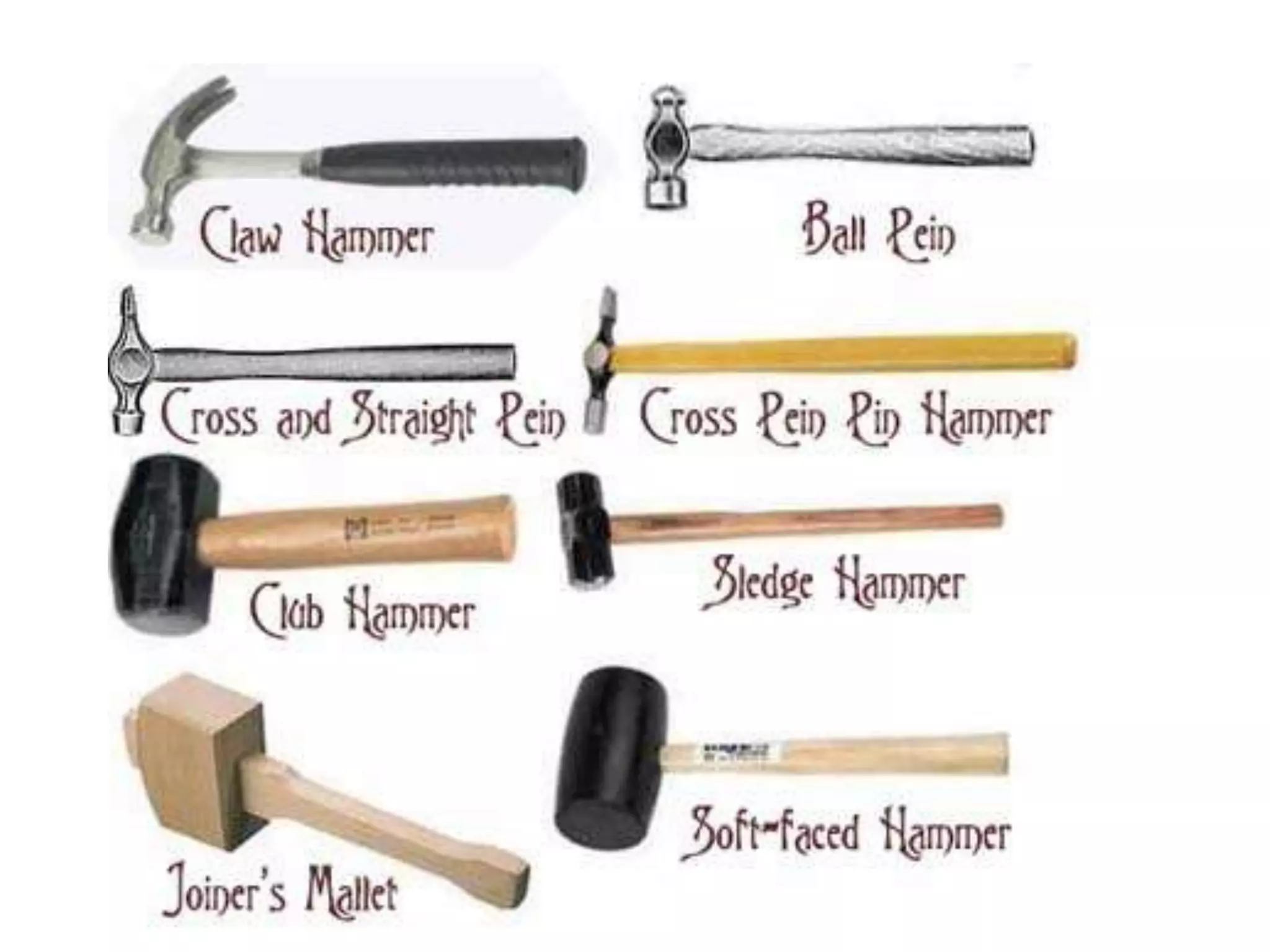
• Use aclaw hammer for pulling nails.
• Do not strike nails or other objects with the cheek of the hammer.
• Do not strike a hardened steel surface, such as a cold chisel, with a
claw hammer.
• Do not strike one hammer against another hammer.
• Do not use a hammer if your hands are oily, greasy or wet.
• Do not use a hammer as a wedge or a pry bar, or for pulling large
spikes.
• Use only the sledge-type hammer on a striking face wrench.
• Do not use a hatchet as a hammer.
• Do not use hammers with rounded, mushroomed, or damaged
heads.
10.
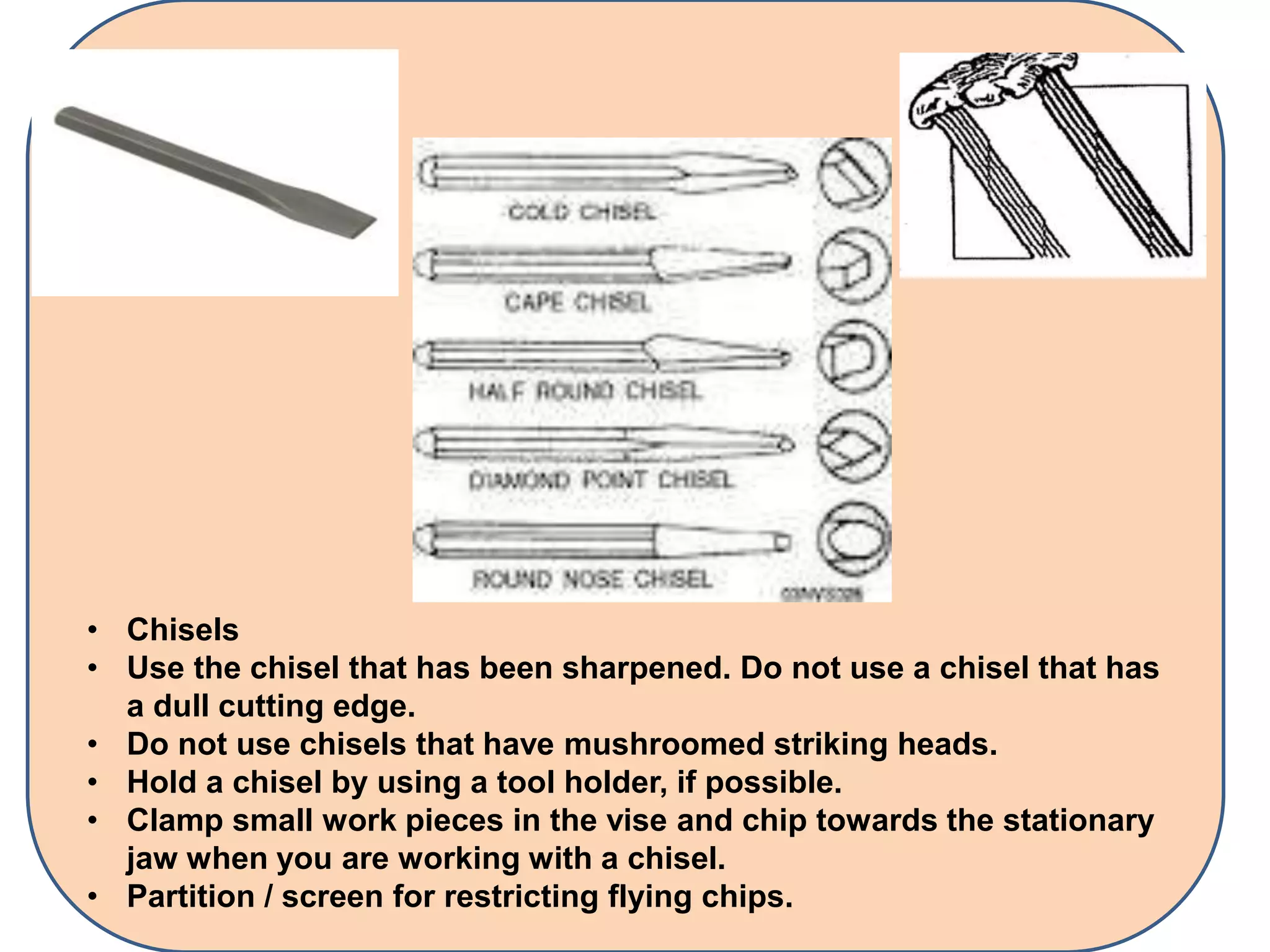
• Chisels
• Usethe chisel that has been sharpened. Do not use a chisel that has
a dull cutting edge.
• Do not use chisels that have mushroomed striking heads.
• Hold a chisel by using a tool holder, if possible.
• Clamp small work pieces in the vise and chip towards the stationary
jaw when you are working with a chisel.
• Partition / screen for restricting flying chips.
12.
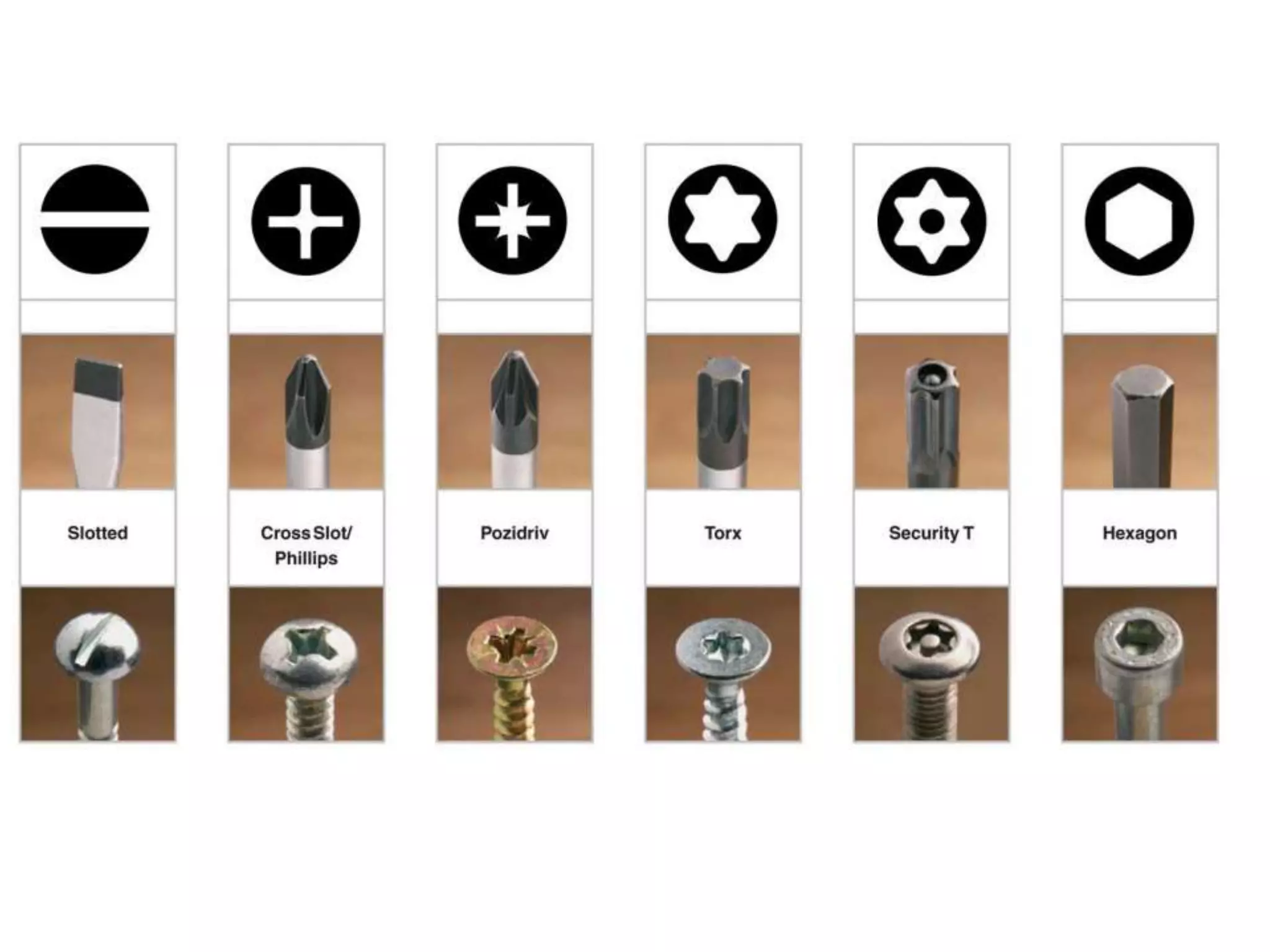
• Always matchthe size and type of screwdriver blade to fit the head
of the screw.
• Do not hold the work piece against your body while using a
screwdriver.
• Do not put your fingers near the blade of the screwdriver when
tightening a screw.
• Use a drill, nail, or an awl to make a starting hole for screws.
• Do not force a screwdriver by striking with a hammer or using a
pliers to twist it.
• Do not use a screwdriver as a punch, chisel, pry bar or nail puller.
• When you are performing electrical work, use the screwdriver that
has the blue handle. This screwdriver is insulated.
• Do not carry a screwdriver in your pocket.
• Do not use a screwdriver if your hands are wet, oily or greasy.
• Do not use a screwdriver to test the charge of a battery.
• When using the spiral ratchet screwdriver, push down firmly and
slowly
15.
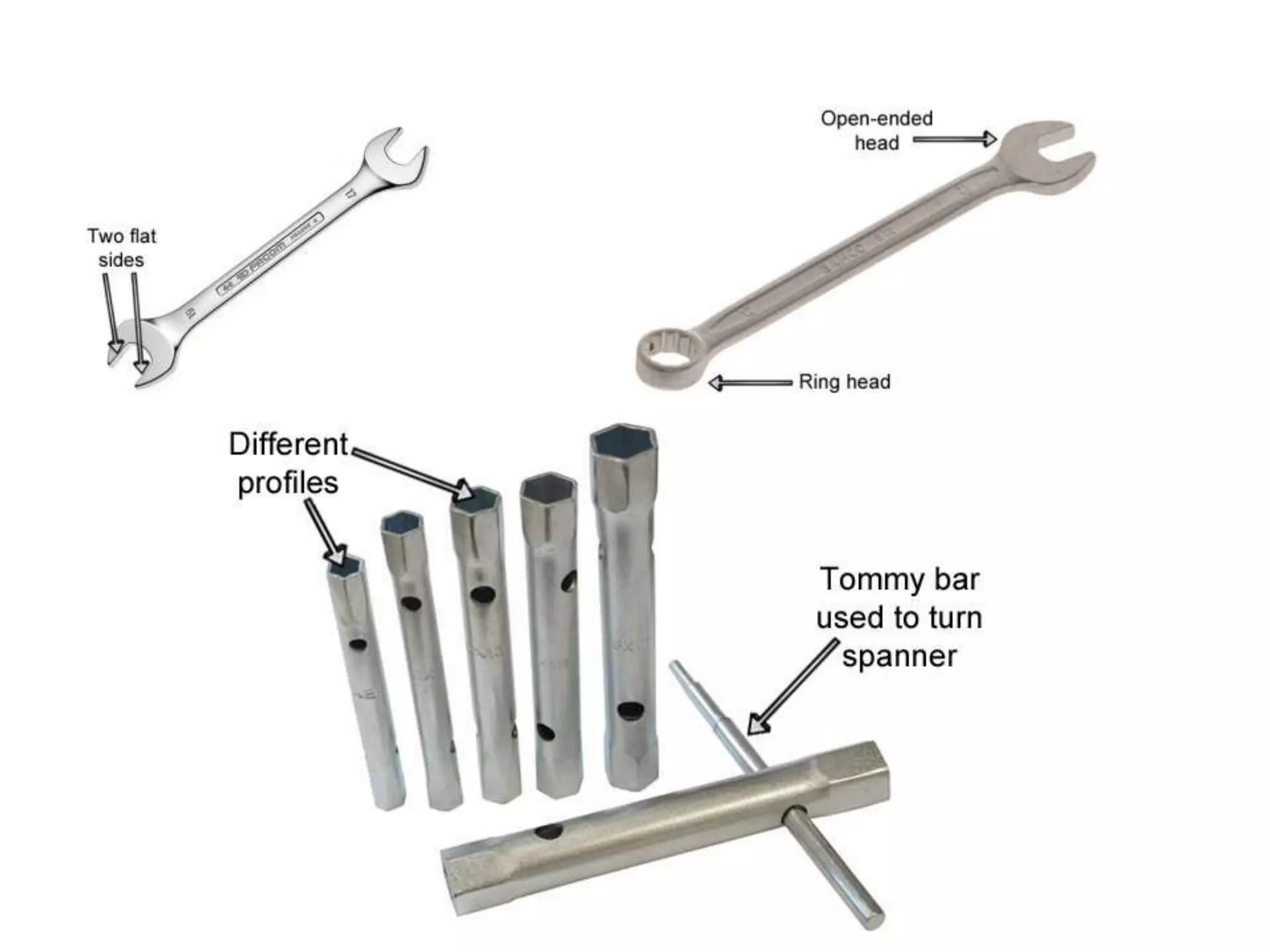
• Use thecorrect wrench for the job - pipe wrenches for pipes
plumbing fittings, and general use wrenches for nuts and bolts.
• Discard any damaged wrenches (e.g., open-ended wrenches with
spread jaws or box wrenched with broken or damaged points).
• Select the correct jaw size to avoid slippage.
• Wear safety glasses or a face shield (with safety glasses or goggles)
where there is a hazard of flying particles or falling debris.
• Position your body in a way that will prevent you from losing
balance and hurting yourself if the wrench slips or something (e.g.,
a bolt) suddenly breaks.
• Use a box or socket wrench with a straight handle, rather than an
offset handle, when possible.
• Ensure that the jaw of an open ended wrench is in full contact (fully
seated, "flat", not tilted) with the nut or bolt before applying
pressure.
16.
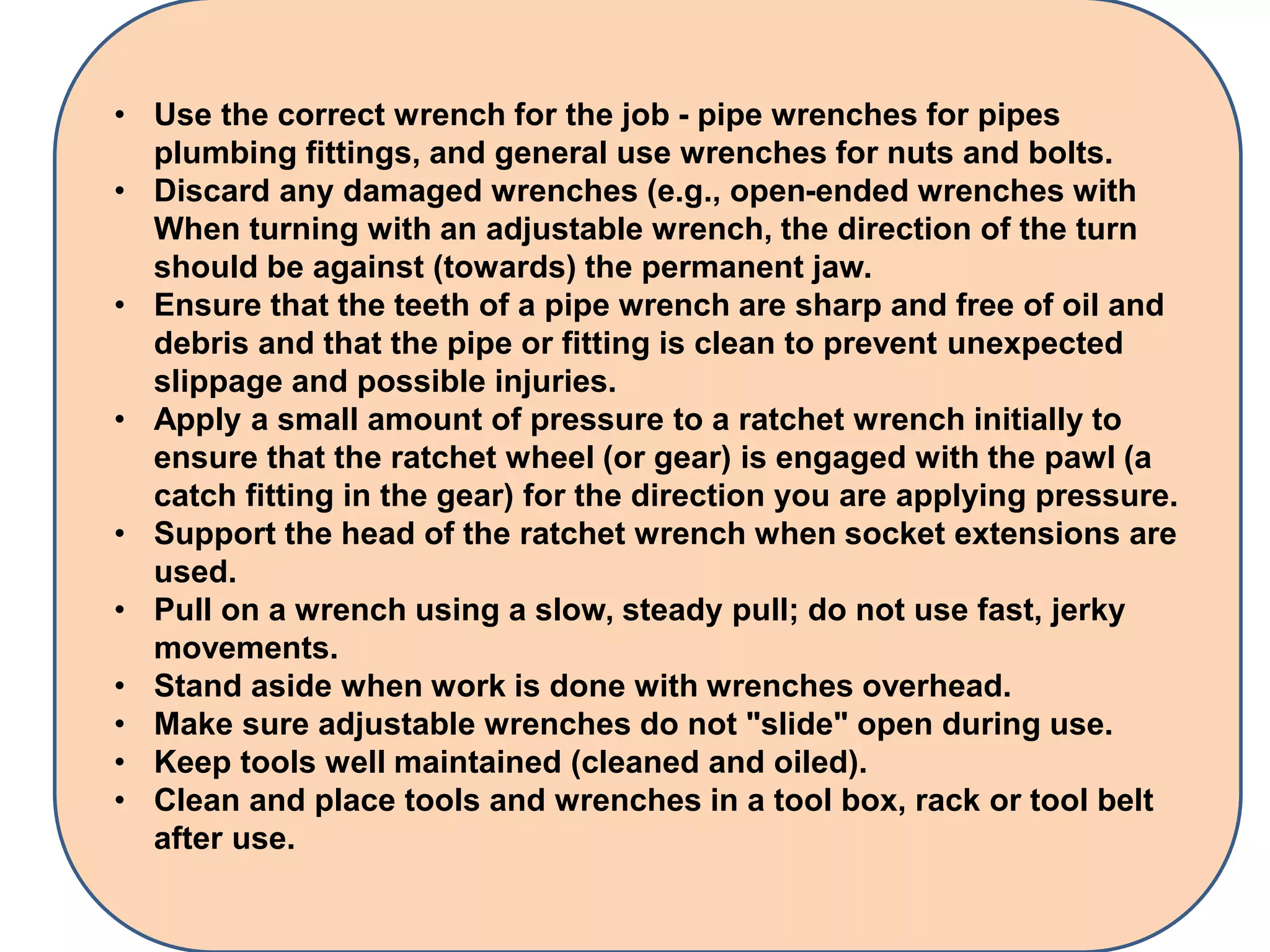
• Use thecorrect wrench for the job - pipe wrenches for pipes
plumbing fittings, and general use wrenches for nuts and bolts.
• Discard any damaged wrenches (e.g., open-ended wrenches with
When turning with an adjustable wrench, the direction of the turn
should be against (towards) the permanent jaw.
• Ensure that the teeth of a pipe wrench are sharp and free of oil and
debris and that the pipe or fitting is clean to prevent unexpected
slippage and possible injuries.
• Apply a small amount of pressure to a ratchet wrench initially to
ensure that the ratchet wheel (or gear) is engaged with the pawl (a
catch fitting in the gear) for the direction you are applying pressure.
• Support the head of the ratchet wrench when socket extensions are
used.
• Pull on a wrench using a slow, steady pull; do not use fast, jerky
movements.
• Stand aside when work is done with wrenches overhead.
• Make sure adjustable wrenches do not "slide" open during use.
• Keep tools well maintained (cleaned and oiled).
• Clean and place tools and wrenches in a tool box, rack or tool belt
after use.
17.
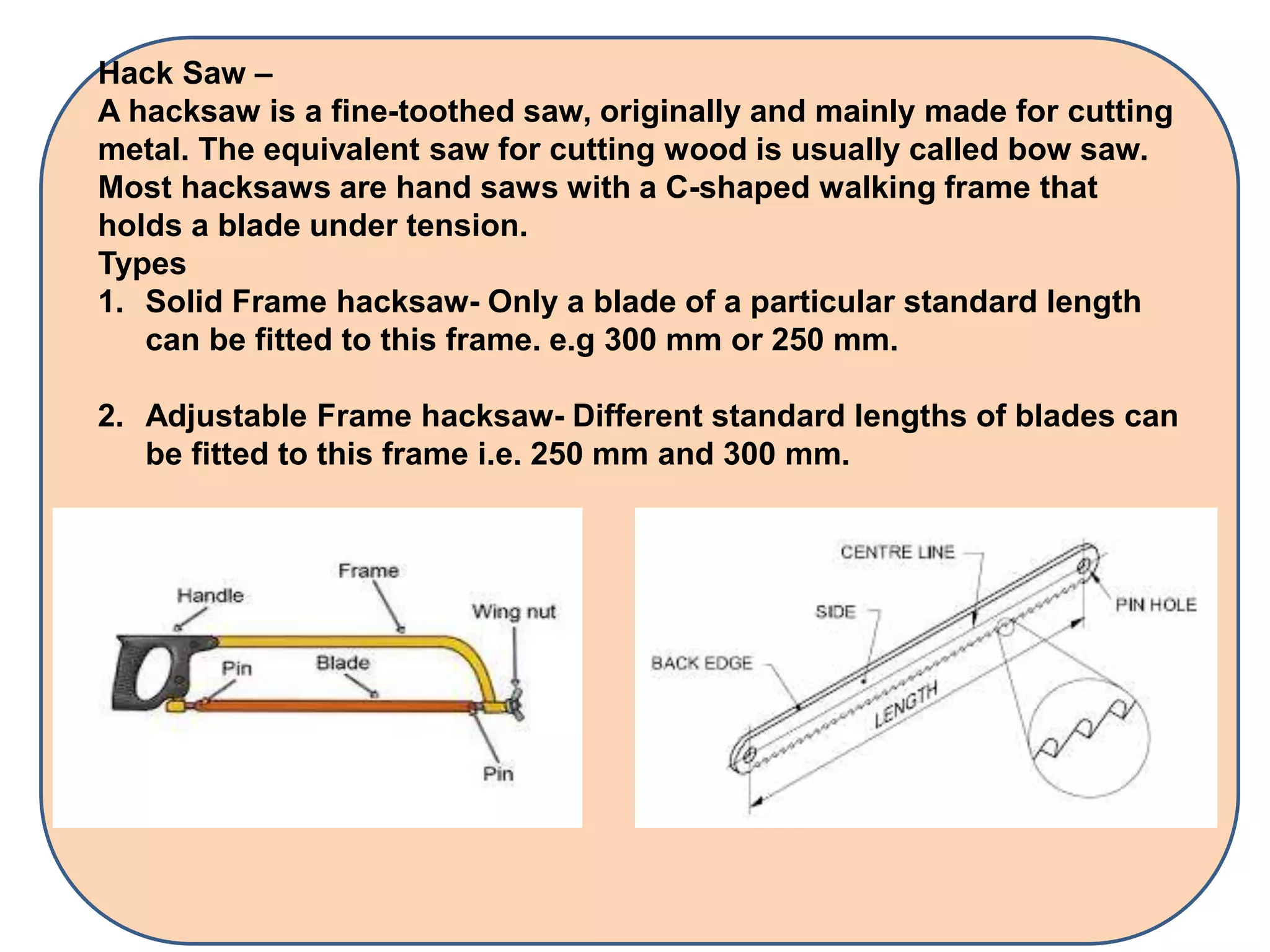
Hack Saw –
Ahacksaw is a fine-toothed saw, originally and mainly made for cutting
metal. The equivalent saw for cutting wood is usually called bow saw.
Most hacksaws are hand saws with a C-shaped walking frame that
holds a blade under tension.
Types
1. Solid Frame hacksaw- Only a blade of a particular standard length
can be fitted to this frame. e.g 300 mm or 250 mm.
2. Adjustable Frame hacksaw- Different standard lengths of blades can
be fitted to this frame i.e. 250 mm and 300 mm.
18.
Allan keys
Allen keys,also known as a hex key, or an Allen wrench, an Allen
key is a hand tool that helps you fit and turn a hexagonal bolt/screw.
Originally named Allen Manufacturing Company, the business
produced hexagonal set screws and wrenches to fasten them. The
terms "Allen wrench" and "Allen key" are derived from the Allen brand
name and refer to the generic product category "hex keys".
Statutory Requirements forHand tools and Portable Power Tools.
Section 35. Protection of eyes.- In respect of any such
manufacturing process carried on in any factory as may be prescribed,
being a process which involves-
(a) risk of injury to the eyes from particles or fragments thrown off in
the course of the process, or
(b) risk to the eyes by reason of exposure to excessive light, the
3[State] Government may by rules require that effective screens or
suitable goggles shall be provided for the protection of persons
employed on, or in the immediate vicinity of the process.
Section 36A of the Factories Act states that portable electric appliance
(any tool, equipment or instrument) when used in any confined space
(tank, vat, chamber, pit, pipe, flue etc.), shall be of low voltage up to 24
Volt only, or other safety device like ELCB should be provided.
If inflammable gas, fume or dust is likely to be present in such confined
space, portable lamp or light should be of flameproof construction.
21.
Basic Safety Rulesfor Hand Tools
ALWAYS WEAR EYE PROTECTION.
Wear the RIGHT SAFETY EQUIPMENT for the job.
Use tools that are the RIGHT SIZE & RIGHT TYPE for your job.
Follow the correct procedure for using EVERY tool.
Keep your cutting tools SHARP and in good condition.
DON’T work with OILY or GREASY hands.
Handle SHARP-EDGED and POINTED TOOLS with care.
Always carry pointed tools by your side with the points and heavy ends
DOWN.
SECURE all small work & short work with a vise or clamp.
NEVER carry tools in your pockets.
DON’T use tools which are LOOSE or CRACKED.
22.
KEEP yourpunches & chisels in good condition. Mushroomed heads can chip & cause
injuries.
DON’T use a file without a HANDLE.
DON’T pry or hammer with a FILE. It may shatter.
DON’T use screwdrivers as chisels or pry bars.
DON’T try to increase your leverage by using a “cheater” with a wrench. Wrenches are
designed at the right strength for their size and length.
AFTER USING A TOOL — clean it and return it to its proper storage place.
If anything breaks or malfunctions — report it to your supervisor AT ONCE.
Use the RIGHT TYPE of tool for the job.
NEVER place tools and materials where they hang on the edge of a bench.
Don’t use tools for things they weren’t meant for.
Store tools and materials vertically, with the points and heavy end down.
Cut away from yourself when you use chisels and other edged tools.
DON’T FORCE screws; make sure that the correct screw for the job is being used.
23.
OSHA Office ofTraining and Education 9
Examples of PPE
Examples of PPE
earplugs, earmuffs
Hearing
vests
Bodies
gloves
Hands and arms
safety shoes
Feet
hard hats
Head
face shields
Face
safety glasses, goggles
Eye
Body Part Protection
24.
Portable Power Tool
Apower tool is a tool that is actuated by an additional power source
and mechanism other than the solely manual labor used with hand
tools. The most common types of power tools use electric motors.
Internal combustion engines and compressed air are also commonly
used.
25.
• Flexible cable(cord) should be protected from misuse, abuse and
damage to insulation resulting in broken or exposed live conductor.
• Plug-socket connection should be tight and safe. No bare
conductors should be inserted in plug. Three pin top should be
used.
• Metal casing should be effectively earthed. Earth .core of the flexible
cable should be properly connected to the metalwork to be handled.
Flexible conduit is not suitable for this purpose.
• Second alternative is the use of 110 V supply with centre tapped to
earth to reduce an effective shock voltage to 55-a relatively safe
voltage.
• Power cutting switches should be within reach and near the
apparatus.
• Regular maintenance to check earth core continuity and strength of
earthing.
26.
• Additional back-upprotection is ELCB. i.e. earth leakage circuit
breaker which detects the current difference between power supply
line and current returning to the supply point. In normal safe
operating condition, this current difference is zero but if there is a
fault and leakage starts to earth, a differential current occurs which
operates the device that rapidly senses and trips its contacts to cut
off power to the apparatus.
• Electric tool should never be put in wet area or used in raining
condition.
• Double protection or double-insulated or all insulated type
equipment which need not be earthed.
• Dead man control. This tool operates till the button is pressed and it
stops as the button is released. Portable saw, hoist and remote
control pendant are of this type.
Pneumatic Power
• Pneumatic or Air-powered tools are less hazardous than electric
power tools. Grinders and impact tools have air hoses (pipes) which
pose tripping or stumbling hazard. Self-storing recoiling air hoses
are safe. Speed regulator or governor is necessary to avoid over-
speeding the tool.
27.
Effects of noiseand vibration cause health hazards. Vibration and jerks
cause strain in the joints and disease. 'White fingers' or 'Vasospastic
vibration syndrome' is a disease due to vibration exposure and
vascular spasm. 8 to 16 Hz frequency causes' the most harmful effects
as it generates resonance in hand-arm system. Safe limit of vibration
intensity i.e daily exposure is
60 HZ for 1 hour working and
112 HZ for 30 minutes working.
To reduce vibration, damping springs, air cushions and vibration
absorbing handles are necessary.
Noise level near the tool should be measured and ear protection should
be given to the operator if necessary. Eye protection is required due to
flying chips. Two chippers should work away from each other, back to
back, to prevent cuts from -flying chips. They should not point a
pneumatic hammer at anyone. Neither should it be used to clean dust
from clothes due to risk of intestine inflation. Jack hammer handles
should have rubber grips to reduce effects of vibration and fatigue.
Operators should wear metatarsal - type safety shoes to protect against
fall of heavy hammer.
28.
Inspection checklist.
1. Lowvoltage or battery powered equipments used in tank and wet
area.
2. Tools well maintained
3. Motor in good condition
4. Approved tools used in explosive area
5. Tools left where they cannot fall.
Cords
1. Proper cable insulation and plug.
2. Cords laid properly and not in gangways / stairs.
Earthing / Grounding
1. Ground wire properly fastened
2. 3 Pin wire plug extension
3. Defects / minor shocks reported
4. ELCB installed.
Guarding
1. Safety Guards are provided on grinders and saws.
2. Moveable guards are operated freely
Adequate Personal protective Equipments are worn during working
Summary
Hazards are usuallythe result of improper tool use or not
following one or more of these protection techniques:
Inspecting the tool before use
Read Tool Owners Manual prior to use
Using PPE (Personal Protective Equipment)
Using guards
Properly storing and maintaining the tool
Keep the workplace neat and free of clutter
Using safe handling techniques









![Statutory Requirements for Hand tools and Portable Power Tools.
Section 35. Protection of eyes.- In respect of any such
manufacturing process carried on in any factory as may be prescribed,
being a process which involves-
(a) risk of injury to the eyes from particles or fragments thrown off in
the course of the process, or
(b) risk to the eyes by reason of exposure to excessive light, the
3[State] Government may by rules require that effective screens or
suitable goggles shall be provided for the protection of persons
employed on, or in the immediate vicinity of the process.
Section 36A of the Factories Act states that portable electric appliance
(any tool, equipment or instrument) when used in any confined space
(tank, vat, chamber, pit, pipe, flue etc.), shall be of low voltage up to 24
Volt only, or other safety device like ELCB should be provided.
If inflammable gas, fume or dust is likely to be present in such confined
space, portable lamp or light should be of flameproof construction.](https://image.slidesharecdn.com/handtoolssafety-230414061517-f64e4821/75/Hand-tools-safety-pptx-20-2048.jpg)