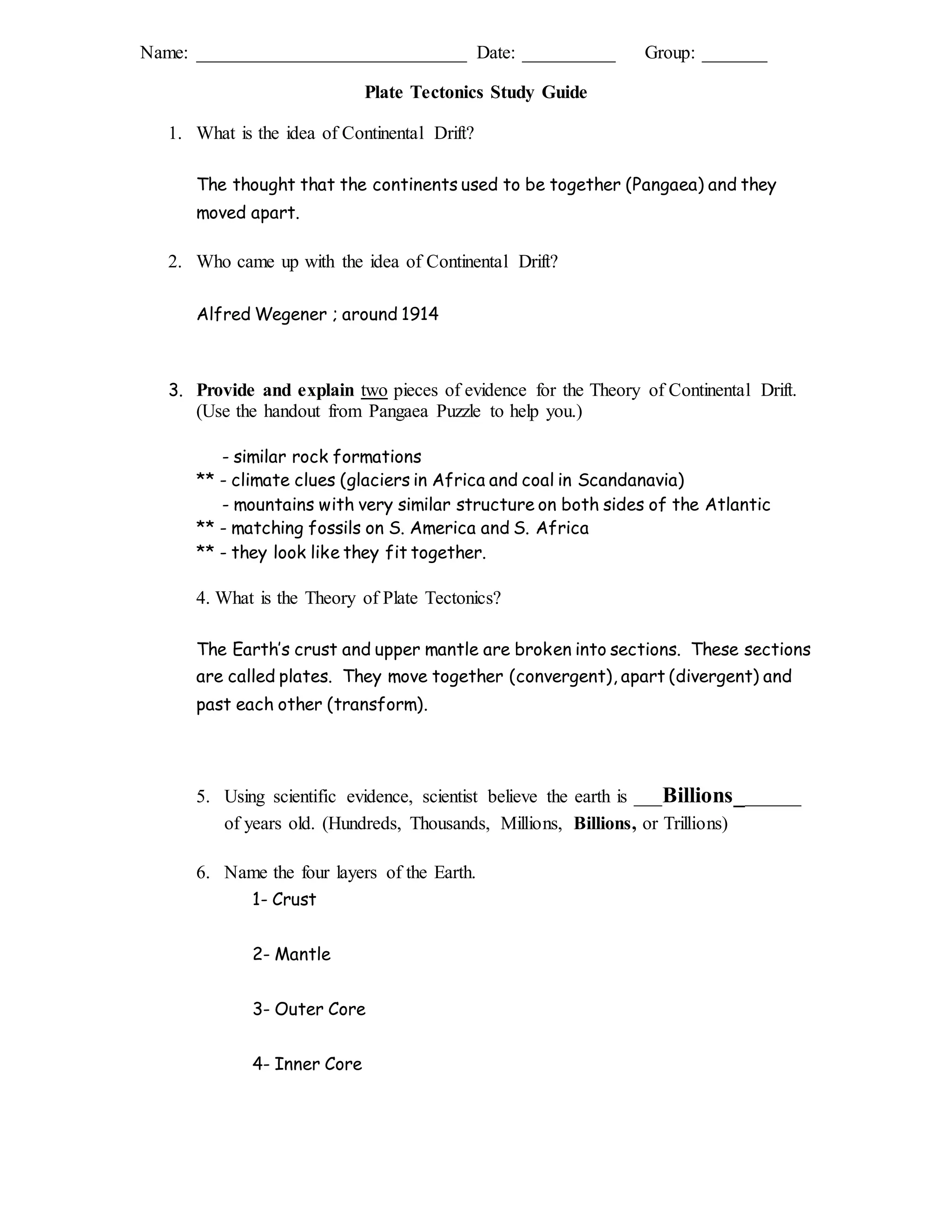
Name: _____________________________ Date: __________ Group: _______
Plate Tectonics Study Guide
1. What is the idea of Continental Drift?
The thought that the continents used to be together (Pangaea) and they
moved apart.
2. Who came up with the idea of Continental Drift?
Alfred Wegener ; around 1914
3. Provide and explain two pieces of evidence for the Theory of Continental Drift.
(Use the handout from Pangaea Puzzle to help you.)
- similar rock formations
** - climate clues (glaciers in Africa and coal in Scandanavia)
- mountains with very similar structure on both sides of the Atlantic
** - matching fossils on S. America and S. Africa
** - they look like they fit together.
4. What is the Theory of Plate Tectonics?
The Earth’s crust and upper mantle are broken into sections. These sections
are called plates. They move together (convergent), apart (divergent) and
past each other (transform).
5. Using scientific evidence, scientist believe the earth is ___Billions_______
of years old. (Hundreds, Thousands, Millions, Billions, or Trillions)
6. Name the four layers of the Earth.
1- Crust
2- Mantle
3- Outer Core
4- Inner Core
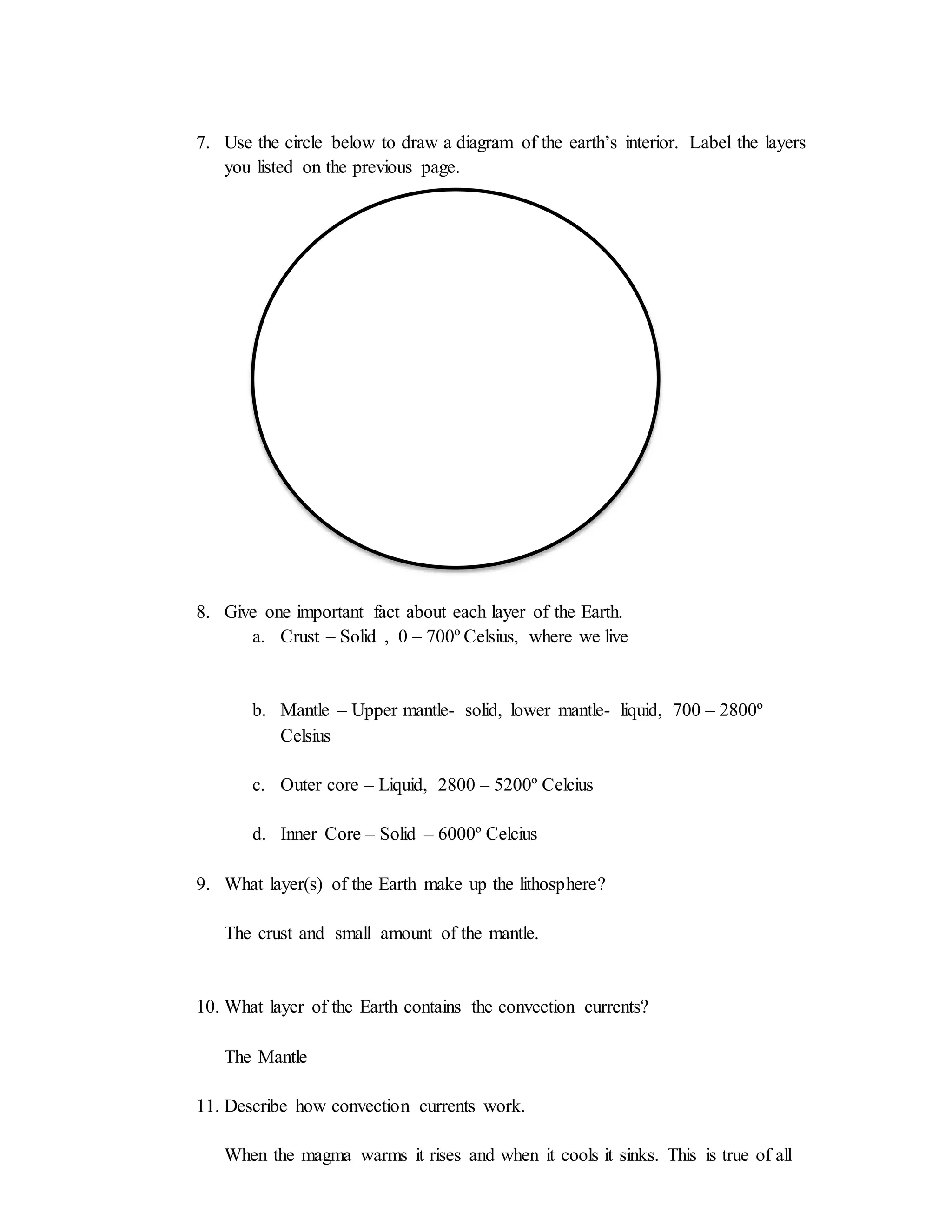
7. Use the circle below to draw a diagram of the earth’s interior. Label the layers
you listed on the previous page.
8. Give one important fact about each layer of the Earth.
a. Crust – Solid , 0 – 700º Celsius, where we live
b. Mantle – Upper mantle- solid, lower mantle- liquid, 700 – 2800º
Celsius
c. Outer core – Liquid, 2800 – 5200º Celcius
d. Inner Core – Solid – 6000º Celcius
9. What layer(s) of the Earth make up the lithosphere?
The crust and small amount of the mantle.
10. What layer of the Earth contains the convection currents?
The Mantle
11. Describe how convection currents work.
When the magma warms it rises and when it cools it sinks. This is true of all
liquids and gases. (This creates a current that moves the lithospheric plates of
the Earth.)
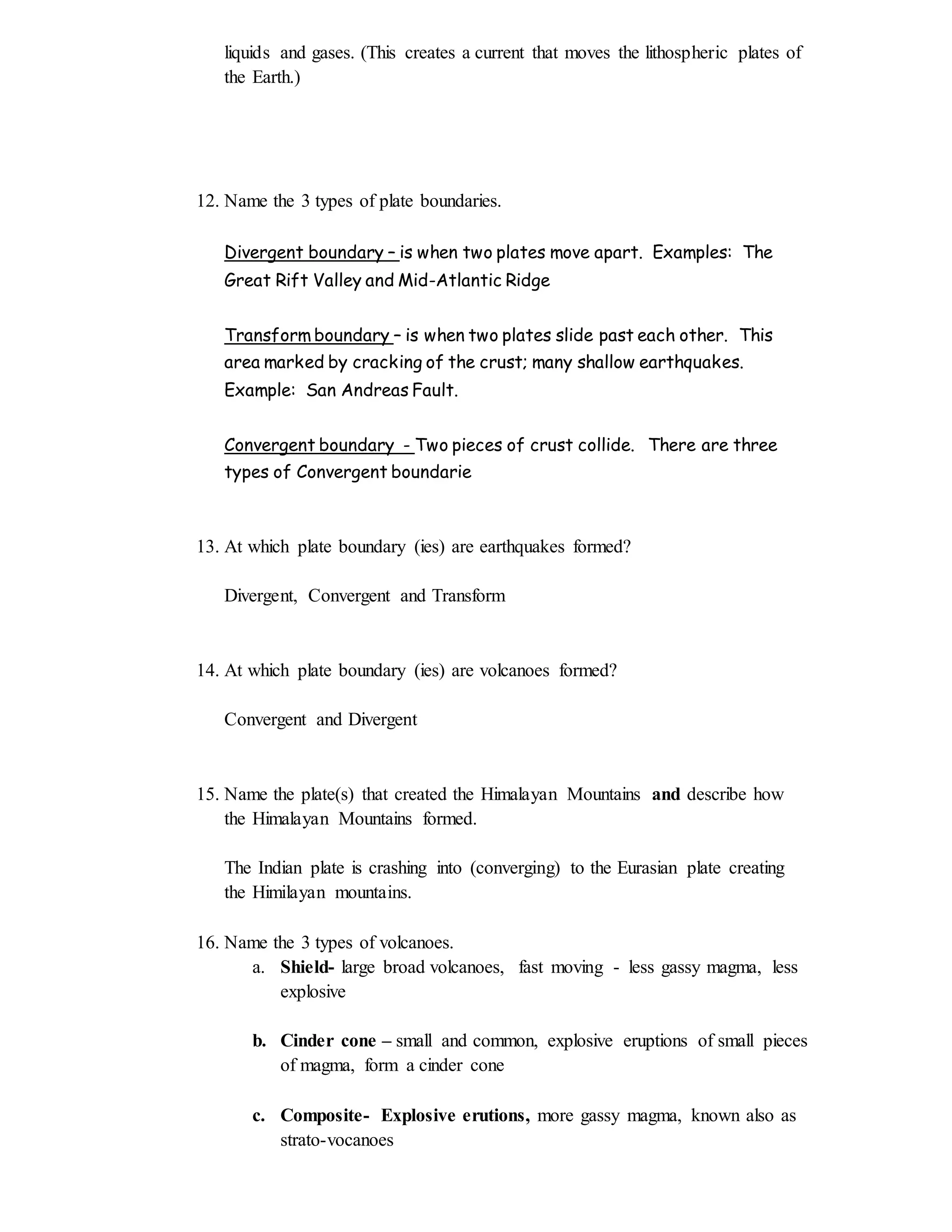
12. Name the 3 types of plate boundaries.
Divergent boundary – is when two plates move apart. Examples: The
Great Rift Valley and Mid-Atlantic Ridge
Transform boundary – is when two plates slide past each other. This
area marked by cracking of the crust; many shallow earthquakes.
Example: San Andreas Fault.
Convergent boundary - Two pieces of crust collide. There are three
types of Convergent boundarie
13. At which plate boundary (ies) are earthquakes formed?
Divergent, Convergent and Transform
14. At which plate boundary (ies) are volcanoes formed?
Convergent and Divergent
15. Name the plate(s) that created the Himalayan Mountains and describe how
the Himalayan Mountains formed.
The Indian plate is crashing into (converging) to the Eurasian plate creating
the Himilayan mountains.
16. Name the 3 types of volcanoes.
a. Shield- large broad volcanoes, fast moving - less gassy magma, less
explosive
b. Cinder cone – small and common, explosive eruptions of small pieces
of magma, form a cinder cone
c. Composite- Explosive erutions, more gassy magma, known also as
strato-vocanoes
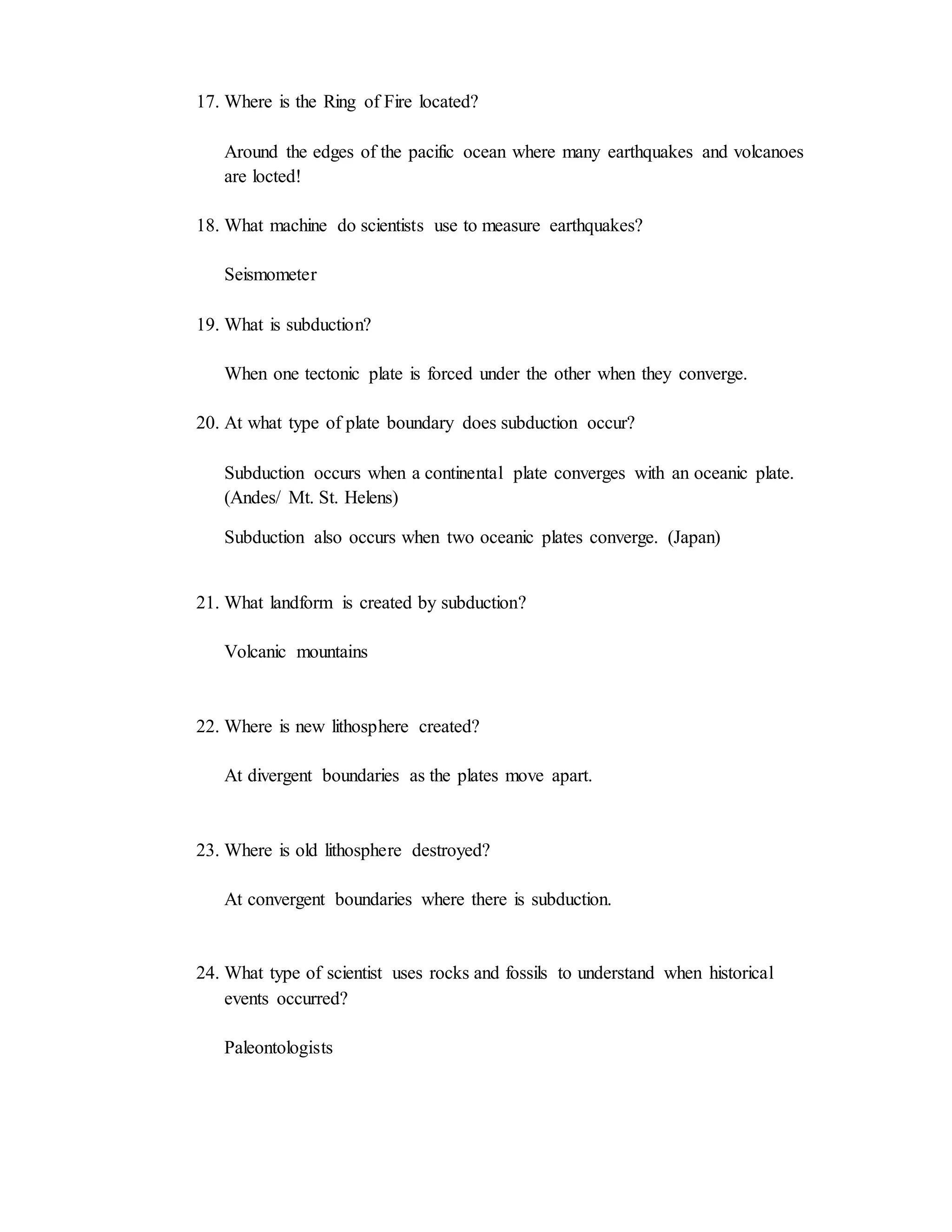
17. Where is the Ring of Fire located?
Around the edges of the pacific ocean where many earthquakes and volcanoes
are locted!
18. What machine do scientists use to measure earthquakes?
Seismometer
19. What is subduction?
When one tectonic plate is forced under the other when they converge.
20. At what type of plate boundary does subduction occur?
Subduction occurs when a continental plate converges with an oceanic plate.
(Andes/ Mt. St. Helens)
Subduction also occurs when two oceanic plates converge. (Japan)
21. What landform is created by subduction?
Volcanic mountains
22. Where is new lithosphere created?
At divergent boundaries as the plates move apart.
23. Where is old lithosphere destroyed?
At convergent boundaries where there is subduction.
24. What type of scientist uses rocks and fossils to understand when historical
events occurred?
Paleontologists

Plate tectonics review sheet

  • 1.
    Name: _____________________________ Date:__________ Group: _______ Plate Tectonics Study Guide 1. What is the idea of Continental Drift? The thought that the continents used to be together (Pangaea) and they moved apart. 2. Who came up with the idea of Continental Drift? Alfred Wegener ; around 1914 3. Provide and explain two pieces of evidence for the Theory of Continental Drift. (Use the handout from Pangaea Puzzle to help you.) - similar rock formations ** - climate clues (glaciers in Africa and coal in Scandanavia) - mountains with very similar structure on both sides of the Atlantic ** - matching fossils on S. America and S. Africa ** - they look like they fit together. 4. What is the Theory of Plate Tectonics? The Earth’s crust and upper mantle are broken into sections. These sections are called plates. They move together (convergent), apart (divergent) and past each other (transform). 5. Using scientific evidence, scientist believe the earth is ___Billions_______ of years old. (Hundreds, Thousands, Millions, Billions, or Trillions) 6. Name the four layers of the Earth. 1- Crust 2- Mantle 3- Outer Core 4- Inner Core
  • 2.
    7. Use thecircle below to draw a diagram of the earth’s interior. Label the layers you listed on the previous page. 8. Give one important fact about each layer of the Earth. a. Crust – Solid , 0 – 700º Celsius, where we live b. Mantle – Upper mantle- solid, lower mantle- liquid, 700 – 2800º Celsius c. Outer core – Liquid, 2800 – 5200º Celcius d. Inner Core – Solid – 6000º Celcius 9. What layer(s) of the Earth make up the lithosphere? The crust and small amount of the mantle. 10. What layer of the Earth contains the convection currents? The Mantle 11. Describe how convection currents work. When the magma warms it rises and when it cools it sinks. This is true of all
  • 3.
    liquids and gases.(This creates a current that moves the lithospheric plates of the Earth.) 12. Name the 3 types of plate boundaries. Divergent boundary – is when two plates move apart. Examples: The Great Rift Valley and Mid-Atlantic Ridge Transform boundary – is when two plates slide past each other. This area marked by cracking of the crust; many shallow earthquakes. Example: San Andreas Fault. Convergent boundary - Two pieces of crust collide. There are three types of Convergent boundarie 13. At which plate boundary (ies) are earthquakes formed? Divergent, Convergent and Transform 14. At which plate boundary (ies) are volcanoes formed? Convergent and Divergent 15. Name the plate(s) that created the Himalayan Mountains and describe how the Himalayan Mountains formed. The Indian plate is crashing into (converging) to the Eurasian plate creating the Himilayan mountains. 16. Name the 3 types of volcanoes. a. Shield- large broad volcanoes, fast moving - less gassy magma, less explosive b. Cinder cone – small and common, explosive eruptions of small pieces of magma, form a cinder cone c. Composite- Explosive erutions, more gassy magma, known also as strato-vocanoes
  • 4.
    17. Where isthe Ring of Fire located? Around the edges of the pacific ocean where many earthquakes and volcanoes are locted! 18. What machine do scientists use to measure earthquakes? Seismometer 19. What is subduction? When one tectonic plate is forced under the other when they converge. 20. At what type of plate boundary does subduction occur? Subduction occurs when a continental plate converges with an oceanic plate. (Andes/ Mt. St. Helens) Subduction also occurs when two oceanic plates converge. (Japan) 21. What landform is created by subduction? Volcanic mountains 22. Where is new lithosphere created? At divergent boundaries as the plates move apart. 23. Where is old lithosphere destroyed? At convergent boundaries where there is subduction. 24. What type of scientist uses rocks and fossils to understand when historical events occurred? Paleontologists