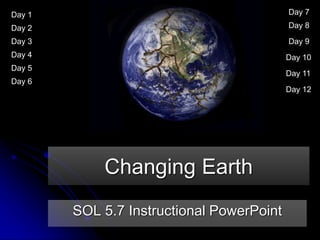
Changing Earth
SOL 5.7 Instructional PowerPoint
Day 1
Day 2
Day 3
Day 4
Day 5
Day 6
Day 7
Day 8
Day 9
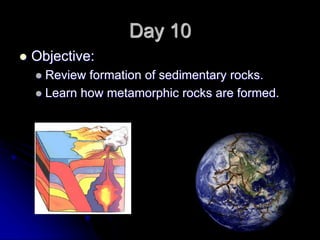
Day 10
Day 11
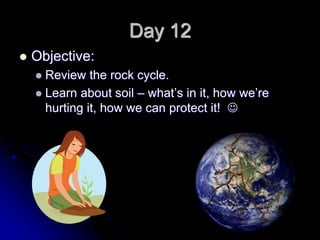
Day 12
Day 1
 Objective:
 Introduce concept of changing Earth.
 Discuss the four layers of the Earth.
Our Changing Earth
 Using a SMARTpen, write a few ideas to
explain how our planet is changing over
time.
Layers of the Earth
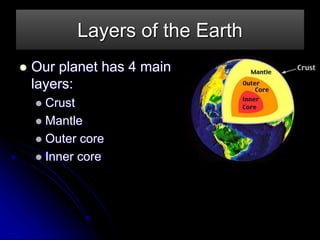
 Our planet has 4 main
layers:
 Crust
 Mantle
 Outer core
 Inner core
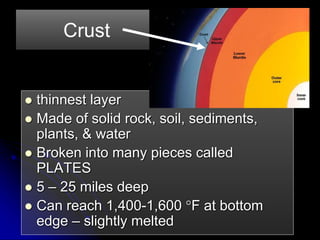
Crust
 thinnest layer
 Made of solid rock, soil, sediments,
plants, & water
 Broken into many pieces called
PLATES
 5 – 25 miles deep
 Can reach 1,400-1,600 F at bottom
edge – slightly melted
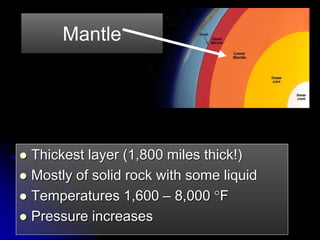
 Thickest layer (1,800 miles thick!)
 Mostly of solid rock with some liquid
 Temperatures 1,600 – 8,000 F
 Pressure increases
Mantle
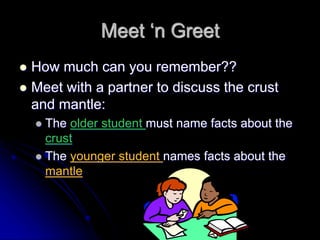
Meet ‘n Greet
 How much can you remember??
 Meet with a partner to discuss the crust
and mantle:
 The older student must name facts about the
crust
 The younger student names facts about the
mantle
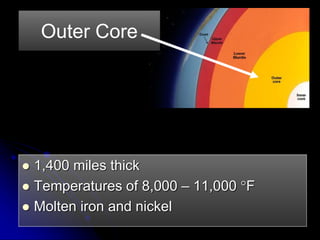
 1,400 miles thick
 Temperatures of 8,000 – 11,000 F
 Molten iron and nickel
Outer Core
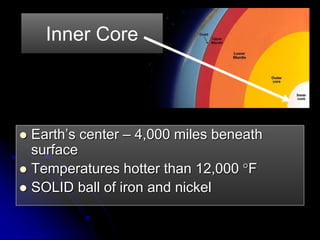
 Earth’s center – 4,000 miles beneath
surface
 Temperatures hotter than 12,000 F
 SOLID ball of iron and nickel
Inner Core
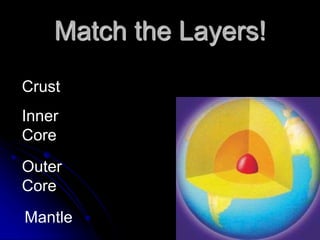
Match the Layers!
Crust
Inner
Core
Outer
Core
Mantle
Closure
 Name the four layers of the Earth.
 What is the thinnest layer?
 What is the thickest layer?
 Which layer is a solid ball of iron and
nickel?
 Which layer is molten (melted) iron and
nickel?
Crust, mantle,
outer core, inner
core
Crust
Mantle
Inner core
Outer core
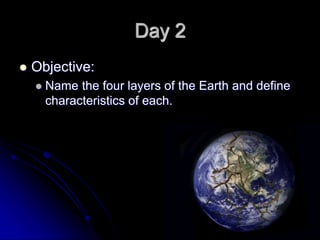
Day 2
 Objective:
 Name the four layers of the Earth and define
characteristics of each.
Review
 Name the four layers of the Earth.
 What is the thinnest layer?
 What is the thickest layer?
 Which layer is a solid ball of iron and
nickel?
 Which layer is molten (melted) iron and
nickel?
Crust, mantle,
outer core, inner
core
Crust
Mantle
Inner core
Outer core
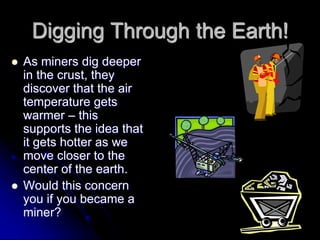
Digging Through the Earth!
 As miners dig deeper
in the crust, they
discover that the air
temperature gets
warmer – this
supports the idea that
it gets hotter as we
move closer to the
center of the earth.
 Would this concern
you if you became a
miner?
ID, Please!
 I am the thickest layer of the Earth.
 I am the thinnest layer of the Earth.
 I am the layer of molten (melted) iron and
nickel.
 I am the hottest layer of the Earth.
 I am 5 – 25 miles deep.
 I am up to 11,000 degrees Fahrenheit.
Write your
answer next to
each.
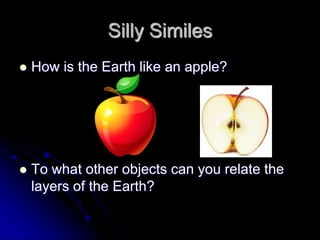
Silly Similes
 How is the Earth like an apple?
 To what other objects can you relate the
layers of the Earth?
Task: Time it!
 If you could travel to the center of the
earth in 1 hour, about how long would it
take you to travel through each of the four
layers? (60 minutes in an hour, 60 seconds in a minute)
 Crust:
 Mantle:
 Outer Core:
 Inner Core:
You have 5
minutes to
complete this
task!
22 seconds
26 min. 16 sec.
21 min. 12 sec.
12 min. 10 sec.
Click to reveal actual times after sharing.
Closure
 Name the four layers of the Earth.
 What is the thinnest layer?
 What is the thickest layer?
 Which layer is a solid ball of iron and
nickel?
 Which layer is the hottest layer?
Crust, mantle,
outer core, inner
core
Crust
Mantle
Inner core
Inner core
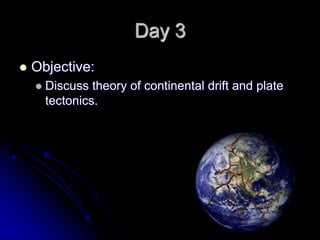
Day 3
 Objective:
 Discuss theory of continental drift and plate
tectonics.
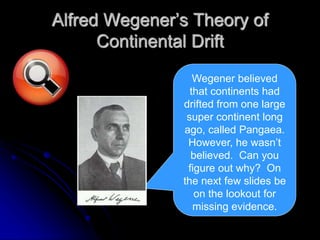
Alfred Wegener’s Theory of
Continental Drift
Wegener believed
that continents had
drifted from one large
super continent long
ago, called Pangaea.
However, he wasn’t
believed. Can you
figure out why? On
the next few slides be
on the lookout for
missing evidence.
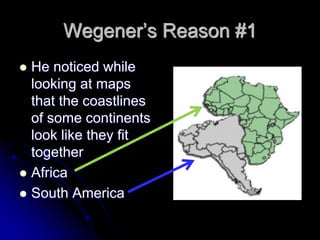
Wegener’s Reason #1
 He noticed while
looking at maps
that the coastlines
of some continents
look like they fit
together
 Africa
 South America
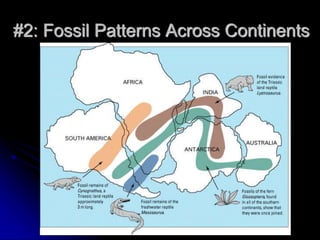
#2: Fossil Patterns Across Continents
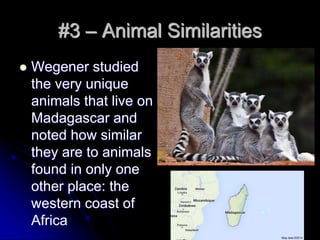
#3 – Animal Similarities
 Wegener studied
the very unique
animals that live on
Madagascar and
noted how similar
they are to animals
found in only one
other place: the
western coast of
Africa
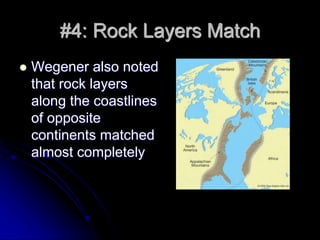
#4: Rock Layers Match
 Wegener also noted
that rock layers
along the coastlines
of opposite
continents matched
almost completely
Meet ‘n Greet
 Wegener had 4 reasons why he believed
the continents had drifted to where they
presently are today. However, he was
missing a piece to the puzzle – why didn’t
scientists believe him? What piece was
he missing? Meet with a partner to
discuss.
Answer:
He couldn’t explain
HOW the continents had moved.
Why would large masses of rock
suddenly migrate to another part of
the planet?
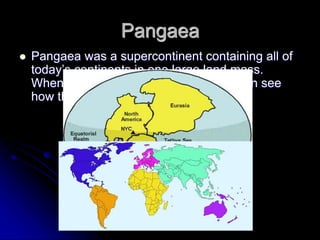
Pangaea
 Pangaea was a supercontinent containing all of
today’s continents in one large land mass.
When you look at the coastlines, you can see
how they must have fit together.
Closure
 What was Wegener’s theory called, in
which he thought the continents have
been moving for millions of years?
 What led him to believe that the continents
had once been attached?
 What did he call the supercontinent?
 Are the continents still moving?
Continental drift
Matching coastlines, animal life,
rock layers, fossils of plants
Pangaea
yes
Day 4
 Objective:
 ID and define plate boundaries.
 Understand how plate tectonics relate
to earthquakes and volcanoes.
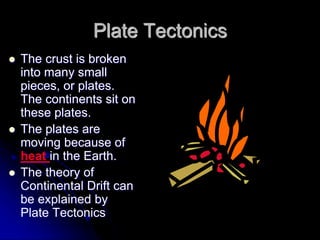
Plate Tectonics
 The crust is broken
into many small
pieces, or plates.
The continents sit on
these plates.
 The plates are
moving because of
heat in the Earth.
 The theory of
Continental Drift can
be explained by
Plate Tectonics
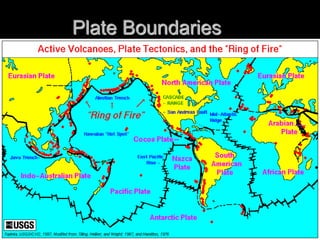
Plate Boundaries
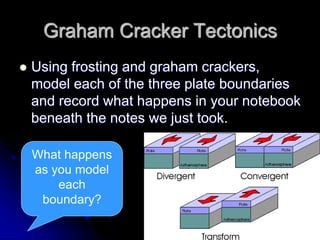
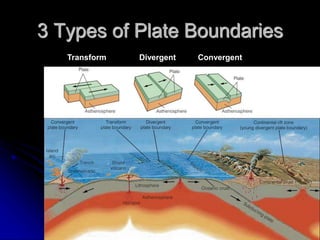
3 Types of Plate Boundaries
Transform Divergent Convergent
Plate Tectonics
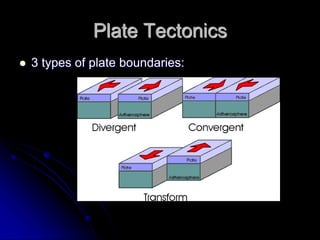
 3 types of plate boundaries:
Graham Cracker Tectonics
 Using frosting and graham crackers,
model each of the three plate boundaries
and record what happens in your notebook
beneath the notes we just took.
What happens
as you model
each
boundary?
Closure
 What type of plate boundary has two
plates colliding?
 In which type of plate boundary do two
plates separate?
 Which type of plate boundary is the San
Andreas fault in California?
 What do we call the cracks in the earth
often seen at plate boundaries?
convergent
divergent
Transform / sliding
faults
Day 5
 Objective:
 Review Plate Boundaries
 Investigate and discuss earthquakes.
 Understand that most earthquakes occur along plate
boundaries.
Review
 What type of plate boundary has two
plates colliding?
 In which type of plate boundary do two
plates separate?
 Which type of plate boundary is the San
Andreas fault in California?
 What do we call the cracks in the earth
often seen at plate boundaries?
convergent
divergent
Transform / sliding
faults
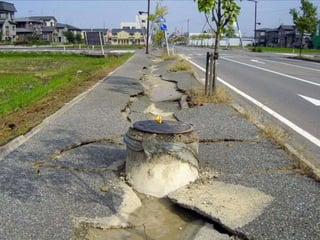
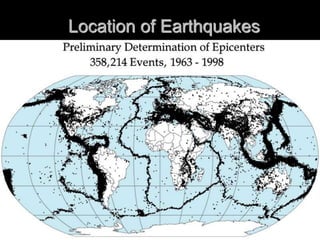
Location of Earthquakes
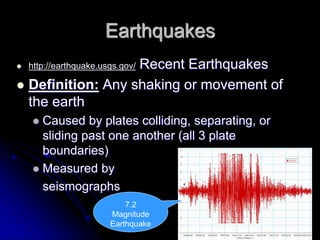
Earthquakes
 http://earthquake.usgs.gov/ Recent Earthquakes
 Definition: Any shaking or movement of
the earth
 Caused by plates colliding, separating, or
sliding past one another (all 3 plate
boundaries)
 Measured by
seismographs
7.2
Magnitude
Earthquake
Earthquake
Measurement
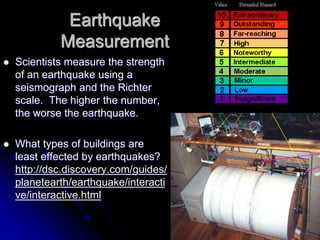
 Scientists measure the strength
of an earthquake using a
seismograph and the Richter
scale. The higher the number,
the worse the earthquake.
 What types of buildings are
least effected by earthquakes?
http://dsc.discovery.com/guides/
planetearth/earthquake/interacti
ve/interactive.html
The Great San Francisco
Earthquake of 1906
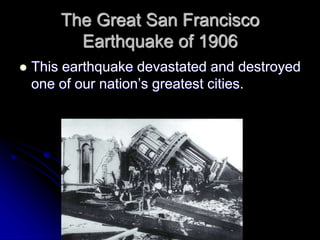
 This earthquake devastated and destroyed
one of our nation’s greatest cities.
Closure
 What causes an earthquake?
 Where do earthquakes MOSTLY occur?
 Can earthquakes occur anywhere?
 What tool is used to measure
earthquakes?
 How are earthquakes rated or ranked?
Pressure build-up inside the earth suddenly releases
Along all three plate boundaries
Yes – the ground can give away wherever there is pressure
Seismometer
Using the Richter scale, higher number for heavy earthquakes
Day 6
 Objective:
 Investigate and discuss volcanoes.
 Understand that most volcanoes occur along
convergent and divergent plate boundaries.
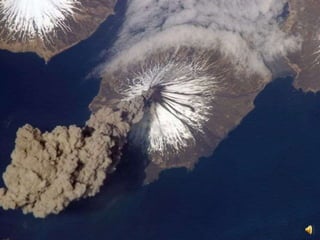
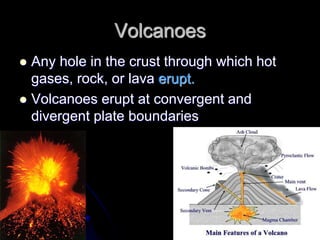
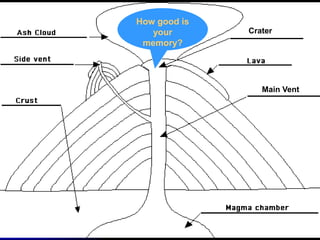
Volcanoes
 Any hole in the crust through which hot
gases, rock, or lava erupt.
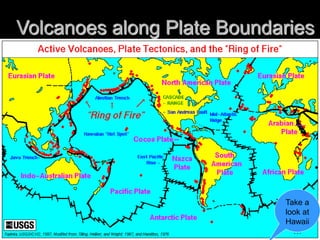
 Volcanoes erupt at convergent and
divergent plate boundaries
Volcanoes along Plate Boundaries
Take a
look at
Hawaii
…
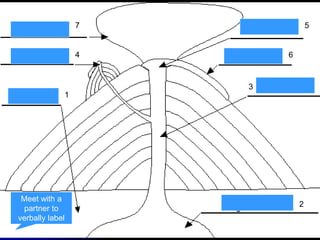
Main Vent
Crater
How good is
your
memory?
Main Vent
Crater
1
2
3
4
5
6
7
Meet with a
partner to
verbally label
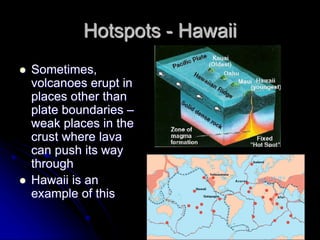
Hotspots - Hawaii
 Sometimes,
volcanoes erupt in
places other than
plate boundaries –
weak places in the
crust where lava
can push its way
through
 Hawaii is an
example of this
Silly Similes
 How is a volcano like a soda bottle?
 How is a volcano like our school at
dismissal?
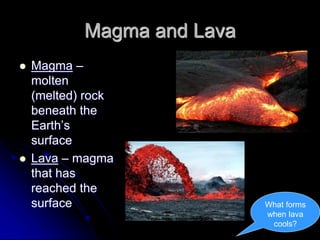
Magma and Lava
 Magma –
molten
(melted) rock
beneath the
Earth’s
surface
 Lava – magma
that has
reached the
surface What forms
when lava
cools?
Closure
 Any opening in the earth’s crust through
which hot gases, ash, and melted rock
erupt is a volcano.
 Magma is molten rock in the Earth.
 Lava is molten rock that has reached the
Earth’s surface.
 Scientists study volcanoes to learn about
temperatures in the Earth’s crust.
 Volcanoes occur along convergent and
divergent plate boundaries.
Day 7
 Objective:
 Understand how volcanic activity leads to
formation of new land and, in the ocean,
islands.
Quick Review!!
 Any opening in the earth’s crust through
which hot gases, ash, and melted rock
erupt is a volcano.
 Magma is molten rock in the Earth.
 Lava is molten rock that has reached the
Earth’s surface.
 Scientists study volcanoes to learn about
temperatures in the Earth’s crust.
 Volcanoes occur along convergent and
divergent plate boundaries. QUIZ
TIME!!!!
Quiz Time!
 Buddy study for 5 minutes with your
12 o’clock appointment.
 Separate desks.
 Name, #, Class at the top of your
page.
 Check your work carefully!!
 Turn into paper sorter when you
finish.
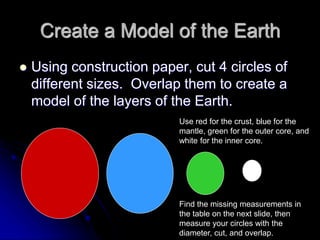
Create a Model of the Earth
 Using construction paper, cut 4 circles of
different sizes. Overlap them to create a
model of the layers of the Earth.
Use red for the crust, blue for the
mantle, green for the outer core, and
white for the inner core.
Find the missing measurements in
the table on the next slide, then
measure your circles with the
diameter, cut, and overlap.
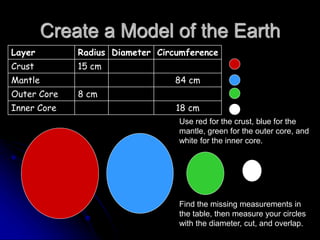
Create a Model of the Earth
Use red for the crust, blue for the
mantle, green for the outer core, and
white for the inner core.
Find the missing measurements in
the table, then measure your circles
with the diameter, cut, and overlap.
Layer Radius Diameter Circumference
Crust 15 cm
Mantle 84 cm
Outer Core 8 cm
Inner Core 18 cm
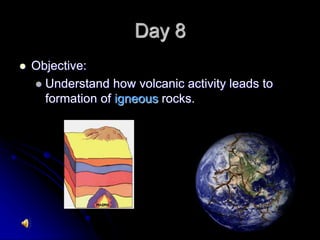
Day 8
 Objective:
 Understand how volcanic activity leads to
formation of igneous rocks.
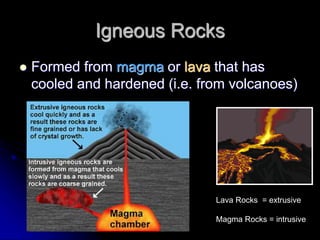
Igneous Rocks
 Formed from magma or lava that has
cooled and hardened (i.e. from volcanoes)
Lava Rocks = extrusive
Magma Rocks = intrusive
Types of Igneous Rocks –
Magma Rocks (intrusive rocks)
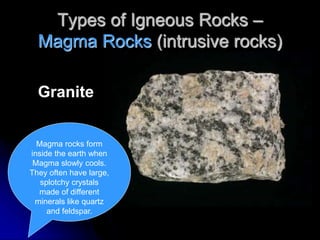
Granite
Magma rocks form
inside the earth when
Magma slowly cools.
They often have large,
splotchy crystals
made of different
minerals like quartz
and feldspar.
Types of Igneous Rocks –
Magma Rocks (intrusive rocks)
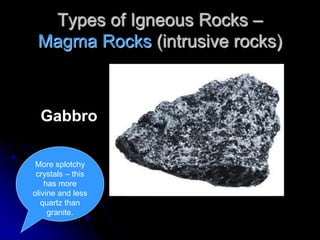
Gabbro
More splotchy
crystals – this
has more
olivine and less
quartz than
granite.
Types of Igneous Rocks –
Lava Rocks (extrusive rocks)
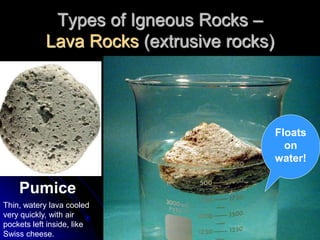
Pumice
Floats
on
water!
Thin, watery lava cooled
very quickly, with air
pockets left inside, like
Swiss cheese.
Types of Igneous Rocks –
Lava Rocks (extrusive rocks)
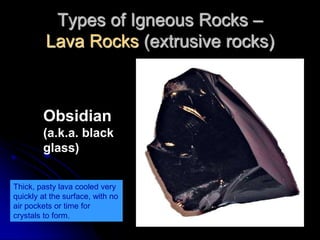
Obsidian
(a.k.a. black
glass)
Thick, pasty lava cooled very
quickly at the surface, with no
air pockets or time for
crystals to form.
Types of Igneous Rocks –
Lava Rocks (extrusive rocks)
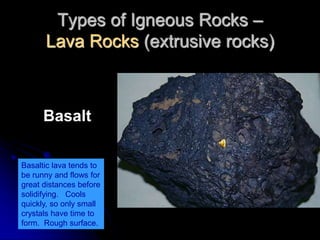
Basalt
Basaltic lava tends to
be runny and flows for
great distances before
solidifying. Cools
quickly, so only small
crystals have time to
form. Rough surface.
And the
winner is…
 In small groups, create a
short skit about a game
show w/ 3 questions.
 The question topics
should relate to igneous
rocks.
 Your contestants should
all fit a theme (i.e. sports
stars, Harry Potter
characters)
 Catchphrase: I love lava!
Closure
 Igneous rocks form from lava or magma
that cools and hardens.
 Magma rocks cooled and hardened slowly
inside the earth and have large crystals.
 Lava rocks cooled quickly at the surface
and have few or no crystals.
 Name some igneous rocks:
granite, gabbro, pumice, obsidian, basalt
Day 9
 Objective:
 Review formation of igneous rocks.
 Study the effects of weathering and erosion.
 Learn how sedimentary rocks are formed.
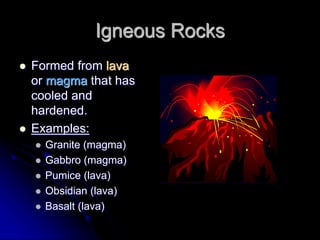
Igneous Rocks
 Formed from lava
or magma that has
cooled and
hardened.
 Examples:
 Granite (magma)
 Gabbro (magma)
 Pumice (lava)
 Obsidian (lava)
 Basalt (lava)
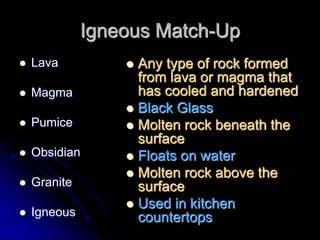
Igneous Match-Up
 Lava
 Magma
 Pumice
 Obsidian
 Granite
 Igneous
 Any type of rock formed
from lava or magma that
has cooled and hardened
 Black Glass
 Molten rock beneath the
surface
 Floats on water
 Molten rock above the
surface
 Used in kitchen
countertops
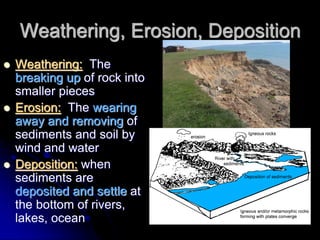
Weathering, Erosion, Deposition
 Weathering: The
breaking up of rock into
smaller pieces
 Erosion: The wearing
away and removing of
sediments and soil by
wind and water
 Deposition: when
sediments are
deposited and settle at
the bottom of rivers,
lakes, ocean
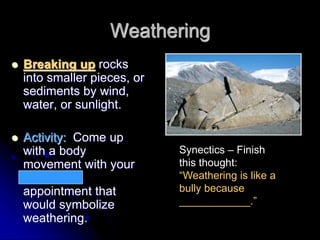
Weathering
 Breaking up rocks
into smaller pieces, or
sediments by wind,
water, or sunlight.
 Activity: Come up
with a body
movement with your
12 o’clock
appointment that
would symbolize
weathering.
Synectics – Finish
this thought:
“Weathering is like a
bully because
____________.”
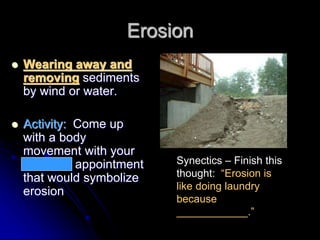
Erosion
 Wearing away and
removing sediments
by wind or water.
 Activity: Come up
with a body
movement with your
3 o’clock appointment
that would symbolize
erosion
Synectics – Finish this
thought: “Erosion is
like doing laundry
because
____________.”
ID, Please!
• I was a big mountain, but wind and water
have broken me down into small pieces
over time… What happened to me?
• I’m a small piece of rock that is being
swept away by a rushing river! What
happened to me?
• I’m a sediment that finally gets to settle at
the bottom of a nice, calm lake. What
happened to me?
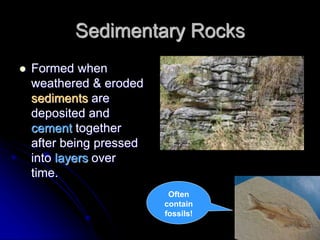
Sedimentary Rocks
 Formed when
weathered & eroded
sediments are
deposited and
cement together
after being pressed
into layers over
time.
Often
contain
fossils!
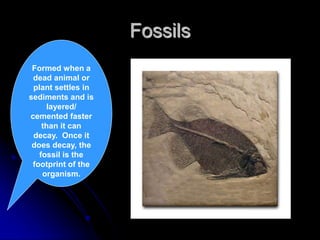
Fossils
Formed when a
dead animal or
plant settles in
sediments and is
layered/
cemented faster
than it can
decay. Once it
does decay, the
fossil is the
footprint of the
organism.
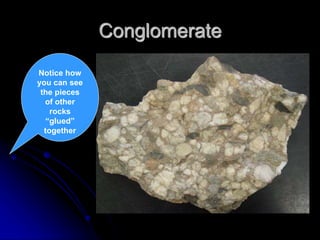
Conglomerate
Notice how
you can see
the pieces
of other
rocks
“glued”
together
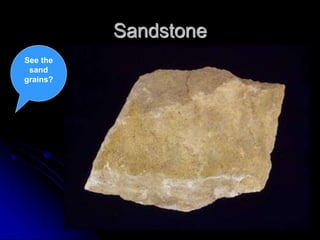
Sandstone
See the
sand
grains?
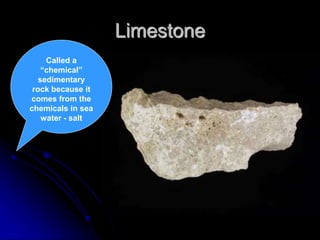
Limestone
Called a
“chemical”
sedimentary
rock because it
comes from the
chemicals in sea
water - salt
Silly Similes
 How is sedimentary rock like your bed?
 What else is like the layers of sedimentary
rock?
Closure
 Wind and water break down rocks into smaller
pieces, or sediments, in a process called
weathering.
 Those sediments are then carried by wind and
water in a process called erosion.
 When sediments settle in the bottom of lakes,
rivers, and oceans it is called deposition.
 Sedimentary rocks are formed when deposited
sediments are pressed together over time.
Day 10
 Objective:
 Review formation of sedimentary rocks.
 Learn how metamorphic rocks are formed.
Sedimentary Review
 Wind and water break down rocks into smaller
pieces, or sediments, in a process called
weathering.
 Those sediments are then carried by wind and
water in a process called erosion.
 When sediments settle in the bottom of lakes,
rivers, and oceans it is called deposition.
 Sedimentary rocks are formed when deposited
sediments are pressed together over time.
Sedimentary Match-Up
 Erosion
 Sediments
 Deposition
 Weathering
 Sedimentary
 Any type of rock formed
from sediments that have
been cemented together
 Sediments settling to the
bottom of lakes & oceans
 Breaking up of rocks into
smaller pieces
 Small pieces of rock
 Wearing away and moving
of sediments
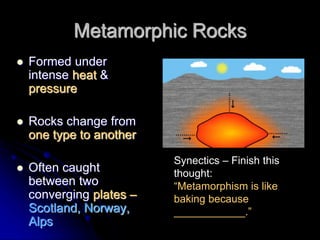
Metamorphic Rocks
 Formed under
intense heat &
pressure
 Rocks change from
one type to another
 Often caught
between two
converging plates –
Scotland, Norway,
Alps
Synectics – Finish this
thought:
“Metamorphism is like
baking because
____________.”
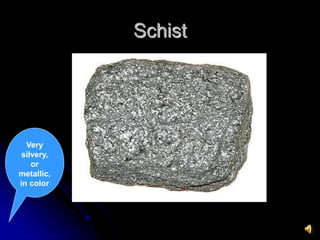
Schist
Very
silvery,
or
metallic,
in color
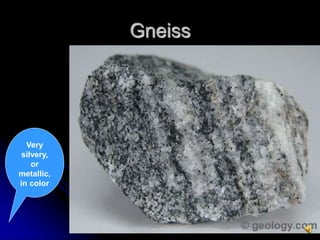
Gneiss
Very
silvery,
or
metallic,
in color
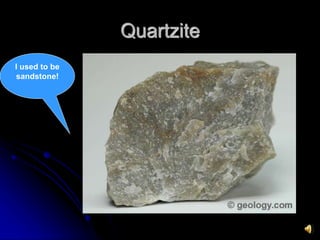
Quartzite
I used to be
sandstone!
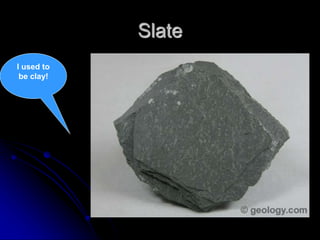
Slate
I used to
be clay!
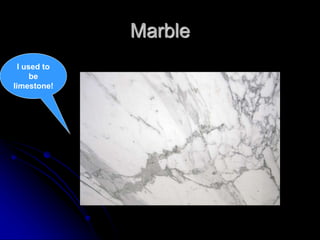
Marble
I used to
be
limestone!
Meet and Greet
 Find a partner and
and come up with
another type of
metamorphism.
ID, Please!
 I am lava that has cooled and hardened.
 I formed from intense heat and pressure.
 I formed from sediments pressed together
over time.
 I am the process of breaking rocks down
into sediments.
 I am the process of one rock type
changing to another.
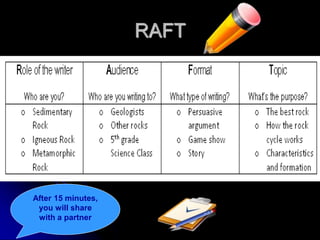
RAFT
-Metamorphic
Rock
After 15 minutes,
you will share
with a partner
Closure
 Metamorphic rocks are formed from another
rock type under intense heat and pressure
 Igneous rocks are formed from magma or lava
that has cooled and hardened.
 Sedimentary rocks are formed when deposited
sediments are pressed together over time.
 Gneiss, schist, marble, and slate are all
examples of metamorphic rocks.
Day 11
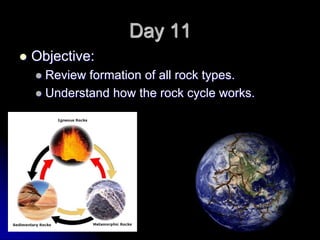
 Objective:
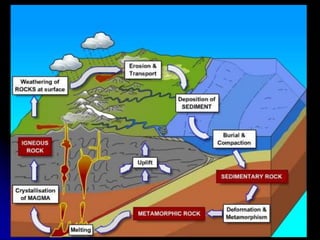
 Review formation of all rock types.
 Understand how the rock cycle works.
Review
 Metamorphic rocks are formed from another
rock type under intense heat and pressure
 Igneous rocks are formed from magma or lava
that has cooled and hardened.
 Sedimentary rocks are formed when deposited
sediments are pressed together over time.
 Gneiss, schist, marble, and slate are all
examples of metamorphic rocks.
Fill in study
guides
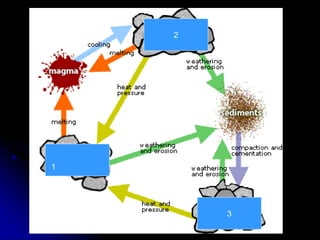
2
3
1
And the
winner is…
 In small groups, create a
short skit about a game
show with 3 questions.
 The question topics should
relate to the rock cycle.
 Your contestants should all
fit a theme (i.e. US
Presidents, Spongebob
characters)
 Catchphrase: Save the
sediments!
Closure
 Metamorphic rocks are formed from another
rock type under intense heat and pressure
 Igneous rocks are formed from magma or lava
that has cooled and hardened.
 Sedimentary rocks are formed when deposited
sediments are pressed together over time.
 Gneiss, schist, marble, and slate are all
examples of metamorphic rocks.
Day 12
 Objective:
 Review the rock cycle.
 Learn about soil – what’s in it, how we’re
hurting it, how we can protect it! 
Rock Cycle Review
 Metamorphic rocks are formed from another
rock type under intense heat and pressure
 Igneous rocks are formed from magma or lava
that has cooled and hardened.
 Sedimentary rocks are formed when deposited
sediments are pressed together over time.
 Gneiss, schist, marble, and slate are all
examples of metamorphic rocks.
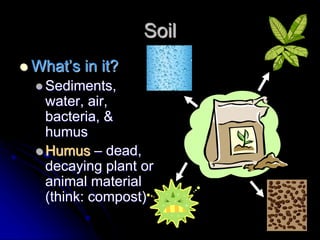
Soil
 What’s in it?
 Sediments,
water, air,
bacteria, &
humus
 Humus – dead,
decaying plant or
animal material
(think: compost)
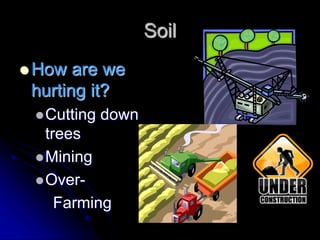
Soil
 How are we
hurting it?
Cutting down
trees
Mining
Over-
Farming
Soil
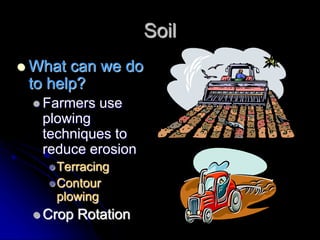
 What can we do
to help?
 Farmers use
plowing
techniques to
reduce erosion
Terracing
Contour
plowing
 Crop Rotation
Soil
 What can
we do to
help?
Replace
plants in
exposed
soil
Meet and Greet
 Find a partner
appointment and list
all the ways plants
help soil. Where
have you seen
exposed soil?
Watershed Experience
 We will go outside to analyze the
different types of ground coverings
we have on our playground.
 Think about which is the best for
healthy soil.
 Around high traffic areas (swings,
etc) what is the best material to use
to keep the ground covered but also
help the soil?
 How does this affect our watershed?
Closure
 Soil is made of humus, air, water, bacteria, and
sediments (weathered rock).
 Humans hurt the soil through mining, farming,
& construction
 Plants help the soil by covering it, anchoring it,
returning nutrients to
it when they die
 Humans can help the soil by planting trees, etc.

Changing earth

  • 1.
    Changing Earth SOL 5.7Instructional PowerPoint Day 1 Day 2 Day 3 Day 4 Day 5 Day 6 Day 7 Day 8 Day 9 Day 10 Day 11 Day 12
  • 2.
    Day 1  Objective: Introduce concept of changing Earth.  Discuss the four layers of the Earth.
  • 3.
    Our Changing Earth Using a SMARTpen, write a few ideas to explain how our planet is changing over time.
  • 4.
    Layers of theEarth  Our planet has 4 main layers:  Crust  Mantle  Outer core  Inner core
  • 5.
    Crust  thinnest layer Made of solid rock, soil, sediments, plants, & water  Broken into many pieces called PLATES  5 – 25 miles deep  Can reach 1,400-1,600 F at bottom edge – slightly melted
  • 6.
     Thickest layer(1,800 miles thick!)  Mostly of solid rock with some liquid  Temperatures 1,600 – 8,000 F  Pressure increases Mantle
  • 7.
    Meet ‘n Greet How much can you remember??  Meet with a partner to discuss the crust and mantle:  The older student must name facts about the crust  The younger student names facts about the mantle
  • 8.
     1,400 milesthick  Temperatures of 8,000 – 11,000 F  Molten iron and nickel Outer Core
  • 9.
     Earth’s center– 4,000 miles beneath surface  Temperatures hotter than 12,000 F  SOLID ball of iron and nickel Inner Core
  • 10.
  • 11.
    Closure  Name thefour layers of the Earth.  What is the thinnest layer?  What is the thickest layer?  Which layer is a solid ball of iron and nickel?  Which layer is molten (melted) iron and nickel? Crust, mantle, outer core, inner core Crust Mantle Inner core Outer core
  • 12.
    Day 2  Objective: Name the four layers of the Earth and define characteristics of each.
  • 13.
    Review  Name thefour layers of the Earth.  What is the thinnest layer?  What is the thickest layer?  Which layer is a solid ball of iron and nickel?  Which layer is molten (melted) iron and nickel? Crust, mantle, outer core, inner core Crust Mantle Inner core Outer core
  • 14.
    Digging Through theEarth!  As miners dig deeper in the crust, they discover that the air temperature gets warmer – this supports the idea that it gets hotter as we move closer to the center of the earth.  Would this concern you if you became a miner?
  • 15.
    ID, Please!  Iam the thickest layer of the Earth.  I am the thinnest layer of the Earth.  I am the layer of molten (melted) iron and nickel.  I am the hottest layer of the Earth.  I am 5 – 25 miles deep.  I am up to 11,000 degrees Fahrenheit. Write your answer next to each.
  • 16.
    Silly Similes  Howis the Earth like an apple?  To what other objects can you relate the layers of the Earth?
  • 17.
    Task: Time it! If you could travel to the center of the earth in 1 hour, about how long would it take you to travel through each of the four layers? (60 minutes in an hour, 60 seconds in a minute)  Crust:  Mantle:  Outer Core:  Inner Core: You have 5 minutes to complete this task! 22 seconds 26 min. 16 sec. 21 min. 12 sec. 12 min. 10 sec. Click to reveal actual times after sharing.
  • 18.
    Closure  Name thefour layers of the Earth.  What is the thinnest layer?  What is the thickest layer?  Which layer is a solid ball of iron and nickel?  Which layer is the hottest layer? Crust, mantle, outer core, inner core Crust Mantle Inner core Inner core
  • 19.
    Day 3  Objective: Discuss theory of continental drift and plate tectonics.
  • 20.
    Alfred Wegener’s Theoryof Continental Drift Wegener believed that continents had drifted from one large super continent long ago, called Pangaea. However, he wasn’t believed. Can you figure out why? On the next few slides be on the lookout for missing evidence.
  • 21.
    Wegener’s Reason #1 He noticed while looking at maps that the coastlines of some continents look like they fit together  Africa  South America
  • 22.
    #2: Fossil PatternsAcross Continents
  • 23.
    #3 – AnimalSimilarities  Wegener studied the very unique animals that live on Madagascar and noted how similar they are to animals found in only one other place: the western coast of Africa
  • 24.
    #4: Rock LayersMatch  Wegener also noted that rock layers along the coastlines of opposite continents matched almost completely
  • 25.
    Meet ‘n Greet Wegener had 4 reasons why he believed the continents had drifted to where they presently are today. However, he was missing a piece to the puzzle – why didn’t scientists believe him? What piece was he missing? Meet with a partner to discuss. Answer: He couldn’t explain HOW the continents had moved. Why would large masses of rock suddenly migrate to another part of the planet?
  • 26.
    Pangaea  Pangaea wasa supercontinent containing all of today’s continents in one large land mass. When you look at the coastlines, you can see how they must have fit together.
  • 27.
    Closure  What wasWegener’s theory called, in which he thought the continents have been moving for millions of years?  What led him to believe that the continents had once been attached?  What did he call the supercontinent?  Are the continents still moving? Continental drift Matching coastlines, animal life, rock layers, fossils of plants Pangaea yes
  • 28.
    Day 4  Objective: ID and define plate boundaries.  Understand how plate tectonics relate to earthquakes and volcanoes.
  • 29.
    Plate Tectonics  Thecrust is broken into many small pieces, or plates. The continents sit on these plates.  The plates are moving because of heat in the Earth.  The theory of Continental Drift can be explained by Plate Tectonics
  • 30.
  • 31.
    3 Types ofPlate Boundaries Transform Divergent Convergent
  • 32.
    Plate Tectonics  3types of plate boundaries:
  • 34.
    Graham Cracker Tectonics Using frosting and graham crackers, model each of the three plate boundaries and record what happens in your notebook beneath the notes we just took. What happens as you model each boundary?
  • 35.
    Closure  What typeof plate boundary has two plates colliding?  In which type of plate boundary do two plates separate?  Which type of plate boundary is the San Andreas fault in California?  What do we call the cracks in the earth often seen at plate boundaries? convergent divergent Transform / sliding faults
  • 36.
    Day 5  Objective: Review Plate Boundaries  Investigate and discuss earthquakes.  Understand that most earthquakes occur along plate boundaries.
  • 37.
    Review  What typeof plate boundary has two plates colliding?  In which type of plate boundary do two plates separate?  Which type of plate boundary is the San Andreas fault in California?  What do we call the cracks in the earth often seen at plate boundaries? convergent divergent Transform / sliding faults
  • 38.
  • 39.
    Earthquakes  http://earthquake.usgs.gov/ RecentEarthquakes  Definition: Any shaking or movement of the earth  Caused by plates colliding, separating, or sliding past one another (all 3 plate boundaries)  Measured by seismographs 7.2 Magnitude Earthquake
  • 40.
    Earthquake Measurement  Scientists measurethe strength of an earthquake using a seismograph and the Richter scale. The higher the number, the worse the earthquake.  What types of buildings are least effected by earthquakes? http://dsc.discovery.com/guides/ planetearth/earthquake/interacti ve/interactive.html
  • 41.
    The Great SanFrancisco Earthquake of 1906  This earthquake devastated and destroyed one of our nation’s greatest cities.
  • 42.
    Closure  What causesan earthquake?  Where do earthquakes MOSTLY occur?  Can earthquakes occur anywhere?  What tool is used to measure earthquakes?  How are earthquakes rated or ranked? Pressure build-up inside the earth suddenly releases Along all three plate boundaries Yes – the ground can give away wherever there is pressure Seismometer Using the Richter scale, higher number for heavy earthquakes
  • 43.
    Day 6  Objective: Investigate and discuss volcanoes.  Understand that most volcanoes occur along convergent and divergent plate boundaries.
  • 45.
    Volcanoes  Any holein the crust through which hot gases, rock, or lava erupt.  Volcanoes erupt at convergent and divergent plate boundaries
  • 46.
    Volcanoes along PlateBoundaries Take a look at Hawaii …
  • 47.
  • 48.
    Main Vent Crater 1 2 3 4 5 6 7 Meet witha partner to verbally label
  • 49.
    Hotspots - Hawaii Sometimes, volcanoes erupt in places other than plate boundaries – weak places in the crust where lava can push its way through  Hawaii is an example of this
  • 50.
    Silly Similes  Howis a volcano like a soda bottle?  How is a volcano like our school at dismissal?
  • 51.
    Magma and Lava Magma – molten (melted) rock beneath the Earth’s surface  Lava – magma that has reached the surface What forms when lava cools?
  • 52.
    Closure  Any openingin the earth’s crust through which hot gases, ash, and melted rock erupt is a volcano.  Magma is molten rock in the Earth.  Lava is molten rock that has reached the Earth’s surface.  Scientists study volcanoes to learn about temperatures in the Earth’s crust.  Volcanoes occur along convergent and divergent plate boundaries.
  • 53.
    Day 7  Objective: Understand how volcanic activity leads to formation of new land and, in the ocean, islands.
  • 54.
    Quick Review!!  Anyopening in the earth’s crust through which hot gases, ash, and melted rock erupt is a volcano.  Magma is molten rock in the Earth.  Lava is molten rock that has reached the Earth’s surface.  Scientists study volcanoes to learn about temperatures in the Earth’s crust.  Volcanoes occur along convergent and divergent plate boundaries. QUIZ TIME!!!!
  • 55.
    Quiz Time!  Buddystudy for 5 minutes with your 12 o’clock appointment.  Separate desks.  Name, #, Class at the top of your page.  Check your work carefully!!  Turn into paper sorter when you finish.

  • 56.
    Create a Modelof the Earth  Using construction paper, cut 4 circles of different sizes. Overlap them to create a model of the layers of the Earth. Use red for the crust, blue for the mantle, green for the outer core, and white for the inner core. Find the missing measurements in the table on the next slide, then measure your circles with the diameter, cut, and overlap.
  • 57.
    Create a Modelof the Earth Use red for the crust, blue for the mantle, green for the outer core, and white for the inner core. Find the missing measurements in the table, then measure your circles with the diameter, cut, and overlap. Layer Radius Diameter Circumference Crust 15 cm Mantle 84 cm Outer Core 8 cm Inner Core 18 cm
  • 58.
    Day 8  Objective: Understand how volcanic activity leads to formation of igneous rocks.
  • 59.
    Igneous Rocks  Formedfrom magma or lava that has cooled and hardened (i.e. from volcanoes) Lava Rocks = extrusive Magma Rocks = intrusive
  • 60.
    Types of IgneousRocks – Magma Rocks (intrusive rocks) Granite Magma rocks form inside the earth when Magma slowly cools. They often have large, splotchy crystals made of different minerals like quartz and feldspar.
  • 61.
    Types of IgneousRocks – Magma Rocks (intrusive rocks) Gabbro More splotchy crystals – this has more olivine and less quartz than granite.
  • 62.
    Types of IgneousRocks – Lava Rocks (extrusive rocks) Pumice Floats on water! Thin, watery lava cooled very quickly, with air pockets left inside, like Swiss cheese.
  • 63.
    Types of IgneousRocks – Lava Rocks (extrusive rocks) Obsidian (a.k.a. black glass) Thick, pasty lava cooled very quickly at the surface, with no air pockets or time for crystals to form.
  • 64.
    Types of IgneousRocks – Lava Rocks (extrusive rocks) Basalt Basaltic lava tends to be runny and flows for great distances before solidifying. Cools quickly, so only small crystals have time to form. Rough surface.
  • 65.
    And the winner is… In small groups, create a short skit about a game show w/ 3 questions.  The question topics should relate to igneous rocks.  Your contestants should all fit a theme (i.e. sports stars, Harry Potter characters)  Catchphrase: I love lava!
  • 66.
    Closure  Igneous rocksform from lava or magma that cools and hardens.  Magma rocks cooled and hardened slowly inside the earth and have large crystals.  Lava rocks cooled quickly at the surface and have few or no crystals.  Name some igneous rocks: granite, gabbro, pumice, obsidian, basalt
  • 67.
    Day 9  Objective: Review formation of igneous rocks.  Study the effects of weathering and erosion.  Learn how sedimentary rocks are formed.
  • 68.
    Igneous Rocks  Formedfrom lava or magma that has cooled and hardened.  Examples:  Granite (magma)  Gabbro (magma)  Pumice (lava)  Obsidian (lava)  Basalt (lava)
  • 69.
    Igneous Match-Up  Lava Magma  Pumice  Obsidian  Granite  Igneous  Any type of rock formed from lava or magma that has cooled and hardened  Black Glass  Molten rock beneath the surface  Floats on water  Molten rock above the surface  Used in kitchen countertops
  • 70.
    Weathering, Erosion, Deposition Weathering: The breaking up of rock into smaller pieces  Erosion: The wearing away and removing of sediments and soil by wind and water  Deposition: when sediments are deposited and settle at the bottom of rivers, lakes, ocean
  • 71.
    Weathering  Breaking uprocks into smaller pieces, or sediments by wind, water, or sunlight.  Activity: Come up with a body movement with your 12 o’clock appointment that would symbolize weathering. Synectics – Finish this thought: “Weathering is like a bully because ____________.”
  • 72.
    Erosion  Wearing awayand removing sediments by wind or water.  Activity: Come up with a body movement with your 3 o’clock appointment that would symbolize erosion Synectics – Finish this thought: “Erosion is like doing laundry because ____________.”
  • 73.
    ID, Please! • Iwas a big mountain, but wind and water have broken me down into small pieces over time… What happened to me? • I’m a small piece of rock that is being swept away by a rushing river! What happened to me? • I’m a sediment that finally gets to settle at the bottom of a nice, calm lake. What happened to me?
  • 74.
    Sedimentary Rocks  Formedwhen weathered & eroded sediments are deposited and cement together after being pressed into layers over time. Often contain fossils!
  • 75.
    Fossils Formed when a deadanimal or plant settles in sediments and is layered/ cemented faster than it can decay. Once it does decay, the fossil is the footprint of the organism.
  • 76.
    Conglomerate Notice how you cansee the pieces of other rocks “glued” together
  • 77.
  • 78.
    Limestone Called a “chemical” sedimentary rock becauseit comes from the chemicals in sea water - salt
  • 79.
    Silly Similes  Howis sedimentary rock like your bed?  What else is like the layers of sedimentary rock?
  • 80.
    Closure  Wind andwater break down rocks into smaller pieces, or sediments, in a process called weathering.  Those sediments are then carried by wind and water in a process called erosion.  When sediments settle in the bottom of lakes, rivers, and oceans it is called deposition.  Sedimentary rocks are formed when deposited sediments are pressed together over time.
  • 81.
    Day 10  Objective: Review formation of sedimentary rocks.  Learn how metamorphic rocks are formed.
  • 82.
    Sedimentary Review  Windand water break down rocks into smaller pieces, or sediments, in a process called weathering.  Those sediments are then carried by wind and water in a process called erosion.  When sediments settle in the bottom of lakes, rivers, and oceans it is called deposition.  Sedimentary rocks are formed when deposited sediments are pressed together over time.
  • 83.
    Sedimentary Match-Up  Erosion Sediments  Deposition  Weathering  Sedimentary  Any type of rock formed from sediments that have been cemented together  Sediments settling to the bottom of lakes & oceans  Breaking up of rocks into smaller pieces  Small pieces of rock  Wearing away and moving of sediments
  • 84.
    Metamorphic Rocks  Formedunder intense heat & pressure  Rocks change from one type to another  Often caught between two converging plates – Scotland, Norway, Alps Synectics – Finish this thought: “Metamorphism is like baking because ____________.”
  • 85.
  • 86.
  • 87.
    Quartzite I used tobe sandstone!
  • 88.
  • 89.
  • 90.
    Meet and Greet Find a partner and and come up with another type of metamorphism.
  • 91.
    ID, Please!  Iam lava that has cooled and hardened.  I formed from intense heat and pressure.  I formed from sediments pressed together over time.  I am the process of breaking rocks down into sediments.  I am the process of one rock type changing to another.
  • 92.
  • 93.
    Closure  Metamorphic rocksare formed from another rock type under intense heat and pressure  Igneous rocks are formed from magma or lava that has cooled and hardened.  Sedimentary rocks are formed when deposited sediments are pressed together over time.  Gneiss, schist, marble, and slate are all examples of metamorphic rocks.
  • 94.
    Day 11  Objective: Review formation of all rock types.  Understand how the rock cycle works.
  • 95.
    Review  Metamorphic rocksare formed from another rock type under intense heat and pressure  Igneous rocks are formed from magma or lava that has cooled and hardened.  Sedimentary rocks are formed when deposited sediments are pressed together over time.  Gneiss, schist, marble, and slate are all examples of metamorphic rocks. Fill in study guides
  • 97.
  • 98.
    And the winner is… In small groups, create a short skit about a game show with 3 questions.  The question topics should relate to the rock cycle.  Your contestants should all fit a theme (i.e. US Presidents, Spongebob characters)  Catchphrase: Save the sediments!
  • 99.
    Closure  Metamorphic rocksare formed from another rock type under intense heat and pressure  Igneous rocks are formed from magma or lava that has cooled and hardened.  Sedimentary rocks are formed when deposited sediments are pressed together over time.  Gneiss, schist, marble, and slate are all examples of metamorphic rocks.
  • 100.
    Day 12  Objective: Review the rock cycle.  Learn about soil – what’s in it, how we’re hurting it, how we can protect it! 
  • 101.
    Rock Cycle Review Metamorphic rocks are formed from another rock type under intense heat and pressure  Igneous rocks are formed from magma or lava that has cooled and hardened.  Sedimentary rocks are formed when deposited sediments are pressed together over time.  Gneiss, schist, marble, and slate are all examples of metamorphic rocks.
  • 102.
    Soil  What’s init?  Sediments, water, air, bacteria, & humus  Humus – dead, decaying plant or animal material (think: compost)
  • 103.
    Soil  How arewe hurting it? Cutting down trees Mining Over- Farming
  • 104.
    Soil  What canwe do to help?  Farmers use plowing techniques to reduce erosion Terracing Contour plowing  Crop Rotation
  • 105.
    Soil  What can wedo to help? Replace plants in exposed soil
  • 106.
    Meet and Greet Find a partner appointment and list all the ways plants help soil. Where have you seen exposed soil?
  • 107.
    Watershed Experience  Wewill go outside to analyze the different types of ground coverings we have on our playground.  Think about which is the best for healthy soil.  Around high traffic areas (swings, etc) what is the best material to use to keep the ground covered but also help the soil?  How does this affect our watershed?
  • 108.
    Closure  Soil ismade of humus, air, water, bacteria, and sediments (weathered rock).  Humans hurt the soil through mining, farming, & construction  Plants help the soil by covering it, anchoring it, returning nutrients to it when they die  Humans can help the soil by planting trees, etc.