
DEFINITION
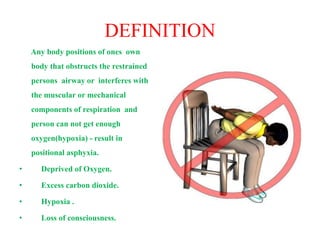
Any body positions of ones own
body that obstructs the restrained
persons airway or interferes with
the muscular or mechanical
components of respiration and
person can not get enough
oxygen(hypoxia) - result in
positional asphyxia.
• Deprived of Oxygen.
• Excess carbon dioxide.
• Hypoxia .
• Loss of consciousness.
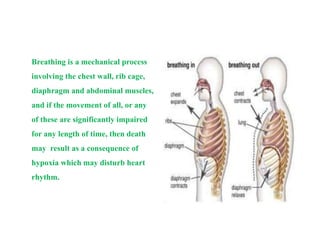
Breathing is a mechanical process
involving the chest wall, rib cage,
diaphragm and abdominal muscles,
and if the movement of all, or any
of these are significantly impaired
for any length of time, then death
may result as a consequence of
hypoxia which may disturb heart
rhythm.
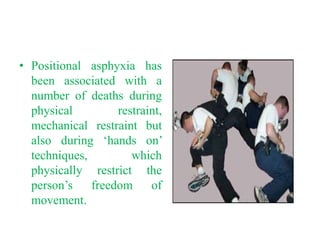
• Positional asphyxia has
been associated with a
number of deaths during
physical restraint,
mechanical restraint but
also during ‘hands on’
techniques, which
physically restrict the
person’s freedom of
movement.
What are Risk Factors?
• Position During Restraint (particularly face down
prone but also hyper flexion).
• Prolonged struggle/agitated delirium syndrome
• Drug or alcohol intoxication, in particular cocaine
and methamphetamine intoxication or cocaine-
induced psychosis
• Mania
• Obesity
• Sedation/Accidents/Organic diseases/quadriplegia
• Respiratory Syndromes including Asthma and Bronchitis.
• Cardio Vascular Disorder including an enlarged heart
(hypertrophic cardiomyopathy) and other cardiovascular
disorders
• Prescribed Drugs.
A combination of factors may place individuals at Risk of
Positional Asphyxia.
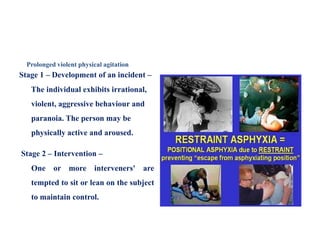
Prolonged violent physical agitation
Stage 1 – Development of an incident –
The individual exhibits irrational,
violent, aggressive behaviour and
paranoia. The person may be
physically active and aroused.
Stage 2 – Intervention –
One or more interveners' are
tempted to sit or lean on the subject
to maintain control.
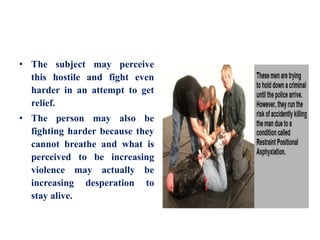
• The subject may perceive
this hostile and fight even
harder in an attempt to get
relief.
• The person may also be
fighting harder because they
cannot breathe and what is
perceived to be increasing
violence may actually be
increasing desperation to
stay alive.
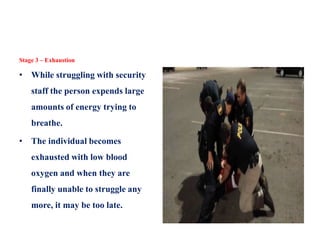
Stage 3 – Exhaustion
• While struggling with security
staff the person expends large
amounts of energy trying to
breathe.
• The individual becomes
exhausted with low blood
oxygen and when they are
finally unable to struggle any
more, it may be too late.
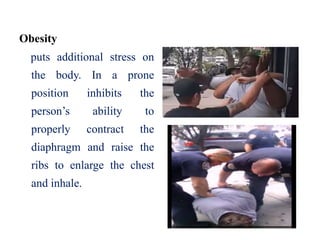
Obesity
puts additional stress on
the body. In a prone
position inhibits the
person’s ability to
properly contract the
diaphragm and raise the
ribs to enlarge the chest
and inhale.
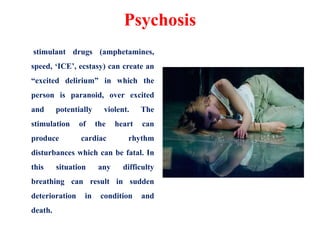
Psychosis
stimulant drugs (amphetamines,
speed, ‘ICE’, ecstasy) can create an
“excited delirium” in which the
person is paranoid, over excited
and potentially violent. The
stimulation of the heart can
produce cardiac rhythm
disturbances which can be fatal. In
this situation any difficulty
breathing can result in sudden
deterioration in condition and
death.
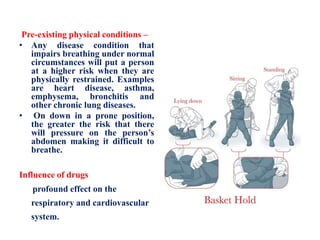
Pre-existing physical conditions –
• Any disease condition that
impairs breathing under normal
circumstances will put a person
at a higher risk when they are
physically restrained. Examples
are heart disease, asthma,
emphysema, bronchitis and
other chronic lung diseases.
• On down in a prone position,
the greater the risk that there
will pressure on the person’s
abdomen making it difficult to
breathe.
Influence of drugs
profound effect on the
respiratory and cardiovascular
system.
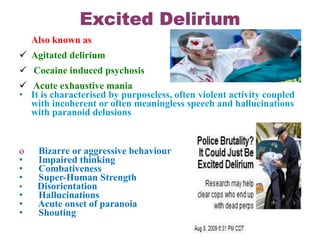
Also known as
 Agitated delirium
 Cocaine induced psychosis
 Acute exhaustive mania
• It is characterised by purposeless, often violent activity coupled
with incoherent or often meaningless speech and hallucinations
with paranoid delusions
o Bizarre or aggressive behaviour
• Impaired thinking
• Combativeness
• Super-Human Strength
• Disorientation
• Hallucinations
• Acute onset of paranoia
• Shouting
• Psychiatric illness
(combined with Drink and/or
Drugs)
• Drug intoxication
(Cocaine is the best known
cause of excited Delirium)
• Alcohol
• Hypothermia
• High tolerance to pain
• Quick to fatigue –
especially after a violent
struggle
• Skin may be hot to touch
• Abnormal Strength
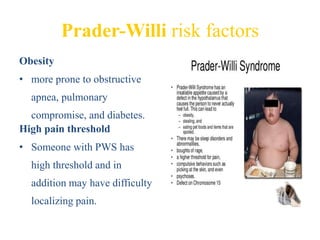
Prader-Willi risk factors
Obesity
• more prone to obstructive
apnea, pulmonary
compromise, and diabetes.
High pain threshold
• Someone with PWS has
high threshold and in
addition may have difficulty
localizing pain.
Increased risk of respiratory difficulties
• Hypotonic and weak chest muscles
Thick saliva
• complicates airway management
Chronic stomach reflux and aspiration
Temperature instability
• Idiopathic hyper and hypothermia have been reported. Fever
may be present despite serious infection.
Bruise easily
Anatomic and physiologic differences
• such as : narrow airway, underdevelopment of the larynx,
edema, hip dysplasia, and scoliosis
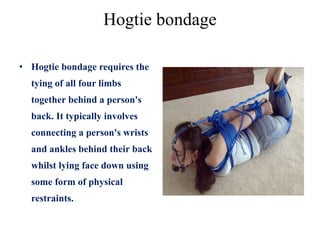
Hogtie bondage
• Hogtie bondage requires the
tying of all four limbs
together behind a person's
back. It typically involves
connecting a person's wrists
and ankles behind their back
whilst lying face down using
some form of physical
restraints.
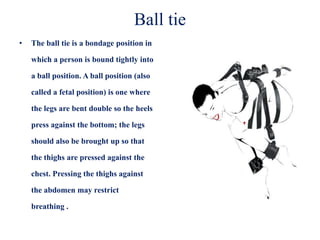
Ball tie
• The ball tie is a bondage position in
which a person is bound tightly into
a ball position. A ball position (also
called a fetal position) is one where
the legs are bent double so the heels
press against the bottom; the legs
should also be brought up so that
the thighs are pressed against the
chest. Pressing the thighs against
the abdomen may restrict
breathing .
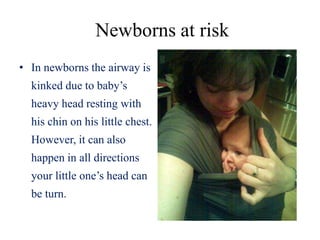
Newborns at risk
• In newborns the airway is
kinked due to baby’s
heavy head resting with
his chin on his little chest.
However, it can also
happen in all directions
your little one’s head can
be turn.
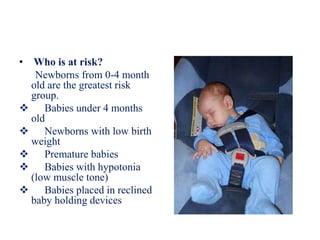
• Who is at risk?
Newborns from 0-4 month
old are the greatest risk
group.
 Babies under 4 months
old
 Newborns with low birth
weight
 Premature babies
 Babies with hypotonia
(low muscle tone)
 Babies placed in reclined
baby holding devices
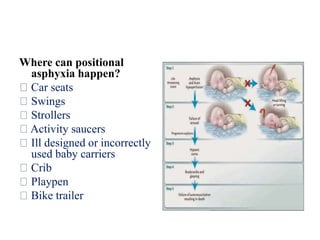
Where can positional
asphyxia happen?
Car seats
Swings
Strollers
Activity saucers
Ill designed or incorrectly
used baby carriers
Crib
Playpen
Bike trailer
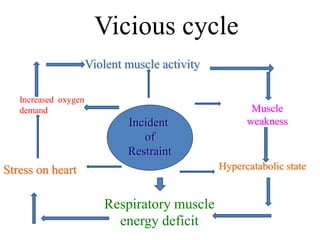
Incident
of
Restraint
Vicious cycle
Violent muscle activity
Respiratory muscle
energy deficit
Muscle
weakness
Hypercatabolic state
Increased oxygen
demand
Stress on heart
• Extreme physical energy expenditure generates
excessive production of adrenalin and
noradrenalin.
• A progressively increasing amount of these body
chemicals in the individuals system can occur
creating a
• “hyper- catabolic state”.
• A hyper-catabolic state can weaken all the body's
muscles especially the
• Respiratory muscles.
• The hyper-catabolic state also puts “stress” on
the heart by increasing its workload
(requiring faster and stronger contractions).
• Thus the heart needs more than normal
amounts of oxygen in order to keep it
functioning.
• If an individual with severe respiratory muscle
fatigue is restrained in a position that impairs
or prevents breathing it is easy to understand
why asphyxia can occur so quickly!
General signs and symptoms
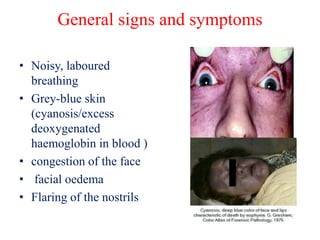
• Noisy, laboured
breathing
• Grey-blue skin
(cyanosis/excess
deoxygenated
haemoglobin in blood )
• congestion of the face
• facial oedema
• Flaring of the nostrils
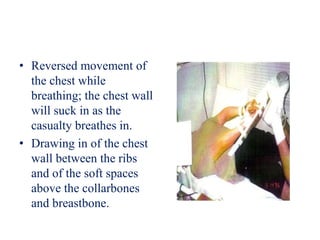
• Reversed movement of
the chest while
breathing; the chest wall
will suck in as the
casualty breathes in.
• Drawing in of the chest
wall between the ribs
and of the soft spaces
above the collarbones
and breastbone.
How to asphyxiate
• Compression to neck
• Compression to chest/back/torso
• Obstructed airways/vomiting
• Chemical/environmental
• Postural position
Distress signs
• Gurgling gasping sounds.
• Extremities cold to touch
• Face becomes flush or ashy
• Bleeding or bruising
• Seizures
• Unconsciousness
• Complaints of “I can’t breathe” or “I have chest pain”
• Limpness of the arms and legs
• A violent and loud individual suddenly changes to a passive, quiet, tranquil.
Safety points
 Avoid putting direct weight or pressure on chest, stomach or back
 Never put pressure on the neck or put the head in a position that compresses
the neck
 Never restrain on a soft surface (mattress) or place a pillow, towel under the
head or over the mouth.
 Achieve a kneeling, sitting or standing position as soon as practical.
 Monitor the individual’s vital signs.
 Get medical assistance immediately if you have any concerns about the
condition of the individual under restraint.
 Staff made aware of basic warning signs and of respiratory distress.
 Must be able to recognise factors that contribute to Positional Asphyxia
(medical history, use of drugs, etc).
 Vigilant monitoring of the person’s condition must be stressed.
 Recent history i.e. past 24 hours – drug taking, alcohol use etc.
 Medical history – establish any heart complaint, breathing problems etc.
thanks

Positional asphyxia

  • 2.
    DEFINITION Any body positionsof ones own body that obstructs the restrained persons airway or interferes with the muscular or mechanical components of respiration and person can not get enough oxygen(hypoxia) - result in positional asphyxia. • Deprived of Oxygen. • Excess carbon dioxide. • Hypoxia . • Loss of consciousness.
  • 3.
    Breathing is amechanical process involving the chest wall, rib cage, diaphragm and abdominal muscles, and if the movement of all, or any of these are significantly impaired for any length of time, then death may result as a consequence of hypoxia which may disturb heart rhythm.
  • 4.
    • Positional asphyxiahas been associated with a number of deaths during physical restraint, mechanical restraint but also during ‘hands on’ techniques, which physically restrict the person’s freedom of movement.
  • 5.
    What are RiskFactors? • Position During Restraint (particularly face down prone but also hyper flexion). • Prolonged struggle/agitated delirium syndrome • Drug or alcohol intoxication, in particular cocaine and methamphetamine intoxication or cocaine- induced psychosis • Mania • Obesity • Sedation/Accidents/Organic diseases/quadriplegia
  • 6.
    • Respiratory Syndromesincluding Asthma and Bronchitis. • Cardio Vascular Disorder including an enlarged heart (hypertrophic cardiomyopathy) and other cardiovascular disorders • Prescribed Drugs. A combination of factors may place individuals at Risk of Positional Asphyxia.
  • 7.
    Prolonged violent physicalagitation Stage 1 – Development of an incident – The individual exhibits irrational, violent, aggressive behaviour and paranoia. The person may be physically active and aroused. Stage 2 – Intervention – One or more interveners' are tempted to sit or lean on the subject to maintain control.
  • 8.
    • The subjectmay perceive this hostile and fight even harder in an attempt to get relief. • The person may also be fighting harder because they cannot breathe and what is perceived to be increasing violence may actually be increasing desperation to stay alive.
  • 9.
    Stage 3 –Exhaustion • While struggling with security staff the person expends large amounts of energy trying to breathe. • The individual becomes exhausted with low blood oxygen and when they are finally unable to struggle any more, it may be too late.
  • 10.
    Obesity puts additional stresson the body. In a prone position inhibits the person’s ability to properly contract the diaphragm and raise the ribs to enlarge the chest and inhale.
  • 11.
    Psychosis stimulant drugs (amphetamines, speed,‘ICE’, ecstasy) can create an “excited delirium” in which the person is paranoid, over excited and potentially violent. The stimulation of the heart can produce cardiac rhythm disturbances which can be fatal. In this situation any difficulty breathing can result in sudden deterioration in condition and death.
  • 12.
    Pre-existing physical conditions– • Any disease condition that impairs breathing under normal circumstances will put a person at a higher risk when they are physically restrained. Examples are heart disease, asthma, emphysema, bronchitis and other chronic lung diseases. • On down in a prone position, the greater the risk that there will pressure on the person’s abdomen making it difficult to breathe. Influence of drugs profound effect on the respiratory and cardiovascular system.
  • 13.
    Also known as Agitated delirium  Cocaine induced psychosis  Acute exhaustive mania • It is characterised by purposeless, often violent activity coupled with incoherent or often meaningless speech and hallucinations with paranoid delusions o Bizarre or aggressive behaviour • Impaired thinking • Combativeness • Super-Human Strength • Disorientation • Hallucinations • Acute onset of paranoia • Shouting
  • 14.
    • Psychiatric illness (combinedwith Drink and/or Drugs) • Drug intoxication (Cocaine is the best known cause of excited Delirium) • Alcohol • Hypothermia • High tolerance to pain • Quick to fatigue – especially after a violent struggle • Skin may be hot to touch • Abnormal Strength
  • 15.
    Prader-Willi risk factors Obesity •more prone to obstructive apnea, pulmonary compromise, and diabetes. High pain threshold • Someone with PWS has high threshold and in addition may have difficulty localizing pain.
  • 16.
    Increased risk ofrespiratory difficulties • Hypotonic and weak chest muscles Thick saliva • complicates airway management Chronic stomach reflux and aspiration Temperature instability • Idiopathic hyper and hypothermia have been reported. Fever may be present despite serious infection. Bruise easily Anatomic and physiologic differences • such as : narrow airway, underdevelopment of the larynx, edema, hip dysplasia, and scoliosis
  • 17.
    Hogtie bondage • Hogtiebondage requires the tying of all four limbs together behind a person's back. It typically involves connecting a person's wrists and ankles behind their back whilst lying face down using some form of physical restraints.
  • 18.
    Ball tie • Theball tie is a bondage position in which a person is bound tightly into a ball position. A ball position (also called a fetal position) is one where the legs are bent double so the heels press against the bottom; the legs should also be brought up so that the thighs are pressed against the chest. Pressing the thighs against the abdomen may restrict breathing .
  • 19.
    Newborns at risk •In newborns the airway is kinked due to baby’s heavy head resting with his chin on his little chest. However, it can also happen in all directions your little one’s head can be turn.
  • 20.
    • Who isat risk? Newborns from 0-4 month old are the greatest risk group.  Babies under 4 months old  Newborns with low birth weight  Premature babies  Babies with hypotonia (low muscle tone)  Babies placed in reclined baby holding devices
  • 21.
    Where can positional asphyxiahappen? Car seats Swings Strollers Activity saucers Ill designed or incorrectly used baby carriers Crib Playpen Bike trailer
  • 22.
    Incident of Restraint Vicious cycle Violent muscleactivity Respiratory muscle energy deficit Muscle weakness Hypercatabolic state Increased oxygen demand Stress on heart
  • 23.
    • Extreme physicalenergy expenditure generates excessive production of adrenalin and noradrenalin. • A progressively increasing amount of these body chemicals in the individuals system can occur creating a • “hyper- catabolic state”. • A hyper-catabolic state can weaken all the body's muscles especially the • Respiratory muscles.
  • 24.
    • The hyper-catabolicstate also puts “stress” on the heart by increasing its workload (requiring faster and stronger contractions). • Thus the heart needs more than normal amounts of oxygen in order to keep it functioning. • If an individual with severe respiratory muscle fatigue is restrained in a position that impairs or prevents breathing it is easy to understand why asphyxia can occur so quickly!
  • 25.
    General signs andsymptoms • Noisy, laboured breathing • Grey-blue skin (cyanosis/excess deoxygenated haemoglobin in blood ) • congestion of the face • facial oedema • Flaring of the nostrils
  • 26.
    • Reversed movementof the chest while breathing; the chest wall will suck in as the casualty breathes in. • Drawing in of the chest wall between the ribs and of the soft spaces above the collarbones and breastbone.
  • 27.
    How to asphyxiate •Compression to neck • Compression to chest/back/torso • Obstructed airways/vomiting • Chemical/environmental • Postural position
  • 28.
    Distress signs • Gurglinggasping sounds. • Extremities cold to touch • Face becomes flush or ashy • Bleeding or bruising • Seizures • Unconsciousness • Complaints of “I can’t breathe” or “I have chest pain” • Limpness of the arms and legs • A violent and loud individual suddenly changes to a passive, quiet, tranquil.
  • 29.
    Safety points  Avoidputting direct weight or pressure on chest, stomach or back  Never put pressure on the neck or put the head in a position that compresses the neck  Never restrain on a soft surface (mattress) or place a pillow, towel under the head or over the mouth.  Achieve a kneeling, sitting or standing position as soon as practical.  Monitor the individual’s vital signs.  Get medical assistance immediately if you have any concerns about the condition of the individual under restraint.
  • 30.
     Staff madeaware of basic warning signs and of respiratory distress.  Must be able to recognise factors that contribute to Positional Asphyxia (medical history, use of drugs, etc).  Vigilant monitoring of the person’s condition must be stressed.  Recent history i.e. past 24 hours – drug taking, alcohol use etc.  Medical history – establish any heart complaint, breathing problems etc.
  • 31.