Blast Injury Management
Dr. Ahmad Muttaqin Alim, Sp.An, EMDM
Disaster
A serious disruption of the functioning of a society,
causing widespread human, material, and/or
environmental losses,
which exceed the ability of an affected society to cope
using only its own resources.
(WADEM, WHO)
Blast Injuries: Unique Aspects
Inflict multi-
system
injuries on
large groups
of people
Cause many
simultaneous
life-threatening
injuries
Hidden
pattern of
injury
Blast Injuries: Pathophysiology
• Spalling
• Caused by shock wave moving through tissues of
different densities → molecular disruption
• Implosion
• Caused by entrapped gases in hollow organs
compressing then expanding → visceral disruption
• Shearing
• Caused by tissues of different densities moving at
different speeds → visceral tearing
• Irreversible Work
• Caused by forces exceeding the tensile strength of
the tissue
Blast Injuries: Categories
Primary injury
• Caused by blast wave → over pressure
Secondary injury
• Caused by flying debris → shrapnel wounds
Tertiary injury
• Caused by blast wind → forceful impact
Quaternary injury
• Caused by other vectors → heat, radiation
6
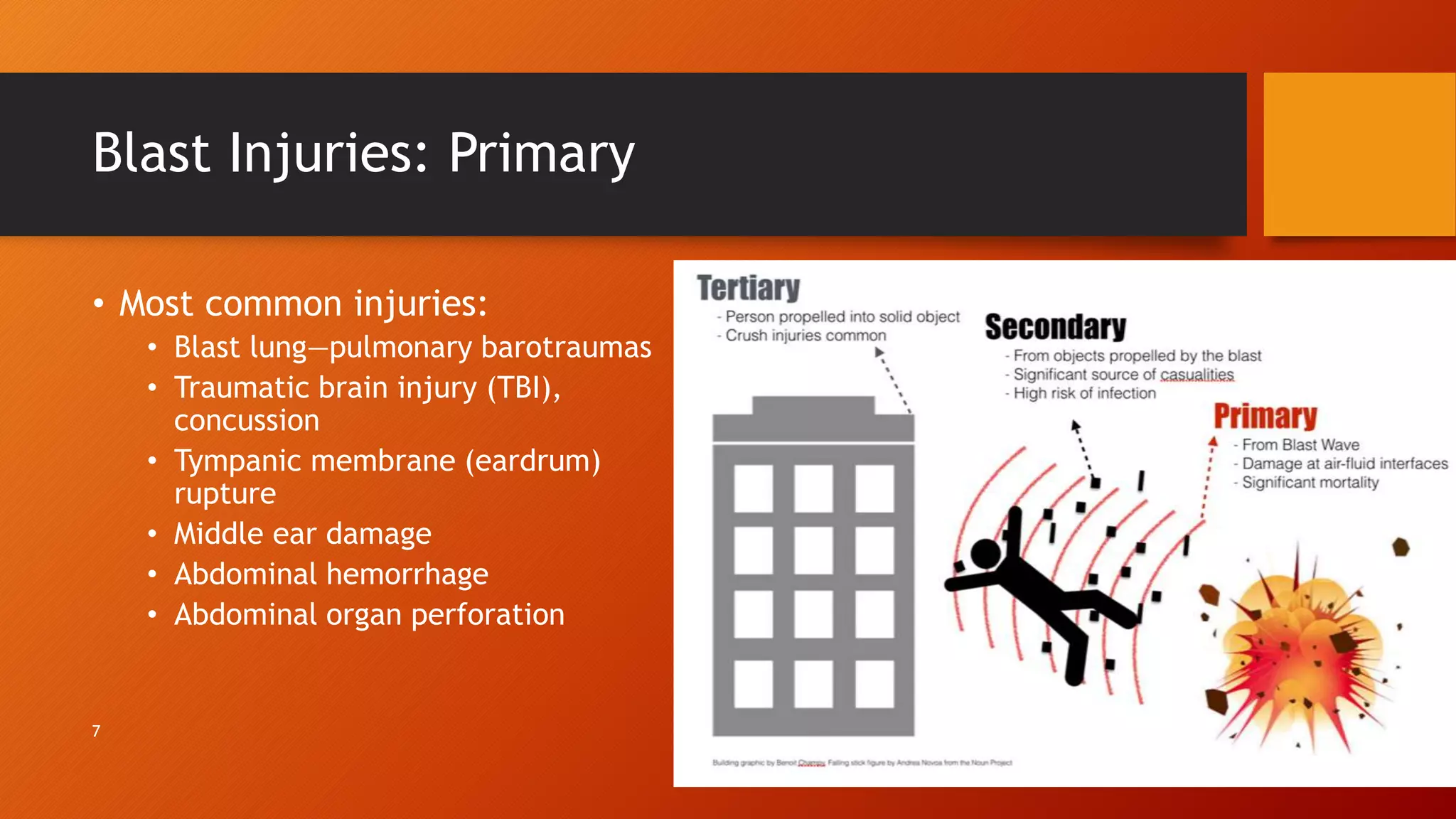
Blast Injuries: Primary
• Blunt trauma from over
pressure wave
• Unique to high-order explosives
• Results from the impact of the
over-pressurization wave with
body surfaces
• Blunt force injuries
• Produces barotrauma
7
Blast Injuries: Primary
• Most common injuries:
• Blast lung—pulmonary barotraumas
• Traumatic brain injury (TBI),
concussion
• Tympanic membrane (eardrum)
rupture
• Middle ear damage
• Abdominal hemorrhage
• Abdominal organ perforation
8
Blast Injuries: Secondary
• The most common cause
of death in a blast event
is secondary blast
injuries. These injuries
are caused by flying
debris generated by the
explosion. Terrorists
often add screws, nails,
and other sharp objects
to bombs to increase
injuries.
Bombings: Injury Patterns and Care
Blast Injuries: Secondary
• The most common types of
secondary blast injuries are:
• Trauma to the head, neck, chest,
abdomen, and extremities in the
form of penetrating and blunt trauma
• Fractures
• Traumatic amputations
• Soft tissue injuries
Blast Injuries: Secondary
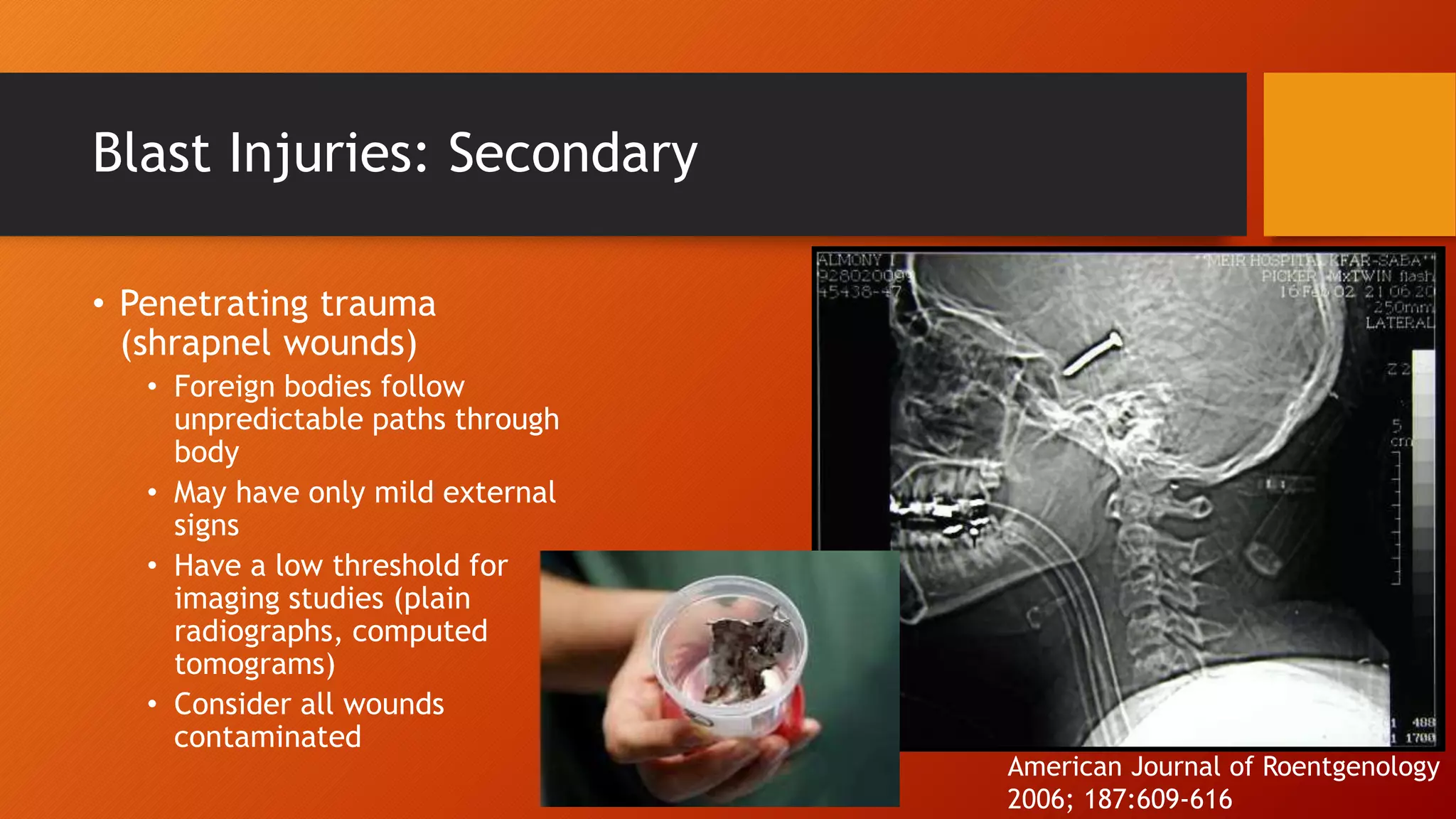
• Penetrating trauma
(shrapnel wounds)
• Foreign bodies follow
unpredictable paths through
body
• May have only mild external
signs
• Have a low threshold for
imaging studies (plain
radiographs, computed
tomograms)
• Consider all wounds
contaminated
American Journal of Roentgenology
2006; 187:609-616
Blast Injuries: Tertiary
• Tertiary injuries result from
individuals being thrown by the
blast wind.
• The most common types of
tertiary blast injuries are:
• Head injuries
• Skull fractures
• Bone fractures
• Treatment for most tertiary
blast injuries follows
established protocols for that
specific injury.
Blast Injuries: Quaternary
• All explosion-related injuries,
illnesses, or diseases not due to
primary, secondary, or tertiary
mechanisms are considered
quaternary blast injuries. This
includes exacerbation or
complications of existing conditions.
• Burns
• Head injuries
• Asthma
• COPD
• Other breathing problems
• Angina
• Hyperglycemia
• Hypertension
• Crush injuries
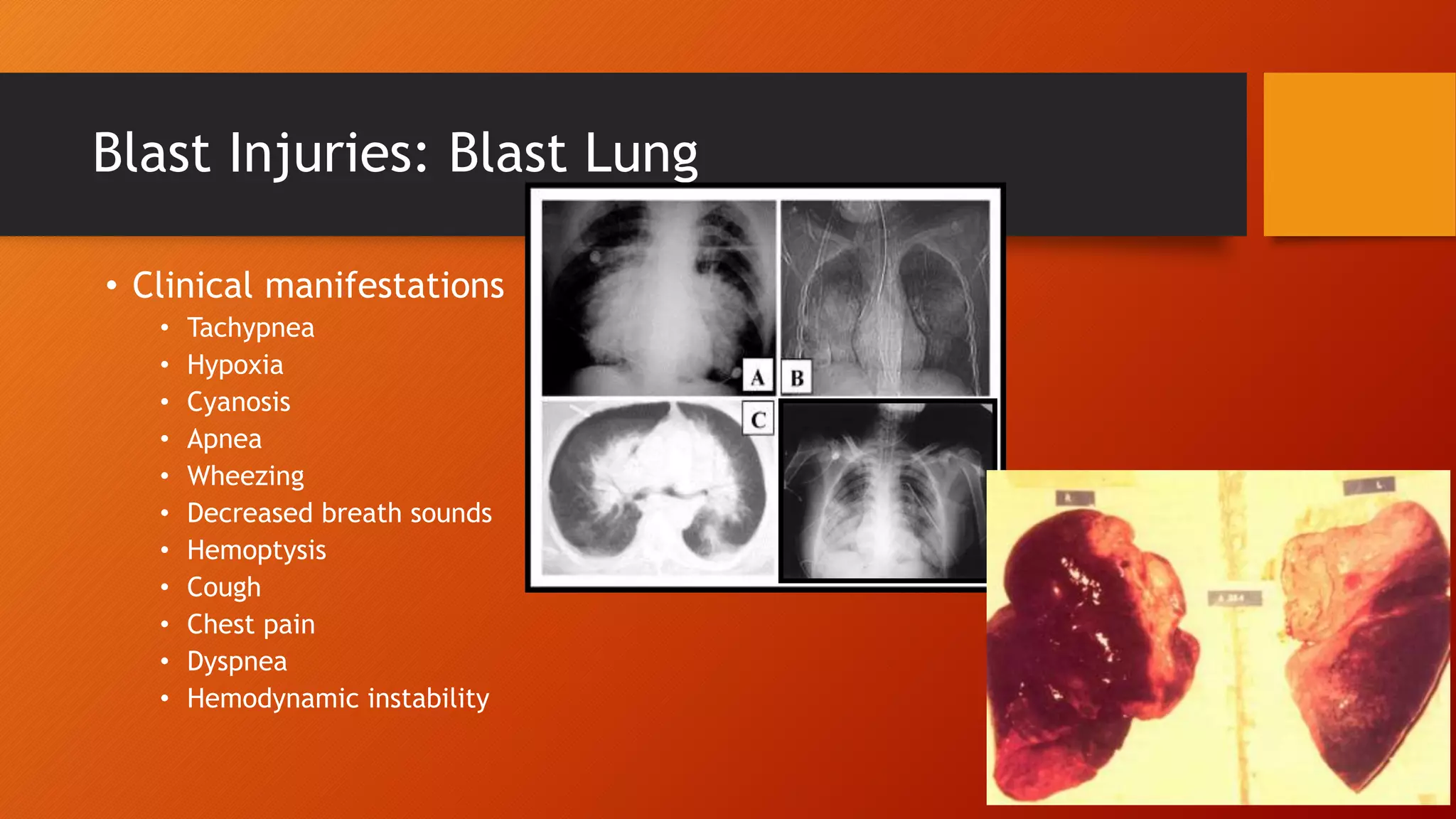
Blast Injuries: Blast Lung
• Clinical manifestations
• Tachypnea
• Hypoxia
• Cyanosis
• Apnea
• Wheezing
• Decreased breath sounds
• Hemoptysis
• Cough
• Chest pain
• Dyspnea
• Hemodynamic instability
14
Blast Injuries: Head
• Primary blast waves can cause
concussions or mild traumatic
brain injury (MTBI) without a
direct blow to the head
Blast Injuries: Head
• Consider the proximity of the
victim to the blast particularly
when given complaints of:
• Loss of consciousness
• Headache
• Fatigue
• Poor concentration, lethargy, amnesia,
or other constitutional symptoms
• Symptoms of concussion and post
traumatic stress disorder (PTSD) can
be similar
Blast Injuries: Ear & TM Rupture
• Ear injuries may include not only
TM rupture, but also ossicular
disruption, cochlear damage, and
foreign bodies.
• Tympanic membrane rupture
indicates exposure to an over
pressurization wave. (at least
40kPa; Lung treshold 100kPa)
NEJM, April 2005; 352: 1335-1342
Blast Injuries: Ear
• Presentation: acute hearing loss (conductive, sensorineural)
• Findings: auditory canal debris, tympanic membrane rupture,
ossicular disruption, cochlear damage
• Treatment: observation; 50-80% of ruptured tympanic membranes
heal; sensorineural hearing loss often permanent
John McManus and Richard B. Schwartzhttps://aneskey.com/blast-injury/
Blast Injuries: Abdomen
• Abdominal injuries (also called
blast abdomen) include
abdominal hemorrhage and
abdominal organ perforation
19
Blast Injuries: Abdomen
• Clinical manifestations include:
• Abdominal or testicular pain
• Tenesmus
• Rectal bleeding
• Solid organ lacerations
• Rebound tenderness
• Guarding
• Absent bowel sounds
• Signs of hypovolemia
• Nausea
• Vomiting
Blast Injuries: Combined Injuries
• Combined injuries, especially blast and burn injury or blast and
crush injury, are common during an explosive event.
DePalma, R. G. et al. N Engl J Med 2005;352:1335-1342
Mechanisms of Blast Injury
Category Characteristics Body Part Affected Types of Injuries
Primary Unique to HE, results from the
impact of the over-
pressurization wave with body
surfaces.
Gas filled structures are
most susceptible - lungs,
GI tract, and middle ear.
Blast lung (pulmonary
barotrauma)
TM rupture and middle ear
damage
Abdominal hemorrhage and
perforation - Globe (eye)
rupture- Concussion (TBI
without physical signs of head
injury)
Secondary Results from flying debris and
bomb fragments.
Any body part may be
affected.
Penetrating ballistic
(fragmentation) or blunt
injuries
Eye penetration (can be occult)
Tertiary Results from individuals being
thrown by the blast wind.
Any body part may be
affected.
Fracture and traumatic
amputation
Closed and open brain injury
Quaternary All explosion-related injuries,
illnesses, or diseases not due to
primary, secondary, or tertiary
mechanisms.
Includes exacerbation or
complications of existing
conditions.
Any body part may be
affected.
Burns (flash, partial, and full
thickness)
Crush injuries
Closed and open brain injury
Asthma, COPD, or other
breathing problems from dust,
smoke, or toxic fumes
Angina
Hyperglycemia, hypertension
Mortality & Morbidity
• Mortality rates vary widely between
incidents.
• An analysis of 29 large bombing (1966 and
2002)
• 8,364 casualties,
• 903 immediate deaths
• 7,461 immediately surviving injured.
• Immediate death/injury rates were higher
for bombings involving
• structural collapse (25%)
• confined space (8%)
• open air detonations (4%).
Mortality & Morbidity
• Unique patterns of injury are found in all
bombing types.
• Enclosed-space explosions, including
those occurring in busses, and in-water
explosions produce more primary blast
injury.
• Explosions leading to structure collapse
produce more orthopedic injuries & trend
towards high mortality (90%).
• Land mine injuries are associated with a
high risk of below- and above-the-knee
amputations.
D-I-S-A-S-T-E-R
• D – Detection
• I – Incident Command
• S – Scene Security and Safety
• A – Assess Hazards
• S – Support
• T – Triage and Treatment
• E – Evacuation
• R – Recovery
Originally arranged by
National Disaster Life Support Foundation, US
(from Advanced Disaster Life Support Manual)
• What type of explosive and how much?
• Where was victim located with respect to the blast?
• What did the victim do after the blast?
• Were fire/fumes present to cause inhalational injury?
• What was orientation of head and torso to the blast?
D-I-S-A-S-T-E-R
• D – Detection
• I – Incident Command
• S – Scene Security and Safety
• A – Assess Hazards
• S – Support
• T – Triage and Treatment
• E – Evacuation
• R – Recovery
Originally arranged by
National Disaster Life Support Foundation, US
(from Advanced Disaster Life Support Manual)
D-I-S-A-S-T-E-R
• D – Detection
• I – Incident Command
• S – Scene Security and Safety
• A – Assess Hazards
• S – Support
• T – Triage and Treatment
• E – Evacuation
• R – Recovery
Originally arranged by
National Disaster Life Support Foundation, US
(from Advanced Disaster Life Support Manual)
D-I-S-A-S-T-E-R
• D – Detection
• I – Incident Command
• S – Scene Security and Safety
• A – Assess Hazards
• S – Support
• T – Triage and Treatment
• E – Evacuation
• R – Recovery
Originally arranged by
National Disaster Life Support Foundation, US
(from Advanced Disaster Life Support Manual)
• Extrication and life support are the primary
management priorities.
• Extent of blast injury cannot be reliably
assessed by typical rapid triage
examination.
• Dogma: As a result, high over-triage rates
are “mandated”.
Hospital Management
• Airway and ventilation management.
• Supplemental Oxygen
• PEEP/CPAP - watch for air emboli.
• Positive pressure ventilation and general anesthesia has been reported to
increase mortality in blast injury.
• Examination
• Consider abdominal films in all patients with significant blast injury.
• CT Scan Abdomen/Pelvis for patients with appropriate signs and symptoms.
• Hearing in both ears should be tested at bedside.
• Wound Management:
• Tetanus status.
• Local exploration.
• Delayed primary closure.
• IV followed by oral antibiotics for all but the most trivial wounds.
Special Scenarios - Homicide Bombings
• Referred to as the “walking smart bomb.”
• Device typically consists of 10 -30 lbs of
explosive.
• May also contain:
• Nails, bolts, ball bearings, or other secondary
blast elements.
• Hazardous chemicals and pesticides.
• Bombers may have HIV, HepB.
Other Consideration: CBRN
• “Dirty bomb”
• Chemical
• Biological
• Radaiological - Nuclear

Blast Injury Management.pptx

  • 1.
    Blast Injury Management Dr.Ahmad Muttaqin Alim, Sp.An, EMDM
  • 2.
    Disaster A serious disruptionof the functioning of a society, causing widespread human, material, and/or environmental losses, which exceed the ability of an affected society to cope using only its own resources. (WADEM, WHO)
  • 3.
    Blast Injuries: UniqueAspects Inflict multi- system injuries on large groups of people Cause many simultaneous life-threatening injuries Hidden pattern of injury
  • 4.
    Blast Injuries: Pathophysiology •Spalling • Caused by shock wave moving through tissues of different densities → molecular disruption • Implosion • Caused by entrapped gases in hollow organs compressing then expanding → visceral disruption • Shearing • Caused by tissues of different densities moving at different speeds → visceral tearing • Irreversible Work • Caused by forces exceeding the tensile strength of the tissue
  • 5.
    Blast Injuries: Categories Primaryinjury • Caused by blast wave → over pressure Secondary injury • Caused by flying debris → shrapnel wounds Tertiary injury • Caused by blast wind → forceful impact Quaternary injury • Caused by other vectors → heat, radiation
  • 6.
    6 Blast Injuries: Primary •Blunt trauma from over pressure wave • Unique to high-order explosives • Results from the impact of the over-pressurization wave with body surfaces • Blunt force injuries • Produces barotrauma
  • 7.
    7 Blast Injuries: Primary •Most common injuries: • Blast lung—pulmonary barotraumas • Traumatic brain injury (TBI), concussion • Tympanic membrane (eardrum) rupture • Middle ear damage • Abdominal hemorrhage • Abdominal organ perforation
  • 8.
    8 Blast Injuries: Secondary •The most common cause of death in a blast event is secondary blast injuries. These injuries are caused by flying debris generated by the explosion. Terrorists often add screws, nails, and other sharp objects to bombs to increase injuries.
  • 9.
    Bombings: Injury Patternsand Care Blast Injuries: Secondary • The most common types of secondary blast injuries are: • Trauma to the head, neck, chest, abdomen, and extremities in the form of penetrating and blunt trauma • Fractures • Traumatic amputations • Soft tissue injuries
  • 10.
    Blast Injuries: Secondary •Penetrating trauma (shrapnel wounds) • Foreign bodies follow unpredictable paths through body • May have only mild external signs • Have a low threshold for imaging studies (plain radiographs, computed tomograms) • Consider all wounds contaminated American Journal of Roentgenology 2006; 187:609-616
  • 11.
    Blast Injuries: Tertiary •Tertiary injuries result from individuals being thrown by the blast wind. • The most common types of tertiary blast injuries are: • Head injuries • Skull fractures • Bone fractures • Treatment for most tertiary blast injuries follows established protocols for that specific injury.
  • 12.
    Blast Injuries: Quaternary •All explosion-related injuries, illnesses, or diseases not due to primary, secondary, or tertiary mechanisms are considered quaternary blast injuries. This includes exacerbation or complications of existing conditions. • Burns • Head injuries • Asthma • COPD • Other breathing problems • Angina • Hyperglycemia • Hypertension • Crush injuries
  • 13.
    Blast Injuries: BlastLung • Clinical manifestations • Tachypnea • Hypoxia • Cyanosis • Apnea • Wheezing • Decreased breath sounds • Hemoptysis • Cough • Chest pain • Dyspnea • Hemodynamic instability
  • 14.
    14 Blast Injuries: Head •Primary blast waves can cause concussions or mild traumatic brain injury (MTBI) without a direct blow to the head
  • 15.
    Blast Injuries: Head •Consider the proximity of the victim to the blast particularly when given complaints of: • Loss of consciousness • Headache • Fatigue • Poor concentration, lethargy, amnesia, or other constitutional symptoms • Symptoms of concussion and post traumatic stress disorder (PTSD) can be similar
  • 16.
    Blast Injuries: Ear& TM Rupture • Ear injuries may include not only TM rupture, but also ossicular disruption, cochlear damage, and foreign bodies. • Tympanic membrane rupture indicates exposure to an over pressurization wave. (at least 40kPa; Lung treshold 100kPa) NEJM, April 2005; 352: 1335-1342
  • 17.
    Blast Injuries: Ear •Presentation: acute hearing loss (conductive, sensorineural) • Findings: auditory canal debris, tympanic membrane rupture, ossicular disruption, cochlear damage • Treatment: observation; 50-80% of ruptured tympanic membranes heal; sensorineural hearing loss often permanent
  • 18.
    John McManus andRichard B. Schwartzhttps://aneskey.com/blast-injury/ Blast Injuries: Abdomen • Abdominal injuries (also called blast abdomen) include abdominal hemorrhage and abdominal organ perforation
  • 19.
    19 Blast Injuries: Abdomen •Clinical manifestations include: • Abdominal or testicular pain • Tenesmus • Rectal bleeding • Solid organ lacerations • Rebound tenderness • Guarding • Absent bowel sounds • Signs of hypovolemia • Nausea • Vomiting
  • 20.
    Blast Injuries: CombinedInjuries • Combined injuries, especially blast and burn injury or blast and crush injury, are common during an explosive event.
  • 21.
    DePalma, R. G.et al. N Engl J Med 2005;352:1335-1342
  • 22.
    Mechanisms of BlastInjury Category Characteristics Body Part Affected Types of Injuries Primary Unique to HE, results from the impact of the over- pressurization wave with body surfaces. Gas filled structures are most susceptible - lungs, GI tract, and middle ear. Blast lung (pulmonary barotrauma) TM rupture and middle ear damage Abdominal hemorrhage and perforation - Globe (eye) rupture- Concussion (TBI without physical signs of head injury) Secondary Results from flying debris and bomb fragments. Any body part may be affected. Penetrating ballistic (fragmentation) or blunt injuries Eye penetration (can be occult) Tertiary Results from individuals being thrown by the blast wind. Any body part may be affected. Fracture and traumatic amputation Closed and open brain injury Quaternary All explosion-related injuries, illnesses, or diseases not due to primary, secondary, or tertiary mechanisms. Includes exacerbation or complications of existing conditions. Any body part may be affected. Burns (flash, partial, and full thickness) Crush injuries Closed and open brain injury Asthma, COPD, or other breathing problems from dust, smoke, or toxic fumes Angina Hyperglycemia, hypertension
  • 23.
    Mortality & Morbidity •Mortality rates vary widely between incidents. • An analysis of 29 large bombing (1966 and 2002) • 8,364 casualties, • 903 immediate deaths • 7,461 immediately surviving injured. • Immediate death/injury rates were higher for bombings involving • structural collapse (25%) • confined space (8%) • open air detonations (4%).
  • 24.
    Mortality & Morbidity •Unique patterns of injury are found in all bombing types. • Enclosed-space explosions, including those occurring in busses, and in-water explosions produce more primary blast injury. • Explosions leading to structure collapse produce more orthopedic injuries & trend towards high mortality (90%). • Land mine injuries are associated with a high risk of below- and above-the-knee amputations.
  • 25.
    D-I-S-A-S-T-E-R • D –Detection • I – Incident Command • S – Scene Security and Safety • A – Assess Hazards • S – Support • T – Triage and Treatment • E – Evacuation • R – Recovery Originally arranged by National Disaster Life Support Foundation, US (from Advanced Disaster Life Support Manual) • What type of explosive and how much? • Where was victim located with respect to the blast? • What did the victim do after the blast? • Were fire/fumes present to cause inhalational injury? • What was orientation of head and torso to the blast?
  • 26.
    D-I-S-A-S-T-E-R • D –Detection • I – Incident Command • S – Scene Security and Safety • A – Assess Hazards • S – Support • T – Triage and Treatment • E – Evacuation • R – Recovery Originally arranged by National Disaster Life Support Foundation, US (from Advanced Disaster Life Support Manual)
  • 27.
    D-I-S-A-S-T-E-R • D –Detection • I – Incident Command • S – Scene Security and Safety • A – Assess Hazards • S – Support • T – Triage and Treatment • E – Evacuation • R – Recovery Originally arranged by National Disaster Life Support Foundation, US (from Advanced Disaster Life Support Manual)
  • 28.
    D-I-S-A-S-T-E-R • D –Detection • I – Incident Command • S – Scene Security and Safety • A – Assess Hazards • S – Support • T – Triage and Treatment • E – Evacuation • R – Recovery Originally arranged by National Disaster Life Support Foundation, US (from Advanced Disaster Life Support Manual) • Extrication and life support are the primary management priorities. • Extent of blast injury cannot be reliably assessed by typical rapid triage examination. • Dogma: As a result, high over-triage rates are “mandated”.
  • 29.
    Hospital Management • Airwayand ventilation management. • Supplemental Oxygen • PEEP/CPAP - watch for air emboli. • Positive pressure ventilation and general anesthesia has been reported to increase mortality in blast injury. • Examination • Consider abdominal films in all patients with significant blast injury. • CT Scan Abdomen/Pelvis for patients with appropriate signs and symptoms. • Hearing in both ears should be tested at bedside. • Wound Management: • Tetanus status. • Local exploration. • Delayed primary closure. • IV followed by oral antibiotics for all but the most trivial wounds.
  • 30.
    Special Scenarios -Homicide Bombings • Referred to as the “walking smart bomb.” • Device typically consists of 10 -30 lbs of explosive. • May also contain: • Nails, bolts, ball bearings, or other secondary blast elements. • Hazardous chemicals and pesticides. • Bombers may have HIV, HepB.
  • 31.
    Other Consideration: CBRN •“Dirty bomb” • Chemical • Biological • Radaiological - Nuclear