Presentation On
Universal Testing
Machine
M Waqas Mushtaq MME-12-11
Muhammad Zubair MME-12-29
M. Faisal Maqsood MME-12-20
Muhammad Ahmad MME-12-14
Gulfam Hussain MME-12-30
Arif Ali MME-12-01
Group No 1
Mechanics Of materials:
Mechanics of materials is a branch of mechanics that
develops relationships between the external loads
applied to a deformable body and the intensity of
internal forces acting within the body as well as the
deformations of the body.
Stress
Strain
Introduction
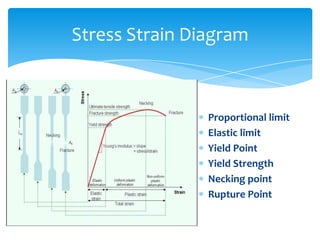
Stress Strain Diagram
Proportional limit
Elastic limit
Yield Point
Yield Strength
Necking point
Rupture Point
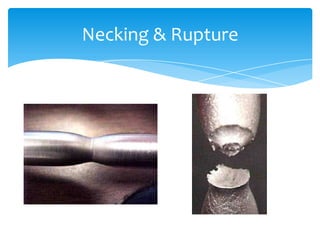
Necking & Rupture
Universal Testing Machine
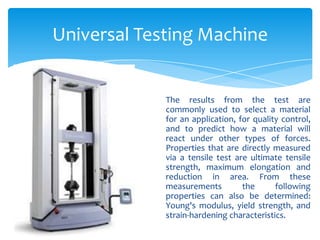
The results from the test are
commonly used to select a material
for an application, for quality control,
and to predict how a material will
react under other types of forces.
Properties that are directly measured
via a tensile test are ultimate tensile
strength, maximum elongation and
reduction in area. From these
measurements the following
properties can also be determined:
Young's modulus, yield strength, and
strain-hardening characteristics.
Tensile Test
Compressive Test
Tortion Test
Shear
Bending
Test Function
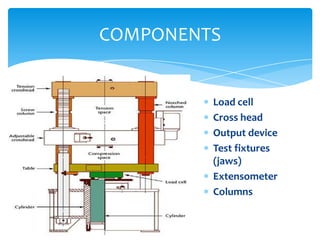
COMPONENTS
Load cell
Cross head
Output device
Test fixtures
(jaws)
Extensometer
Columns
TYPES
Mechanical
The electromechanical machine uses an
electric motor, gear reduction system
and one, two or four screws to move the
crosshead up or down
. A range of crosshead speeds can be
achieved by changing the speed of the
motor.
A microprocessor based closed-loop
servo system can be Implemented to
accurately control the speed of the
crosshead.
Hydraulic
A hydraulic testing machine uses either a
single- or dual-acting piston to move the
crosshead up or down.
In a manually operated machine, the
operator adjusts a needle valve to control
the rate of loading. In a closed-loop
hydraulic servo system, the needle valve is
replaced by an electrically operated servo-
valve for precise control.
In general, the electromechanical machine
is capable of a wide range of test speeds
and long crosshead displacements, whereas
the hydraulic machine is a cost-effective
solution for generating high forces.
TYPES
Digitally operated
Universal Testing Machine
Computer operated
Universal Testing Machine
Single Column Universal
Testing Machines
Double / Dual Column
Universal Testing
Machines
Four Column Universal
Testing Machines
It works on the principle of elongation and
deformation.
In UTM Tensile, Compressive and Shear Forces are
acting.
Working Principle
Working Procedure
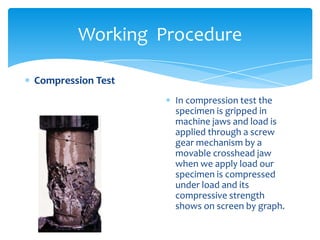
Compression Test
In compression test the
specimen is gripped in
machine jaws and load is
applied through a screw
gear mechanism by a
movable crosshead jaw
when we apply load our
specimen is compressed
under load and its
compressive strength
shows on screen by graph.
In tensile test the specimen is gripped in machine
jaws and load is applied through a screw gear
mechanism by a movable crosshead jaw when we
apply load our specimen is elongated under load and
stress strain graph is shown on screen.
Tensile Test
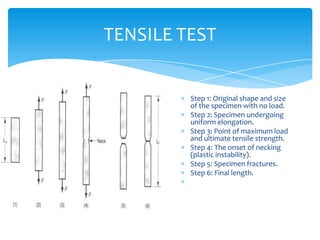
TENSILE TEST
Step 1: Original shape and size
of the specimen with no load.
Step 2: Specimen undergoing
uniform elongation.
Step 3: Point of maximum load
and ultimate tensile strength.
Step 4: The onset of necking
(plastic instability).
Step 5: Specimen fractures.
Step 6: Final length.

Universal testing machines

  • 1.
  • 2.
    M Waqas MushtaqMME-12-11 Muhammad Zubair MME-12-29 M. Faisal Maqsood MME-12-20 Muhammad Ahmad MME-12-14 Gulfam Hussain MME-12-30 Arif Ali MME-12-01 Group No 1
  • 3.
    Mechanics Of materials: Mechanicsof materials is a branch of mechanics that develops relationships between the external loads applied to a deformable body and the intensity of internal forces acting within the body as well as the deformations of the body. Stress Strain Introduction
  • 4.
    Stress Strain Diagram Proportionallimit Elastic limit Yield Point Yield Strength Necking point Rupture Point
  • 5.
  • 6.
    Universal Testing Machine Theresults from the test are commonly used to select a material for an application, for quality control, and to predict how a material will react under other types of forces. Properties that are directly measured via a tensile test are ultimate tensile strength, maximum elongation and reduction in area. From these measurements the following properties can also be determined: Young's modulus, yield strength, and strain-hardening characteristics.
  • 7.
    Tensile Test Compressive Test TortionTest Shear Bending Test Function
  • 8.
    COMPONENTS Load cell Cross head Outputdevice Test fixtures (jaws) Extensometer Columns
  • 9.
    TYPES Mechanical The electromechanical machineuses an electric motor, gear reduction system and one, two or four screws to move the crosshead up or down . A range of crosshead speeds can be achieved by changing the speed of the motor. A microprocessor based closed-loop servo system can be Implemented to accurately control the speed of the crosshead. Hydraulic A hydraulic testing machine uses either a single- or dual-acting piston to move the crosshead up or down. In a manually operated machine, the operator adjusts a needle valve to control the rate of loading. In a closed-loop hydraulic servo system, the needle valve is replaced by an electrically operated servo- valve for precise control. In general, the electromechanical machine is capable of a wide range of test speeds and long crosshead displacements, whereas the hydraulic machine is a cost-effective solution for generating high forces.
  • 10.
    TYPES Digitally operated Universal TestingMachine Computer operated Universal Testing Machine Single Column Universal Testing Machines Double / Dual Column Universal Testing Machines Four Column Universal Testing Machines
  • 11.
    It works onthe principle of elongation and deformation. In UTM Tensile, Compressive and Shear Forces are acting. Working Principle
  • 12.
    Working Procedure Compression Test Incompression test the specimen is gripped in machine jaws and load is applied through a screw gear mechanism by a movable crosshead jaw when we apply load our specimen is compressed under load and its compressive strength shows on screen by graph.
  • 13.
    In tensile testthe specimen is gripped in machine jaws and load is applied through a screw gear mechanism by a movable crosshead jaw when we apply load our specimen is elongated under load and stress strain graph is shown on screen. Tensile Test
  • 14.
    TENSILE TEST Step 1:Original shape and size of the specimen with no load. Step 2: Specimen undergoing uniform elongation. Step 3: Point of maximum load and ultimate tensile strength. Step 4: The onset of necking (plastic instability). Step 5: Specimen fractures. Step 6: Final length.