Barkatullah University Institute of Technology
                         Presentation on ….


                    Submitted to:             Presented by
                                              MECH ENGG
                                              III Sem.

                                                             1
OUTLINE
Introduction
   Tensile Test- Basic Principles
   Terminology
   Objectives of the Lab
   Tensile Test (Material and Equipment)
   Tensile Test Example (Video , Material
   Properties and Simulation)
INTRODUCTION
 A universal testing machine, also known as a
 universal tester, materials testing machine or
 materials test frame, is used to test the tensile
 stress and compressive strength of materials. It
 is named after the fact that it can perform many
 standard tensile and compression tests on
 materials, components, and structures.
COMPONENTS
Load frame - usually consisting of two strong
  supports for the machine. Some small
  machines have a single support.
Load cell - A force transducer or other means of
  measuring the load is required. Periodic
  calibration is usually called for.
Cross head - A movable cross head (crosshead) is
  controlled to move up or down. Usually this is
  at a constant speed: sometimes called a
  constant rate of extension (CRE) machine.
Output device - A means of providing the test
  result is needed. Some older machines have
  dial or digital displays and chart recorders.
  Many newer machines have a computer
  interface for analysis and printing.
Conditioning - Many tests require controlled
  conditioning . The machine can be in a
  controlled room or a special environmental
  chamber can be placed around the test
  specimen for the test.
Test fixtures, specimen holding jaws, and related
  sample making equipment are called for in
  many test methods.
The set-up and usage are detailed in a test method, often
  published by a standards organization. This specifies the
  sample preparation, fixturing, gauge length (the length
  which is under study or observation), analysis, etc.
The specimen is placed in the machine between the grips
  and an extensometer if required can automatically record
  the change in gauge length during the test. If an
  extensometer is not fitted, the machine itself can record
  the displacement between its cross heads on which the
  specimen is held.
However, this method not only records the change in length
  of the specimen but also all other extending / elastic
  components of the testing machine and its drive systems
  including any slipping of the specimen in the grips.
Once the machine is started it begins to apply an increasing
  load on specimen. Throughout the tests the control
  system and its associated software record the load and
  extension or compression of the specimen.
Machines range from very small table top systems to ones
  with over 53 MN (12 million lbf) capacity.
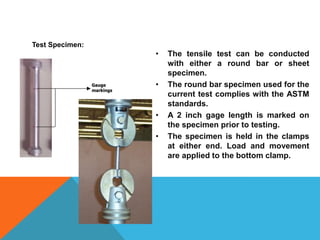
Test Specimen:
                            •   The tensile test can be conducted
                                with either a round bar or sheet
                                specimen.
                 Gauge      •   The round bar specimen used for the
                 markings
                                current test complies with the ASTM
                                standards.
                            •   A 2 inch gage length is marked on
                                the specimen prior to testing.
                            •   The specimen is held in the clamps
                                at either end. Load and movement
                                are applied to the bottom clamp.
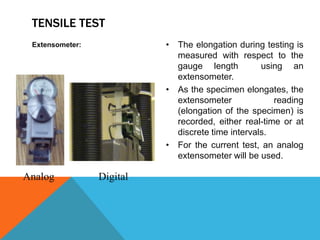
TENSILE TEST
 Extensometer:             • The elongation during testing is
                             measured with respect to the
                             gauge length          using an
                             extensometer.
                           • As the specimen elongates, the
                             extensometer             reading
                             (elongation of the specimen) is
                             recorded, either real-time or at
                             discrete time intervals.
                           • For the current test, an analog
                             extensometer will be used.

Analog           Digital
TENSILE TEST
  Procedure:

Mark a 2 inch gage length on the tensile test specimen using
  the dial calipers and marker.
Measure the diameter of the specimen using dial calipers.
Load specimen in the machine grips and remove most of the
  slack by moving the lower crosshead.
Attach and zero the extensometer; secure it with a lanyard
   so it will not fall and break if specimen fracture occurs
   before the extensometer can be removed.
Zero the load indicator and open the right side hydraulic
  valve about ½ turn.
TENSILE TEST
   Procedure (continued):

As the sample is loaded, close the valve and record the load and
   elongation at regular load intervals (e.g. every 1000 pounds) up
   to the yield point (when the load starts increasing more slowly
   and the strain starts increasing more rapidly).
Continue to load the sample until the extensometer range is
  exceeded, then remove the extensometer.
Continue to load the sample until it breaks; pay close attention to
  the load indicator and record the load at failure.
Observe and record the maximum load on the follower needle.
Using the dial calipers, measure the final gage length and gage
   diameter of the fractured specimen (note: when you calculate
   the fracture strength, use the fracture area calculated from the
   measured final diameter).
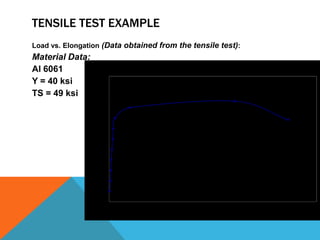
TENSILE TEST EXAMPLE
Load vs. Elongation (Data obtained from the tensile test):
Material Data:
                                                    Load Vs. Elongation
Al 6061
                           12000
Y = 40 ksi
TS = 49 ksi                10000


                            8000
               Load (lb)


                            6000


                            4000


                            2000


                               0
                                   0   0.05   0.1     0.15         0.2          0.25   0.3   0.35   0.4

                                                             Elongation (in.)
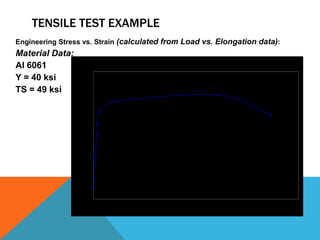
TENSILE TEST EXAMPLE
Engineering Stress vs. Strain (calculated from Load vs. Elongation data):
Material Data:
                                                             Engineering Stress vs. Engineering Strain
Al 6061
                                          60000
Y = 40 ksi
TS = 49 ksi                               50000
               Engineering Stress (psi)


                                          40000


                                          30000


                                          20000


                                          10000


                                              0
                                                  0   0.02     0.04   0.06     0.08     0.1      0.12     0.14   0.16   0.18   0.2
                                                                             Engineering Strain (in/in)
TENSILE TEST EXAMPLE
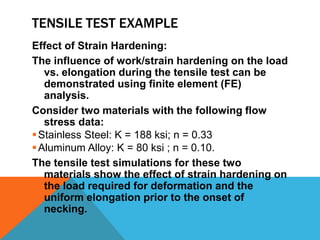
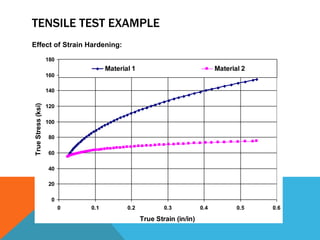
Effect of Strain Hardening:
The influence of work/strain hardening on the load
   vs. elongation during the tensile test can be
   demonstrated using finite element (FE)
   analysis.
Consider two materials with the following flow
   stress data:
 Stainless Steel: K = 188 ksi; n = 0.33
 Aluminum Alloy: K = 80 ksi ; n = 0.10.
The tensile test simulations for these two
   materials show the effect of strain hardening on
   the load required for deformation and the
   uniform elongation prior to the onset of
   necking.
TENSILE TEST EXAMPLE
Effect of Strain Hardening:

                     180
                                     Material 1                               Material 2
                     160

                     140
 True Stress (ksi)


                     120

                     100

                     80

                     60

                     40

                     20

                      0
                           0   0.1          0.2           0.3           0.4          0.5   0.6

                                                  True Strain (in/in)
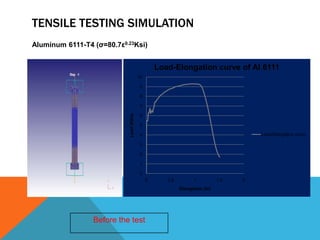
TENSILE TESTING SIMULATION
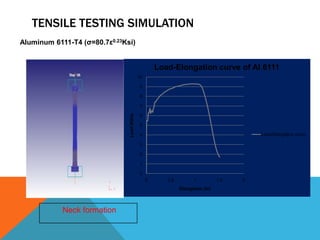
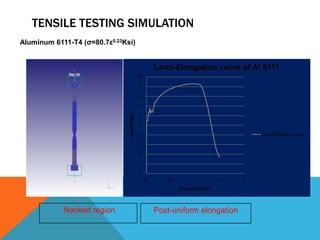
Aluminum 6111-T4 (σ=80.7ε0.23Ksi)


                                                  Load-Elongation curve of Al 6111
                                         10

                                          9

                                          8

                                          7


                           Load (Klbs)
                                          6

                                          5

                                          4                                            Load-Elongation curve

                                          3

                                          2

                                          1

                                          0
                                              0      0.5         1           1.5   2
                                                           Elongation (in)


                 Before the test
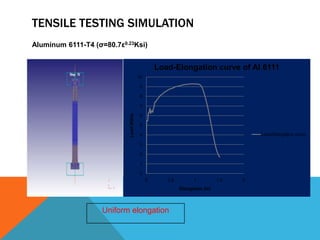
TENSILE TESTING SIMULATION
Aluminum 6111-T4 (σ=80.7ε0.23Ksi)


                                                  Load-Elongation curve of Al 6111
                                         10

                                          9

                                          8

                                          7


                           Load (Klbs)
                                          6

                                          5

                                          4                                            Load-Elongation curve

                                          3

                                          2

                                          1

                                          0
                                              0      0.5         1           1.5   2
                                                           Elongation (in)


                    Uniform elongation
TENSILE TESTING SIMULATION
Aluminum 6111-T4 (σ=80.7ε0.23Ksi)


                                                      Load-Elongation curve of Al 6111
                                             10

                                              9

                                              8

                                              7


                               Load (Klbs)
                                              6

                                              5

                                              4                                            Load-Elongation curve

                                              3

                                              2

                                              1

                                              0
                                                  0      0.5         1           1.5   2
                                                               Elongation (in)


            Neck formation
TENSILE TESTING SIMULATION
Aluminum 6111-T4 (σ=80.7ε0.23Ksi)


                                                      Load-Elongation curve of Al 6111
                                             10

                                              9

                                              8

                                              7


                               Load (Klbs)
                                              6

                                              5

                                              4                                            Load-Elongation curve

                                              3

                                              2

                                              1

                                              0
                                                  0      0.5         1           1.5   2
                                                               Elongation (in)


            Necked region                             Post-uniform elongation
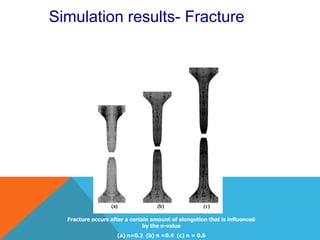
Simulation results- Fracture


  Fracture occurs after a certain amount of elongation that is influenced
                               by the n-value
                    (a) n=0.2 (b) n =0.4 (c) n = 0.6

Universal testing machines

  • 1.
    Barkatullah University Instituteof Technology Presentation on …. Submitted to: Presented by MECH ENGG III Sem. 1
  • 2.
    OUTLINE Introduction Tensile Test- Basic Principles Terminology Objectives of the Lab Tensile Test (Material and Equipment) Tensile Test Example (Video , Material Properties and Simulation)
  • 3.
    INTRODUCTION A universaltesting machine, also known as a universal tester, materials testing machine or materials test frame, is used to test the tensile stress and compressive strength of materials. It is named after the fact that it can perform many standard tensile and compression tests on materials, components, and structures.
  • 4.
    COMPONENTS Load frame -usually consisting of two strong supports for the machine. Some small machines have a single support. Load cell - A force transducer or other means of measuring the load is required. Periodic calibration is usually called for. Cross head - A movable cross head (crosshead) is controlled to move up or down. Usually this is at a constant speed: sometimes called a constant rate of extension (CRE) machine.
  • 5.
    Output device -A means of providing the test result is needed. Some older machines have dial or digital displays and chart recorders. Many newer machines have a computer interface for analysis and printing. Conditioning - Many tests require controlled conditioning . The machine can be in a controlled room or a special environmental chamber can be placed around the test specimen for the test. Test fixtures, specimen holding jaws, and related sample making equipment are called for in many test methods.
  • 6.
    The set-up andusage are detailed in a test method, often published by a standards organization. This specifies the sample preparation, fixturing, gauge length (the length which is under study or observation), analysis, etc. The specimen is placed in the machine between the grips and an extensometer if required can automatically record the change in gauge length during the test. If an extensometer is not fitted, the machine itself can record the displacement between its cross heads on which the specimen is held.
  • 7.
    However, this methodnot only records the change in length of the specimen but also all other extending / elastic components of the testing machine and its drive systems including any slipping of the specimen in the grips. Once the machine is started it begins to apply an increasing load on specimen. Throughout the tests the control system and its associated software record the load and extension or compression of the specimen. Machines range from very small table top systems to ones with over 53 MN (12 million lbf) capacity.
  • 8.
    Test Specimen: • The tensile test can be conducted with either a round bar or sheet specimen. Gauge • The round bar specimen used for the markings current test complies with the ASTM standards. • A 2 inch gage length is marked on the specimen prior to testing. • The specimen is held in the clamps at either end. Load and movement are applied to the bottom clamp.
  • 9.
    TENSILE TEST Extensometer: • The elongation during testing is measured with respect to the gauge length using an extensometer. • As the specimen elongates, the extensometer reading (elongation of the specimen) is recorded, either real-time or at discrete time intervals. • For the current test, an analog extensometer will be used. Analog Digital
  • 10.
    TENSILE TEST Procedure: Mark a 2 inch gage length on the tensile test specimen using the dial calipers and marker. Measure the diameter of the specimen using dial calipers. Load specimen in the machine grips and remove most of the slack by moving the lower crosshead. Attach and zero the extensometer; secure it with a lanyard so it will not fall and break if specimen fracture occurs before the extensometer can be removed. Zero the load indicator and open the right side hydraulic valve about ½ turn.
  • 11.
    TENSILE TEST Procedure (continued): As the sample is loaded, close the valve and record the load and elongation at regular load intervals (e.g. every 1000 pounds) up to the yield point (when the load starts increasing more slowly and the strain starts increasing more rapidly). Continue to load the sample until the extensometer range is exceeded, then remove the extensometer. Continue to load the sample until it breaks; pay close attention to the load indicator and record the load at failure. Observe and record the maximum load on the follower needle. Using the dial calipers, measure the final gage length and gage diameter of the fractured specimen (note: when you calculate the fracture strength, use the fracture area calculated from the measured final diameter).
  • 12.
    TENSILE TEST EXAMPLE Loadvs. Elongation (Data obtained from the tensile test): Material Data: Load Vs. Elongation Al 6061 12000 Y = 40 ksi TS = 49 ksi 10000 8000 Load (lb) 6000 4000 2000 0 0 0.05 0.1 0.15 0.2 0.25 0.3 0.35 0.4 Elongation (in.)
  • 13.
    TENSILE TEST EXAMPLE EngineeringStress vs. Strain (calculated from Load vs. Elongation data): Material Data: Engineering Stress vs. Engineering Strain Al 6061 60000 Y = 40 ksi TS = 49 ksi 50000 Engineering Stress (psi) 40000 30000 20000 10000 0 0 0.02 0.04 0.06 0.08 0.1 0.12 0.14 0.16 0.18 0.2 Engineering Strain (in/in)
  • 14.
    TENSILE TEST EXAMPLE Effectof Strain Hardening: The influence of work/strain hardening on the load vs. elongation during the tensile test can be demonstrated using finite element (FE) analysis. Consider two materials with the following flow stress data:  Stainless Steel: K = 188 ksi; n = 0.33  Aluminum Alloy: K = 80 ksi ; n = 0.10. The tensile test simulations for these two materials show the effect of strain hardening on the load required for deformation and the uniform elongation prior to the onset of necking.
  • 15.
    TENSILE TEST EXAMPLE Effectof Strain Hardening: 180 Material 1 Material 2 160 140 True Stress (ksi) 120 100 80 60 40 20 0 0 0.1 0.2 0.3 0.4 0.5 0.6 True Strain (in/in)
  • 16.
    TENSILE TESTING SIMULATION Aluminum6111-T4 (σ=80.7ε0.23Ksi) Load-Elongation curve of Al 6111 10 9 8 7 Load (Klbs) 6 5 4 Load-Elongation curve 3 2 1 0 0 0.5 1 1.5 2 Elongation (in) Before the test
  • 17.
    TENSILE TESTING SIMULATION Aluminum6111-T4 (σ=80.7ε0.23Ksi) Load-Elongation curve of Al 6111 10 9 8 7 Load (Klbs) 6 5 4 Load-Elongation curve 3 2 1 0 0 0.5 1 1.5 2 Elongation (in) Uniform elongation
  • 18.
    TENSILE TESTING SIMULATION Aluminum6111-T4 (σ=80.7ε0.23Ksi) Load-Elongation curve of Al 6111 10 9 8 7 Load (Klbs) 6 5 4 Load-Elongation curve 3 2 1 0 0 0.5 1 1.5 2 Elongation (in) Neck formation
  • 19.
    TENSILE TESTING SIMULATION Aluminum6111-T4 (σ=80.7ε0.23Ksi) Load-Elongation curve of Al 6111 10 9 8 7 Load (Klbs) 6 5 4 Load-Elongation curve 3 2 1 0 0 0.5 1 1.5 2 Elongation (in) Necked region Post-uniform elongation
  • 20.
    Simulation results- Fracture Fracture occurs after a certain amount of elongation that is influenced by the n-value (a) n=0.2 (b) n =0.4 (c) n = 0.6