CPP301
Core Project-II
Design and development of horizontal tensile testing machine (5kN)
Under the supervision of:
Dr. Dhiraj Kumar Mahajan
A Presentation by
Sajeed Mahaboob (2011ME1111)
Krishanu Sarkar (2012MEB1102)
1
MOTIVATION
• Tensile tests are performed to achieve material
parameters such as UTS, yield strength, % elongation, %
area reduction and young’s modulus.
• These important parameters obtained are useful for
selection of engineering materials for many applications.
• Need of horizontal tensile machine for testing in different
environment conditions.
• Miniaturized (Horizontal, Max 5kN)
2
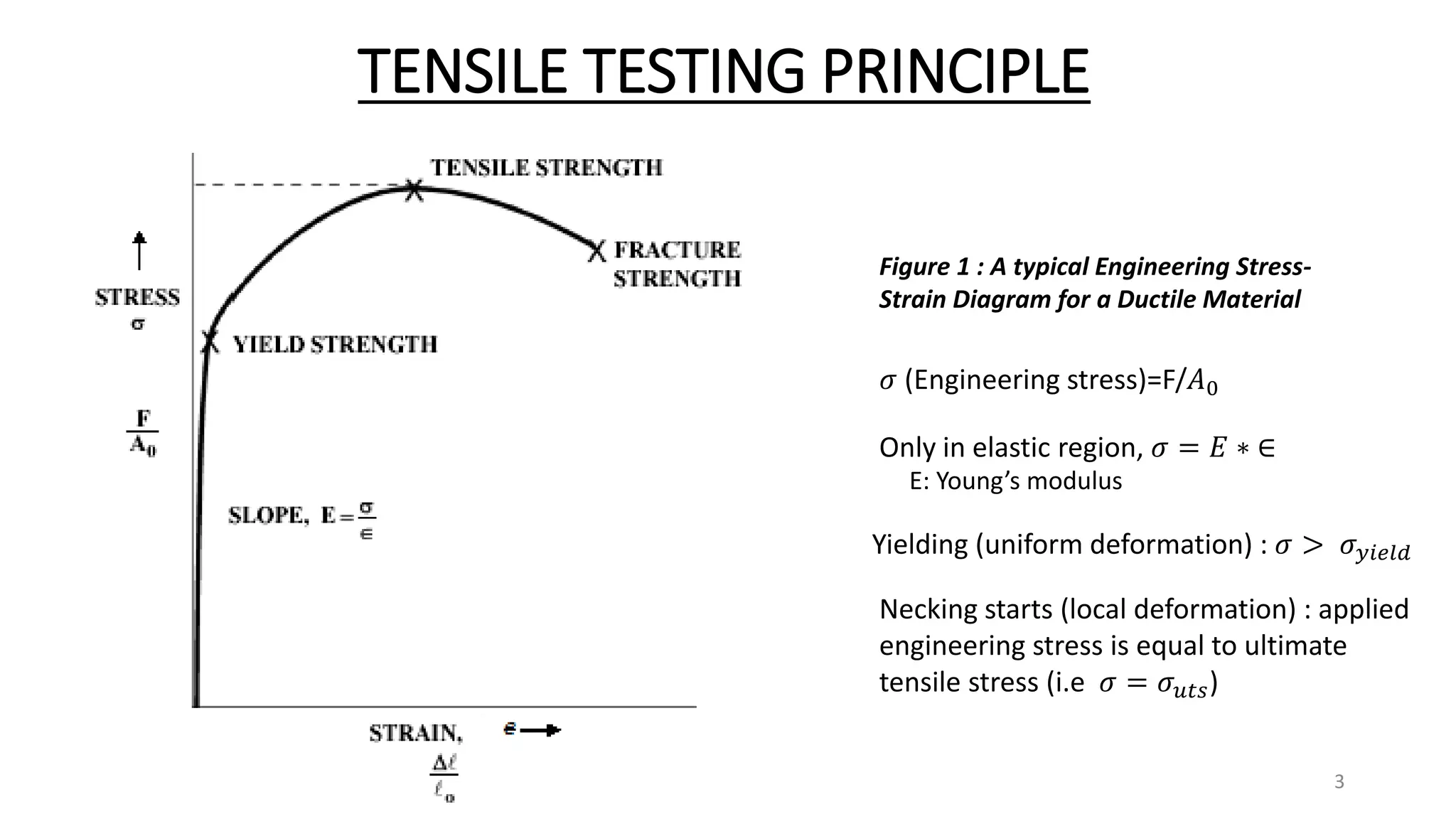
TENSILE TESTING PRINCIPLE
3
Figure 1 : A typical Engineering Stress-
Strain Diagram for a Ductile Material
𝜎 (Engineering stress)=F/𝐴0
Necking starts (local deformation) : applied
engineering stress is equal to ultimate
tensile stress (i.e 𝜎 = 𝜎 𝑢𝑡𝑠)
Yielding (uniform deformation) : 𝜎 > 𝜎 𝑦𝑖𝑒𝑙𝑑
E: Young’s modulus
Only in elastic region, 𝜎 = 𝐸 ∗ ∈
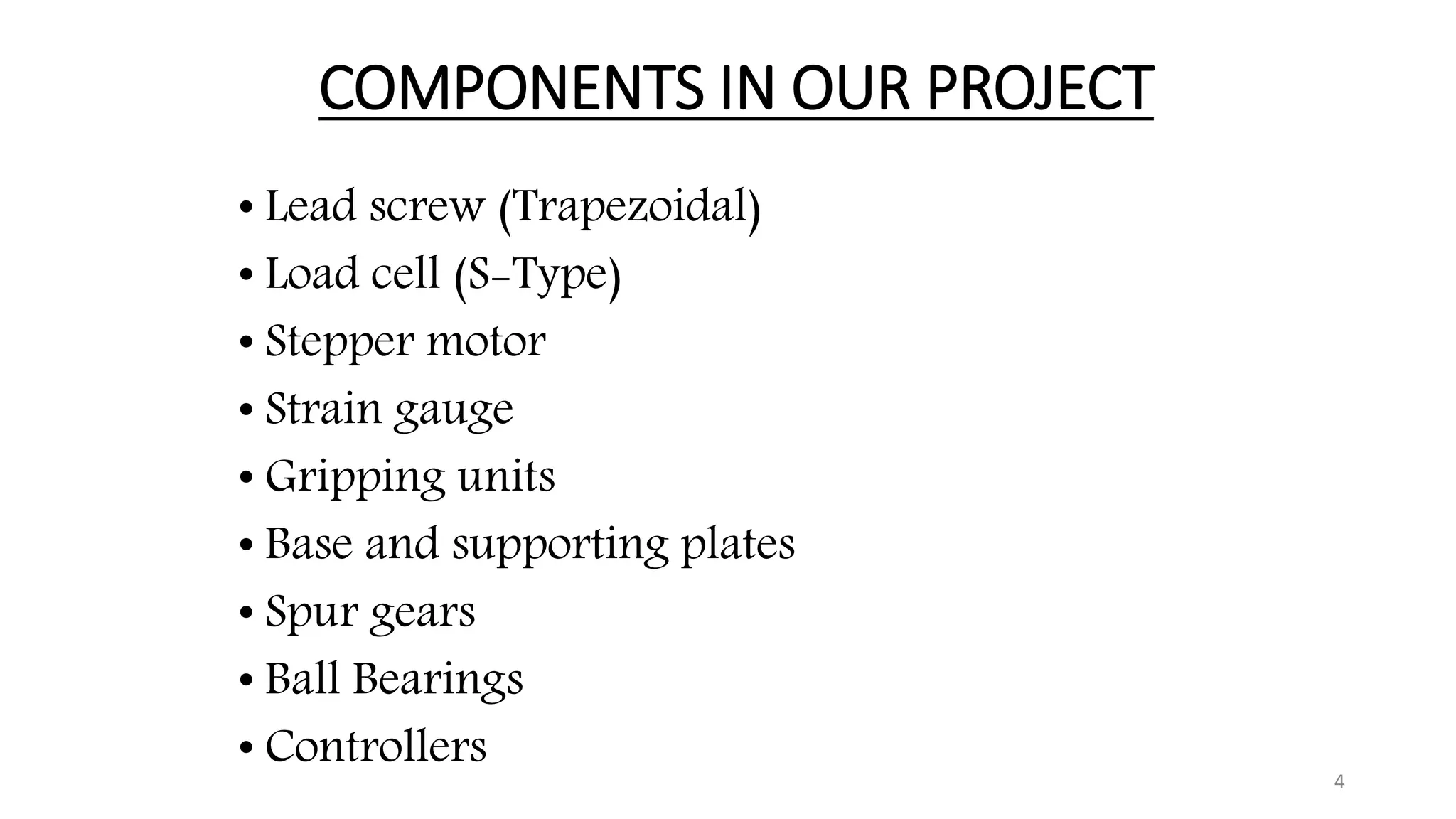
COMPONENTS IN OUR PROJECT
• Lead screw (Trapezoidal)
• Load cell (S-Type)
• Stepper motor
• Strain gauge
• Gripping units
• Base and supporting plates
• Spur gears
• Ball Bearings
• Controllers 4
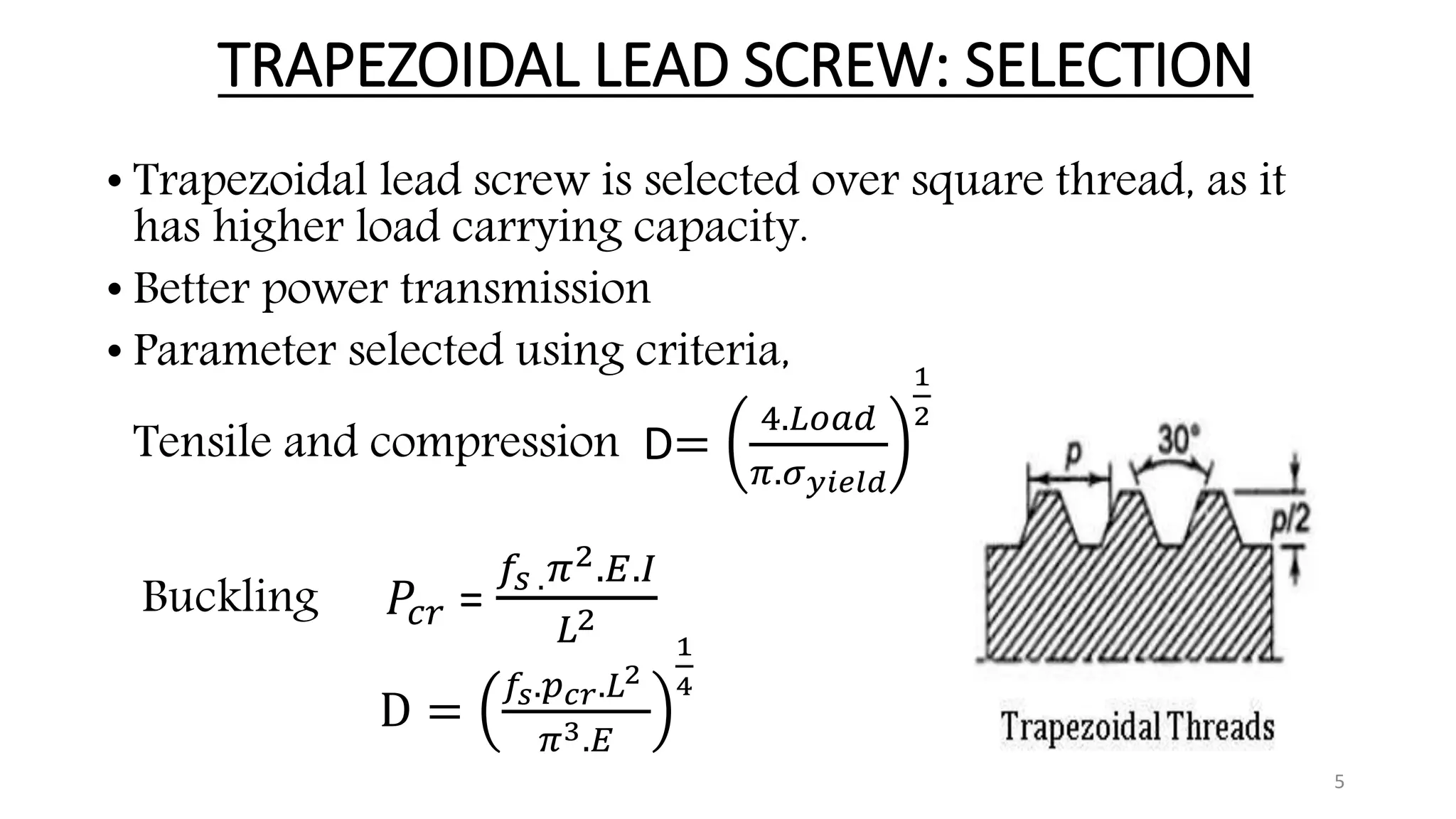
TRAPEZOIDAL LEAD SCREW: SELECTION
• Trapezoidal lead screw is selected over square thread, as it
has higher load carrying capacity.
• Better power transmission
• Parameter selected using criteria,
Tensile and compression D=
4.𝐿𝑜𝑎𝑑
𝜋.𝜎 𝑦𝑖𝑒𝑙𝑑
1
2
Buckling 𝑃𝑐𝑟 =
𝑓𝑠 . 𝜋2.𝐸.𝐼
𝐿2
D =
𝑓𝑠.𝑝 𝑐𝑟.𝐿2
𝜋3.𝐸
1
4
5
6
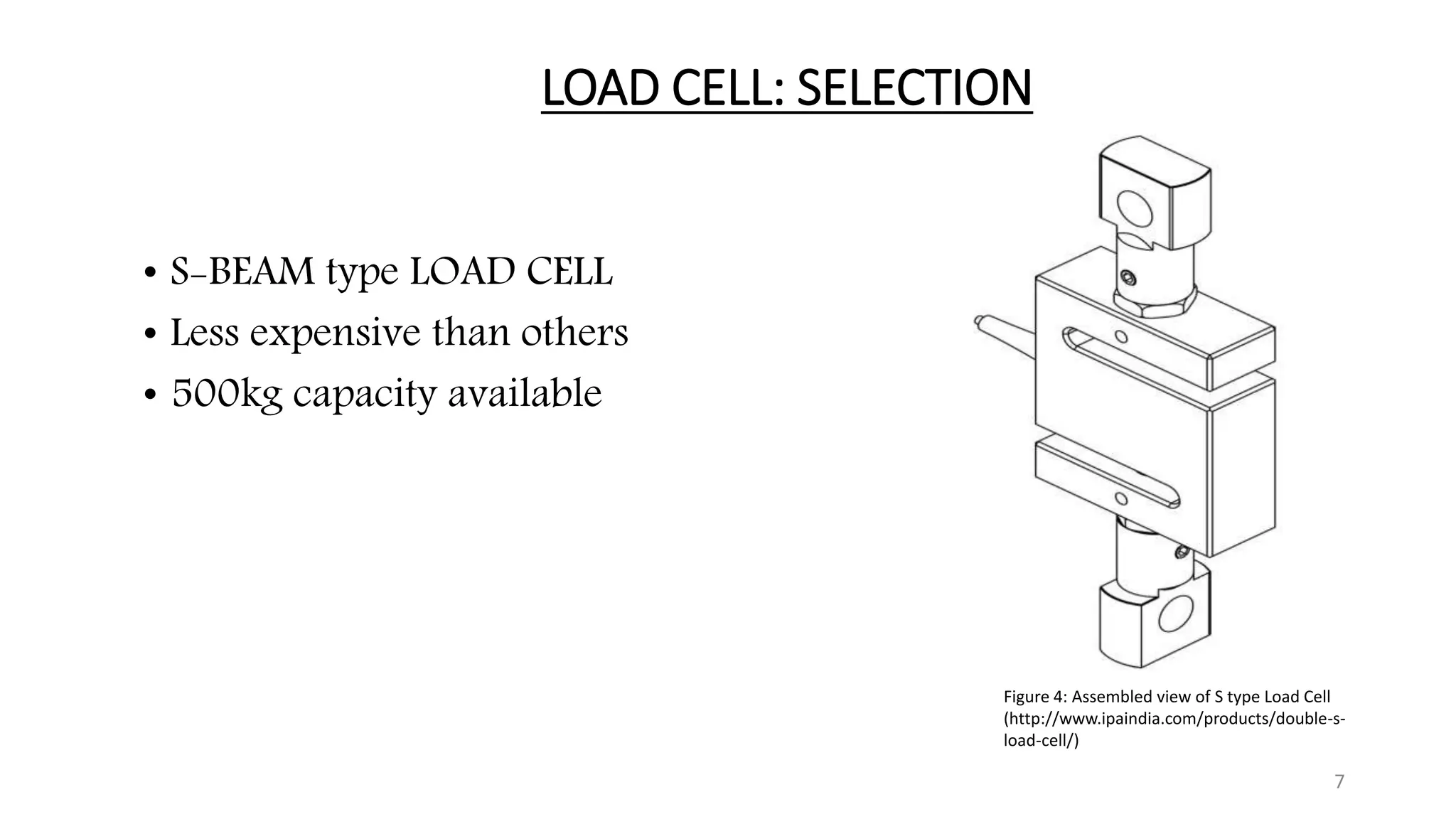
LOAD CELL: SELECTION
• S-BEAM type LOAD CELL
• Less expensive than others
• 500kg capacity available
7
Figure 4: Assembled view of S type Load Cell
(http://www.ipaindia.com/products/double-s-
load-cell/)
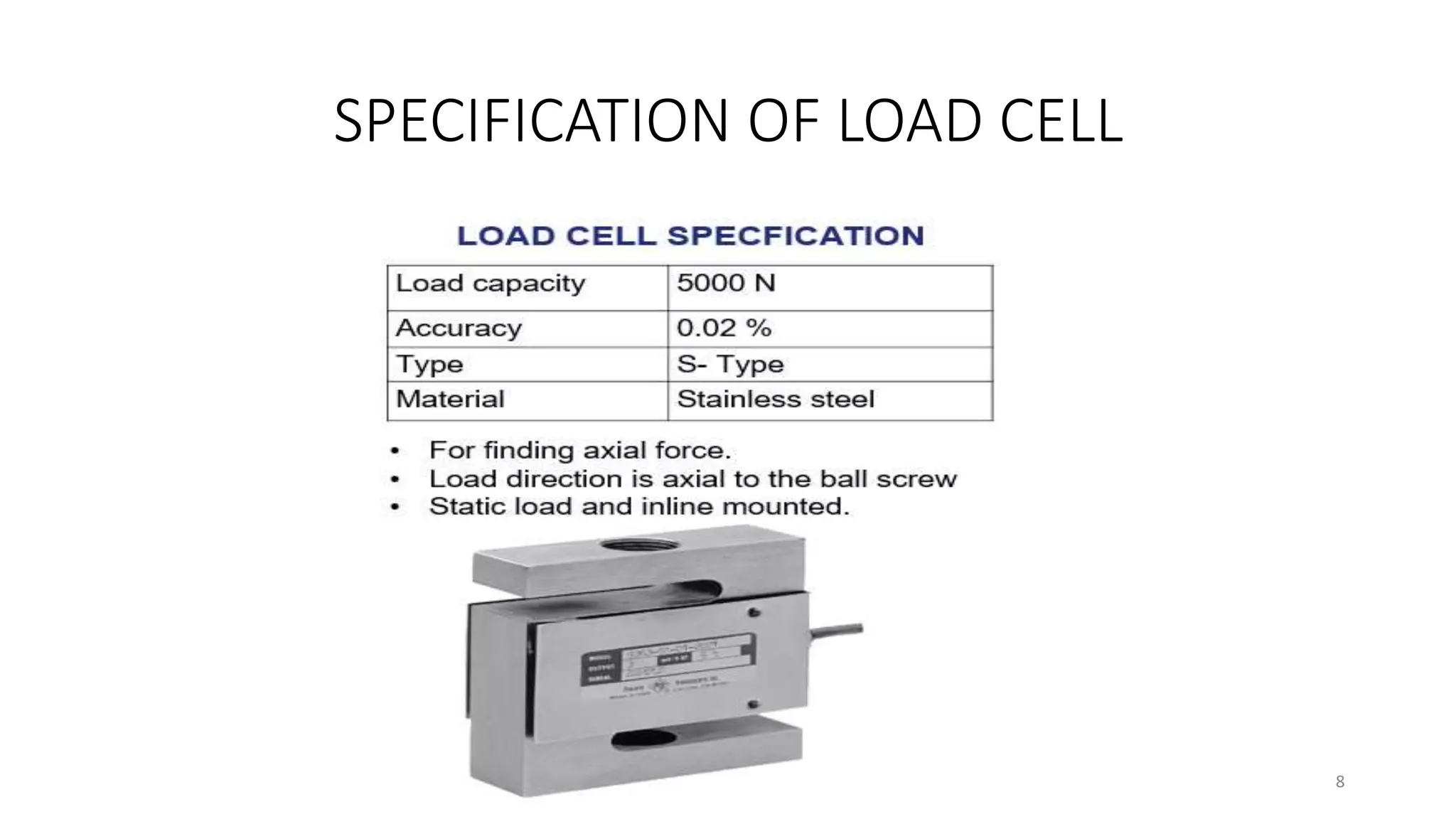
SPECIFICATION OF LOAD CELL
8
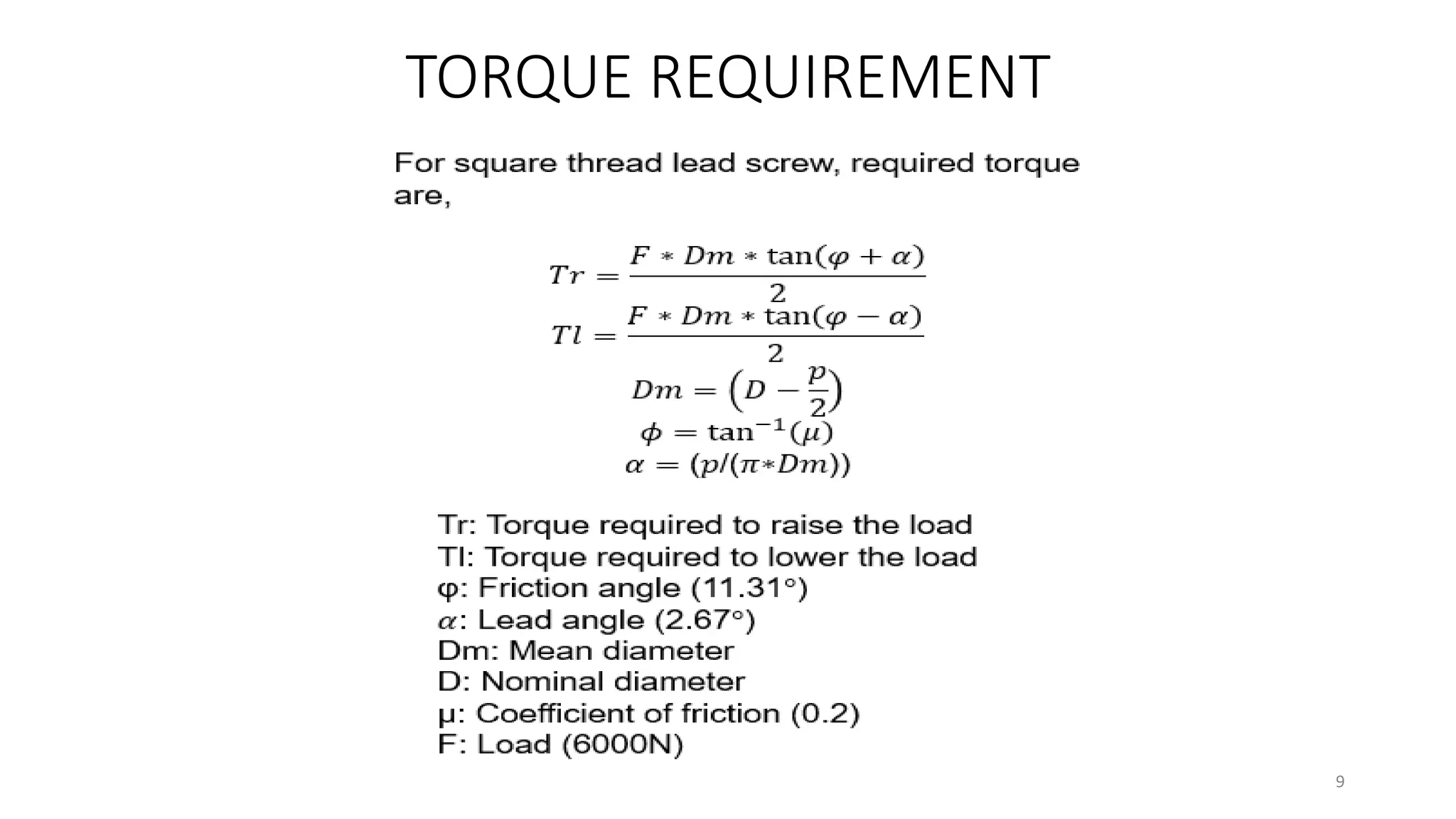
TORQUE REQUIREMENT
9
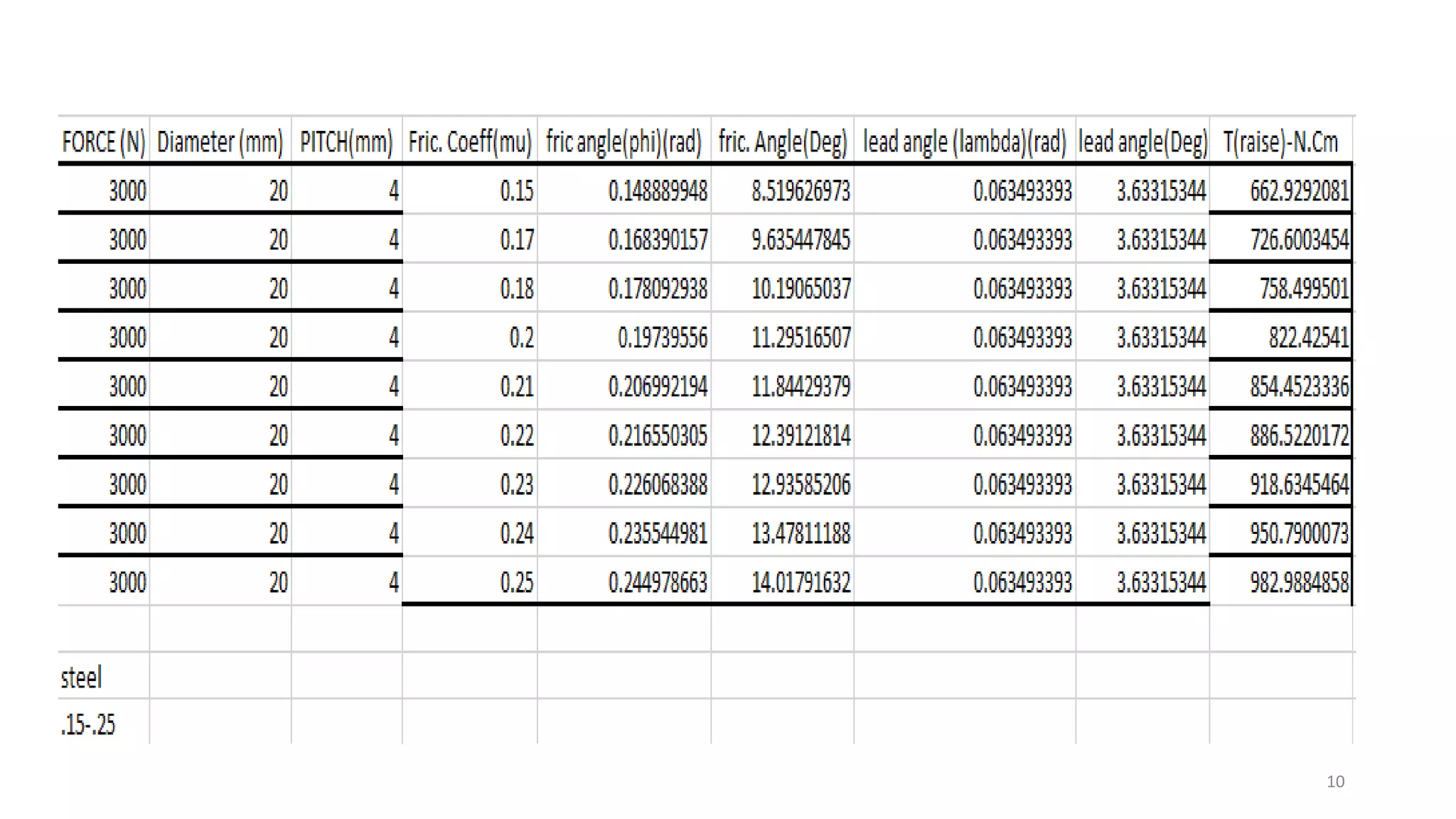
10
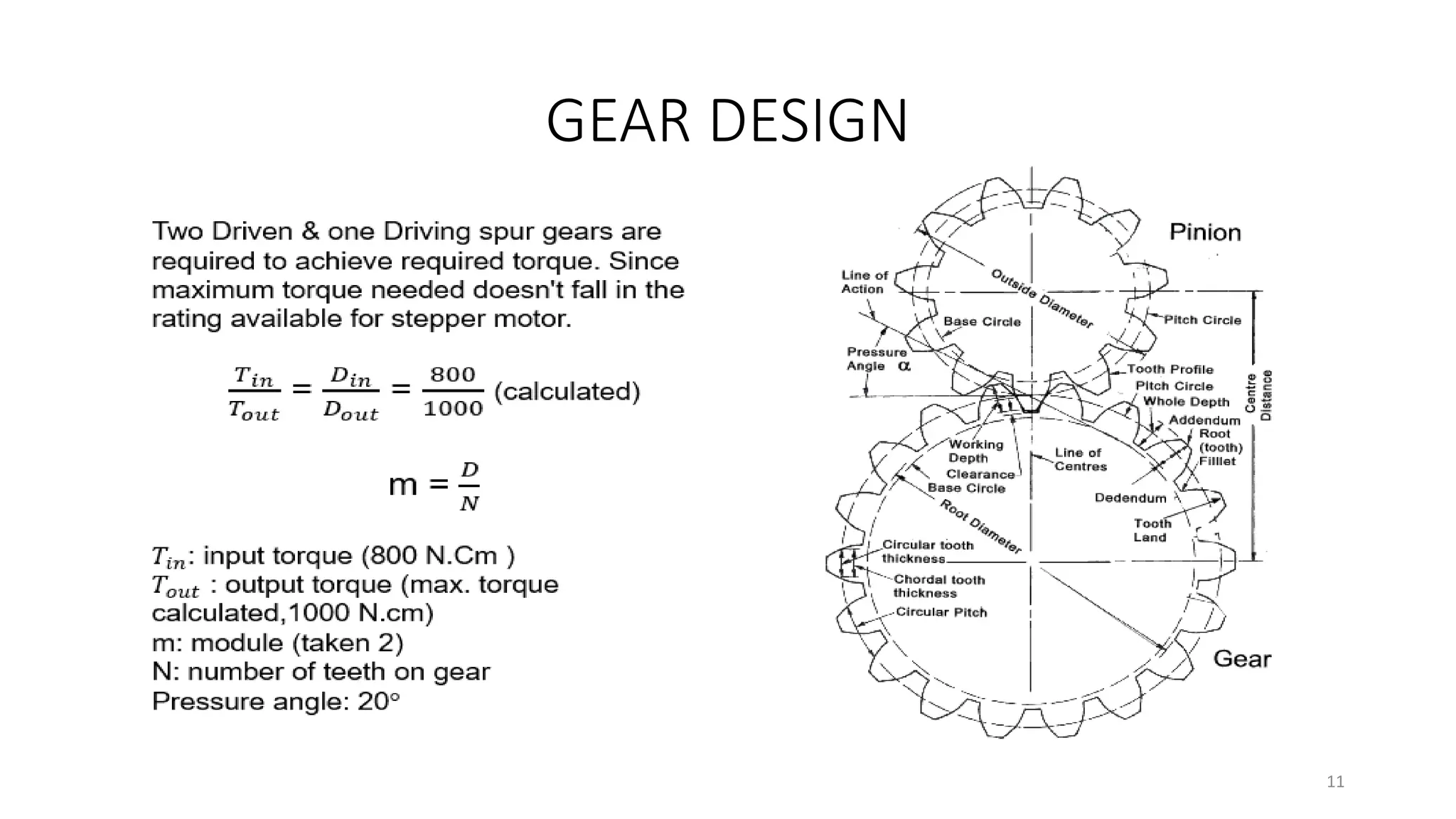
GEAR DESIGN
11
• Constraints: Center to center distance is 50 mm
• Torque ratio: 1000/800 (calculated)
• Bore diameter: 19mm for driving and 15mm for driven gear.
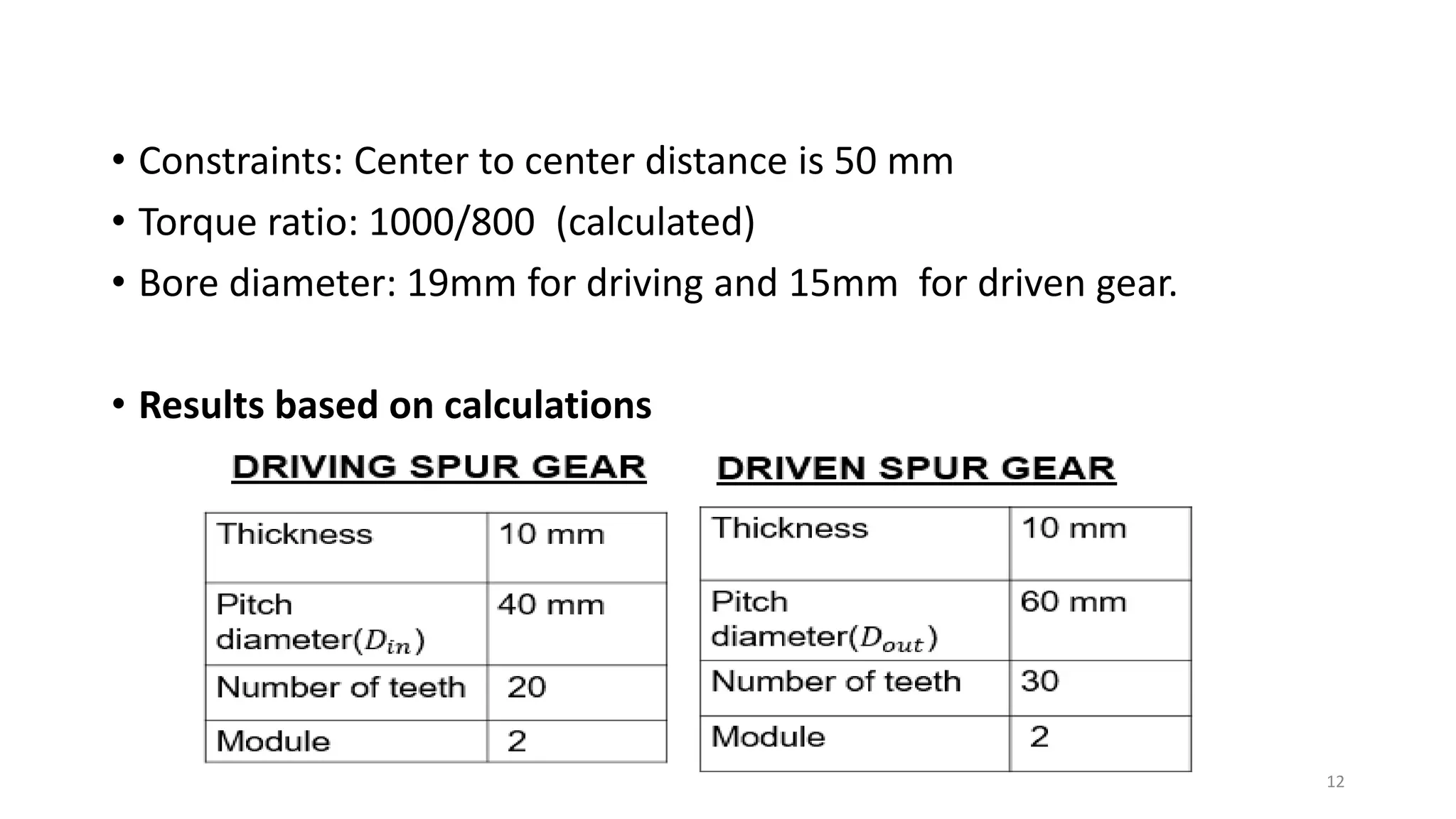
• Results based on calculations
12
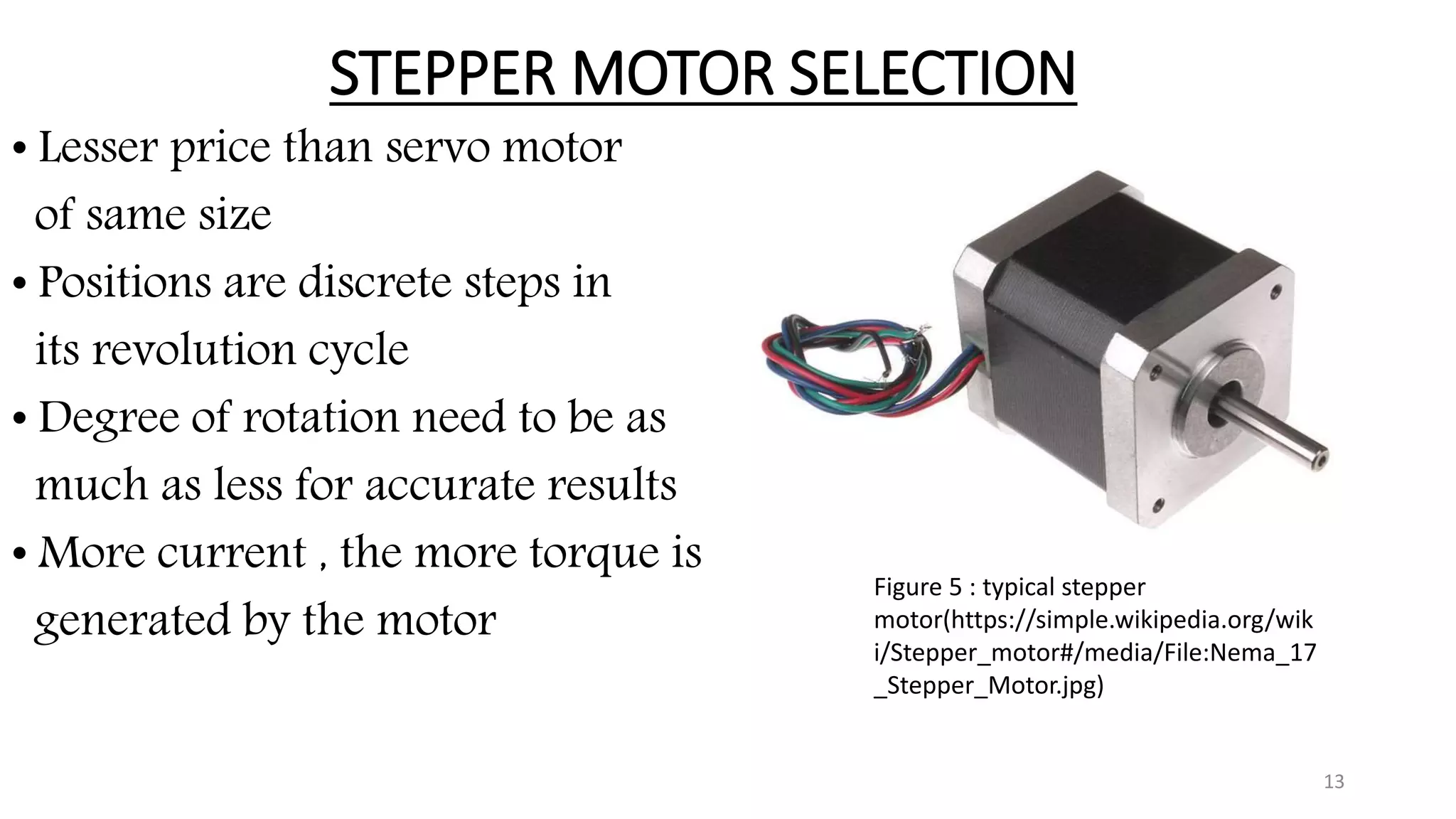
STEPPER MOTOR SELECTION
• Lesser price than servo motor
of same size
• Positions are discrete steps in
its revolution cycle
• Degree of rotation need to be as
much as less for accurate results
• More current , the more torque is
generated by the motor
13
Figure 5 : typical stepper
motor(https://simple.wikipedia.org/wik
i/Stepper_motor#/media/File:Nema_17
_Stepper_Motor.jpg)
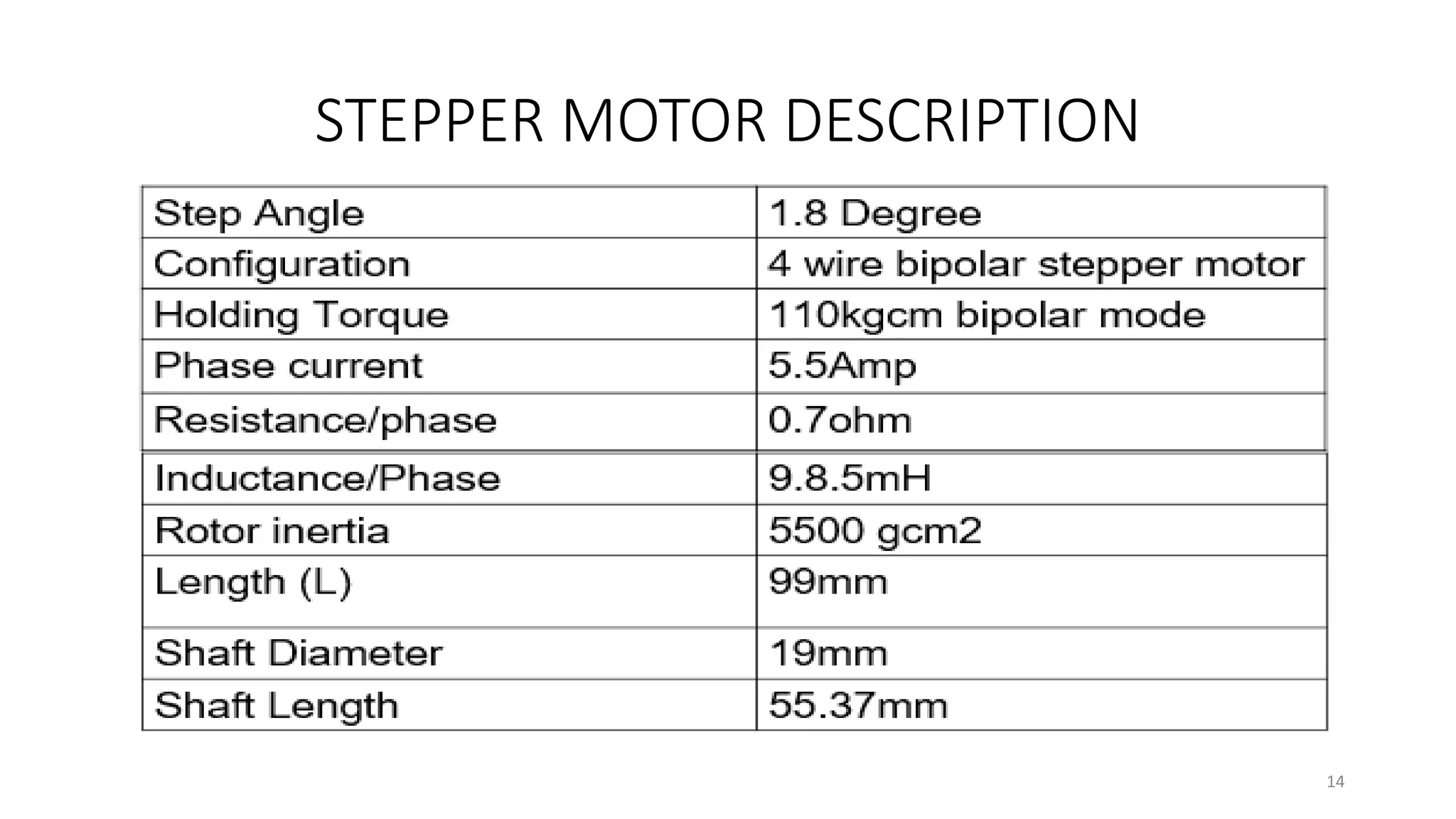
STEPPER MOTOR DESCRIPTION
14
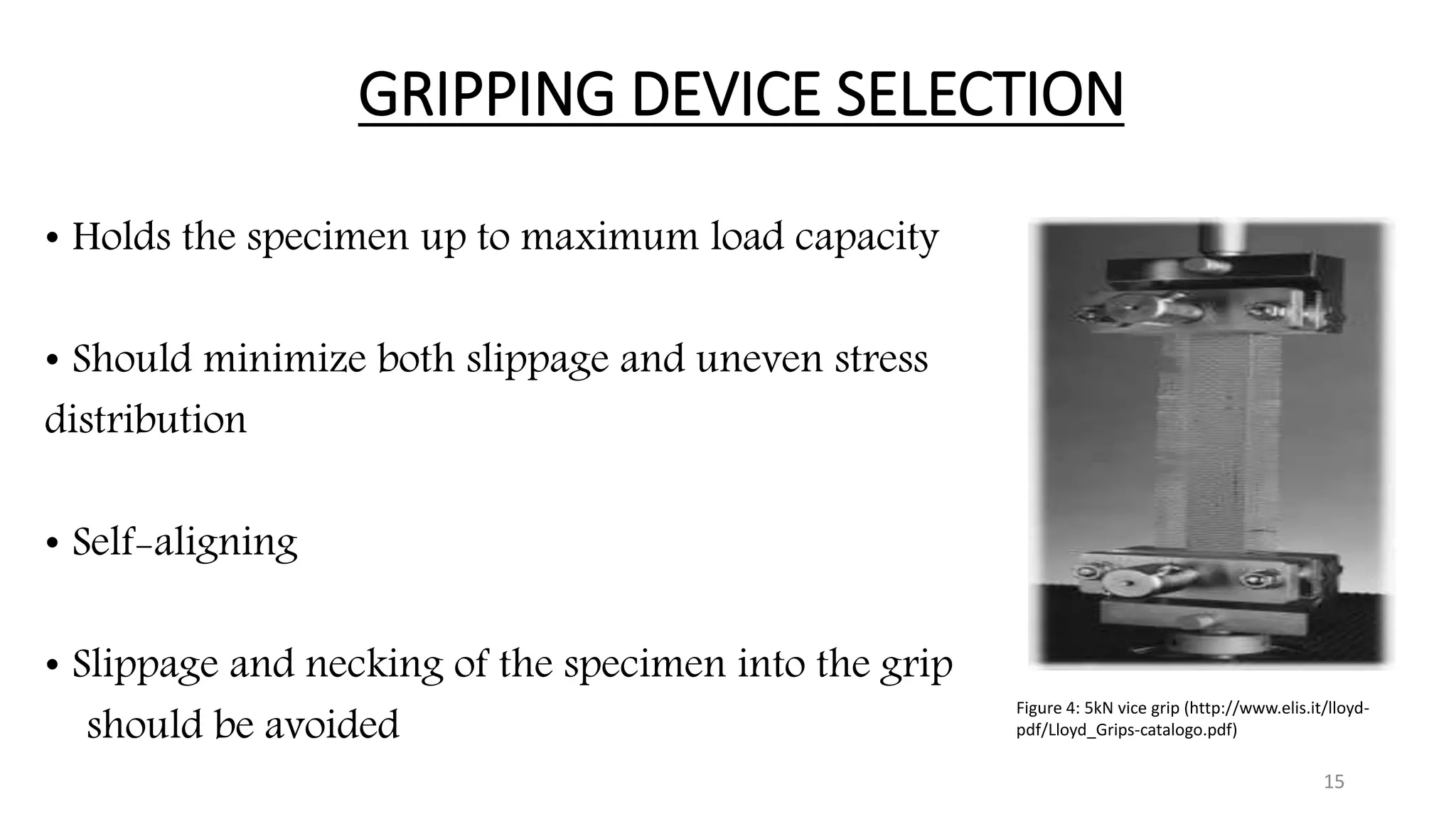
GRIPPING DEVICE SELECTION
• Holds the specimen up to maximum load capacity
• Should minimize both slippage and uneven stress
distribution
• Self-aligning
• Slippage and necking of the specimen into the grip
should be avoided
15
Figure 4: 5kN vice grip (http://www.elis.it/lloyd-
pdf/Lloyd_Grips-catalogo.pdf)
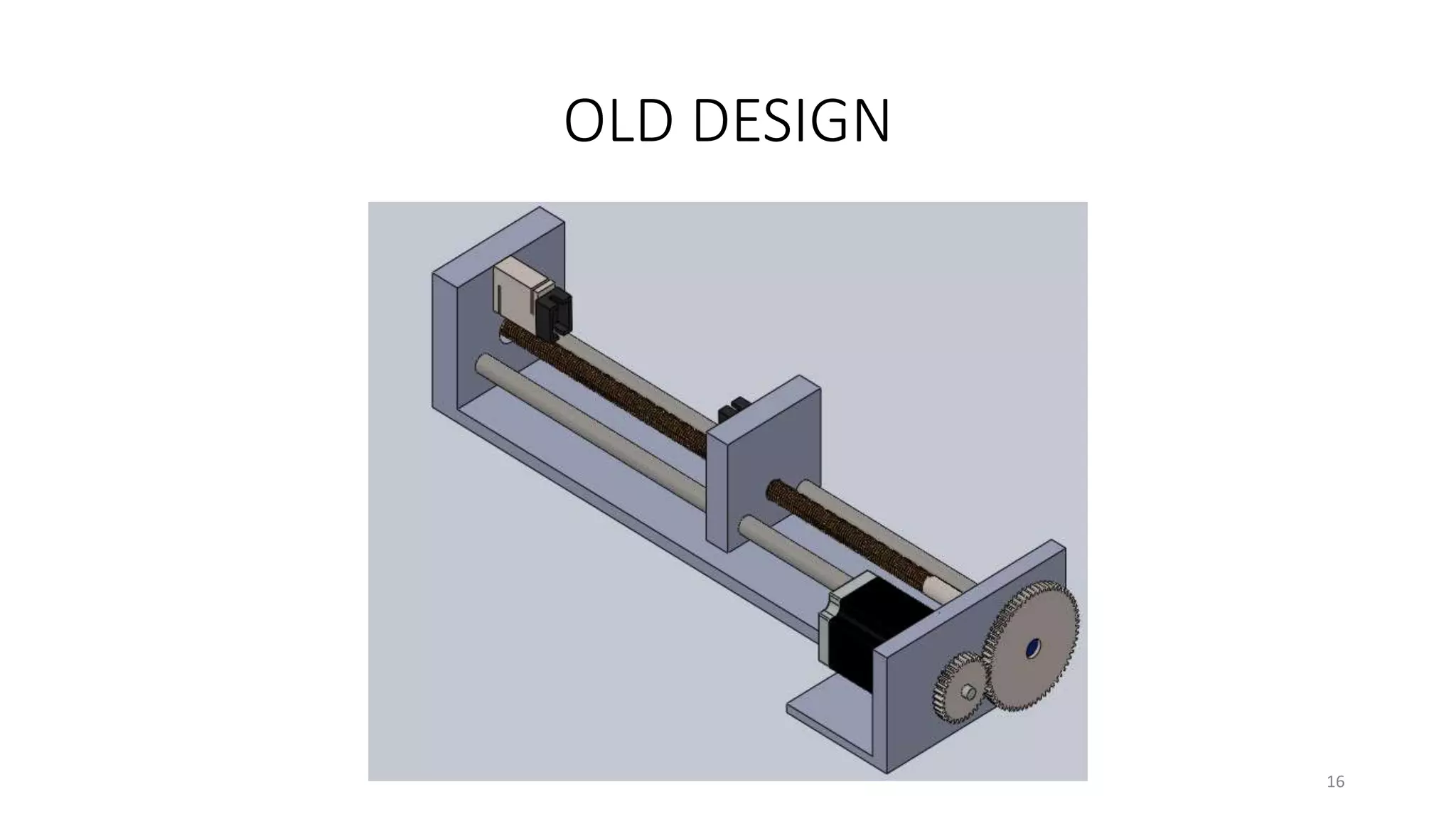
OLD DESIGN
16
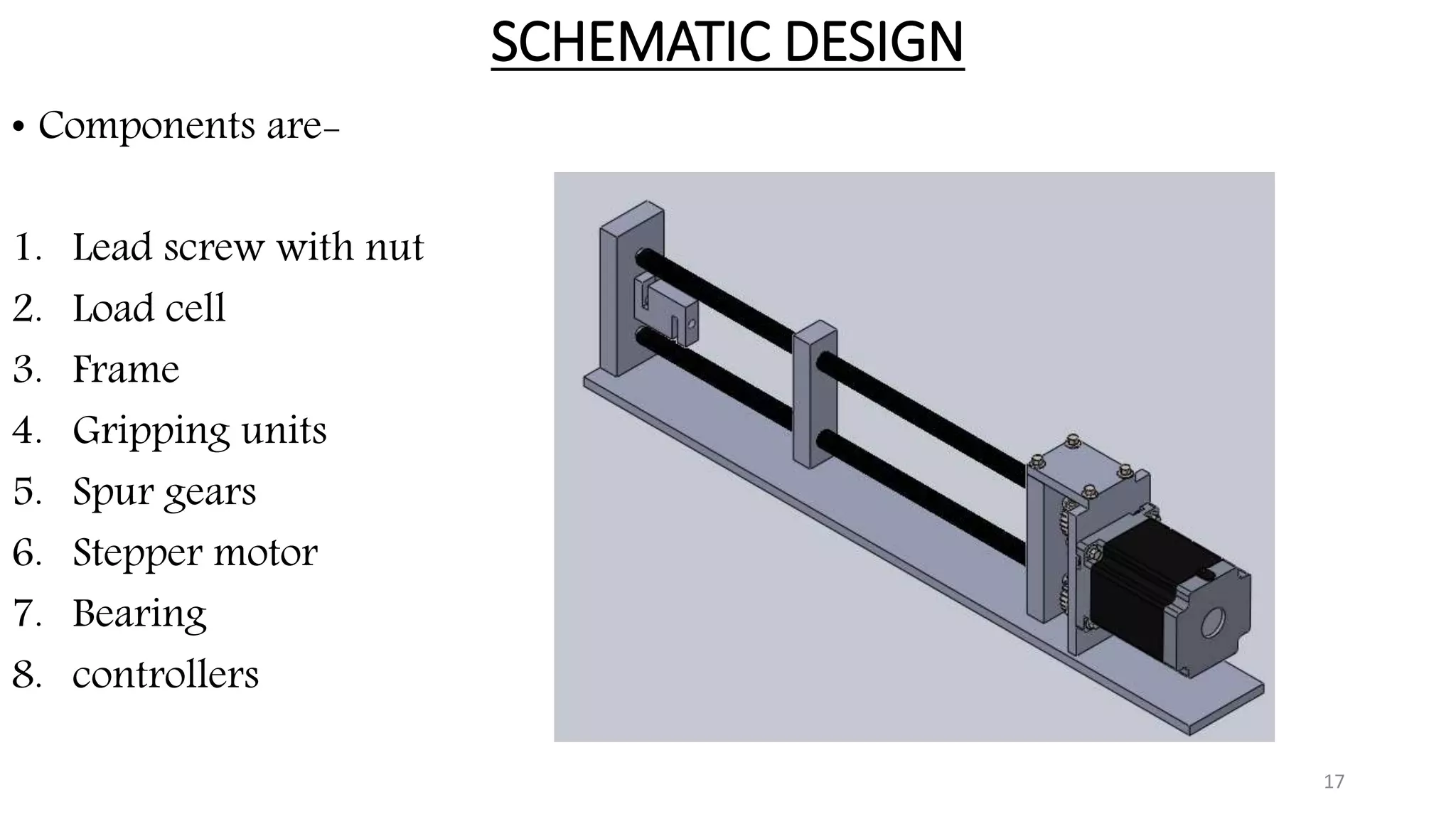
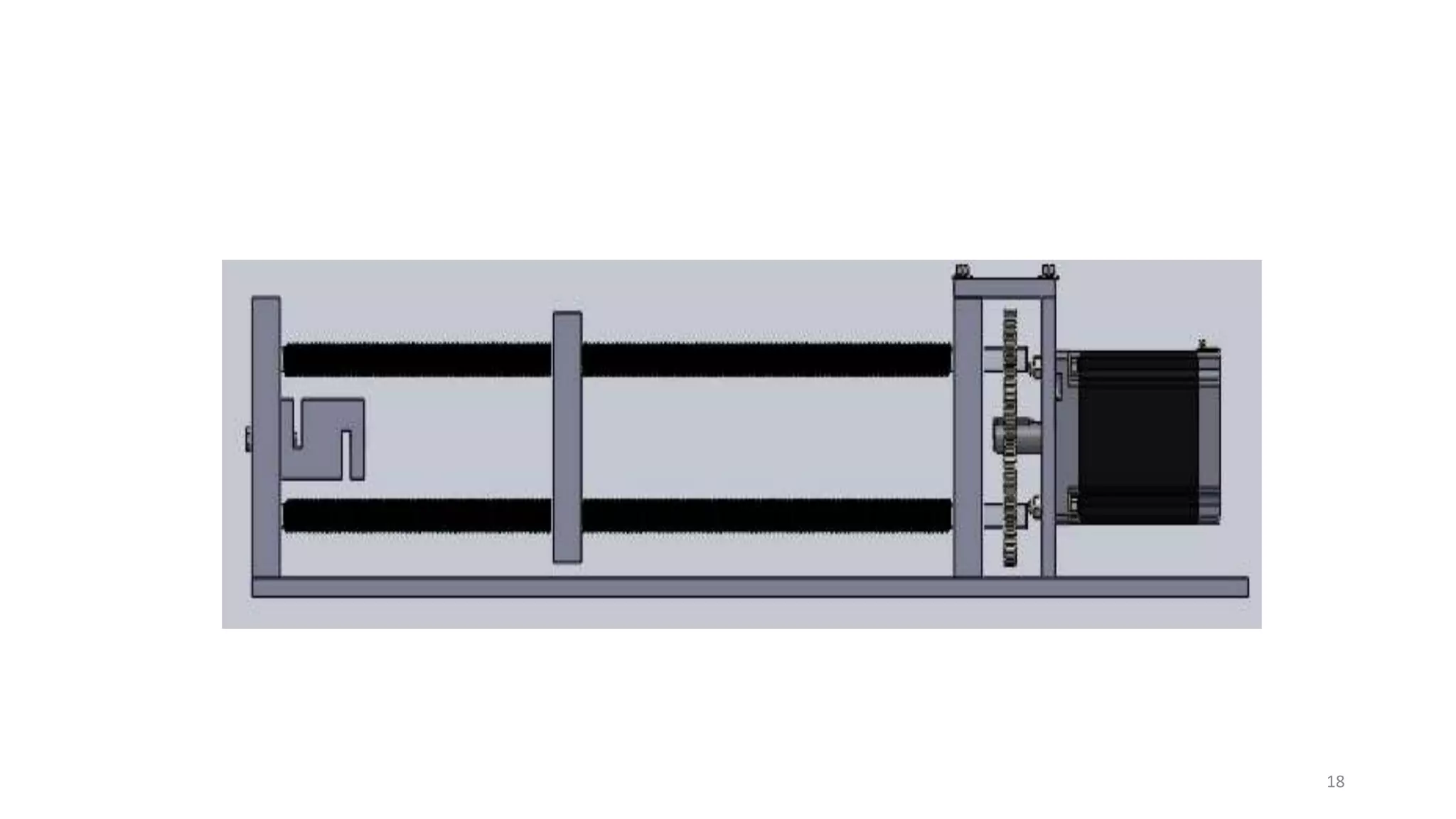
SCHEMATIC DESIGN
• Components are-
1. Lead screw with nut
2. Load cell
3. Frame
4. Gripping units
5. Spur gears
6. Stepper motor
7. Bearing
8. controllers
17
18
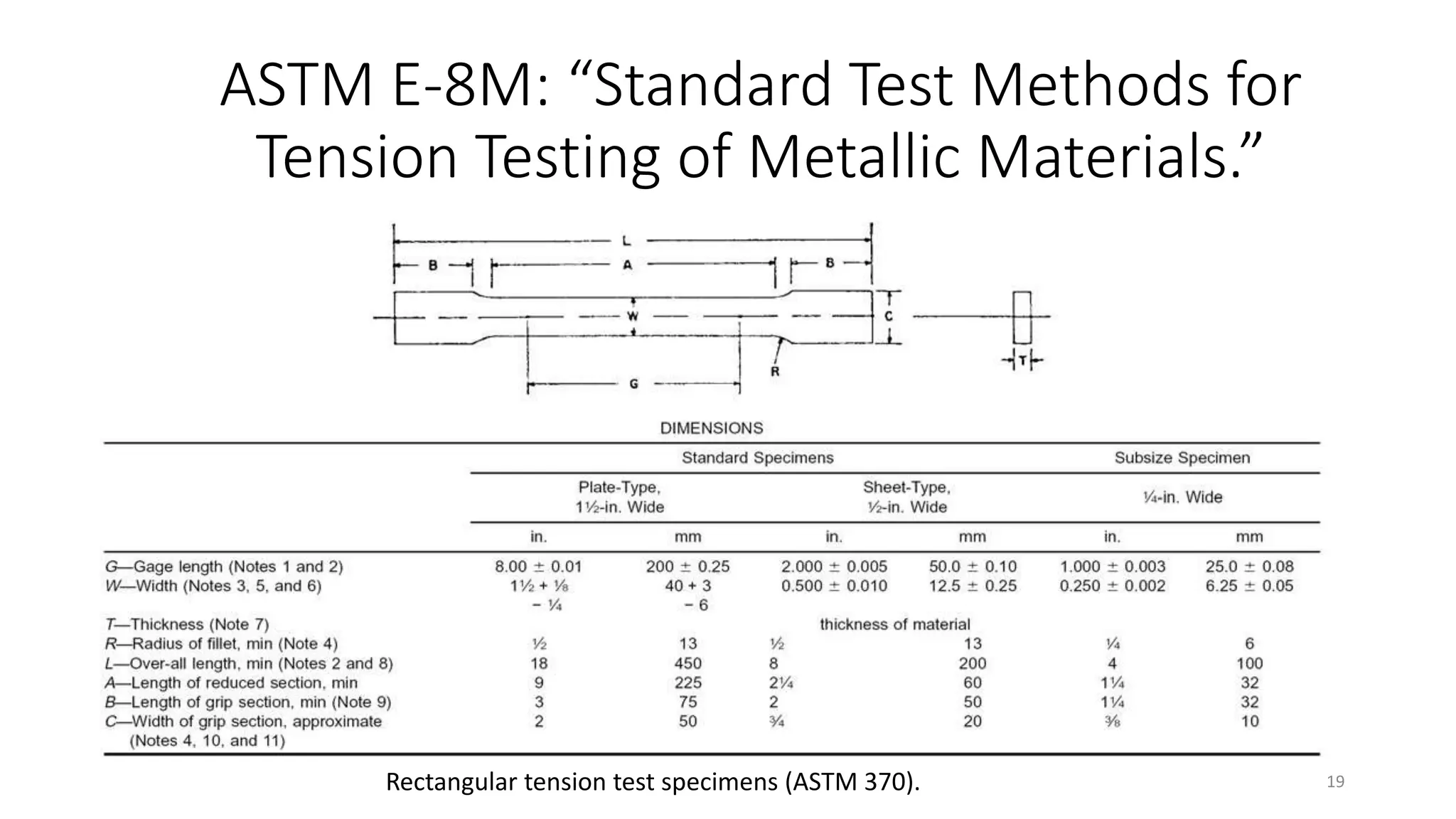
ASTM E-8M: “Standard Test Methods for
Tension Testing of Metallic Materials.”
19Rectangular tension test specimens (ASTM 370).
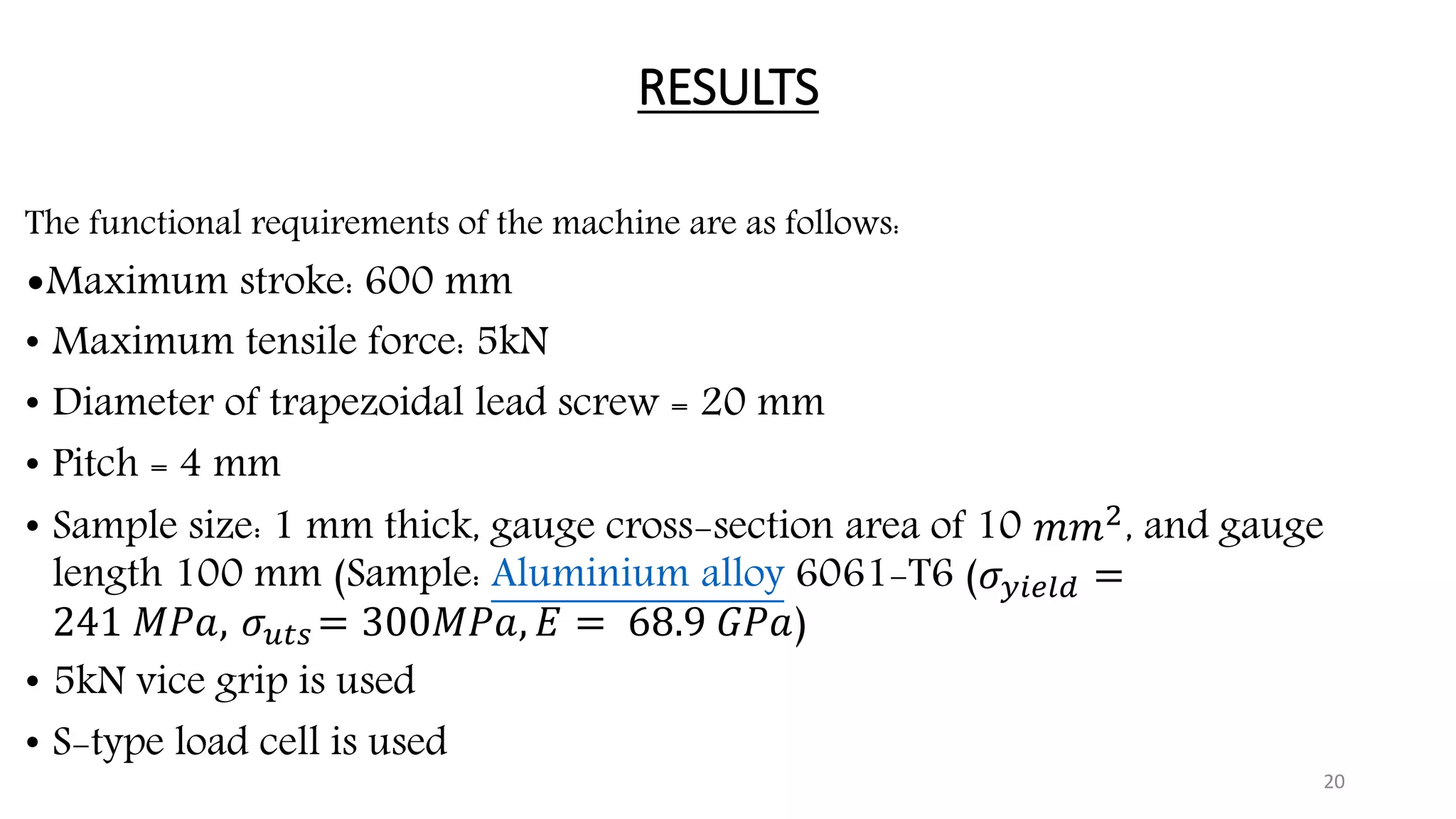
RESULTS
The functional requirements of the machine are as follows:
•Maximum stroke: 600 mm
• Maximum tensile force: 5kN
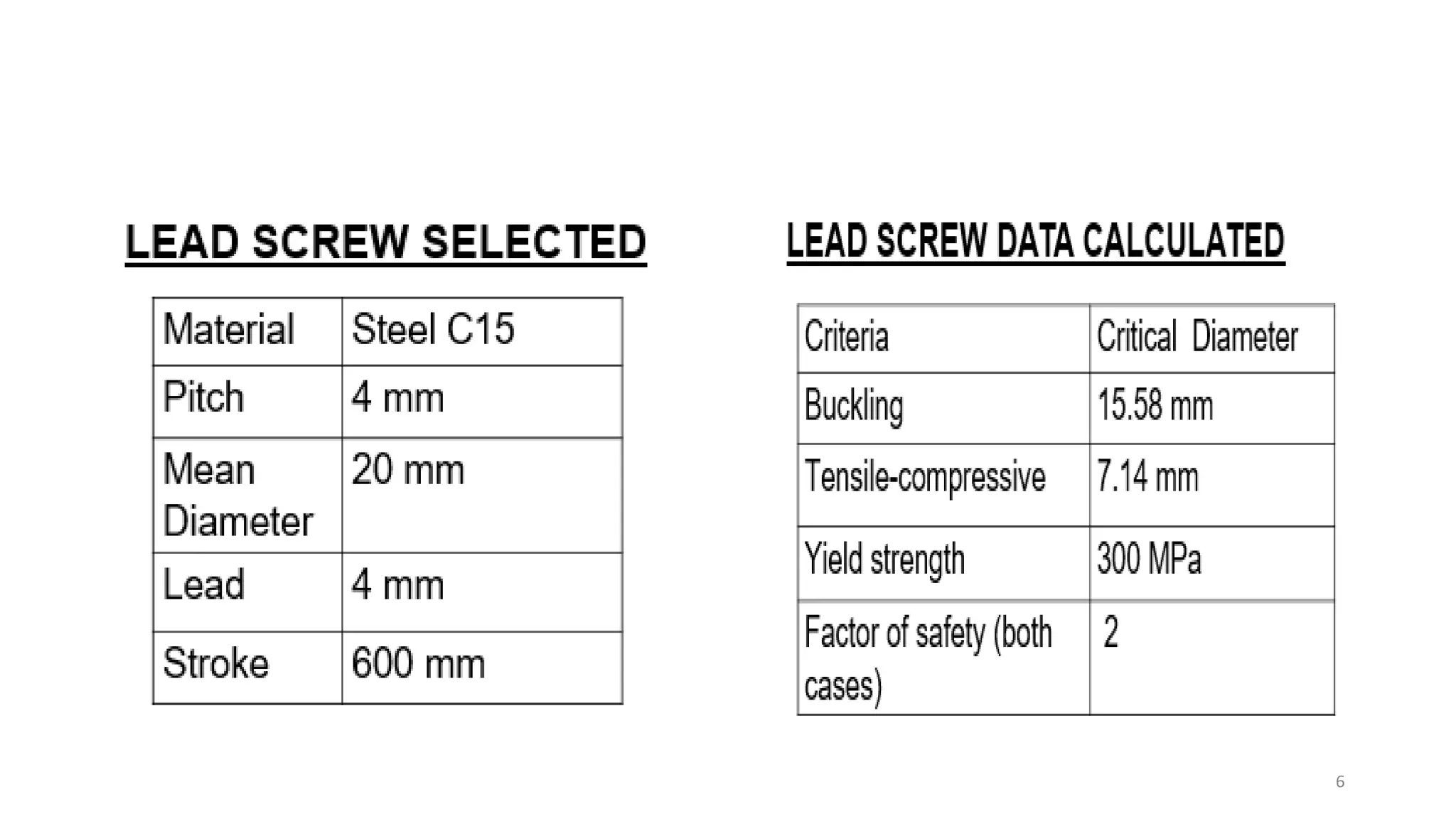
• Diameter of trapezoidal lead screw = 20 mm
• Pitch = 4 mm
• Sample size: 1 mm thick, gauge cross-section area of 10 𝑚𝑚2
, and gauge
length 100 mm (Sample: Aluminium alloy 6061-T6 (𝜎 𝑦𝑖𝑒𝑙𝑑 =
241 𝑀𝑃𝑎, 𝜎 𝑢𝑡𝑠 = 300𝑀𝑃𝑎, 𝐸 = 68.9 𝐺𝑃𝑎)
• 5kN vice grip is used
• S-type load cell is used
20
REFERENCES…
[1] RUSSELL C.HIBBELER, Mechanics of materials, 9th edition.
[2] Woong Lim & Ho-Kyung Kim, Design and development of a miniaturised tensile testing machine, Global Journal of
Engineering Education, Volume 15, Number 1, 2013
[3] Shigley, Mechanical Engineering Design, Richard G. Budynas
[4] Machine Design by V L. Maleev and Hartman
[5] https://en.wikipedia.org/wiki/Tensile_testing
[6] https://en.wikipedia.org/wiki/Linear_encoder
[7] http://www.ipaindia.com/products/double-s-load-cell/
[8] http://www.elis.it/lloyd-pdf/Lloyd_Grips-catalogo.pdf
[9] http://www.motionusa.com.s3-website-us-east-1.amazonaws.com/nook/BallScrews/PowerTrac_Full_Catalog.pdf
[10] http://www.festo.com/net/SupportPortal/Files/10257/Festo_10_Tips_servos_steppers.pdf
[11] https://simple.wikipedia.org/wiki/File:Nema_17_Stepper_Motor.jpg
[12] ASTM E-8M: “Standard Test Methods for Tension Testing of Metallic Materials.”
http://compass.astm.org/EDIT/html_annot.cgi?E8+15a
21
Thank you!
22

Design and development of horizontal tensile testing machine (5kN)

  • 1.
    CPP301 Core Project-II Design anddevelopment of horizontal tensile testing machine (5kN) Under the supervision of: Dr. Dhiraj Kumar Mahajan A Presentation by Sajeed Mahaboob (2011ME1111) Krishanu Sarkar (2012MEB1102) 1
  • 2.
    MOTIVATION • Tensile testsare performed to achieve material parameters such as UTS, yield strength, % elongation, % area reduction and young’s modulus. • These important parameters obtained are useful for selection of engineering materials for many applications. • Need of horizontal tensile machine for testing in different environment conditions. • Miniaturized (Horizontal, Max 5kN) 2
  • 3.
    TENSILE TESTING PRINCIPLE 3 Figure1 : A typical Engineering Stress- Strain Diagram for a Ductile Material 𝜎 (Engineering stress)=F/𝐴0 Necking starts (local deformation) : applied engineering stress is equal to ultimate tensile stress (i.e 𝜎 = 𝜎 𝑢𝑡𝑠) Yielding (uniform deformation) : 𝜎 > 𝜎 𝑦𝑖𝑒𝑙𝑑 E: Young’s modulus Only in elastic region, 𝜎 = 𝐸 ∗ ∈
  • 4.
    COMPONENTS IN OURPROJECT • Lead screw (Trapezoidal) • Load cell (S-Type) • Stepper motor • Strain gauge • Gripping units • Base and supporting plates • Spur gears • Ball Bearings • Controllers 4
  • 5.
    TRAPEZOIDAL LEAD SCREW:SELECTION • Trapezoidal lead screw is selected over square thread, as it has higher load carrying capacity. • Better power transmission • Parameter selected using criteria, Tensile and compression D= 4.𝐿𝑜𝑎𝑑 𝜋.𝜎 𝑦𝑖𝑒𝑙𝑑 1 2 Buckling 𝑃𝑐𝑟 = 𝑓𝑠 . 𝜋2.𝐸.𝐼 𝐿2 D = 𝑓𝑠.𝑝 𝑐𝑟.𝐿2 𝜋3.𝐸 1 4 5
  • 6.
  • 7.
    LOAD CELL: SELECTION •S-BEAM type LOAD CELL • Less expensive than others • 500kg capacity available 7 Figure 4: Assembled view of S type Load Cell (http://www.ipaindia.com/products/double-s- load-cell/)
  • 8.
  • 9.
  • 10.
  • 11.
  • 12.
    • Constraints: Centerto center distance is 50 mm • Torque ratio: 1000/800 (calculated) • Bore diameter: 19mm for driving and 15mm for driven gear. • Results based on calculations 12
  • 13.
    STEPPER MOTOR SELECTION •Lesser price than servo motor of same size • Positions are discrete steps in its revolution cycle • Degree of rotation need to be as much as less for accurate results • More current , the more torque is generated by the motor 13 Figure 5 : typical stepper motor(https://simple.wikipedia.org/wik i/Stepper_motor#/media/File:Nema_17 _Stepper_Motor.jpg)
  • 14.
  • 15.
    GRIPPING DEVICE SELECTION •Holds the specimen up to maximum load capacity • Should minimize both slippage and uneven stress distribution • Self-aligning • Slippage and necking of the specimen into the grip should be avoided 15 Figure 4: 5kN vice grip (http://www.elis.it/lloyd- pdf/Lloyd_Grips-catalogo.pdf)
  • 16.
  • 17.
    SCHEMATIC DESIGN • Componentsare- 1. Lead screw with nut 2. Load cell 3. Frame 4. Gripping units 5. Spur gears 6. Stepper motor 7. Bearing 8. controllers 17
  • 18.
  • 19.
    ASTM E-8M: “StandardTest Methods for Tension Testing of Metallic Materials.” 19Rectangular tension test specimens (ASTM 370).
  • 20.
    RESULTS The functional requirementsof the machine are as follows: •Maximum stroke: 600 mm • Maximum tensile force: 5kN • Diameter of trapezoidal lead screw = 20 mm • Pitch = 4 mm • Sample size: 1 mm thick, gauge cross-section area of 10 𝑚𝑚2 , and gauge length 100 mm (Sample: Aluminium alloy 6061-T6 (𝜎 𝑦𝑖𝑒𝑙𝑑 = 241 𝑀𝑃𝑎, 𝜎 𝑢𝑡𝑠 = 300𝑀𝑃𝑎, 𝐸 = 68.9 𝐺𝑃𝑎) • 5kN vice grip is used • S-type load cell is used 20
  • 21.
    REFERENCES… [1] RUSSELL C.HIBBELER,Mechanics of materials, 9th edition. [2] Woong Lim & Ho-Kyung Kim, Design and development of a miniaturised tensile testing machine, Global Journal of Engineering Education, Volume 15, Number 1, 2013 [3] Shigley, Mechanical Engineering Design, Richard G. Budynas [4] Machine Design by V L. Maleev and Hartman [5] https://en.wikipedia.org/wiki/Tensile_testing [6] https://en.wikipedia.org/wiki/Linear_encoder [7] http://www.ipaindia.com/products/double-s-load-cell/ [8] http://www.elis.it/lloyd-pdf/Lloyd_Grips-catalogo.pdf [9] http://www.motionusa.com.s3-website-us-east-1.amazonaws.com/nook/BallScrews/PowerTrac_Full_Catalog.pdf [10] http://www.festo.com/net/SupportPortal/Files/10257/Festo_10_Tips_servos_steppers.pdf [11] https://simple.wikipedia.org/wiki/File:Nema_17_Stepper_Motor.jpg [12] ASTM E-8M: “Standard Test Methods for Tension Testing of Metallic Materials.” http://compass.astm.org/EDIT/html_annot.cgi?E8+15a 21
  • 22.