Get the box of StuffGet the box of Stuff
Wood, steel, aluminum, melamineWood, steel, aluminum, melamine
Properties of MaterialsProperties of Materials
Goal: Students will be able toGoal: Students will be able to
describe various physicaldescribe various physical
properties that materials haveproperties that materials have
DiscussionDiscussion
 differentiate between chemical anddifferentiate between chemical and
physical propertiesphysical properties
 At your tables list examples of chemicalAt your tables list examples of chemical
and physical properties.and physical properties.
 I will call on each table and make a list ofI will call on each table and make a list of
all the ones we can think of.all the ones we can think of.
Chemical PropertiesChemical Properties
 how a material interacts with anotherhow a material interacts with another
materialmaterial
 ““social” behaviorsocial” behavior
 response to other matter (or lack ofresponse to other matter (or lack of
response)response)
 reactionsreactions
Chemical PropertiesChemical Properties
 Examples:Examples:
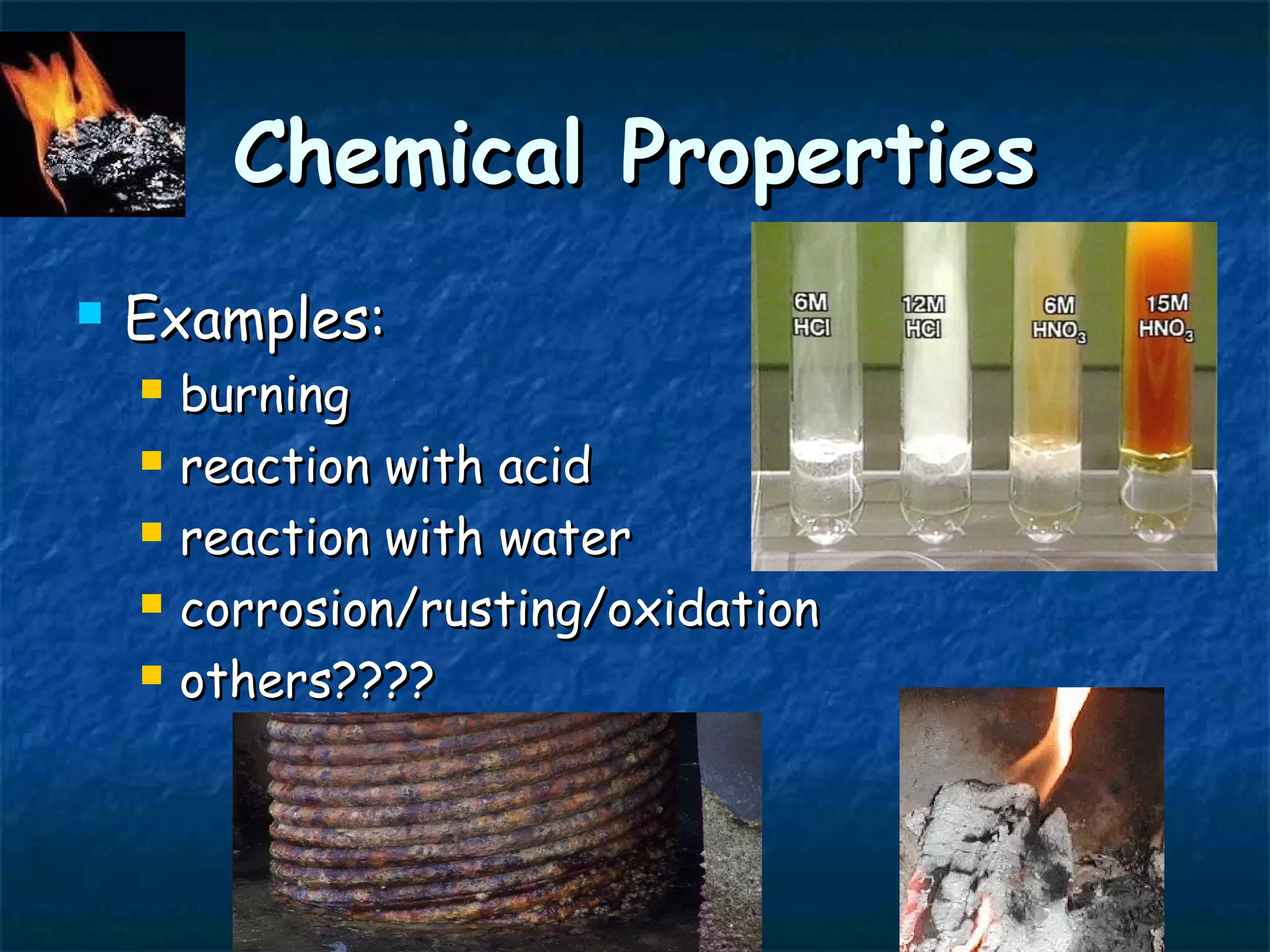
 burningburning
 reaction with acidreaction with acid
 reaction with waterreaction with water
 corrosion/rusting/oxidationcorrosion/rusting/oxidation
 others????others????
Physical PropertiesPhysical Properties
 characteristics it possesses by itselfcharacteristics it possesses by itself
(in and of itself)(in and of itself)
 ““personal” traitspersonal” traits
 response to energyresponse to energy
Physical PropertiesPhysical Properties
 colorcolor
 sizesize
 texturetexture
 melting pointmelting point
 boiling pointboiling point
 solubilitysolubility
 lusterluster
 densitydensity
 magnetismmagnetism
 odorodor
 viscosityviscosity
 crystalline structurecrystalline structure
Physical PropertiesPhysical Properties
 ElectricalElectrical propertiesproperties
 conductor or insulatorconductor or insulator
 OpticalOptical properties – response to lightproperties – response to light
 index ofindex of refractionrefraction – bending of light– bending of light
 transparenttransparent – light passes through– light passes through
 translucenttranslucent – some light passes through but no– some light passes through but no
distinct imagedistinct image
 opaqueopaque – no light passes through– no light passes through
Physical PropertiesPhysical Properties
 ThermalThermal properties – response to heatproperties – response to heat
 conductivityconductivity
 specific heat – how much energy it takes tospecific heat – how much energy it takes to
change temperaturechange temperature
 thermal expansion –thermal expansion – example: iron wireexample: iron wire
demodemo
Mechanical PropertiesMechanical Properties
 subgroup of physicalsubgroup of physical
 response to force or stressresponse to force or stress
 forceforce – a push or pull– a push or pull
 stressstress – force causing a deformation or– force causing a deformation or
distortion (force per unit area)distortion (force per unit area)
Mechanical PropertiesMechanical Properties
ExamplesExamples
 workabilityworkability
 malleabilitymalleability – can be flattened– can be flattened
 ductilityductility – can be drawn into wire– can be drawn into wire
(stretched), bent, or extruded(stretched), bent, or extruded
Mechanical PropertiesMechanical Properties
ExamplesExamples
 brittlenessbrittleness
 breaks instead of deforming when stress isbreaks instead of deforming when stress is
appliedapplied
 hardnesshardness
 resistance to denting or scratchingresistance to denting or scratching
Mechanical PropertiesMechanical Properties
ExamplesExamples
 elasticityelasticity
 ability to return to original shape afterability to return to original shape after
being deformed by stressbeing deformed by stress
 rubber ball or piece of elasticrubber ball or piece of elastic
 plasticityplasticity
 retains new shape after being deformed byretains new shape after being deformed by
stressstress
 wet clay ball or piece of saran wrapwet clay ball or piece of saran wrap
Some of the propertiesSome of the properties
 At your tables you will find some signsAt your tables you will find some signs
with different physical properties.with different physical properties.
 Go around between tables and answer theGo around between tables and answer the
questions on a separate piece of paper.questions on a separate piece of paper.
Index of Refraction
Question. What two materials here have a similar index of refraction?
(the three materials are glass, HDPE, and mineral oil)
Electrical conductivity
What materials here are non-conductive electrically?
(the materials are brass, copper coated steel, wax, glass and carbon fiber)
Hardness
Which material here is the hardest?
(Pine and Melamine)
Mechanical PropertiesMechanical Properties
ExamplesExamples
 toughnesstoughness
 ability to absorb energyability to absorb energy
 resistance to fractureresistance to fracture
 strengthstrength
 resistance to distortion by stress or forceresistance to distortion by stress or force
 several types: tensile, compressive,several types: tensile, compressive,
torsional, bending, sheartorsional, bending, shear
Types of Stresses/ForcesTypes of Stresses/Forces
 TensionTension
 pullingpulling

examples:examples: tug-of-war, slingshottug-of-war, slingshot
 CompressionCompression
 pushing together or squeezingpushing together or squeezing

examples:examples: bed springs, can crusher, bench visebed springs, can crusher, bench vise
stress
strain
Ceramic or
glass
metal
polymer
straight line = elastic region
curved line = plastic region
City of MaterialsCity of Materials
 http://www.cityofmaterials.comhttp://www.cityofmaterials.com
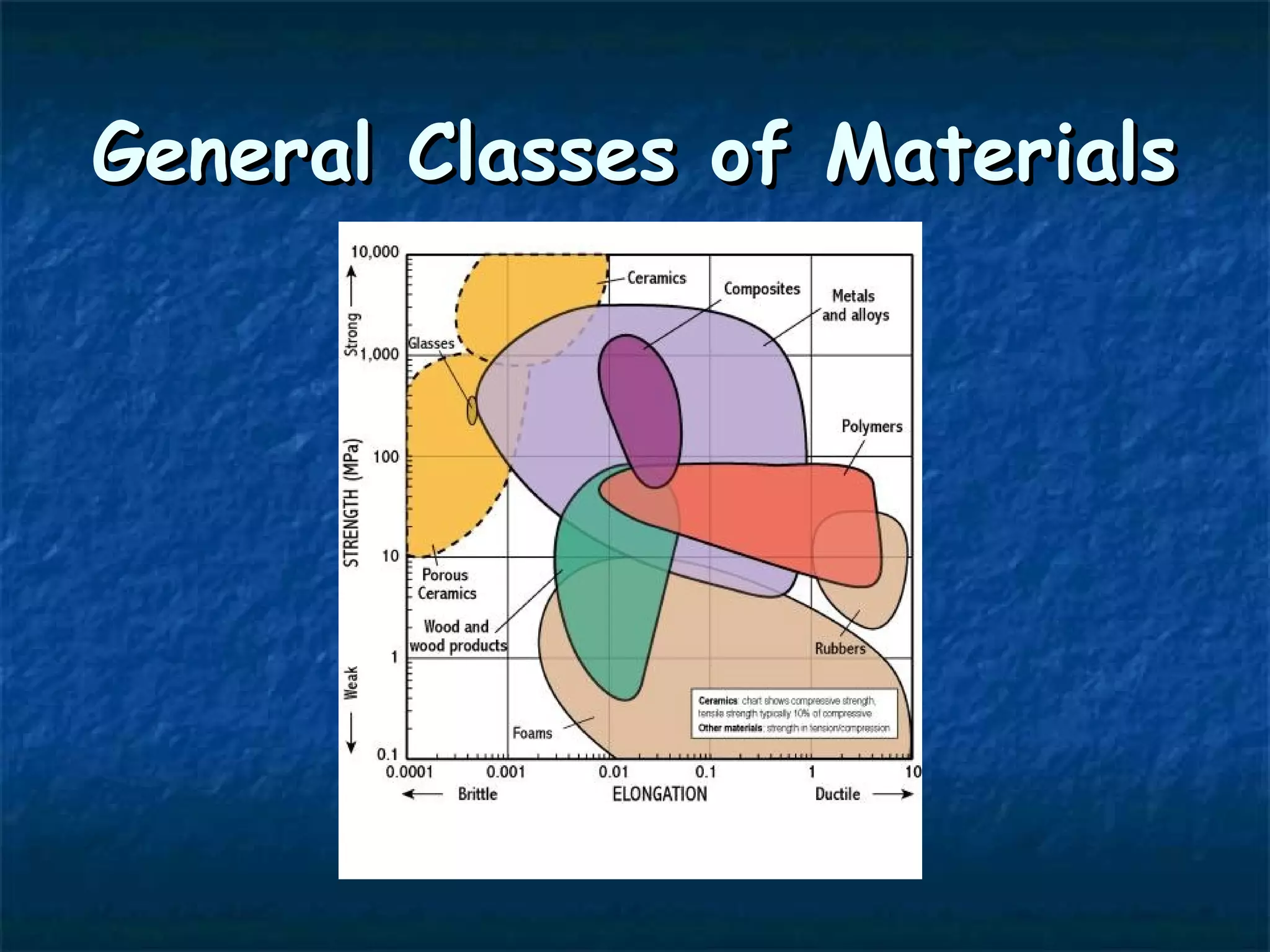
General Classes of MaterialsGeneral Classes of Materials
PolymersPolymers
CeramicsCeramics
CompositesComposites
Metals and AlloysMetals and Alloys
Wood and Wood ProductsWood and Wood Products
Free writeFree write
 On a piece of paper please describeOn a piece of paper please describe
various physical and chemical propertiesvarious physical and chemical properties
that material's have. If you can includethat material's have. If you can include
how you could test those physicalhow you could test those physical
properties.properties.

Physical mechanical chemcial properties of materials

  • 1.
    Get the boxof StuffGet the box of Stuff Wood, steel, aluminum, melamineWood, steel, aluminum, melamine
  • 2.
    Properties of MaterialsPropertiesof Materials Goal: Students will be able toGoal: Students will be able to describe various physicaldescribe various physical properties that materials haveproperties that materials have
  • 3.
    DiscussionDiscussion  differentiate betweenchemical anddifferentiate between chemical and physical propertiesphysical properties  At your tables list examples of chemicalAt your tables list examples of chemical and physical properties.and physical properties.  I will call on each table and make a list ofI will call on each table and make a list of all the ones we can think of.all the ones we can think of.
  • 4.
    Chemical PropertiesChemical Properties how a material interacts with anotherhow a material interacts with another materialmaterial  ““social” behaviorsocial” behavior  response to other matter (or lack ofresponse to other matter (or lack of response)response)  reactionsreactions
  • 5.
    Chemical PropertiesChemical Properties Examples:Examples:  burningburning  reaction with acidreaction with acid  reaction with waterreaction with water  corrosion/rusting/oxidationcorrosion/rusting/oxidation  others????others????
  • 6.
    Physical PropertiesPhysical Properties characteristics it possesses by itselfcharacteristics it possesses by itself (in and of itself)(in and of itself)  ““personal” traitspersonal” traits  response to energyresponse to energy
  • 7.
    Physical PropertiesPhysical Properties colorcolor  sizesize  texturetexture  melting pointmelting point  boiling pointboiling point  solubilitysolubility  lusterluster  densitydensity  magnetismmagnetism  odorodor  viscosityviscosity  crystalline structurecrystalline structure
  • 8.
    Physical PropertiesPhysical Properties ElectricalElectrical propertiesproperties  conductor or insulatorconductor or insulator  OpticalOptical properties – response to lightproperties – response to light  index ofindex of refractionrefraction – bending of light– bending of light  transparenttransparent – light passes through– light passes through  translucenttranslucent – some light passes through but no– some light passes through but no distinct imagedistinct image  opaqueopaque – no light passes through– no light passes through
  • 10.
    Physical PropertiesPhysical Properties ThermalThermal properties – response to heatproperties – response to heat  conductivityconductivity  specific heat – how much energy it takes tospecific heat – how much energy it takes to change temperaturechange temperature  thermal expansion –thermal expansion – example: iron wireexample: iron wire demodemo
  • 11.
    Mechanical PropertiesMechanical Properties subgroup of physicalsubgroup of physical  response to force or stressresponse to force or stress  forceforce – a push or pull– a push or pull  stressstress – force causing a deformation or– force causing a deformation or distortion (force per unit area)distortion (force per unit area)
  • 12.
    Mechanical PropertiesMechanical Properties ExamplesExamples workabilityworkability  malleabilitymalleability – can be flattened– can be flattened  ductilityductility – can be drawn into wire– can be drawn into wire (stretched), bent, or extruded(stretched), bent, or extruded
  • 13.
    Mechanical PropertiesMechanical Properties ExamplesExamples brittlenessbrittleness  breaks instead of deforming when stress isbreaks instead of deforming when stress is appliedapplied  hardnesshardness  resistance to denting or scratchingresistance to denting or scratching
  • 14.
    Mechanical PropertiesMechanical Properties ExamplesExamples elasticityelasticity  ability to return to original shape afterability to return to original shape after being deformed by stressbeing deformed by stress  rubber ball or piece of elasticrubber ball or piece of elastic  plasticityplasticity  retains new shape after being deformed byretains new shape after being deformed by stressstress  wet clay ball or piece of saran wrapwet clay ball or piece of saran wrap
  • 15.
    Some of thepropertiesSome of the properties  At your tables you will find some signsAt your tables you will find some signs with different physical properties.with different physical properties.  Go around between tables and answer theGo around between tables and answer the questions on a separate piece of paper.questions on a separate piece of paper.
  • 16.
    Index of Refraction Question.What two materials here have a similar index of refraction? (the three materials are glass, HDPE, and mineral oil) Electrical conductivity What materials here are non-conductive electrically? (the materials are brass, copper coated steel, wax, glass and carbon fiber) Hardness Which material here is the hardest? (Pine and Melamine)
  • 18.
    Mechanical PropertiesMechanical Properties ExamplesExamples toughnesstoughness  ability to absorb energyability to absorb energy  resistance to fractureresistance to fracture  strengthstrength  resistance to distortion by stress or forceresistance to distortion by stress or force  several types: tensile, compressive,several types: tensile, compressive, torsional, bending, sheartorsional, bending, shear
  • 19.
    Types of Stresses/ForcesTypesof Stresses/Forces  TensionTension  pullingpulling  examples:examples: tug-of-war, slingshottug-of-war, slingshot  CompressionCompression  pushing together or squeezingpushing together or squeezing  examples:examples: bed springs, can crusher, bench visebed springs, can crusher, bench vise
  • 21.
    stress strain Ceramic or glass metal polymer straight line= elastic region curved line = plastic region
  • 22.
    City of MaterialsCityof Materials  http://www.cityofmaterials.comhttp://www.cityofmaterials.com
  • 27.
    General Classes ofMaterialsGeneral Classes of Materials
  • 28.
  • 29.
  • 30.
  • 31.
  • 32.
  • 33.
    Wood and WoodProductsWood and Wood Products
  • 34.
    Free writeFree write On a piece of paper please describeOn a piece of paper please describe various physical and chemical propertiesvarious physical and chemical properties that material's have. If you can includethat material's have. If you can include how you could test those physicalhow you could test those physical properties.properties.

Editor's Notes

  • #6 Burning – strike a match and burn a piece of paper – burn a piece of magnesium – “burn” a copper wire Drop a piece of zinc in HCl 3. Show clip of sodium in water????
  • #8 http://cwx.prenhall.com/petrucci/medialib/media_portfolio/20.html - videos Demo – viscosity tubes Pyrite for luster
  • #9 1. Use a digital meter on a conductor and on an insulator 2. Index of refraction – how much light bends as it passes through a substance – example: standing in waist deep water or a pencil in a beaker of water, remind students of water gel crystals we did at beginning of year show examples of all 3 – use glass or plastic – show a Corelle plate http://webphysics.davidson.edu/faculty/dmb/EdibleOpticalMaterials/find_n_background.htm
  • #10 http://gr5.org/index_of_refraction/
  • #11 Conductivity – have them touch a table leg (wood) and a chair leg (metal) at the same time – discuss – use Ed. In. melt blocks Specific heat – metals have low – doesn’t take much energy to heat them up or cool them down – ceramics/glass are higher – water is very high (reason it is used in cooling systems) Ball and ring, bimetallic strip, piston and sleeve
  • #13 Malleability - (show students a rolled penny) Ductility - (show drawn wire) Show Play doh fun factory for extrusion http://www.chem-pics.co.uk/animations.htm
  • #14 Brittleness – snap a piece of chalk Hardness - pass around talc (do a metal hardness test demo – dent metal plates using a heavy weight w/ a ball bearing attached – make a shading of the dents and measure their width w/ a caliper – rank the metals)
  • #15 Show happy/sad balls Show poppers????
  • #19 (toss a metal piece - scoopula, plastic water bottle, unglazed dried clay (in a baggie), a test tube (in a baggie), Corelle plate) – metals and polymers tend to exhibit more toughness than ceramics or glass – Corelle is an exception http://www.wmtr.com/Content/charpy.htm Excellent simulation - http://www.steeluniversity.org/content/html/eng/charpy-test.asp
  • #20 Also use the 2 overheads
  • #21 (demo – break a piece of chalk w/ torsion)
  • #27 stress/strain stuff - OSU Properties of industrial materials PP - OSU 3. Strength and elongation graphs - Cambridge
  • #31 Class level
  • #32 Polymers
  • #33 ceramics
  • #34 composites
  • #35 Metals and alloys
  • #36 Metals and alloys
  • #37 Wood and wood products