HEPARIN INDUCED
THROMBOCYTOPENIA
(HIT)
Dr. Sayeedur Rahman Khan Rumi
Dr.rumibd@gmail.com
MD Cardiology Final Part Student
NHFH & RI
Introduction
• Heparin is a widely used anticoagulant drug for the treatment and
prevention of thromboembolic disorders
• Heparin may cause immune thrombocytopenia (a reduction in
platelet count), or HIT
• HIT occurs in approximately 3%-5% of patients during or after UFH
treatment for 5 days or more.
• The incidence is much lower, less than 1% during and after LMWH
therapy.
• HIT can cause life- or limb-threatening thromboses
Heparin Induced Thrombocytopenia
• Heparin induced thrombocytopenia (HIT) is characterized by a
decrease in the platelet count of more than 50% from the highest
platelet count value after the start of heparin, an onset 5 to 10 days
after the start of heparin, hypercoagulability, and the presence of
heparin dependent, platelet activating IgG antibodies.
• HIT is an immune-mediated potentially fatal syndrome in which the
heparin-induced immunoglobulins bridge platelets causing both
thrombocytopenia and thrombosis.
• HIT does not induce bleeding but rather results in a paradoxical
prothrombotic state.
• HIT is more common in surgical than medical patients (especially
cardiac and orthopaedic patients).
1. Increased platelet destruction
• Non-immune
• Septicemia/Inflammation
• Disseminated intravascular coagulation
• Thrombotic thrombocytopenic purpura
• Immune
• Autoimmune: idiopathic or secondary immune thrombocytopenia
• Alloimmune: post-transfusion purpura
• Drug-induced: prothrombic (heparin), prohemorrhagic (quinine,
quinidine, gold, sulfa antibiotics, rifampin, vancomycin, NSAIDs, many
others)
Clinical Conditions/Causes of Thrombocytopenia
(Cont‘d )
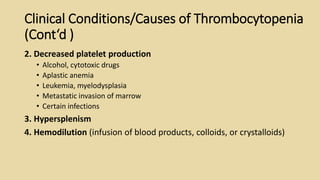
2. Decreased platelet production
• Alcohol, cytotoxic drugs
• Aplastic anemia
• Leukemia, myelodysplasia
• Metastatic invasion of marrow
• Certain infections
3. Hypersplenism
4. Hemodilution (infusion of blood products, colloids, or crystalloids)
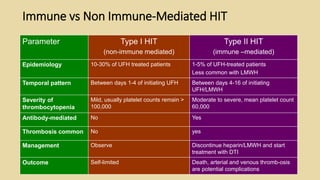
TYPES OF HIT
Parameter Type I HIT
(non-immune mediated)
Type II HIT
(immune –mediated)
Epidemiology 10-30% of UFH treated patients 1-5% of UFH-treated patients
Less common with LMWH
Temporal pattern Between days 1-4 of initiating UFH Between days 4-16 of initiating
UFH/LMWH
Severity of
thrombocytopenia
Mild, usually platelet counts remain >
100,000
Moderate to severe, mean platelet count
60,000
Antibody-mediated No Yes
Thrombosis common No yes
Management Observe Discontinue heparin/LMWH and start
treatment with DTI
Outcome Self-limited Death, arterial and venous thromb-osis
are potential complications
Immune vs Non Immune-Mediated HIT
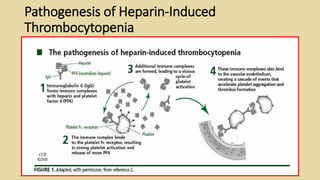
Pathogenesis of Heparin-Induced
Thrombocytopenia
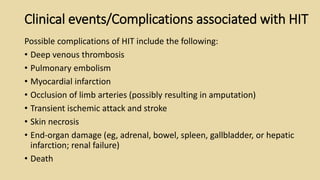
Clinical events/Complications associated with HIT
Possible complications of HIT include the following:
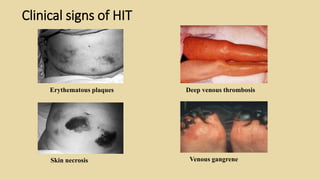
• Deep venous thrombosis
• Pulmonary embolism
• Myocardial infarction
• Occlusion of limb arteries (possibly resulting in amputation)
• Transient ischemic attack and stroke
• Skin necrosis
• End-organ damage (eg, adrenal, bowel, spleen, gallbladder, or hepatic
infarction; renal failure)
• Death
Clinical signs of HIT
Erythematous plaques
Skin necrosis
Deep venous thrombosis
Venous gangrene
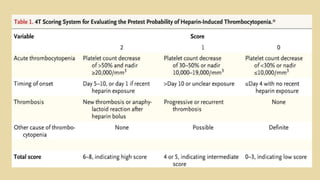
DIAGNOSIS OF HIT
Treatment of HIT
• The prompt cessation of heparin.
• As the condition is prothrombotic, these patients require alternative
anticoagulation (In the United States, lepirudin, argatroban, and
bivalirudin are licensed for HIT therapy)
• Prophylactic platelet transfusions should be avoided in patients with
HIT. The risk of bleeding is very low, and such transfusions can
increase the risk of thrombosis.
• The British Society of Haematology advises that all patients receiving
prolonged heparin of any sort should have platelet counts on day 1
and every 2-4 days.
Thank you

Heparin Induced Thrombocytopeia (HIT)

  • 1.
    HEPARIN INDUCED THROMBOCYTOPENIA (HIT) Dr. SayeedurRahman Khan Rumi Dr.rumibd@gmail.com MD Cardiology Final Part Student NHFH & RI
  • 2.
    Introduction • Heparin isa widely used anticoagulant drug for the treatment and prevention of thromboembolic disorders • Heparin may cause immune thrombocytopenia (a reduction in platelet count), or HIT • HIT occurs in approximately 3%-5% of patients during or after UFH treatment for 5 days or more. • The incidence is much lower, less than 1% during and after LMWH therapy. • HIT can cause life- or limb-threatening thromboses
  • 3.
    Heparin Induced Thrombocytopenia •Heparin induced thrombocytopenia (HIT) is characterized by a decrease in the platelet count of more than 50% from the highest platelet count value after the start of heparin, an onset 5 to 10 days after the start of heparin, hypercoagulability, and the presence of heparin dependent, platelet activating IgG antibodies. • HIT is an immune-mediated potentially fatal syndrome in which the heparin-induced immunoglobulins bridge platelets causing both thrombocytopenia and thrombosis. • HIT does not induce bleeding but rather results in a paradoxical prothrombotic state. • HIT is more common in surgical than medical patients (especially cardiac and orthopaedic patients).
  • 4.
    1. Increased plateletdestruction • Non-immune • Septicemia/Inflammation • Disseminated intravascular coagulation • Thrombotic thrombocytopenic purpura • Immune • Autoimmune: idiopathic or secondary immune thrombocytopenia • Alloimmune: post-transfusion purpura • Drug-induced: prothrombic (heparin), prohemorrhagic (quinine, quinidine, gold, sulfa antibiotics, rifampin, vancomycin, NSAIDs, many others) Clinical Conditions/Causes of Thrombocytopenia
  • 5.
    Clinical Conditions/Causes ofThrombocytopenia (Cont‘d ) 2. Decreased platelet production • Alcohol, cytotoxic drugs • Aplastic anemia • Leukemia, myelodysplasia • Metastatic invasion of marrow • Certain infections 3. Hypersplenism 4. Hemodilution (infusion of blood products, colloids, or crystalloids)
  • 6.
  • 7.
    Parameter Type IHIT (non-immune mediated) Type II HIT (immune –mediated) Epidemiology 10-30% of UFH treated patients 1-5% of UFH-treated patients Less common with LMWH Temporal pattern Between days 1-4 of initiating UFH Between days 4-16 of initiating UFH/LMWH Severity of thrombocytopenia Mild, usually platelet counts remain > 100,000 Moderate to severe, mean platelet count 60,000 Antibody-mediated No Yes Thrombosis common No yes Management Observe Discontinue heparin/LMWH and start treatment with DTI Outcome Self-limited Death, arterial and venous thromb-osis are potential complications Immune vs Non Immune-Mediated HIT
  • 8.
  • 9.
    Clinical events/Complications associatedwith HIT Possible complications of HIT include the following: • Deep venous thrombosis • Pulmonary embolism • Myocardial infarction • Occlusion of limb arteries (possibly resulting in amputation) • Transient ischemic attack and stroke • Skin necrosis • End-organ damage (eg, adrenal, bowel, spleen, gallbladder, or hepatic infarction; renal failure) • Death
  • 10.
    Clinical signs ofHIT Erythematous plaques Skin necrosis Deep venous thrombosis Venous gangrene
  • 11.
  • 13.
    Treatment of HIT •The prompt cessation of heparin. • As the condition is prothrombotic, these patients require alternative anticoagulation (In the United States, lepirudin, argatroban, and bivalirudin are licensed for HIT therapy) • Prophylactic platelet transfusions should be avoided in patients with HIT. The risk of bleeding is very low, and such transfusions can increase the risk of thrombosis. • The British Society of Haematology advises that all patients receiving prolonged heparin of any sort should have platelet counts on day 1 and every 2-4 days.
  • 14.