ABNORMAL UTERINE BLEEDING
PROF. M.C.BANSAL.
MBBS.MS.MICOG.FICOG.
FOUNDER PRINCIPAL & CONTROLLER;
JHALAWAR MEDICAL COLLEGE AND
HOSPITAL JHALAWAR.
EX. PRINCIPAL & CONTROLLER;
MAHATMA GANDHI MEDICAL COLLEGE
AND HOSPITAL , SITAPURA, JAIPUR
Normal Menstrual Cycle
 Menstration is a cyclic physiological phenomena
 starting at the age of Menarche (10-12years) till
establishment of Menopause (45-55 yrs).
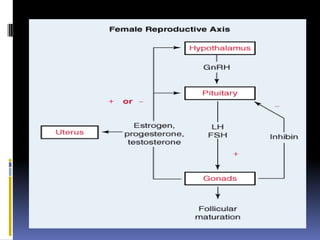
 It is regulated by hypothalmo-pituitary- ovarian
hormones secreted in pulsatile and cyclic
pattern.
 Also influenced by endometrial response top
these (E& P ) hormones and coagulation
cascade.
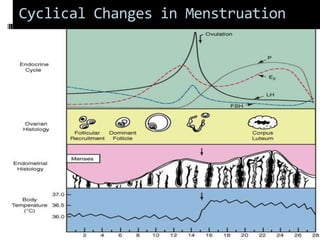
 Cycle lenghth-21-35 days , mean menstrual
blood loss -30-40 ml , duration of bleeding
(period0---2-8 days.
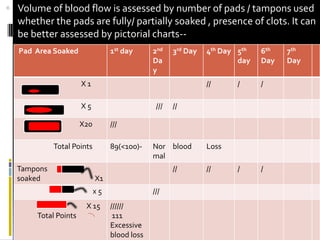
 Volume of blood flow is assessed by number of pads / tampons used
whether the pads are fully/ partially soaked , presence of clots. It can
be better assessed by pictorial charts--
Pad Area Soaked 1st day 2nd
Da
y
3rd Day 4th Day 5th
day
6th
Day
7th
Day
X 1 // / /
X 5 /// //
X20 ///
Total Points 89(<1oo)- Nor
mal
blood Loss
Tampons
soaked X1
// // / /
x 5 ///
D X 15
Total Points
//////
111
Excessive
blood loss
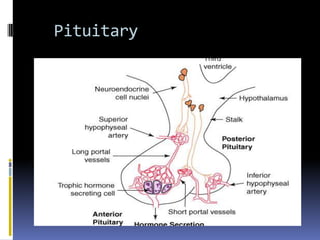
Pituitary
Cyclical Changes in Menstruation
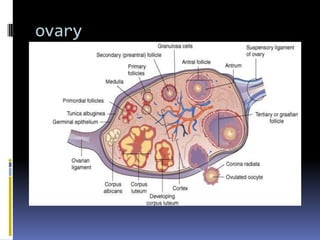
ovary
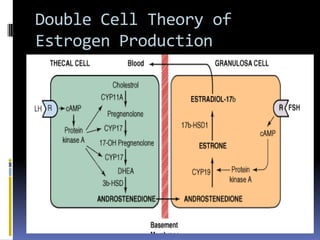
Double Cell Theory of
Estrogen Production
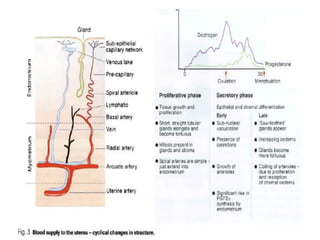
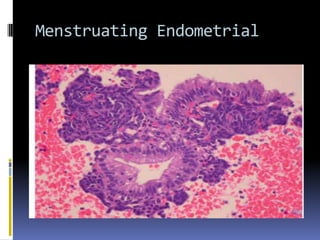
Menstruating Endometrial
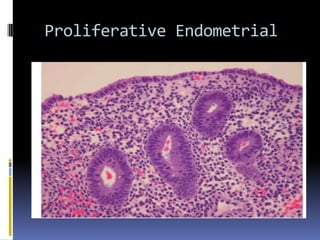
Proliferative Endometrial
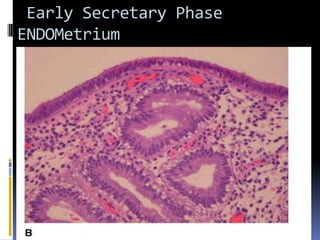
Early Secretary Phase
ENDOMetrium
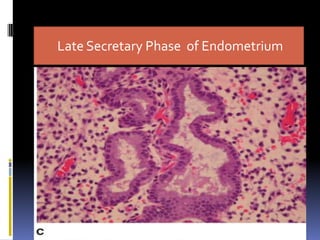
Late Secretary Phase of Endometrium
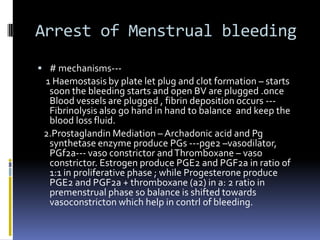
Arrest of Menstrual bleeding
 # mechanisms---
1 Haemostasis by plate let plug and clot formation – starts
soon the bleeding starts and open BV are plugged .once
Blood vessels are plugged , fibrin deposition occurs ---
Fibrinolysis also go hand in hand to balance and keep the
blood loss fluid.
2.Prostaglandin Mediation – Archadonic acid and Pg
synthetase enzyme produce PGs ---pge2 –vasodilator,
PGf2a--- vaso constrictor andThromboxane – vaso
constrictor. Estrogen produce PGE2 and PGF2a in ratio of
1:1 in proliferative phase ; while Progesterone produce
PGE2 and PGF2a + thromboxane (a2) in a: 2 ratio in
premenstrual phase so balance is shifted towards
vasoconstricton which help in contrl of bleeding.
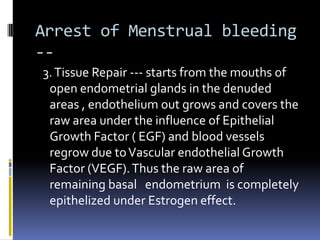
Arrest of Menstrual bleeding
--
3.Tissue Repair --- starts from the mouths of
open endometrial glands in the denuded
areas , endothelium out grows and covers the
raw area under the influence of Epithelial
Growth Factor ( EGF) and blood vessels
regrow due toVascular endothelial Growth
Factor (VEGF).Thus the raw area of
remaining basal endometrium is completely
epithelized under Estrogen effect.
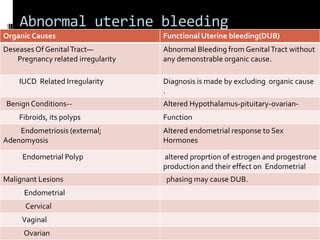
Abnormal uterine bleeding
Organic Causes Functional Uterine bleeding(DUB)
Deseases Of GenitalTract—
Pregnancy related irregularity
Abnormal Bleeding from GenitalTract without
any demonstrable organic cause.
IUCD Related Irregularity Diagnosis is made by excluding organic cause
.
Benign Conditions-- Altered Hypothalamus-pituitary-ovarian-
Fibroids, its polyps Function
Endometriosis (external;
Adenomyosis
Altered endometrial response to Sex
Hormones
Endometrial Polyp altered proprtion of estrogen and progestrone
production and their effect on Endometrial
Malignant Lesions phasing may cause DUB.
Endometrial
Cervical
Vaginal
Ovarian
Menstrual Patterns IN DUB
 Regularity—1. regular ,2 irregular , absent.
 Frequency---1. frequent < 21 days, 2. Normal
21-35 days,3. Infrequent >35 days.
 Duration– Normal 2-8 days , Prolong > 8 days
.shortened <2 days .
 Volume – normal 20 -80ml , Heavy > 80
ml, Light < 15 ml
Terminology
 Menorrhagia –Regular cycle with prolonged or
heavy flow.
 Polymenorrhoea – frequent cycles but normal
bleeding .
 Poly menorrhagia – frequent cycles with heavy
bleeding .
 Metrorrhagia ----Inter menstrual Bleeding .
 Oligomenorrhoea—Infrequent cycle with normal
bleeding .
 Hypomenorrhoea—Regular normal cycle with
light Bleeding.
Classification of DUB
1. Anovulatory –
Metropathia Haemprrhagica.
Threshold Bleeding.
2.Ovulatory ---
Idiopathic ovulatory Menorrhagia.
Luteal Phase Defect.
Anovulatory DUB
 In some adolescent girls and perimenopausal women,
Ovarian follicles develop(FSH Stimulation) and
produce estrogen in variable amount leading to
proliferation of endometrium .
 Dominant follicle may not develop due to insufficient
LH surge – no ovulation—no development of carpus
Luteum ---no progesterone --- no secretary changes in
endometrium ; estrogen still secreted by follicles
(grannulosa cells) .
 Unopposed estrogenic Stimulation and some time
hyper ( super threshold ) level of estrogen results in
over growth of endometrium(hyperplasia) ----resulting
in prolonged cycle and increased blood loss during
period.
Anovulatory DUB
 When endometrium over grow s its blood
supply , lack of progesterone causes
decrease PGE2 vasodilators initially and
Avascular necrosis of functional
endometrium occur , endometrium is shade
off Lack of vasoconstrictors--- PGf2a and
thromboxane results in excessive blood loss
which is pain less and prolonged for 20-
30days (As irregular shading of endometrium
continues for such a long time ).
 Persistent Follicles under go the formation of
follicular cysts.
Anovlatory DUB Metropathia Hamorrhagica
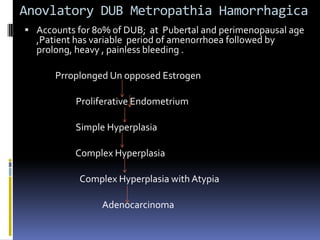
 Accounts for 80% of DUB; at Pubertal and perimenopausal age
,Patient has variable period of amenorrhoea followed by
prolong, heavy , painless bleeding .
Prroplonged Un opposed Estrogen
Proliferative Endometrium
Simple Hyperplasia
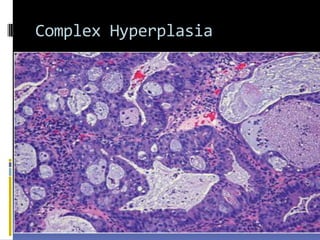
Complex Hyperplasia
Complex Hyperplasia with Atypia
Adenocarcinoma
Endometrium in Metyrpathia
Haemorrhagica
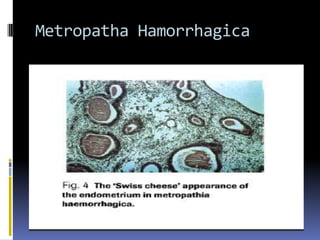
 Usually reveals cystic hyperplasia( simple
hyperplasia with out atypia) called swiss
cheese appearance .
- Hyperplastic glands and strauma.
- Cystic or irregularly dilated glands.
- Thick walled , tortuous , dilated spiral
arterioles and veins.
- Infarction and thrombosis of blood vessels.
- Necrosis of functional endometrium .
Metropatha Hamorrhagica
Progress And Course of Metropathia
Haemorrhagica
 Incidence of malignancy ---
simple cystic Hyperplasia---1%
Complex hyperplasia with atypia---29%
It is further increased in perimenopausal
women who are obese, diabetic,on E2 therapy,
hypertensive and relatively infertile , H/O Ca
endometrium in family and had PCOD.
Young Girls who are obese with or with out PCOD
are prone to have metropathia Haemorrhagica
of early changes which are reversible with
progesterone / Ocs therapy.
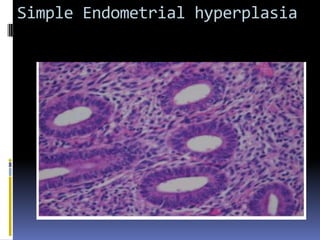
Simple Endometrial hyperplasia
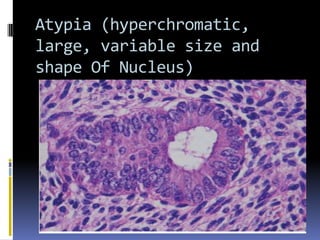
Atypia (hyperchromatic,
large, variable size and
shape Of Nucleus)
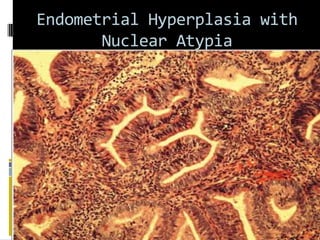
Endometrial Hyperplasia with
Nuclear Atypia
Complex Hyperplasia
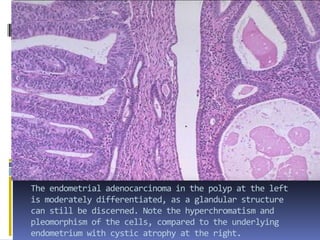
The endometrial adenocarcinoma in the polyp at the left
is moderately differentiated, as a glandular structure
can still be discerned. Note the hyperchromatism and
pleomorphism of the cells, compared to the underlying
endometrium with cystic atrophy at the right.
Threshold Bleeding
 This is often seen in peri menopausal women .
There is insufficient development of ovarian
follicles resulting in low estrogen level not able
to sustain endometrium or trigger LH surge ( no
ovulation ).
 Such women can have prolonged and excessive
bleeding due to absence of progesterone and
lack of PGF2a and thomboxane.
 Bleeding PV in these women can be controlled
with cyclic E2 + P CombinationTherapy as both
are at low level .
Ovulatory DUB
 More common in women of reproductive age
group (21-40 years ) .
 Accounts for 20% cases of DUB.
 Patient usually present Cyclic excessive
bleeding / premenstrual spotting.
 Periods are associated with Pain .
Idiopathic Adulatory
Menorrhagia (DUB )
 An alteration in ratio of PGE2 and PGF2a ( vaso
dilator : vaso constrictor )occurs in some women
despite of ovulation and normal progesterone
production from carpus luetium .
 Increase in PGE receptors in endometrium ,
reduction in thrombxane production and
increased fibrinolytic activity has also been
demonstrated in these women .
 PgF2a causes Dysmenorrhea.
 HP report of endometrium reveals secrtory
changes
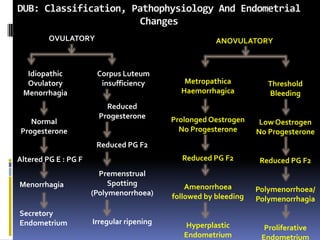
DUB: Classification, Pathophysiology And Endometrial
Changes
OVULATORY
Idiopathic
Ovulatory
Menorrhagia
Corpus Luteum
insufficiency
Normal
Progesterone
Altered PG E : PG F
Menorrhagia
Secretory
Endometrium
Reduced
Progesterone
Reduced PG F2
Premenstrual
Spotting
(Polymenorrhoea)
Irregular ripening
ANOVULATORY
Metropathica
Haemorrhagica
Prolonged Oestrogen
No Progesterone
Reduced PG F2
Amenorrhoea
followed by bleeding
Hyperplastic
Endometrium
Threshold
Bleeding
Low Oestrogen
No Progesterone
Reduced PG F2
Polymenorrhoea/
Polymenorrhagia
Proliferative
Endometrium
Luteal Phase Defect
 In adequate Functioning of carpus luteum can
result in--
-- in sufficient and erratic production of
Progesterone.As well as alteration in the
ratio of PGE : PGF
---resulting in irregular and patchy screttory
changes in the endometrium
Both pathophysiological deficit leads to
irregular ripening and or irregular shading
of endometrium .
History Taking In DUB
 Age
 Age at menarche.
 Parity.
 Menstrual History—regularity, frequency, duration of
bleeding ,Volume of blood loss.
 Post coital bleeding ?
 Dysmenorrhoea – spasmodic / congestive .
 Dyspareunia.
 O.H.---fertility / infertility/ gravidity / parity etc.
 AssociatedVaginal Discharge .
 RescentAbortion / delivery / ectopic pregnancy .
 IUCD insertion , ocs, hormone therapy/ drugs.
 Symptoms of thyroid disease.
 Symptoms of any bleeding disorder.
Examination
 General Physical .
 Pallor.
 thyroid.
 BMI .
 Signs of PCOD .
 Speculum Examination.
 PV examination --- uterine, position, size. Shape
surface , consistency ,tenderness and mobility .
 Furnaces for any anneal mass /tenderness/
indurations
Investigations
 LaboratoryTests HB ,T/DLC, BT. CT, PT , PPT, platelets
count , ESR, Fasting Blood Sugar,,T3-T4-TSH.– to know
degree of anemia, to exclude coagulation disorders and
leukemia's, Diabetes and thyroid disorders.
 TVS /abdominal USG –to exclude Genital tract lesions like
fibroids, endometrial thickening , endometriosis, PCOD ,
polyps , IUCD pregnancy related conditions anneal mass
etc .
 Soon Historiography– intra cavity lesions like polyp fibroid
.
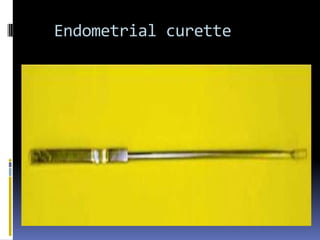
 Dilatation Curettage--- Endometrial sampling for HPR---
type of endometrial ; secretary , LPD, proliferative /
hyperplasia , inflammation like tuberculosis and
precancerous or cancer lesion .
 Hysteroscopy---diagnostic as wells therapeutic use in
IUCD sub mucous fibroid , polyps .
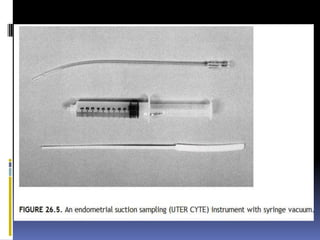
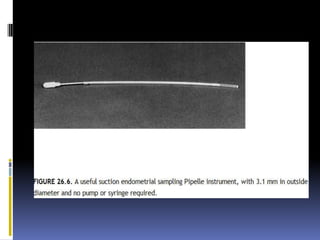
Endometrial curette
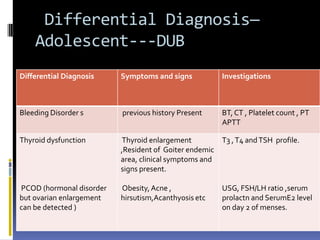
Differential Diagnosis—
Adolescent---DUB
Differential Diagnosis Symptoms and signs Investigations
Bleeding Disorder s previous history Present BT, CT , Platelet count , PT
APTT
Thyroid dysfunction
PCOD (hormonal disorder
but ovarian enlargement
can be detected )
Thyroid enlargement
,Resident of Goiter endemic
area, clinical symptoms and
signs present.
Obesity,Acne ,
hirsutism,Acanthyosis etc
T3 ,T4 andTSH profile.
USG, FSH/LH ratio ,serum
prolactn and SerumE2 level
on day 2 of menses.
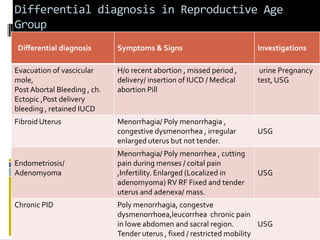
Differential diagnosis in Reproductive Age
Group
Differential diagnosis Symptoms & Signs Investigations
Evacuation of vascicular
mole,
PostAbortal Bleeding , ch.
Ectopic ,Post delivery
bleeding , retained IUCD
H/o recent abortion , missed period ,
delivery/ insertion of IUCD / Medical
abortion Pill
urine Pregnancy
test, USG
Fibroid Uterus Menorrhagia/ Poly menorrhagia ,
congestive dysmenorrhea , irregular
enlarged uterus but not tender.
USG
Endometriosis/
Adenomyoma
Menorrhagia/ Poly menorrhea , cutting
pain during menses / coital pain
,Infertility. Enlarged (Localized in
adenomyoma) RV RF Fixed and tender
uterus and adenexa/ mass.
USG
Chronic PID Poly menorrhagia, congestve
dysmenorrhoea,leucorrhea chronic pain
in lowe abdomen and sacral region.
Tender uterus , fixed / restricted mobility
USG
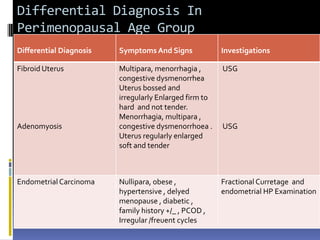
Differential Diagnosis In
Perimenopausal Age Group
Differential Diagnosis Symptoms And Signs Investigations
Fibroid Uterus
Adenomyosis
Multipara, menorrhagia ,
congestive dysmenorrhea
Uterus bossed and
irregularly Enlarged firm to
hard and not tender.
Menorrhagia, multipara ,
congestive dysmenorrhoea .
Uterus regularly enlarged
soft and tender
USG
USG
Endometrial Carcinoma Nullipara, obese ,
hypertensive , delyed
menopause , diabetic ,
family history +/_ , PCOD ,
Irregular /freuent cycles
Fractional Curretage and
endometrial HP Examination
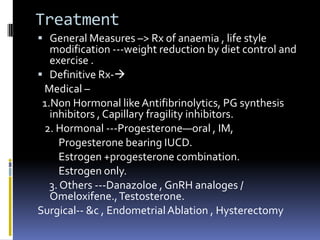
Treatment
 General Measures –> Rx of anaemia , life style
modification ---weight reduction by diet control and
exercise .
 Definitive Rx-
Medical –
1.Non Hormonal like Antifibrinolytics, PG synthesis
inhibitors , Capillary fragility inhibitors.
2. Hormonal ---Progesterone—oral , IM,
Progesterone bearing IUCD.
Estrogen +progesterone combination.
Estrogen only.
3. Others ---Danazoloe , GnRH analoges /
Omeloxifene.,Testosterone.
Surgical-- &c , EndometrialAblation , Hysterectomy
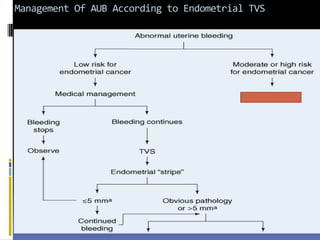
Management Of AUB According to Endometrial TVS
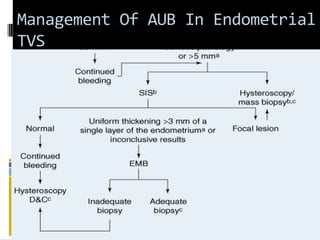
Management Of AUB In Endometrial
TVS
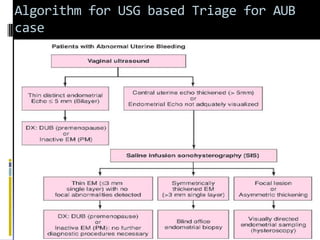
Algorithm for USG based Triage for AUB
case
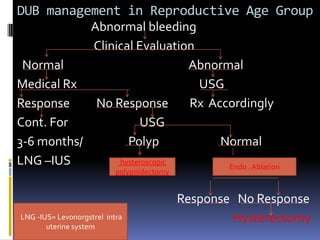
DUB management in Reproductive Age Group
Abnormal bleeding
Clinical Evaluation
Normal Abnormal
Medical Rx USG
Response No Response Rx Accordingly
Cont. For USG
3-6 months/ Polyp Normal
LNG –IUS
Response No Response
Hysterectomy
hysteroscopic
polypoidectomy
Endo . Ablation
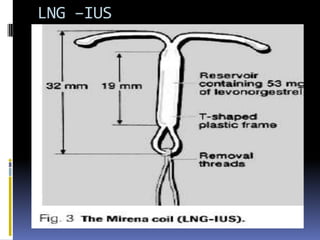
LNG -IUS= Levonorgstrel intra
uterine system
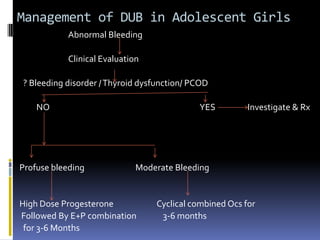
Management of DUB in Adolescent Girls
Abnormal Bleeding
Clinical Evaluation
? Bleeding disorder /Thyroid dysfunction/ PCOD
NO YES Investigate & Rx
Profuse bleeding Moderate Bleeding
High Dose Progesterone Cyclical combined Ocs for
Followed By E+P combination 3-6 months
for 3-6 Months
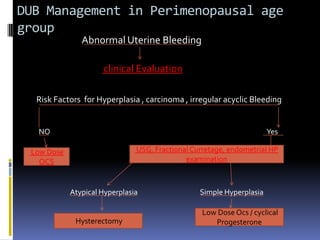
DUB Management in Perimenopausal age
group
Abnormal Uterine Bleeding
clinical Evaluation
Risk Factors for Hyperplasia , carcinoma , irregular acyclic Bleeding
NO Yes
Low Dose
OCS
USG, Fractional Curretage, endometrial HP
examination
Atypical Hyperplasia Simple Hyperplasia
Hysterectomy
Low Dose Ocs / cyclical
Progesterone
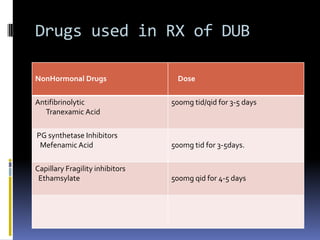
Drugs used in RX of DUB
NonHormonal Drugs Dose
Antifibrinolytic
Tranexamic Acid
500mg tid/qid for 3-5 days
PG synthetase Inhibitors
Mefenamic Acid 500mg tid for 3-5days.
Capillary Fragility inhibitors
Ethamsylate 500mg qid for 4-5 days
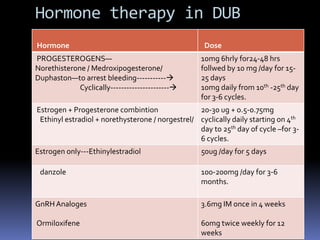
Hormone therapy in DUB
Hormone Dose
PROGESTEROGENS—
Norethisterone / Medroxipogesterone/
Duphaston—to arrest bleeding-----------
Cyclically----------------------
10mg 6hrly for24-48 hrs
follwed by 10 mg /day for 15-
25 days
10mg daily from 10th -25th day
for 3-6 cycles.
Estrogen + Progesterone combintion
Ethinyl estradiol + norethysterone / norgestrel/
20-30 ug + o.5-0.75mg
cyclically daily starting on 4th
day to 25th day of cycle –for 3-
6 cycles.
Estrogen only---Ethinylestradiol 50ug /day for 5 days
danzole 100-200mg /day for 3-6
months.
GnRHAnaloges
Ormiloxifene
3.6mg IM once in 4 weeks
60mg twice weekly for 12
weeks
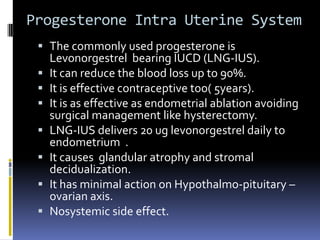
Progesterone Intra Uterine System
 The commonly used progesterone is
Levonorgestrel bearing IUCD (LNG-IUS).
 It can reduce the blood loss up to 90%.
 It is effective contraceptive too( 5years).
 It is as effective as endometrial ablation avoiding
surgical management like hysterectomy.
 LNG-IUS delivers 20 ug levonorgestrel daily to
endometrium .
 It causes glandular atrophy and stromal
decidualization.
 It has minimal action on Hypothalmo-pituitary –
ovarian axis.
 Nosystemic side effect.
LNG –IUS
Surgical Treatment of DUB
 Conservative
-Dilatation & Curretage—routine / Fractional
-Endometrial ablation.
 Redical
-Hysterectomy
Total
Pan Hysterectmy.
Total with unilateral salping overiotomy/
shalpingo oophrectomy.
Endometrial Ablation
 Ablation means == elimination
1. Indication
failed medical therapy .
Young women desires to preserve uterus.
Poor surgical risk for hysterectomy (non
carcinoma lesion of endometrium)
2. Contra Indications
Desire for fertility
Large uterine cavity -- <12cm.
Endometrial hyperplasisia with Atypia.
Suspected malignancy of genital tract.
Multiple or large fibroids/ nonfunctional ovarian
cysts.
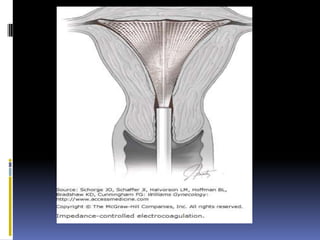
Endometrial ablation Techniques
 First GenerationTechniques
Endometrial laser .
Trans cervical resection .
Roller wall electro coagulation .
 Second generationTechniques
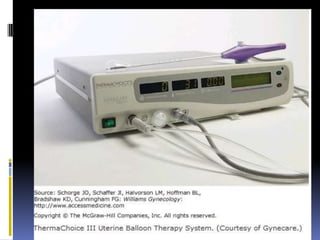
Thermal Ballon Ablation .
Microwave ablation .
Radiofrequency induced ablation .
Hydrotherma ablation .
Electrode mash
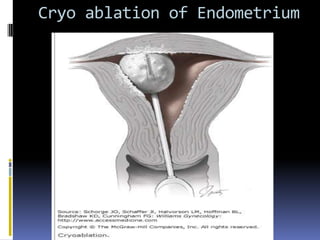
Cryo Ablation .
Laser interstitial therapy.
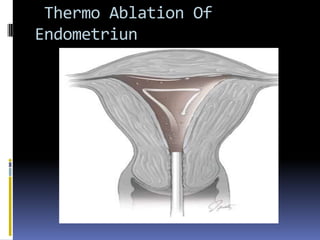
Thermo Ablation Of
Endometriun
Cryo ablation of Endometrium
Disadvantages of !st generation Ablation
Technique.
 Require skilled person.
 Require long training.
 Require general anasthesia.
 More chances of uterine perforation and fluid
over load.
Long term results of Ablation---
30% women remain amenorrhi0ec .
40-50 % women have reduced bleeding during
their menstrual periods.
10-20 % women reqquire hysterectomy due to
failure e.g. no relief from bleeding.
Hysterectomy Indications
 Endometrial hyperplasia with atypia.
 Failed Medical therapy in women over the
age of 40-45.
 Failed endometrial Ablation.
 Other pelvic pathology that needs surgery
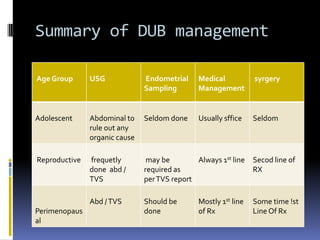
Summary of DUB management
Age Group USG Endometrial
Sampling
Medical
Management
syrgery
Adolescent Abdominal to
rule out any
organic cause
Seldom done Usually sffice Seldom
Reproductive frequetly
done abd /
TVS
may be
required as
perTVS report
Always 1st line Secod line of
RX
Perimenopaus
al
Abd /TVS Should be
done
Mostly 1st line
of Rx
Some time !st
Line Of Rx
Key Points
 AUB can be due to organic disease or functional
disorder.
 It can occur in any age group –adolescent/ reproductive
or perimenopausal .
 Dub is diagnose by exclusion of organic lesions by
clinical and investigatory methods.
 Drug Rx (non hormonal –then hormonal should be given
first as majority of cases will get desired response.
 LNG –IUS has revolutionized the medical management
and has reduced the need of surgical Rx.
 If medical management fails – endometrial ablation can
be done.
 If there are contra indication for Ablation and or it fails
hysterectomy can be done in Perimenopausal women .
Rx of DUB Is to Be Individualized Approach

Abnormal uterine bleeding

  • 1.
    ABNORMAL UTERINE BLEEDING PROF.M.C.BANSAL. MBBS.MS.MICOG.FICOG. FOUNDER PRINCIPAL & CONTROLLER; JHALAWAR MEDICAL COLLEGE AND HOSPITAL JHALAWAR. EX. PRINCIPAL & CONTROLLER; MAHATMA GANDHI MEDICAL COLLEGE AND HOSPITAL , SITAPURA, JAIPUR
  • 2.
    Normal Menstrual Cycle Menstration is a cyclic physiological phenomena  starting at the age of Menarche (10-12years) till establishment of Menopause (45-55 yrs).  It is regulated by hypothalmo-pituitary- ovarian hormones secreted in pulsatile and cyclic pattern.  Also influenced by endometrial response top these (E& P ) hormones and coagulation cascade.  Cycle lenghth-21-35 days , mean menstrual blood loss -30-40 ml , duration of bleeding (period0---2-8 days.
  • 3.
     Volume ofblood flow is assessed by number of pads / tampons used whether the pads are fully/ partially soaked , presence of clots. It can be better assessed by pictorial charts-- Pad Area Soaked 1st day 2nd Da y 3rd Day 4th Day 5th day 6th Day 7th Day X 1 // / / X 5 /// // X20 /// Total Points 89(<1oo)- Nor mal blood Loss Tampons soaked X1 // // / / x 5 /// D X 15 Total Points ////// 111 Excessive blood loss
  • 4.
  • 6.
    Cyclical Changes inMenstruation
  • 8.
  • 9.
    Double Cell Theoryof Estrogen Production
  • 10.
  • 11.
  • 12.
  • 13.
    Late Secretary Phaseof Endometrium
  • 14.
    Arrest of Menstrualbleeding  # mechanisms--- 1 Haemostasis by plate let plug and clot formation – starts soon the bleeding starts and open BV are plugged .once Blood vessels are plugged , fibrin deposition occurs --- Fibrinolysis also go hand in hand to balance and keep the blood loss fluid. 2.Prostaglandin Mediation – Archadonic acid and Pg synthetase enzyme produce PGs ---pge2 –vasodilator, PGf2a--- vaso constrictor andThromboxane – vaso constrictor. Estrogen produce PGE2 and PGF2a in ratio of 1:1 in proliferative phase ; while Progesterone produce PGE2 and PGF2a + thromboxane (a2) in a: 2 ratio in premenstrual phase so balance is shifted towards vasoconstricton which help in contrl of bleeding.
  • 15.
    Arrest of Menstrualbleeding -- 3.Tissue Repair --- starts from the mouths of open endometrial glands in the denuded areas , endothelium out grows and covers the raw area under the influence of Epithelial Growth Factor ( EGF) and blood vessels regrow due toVascular endothelial Growth Factor (VEGF).Thus the raw area of remaining basal endometrium is completely epithelized under Estrogen effect.
  • 16.
    Abnormal uterine bleeding OrganicCauses Functional Uterine bleeding(DUB) Deseases Of GenitalTract— Pregnancy related irregularity Abnormal Bleeding from GenitalTract without any demonstrable organic cause. IUCD Related Irregularity Diagnosis is made by excluding organic cause . Benign Conditions-- Altered Hypothalamus-pituitary-ovarian- Fibroids, its polyps Function Endometriosis (external; Adenomyosis Altered endometrial response to Sex Hormones Endometrial Polyp altered proprtion of estrogen and progestrone production and their effect on Endometrial Malignant Lesions phasing may cause DUB. Endometrial Cervical Vaginal Ovarian
  • 17.
    Menstrual Patterns INDUB  Regularity—1. regular ,2 irregular , absent.  Frequency---1. frequent < 21 days, 2. Normal 21-35 days,3. Infrequent >35 days.  Duration– Normal 2-8 days , Prolong > 8 days .shortened <2 days .  Volume – normal 20 -80ml , Heavy > 80 ml, Light < 15 ml
  • 18.
    Terminology  Menorrhagia –Regularcycle with prolonged or heavy flow.  Polymenorrhoea – frequent cycles but normal bleeding .  Poly menorrhagia – frequent cycles with heavy bleeding .  Metrorrhagia ----Inter menstrual Bleeding .  Oligomenorrhoea—Infrequent cycle with normal bleeding .  Hypomenorrhoea—Regular normal cycle with light Bleeding.
  • 19.
    Classification of DUB 1.Anovulatory – Metropathia Haemprrhagica. Threshold Bleeding. 2.Ovulatory --- Idiopathic ovulatory Menorrhagia. Luteal Phase Defect.
  • 20.
    Anovulatory DUB  Insome adolescent girls and perimenopausal women, Ovarian follicles develop(FSH Stimulation) and produce estrogen in variable amount leading to proliferation of endometrium .  Dominant follicle may not develop due to insufficient LH surge – no ovulation—no development of carpus Luteum ---no progesterone --- no secretary changes in endometrium ; estrogen still secreted by follicles (grannulosa cells) .  Unopposed estrogenic Stimulation and some time hyper ( super threshold ) level of estrogen results in over growth of endometrium(hyperplasia) ----resulting in prolonged cycle and increased blood loss during period.
  • 21.
    Anovulatory DUB  Whenendometrium over grow s its blood supply , lack of progesterone causes decrease PGE2 vasodilators initially and Avascular necrosis of functional endometrium occur , endometrium is shade off Lack of vasoconstrictors--- PGf2a and thromboxane results in excessive blood loss which is pain less and prolonged for 20- 30days (As irregular shading of endometrium continues for such a long time ).  Persistent Follicles under go the formation of follicular cysts.
  • 22.
    Anovlatory DUB MetropathiaHamorrhagica  Accounts for 80% of DUB; at Pubertal and perimenopausal age ,Patient has variable period of amenorrhoea followed by prolong, heavy , painless bleeding . Prroplonged Un opposed Estrogen Proliferative Endometrium Simple Hyperplasia Complex Hyperplasia Complex Hyperplasia with Atypia Adenocarcinoma
  • 23.
    Endometrium in Metyrpathia Haemorrhagica Usually reveals cystic hyperplasia( simple hyperplasia with out atypia) called swiss cheese appearance . - Hyperplastic glands and strauma. - Cystic or irregularly dilated glands. - Thick walled , tortuous , dilated spiral arterioles and veins. - Infarction and thrombosis of blood vessels. - Necrosis of functional endometrium .
  • 24.
  • 25.
    Progress And Courseof Metropathia Haemorrhagica  Incidence of malignancy --- simple cystic Hyperplasia---1% Complex hyperplasia with atypia---29% It is further increased in perimenopausal women who are obese, diabetic,on E2 therapy, hypertensive and relatively infertile , H/O Ca endometrium in family and had PCOD. Young Girls who are obese with or with out PCOD are prone to have metropathia Haemorrhagica of early changes which are reversible with progesterone / Ocs therapy.
  • 26.
  • 27.
    Atypia (hyperchromatic, large, variablesize and shape Of Nucleus)
  • 28.
  • 29.
  • 30.
    The endometrial adenocarcinomain the polyp at the left is moderately differentiated, as a glandular structure can still be discerned. Note the hyperchromatism and pleomorphism of the cells, compared to the underlying endometrium with cystic atrophy at the right.
  • 31.
    Threshold Bleeding  Thisis often seen in peri menopausal women . There is insufficient development of ovarian follicles resulting in low estrogen level not able to sustain endometrium or trigger LH surge ( no ovulation ).  Such women can have prolonged and excessive bleeding due to absence of progesterone and lack of PGF2a and thomboxane.  Bleeding PV in these women can be controlled with cyclic E2 + P CombinationTherapy as both are at low level .
  • 32.
    Ovulatory DUB  Morecommon in women of reproductive age group (21-40 years ) .  Accounts for 20% cases of DUB.  Patient usually present Cyclic excessive bleeding / premenstrual spotting.  Periods are associated with Pain .
  • 33.
    Idiopathic Adulatory Menorrhagia (DUB)  An alteration in ratio of PGE2 and PGF2a ( vaso dilator : vaso constrictor )occurs in some women despite of ovulation and normal progesterone production from carpus luetium .  Increase in PGE receptors in endometrium , reduction in thrombxane production and increased fibrinolytic activity has also been demonstrated in these women .  PgF2a causes Dysmenorrhea.  HP report of endometrium reveals secrtory changes
  • 34.
    DUB: Classification, PathophysiologyAnd Endometrial Changes OVULATORY Idiopathic Ovulatory Menorrhagia Corpus Luteum insufficiency Normal Progesterone Altered PG E : PG F Menorrhagia Secretory Endometrium Reduced Progesterone Reduced PG F2 Premenstrual Spotting (Polymenorrhoea) Irregular ripening ANOVULATORY Metropathica Haemorrhagica Prolonged Oestrogen No Progesterone Reduced PG F2 Amenorrhoea followed by bleeding Hyperplastic Endometrium Threshold Bleeding Low Oestrogen No Progesterone Reduced PG F2 Polymenorrhoea/ Polymenorrhagia Proliferative Endometrium
  • 35.
    Luteal Phase Defect In adequate Functioning of carpus luteum can result in-- -- in sufficient and erratic production of Progesterone.As well as alteration in the ratio of PGE : PGF ---resulting in irregular and patchy screttory changes in the endometrium Both pathophysiological deficit leads to irregular ripening and or irregular shading of endometrium .
  • 36.
    History Taking InDUB  Age  Age at menarche.  Parity.  Menstrual History—regularity, frequency, duration of bleeding ,Volume of blood loss.  Post coital bleeding ?  Dysmenorrhoea – spasmodic / congestive .  Dyspareunia.  O.H.---fertility / infertility/ gravidity / parity etc.  AssociatedVaginal Discharge .  RescentAbortion / delivery / ectopic pregnancy .  IUCD insertion , ocs, hormone therapy/ drugs.  Symptoms of thyroid disease.  Symptoms of any bleeding disorder.
  • 37.
    Examination  General Physical.  Pallor.  thyroid.  BMI .  Signs of PCOD .  Speculum Examination.  PV examination --- uterine, position, size. Shape surface , consistency ,tenderness and mobility .  Furnaces for any anneal mass /tenderness/ indurations
  • 38.
    Investigations  LaboratoryTests HB,T/DLC, BT. CT, PT , PPT, platelets count , ESR, Fasting Blood Sugar,,T3-T4-TSH.– to know degree of anemia, to exclude coagulation disorders and leukemia's, Diabetes and thyroid disorders.  TVS /abdominal USG –to exclude Genital tract lesions like fibroids, endometrial thickening , endometriosis, PCOD , polyps , IUCD pregnancy related conditions anneal mass etc .  Soon Historiography– intra cavity lesions like polyp fibroid .  Dilatation Curettage--- Endometrial sampling for HPR--- type of endometrial ; secretary , LPD, proliferative / hyperplasia , inflammation like tuberculosis and precancerous or cancer lesion .  Hysteroscopy---diagnostic as wells therapeutic use in IUCD sub mucous fibroid , polyps .
  • 39.
  • 42.
    Differential Diagnosis— Adolescent---DUB Differential DiagnosisSymptoms and signs Investigations Bleeding Disorder s previous history Present BT, CT , Platelet count , PT APTT Thyroid dysfunction PCOD (hormonal disorder but ovarian enlargement can be detected ) Thyroid enlargement ,Resident of Goiter endemic area, clinical symptoms and signs present. Obesity,Acne , hirsutism,Acanthyosis etc T3 ,T4 andTSH profile. USG, FSH/LH ratio ,serum prolactn and SerumE2 level on day 2 of menses.
  • 43.
    Differential diagnosis inReproductive Age Group Differential diagnosis Symptoms & Signs Investigations Evacuation of vascicular mole, PostAbortal Bleeding , ch. Ectopic ,Post delivery bleeding , retained IUCD H/o recent abortion , missed period , delivery/ insertion of IUCD / Medical abortion Pill urine Pregnancy test, USG Fibroid Uterus Menorrhagia/ Poly menorrhagia , congestive dysmenorrhea , irregular enlarged uterus but not tender. USG Endometriosis/ Adenomyoma Menorrhagia/ Poly menorrhea , cutting pain during menses / coital pain ,Infertility. Enlarged (Localized in adenomyoma) RV RF Fixed and tender uterus and adenexa/ mass. USG Chronic PID Poly menorrhagia, congestve dysmenorrhoea,leucorrhea chronic pain in lowe abdomen and sacral region. Tender uterus , fixed / restricted mobility USG
  • 44.
    Differential Diagnosis In PerimenopausalAge Group Differential Diagnosis Symptoms And Signs Investigations Fibroid Uterus Adenomyosis Multipara, menorrhagia , congestive dysmenorrhea Uterus bossed and irregularly Enlarged firm to hard and not tender. Menorrhagia, multipara , congestive dysmenorrhoea . Uterus regularly enlarged soft and tender USG USG Endometrial Carcinoma Nullipara, obese , hypertensive , delyed menopause , diabetic , family history +/_ , PCOD , Irregular /freuent cycles Fractional Curretage and endometrial HP Examination
  • 45.
    Treatment  General Measures–> Rx of anaemia , life style modification ---weight reduction by diet control and exercise .  Definitive Rx- Medical – 1.Non Hormonal like Antifibrinolytics, PG synthesis inhibitors , Capillary fragility inhibitors. 2. Hormonal ---Progesterone—oral , IM, Progesterone bearing IUCD. Estrogen +progesterone combination. Estrogen only. 3. Others ---Danazoloe , GnRH analoges / Omeloxifene.,Testosterone. Surgical-- &c , EndometrialAblation , Hysterectomy
  • 46.
    Management Of AUBAccording to Endometrial TVS
  • 47.
    Management Of AUBIn Endometrial TVS
  • 48.
    Algorithm for USGbased Triage for AUB case
  • 49.
    DUB management inReproductive Age Group Abnormal bleeding Clinical Evaluation Normal Abnormal Medical Rx USG Response No Response Rx Accordingly Cont. For USG 3-6 months/ Polyp Normal LNG –IUS Response No Response Hysterectomy hysteroscopic polypoidectomy Endo . Ablation LNG -IUS= Levonorgstrel intra uterine system
  • 50.
    Management of DUBin Adolescent Girls Abnormal Bleeding Clinical Evaluation ? Bleeding disorder /Thyroid dysfunction/ PCOD NO YES Investigate & Rx Profuse bleeding Moderate Bleeding High Dose Progesterone Cyclical combined Ocs for Followed By E+P combination 3-6 months for 3-6 Months
  • 51.
    DUB Management inPerimenopausal age group Abnormal Uterine Bleeding clinical Evaluation Risk Factors for Hyperplasia , carcinoma , irregular acyclic Bleeding NO Yes Low Dose OCS USG, Fractional Curretage, endometrial HP examination Atypical Hyperplasia Simple Hyperplasia Hysterectomy Low Dose Ocs / cyclical Progesterone
  • 52.
    Drugs used inRX of DUB NonHormonal Drugs Dose Antifibrinolytic Tranexamic Acid 500mg tid/qid for 3-5 days PG synthetase Inhibitors Mefenamic Acid 500mg tid for 3-5days. Capillary Fragility inhibitors Ethamsylate 500mg qid for 4-5 days
  • 53.
    Hormone therapy inDUB Hormone Dose PROGESTEROGENS— Norethisterone / Medroxipogesterone/ Duphaston—to arrest bleeding----------- Cyclically---------------------- 10mg 6hrly for24-48 hrs follwed by 10 mg /day for 15- 25 days 10mg daily from 10th -25th day for 3-6 cycles. Estrogen + Progesterone combintion Ethinyl estradiol + norethysterone / norgestrel/ 20-30 ug + o.5-0.75mg cyclically daily starting on 4th day to 25th day of cycle –for 3- 6 cycles. Estrogen only---Ethinylestradiol 50ug /day for 5 days danzole 100-200mg /day for 3-6 months. GnRHAnaloges Ormiloxifene 3.6mg IM once in 4 weeks 60mg twice weekly for 12 weeks
  • 54.
    Progesterone Intra UterineSystem  The commonly used progesterone is Levonorgestrel bearing IUCD (LNG-IUS).  It can reduce the blood loss up to 90%.  It is effective contraceptive too( 5years).  It is as effective as endometrial ablation avoiding surgical management like hysterectomy.  LNG-IUS delivers 20 ug levonorgestrel daily to endometrium .  It causes glandular atrophy and stromal decidualization.  It has minimal action on Hypothalmo-pituitary – ovarian axis.  Nosystemic side effect.
  • 55.
  • 56.
    Surgical Treatment ofDUB  Conservative -Dilatation & Curretage—routine / Fractional -Endometrial ablation.  Redical -Hysterectomy Total Pan Hysterectmy. Total with unilateral salping overiotomy/ shalpingo oophrectomy.
  • 57.
    Endometrial Ablation  Ablationmeans == elimination 1. Indication failed medical therapy . Young women desires to preserve uterus. Poor surgical risk for hysterectomy (non carcinoma lesion of endometrium) 2. Contra Indications Desire for fertility Large uterine cavity -- <12cm. Endometrial hyperplasisia with Atypia. Suspected malignancy of genital tract. Multiple or large fibroids/ nonfunctional ovarian cysts.
  • 58.
    Endometrial ablation Techniques First GenerationTechniques Endometrial laser . Trans cervical resection . Roller wall electro coagulation .  Second generationTechniques Thermal Ballon Ablation . Microwave ablation . Radiofrequency induced ablation . Hydrotherma ablation . Electrode mash Cryo Ablation . Laser interstitial therapy.
  • 59.
  • 62.
    Cryo ablation ofEndometrium
  • 63.
    Disadvantages of !stgeneration Ablation Technique.  Require skilled person.  Require long training.  Require general anasthesia.  More chances of uterine perforation and fluid over load. Long term results of Ablation--- 30% women remain amenorrhi0ec . 40-50 % women have reduced bleeding during their menstrual periods. 10-20 % women reqquire hysterectomy due to failure e.g. no relief from bleeding.
  • 64.
    Hysterectomy Indications  Endometrialhyperplasia with atypia.  Failed Medical therapy in women over the age of 40-45.  Failed endometrial Ablation.  Other pelvic pathology that needs surgery
  • 65.
    Summary of DUBmanagement Age Group USG Endometrial Sampling Medical Management syrgery Adolescent Abdominal to rule out any organic cause Seldom done Usually sffice Seldom Reproductive frequetly done abd / TVS may be required as perTVS report Always 1st line Secod line of RX Perimenopaus al Abd /TVS Should be done Mostly 1st line of Rx Some time !st Line Of Rx
  • 66.
    Key Points  AUBcan be due to organic disease or functional disorder.  It can occur in any age group –adolescent/ reproductive or perimenopausal .  Dub is diagnose by exclusion of organic lesions by clinical and investigatory methods.  Drug Rx (non hormonal –then hormonal should be given first as majority of cases will get desired response.  LNG –IUS has revolutionized the medical management and has reduced the need of surgical Rx.  If medical management fails – endometrial ablation can be done.  If there are contra indication for Ablation and or it fails hysterectomy can be done in Perimenopausal women . Rx of DUB Is to Be Individualized Approach