Zhang Huiying Normal and Abnormal  Menstruation Reproductive Endocrinology
Main contents Normal manstruation Abnormal uterine bleeding ★ Amenorrhea  ★ Perimenopause and perimenopausal syndrome polycystic ovarian syndrome(PCOS)
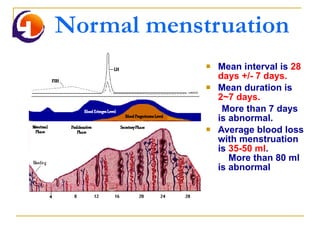
Normal menstruation Mean interval is  28 days +/- 7 days. Mean duration is  2~7 days. More than 7 days is abnormal. Average blood loss with menstruation is  35-50 ml .   More than 80 ml is abnormal
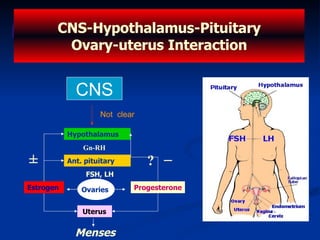
CNS-Hypothalamus-Pituitary Ovary-uterus Interaction Hypothalamus Gn-RH Ant. pituitary FSH, LH Ovaries  Uterus Progesterone Estrogen Menses – ± ? CNS Not  clear
The normal menstrual cycle is the result of complex interactions between the hypothalamic- pituitary-ovarian (HPO) endocrine axis.  Hypothalamus secrete gonadotropin-releasing hormone, The anterior pituitary release the FSH and LH Every cycle the ovary change from  follicular development phase to the luteal phase  secrete estrogen and progesterone  The endometrium change from proliferative phases to secretory phases. When progesterone and estrogen levels fall with the demise of the corpus luteum, vasoactive substances such as prostaglandins, histamine and bradykinin are produced by the endometrium. Prostaglandins cause spasm of the spiral arterioles which results in ischaemic necrosis and shedding of all but the basal layer of the endometrium.
The control of regular menstrual blood loss vasodilatation of spiral arterioles fibrinolytic activity of menstrual blood endometrial regeneration.
Abnormal uterine bleeding
Sorts of bleeding Abnormal menstrual bleeding Other causes  pregnancy Systemic  disease Cancer
Patterns of abnormal uterine bleeding Menorrhagia(hypermenorrhea) Hypomenorrhea Metrorrhagia(intermenstrual bleeding) Polymenorrhea Menometrorrhagia Oligomenorrhea Contact bleeding(postcoital bleeding)
Menorrhagia Menorrhagia is heavy or prolonged menstrual flow. It is defined as menstrual blood loss exceeding 80 ml per cycle. Submucous myomas ,  adenomyosis , IUDs , endometrial hyperplasias , malignant tumors , and dysfunctional bleeding are causes of menorrhagia.
Hypomenorrhea Hypomenorrhea is unusually light menstrual flow , sometimes only spotting.  cervical stenosis and Uterine synechiae ( Asherman's syndrome ) can be causative
Metrorrhagia Metrorrhagia is bleeding occurring at any time between menstrual periods.  Ovulatory bleeding occurs at midcycle as spotting
Polymenorrhea Polymenorrhea describes periods that occur too frequently, less than 21 days apart. This is usually associated with anovulation and rarely with a shortened luteal phase in the menstrual cycle.
Menometrorrhagia Menometrorrhagia is bleeding that occurs at irregular intervals. The amount and duration of bleeding also vary.  Sudden onset of irregular bleeding episodes may be an indication of malignant tumors or complications of pregnancy.
Oligomenorrhea Oligomenorrhea describes menstrual periods that occur more than 35 days apart.  Bleeding is usually associated with anovulation
Contact bleeding(postcoital bleeding) Contact bleeding must be considered a sign of cervical cancer until proved otherwise.
Evaluation of abnormal uterine bleeding History Physical examination Cytologic examination Endometrial biopsy Saline hysterosonogram Hysteroscopy Dilatation and curettage(D & C) Other diagnostic procedures(assay hCG,pelvic ultrasonography,laparoscopy)
History the amount of menstrual flow  the length of the menstrual cycle and menstrual period the length and amount of episodes of intermenstrual bleeding any episodes of contact bleeding.  the last menstrual period , the last normal menstrual period age at menarche and menopause any changes in general health.
Physical examination Abdominal masses and an enlarged , irregular uterus suggest myoma. A symmetrically enlarged uterus is more typical of adenomyosis or endometrial carcinoma.  Atrophic and inflammatory vulvar and vaginal lesions can be visualized cervical polyps and invasive lesions of cervical carcinoma can be seen.  Rectovaginal examination is especially important sometimes
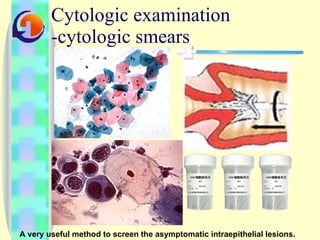
Cytologic examination -cytologic smears A very useful method to screen the asymptomatic intraepithelial lesions.
Endometrial biopsy the Novak suction curet the Duncan curet the Kevorkisn curet the pipelle.
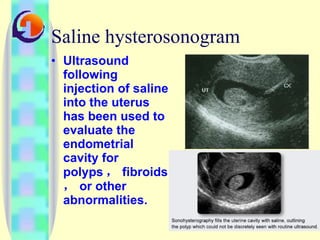
Saline hysterosonogram Ultrasound following injection of saline into the uterus has been used to evaluate the endometrial cavity for polyps , fibroids , or other abnormalities.
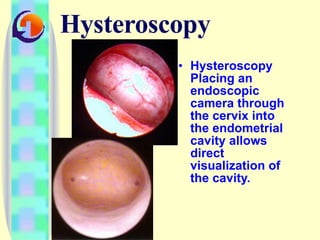
Hysteroscopy Hysteroscopy Placing an endoscopic camera through the cervix into the endometrial cavity allows direct visualization of the cavity.
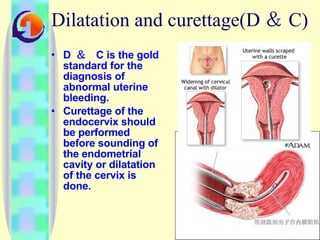
Dilatation and curettage(D & C) D  &  C is the gold standard for the diagnosis of abnormal uterine bleeding.  Curettage of the endocervix should be performed before sounding of the endometrial cavity or dilatation of the cervix is done.
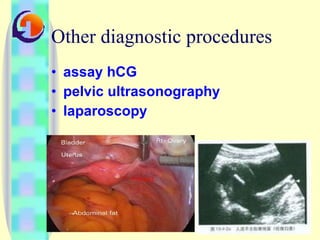
Other diagnostic procedures assay hCG pelvic ultrasonography laparoscopy
abnormal uterine bleeding due to gynecologic diseases and disorders Vulva and vagina --atrophic vulvitis or vaginitis Cervix – eversion, cervical polyps, cervical cancer Uterus –endometritis,  hyperplasias, cancer, submucous myomas,IUD Ovaries—estrogen-producing tumor, other cancers
Abnormal bleeding due to nongynecologic diseases and disorders Severe hypothyroidism Liver disease Blood dyscrasias and coagulation abnormalities Use anticoagulants or adrenal steroids
Dysfunctional uterine bleeding(DUB)
definition ★ Dysfunctional uterine bleeding(DUB) is irregular, abnormal uterine bleeding with no demonstrable organic causes. That is not caused by a tumor, infection, or pregnancy. It may be occur during postmenarchal and perimenopausal periods in a woman's reproductive life.  Exclusion of pathologic causes of abnormal bleeding establishes the diagnosis of DUB
DUB  occur in  before the menopause(50%) after menarche(20%)  reproductive times(30%)
Etiology  of DUB: 1.  disorders of   hypothalamus---pituitary ---ovary axis immature of feedback regulation in young women ovarian function failure in premenopause women 2.other Factors: the effects of sex hormones  nervous Circumstance  change PCOS,TSH ↑,PRL↑ excessive physical exercise
Mechanisms have developing folliculi  no mature follicle  no corpus luteum only have estrogen, but no progestin  breakthrough bleeding, spoting
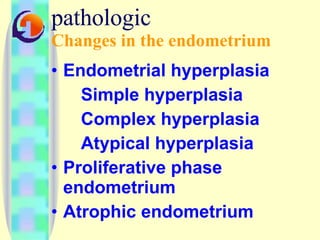
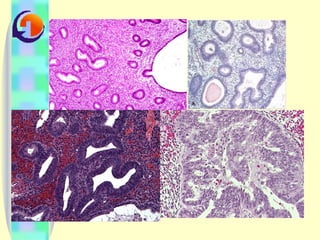
pathologic  Changes in the endometrium Endometrial hyperplasia Simple hyperplasia  Complex hyperplasia  Atypical hyperplasia Proliferative phase endometrium Atrophic endometrium
 
Treatment Depends on the age of patient Adolescent Young woman  Premenopausal woman
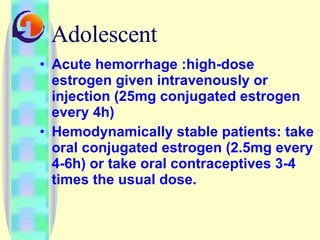
Adolescent Acute hemorrhage :high-dose estrogen given intravenously or injection (25mg conjugated estrogen every 4h)  Hemodynamically stable patients: take oral conjugated estrogen (2.5mg every 4-6h) or take oral contraceptives 3-4 times the usual dose.
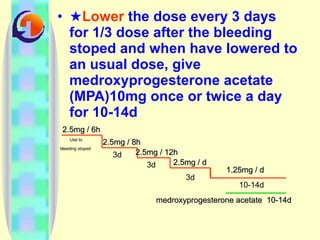
★ Lower  the dose every 3 days for 1/3 dose after the bleeding stoped and when have lowered to an usual dose, give medroxyprogesterone acetate (MPA)10mg once or twice a day for 10-14d  2.5mg / 6h 2.5mg / 8h 2.5mg / 12h 2.5mg / d Use to  bleeding stoped   3d 3d 3d 1.25mg / d 10-14d medroxyprogesterone acetate  10-14d
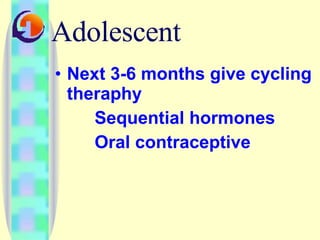
Next 3-6 months give cycling theraphy Sequential hormones Oral contraceptive Adolescent
Young women  Except the pathologic causes is necessary Hormonal management is the same as for adolescents Oral contraceptives may be used as normally prescribed if the patient don’t desire for childbearing Induce ovulation if necessary
Premenopausal women More care should be given to excluding pathologic causes because of the possibility of endometrial cancer Aspiration ,curettage,or both should  clearly establish anovulatory or dyssynchronous cycles as the cause before hormonal therapy is started. Recurrences of abnormal bleeding demand further evaluation
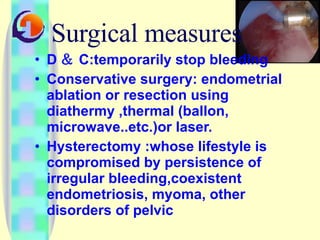
Surgical measures D & C:temporarily stop bleeding Conservative surgery: endometrial ablation or resection using diathermy ,thermal (ballon, microwave..etc.)or laser.  Hysterectomy :whose lifestyle is compromised by persistence of irregular bleeding,coexistent endometriosis, myoma, other disorders of pelvic
polycystic ovarian syndrome(PCOS)
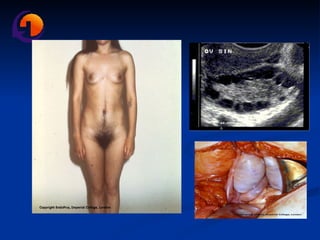
BACKGROUND In 1935, Stein and Leventhal published a paper on their findings in seven women with amenorrhea,  hirsutism, obesity, and  a characteristic polycystic  appearance to their ovaries — one of the first descriptions of a complex phenotype today known as the  polycystic ovary syndrome . The condition is now well recognized as having a major effect throughout life on the reproductive, metabolic, and cardiovascular health of affected women.
Clinical Manifestations Menstrual dysfunction- oligomenorrhea or amenorrhea  Hyperandrogenism -hirsutism, acne, male pattern balding or hair loss Ovarian Morphology- Polycystic ovaries be seen on ultrasonography  Infertility  Obesity and insulin resistance -At least one-half of women with PCOS are obese and with insulin resistance  Biochemical Abnormalities-elevated serum androgen levels,LH/FSH≥2.5~3, hyperinsulinemia , Slightly elevated prolactin.
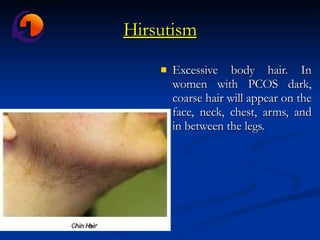
Hirsutism Excessive body hair. In women with PCOS dark, coarse hair will appear on the face, neck, chest, arms, and in between the legs.
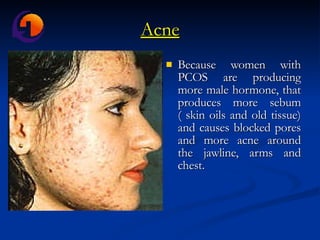
Acne Because women with PCOS are producing more male hormone, that produces more sebum ( skin oils and old tissue) and causes blocked pores and more acne around the jawline, arms and chest.
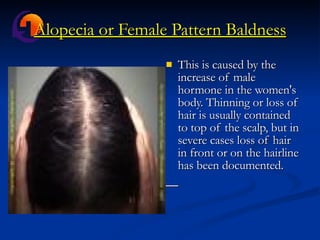
Alopecia or Female Pattern Baldness This is caused by the increase of male hormone in the women's body. Thinning or loss of hair is usually contained to top of the scalp, but in severe cases loss of hair in front or on the hairline has been documented.
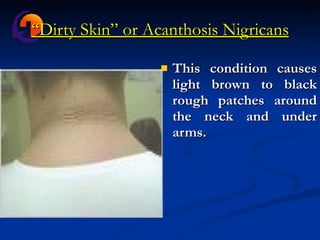
“ Dirty Skin” or Acanthosis Nigricans This condition causes light brown to black rough patches around the neck and under arms.
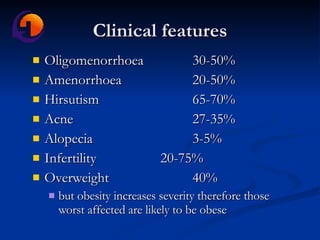
Clinical features Oligomenorrhoea 30-50% Amenorrhoea 20-50% Hirsutism 65-70% Acne 27-35% Alopecia 3-5% Infertility 20-75% Overweight 40%  but obesity increases severity therefore those worst affected are likely to be obese
 
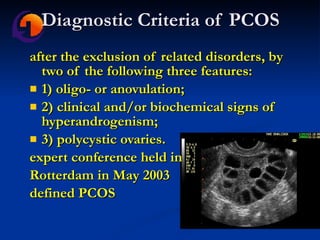
Diagnostic Criteria of PCOS after the exclusion of related disorders, by two of the following three features: 1) oligo- or anovulation;  2) clinical and/or biochemical signs of hyperandrogenism;  3) polycystic ovaries.  expert conference held in  Rotterdam in May 2003  defined PCOS
Long term risks of PCOS Type 2 diabetes Cardiovascular disease Infertility Miscarriage Gestational DM Endometrial cancer
Mechanism of PCOS Complicated  and unclearly  knowed
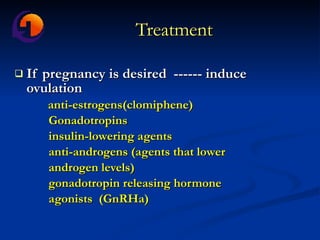
Treatment If pregnancy is desired  ------ induce ovulation  anti-estrogens(clomiphene) Gonadotropins insulin-lowering agents anti-androgens (agents that lower  androgen levels) gonadotropin releasing hormone  agonists  (GnRHa)
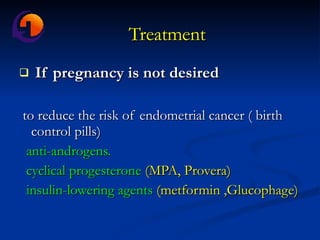
If pregnancy is not desired to reduce the risk of endometrial cancer ( birth control pills) anti-androgens. cyclical progesterone   (MPA, Provera) insulin-lowering agents   (metformin ,Glucophage) Treatment

26.2008 Reproductive Endocrinology

  • 1.
    Zhang Huiying Normaland Abnormal Menstruation Reproductive Endocrinology
  • 2.
    Main contents Normalmanstruation Abnormal uterine bleeding ★ Amenorrhea ★ Perimenopause and perimenopausal syndrome polycystic ovarian syndrome(PCOS)
  • 3.
    Normal menstruation Meaninterval is 28 days +/- 7 days. Mean duration is 2~7 days. More than 7 days is abnormal. Average blood loss with menstruation is 35-50 ml . More than 80 ml is abnormal
  • 4.
    CNS-Hypothalamus-Pituitary Ovary-uterus InteractionHypothalamus Gn-RH Ant. pituitary FSH, LH Ovaries Uterus Progesterone Estrogen Menses – ± ? CNS Not clear
  • 5.
    The normal menstrualcycle is the result of complex interactions between the hypothalamic- pituitary-ovarian (HPO) endocrine axis. Hypothalamus secrete gonadotropin-releasing hormone, The anterior pituitary release the FSH and LH Every cycle the ovary change from follicular development phase to the luteal phase secrete estrogen and progesterone The endometrium change from proliferative phases to secretory phases. When progesterone and estrogen levels fall with the demise of the corpus luteum, vasoactive substances such as prostaglandins, histamine and bradykinin are produced by the endometrium. Prostaglandins cause spasm of the spiral arterioles which results in ischaemic necrosis and shedding of all but the basal layer of the endometrium.
  • 6.
    The control ofregular menstrual blood loss vasodilatation of spiral arterioles fibrinolytic activity of menstrual blood endometrial regeneration.
  • 7.
  • 8.
    Sorts of bleedingAbnormal menstrual bleeding Other causes pregnancy Systemic disease Cancer
  • 9.
    Patterns of abnormaluterine bleeding Menorrhagia(hypermenorrhea) Hypomenorrhea Metrorrhagia(intermenstrual bleeding) Polymenorrhea Menometrorrhagia Oligomenorrhea Contact bleeding(postcoital bleeding)
  • 10.
    Menorrhagia Menorrhagia isheavy or prolonged menstrual flow. It is defined as menstrual blood loss exceeding 80 ml per cycle. Submucous myomas , adenomyosis , IUDs , endometrial hyperplasias , malignant tumors , and dysfunctional bleeding are causes of menorrhagia.
  • 11.
    Hypomenorrhea Hypomenorrhea isunusually light menstrual flow , sometimes only spotting. cervical stenosis and Uterine synechiae ( Asherman's syndrome ) can be causative
  • 12.
    Metrorrhagia Metrorrhagia isbleeding occurring at any time between menstrual periods. Ovulatory bleeding occurs at midcycle as spotting
  • 13.
    Polymenorrhea Polymenorrhea describesperiods that occur too frequently, less than 21 days apart. This is usually associated with anovulation and rarely with a shortened luteal phase in the menstrual cycle.
  • 14.
    Menometrorrhagia Menometrorrhagia isbleeding that occurs at irregular intervals. The amount and duration of bleeding also vary. Sudden onset of irregular bleeding episodes may be an indication of malignant tumors or complications of pregnancy.
  • 15.
    Oligomenorrhea Oligomenorrhea describesmenstrual periods that occur more than 35 days apart. Bleeding is usually associated with anovulation
  • 16.
    Contact bleeding(postcoital bleeding)Contact bleeding must be considered a sign of cervical cancer until proved otherwise.
  • 17.
    Evaluation of abnormaluterine bleeding History Physical examination Cytologic examination Endometrial biopsy Saline hysterosonogram Hysteroscopy Dilatation and curettage(D & C) Other diagnostic procedures(assay hCG,pelvic ultrasonography,laparoscopy)
  • 18.
    History the amountof menstrual flow the length of the menstrual cycle and menstrual period the length and amount of episodes of intermenstrual bleeding any episodes of contact bleeding. the last menstrual period , the last normal menstrual period age at menarche and menopause any changes in general health.
  • 19.
    Physical examination Abdominalmasses and an enlarged , irregular uterus suggest myoma. A symmetrically enlarged uterus is more typical of adenomyosis or endometrial carcinoma. Atrophic and inflammatory vulvar and vaginal lesions can be visualized cervical polyps and invasive lesions of cervical carcinoma can be seen. Rectovaginal examination is especially important sometimes
  • 20.
    Cytologic examination -cytologicsmears A very useful method to screen the asymptomatic intraepithelial lesions.
  • 21.
    Endometrial biopsy theNovak suction curet the Duncan curet the Kevorkisn curet the pipelle.
  • 22.
    Saline hysterosonogram Ultrasoundfollowing injection of saline into the uterus has been used to evaluate the endometrial cavity for polyps , fibroids , or other abnormalities.
  • 23.
    Hysteroscopy Hysteroscopy Placingan endoscopic camera through the cervix into the endometrial cavity allows direct visualization of the cavity.
  • 24.
    Dilatation and curettage(D& C) D & C is the gold standard for the diagnosis of abnormal uterine bleeding. Curettage of the endocervix should be performed before sounding of the endometrial cavity or dilatation of the cervix is done.
  • 25.
    Other diagnostic proceduresassay hCG pelvic ultrasonography laparoscopy
  • 26.
    abnormal uterine bleedingdue to gynecologic diseases and disorders Vulva and vagina --atrophic vulvitis or vaginitis Cervix – eversion, cervical polyps, cervical cancer Uterus –endometritis, hyperplasias, cancer, submucous myomas,IUD Ovaries—estrogen-producing tumor, other cancers
  • 27.
    Abnormal bleeding dueto nongynecologic diseases and disorders Severe hypothyroidism Liver disease Blood dyscrasias and coagulation abnormalities Use anticoagulants or adrenal steroids
  • 28.
  • 29.
    definition ★ Dysfunctionaluterine bleeding(DUB) is irregular, abnormal uterine bleeding with no demonstrable organic causes. That is not caused by a tumor, infection, or pregnancy. It may be occur during postmenarchal and perimenopausal periods in a woman's reproductive life. Exclusion of pathologic causes of abnormal bleeding establishes the diagnosis of DUB
  • 30.
    DUB occurin before the menopause(50%) after menarche(20%) reproductive times(30%)
  • 31.
    Etiology ofDUB: 1. disorders of hypothalamus---pituitary ---ovary axis immature of feedback regulation in young women ovarian function failure in premenopause women 2.other Factors: the effects of sex hormones nervous Circumstance change PCOS,TSH ↑,PRL↑ excessive physical exercise
  • 32.
    Mechanisms have developingfolliculi no mature follicle no corpus luteum only have estrogen, but no progestin breakthrough bleeding, spoting
  • 33.
    pathologic Changesin the endometrium Endometrial hyperplasia Simple hyperplasia Complex hyperplasia Atypical hyperplasia Proliferative phase endometrium Atrophic endometrium
  • 34.
  • 35.
    Treatment Depends onthe age of patient Adolescent Young woman Premenopausal woman
  • 36.
    Adolescent Acute hemorrhage:high-dose estrogen given intravenously or injection (25mg conjugated estrogen every 4h) Hemodynamically stable patients: take oral conjugated estrogen (2.5mg every 4-6h) or take oral contraceptives 3-4 times the usual dose.
  • 37.
    ★ Lower the dose every 3 days for 1/3 dose after the bleeding stoped and when have lowered to an usual dose, give medroxyprogesterone acetate (MPA)10mg once or twice a day for 10-14d 2.5mg / 6h 2.5mg / 8h 2.5mg / 12h 2.5mg / d Use to bleeding stoped 3d 3d 3d 1.25mg / d 10-14d medroxyprogesterone acetate 10-14d
  • 38.
    Next 3-6 monthsgive cycling theraphy Sequential hormones Oral contraceptive Adolescent
  • 39.
    Young women Except the pathologic causes is necessary Hormonal management is the same as for adolescents Oral contraceptives may be used as normally prescribed if the patient don’t desire for childbearing Induce ovulation if necessary
  • 40.
    Premenopausal women Morecare should be given to excluding pathologic causes because of the possibility of endometrial cancer Aspiration ,curettage,or both should clearly establish anovulatory or dyssynchronous cycles as the cause before hormonal therapy is started. Recurrences of abnormal bleeding demand further evaluation
  • 41.
    Surgical measures D& C:temporarily stop bleeding Conservative surgery: endometrial ablation or resection using diathermy ,thermal (ballon, microwave..etc.)or laser. Hysterectomy :whose lifestyle is compromised by persistence of irregular bleeding,coexistent endometriosis, myoma, other disorders of pelvic
  • 42.
  • 43.
    BACKGROUND In 1935,Stein and Leventhal published a paper on their findings in seven women with amenorrhea, hirsutism, obesity, and a characteristic polycystic appearance to their ovaries — one of the first descriptions of a complex phenotype today known as the polycystic ovary syndrome . The condition is now well recognized as having a major effect throughout life on the reproductive, metabolic, and cardiovascular health of affected women.
  • 44.
    Clinical Manifestations Menstrualdysfunction- oligomenorrhea or amenorrhea Hyperandrogenism -hirsutism, acne, male pattern balding or hair loss Ovarian Morphology- Polycystic ovaries be seen on ultrasonography Infertility Obesity and insulin resistance -At least one-half of women with PCOS are obese and with insulin resistance Biochemical Abnormalities-elevated serum androgen levels,LH/FSH≥2.5~3, hyperinsulinemia , Slightly elevated prolactin.
  • 45.
    Hirsutism Excessive bodyhair. In women with PCOS dark, coarse hair will appear on the face, neck, chest, arms, and in between the legs.
  • 46.
    Acne Because womenwith PCOS are producing more male hormone, that produces more sebum ( skin oils and old tissue) and causes blocked pores and more acne around the jawline, arms and chest.
  • 47.
    Alopecia or FemalePattern Baldness This is caused by the increase of male hormone in the women's body. Thinning or loss of hair is usually contained to top of the scalp, but in severe cases loss of hair in front or on the hairline has been documented.
  • 48.
    “ Dirty Skin”or Acanthosis Nigricans This condition causes light brown to black rough patches around the neck and under arms.
  • 49.
    Clinical features Oligomenorrhoea30-50% Amenorrhoea 20-50% Hirsutism 65-70% Acne 27-35% Alopecia 3-5% Infertility 20-75% Overweight 40% but obesity increases severity therefore those worst affected are likely to be obese
  • 50.
  • 51.
    Diagnostic Criteria ofPCOS after the exclusion of related disorders, by two of the following three features: 1) oligo- or anovulation; 2) clinical and/or biochemical signs of hyperandrogenism; 3) polycystic ovaries. expert conference held in Rotterdam in May 2003 defined PCOS
  • 52.
    Long term risksof PCOS Type 2 diabetes Cardiovascular disease Infertility Miscarriage Gestational DM Endometrial cancer
  • 53.
    Mechanism of PCOSComplicated and unclearly knowed
  • 54.
    Treatment If pregnancyis desired ------ induce ovulation anti-estrogens(clomiphene) Gonadotropins insulin-lowering agents anti-androgens (agents that lower androgen levels) gonadotropin releasing hormone agonists (GnRHa)
  • 55.
    If pregnancy isnot desired to reduce the risk of endometrial cancer ( birth control pills) anti-androgens. cyclical progesterone (MPA, Provera) insulin-lowering agents (metformin ,Glucophage) Treatment