Laparoscopic Splenectomy George Ferzli, MD, FACS Department of Laparoscopic Surgery Staten Island University Hospital
Historical background “An organ of mystery” (Galen) “Unnecessary” (Aristotle) “An organ that hinders the speed of runners” (Pliny) “An organ that produce laughter and mirth” (Babylonian Talmud)
Open splenic surgery 1 st  splenectomy: 1549, Adrian Zacarelli 1 st  partial splenectomy: 1590, Franciscus Rosetti 1 st  splenectomy in the USA: 1816, O’Brien 1 st  repair of lacerated spleen: 1895, Zikoff (Russian)
Laparoscopic splenectomy In 1992, several reports of laparoscopic splenectomies started emerging in small series.  Laparoscopic splenectomy has become a useful alternative to open splenectomy.
Spleen Anatomy Most common relationship of artery and vein is artery anterior Other positions occur Main artery divides into hilar branches over the pancreatic tail
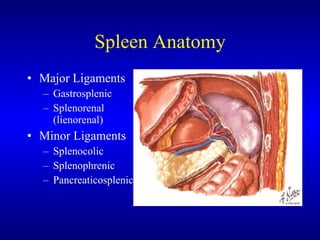
Spleen Anatomy Major Ligaments Gastrosplenic Splenorenal (lienorenal)  Minor Ligaments Splenocolic Splenophrenic Pancreaticosplenic
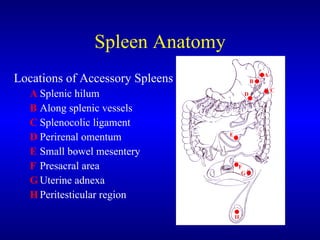
Spleen Anatomy Locations of Accessory Spleens A Splenic hilum B Along splenic vessels C Splenocolic ligament D Perirenal omentum E Small bowel mesentery F Presacral area G Uterine adnexa H Peritesticular region
Splenic Function Immune function Filtering function Opsonin production Clearance of encapsulated organisms Clearance of metastatic cells Erythrocyte maintenance Platelet reservoir Storage organ for factor VIII
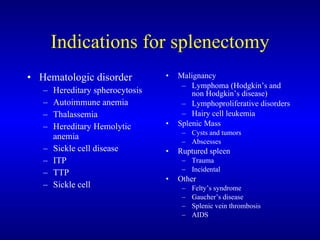
Indications for splenectomy Hematologic disorder Hereditary spherocytosis Autoimmune anemia Thalassemia Hereditary Hemolytic anemia Sickle cell disease ITP TTP Sickle cell Malignancy Lymphoma (Hodgkin’s and non Hodgkin’s disease) Lymphoproliferative disorders Hairy cell leukemia Splenic Mass Cysts and tumors Abscesses Ruptured spleen Trauma Incidental Other Felty’s syndrome Gaucher’s disease Splenic vein thrombosis AIDS
Change of Indications Decrease  Increase Decline of staging laparotomy for Hodgkin’s disease Increase of splenectomies for hereditary spherocytosis and myeloproliferative disorders Significant Increase indication for ITP New indication: Hairy cell leukemia, Felty’s syndrome, AIDS
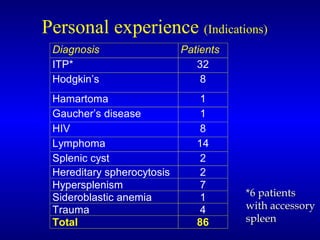
Personal experience  (Indications) *6 patients with accessory spleen
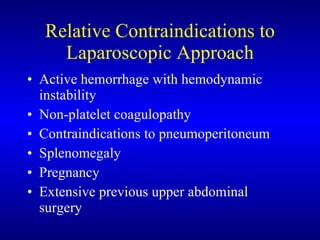
Relative Contraindications to Laparoscopic Approach Active hemorrhage with hemodynamic instability Non-platelet coagulopathy Contraindications to pneumoperitoneum Splenomegaly Pregnancy Extensive previous upper abdominal surgery
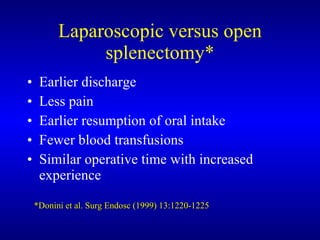
Laparoscopic versus open splenectomy* Earlier discharge Less pain Earlier resumption of oral intake Fewer blood transfusions Similar operative time with increased experience *Donini et al. Surg Endosc (1999) 13:1220-1225
Three Areas of Controversy Is  massive splenomegaly  a contraindication for laparoscopic splenectomy? What is the role of laparoscopy in the management of  splenic rupture ? Does laparoscopic splenectomy for hematologic disease result in higher  recurrence ?
Massive splenomegaly Technical challenge Difficulty to manipulate the spleen Difficulty in the extraction of the spleen Options Totally laparoscopic splenectomy Hand port assisted * *Meijer et al J Laparoendosc & Adv Techn (1999) 9:507-10
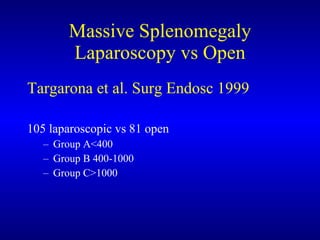
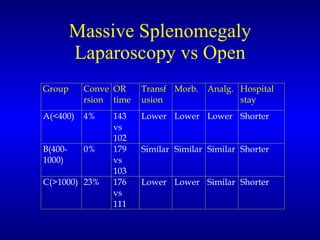
Massive Splenomegaly Laparoscopy vs Open Targarona et al. Surg Endosc 1999 105 laparoscopic vs 81 open Group A<400  Group B 400-1000 Group C>1000
Massive Splenomegaly Laparoscopy vs Open
Laparoscopic Splenectomy for Ruptured Spleen Indications Incidental splenectomy Trauma splenorrhaphy splenectomy
Laparoscopic Splenectomy for Ruptured Spleen The patient has to be hemodynamically stable (on going bleeding requiring large blood transfusion) Use of 10mm suction/irrigation device Early control of splenic hilum Hand port could be helpful
Accessory spleens (AS) The reported incidence in OS (15 30%) is higher then LS (4-12%)  Long term follow up is essential  because a small accessory spleen can hypertrophy after splenectomy and be detected via CT scan or scintigraphy
Residual Splenic Function Targarano et al. Arch Surg 1998 48 LS for hematologic disease 9 patients no clinical improvement Of the 9 patients, 3 had residual function on scintigraphy scan Of the 3 patients,  2 had accessory  spleen and  1 had implants  of splenic tissue
Residual Splenic Function Shimomatsuya et al. Surg Endos 1999 20 OS and 14 LS for ITP Similar failure rate between OS and LS Similar number of accessory spleens detected intraoperatively between OS and LS
Prevention of Residual Function Extreme care to avoid parenchymal rupture and cell spillage Systematic and careful exploration of the abdominal cavity for accessory spleens
Preoperative Considerations Pneumovax, haemophilus, meningococcus vaccinations 2 weeks pre-op Corticosteroids Availability of blood and platelet products Preoperative IgG administration to patients with ITP and critically low platelet counts Perioperative antibiotics Pre-operative embolization- controversial
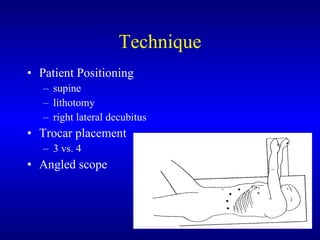
Technique Patient Positioning supine lithotomy right lateral decubitus Trocar placement 3 vs. 4 Angled scope
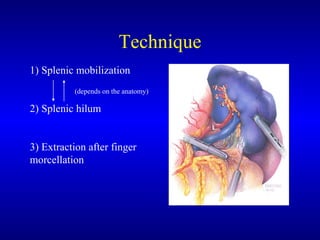
Technique 1) Splenic mobilization 2) Splenic hilum 3) Extraction after finger morcellation (depends on the anatomy)
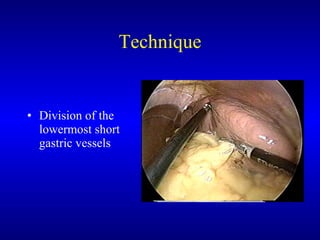
Technique Division of the lowermost short gastric vessels
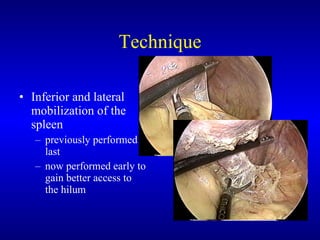
Technique Inferior and lateral mobilization of the spleen previously performed last now performed early to gain better access to the hilum
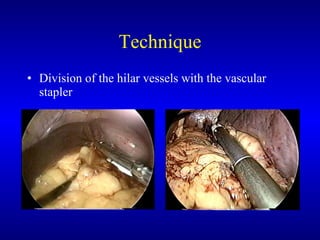
Technique Division of the hilar vessels with the vascular stapler
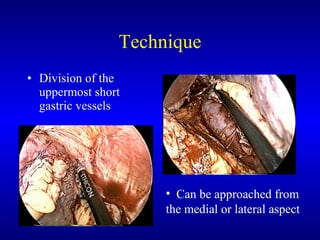
Technique Division of the uppermost short gastric vessels Can be approached from the medial or lateral aspect
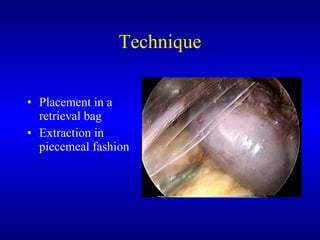
Technique Placement in a retrieval bag Extraction in piecemeal fashion
Post-op Considerations Removal of NGT and foley prior to extubation Up in chair for a few hours the night of surgery Liquid diet begun on the first post-op day Ambulate in the hall on the first post-op day Discharge on the first or second post-op day
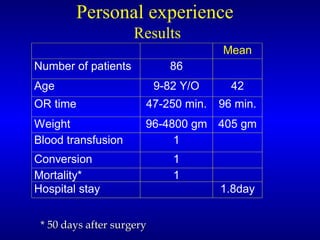
Personal experience  Results * 50 days after surgery
Complications Wound infection Post splenectomy sepsis Atelectasis Post-op bleeding DVT Gastric perforation Pancreatic fistula
Conclusion Our data indicates that the indications for laparoscopic splenectomy are the same as for open splenectomy Massive splenomegaly, ruptured spleen are not a contraindication Residual function and accessory spleen are not a concern

Laparoscopic Splenectomy

  • 1.
    Laparoscopic Splenectomy GeorgeFerzli, MD, FACS Department of Laparoscopic Surgery Staten Island University Hospital
  • 2.
    Historical background “Anorgan of mystery” (Galen) “Unnecessary” (Aristotle) “An organ that hinders the speed of runners” (Pliny) “An organ that produce laughter and mirth” (Babylonian Talmud)
  • 3.
    Open splenic surgery1 st splenectomy: 1549, Adrian Zacarelli 1 st partial splenectomy: 1590, Franciscus Rosetti 1 st splenectomy in the USA: 1816, O’Brien 1 st repair of lacerated spleen: 1895, Zikoff (Russian)
  • 4.
    Laparoscopic splenectomy In1992, several reports of laparoscopic splenectomies started emerging in small series. Laparoscopic splenectomy has become a useful alternative to open splenectomy.
  • 5.
    Spleen Anatomy Mostcommon relationship of artery and vein is artery anterior Other positions occur Main artery divides into hilar branches over the pancreatic tail
  • 6.
    Spleen Anatomy MajorLigaments Gastrosplenic Splenorenal (lienorenal) Minor Ligaments Splenocolic Splenophrenic Pancreaticosplenic
  • 7.
    Spleen Anatomy Locationsof Accessory Spleens A Splenic hilum B Along splenic vessels C Splenocolic ligament D Perirenal omentum E Small bowel mesentery F Presacral area G Uterine adnexa H Peritesticular region
  • 8.
    Splenic Function Immunefunction Filtering function Opsonin production Clearance of encapsulated organisms Clearance of metastatic cells Erythrocyte maintenance Platelet reservoir Storage organ for factor VIII
  • 9.
    Indications for splenectomyHematologic disorder Hereditary spherocytosis Autoimmune anemia Thalassemia Hereditary Hemolytic anemia Sickle cell disease ITP TTP Sickle cell Malignancy Lymphoma (Hodgkin’s and non Hodgkin’s disease) Lymphoproliferative disorders Hairy cell leukemia Splenic Mass Cysts and tumors Abscesses Ruptured spleen Trauma Incidental Other Felty’s syndrome Gaucher’s disease Splenic vein thrombosis AIDS
  • 10.
    Change of IndicationsDecrease Increase Decline of staging laparotomy for Hodgkin’s disease Increase of splenectomies for hereditary spherocytosis and myeloproliferative disorders Significant Increase indication for ITP New indication: Hairy cell leukemia, Felty’s syndrome, AIDS
  • 11.
    Personal experience (Indications) *6 patients with accessory spleen
  • 12.
    Relative Contraindications toLaparoscopic Approach Active hemorrhage with hemodynamic instability Non-platelet coagulopathy Contraindications to pneumoperitoneum Splenomegaly Pregnancy Extensive previous upper abdominal surgery
  • 13.
    Laparoscopic versus opensplenectomy* Earlier discharge Less pain Earlier resumption of oral intake Fewer blood transfusions Similar operative time with increased experience *Donini et al. Surg Endosc (1999) 13:1220-1225
  • 14.
    Three Areas ofControversy Is massive splenomegaly a contraindication for laparoscopic splenectomy? What is the role of laparoscopy in the management of splenic rupture ? Does laparoscopic splenectomy for hematologic disease result in higher recurrence ?
  • 15.
    Massive splenomegaly Technicalchallenge Difficulty to manipulate the spleen Difficulty in the extraction of the spleen Options Totally laparoscopic splenectomy Hand port assisted * *Meijer et al J Laparoendosc & Adv Techn (1999) 9:507-10
  • 16.
    Massive Splenomegaly Laparoscopyvs Open Targarona et al. Surg Endosc 1999 105 laparoscopic vs 81 open Group A<400 Group B 400-1000 Group C>1000
  • 17.
  • 18.
    Laparoscopic Splenectomy forRuptured Spleen Indications Incidental splenectomy Trauma splenorrhaphy splenectomy
  • 19.
    Laparoscopic Splenectomy forRuptured Spleen The patient has to be hemodynamically stable (on going bleeding requiring large blood transfusion) Use of 10mm suction/irrigation device Early control of splenic hilum Hand port could be helpful
  • 20.
    Accessory spleens (AS)The reported incidence in OS (15 30%) is higher then LS (4-12%) Long term follow up is essential because a small accessory spleen can hypertrophy after splenectomy and be detected via CT scan or scintigraphy
  • 21.
    Residual Splenic FunctionTargarano et al. Arch Surg 1998 48 LS for hematologic disease 9 patients no clinical improvement Of the 9 patients, 3 had residual function on scintigraphy scan Of the 3 patients, 2 had accessory spleen and 1 had implants of splenic tissue
  • 22.
    Residual Splenic FunctionShimomatsuya et al. Surg Endos 1999 20 OS and 14 LS for ITP Similar failure rate between OS and LS Similar number of accessory spleens detected intraoperatively between OS and LS
  • 23.
    Prevention of ResidualFunction Extreme care to avoid parenchymal rupture and cell spillage Systematic and careful exploration of the abdominal cavity for accessory spleens
  • 24.
    Preoperative Considerations Pneumovax,haemophilus, meningococcus vaccinations 2 weeks pre-op Corticosteroids Availability of blood and platelet products Preoperative IgG administration to patients with ITP and critically low platelet counts Perioperative antibiotics Pre-operative embolization- controversial
  • 25.
    Technique Patient Positioningsupine lithotomy right lateral decubitus Trocar placement 3 vs. 4 Angled scope
  • 26.
    Technique 1) Splenicmobilization 2) Splenic hilum 3) Extraction after finger morcellation (depends on the anatomy)
  • 27.
    Technique Division ofthe lowermost short gastric vessels
  • 28.
    Technique Inferior andlateral mobilization of the spleen previously performed last now performed early to gain better access to the hilum
  • 29.
    Technique Division ofthe hilar vessels with the vascular stapler
  • 30.
    Technique Division ofthe uppermost short gastric vessels Can be approached from the medial or lateral aspect
  • 31.
    Technique Placement ina retrieval bag Extraction in piecemeal fashion
  • 32.
    Post-op Considerations Removalof NGT and foley prior to extubation Up in chair for a few hours the night of surgery Liquid diet begun on the first post-op day Ambulate in the hall on the first post-op day Discharge on the first or second post-op day
  • 33.
    Personal experience Results * 50 days after surgery
  • 34.
    Complications Wound infectionPost splenectomy sepsis Atelectasis Post-op bleeding DVT Gastric perforation Pancreatic fistula
  • 35.
    Conclusion Our dataindicates that the indications for laparoscopic splenectomy are the same as for open splenectomy Massive splenomegaly, ruptured spleen are not a contraindication Residual function and accessory spleen are not a concern