RM
Series
Statistics In
Medical Research
Dr. A.P. Kulkarni
MD, DPH, PhD, FIAPSM
drapkulkarni@gmail.com
LOGOLesson Objectives
Appreciate the role of statistics in medical
research1
At the end of the lesson, the participants
would be able to:
Utilize services of statistician fruitfully in
research2
2
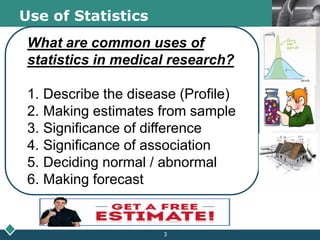
LOGOUse of Statistics
What are common uses of
statistics in medical research?
1. Describe the disease (Profile)
2. Making estimates from sample
3. Significance of difference
4. Significance of association
5. Deciding normal / abnormal
6. Making forecast
3
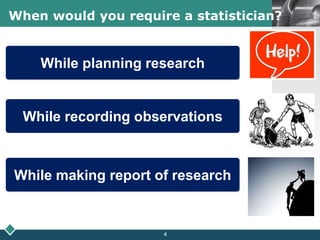
LOGOWhen would you require a statistician?
While planning research
While recording observations
While making report of research
4
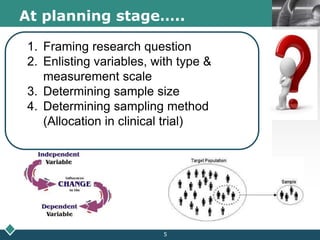
LOGOAt planning stageโ€ฆ..
1. Framing research question
2. Enlisting variables, with type &
measurement scale
3. Determining sample size
4. Determining sampling method
(Allocation in clinical trial)
5
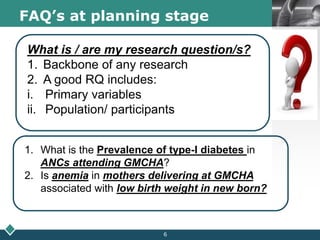
LOGOFAQโ€™s at planning stage
What is / are my research question/s?
1. Backbone of any research
2. A good RQ includes:
i. Primary variables
ii. Population/ participants
1. What is the Prevalence of type-I diabetes in
ANCs attending GMCHA?
2. Is anemia in mothers delivering at GMCHA
associated with low birth weight in new born?
6
LOGOFAQโ€™s at planning stage
Why should I frame RQs at the beginning?
1. Helps focused research
2. Helps knowing primary variable/s
3. Defines population/ participants. This in
turn, helps deciding sampling method
4. Good RQ can indicate study design
7
LOGOFAQโ€™s at planning stage
What variables am I dealing with?
1. Variables in RQ: Primary variables
2. Variables affecting primary variables:
Confounders
3. Demographic variables
Is cure rate of drug-A more than that of
drug-B in disease-X
1. Primary variable/s: Cure rate, Drug given
2. Confounders: Severity of disease, Gender,
Age, Co-morbidities
8
LOGOFAQโ€™s at planning stage
Why should I determine sample size?
1. Results become invalid if study is
done on smaller sample than required
2. You may actually require lesser
sample size than you think. Un-
necessary efforts, resources can be
saved
9
LOGOFAQโ€™s at planning stage
What information statistician requires for
calculating sample size?
Depends on:
1. Study design
2. Acceptable alpha & beta error
3. Precision required
4. Your estimate of primary variable/s in RQ
SOFTWARE: EPI-info, Open-Epi
10
LOGOFAQโ€™s at planning stage
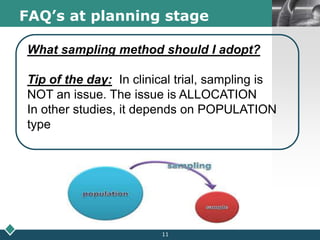
What sampling method should I adopt?
Tip of the day: In clinical trial, sampling is
NOT an issue. The issue is ALLOCATION
In other studies, it depends on POPULATION
type
11
LOGO
Dr. A.P. Kulkarni12
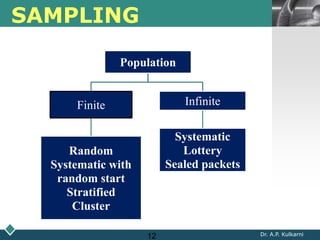
SAMPLING
Population
Finite
Random
Systematic with
random start
Stratified
Cluster
Infinite
Systematic
Lottery
Sealed packets
LOGOFAQโ€™s at planning stage
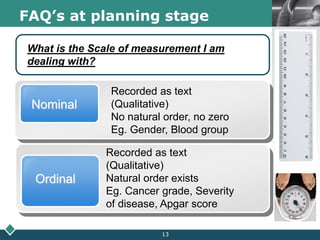
What is the Scale of measurement I am
dealing with?
Nominal
Recorded as text
(Qualitative)
No natural order, no zero
Eg. Gender, Blood group
Ordinal
Recorded as text
(Qualitative)
Natural order exists
Eg. Cancer grade, Severity
of disease, Apgar score
13
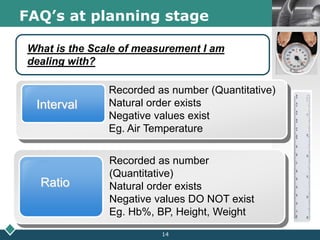
LOGOFAQโ€™s at planning stage
What is the Scale of measurement I am
dealing with?
Interval
Recorded as number (Quantitative)
Natural order exists
Negative values exist
Eg. Air Temperature
Ratio
Recorded as number
(Quantitative)
Natural order exists
Negative values DO NOT exist
Eg. Hb%, BP, Height, Weight
14
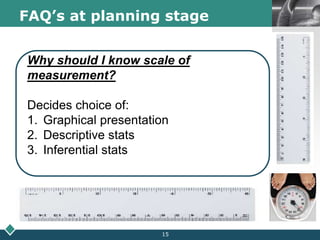
LOGOFAQโ€™s at planning stage
Why should I know scale of
measurement?
Decides choice of:
1. Graphical presentation
2. Descriptive stats
3. Inferential stats
15
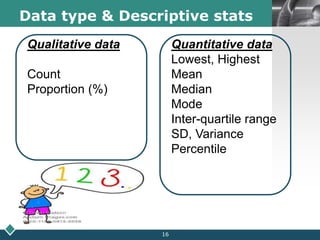
LOGOData type & Descriptive stats
Qualitative data
Count
Proportion (%)
Quantitative data
Lowest, Highest
Mean
Median
Mode
Inter-quartile range
SD, Variance
Percentile
16
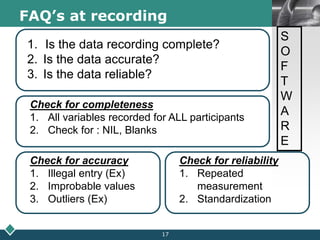
LOGOFAQโ€™s at recording
1. Is the data recording complete?
2. Is the data accurate?
3. Is the data reliable?
Check for completeness
1. All variables recorded for ALL participants
2. Check for : NIL, Blanks
Check for accuracy
1. Illegal entry (Ex)
2. Improbable values
3. Outliers (Ex)
Check for reliability
1. Repeated
measurement
2. Standardization
S
O
F
T
W
A
R
E
17
LOGOFAQโ€™s at reporting stage
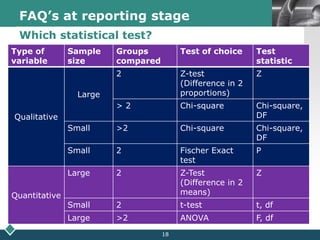
Which statistical test?
Type of
variable
Sample
size
Groups
compared
Test of choice Test
statistic
Qualitative
Large
2 Z-test
(Difference in 2
proportions)
Z
> 2 Chi-square Chi-square,
DF
Small >2 Chi-square Chi-square,
DF
Small 2 Fischer Exact
test
P
Quantitative
Large 2 Z-Test
(Difference in 2
means)
Z
Small 2 t-test t, df
Large >2 ANOVA F, df
18
LOGOFAQโ€™s at reporting stage
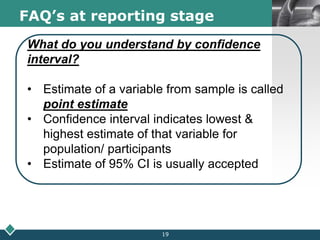
What do you understand by confidence
interval?
โ€ข Estimate of a variable from sample is called
point estimate
โ€ข Confidence interval indicates lowest &
highest estimate of that variable for
population/ participants
โ€ข Estimate of 95% CI is usually accepted
19
LOGOFAQโ€™s at reporting stage
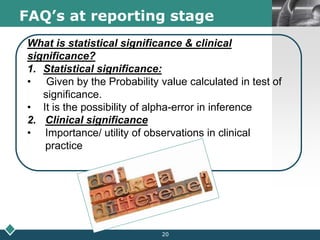
What is statistical significance & clinical
significance?
1. Statistical significance:
โ€ข Given by the Probability value calculated in test of
significance.
โ€ข It is the possibility of alpha-error in inference
2. Clinical significance
โ€ข Importance/ utility of observations in clinical
practice
20
LOGOIn conclusionโ€ฆโ€ฆ
1. Statisticians play important role in medical
research from start to end.
2. Statistician should therefore, be a member of
research team.
3. Statistician and clinician speak different
language. For effective communication,
clinicians in research, must learn the language
of statistics.
4. Another alternative is to use a translator and
what better person can you have than a
specialist in Community Medicine?
21
RM
Series
C l i c k t o e d i t c o m p a n y s l o g a n .

Statistics in medical research

  • 1.
    RM Series Statistics In Medical Research Dr.A.P. Kulkarni MD, DPH, PhD, FIAPSM drapkulkarni@gmail.com
  • 2.
    LOGOLesson Objectives Appreciate therole of statistics in medical research1 At the end of the lesson, the participants would be able to: Utilize services of statistician fruitfully in research2 2
  • 3.
    LOGOUse of Statistics Whatare common uses of statistics in medical research? 1. Describe the disease (Profile) 2. Making estimates from sample 3. Significance of difference 4. Significance of association 5. Deciding normal / abnormal 6. Making forecast 3
  • 4.
    LOGOWhen would yourequire a statistician? While planning research While recording observations While making report of research 4
  • 5.
    LOGOAt planning stageโ€ฆ.. 1.Framing research question 2. Enlisting variables, with type & measurement scale 3. Determining sample size 4. Determining sampling method (Allocation in clinical trial) 5
  • 6.
    LOGOFAQโ€™s at planningstage What is / are my research question/s? 1. Backbone of any research 2. A good RQ includes: i. Primary variables ii. Population/ participants 1. What is the Prevalence of type-I diabetes in ANCs attending GMCHA? 2. Is anemia in mothers delivering at GMCHA associated with low birth weight in new born? 6
  • 7.
    LOGOFAQโ€™s at planningstage Why should I frame RQs at the beginning? 1. Helps focused research 2. Helps knowing primary variable/s 3. Defines population/ participants. This in turn, helps deciding sampling method 4. Good RQ can indicate study design 7
  • 8.
    LOGOFAQโ€™s at planningstage What variables am I dealing with? 1. Variables in RQ: Primary variables 2. Variables affecting primary variables: Confounders 3. Demographic variables Is cure rate of drug-A more than that of drug-B in disease-X 1. Primary variable/s: Cure rate, Drug given 2. Confounders: Severity of disease, Gender, Age, Co-morbidities 8
  • 9.
    LOGOFAQโ€™s at planningstage Why should I determine sample size? 1. Results become invalid if study is done on smaller sample than required 2. You may actually require lesser sample size than you think. Un- necessary efforts, resources can be saved 9
  • 10.
    LOGOFAQโ€™s at planningstage What information statistician requires for calculating sample size? Depends on: 1. Study design 2. Acceptable alpha & beta error 3. Precision required 4. Your estimate of primary variable/s in RQ SOFTWARE: EPI-info, Open-Epi 10
  • 11.
    LOGOFAQโ€™s at planningstage What sampling method should I adopt? Tip of the day: In clinical trial, sampling is NOT an issue. The issue is ALLOCATION In other studies, it depends on POPULATION type 11
  • 12.
    LOGO Dr. A.P. Kulkarni12 SAMPLING Population Finite Random Systematicwith random start Stratified Cluster Infinite Systematic Lottery Sealed packets
  • 13.
    LOGOFAQโ€™s at planningstage What is the Scale of measurement I am dealing with? Nominal Recorded as text (Qualitative) No natural order, no zero Eg. Gender, Blood group Ordinal Recorded as text (Qualitative) Natural order exists Eg. Cancer grade, Severity of disease, Apgar score 13
  • 14.
    LOGOFAQโ€™s at planningstage What is the Scale of measurement I am dealing with? Interval Recorded as number (Quantitative) Natural order exists Negative values exist Eg. Air Temperature Ratio Recorded as number (Quantitative) Natural order exists Negative values DO NOT exist Eg. Hb%, BP, Height, Weight 14
  • 15.
    LOGOFAQโ€™s at planningstage Why should I know scale of measurement? Decides choice of: 1. Graphical presentation 2. Descriptive stats 3. Inferential stats 15
  • 16.
    LOGOData type &Descriptive stats Qualitative data Count Proportion (%) Quantitative data Lowest, Highest Mean Median Mode Inter-quartile range SD, Variance Percentile 16
  • 17.
    LOGOFAQโ€™s at recording 1.Is the data recording complete? 2. Is the data accurate? 3. Is the data reliable? Check for completeness 1. All variables recorded for ALL participants 2. Check for : NIL, Blanks Check for accuracy 1. Illegal entry (Ex) 2. Improbable values 3. Outliers (Ex) Check for reliability 1. Repeated measurement 2. Standardization S O F T W A R E 17
  • 18.
    LOGOFAQโ€™s at reportingstage Which statistical test? Type of variable Sample size Groups compared Test of choice Test statistic Qualitative Large 2 Z-test (Difference in 2 proportions) Z > 2 Chi-square Chi-square, DF Small >2 Chi-square Chi-square, DF Small 2 Fischer Exact test P Quantitative Large 2 Z-Test (Difference in 2 means) Z Small 2 t-test t, df Large >2 ANOVA F, df 18
  • 19.
    LOGOFAQโ€™s at reportingstage What do you understand by confidence interval? โ€ข Estimate of a variable from sample is called point estimate โ€ข Confidence interval indicates lowest & highest estimate of that variable for population/ participants โ€ข Estimate of 95% CI is usually accepted 19
  • 20.
    LOGOFAQโ€™s at reportingstage What is statistical significance & clinical significance? 1. Statistical significance: โ€ข Given by the Probability value calculated in test of significance. โ€ข It is the possibility of alpha-error in inference 2. Clinical significance โ€ข Importance/ utility of observations in clinical practice 20
  • 21.
    LOGOIn conclusionโ€ฆโ€ฆ 1. Statisticiansplay important role in medical research from start to end. 2. Statistician should therefore, be a member of research team. 3. Statistician and clinician speak different language. For effective communication, clinicians in research, must learn the language of statistics. 4. Another alternative is to use a translator and what better person can you have than a specialist in Community Medicine? 21
  • 22.
    RM Series C l ic k t o e d i t c o m p a n y s l o g a n .