Introduction to Biostatistics
By: Diriba D. (MPH in Epidemiology)
Email: debaba.tolosa@gmail.com
December , 2022
1
Course objectives:
 Course objectives:
At the end of the course students will be able to
Define statistics and Biostatistics
The role of statistics in health sciences
Describe scale of measurement
methods of collection, recording, coding and
handling data;
–Measures of central tendency and dispersion and
present data in form of tables, graphs, etc.;
– identify and make use of data from existing health
records;
2
Introduction to Statistics
Definition:
 The term statistics is used to mean either statistical data or
statistical methods.
 Statistical data: refers to numerical descriptions of things.
 counts e.g. number of student attending this class.
 Measurements e.g. measuring BP, Weight etc.
 Statistics is concerned with scientific methods for collecting,
organizing, summarizing, presenting and analyzing data as well as
deriving valid conclusions.
3
Introduction to Statistics…
 Statistics is a field of study concerned with
1. Collection, organization, summarization and analysis of data.
2. Drawing of inferences about a body of data when only a part of
the data is observed.
5
Characteristics of statistical data
 They must be in aggregates
 They must be enumerated or estimated according to a reasonable
standard of accuracy
 They must have been collected in a systematic manner for a
predetermined purpose.
 They must be placed in relation to each other.
6
Statistics methods fall into two broad
areas
1. Descriptive statistics merely describes, organize, or summarize
the actual data available.
 One branch of descriptive statistics of special relevance in medicine
is that of vital statistics(vital events): birth, death, marriage,
divorce, and the occurrence of particular disease.
 Descriptive statistics includes: tabular, graphical, and measures of
tendency and variation.
7
Cont…
2. Inferential Statistics: The branch of statistics that is most
relevant to public health and clinical medicine
 This branch of statistics deals with techniques of making
conclusions about the population.
 Inferential statistics builds upon descriptive statistics.
 The inferences are drawn from particular properties of sample to
particular properties of population.
 The basic aim of all statistical inference is to employ sampled data
to infer to a population from which the sample was obtained.
8
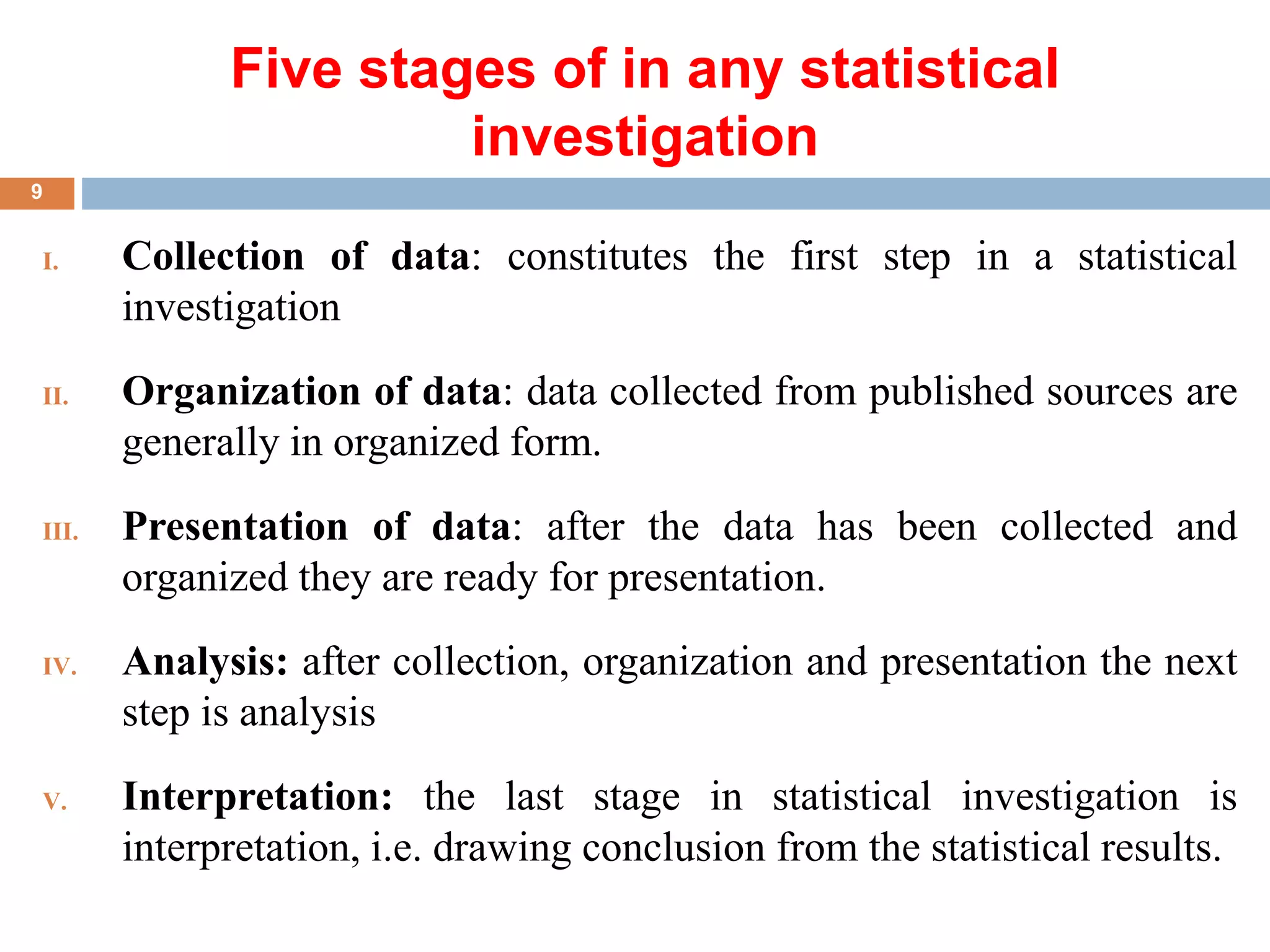
Five stages of in any statistical
investigation
I. Collection of data: constitutes the first step in a statistical
investigation
II. Organization of data: data collected from published sources are
generally in organized form.
III. Presentation of data: after the data has been collected and
organized they are ready for presentation.
IV. Analysis: after collection, organization and presentation the next
step is analysis
V. Interpretation: the last stage in statistical investigation is
interpretation, i.e. drawing conclusion from the statistical results.
9
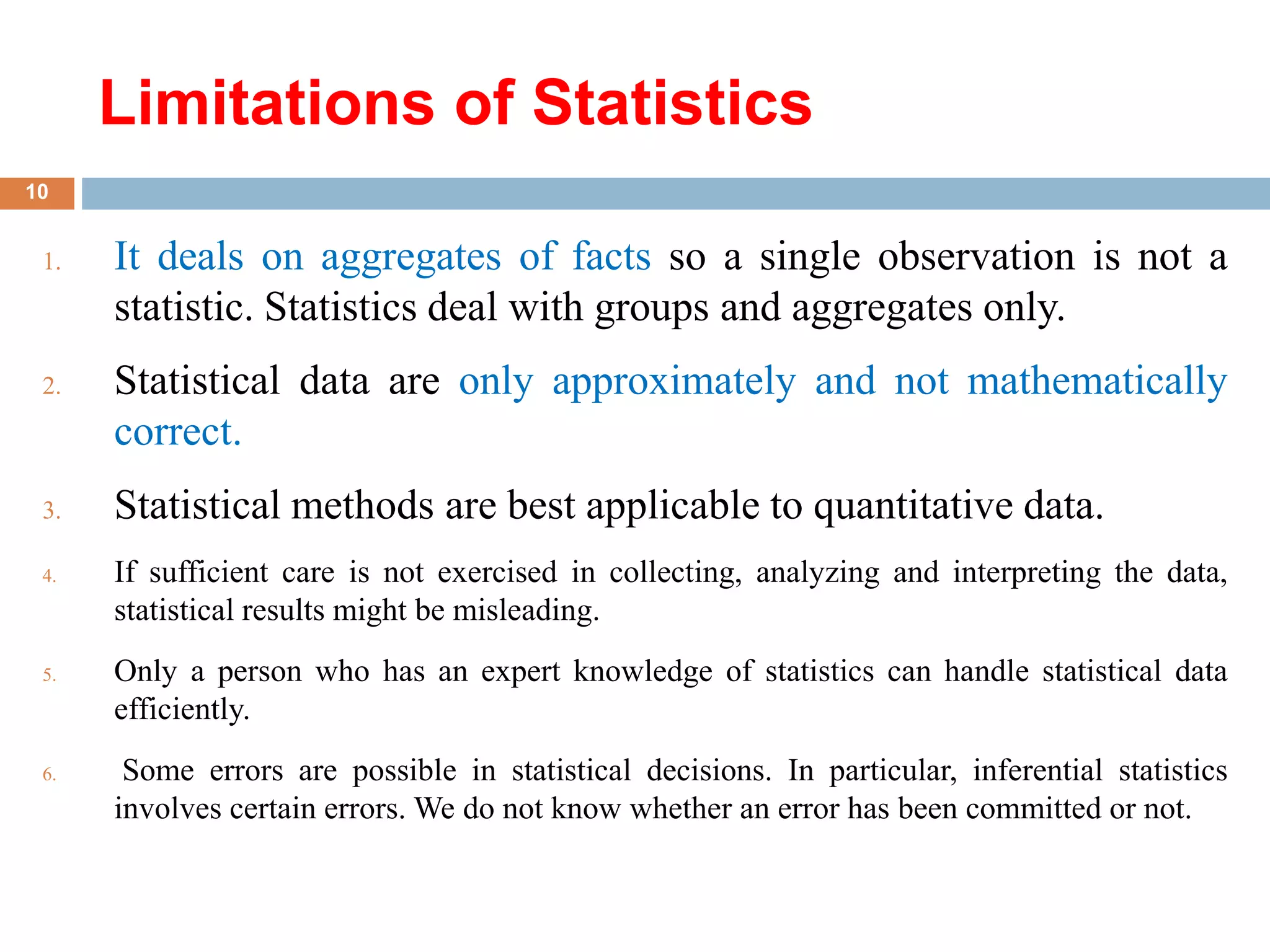
Limitations of Statistics
1. It deals on aggregates of facts so a single observation is not a
statistic. Statistics deal with groups and aggregates only.
2. Statistical data are only approximately and not mathematically
correct.
3. Statistical methods are best applicable to quantitative data.
4. If sufficient care is not exercised in collecting, analyzing and interpreting the data,
statistical results might be misleading.
5. Only a person who has an expert knowledge of statistics can handle statistical data
efficiently.
6. Some errors are possible in statistical decisions. In particular, inferential statistics
involves certain errors. We do not know whether an error has been committed or not.
10
11
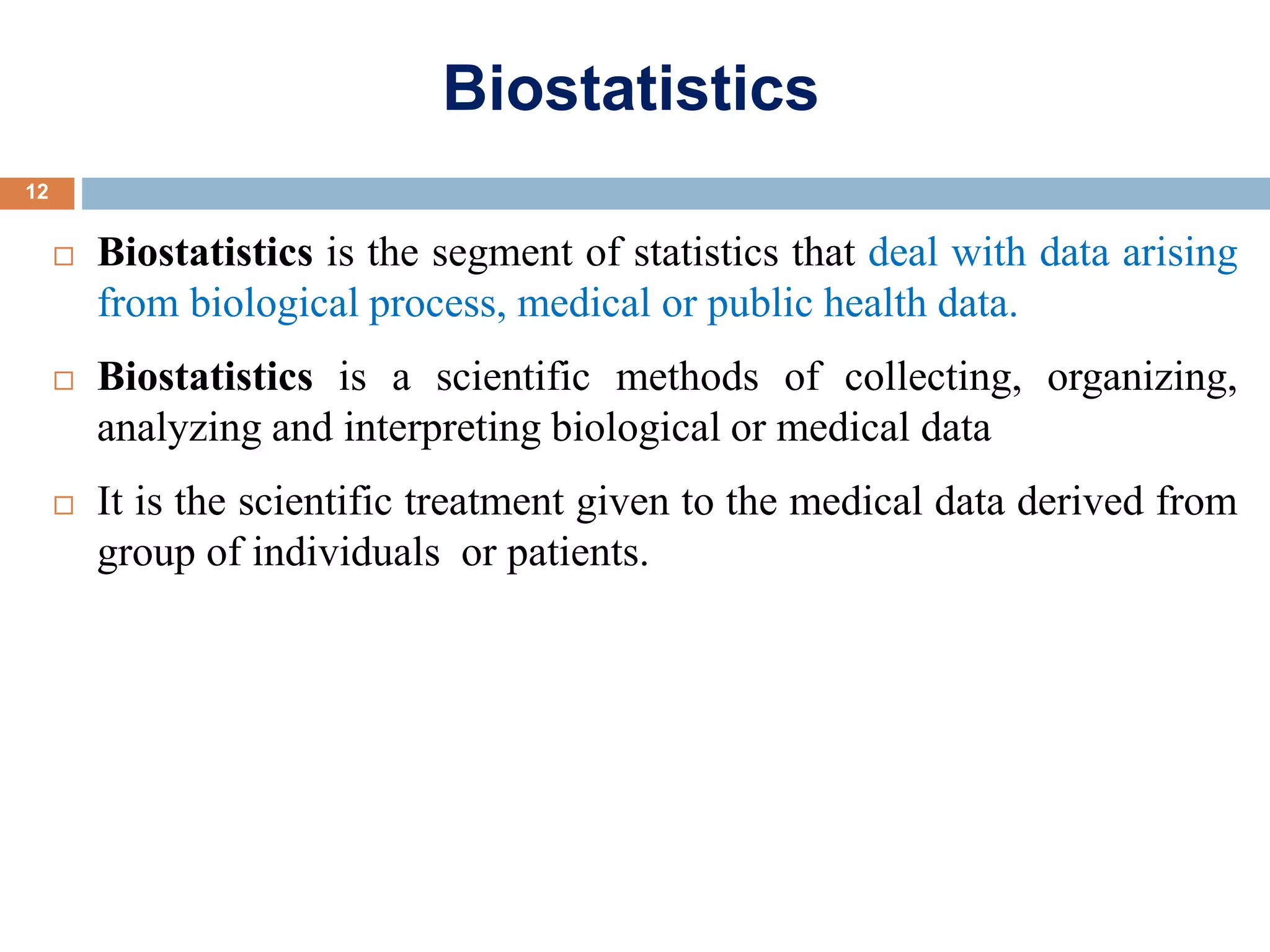
Biostatistics
 Biostatistics is the segment of statistics that deal with data arising
from biological process, medical or public health data.
 Biostatistics is a scientific methods of collecting, organizing,
analyzing and interpreting biological or medical data
 It is the scientific treatment given to the medical data derived from
group of individuals or patients.
12
13
14
15
16
Role of Statistics in Clinical
Medicine
 The main theory of statistics lies in the term variability.
 No two individuals are same.
 For example, blood pressure of person may vary from time to time
as well as from person to person.
 We can also have instrumental variability as well as observers
variability.
 Methods of statistical inference provide largely objective means for
drawing conclusions from the data about the issue under study.
 Medical science is full of uncertainties and statistics deals with uncertainties.
17
Role of Statistics in Clinical
Medicine
 Statistical methods try to quantify the uncertainties
present in medical science.
 It helps the researcher to arrive at a scientific judgment
about a hypothesis.
 It has been argued that decision making is an integral part
of a physician’s work.
 Frequently, decision making is probability based!
18
Thank you !
19

1 Introduction to Biostatistics last.pptx

  • 1.
    Introduction to Biostatistics By:Diriba D. (MPH in Epidemiology) Email: debaba.tolosa@gmail.com December , 2022 1
  • 2.
    Course objectives:  Courseobjectives: At the end of the course students will be able to Define statistics and Biostatistics The role of statistics in health sciences Describe scale of measurement methods of collection, recording, coding and handling data; –Measures of central tendency and dispersion and present data in form of tables, graphs, etc.; – identify and make use of data from existing health records; 2
  • 3.
    Introduction to Statistics Definition: The term statistics is used to mean either statistical data or statistical methods.  Statistical data: refers to numerical descriptions of things.  counts e.g. number of student attending this class.  Measurements e.g. measuring BP, Weight etc.  Statistics is concerned with scientific methods for collecting, organizing, summarizing, presenting and analyzing data as well as deriving valid conclusions. 3
  • 4.
  • 5.
    Introduction to Statistics… Statistics is a field of study concerned with 1. Collection, organization, summarization and analysis of data. 2. Drawing of inferences about a body of data when only a part of the data is observed. 5
  • 6.
    Characteristics of statisticaldata  They must be in aggregates  They must be enumerated or estimated according to a reasonable standard of accuracy  They must have been collected in a systematic manner for a predetermined purpose.  They must be placed in relation to each other. 6
  • 7.
    Statistics methods fallinto two broad areas 1. Descriptive statistics merely describes, organize, or summarize the actual data available.  One branch of descriptive statistics of special relevance in medicine is that of vital statistics(vital events): birth, death, marriage, divorce, and the occurrence of particular disease.  Descriptive statistics includes: tabular, graphical, and measures of tendency and variation. 7
  • 8.
    Cont… 2. Inferential Statistics:The branch of statistics that is most relevant to public health and clinical medicine  This branch of statistics deals with techniques of making conclusions about the population.  Inferential statistics builds upon descriptive statistics.  The inferences are drawn from particular properties of sample to particular properties of population.  The basic aim of all statistical inference is to employ sampled data to infer to a population from which the sample was obtained. 8
  • 9.
    Five stages ofin any statistical investigation I. Collection of data: constitutes the first step in a statistical investigation II. Organization of data: data collected from published sources are generally in organized form. III. Presentation of data: after the data has been collected and organized they are ready for presentation. IV. Analysis: after collection, organization and presentation the next step is analysis V. Interpretation: the last stage in statistical investigation is interpretation, i.e. drawing conclusion from the statistical results. 9
  • 10.
    Limitations of Statistics 1.It deals on aggregates of facts so a single observation is not a statistic. Statistics deal with groups and aggregates only. 2. Statistical data are only approximately and not mathematically correct. 3. Statistical methods are best applicable to quantitative data. 4. If sufficient care is not exercised in collecting, analyzing and interpreting the data, statistical results might be misleading. 5. Only a person who has an expert knowledge of statistics can handle statistical data efficiently. 6. Some errors are possible in statistical decisions. In particular, inferential statistics involves certain errors. We do not know whether an error has been committed or not. 10
  • 11.
  • 12.
    Biostatistics  Biostatistics isthe segment of statistics that deal with data arising from biological process, medical or public health data.  Biostatistics is a scientific methods of collecting, organizing, analyzing and interpreting biological or medical data  It is the scientific treatment given to the medical data derived from group of individuals or patients. 12
  • 13.
  • 14.
  • 15.
  • 16.
  • 17.
    Role of Statisticsin Clinical Medicine  The main theory of statistics lies in the term variability.  No two individuals are same.  For example, blood pressure of person may vary from time to time as well as from person to person.  We can also have instrumental variability as well as observers variability.  Methods of statistical inference provide largely objective means for drawing conclusions from the data about the issue under study.  Medical science is full of uncertainties and statistics deals with uncertainties. 17
  • 18.
    Role of Statisticsin Clinical Medicine  Statistical methods try to quantify the uncertainties present in medical science.  It helps the researcher to arrive at a scientific judgment about a hypothesis.  It has been argued that decision making is an integral part of a physician’s work.  Frequently, decision making is probability based! 18
  • 19.

Editor's Notes

  • #3 Health statistics are used to understand risk factors for communities, track and monitor diseases, see the impact of policy changes, and assess the quality and safety of health care. Health statistics are a form of evidence, or facts that can support a conclusion.
  • #4 Brainstorm: How do you understand science and hypothesis ? Data organization is a process of organizing raw data, by classifying them into different categories.
  • #13 Biostatistics is the application of statistical techniques to scientific research in health-related fields, including medicine, biology, and public health, and the development of new tools to study these areas.