LEADLESS PACEMAKER
Dr Abhishek Rathore MD SJICR, Bangalore
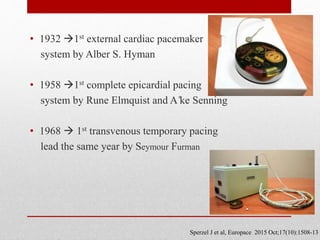
• 1932 1st external cardiac pacemaker
system by Alber S. Hyman
• 1958 1st complete epicardial pacing
system by Rune Elmquist and A ̊ke Senning
• 1968  1st transvenous temporary pacing
lead the same year by Seymour Furman
Sperzel J et al, Europace 2015 Oct;17(10):1508-13
What is Leadless Pacemaker ?
• A leadless pacemaker is a small implantable device that
sends electrical pulses to the heart whenever it senses that
the heartbeat is too slow.
• Advantages:
• Less invasive
• Less implantation time (25 to 40mins vs 60 mins)
• Less recovery time
• Eliminates complications related to the transvenous leads
eg. venous obstruction, insulation breaks, lead dislodgement,
electrical malfunction, lead fractures, and infection.
• No visible lump or scar
• shoulder mobility is maintained(6 out of 10 patients
experience reduced mobility in the shoulder)
• No Pocket hematoma/infection ( Vs 0.5-1.5% incidence)
• No Hemothorax/pneumothorax
• Less radiation
• better quality of life.
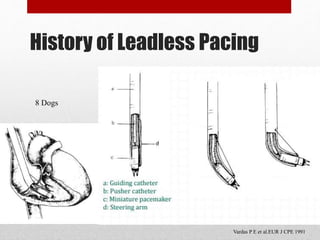
History of Leadless Pacing
Vardas P E et al.EUR J CPE 1991
8 Dogs
What's Needed for
Leadless Pacemaker ?
• Catheter based delivery system
• High density energy source
• Low power electronics
• Novel communication scheme
• Biocompatible materials
• Dependable fixation design
• Retrievability capability
Leadless Pacemakers
Devices Availaible:
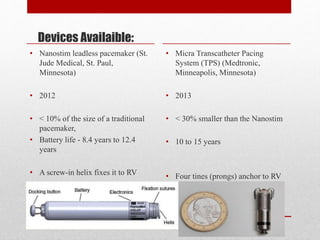
• Nanostim leadless pacemaker (St.
Jude Medical, St. Paul,
Minnesota)
• 2012
• < 10% of the size of a traditional
pacemaker,
• Battery life - 8.4 years to 12.4
years
• A screw-in helix fixes it to RV
• Micra Transcatheter Pacing
System (TPS) (Medtronic,
Minneapolis, Minnesota)
• 2013
• < 30% smaller than the Nanostim
• 10 to 15 years
• Four tines (prongs) anchor to RV
Device features MicraTM NanotismTM
Volume (cm3) 0.8 1.0
Length (mm) 26 42
Diameter (mm) 6.7 5.99
Weight (gr) 2 2
Introducer (Fr) 24 18
Fixation
Self-expanding nitinol
tines
Helical wire screw
(+nylon tines)
Pacing mode VVI(R) VVI(R)
Rate Response
Sensor
Accelerometer Temperature
Telemetry Radiofrequency Conductive
Battery
Lithium silver Vanadium
oxide/Carbon
Monoflouride
Lithium Carbon Flouride
Micra vs Nanotism
Periprocedural
data MicraTM NanotismTM
Number of patients 725 526
Successful
implantation (%)
99.2 95.8
Final device
position (%)
Apex
Septum
Mid-septum
Outflow
tract
65.
23.8
7.8
0.6
Apex
Apical septum
Outflow/septum/other
Missing
data
38.1
19.0
42.7
0.2
Procedure duration
(min)
34.8±24.1 46.5±25.3
Fluoroscopy
duration (min)
8.9±16.6 13.9±9.1
Major
complications (%)
4.0 6.5
Device
dislodgement (%)
0 1.1
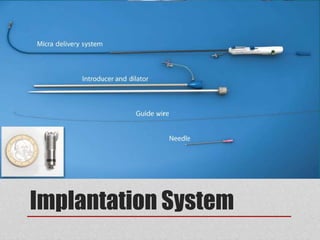
Implantation System
•
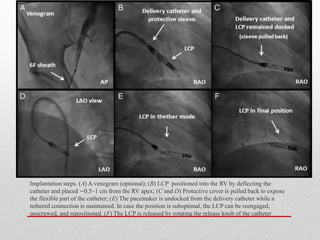
Implantation steps. (A) A venogram (optional); (B) LCP positioned into the RV by deflecting the
catheter and placed ∼0.5–1 cm from the RV apex; (C and D) Protective cover is pulled back to expose
the flexible part of the catheter; (E) The pacemaker is undocked from the delivery catheter while a
tethered connection is maintained. In case the position is suboptimal, the LCP can be reengaged,
unscrewed, and repositioned. (F) The LCP is released by rotating the release knob of the catheter.
Contraindications for Leadless
pacemaker
• Pacemaker, ICD, CRT, neurostimulator or any other implanted device
which uses electrical current
• Unstable angina pectoris, recent myocardial infarction
• Mechanical tricuspid valve
• Implanted vena cava filter
• Left ventricular assist device
• Morbidly obese where telemetric programmer communication can be
limited
• Limited or missing femoral venous access or stenosis
• Unable to tolerate emergency sternotomy
• Intolerance to titanium or nickel-titanium (nitinol) alloy
Leadless Trial
Permanent Leadless Cardiac Pacing Results of the LEADLESS Trial
• Background—Conventional cardiac pacemakers are associated with several
potential short- and long-term complications related to either the transvenous lead
or subcutaneous pulse generator. We tested the safety and clinical performance of
a novel completely self-contained leadless cardiac pacemaker (LCP) ie,Nanotism.
• Methods and Results—The primary safety endpoint was freedom from
complications at 90 days. Secondary performance endpoints included implant
success rate, implant time and measures of device performance (pacing/sensing
thresholds and rate-responsive performance). The mean age of the patient cohort
(n=33) was 77 ± 8 years and 67% of the patients were male (n= 22/33). The most
common indication for cardiac pacing was permanent AF with atrioventricular
block (n = 22, 67%). The implant success rate was 97% (n= 32). Five patients
(15%) required the use of >1 LCP during the procedure. One patient developed
RV perforation and cardiac tamponade during the implant procedure, and
eventually died as a result of stroke. The overall complication-free rate was 94%
(31/33). After 3 months of follow-up, the measures of pacing performance
(sensing, impedance and pacing threshold) either improved or were stably within
the accepted range.
• Conclusions—In a prospective non-randomized study, a completely self-
contained single-chamber leadless cardiac pacemaker has shown to be safe and
feasible. The absence of a transvenous lead and subcutaneous pulse generator
could represent a paradigm shift in cardiac pacing.
Reddy VY et al. Circulation. 2014;129:1466-71
From: Chronic Performance of a Leadless Cardiac Pacemaker: 1-Year Follow-Up of the LEADLESS Trial
J Am Coll Cardiol. 2015;65(15):1497-1504. doi:10.1016/j.jacc.2015.02.022
(Left) Kaplan-Meier survival curve represents freedom from device-related complications: 2 patients had device-related complications (6%, 31 of
33), both periprocedurally. During further follow-up, no complications occurred in the remaining patients (n = 31). (Right) Device performance
measurements of the leadless cardiac pacemaker. The mean value ± SD of pacing threshold (at 0.4 ms [V]) (right top); the R-wave amplitude
(mV) (right middle); and the pacing impedance (Ω) (right bottom) at each follow-up assessment.
Leadless II Trial
• Prospective, multicenter, non-randomized, FDA IDE study
• Objective: – To evaluate the clinical safety and efficacy of non-
surgical implantation of the leadless cardiac pacemaker in patients
indicated for a VVI(R) pacemaker.
• Primary Cohort: 1st 300 patients followed for 6mo (June 2015)
• Total Cohort: All patients enrolled by June 2015 (n=526)
• Primary Endpoints (by ITT):
• – Safety: Freedom from Serious Adverse Device Effects at 6 months
– Efficacy: Acceptable pacing capture threshold (d2.0 V at 0.4 msec)
and a therapeutically acceptable sensing amplitude (R wave e5.0 mV,
or a value equal to or greater than the value at implantation) through
6 mo.
• 56 Centers in the US, Canada and Australia
• – 100 Operators (only one had prior experience with leadless pacing)
Outcomes of Leadless II Trial
• Device was successfully implanted in ~96% of patients
• Primary Safety Endpoint (Intent-to-Treat Analysis)
• – 280 of the 300 patients achieved endpoint (93.3%; 95% CI = 89.9
to 95.9)
• – This exceeded the performance goal of 86% (P<0.001)
• Primary Efficacy Endpoint (Intent-to-Treat Analysis)
– 270 of the 300 patients achieved endpoint (90.0%; 95% CI = 86.0
to 93.2)
– This exceeded the performance goal of 85% (P = 0.007) •
• Efficacy (Successful implants) – 289 patients with successful device
implant
• – 270 of the 289 patients achieved endpoint (93.4%; 95% CI = 89.9
to 96.0)
• – This exceeded the performance goal of 85% (P <0.001)
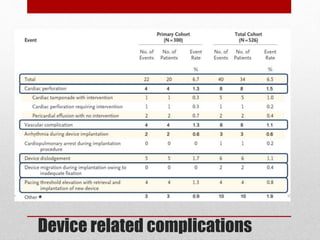
Device related complications
Conclusion
• The Leadless Pacemaker was successfully implanted in ~96%
of attempted patients.
• The trial met the pre-specified Safety and Efficacy endpoints
Complication rate similar to that seen with conventional
pacemakers
• Complication rate likely to improve with operator
experience
• The device was shown to be retrievable in a subgroup of
patients (n=7) who needed a replacement (Time from implant
= 160±180 days; Range = 1 to 413 days)
• The estimated device longevity based on the 6-month follow
up duration is encouraging
A Leadless Intracardiac Transcatheter Pacing System
BACKGROUND
A leadless intracardiac transcatheter pacing system has been designed to avoid the need for a pacemaker pocket and
transvenous lead.
METHODS
A prospective multicenter study . The analysis of the primary end points began when 300 patients reached 6 months of
follow- up. The primary safety end point was freedom from system-related or procedure related major complications. The
primary efficacy end point was the percentage of patients with low and stable pacing capture thresholds at 6 months (≤2.0
V at a pulse width of 0.24 msec and an increase of ≤1.5 V from the time of implantation). The safety and efficacy end
points were evaluated against performance goals (based on historical data) of 83% and 80%, respectively. We also
performed a post hoc analysis in which the rates of major complications were compared with those in a control cohort of
2667 patients with transvenous pacemakers from six previously published studies.
RESULTS
The device was successfully implanted in 719 of 725 patients (99.2%). The Kaplan– Meier estimate of the rate of the
primary safety end point was 96.0% (95% confidence interval [CI], 93.9 to 97.3; P<0.001 for the comparison with the
safety performance goal of 83%); there were 28 major complications in 25 of 725 patients, and no dislodgements. The rate
of the primary efficacy end point was 98.3% (95% CI, 96.1 to 99.5; P<0.001 for the comparison with the efficacy
performance goal of 80%) among 292 of 297 patients with paired 6-month data. Although there were 28 major
complications in 25 patients, patients with transcatheter pacemakers had significantly fewer major complications than did
the control patients (hazard ratio, 0.49; 95% CI, 0.33 to 0.75; P = 0.001).
CONCLUSIONS
In this historical comparison study, the transcatheter pacemaker met the prespecified safety and efficacy goals; it had a
safety profile similar to that of a transvenous system while providing low and stable pacing thresholds
Reynolds D et al. NEJM. Feb 2016
Electrical Performance, Characteristics of
the Transcatheter Pacemaker,according to
Study Visit.
WiCSTM
clinical data:
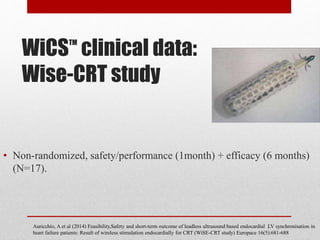
Wise-CRT study
• Non-randomized, safety/performance (1month) + efficacy (6 months)
(N=17).
Auricchio, A et al (2014) Feasibility,Safety and short-term outcome of leadless ultrasound based endocardial LV synchronisation in
heart failure patients: Result of wireless stimulation endocardially for CRT (WiSE-CRT study) Europace 16(5):681-688
Device Characteristics:
• Woven polyester outer jacket(enhance endothelialisation)
• Aortic retrograde approach
• Tissue viability should be confirmed( intracardiac ECG
and external electrophysiological stimulator)
Out of 17 patients-
• 7 pts had failed CS lead implantation for CRT
• 2 pts were non-responders to CRT
• 8 pts had previous Pacemaker or ICD in place but had CRT
indications
• Only able to implant in 13 patients.(3 pts had Pericardial
effusion and in1 patient no sufficient pacing threshold
achieved.)
• No thromboembolism noted.
• Study was terminated.
• BiV pacing documented in 83% and clinical efficacy in 92%.
Conclusion
• A promising alternative to conventional single chamber
pacemaker systems.
• Safety and long-term outcome of leadless pacemaker
need to be evaluated in more detail.
Thank You

Leadless pacemaker

  • 1.
    LEADLESS PACEMAKER Dr AbhishekRathore MD SJICR, Bangalore
  • 2.
    • 1932 1stexternal cardiac pacemaker system by Alber S. Hyman • 1958 1st complete epicardial pacing system by Rune Elmquist and A ̊ke Senning • 1968  1st transvenous temporary pacing lead the same year by Seymour Furman Sperzel J et al, Europace 2015 Oct;17(10):1508-13
  • 3.
    What is LeadlessPacemaker ? • A leadless pacemaker is a small implantable device that sends electrical pulses to the heart whenever it senses that the heartbeat is too slow.
  • 4.
    • Advantages: • Lessinvasive • Less implantation time (25 to 40mins vs 60 mins) • Less recovery time • Eliminates complications related to the transvenous leads eg. venous obstruction, insulation breaks, lead dislodgement, electrical malfunction, lead fractures, and infection. • No visible lump or scar • shoulder mobility is maintained(6 out of 10 patients experience reduced mobility in the shoulder) • No Pocket hematoma/infection ( Vs 0.5-1.5% incidence) • No Hemothorax/pneumothorax • Less radiation • better quality of life.
  • 5.
    History of LeadlessPacing Vardas P E et al.EUR J CPE 1991 8 Dogs
  • 6.
    What's Needed for LeadlessPacemaker ? • Catheter based delivery system • High density energy source • Low power electronics • Novel communication scheme • Biocompatible materials • Dependable fixation design • Retrievability capability
  • 7.
  • 8.
    Devices Availaible: • Nanostimleadless pacemaker (St. Jude Medical, St. Paul, Minnesota) • 2012 • < 10% of the size of a traditional pacemaker, • Battery life - 8.4 years to 12.4 years • A screw-in helix fixes it to RV • Micra Transcatheter Pacing System (TPS) (Medtronic, Minneapolis, Minnesota) • 2013 • < 30% smaller than the Nanostim • 10 to 15 years • Four tines (prongs) anchor to RV
  • 9.
    Device features MicraTMNanotismTM Volume (cm3) 0.8 1.0 Length (mm) 26 42 Diameter (mm) 6.7 5.99 Weight (gr) 2 2 Introducer (Fr) 24 18 Fixation Self-expanding nitinol tines Helical wire screw (+nylon tines) Pacing mode VVI(R) VVI(R) Rate Response Sensor Accelerometer Temperature Telemetry Radiofrequency Conductive Battery Lithium silver Vanadium oxide/Carbon Monoflouride Lithium Carbon Flouride
  • 10.
  • 11.
    Periprocedural data MicraTM NanotismTM Numberof patients 725 526 Successful implantation (%) 99.2 95.8 Final device position (%) Apex Septum Mid-septum Outflow tract 65. 23.8 7.8 0.6 Apex Apical septum Outflow/septum/other Missing data 38.1 19.0 42.7 0.2 Procedure duration (min) 34.8±24.1 46.5±25.3 Fluoroscopy duration (min) 8.9±16.6 13.9±9.1 Major complications (%) 4.0 6.5 Device dislodgement (%) 0 1.1
  • 12.
  • 13.
    • Implantation steps. (A)A venogram (optional); (B) LCP positioned into the RV by deflecting the catheter and placed ∼0.5–1 cm from the RV apex; (C and D) Protective cover is pulled back to expose the flexible part of the catheter; (E) The pacemaker is undocked from the delivery catheter while a tethered connection is maintained. In case the position is suboptimal, the LCP can be reengaged, unscrewed, and repositioned. (F) The LCP is released by rotating the release knob of the catheter.
  • 15.
    Contraindications for Leadless pacemaker •Pacemaker, ICD, CRT, neurostimulator or any other implanted device which uses electrical current • Unstable angina pectoris, recent myocardial infarction • Mechanical tricuspid valve • Implanted vena cava filter • Left ventricular assist device • Morbidly obese where telemetric programmer communication can be limited • Limited or missing femoral venous access or stenosis • Unable to tolerate emergency sternotomy • Intolerance to titanium or nickel-titanium (nitinol) alloy
  • 17.
    Leadless Trial Permanent LeadlessCardiac Pacing Results of the LEADLESS Trial • Background—Conventional cardiac pacemakers are associated with several potential short- and long-term complications related to either the transvenous lead or subcutaneous pulse generator. We tested the safety and clinical performance of a novel completely self-contained leadless cardiac pacemaker (LCP) ie,Nanotism. • Methods and Results—The primary safety endpoint was freedom from complications at 90 days. Secondary performance endpoints included implant success rate, implant time and measures of device performance (pacing/sensing thresholds and rate-responsive performance). The mean age of the patient cohort (n=33) was 77 ± 8 years and 67% of the patients were male (n= 22/33). The most common indication for cardiac pacing was permanent AF with atrioventricular block (n = 22, 67%). The implant success rate was 97% (n= 32). Five patients (15%) required the use of >1 LCP during the procedure. One patient developed RV perforation and cardiac tamponade during the implant procedure, and eventually died as a result of stroke. The overall complication-free rate was 94% (31/33). After 3 months of follow-up, the measures of pacing performance (sensing, impedance and pacing threshold) either improved or were stably within the accepted range. • Conclusions—In a prospective non-randomized study, a completely self- contained single-chamber leadless cardiac pacemaker has shown to be safe and feasible. The absence of a transvenous lead and subcutaneous pulse generator could represent a paradigm shift in cardiac pacing. Reddy VY et al. Circulation. 2014;129:1466-71
  • 20.
    From: Chronic Performanceof a Leadless Cardiac Pacemaker: 1-Year Follow-Up of the LEADLESS Trial J Am Coll Cardiol. 2015;65(15):1497-1504. doi:10.1016/j.jacc.2015.02.022 (Left) Kaplan-Meier survival curve represents freedom from device-related complications: 2 patients had device-related complications (6%, 31 of 33), both periprocedurally. During further follow-up, no complications occurred in the remaining patients (n = 31). (Right) Device performance measurements of the leadless cardiac pacemaker. The mean value ± SD of pacing threshold (at 0.4 ms [V]) (right top); the R-wave amplitude (mV) (right middle); and the pacing impedance (Ω) (right bottom) at each follow-up assessment.
  • 21.
    Leadless II Trial •Prospective, multicenter, non-randomized, FDA IDE study • Objective: – To evaluate the clinical safety and efficacy of non- surgical implantation of the leadless cardiac pacemaker in patients indicated for a VVI(R) pacemaker. • Primary Cohort: 1st 300 patients followed for 6mo (June 2015) • Total Cohort: All patients enrolled by June 2015 (n=526) • Primary Endpoints (by ITT): • – Safety: Freedom from Serious Adverse Device Effects at 6 months – Efficacy: Acceptable pacing capture threshold (d2.0 V at 0.4 msec) and a therapeutically acceptable sensing amplitude (R wave e5.0 mV, or a value equal to or greater than the value at implantation) through 6 mo. • 56 Centers in the US, Canada and Australia • – 100 Operators (only one had prior experience with leadless pacing)
  • 22.
    Outcomes of LeadlessII Trial • Device was successfully implanted in ~96% of patients • Primary Safety Endpoint (Intent-to-Treat Analysis) • – 280 of the 300 patients achieved endpoint (93.3%; 95% CI = 89.9 to 95.9) • – This exceeded the performance goal of 86% (P<0.001) • Primary Efficacy Endpoint (Intent-to-Treat Analysis) – 270 of the 300 patients achieved endpoint (90.0%; 95% CI = 86.0 to 93.2) – This exceeded the performance goal of 85% (P = 0.007) • • Efficacy (Successful implants) – 289 patients with successful device implant • – 270 of the 289 patients achieved endpoint (93.4%; 95% CI = 89.9 to 96.0) • – This exceeded the performance goal of 85% (P <0.001)
  • 23.
  • 24.
    Conclusion • The LeadlessPacemaker was successfully implanted in ~96% of attempted patients. • The trial met the pre-specified Safety and Efficacy endpoints Complication rate similar to that seen with conventional pacemakers • Complication rate likely to improve with operator experience • The device was shown to be retrievable in a subgroup of patients (n=7) who needed a replacement (Time from implant = 160±180 days; Range = 1 to 413 days) • The estimated device longevity based on the 6-month follow up duration is encouraging
  • 25.
    A Leadless IntracardiacTranscatheter Pacing System BACKGROUND A leadless intracardiac transcatheter pacing system has been designed to avoid the need for a pacemaker pocket and transvenous lead. METHODS A prospective multicenter study . The analysis of the primary end points began when 300 patients reached 6 months of follow- up. The primary safety end point was freedom from system-related or procedure related major complications. The primary efficacy end point was the percentage of patients with low and stable pacing capture thresholds at 6 months (≤2.0 V at a pulse width of 0.24 msec and an increase of ≤1.5 V from the time of implantation). The safety and efficacy end points were evaluated against performance goals (based on historical data) of 83% and 80%, respectively. We also performed a post hoc analysis in which the rates of major complications were compared with those in a control cohort of 2667 patients with transvenous pacemakers from six previously published studies. RESULTS The device was successfully implanted in 719 of 725 patients (99.2%). The Kaplan– Meier estimate of the rate of the primary safety end point was 96.0% (95% confidence interval [CI], 93.9 to 97.3; P<0.001 for the comparison with the safety performance goal of 83%); there were 28 major complications in 25 of 725 patients, and no dislodgements. The rate of the primary efficacy end point was 98.3% (95% CI, 96.1 to 99.5; P<0.001 for the comparison with the efficacy performance goal of 80%) among 292 of 297 patients with paired 6-month data. Although there were 28 major complications in 25 patients, patients with transcatheter pacemakers had significantly fewer major complications than did the control patients (hazard ratio, 0.49; 95% CI, 0.33 to 0.75; P = 0.001). CONCLUSIONS In this historical comparison study, the transcatheter pacemaker met the prespecified safety and efficacy goals; it had a safety profile similar to that of a transvenous system while providing low and stable pacing thresholds Reynolds D et al. NEJM. Feb 2016
  • 27.
    Electrical Performance, Characteristicsof the Transcatheter Pacemaker,according to Study Visit.
  • 28.
    WiCSTM clinical data: Wise-CRT study •Non-randomized, safety/performance (1month) + efficacy (6 months) (N=17). Auricchio, A et al (2014) Feasibility,Safety and short-term outcome of leadless ultrasound based endocardial LV synchronisation in heart failure patients: Result of wireless stimulation endocardially for CRT (WiSE-CRT study) Europace 16(5):681-688
  • 29.
    Device Characteristics: • Wovenpolyester outer jacket(enhance endothelialisation) • Aortic retrograde approach • Tissue viability should be confirmed( intracardiac ECG and external electrophysiological stimulator)
  • 30.
    Out of 17patients- • 7 pts had failed CS lead implantation for CRT • 2 pts were non-responders to CRT • 8 pts had previous Pacemaker or ICD in place but had CRT indications • Only able to implant in 13 patients.(3 pts had Pericardial effusion and in1 patient no sufficient pacing threshold achieved.) • No thromboembolism noted. • Study was terminated. • BiV pacing documented in 83% and clinical efficacy in 92%.
  • 31.
    Conclusion • A promisingalternative to conventional single chamber pacemaker systems. • Safety and long-term outcome of leadless pacemaker need to be evaluated in more detail.
  • 32.