Percutaneous Revascularization for Ischemic Left Ventricular Dysfunction
List of authors.Divaka Perera, M.D.,
Tim Clayton, M.Sc.,
Peter D. O’Kane, M.D.,
John P. Greenwood, Ph.D.,
Roshan Weerackody, Ph.D.,
Matthew Ryan, Ph.D.,
Holly P. Morgan, M.B., B.Ch.,
Matthew Dodd, M.Sc.,
Richard Evans, B.A.,
Ruth Canter, M.Sc.,
Sophie Arnold, M.Sc.,
Lana J. Dixon, Ph.D.,
et al.,
for the REVIVED-BCIS2 Investigators*
NEJM
27/8/2022
REVIVED-BCIS2 UK
BACKGROUND
• Whether revascularization by percutaneous
coronary intervention (PCI) can improve
event-free survival and left ventricular
function in patients with severe ischemic left
ventricular systolic dysfunction, as compared
with optimal medical therapy (i.e., individually
adjusted pharmacologic and device therapy
for heart failure) alone, is unknown.
Methods
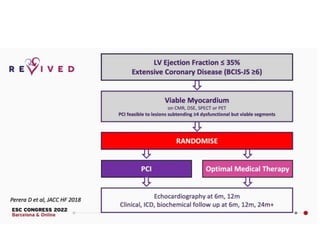
• We randomly assigned patients with a left ventricular
ejection fraction of 35% or less, extensive coronary
artery disease amenable to PCI, and demonstrable
myocardial viability to a strategy of either PCI plus
optimal medical therapy (PCI group) or optimal medical
therapy alone (optimal-medical-therapy group).
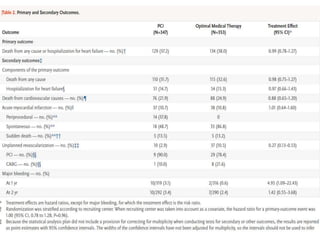
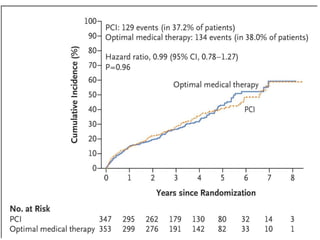
• The primary composite outcome was death from any
cause or hospitalization for heart failure.
• Major secondary outcomes were left ventricular
ejection fraction at 6 and 12 months and quality-of-life
scores.
• Patients were randomly assigned in a 1:1 ratio to
a strategy of PCI plus optimal medical therapy
(PCI group) or optimal medical therapy alone
(optimal-medical-therapy group).
• Optimal medical therapy refers to individually
adjusted pharmacologic and device therapy for
heart failure. In the PCI group, the protocol
required that revascularization be attempted on
all diseased proximal coronary vessels subtending
areas of viable myocardium.
• The extent of revascularization was
characterized by the British Cardiovascular
Intervention Society jeopardy score and
anatomical revascularization index, which was
calculated as follows: [(the pre-PCI jeopardy
score minus the post-PCI jeopardy score)
divided by (the pre-PCI jeopardy score)]×100,
with 100% indicating complete
revascularization of all angiographically
significant coronary disease
• Medical therapy for heart failure was initiated
before enrollment and customized according
to the patient’s individual needs throughout
the trial by heart-failure specialists at the
recruiting centers.
• A medical-therapy committee reviewed
guidelines periodically and refined
recommendations to ensure that the
pharmacologic and device therapy given to all
patients in the trial remained contemporary.
The decision to insert an implantable
cardioverter–defibrillator (ICD) or cardiac
resynchronization therapy device was at the
discretion of treating clinicians but had to be
documented before randomization.
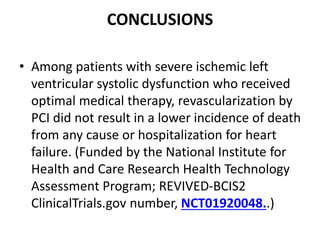
CONCLUSIONS
• Among patients with severe ischemic left
ventricular systolic dysfunction who received
optimal medical therapy, revascularization by
PCI did not result in a lower incidence of death
from any cause or hospitalization for heart
failure. (Funded by the National Institute for
Health and Care Research Health Technology
Assessment Program; REVIVED-BCIS2
ClinicalTrials.gov number, NCT01920048..)
Percutaneous Revascularization for Ischemic Left Ventricular Dysfunction  REVIVED BCIS 2.pptx

Percutaneous Revascularization for Ischemic Left Ventricular Dysfunction REVIVED BCIS 2.pptx

  • 1.
    Percutaneous Revascularization forIschemic Left Ventricular Dysfunction List of authors.Divaka Perera, M.D., Tim Clayton, M.Sc., Peter D. O’Kane, M.D., John P. Greenwood, Ph.D., Roshan Weerackody, Ph.D., Matthew Ryan, Ph.D., Holly P. Morgan, M.B., B.Ch., Matthew Dodd, M.Sc., Richard Evans, B.A., Ruth Canter, M.Sc., Sophie Arnold, M.Sc., Lana J. Dixon, Ph.D., et al., for the REVIVED-BCIS2 Investigators* NEJM 27/8/2022
  • 4.
  • 5.
    BACKGROUND • Whether revascularizationby percutaneous coronary intervention (PCI) can improve event-free survival and left ventricular function in patients with severe ischemic left ventricular systolic dysfunction, as compared with optimal medical therapy (i.e., individually adjusted pharmacologic and device therapy for heart failure) alone, is unknown.
  • 6.
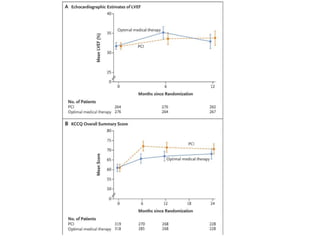
    Methods • We randomlyassigned patients with a left ventricular ejection fraction of 35% or less, extensive coronary artery disease amenable to PCI, and demonstrable myocardial viability to a strategy of either PCI plus optimal medical therapy (PCI group) or optimal medical therapy alone (optimal-medical-therapy group). • The primary composite outcome was death from any cause or hospitalization for heart failure. • Major secondary outcomes were left ventricular ejection fraction at 6 and 12 months and quality-of-life scores.
  • 7.
    • Patients wererandomly assigned in a 1:1 ratio to a strategy of PCI plus optimal medical therapy (PCI group) or optimal medical therapy alone (optimal-medical-therapy group). • Optimal medical therapy refers to individually adjusted pharmacologic and device therapy for heart failure. In the PCI group, the protocol required that revascularization be attempted on all diseased proximal coronary vessels subtending areas of viable myocardium.
  • 9.
    • The extentof revascularization was characterized by the British Cardiovascular Intervention Society jeopardy score and anatomical revascularization index, which was calculated as follows: [(the pre-PCI jeopardy score minus the post-PCI jeopardy score) divided by (the pre-PCI jeopardy score)]×100, with 100% indicating complete revascularization of all angiographically significant coronary disease
  • 10.
    • Medical therapyfor heart failure was initiated before enrollment and customized according to the patient’s individual needs throughout the trial by heart-failure specialists at the recruiting centers.
  • 11.
    • A medical-therapycommittee reviewed guidelines periodically and refined recommendations to ensure that the pharmacologic and device therapy given to all patients in the trial remained contemporary. The decision to insert an implantable cardioverter–defibrillator (ICD) or cardiac resynchronization therapy device was at the discretion of treating clinicians but had to be documented before randomization.
  • 19.
    CONCLUSIONS • Among patientswith severe ischemic left ventricular systolic dysfunction who received optimal medical therapy, revascularization by PCI did not result in a lower incidence of death from any cause or hospitalization for heart failure. (Funded by the National Institute for Health and Care Research Health Technology Assessment Program; REVIVED-BCIS2 ClinicalTrials.gov number, NCT01920048..)