PROTEIN SYNTHESIS
CENTRAL DOGMA OF MOLECULAR BIOLOGY DNA   RNA     Protein   transcription translation
GROWING CELL Before cell division the cell’s DNA has to duplicate (DNA REPLICATION) While the cell is growing it needs enzymes and extra proteins…
TRANSCRIPTION THE PROTEINS ARE MADE IN THE  CYTOPLASM  IN THE  RIBOSOMES THE INFO FROM THE DNA IS COPIED INTO m RNA, WHICH CAN LEAVE THE NUCLEUS AND GET TO THE RIBOSOMES IN THE CYTOPLASM. THE INFORMATION FOR PROTEIN SYNTHESIS IS IN THE  DNA  IN THE  NUCLEUS . DNA INFO  COPIED TO mRNA
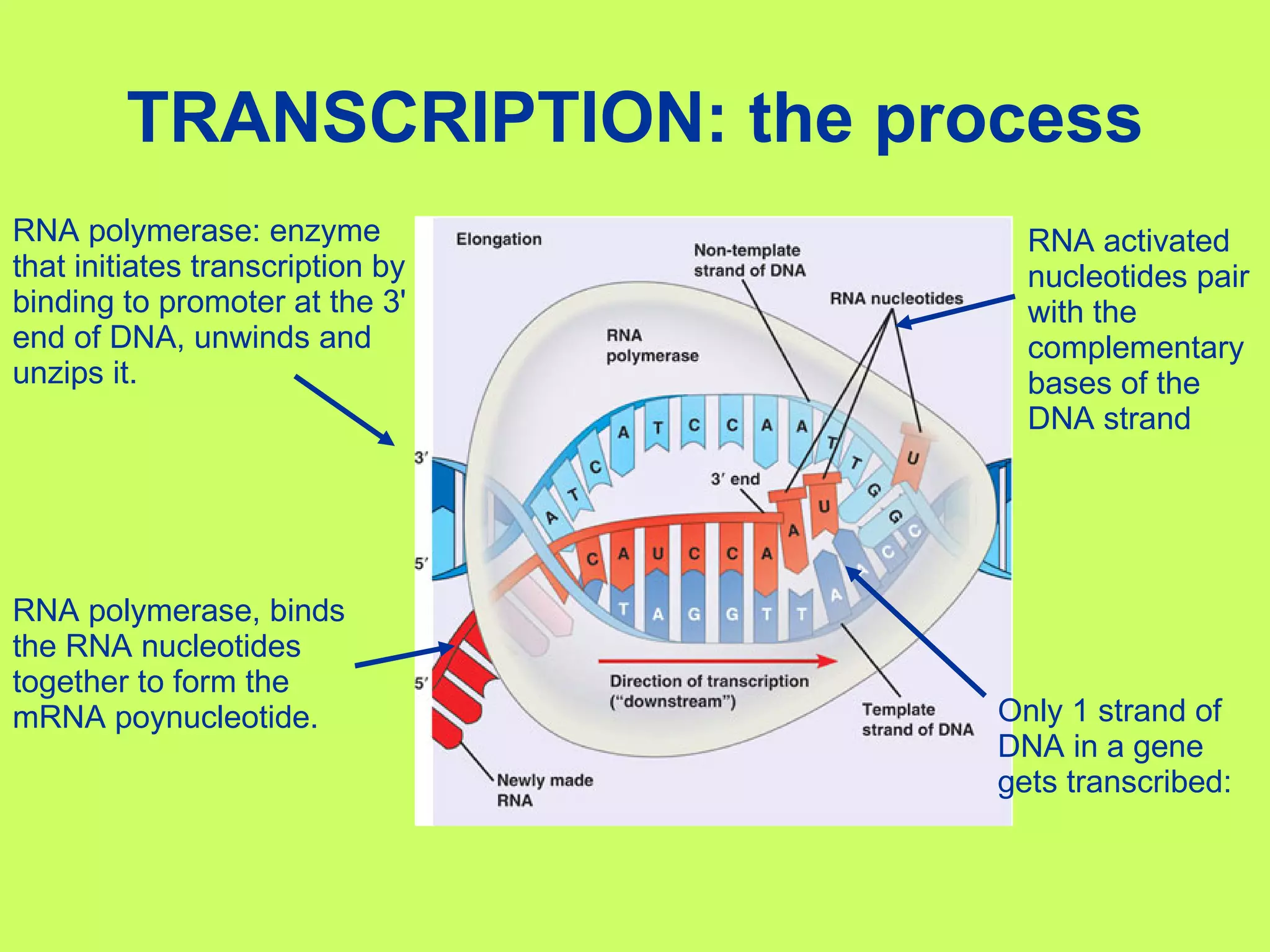
TRANSCRIPTION: the process Only 1 strand of DNA in a gene gets transcribed:  RNA polymerase: enzyme that initiates transcription by binding to promoter at the 3' end of DNA, unwinds and unzips it. RNA activated nucleotides pair with the complementary bases of the DNA strand  RNA polymerase, binds the RNA nucleotides together to form the mRNA poynucleotide.
ANIMATION http://207.207.4.198/pub/flash/26/transmenu_s.swf CLIK here to view an animation of the whole process of transcription!
TRANSLATION DNA M RNA PROTEIN transcription DNA info is copied into to RNA code, which is still in the “language” of nitrogenous bases, except that adenine on the DNA pairs with uracil (in place of thymine) on the RNA. HAPPENS IN NUCLEUS. translation The RNA code is then  translated  to protein code, which is a different “language.” (nitrogenous bases to aminoacids.  This process involves ribosomes and two kinds of RNA:  mRNA  and  tRNA . HAPPENS IN CYTOPLASM
INFORMATION IN THE mRNA Codon:  sequence of 3 nucleotides on  m-RNA that codes for one amino acid.  The GENETIC CODE states which codon stands for which aminoacid. 1 aminoacid 1 aminoacid
GENETIC CODE Even though there are only 20 amino acids that exist, there are actually 64 possible  tRNA molecules: 4  X  4  X  4  = 64 possible combinations CODON CODON CODON G C U 1º NUCLEOTIDE 2º NUCLEOTIDE 3º NUCLEOTIDE =Gly
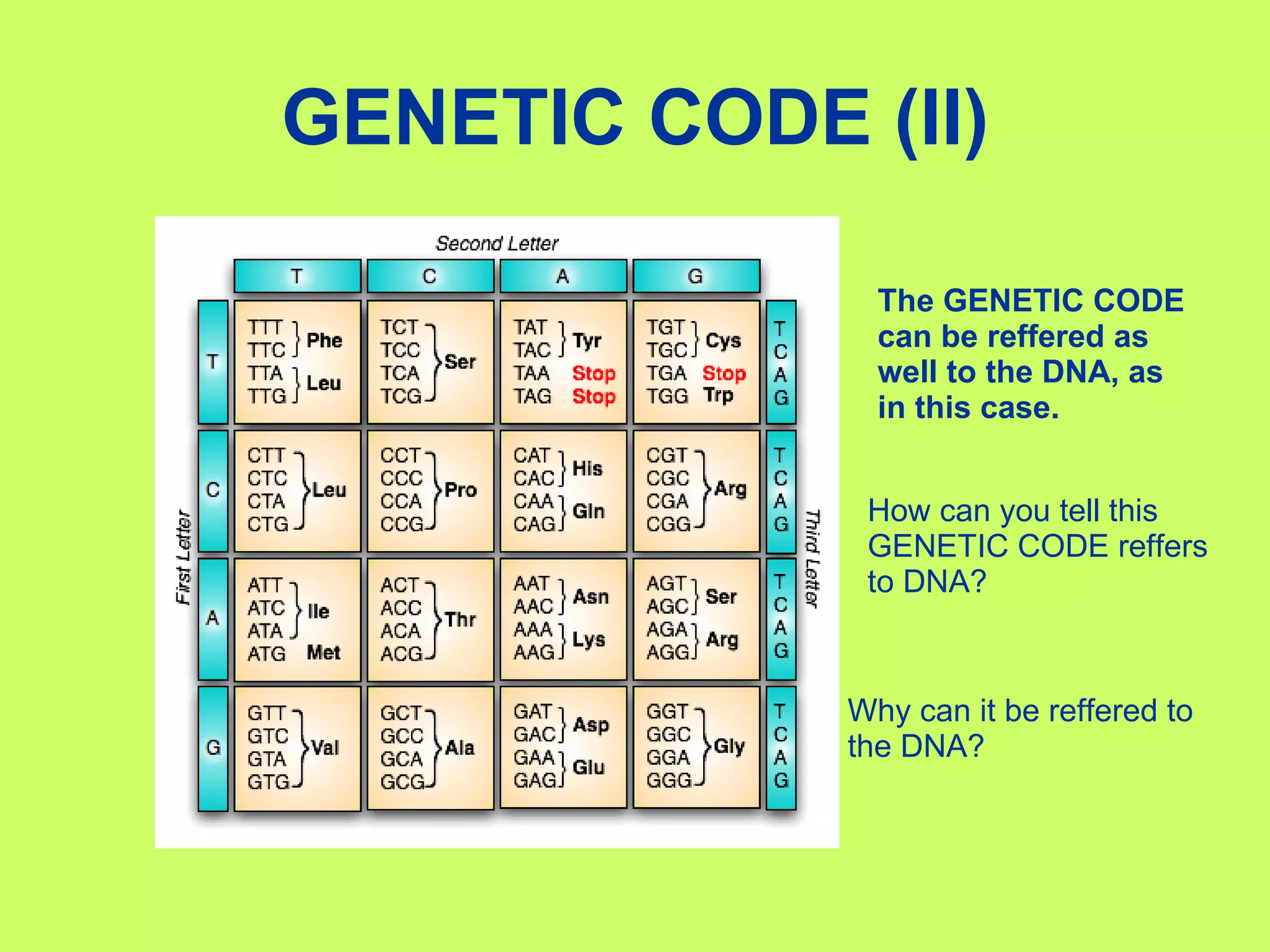
GENETIC CODE (II) The GENETIC CODE can be reffered as well to the DNA, as in this case. How can you tell this GENETIC CODE reffers to DNA? Why can it be reffered to the DNA?
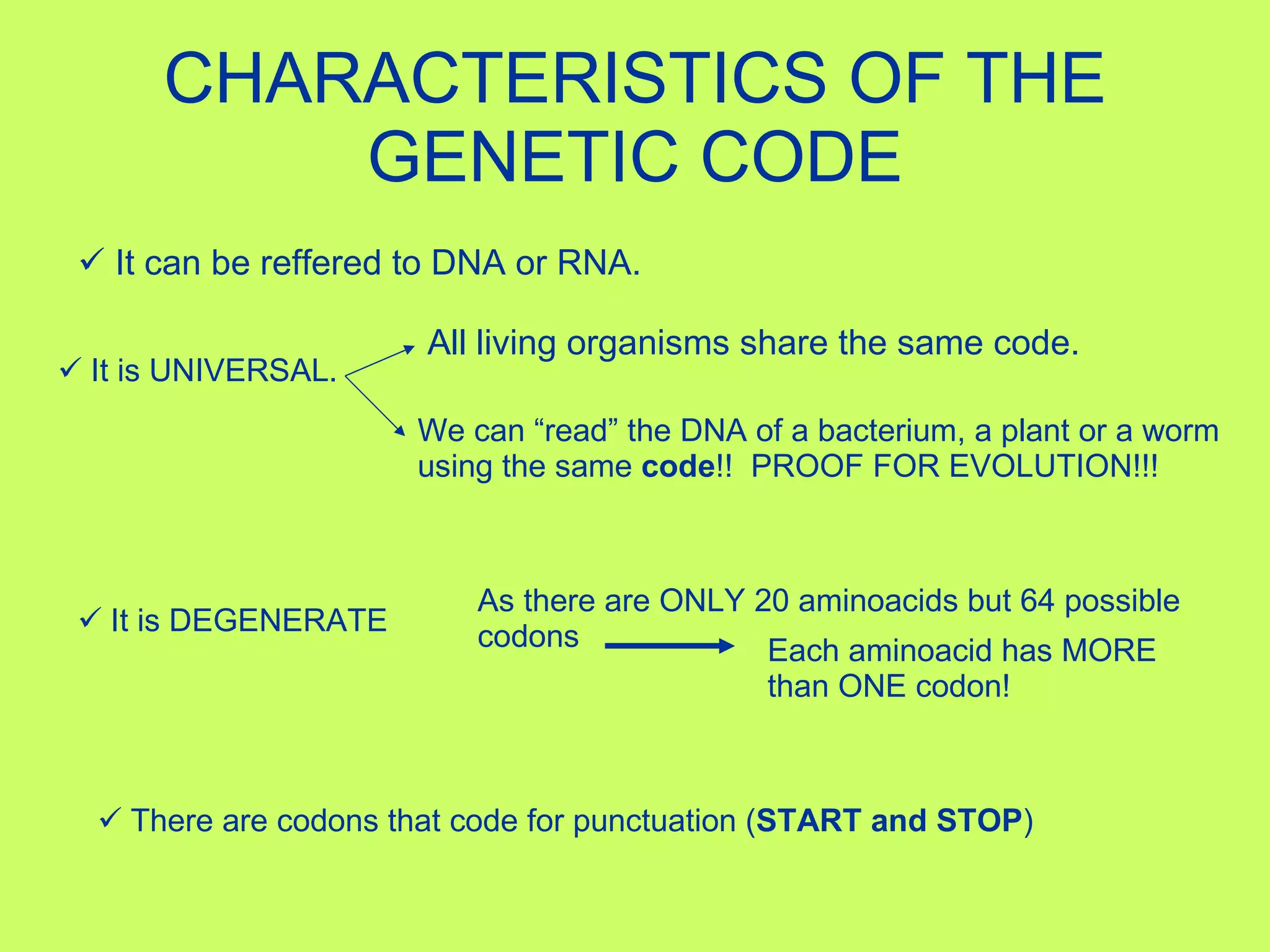
CHARACTERISTICS OF THE GENETIC CODE It can be reffered to DNA or RNA. It is UNIVERSAL.   All living organisms share the same code. We can “read” the DNA of a bacterium, a plant or a worm using the same  code !!  PROOF FOR EVOLUTION!!! It is DEGENERATE As there are ONLY 20 aminoacids but 64 possible codons Each aminoacid has MORE than ONE codon! There are codons that code for punctuation ( START and STOP )
TRANSLATION LOADED tRNA RIBOSOME mRNA COMPONENTS PRESENT IN THE PROCESS anticodon Aminoacid carried codon
TRANSLATION The newly made mRNA (transcription) leaves the nuceus and binds with the ribosome in the cytoplasm. ONE codon is exposed at site P and another codon at site A A tRNA with a complementary codon in its anticodon site will bind with the codon at site P, bringing an aminoacid. 1º AMINOACID: Methionine (AUG) in site P.
TRANSLATION Even though every protein begins with the Methionine amino acid, not all  proteins will ultimately have methionine at one end. If the "start"  methionine is not needed, it is removed before the new protein goes to  work (either inside the cell or outside the cell, depending on the type of  protein synthesized)
TRANSLATION 2º AMINOACID:  Glycine (only in this case) in site A. PEPTIDIC BOND IS FORMED A
TRANSLATION STOP codon NO aminoacid is added. Its the END of the polypeptide! Growing polypeptide
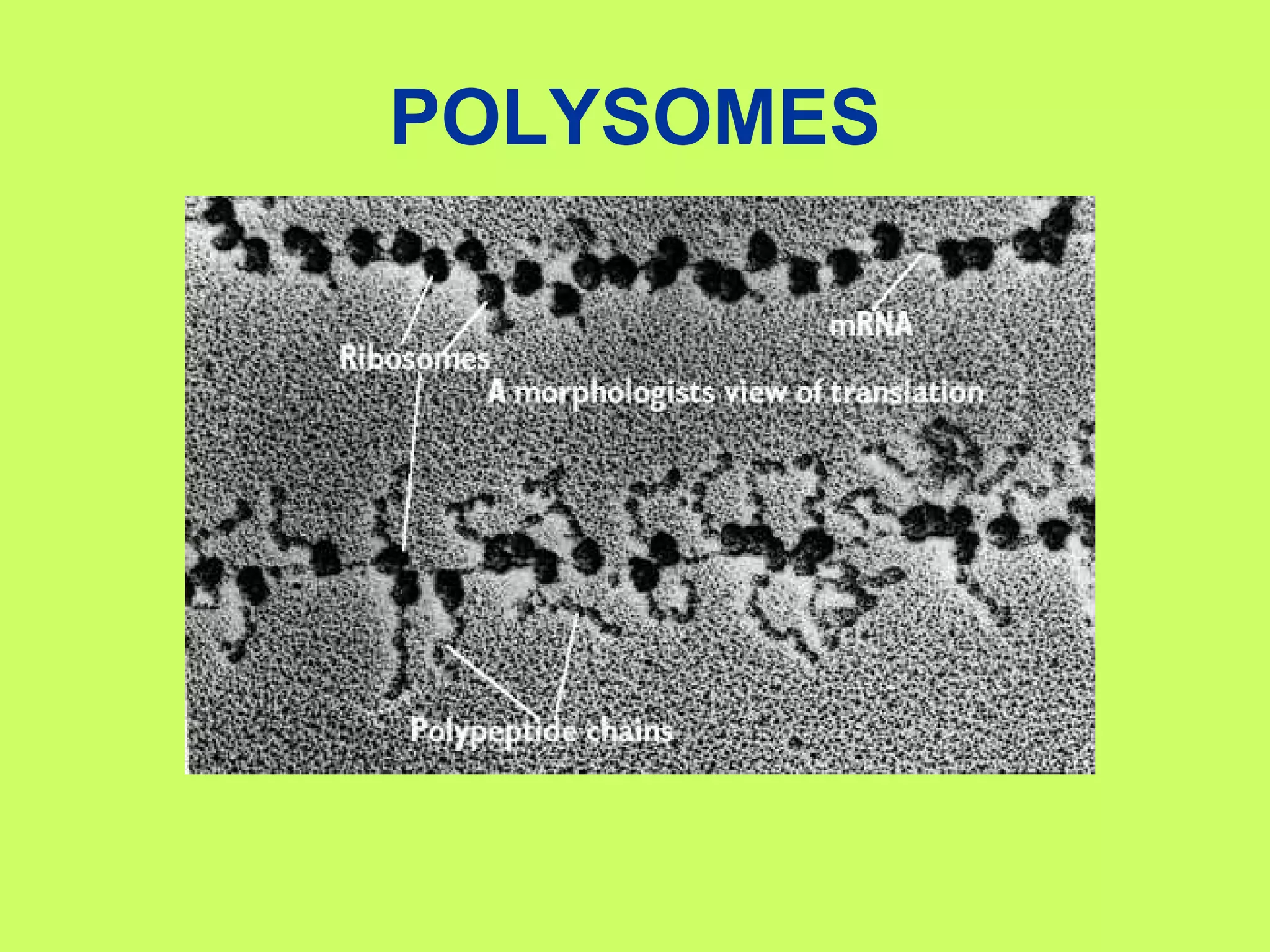
POLYSOMES
ANIMATION http://ncc.gmu.edu/dna/ANIMPROT.htm   CLIK here to view an animation of the whole process of translation!
 

Protein Synthesis

  • 1.
  • 2.
    CENTRAL DOGMA OFMOLECULAR BIOLOGY DNA   RNA    Protein transcription translation
  • 3.
    GROWING CELL Beforecell division the cell’s DNA has to duplicate (DNA REPLICATION) While the cell is growing it needs enzymes and extra proteins…
  • 4.
    TRANSCRIPTION THE PROTEINSARE MADE IN THE CYTOPLASM IN THE RIBOSOMES THE INFO FROM THE DNA IS COPIED INTO m RNA, WHICH CAN LEAVE THE NUCLEUS AND GET TO THE RIBOSOMES IN THE CYTOPLASM. THE INFORMATION FOR PROTEIN SYNTHESIS IS IN THE DNA IN THE NUCLEUS . DNA INFO COPIED TO mRNA
  • 5.
    TRANSCRIPTION: the processOnly 1 strand of DNA in a gene gets transcribed: RNA polymerase: enzyme that initiates transcription by binding to promoter at the 3' end of DNA, unwinds and unzips it. RNA activated nucleotides pair with the complementary bases of the DNA strand RNA polymerase, binds the RNA nucleotides together to form the mRNA poynucleotide.
  • 6.
    ANIMATION http://207.207.4.198/pub/flash/26/transmenu_s.swf CLIKhere to view an animation of the whole process of transcription!
  • 7.
    TRANSLATION DNA MRNA PROTEIN transcription DNA info is copied into to RNA code, which is still in the “language” of nitrogenous bases, except that adenine on the DNA pairs with uracil (in place of thymine) on the RNA. HAPPENS IN NUCLEUS. translation The RNA code is then translated to protein code, which is a different “language.” (nitrogenous bases to aminoacids. This process involves ribosomes and two kinds of RNA: mRNA and tRNA . HAPPENS IN CYTOPLASM
  • 8.
    INFORMATION IN THEmRNA Codon: sequence of 3 nucleotides on m-RNA that codes for one amino acid. The GENETIC CODE states which codon stands for which aminoacid. 1 aminoacid 1 aminoacid
  • 9.
    GENETIC CODE Eventhough there are only 20 amino acids that exist, there are actually 64 possible tRNA molecules: 4 X 4 X 4 = 64 possible combinations CODON CODON CODON G C U 1º NUCLEOTIDE 2º NUCLEOTIDE 3º NUCLEOTIDE =Gly
  • 10.
    GENETIC CODE (II)The GENETIC CODE can be reffered as well to the DNA, as in this case. How can you tell this GENETIC CODE reffers to DNA? Why can it be reffered to the DNA?
  • 11.
    CHARACTERISTICS OF THEGENETIC CODE It can be reffered to DNA or RNA. It is UNIVERSAL. All living organisms share the same code. We can “read” the DNA of a bacterium, a plant or a worm using the same code !! PROOF FOR EVOLUTION!!! It is DEGENERATE As there are ONLY 20 aminoacids but 64 possible codons Each aminoacid has MORE than ONE codon! There are codons that code for punctuation ( START and STOP )
  • 12.
    TRANSLATION LOADED tRNARIBOSOME mRNA COMPONENTS PRESENT IN THE PROCESS anticodon Aminoacid carried codon
  • 13.
    TRANSLATION The newlymade mRNA (transcription) leaves the nuceus and binds with the ribosome in the cytoplasm. ONE codon is exposed at site P and another codon at site A A tRNA with a complementary codon in its anticodon site will bind with the codon at site P, bringing an aminoacid. 1º AMINOACID: Methionine (AUG) in site P.
  • 14.
    TRANSLATION Even thoughevery protein begins with the Methionine amino acid, not all proteins will ultimately have methionine at one end. If the "start" methionine is not needed, it is removed before the new protein goes to work (either inside the cell or outside the cell, depending on the type of protein synthesized)
  • 15.
    TRANSLATION 2º AMINOACID: Glycine (only in this case) in site A. PEPTIDIC BOND IS FORMED A
  • 16.
    TRANSLATION STOP codonNO aminoacid is added. Its the END of the polypeptide! Growing polypeptide
  • 17.
  • 18.
    ANIMATION http://ncc.gmu.edu/dna/ANIMPROT.htm CLIK here to view an animation of the whole process of translation!
  • 19.