AVINASH
BVN13007
DEFINITION :-
Transcription is synthesis of single stranded
RNA from a double stranded DNA template. Its
produces messenger RNA ( mRNA).
Translation is the 1st stage of protein
biosynthesis from RNA. In this process
formation of a polypeptide by using mRNA as a
template. It occurs in ribosomes.
Transcription and Translation both process are
the part of gene expression.
Cont…
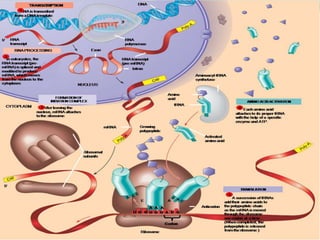
In a eukaryotic cell the nuclear envelope
separates transcription from translation.
Extensive RNA processing occurs in the
nucleus.
TRANSCRIPTION
INTRODUCTION :-
Transcription is the synthesis of mRNA from a
DNA template which occurs in 5’-3’ direction.
During transcription , a DNA sequence is read
by an RNA polymerase which produce a
complementary and antiparallel RNA strand.
Transcription is the first step leading to gene
expression.
Cont…
The stretch of DNA transcribed into an RNA
molecule is called as transcription unit which
encoded at least one gene.
The result of the transcription is a mRNA
which will then be used to create that protein
via the process of translation
Transcription
Prokaryotes Vs Eukaryotes.
Prokaryotic transcription occurring in
cytoplasm alongside translation and eukaryotic
transcription occurring only in the nucleus
where it is separated from the cytoplasm by the
nuclear membrane.
Eukaryotic DNA not currently used in stored
as heterochromatin around histones to from
nucleosomes and must be unwound as
euchromatin to be transcribed.
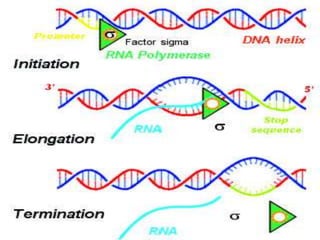
STAGES OF TRANSCRIPTION :-
 There are three stages involved in transcription :-
A. INITIATION
B. ELONGATION
C. TERMINATION
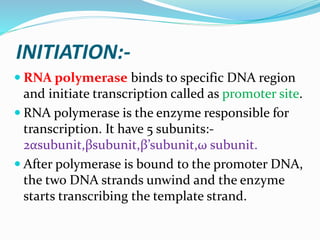
INITIATION:-
 RNA polymerase binds to specific DNA region
and initiate transcription called as promoter site.
 RNA polymerase is the enzyme responsible for
transcription. It have 5 subunits:-
2αsubunit,βsubunit,β’subunit,ω subunit.
 After polymerase is bound to the promoter DNA,
the two DNA strands unwind and the enzyme
starts transcribing the template strand.
Cont…
The position of the first synthesized base
of the RNA is called the start site .
ELONGATION:-
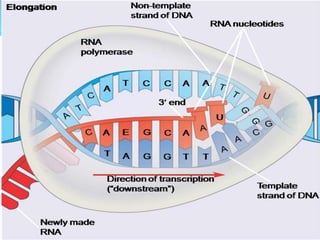
 RNA polymerase moves along DNA template
and sequentially synthesizes the RNA chain.
 DNA is unwinding ahead of the moving
polymerase and the helix is reformed behind it.
It unwinds 10-20 DNA bases at a time.
 RNA polymerase add nucleotides in the 5’-3’
direction.
 The new section of RNA ‘peels away’ as the
double helix reforms.
TERMINATION:-
 Transcription stops when RNA polymerase
reaches a section of DNA called the terminator.
 Terminator sequence = AAUAAA.
 Next, the RNA strand is released and RNA
polymerase dissociates from the DNA.
 The RNA strand will go through more
processing.
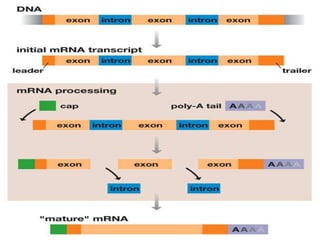
RNA Processing :-
 The orignal transcript from the DNA is called
as pre-m RNA.
 It contains transcript of both intron and exons.
Intron:- it is non-coding sections of nucleic
acid found between coding regions.
Exons:-coding regions of nucleic acids
 Pre-mRNA never leaves the cell’s nucleus.
Cont…
 The introns are excised and exons are joined
together to form mRNA.
 The introns are removed by a process called
splicing to produce messenger RNA (mRNA)
TRANSLATION
 Translation is a process in which the formation
of polypeptide (PROTEIN) by decoding mRNA
produced in transcription.
 It occurs in ribosome which are present in
cytoplasm.
 It begins after mRNA enters in cytoplasm.
 It uses tRNA as the interpreter of mRNA.
PHASES IN TRANSLATION :-
 Translation proceed in four phases:-
1. INITIATION
2. ELONGATION
3. TRANSLOCATION
4. TERMINATION
INITIATION :-
 The initiation stage of translation brings
together mRNA, tRNA bearing the first amino
acid of the polypeptide, and two subunits of a
ribosome
 The components involved are the large and
small subunits of ribosome, mRNA, initiator
tRNA in its charged form and three factors (
IF1.IF2,IF3) and GTP.
 The tRNA has a amino acid linked to it is term
as Charged tRNA.
Cont…
 IF1 and IF2 bind to free 30S subunit.
 IF3 complexed with GTP then bind to the small
subunit. It will assist the charged initiator
tRNA to bind.
 The assembled ribosome has 2 tRNA binding
sites. These are called A-site (acceptor) for
aminoacyl and P-site(donor)for polypeptide.
 The A-site is where incoming aminoacyl-tRNA
moleules bind and P-site where the growing
polypeptide chain usually found.
Cont…
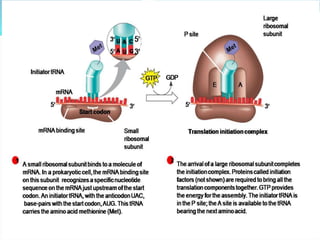
 One major outcome of initiation is the
placement of initiator tRNA in the P-site.
 Start codon :- AUG
 Start anticodon :- UAC
 The small ribosomal subunit attaches to 5’ end
of mRNA.
ELONGATION:-
 In this amino acid are added one by one to the first
amino acid called as amino acid delivery.
 In codon recognition , mRNA codon in the A site
forms hydrogen bond with the tRNA anticodon.
 In peptide bond formation, the ribosome catalyzes
the formation of the peptide bond between the
amino acids. The polypeptide extending from the P-
site moves to A-site to attach to the new Amino Acid.
 In elongation process three elongation factors
(EF-T4,EF-T5,EF-G) which will bind with GTP or GDP.
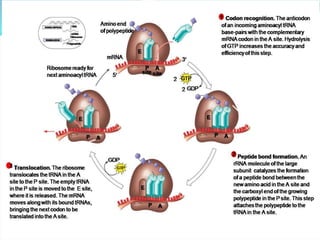
TRANSLOCATION :-
 The t-RNA with the polypeptide chain in the A site is
translocated to the P site. tRNA at the P site moves to
the E site and leaves the ribosome.
 The ribosome moves down the mRNA in the 5’-3’
direction.
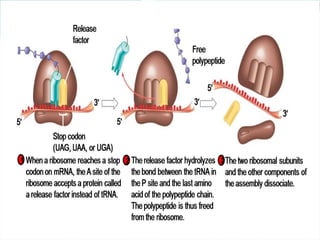
TERMINATION:-
 Protein factors called release factors interact
with the stop codons and cause release of the
completed polypeptide chain.
 Stop codon – UAA,UAG,UGA.
 RF1 recognises the codons UAA and UAG. RF2
recognises UAA and UGA. RF3 helps either RF1
and RF2 to carry out the reaction.
Translation in Eukaryotes:-
INITIATION:-
 Eukaryote have atleast 9 initiation factor.
 Eukaryotic initiator t RNA does not become
formylated as in prokaryotes.
ELONGATION:-
 The factors eEF1a,eEF1b,eEFz are involved in
elongation.
TERMINATION:- Eukaryotes have only
one release factor eRF which recognize
all the stop codons.
REFRENCE:-
BIOTECHNOLOGY
FUNDAMENTALS
BY
FIRDOS ALAM KHAN
Transcription &translation

Transcription &translation

  • 1.
  • 2.
    DEFINITION :- Transcription issynthesis of single stranded RNA from a double stranded DNA template. Its produces messenger RNA ( mRNA). Translation is the 1st stage of protein biosynthesis from RNA. In this process formation of a polypeptide by using mRNA as a template. It occurs in ribosomes. Transcription and Translation both process are the part of gene expression.
  • 3.
    Cont… In a eukaryoticcell the nuclear envelope separates transcription from translation. Extensive RNA processing occurs in the nucleus.
  • 5.
    TRANSCRIPTION INTRODUCTION :- Transcription isthe synthesis of mRNA from a DNA template which occurs in 5’-3’ direction. During transcription , a DNA sequence is read by an RNA polymerase which produce a complementary and antiparallel RNA strand. Transcription is the first step leading to gene expression.
  • 6.
    Cont… The stretch ofDNA transcribed into an RNA molecule is called as transcription unit which encoded at least one gene. The result of the transcription is a mRNA which will then be used to create that protein via the process of translation
  • 7.
    Transcription Prokaryotes Vs Eukaryotes. Prokaryotictranscription occurring in cytoplasm alongside translation and eukaryotic transcription occurring only in the nucleus where it is separated from the cytoplasm by the nuclear membrane. Eukaryotic DNA not currently used in stored as heterochromatin around histones to from nucleosomes and must be unwound as euchromatin to be transcribed.
  • 9.
    STAGES OF TRANSCRIPTION:-  There are three stages involved in transcription :- A. INITIATION B. ELONGATION C. TERMINATION
  • 11.
    INITIATION:-  RNA polymerasebinds to specific DNA region and initiate transcription called as promoter site.  RNA polymerase is the enzyme responsible for transcription. It have 5 subunits:- 2αsubunit,βsubunit,β’subunit,ω subunit.  After polymerase is bound to the promoter DNA, the two DNA strands unwind and the enzyme starts transcribing the template strand.
  • 12.
    Cont… The position ofthe first synthesized base of the RNA is called the start site .
  • 13.
    ELONGATION:-  RNA polymerasemoves along DNA template and sequentially synthesizes the RNA chain.  DNA is unwinding ahead of the moving polymerase and the helix is reformed behind it. It unwinds 10-20 DNA bases at a time.  RNA polymerase add nucleotides in the 5’-3’ direction.  The new section of RNA ‘peels away’ as the double helix reforms.
  • 15.
    TERMINATION:-  Transcription stopswhen RNA polymerase reaches a section of DNA called the terminator.  Terminator sequence = AAUAAA.  Next, the RNA strand is released and RNA polymerase dissociates from the DNA.  The RNA strand will go through more processing.
  • 16.
    RNA Processing :- The orignal transcript from the DNA is called as pre-m RNA.  It contains transcript of both intron and exons. Intron:- it is non-coding sections of nucleic acid found between coding regions. Exons:-coding regions of nucleic acids  Pre-mRNA never leaves the cell’s nucleus.
  • 17.
    Cont…  The intronsare excised and exons are joined together to form mRNA.  The introns are removed by a process called splicing to produce messenger RNA (mRNA)
  • 19.
    TRANSLATION  Translation isa process in which the formation of polypeptide (PROTEIN) by decoding mRNA produced in transcription.  It occurs in ribosome which are present in cytoplasm.  It begins after mRNA enters in cytoplasm.  It uses tRNA as the interpreter of mRNA.
  • 20.
    PHASES IN TRANSLATION:-  Translation proceed in four phases:- 1. INITIATION 2. ELONGATION 3. TRANSLOCATION 4. TERMINATION
  • 21.
    INITIATION :-  Theinitiation stage of translation brings together mRNA, tRNA bearing the first amino acid of the polypeptide, and two subunits of a ribosome  The components involved are the large and small subunits of ribosome, mRNA, initiator tRNA in its charged form and three factors ( IF1.IF2,IF3) and GTP.  The tRNA has a amino acid linked to it is term as Charged tRNA.
  • 22.
    Cont…  IF1 andIF2 bind to free 30S subunit.  IF3 complexed with GTP then bind to the small subunit. It will assist the charged initiator tRNA to bind.  The assembled ribosome has 2 tRNA binding sites. These are called A-site (acceptor) for aminoacyl and P-site(donor)for polypeptide.  The A-site is where incoming aminoacyl-tRNA moleules bind and P-site where the growing polypeptide chain usually found.
  • 23.
    Cont…  One majoroutcome of initiation is the placement of initiator tRNA in the P-site.  Start codon :- AUG  Start anticodon :- UAC  The small ribosomal subunit attaches to 5’ end of mRNA.
  • 25.
    ELONGATION:-  In thisamino acid are added one by one to the first amino acid called as amino acid delivery.  In codon recognition , mRNA codon in the A site forms hydrogen bond with the tRNA anticodon.  In peptide bond formation, the ribosome catalyzes the formation of the peptide bond between the amino acids. The polypeptide extending from the P- site moves to A-site to attach to the new Amino Acid.  In elongation process three elongation factors (EF-T4,EF-T5,EF-G) which will bind with GTP or GDP.
  • 26.
    TRANSLOCATION :-  Thet-RNA with the polypeptide chain in the A site is translocated to the P site. tRNA at the P site moves to the E site and leaves the ribosome.  The ribosome moves down the mRNA in the 5’-3’ direction.
  • 28.
    TERMINATION:-  Protein factorscalled release factors interact with the stop codons and cause release of the completed polypeptide chain.  Stop codon – UAA,UAG,UGA.  RF1 recognises the codons UAA and UAG. RF2 recognises UAA and UGA. RF3 helps either RF1 and RF2 to carry out the reaction.
  • 30.
    Translation in Eukaryotes:- INITIATION:- Eukaryote have atleast 9 initiation factor.  Eukaryotic initiator t RNA does not become formylated as in prokaryotes. ELONGATION:-  The factors eEF1a,eEF1b,eEFz are involved in elongation.
  • 31.
    TERMINATION:- Eukaryotes haveonly one release factor eRF which recognize all the stop codons.
  • 33.