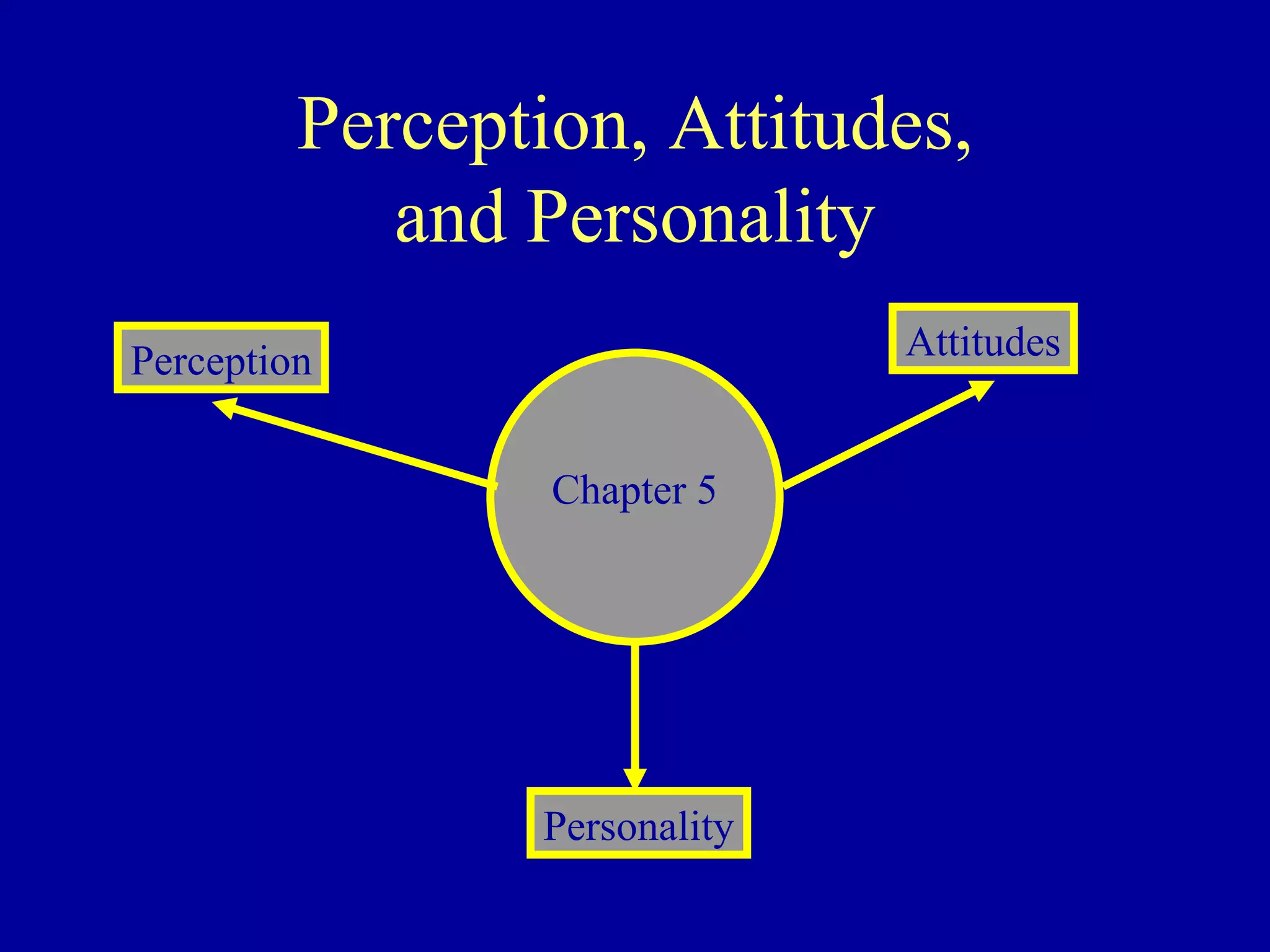
Chapter 5 Perception, Attitudes, and Personality
Learning Goals Understand human perceptual processes and how people form impressions of others Describe types of perceptual error and their effects on information people get from their environment Explain attribution processes and their effects on perception and attitudes
Learning Goals (Cont.) Discuss the nature of attitudes, how they form and how they change Explain the different views of human personality development Discuss some dimensions of personality and several personality types Recognize the effects of different cultures on perception, attitudes, and personality
Chapter Overview Introduction Perception Attitudes Personality International Aspects of Perception, Attitudes, and Personality Ethical Issues in Perception, Attitudes, and Personality
Perception, Attitudes, and Personality Perception Attitudes Personality Chapter 5
Perception A cognitive process:  lets a person make sense of stimuli from the environment Affects all senses:  sight, touch, taste, smell, hearing Includes inputs to person and choice of inputs to which the person attends Stimulus sources:  people, events, physical objects, ideas Helps adaptation to a changing environment
Perception (Cont.) Perceptual process   Target:   object of the person’s perceptual process Threshold:   minimum information from target for the person to notice the target Detection threshold:   point at which person notices something has changed in her or his environment Recognition threshold:   point at which person can identify the target or change in the target See text book Figure 5.1
Perception (Cont.) Perceptual process (cont.) Target emerges from its surrounding context sometimes slowly, sometimes quickly Quickly discriminate a high-contrast target from its background; an ambiguous target takes more time to see Contrast can come from the target's size, color, loudness, or smell
Perception (Cont.) Perceptual process (cont.)  People attend more quickly to positively valued stimuli than to negatively valued stimuli Example:  achievement-oriented employees notice announcements about promotion opportunities faster than an employee with less achievement motivation
Perception (Cont.) Perceptual defense:   shield self from negatively valued stimuli Example:  block out annoying sounds Organizational example:  block some feedback from a supervisor or coworker when it is negative
Perception (Cont.) Perceptual errors:   mistakes in the perceptual process Perceptual set Beliefs about a target based on information about the target or previous experiences with it Information about the target from any source Beliefs act like instructions for processing stimuli from the target
Perception (Cont.) Perceptual errors (cont.) Stereotype:  beliefs and perceived attributes about a target based on the target’s group Examples American university students:  energetic and spontaneous Russian university students:  orderly and obedient
Self-Perception: A View of Self Self-perception:   process by which people develop a view of themselves Develops from social interaction within different groups, including groups encountered on the Internet Self-perception has three parts:  self-concept, self-esteem, self-presentation
Self-Perception: A View of Self (Cont.) Self-concept: Set of beliefs people have about themselves View people hold of their personal qualities and attributes Factors affecting a person's self-concept Observations of behavior Recall of past significant events Effect of the surrounding social context
Self-Perception: A View of Self (Cont.) Self-concept (cont.) Observations of behavior People see their behavior, and their situation, in the same way they see the behavior of other people Person believes the behavior occurred voluntarily:  concludes the behavior happened because of some personal quality or attribute
Self-Perception: A View of Self (Cont.) Self-concept (cont.) Observations of behavior (cont.) People learn about themselves by comparing themselves to other people with similar qualities Example:  you may want to assess your abilities to hold a supervisory position.  You compare yourself to people with backgrounds similar to yours who have had recent promotions
Self-Perception: A View of Self (Cont.) Self-concept (cont.) Recall of past significant events and effect of the surrounding social context Recall events important in their lives; not error free Tend to recall events they attribute to themselves and not to a situation or other people Often overestimate their role in past events Place more weight on the effects of their behavior and less on the surrounding situation or other people
Self-Perception: A View of Self (Cont.) Self-esteem Emotional dimension of self-perception Positive and negative judgments people have of themselves People with low self-esteem tend to be unsuccessful; do not adapt well to stressful events Those with high self-esteem have the opposite experiences
Self-Perception: A View of Self (Cont.) Self-awareness People differ in degree of self-awareness Two forms Private self-consciousness:  behave according to attend to inner feelings and standards Public self-consciousness:  behave according to social standard correct for the situation
Self-Perception: A View of Self (Cont.) Self-presentation Behavioral strategies people use to affect how others see them How they think about themselves Goals of self-presentation Affect other people's impressions to win their approval Increase the person's influence in a situation Ensure that others have an accurate impression of the person
Self-Perception: A View of Self (Cont.) Self-presentation (cont.) Highly conscious of public image:  change behavior from situation to situation.  Readily conform to situational norms People who want others to perceive them in a particular way behave consistently in different situations.  They act in ways they perceive as true to themselves with little regard for the norms of the situation
Social Perception: A View of Others Social perception:  process by which people come to know and understand each other Forming impression of a person:  perceiver first observes the person, the situation, and the person's behavior
Social Perception: A View of Others (Cont.) Form a quick impression by making a snap judgment about that person, or Make attributions and integrate the attributions to form a final impression Confirmation biases lead the perceiver to hold tenaciously to it
Social Perception: A View of Others (Cont.) Elements of social perception Three sets of clues help form the impression of another person Person Situation surrounding the person Observed behavior of the person
Social Perception: A View of Others (Cont.) Elements of social perception (cont.) Developing first impressions Use different physical aspects of the person:  height, weight, hair color, eyeglasses Stereotypes based on physical features Thin men:  tense, suspicious, stubborn Blond women:  fun loving Neatly dressed people:  responsible Stereotypes result from attributing qualities to people based on previously formed perceptions
Social Perception: A View of Others (Cont.) Elements of social perception (cont.)  Preconceptions about the situations in which we see the behavior of other people Develop from experience with the same or similar situations Situation raises expectations about behavior the situation should cause Example:  when two people are introduced, we expect both parties to acknowledge the other and probably to shake hands
Social Perception: A View of Others (Cont.) Attribution processes People use attribution processes to explain the causes of behavior they see in others Begins with a quick personal attribution followed by adjustment based on the characteristics of the situation
Social Perception: A View of Others (Cont.) Personal attribution Characteristics of the person such as beliefs, disposition, or personality, and not the situation, caused the person's behavior Example:  when you conclude that another student spends many hours completing a project because he likes to work hard or values hard work, you are making a personal attribution
Social Perception: A View of Others (Cont.) Situational attribution Aspects of the situation, not qualities of the person, cause the person's behavior Example:  a student worked hard because of the reward of a good grade
Social Perception: A View of Others (Cont.) Perceiver uses three types of information when forming an attribution Consensus information Distinctiveness information Consistency information
Social Perception: A View of Others (Cont.) Consensus information Observe other people in the same or a similar situation If other people show the same behavior as the target person, the situation caused the behavior If other people behave differently from the target person, the person caused the behavior
Social Perception: A View of Others (Cont.) Distinctiveness information Observe the target person in a different situation If the response is different in the new situation, the situation caused the behavior If the response is the same, the person caused the behavior
Social Perception: A View of Others (Cont.) Consistency information Observe the target person in a similar situation, but at a different time High consistency:  same behavior at both times Low consistency:  different behavior at both times
Social Perception: A View of Others (Cont.) Combine consensus, distinctiveness, and consistency information to form attribution Personal attribution:  behavior high in consistency; low in consensus and distinctiveness Situational attribution:  behavior high in consensus and distinctiveness; low in consistency
Social Perception: A View of Others (Cont.) Fundamental attribution error Observer underestimates situation as cause of behavior; overestimates the as cause Explaining their behavior:  tend to ascribe causes to the situation, not to personal qualities Explaining other’s behavior:  tend to ascribe its causes to personal qualities, not the situation
Social Perception: A View of Others (Cont.) False consensus   Overestimate the degree to which others agree with the person's view Reinforces the view the perceiver has of another person
Social Perception: A View of Others (Cont.) Integration of attributions to form final impression:  disposition of perceiver Effects of recent experiences:  positive or negative event just before meeting someone for the first time can affect the impression of the person Mood at time of first meeting: Positive impressions in a good mood Negative impressions in a bad mood
Attitudes An  attitude  is “a learned predisposition to respond in a consistently favorable or unfavorable manner with respect to a given object” Attitude object :   physical objects, issues, ideas, events, people, places
Attitudes (Cont.) Parts of an attitude Cognitive:   perceptions and beliefs about an attitude object Affective:   feelings about an attitude object Behavioral intentions:   how the person wants to behave and what a person says about an attitude object
Attitudes (Cont.) Common work attitudes Organizational commitment Satisfaction Job involvement Play a role in employee turnover
Attitudes (Cont.) Some connection between attitudes and behavior, although not strong People with strong attitudes about an object will likely behave in accord with their attitude Strong positive attitudes about Macintosh ©  computers leads to buying one Ardent followers of Jesse Jackson will likely vote for him
Attitudes (Cont.) Attitude formation:   affected by the person’s  beliefs  about an object and the amount and type of information the person has about the object Perceives positive attributes:  develops positive attitude Perceives negative attributes:  develops negative attitude
Attitudes (Cont.) Attitude formation (cont.) Family upbringing Peer groups Work groups General social experiences
Attitudes (Cont.) Attitude change Something persuades the person to shift his or her attitudes (persuasive communication) Norms of a social group can affect a person’s attitude (social norms) Person becomes uncomfortable with some aspects of her or his beliefs (cognitive dissonance)
Attitudes (Cont.) Persuasive communication Advertising Tries to change cognitive part of attitude Assumes affective part will also change Attitude change process Win target’s attention Understand message Accept the influence Remember the message
Attitudes (Cont.) Social influence  on attitudes People are embedded in social groups Feel pressures to conform to norms If person values membership in group, likely will align attitudes with the group norms
Attitudes (Cont.) Cognitive dissonance Hold multiple beliefs or cognitions about an attitude object Feel tension when discrepancies develop Motivated to reduce the tension Change one or more cognitions Other parts of attitude also change
Personality Set of traits, characteristics, and predispositions of a person Usually matures and stabilizes by about age 30 Affects how a person adjusts to different environments
Personality Theories Cognitive theory:  people develop their thinking patterns as their life unfolds Learning theories:   behavior patterns develop from the social environment Biological theories:   personality as genetically inherited
Personality Theories (Cont.) Cognitive theory Develop thinking patterns as life unfolds Affects how the person interprets and internalizes life's events Cognitive development stages Reflexive behavior of infant More complex modes of perception and interpretation of events Neither driven by instincts nor unwittingly shaped by environmental influences
Personality Theories (Cont.) Learning theories Learn behavior from social interaction with other people Young child:  early family socialization Continuously learn from social environment:  stable behavior forms the personality Uniqueness of each personality follows from variability in social experiences
Personality Theories (Cont.) Biological theories Ethological theory Develop common characteristics as a result of evolution Behavioral characteristics that have helped survival over generations become inborn characteristics
Personality Theories (Cont.) Biological theories (cont.) Behavior genetics Individual's unique gene structure affects personality development Personality develops from interactions between a person's genetic structure and social environment
The  Big-Five Personality Dimensions Extroversion High:  talkative, sociable Low:  reserved, introverted Emotional stability High:  calm, relaxed Low:  worried, depressed Agreeableness High:  cooperative, tolerant Low:  rude, cold
The  Big-Five Personality Dimensions (Cont.) Conscientiousness High:  dependable, thorough Low:  sloppy, careless Openness to experience High:  curious, intelligent Low:  simple, conventional Assess yourself on each dimension
Personality Types Locus of control:   people control the consequences of their actions or are controlled by external factors External control:  luck, fate, or powerful external forces control one’s destiny Internal control:  believe they control what happens to them Assess yourself against each type.
Personality Types (Cont.) Machiavellianism Holds cynical views of other people's motives Places little value on honesty Approaches the world with manipulative intent Maintains distance between self and others Emotionally detached from other people Suspicious interpersonal orientation can contribute to high interpersonal conflict
Personality Types (Cont.) Machiavellianism (cont.) Focus on personal goals, even if reaching them requires unethical behavior Suspicious orientation leads to view of organizational world as a web of political processes
Personality Types (Cont.) Type A personality:   a keen sense of time urgency, focuses excessively on achievement, aggressive Type B personality:   strong self-esteem, even tempered, no sense of time urgency Type A:  significant risk factor for coronary heart disease.
Personality Types (Cont.) Myers-Briggs Type Indicator (MBTI) Popular personality assessment device Four bi-polar dimensions Extroverted (E) - introverted (I) Sensing (S) - intuitive (I) Thinking (T) - feeling (F) Perceiving (P) - judging (J) Assigns people to one of sixteen types based on these dimensions
Personality Types (Cont.) Myers-Briggs Type Indicator (MBTI) (cont.) Extroverts look outward; introverts turn inward Sensers use data; intuitives use hunches Thinkers are objective; feelers are subjective Perceivers are flexible; judgers want closure ESTJ type:  extroverted, sensing, thinking, and judging
International Aspects of Perception, Attitudes, and Personality Culturally based stereotypes Swiss:  punctual Germans:  task-oriented Americans:  energetic People who hold these stereotypes experience surprises when they meet people from these countries who do not fit the stereotypes
International Aspects of Perception, Attitudes, and Personality (Cont.) Culturally based stereotypes (cont.) Project aspects of own culture onto people and situations in a different culture Assumes that the new culture mirrors their own Example:  Korean manager visiting Sweden assumes all women seated behind desks are secretaries Such behavior would be inappropriate and possibly dysfunctional in Sweden where many women hold management positions
International Aspects of Perception, Attitudes, and Personality (Cont.) Attitudes about organizational design, management, and decision making: U.S. managers:  a hierarchical organizational design helps solve problems and guides the division of labor in the organization French and Italian managers:  a hierarchical design lets people know authority relationships in the organization
International Aspects of Perception, Attitudes, and Personality (Cont.) Attitudes (cont.) Italian managers:  bypassing a manager to reach a subordinate employee is insubordination Swedish and Austrian organizations:  decentralized decision making Philippine and Indian organizations:  centralized decision making Conclusion:  Organizations that cross national borders and draw managers from many different countries have high conflict potential.
International Aspects of Perception, Attitudes, and Personality (Cont.) Personality characteristics People in individualistic cultures (United States) have a stronger need for autonomy than people in group-oriented cultures (Japan) People in cultures that emphasize avoiding uncertainty (Belgium, Peru) have a stronger need for security than people in cultures that are less concerned about avoiding uncertainty (Singapore, Ireland)
Ethical Issues in Perception, Attitudes, and Personality Stereotypes and workforce diversity Can have inaccurate stereotypes about the ethics of people with different social, racial, and ethnic backgrounds These stereotypes can affect the opinions people develop about the ethical behavior of such people in the workplace
Ethical Issues in Perception, Attitudes, and Personality (Cont.) Self-presentation Deliberately managing self-presentations so decisions and behavior appear ethical Limited experimental evidence suggests one can favorably manage other people's impressions of their ethical attitudes
Ethical Issues in Perception, Attitudes, and Personality (Cont.) Attribution and accountability Individual responsibility is central to ethical behavior Attribution of responsibility to a person:  person behaved ethically or unethically Attribution of responsibility to the situation:  individual not held accountable Example:  observer believed the person had behaved unethically because of a directive Errors in attribution:  could conclude that he or she was not responsible for an unethical act
Ethical Issues in Perception, Attitudes, and Personality (Cont.) Ethical attitudes Little reliable and valid information about ethical attitudes Some evidence points to the absence of a fixed set of ethical attitudes among managers Attitudes about ethics in organizations and decision making are situational and varying The morality of behavior and decisions is determined by their social context, not by abstract and absolute rules

Chapter 5 perception attitude and personality

  • 1.
    Chapter 5 Perception,Attitudes, and Personality
  • 2.
    Learning Goals Understandhuman perceptual processes and how people form impressions of others Describe types of perceptual error and their effects on information people get from their environment Explain attribution processes and their effects on perception and attitudes
  • 3.
    Learning Goals (Cont.)Discuss the nature of attitudes, how they form and how they change Explain the different views of human personality development Discuss some dimensions of personality and several personality types Recognize the effects of different cultures on perception, attitudes, and personality
  • 4.
    Chapter Overview IntroductionPerception Attitudes Personality International Aspects of Perception, Attitudes, and Personality Ethical Issues in Perception, Attitudes, and Personality
  • 5.
    Perception, Attitudes, andPersonality Perception Attitudes Personality Chapter 5
  • 6.
    Perception A cognitiveprocess: lets a person make sense of stimuli from the environment Affects all senses: sight, touch, taste, smell, hearing Includes inputs to person and choice of inputs to which the person attends Stimulus sources: people, events, physical objects, ideas Helps adaptation to a changing environment
  • 7.
    Perception (Cont.) Perceptualprocess Target: object of the person’s perceptual process Threshold: minimum information from target for the person to notice the target Detection threshold: point at which person notices something has changed in her or his environment Recognition threshold: point at which person can identify the target or change in the target See text book Figure 5.1
  • 8.
    Perception (Cont.) Perceptualprocess (cont.) Target emerges from its surrounding context sometimes slowly, sometimes quickly Quickly discriminate a high-contrast target from its background; an ambiguous target takes more time to see Contrast can come from the target's size, color, loudness, or smell
  • 9.
    Perception (Cont.) Perceptualprocess (cont.) People attend more quickly to positively valued stimuli than to negatively valued stimuli Example: achievement-oriented employees notice announcements about promotion opportunities faster than an employee with less achievement motivation
  • 10.
    Perception (Cont.) Perceptualdefense: shield self from negatively valued stimuli Example: block out annoying sounds Organizational example: block some feedback from a supervisor or coworker when it is negative
  • 11.
    Perception (Cont.) Perceptualerrors: mistakes in the perceptual process Perceptual set Beliefs about a target based on information about the target or previous experiences with it Information about the target from any source Beliefs act like instructions for processing stimuli from the target
  • 12.
    Perception (Cont.) Perceptualerrors (cont.) Stereotype: beliefs and perceived attributes about a target based on the target’s group Examples American university students: energetic and spontaneous Russian university students: orderly and obedient
  • 13.
    Self-Perception: A Viewof Self Self-perception: process by which people develop a view of themselves Develops from social interaction within different groups, including groups encountered on the Internet Self-perception has three parts: self-concept, self-esteem, self-presentation
  • 14.
    Self-Perception: A Viewof Self (Cont.) Self-concept: Set of beliefs people have about themselves View people hold of their personal qualities and attributes Factors affecting a person's self-concept Observations of behavior Recall of past significant events Effect of the surrounding social context
  • 15.
    Self-Perception: A Viewof Self (Cont.) Self-concept (cont.) Observations of behavior People see their behavior, and their situation, in the same way they see the behavior of other people Person believes the behavior occurred voluntarily: concludes the behavior happened because of some personal quality or attribute
  • 16.
    Self-Perception: A Viewof Self (Cont.) Self-concept (cont.) Observations of behavior (cont.) People learn about themselves by comparing themselves to other people with similar qualities Example: you may want to assess your abilities to hold a supervisory position. You compare yourself to people with backgrounds similar to yours who have had recent promotions
  • 17.
    Self-Perception: A Viewof Self (Cont.) Self-concept (cont.) Recall of past significant events and effect of the surrounding social context Recall events important in their lives; not error free Tend to recall events they attribute to themselves and not to a situation or other people Often overestimate their role in past events Place more weight on the effects of their behavior and less on the surrounding situation or other people
  • 18.
    Self-Perception: A Viewof Self (Cont.) Self-esteem Emotional dimension of self-perception Positive and negative judgments people have of themselves People with low self-esteem tend to be unsuccessful; do not adapt well to stressful events Those with high self-esteem have the opposite experiences
  • 19.
    Self-Perception: A Viewof Self (Cont.) Self-awareness People differ in degree of self-awareness Two forms Private self-consciousness: behave according to attend to inner feelings and standards Public self-consciousness: behave according to social standard correct for the situation
  • 20.
    Self-Perception: A Viewof Self (Cont.) Self-presentation Behavioral strategies people use to affect how others see them How they think about themselves Goals of self-presentation Affect other people's impressions to win their approval Increase the person's influence in a situation Ensure that others have an accurate impression of the person
  • 21.
    Self-Perception: A Viewof Self (Cont.) Self-presentation (cont.) Highly conscious of public image: change behavior from situation to situation. Readily conform to situational norms People who want others to perceive them in a particular way behave consistently in different situations. They act in ways they perceive as true to themselves with little regard for the norms of the situation
  • 22.
    Social Perception: AView of Others Social perception: process by which people come to know and understand each other Forming impression of a person: perceiver first observes the person, the situation, and the person's behavior
  • 23.
    Social Perception: AView of Others (Cont.) Form a quick impression by making a snap judgment about that person, or Make attributions and integrate the attributions to form a final impression Confirmation biases lead the perceiver to hold tenaciously to it
  • 24.
    Social Perception: AView of Others (Cont.) Elements of social perception Three sets of clues help form the impression of another person Person Situation surrounding the person Observed behavior of the person
  • 25.
    Social Perception: AView of Others (Cont.) Elements of social perception (cont.) Developing first impressions Use different physical aspects of the person: height, weight, hair color, eyeglasses Stereotypes based on physical features Thin men: tense, suspicious, stubborn Blond women: fun loving Neatly dressed people: responsible Stereotypes result from attributing qualities to people based on previously formed perceptions
  • 26.
    Social Perception: AView of Others (Cont.) Elements of social perception (cont.) Preconceptions about the situations in which we see the behavior of other people Develop from experience with the same or similar situations Situation raises expectations about behavior the situation should cause Example: when two people are introduced, we expect both parties to acknowledge the other and probably to shake hands
  • 27.
    Social Perception: AView of Others (Cont.) Attribution processes People use attribution processes to explain the causes of behavior they see in others Begins with a quick personal attribution followed by adjustment based on the characteristics of the situation
  • 28.
    Social Perception: AView of Others (Cont.) Personal attribution Characteristics of the person such as beliefs, disposition, or personality, and not the situation, caused the person's behavior Example: when you conclude that another student spends many hours completing a project because he likes to work hard or values hard work, you are making a personal attribution
  • 29.
    Social Perception: AView of Others (Cont.) Situational attribution Aspects of the situation, not qualities of the person, cause the person's behavior Example: a student worked hard because of the reward of a good grade
  • 30.
    Social Perception: AView of Others (Cont.) Perceiver uses three types of information when forming an attribution Consensus information Distinctiveness information Consistency information
  • 31.
    Social Perception: AView of Others (Cont.) Consensus information Observe other people in the same or a similar situation If other people show the same behavior as the target person, the situation caused the behavior If other people behave differently from the target person, the person caused the behavior
  • 32.
    Social Perception: AView of Others (Cont.) Distinctiveness information Observe the target person in a different situation If the response is different in the new situation, the situation caused the behavior If the response is the same, the person caused the behavior
  • 33.
    Social Perception: AView of Others (Cont.) Consistency information Observe the target person in a similar situation, but at a different time High consistency: same behavior at both times Low consistency: different behavior at both times
  • 34.
    Social Perception: AView of Others (Cont.) Combine consensus, distinctiveness, and consistency information to form attribution Personal attribution: behavior high in consistency; low in consensus and distinctiveness Situational attribution: behavior high in consensus and distinctiveness; low in consistency
  • 35.
    Social Perception: AView of Others (Cont.) Fundamental attribution error Observer underestimates situation as cause of behavior; overestimates the as cause Explaining their behavior: tend to ascribe causes to the situation, not to personal qualities Explaining other’s behavior: tend to ascribe its causes to personal qualities, not the situation
  • 36.
    Social Perception: AView of Others (Cont.) False consensus Overestimate the degree to which others agree with the person's view Reinforces the view the perceiver has of another person
  • 37.
    Social Perception: AView of Others (Cont.) Integration of attributions to form final impression: disposition of perceiver Effects of recent experiences: positive or negative event just before meeting someone for the first time can affect the impression of the person Mood at time of first meeting: Positive impressions in a good mood Negative impressions in a bad mood
  • 38.
    Attitudes An attitude is “a learned predisposition to respond in a consistently favorable or unfavorable manner with respect to a given object” Attitude object : physical objects, issues, ideas, events, people, places
  • 39.
    Attitudes (Cont.) Partsof an attitude Cognitive: perceptions and beliefs about an attitude object Affective: feelings about an attitude object Behavioral intentions: how the person wants to behave and what a person says about an attitude object
  • 40.
    Attitudes (Cont.) Commonwork attitudes Organizational commitment Satisfaction Job involvement Play a role in employee turnover
  • 41.
    Attitudes (Cont.) Someconnection between attitudes and behavior, although not strong People with strong attitudes about an object will likely behave in accord with their attitude Strong positive attitudes about Macintosh © computers leads to buying one Ardent followers of Jesse Jackson will likely vote for him
  • 42.
    Attitudes (Cont.) Attitudeformation: affected by the person’s beliefs about an object and the amount and type of information the person has about the object Perceives positive attributes: develops positive attitude Perceives negative attributes: develops negative attitude
  • 43.
    Attitudes (Cont.) Attitudeformation (cont.) Family upbringing Peer groups Work groups General social experiences
  • 44.
    Attitudes (Cont.) Attitudechange Something persuades the person to shift his or her attitudes (persuasive communication) Norms of a social group can affect a person’s attitude (social norms) Person becomes uncomfortable with some aspects of her or his beliefs (cognitive dissonance)
  • 45.
    Attitudes (Cont.) Persuasivecommunication Advertising Tries to change cognitive part of attitude Assumes affective part will also change Attitude change process Win target’s attention Understand message Accept the influence Remember the message
  • 46.
    Attitudes (Cont.) Socialinfluence on attitudes People are embedded in social groups Feel pressures to conform to norms If person values membership in group, likely will align attitudes with the group norms
  • 47.
    Attitudes (Cont.) Cognitivedissonance Hold multiple beliefs or cognitions about an attitude object Feel tension when discrepancies develop Motivated to reduce the tension Change one or more cognitions Other parts of attitude also change
  • 48.
    Personality Set oftraits, characteristics, and predispositions of a person Usually matures and stabilizes by about age 30 Affects how a person adjusts to different environments
  • 49.
    Personality Theories Cognitivetheory: people develop their thinking patterns as their life unfolds Learning theories: behavior patterns develop from the social environment Biological theories: personality as genetically inherited
  • 50.
    Personality Theories (Cont.)Cognitive theory Develop thinking patterns as life unfolds Affects how the person interprets and internalizes life's events Cognitive development stages Reflexive behavior of infant More complex modes of perception and interpretation of events Neither driven by instincts nor unwittingly shaped by environmental influences
  • 51.
    Personality Theories (Cont.)Learning theories Learn behavior from social interaction with other people Young child: early family socialization Continuously learn from social environment: stable behavior forms the personality Uniqueness of each personality follows from variability in social experiences
  • 52.
    Personality Theories (Cont.)Biological theories Ethological theory Develop common characteristics as a result of evolution Behavioral characteristics that have helped survival over generations become inborn characteristics
  • 53.
    Personality Theories (Cont.)Biological theories (cont.) Behavior genetics Individual's unique gene structure affects personality development Personality develops from interactions between a person's genetic structure and social environment
  • 54.
    The Big-FivePersonality Dimensions Extroversion High: talkative, sociable Low: reserved, introverted Emotional stability High: calm, relaxed Low: worried, depressed Agreeableness High: cooperative, tolerant Low: rude, cold
  • 55.
    The Big-FivePersonality Dimensions (Cont.) Conscientiousness High: dependable, thorough Low: sloppy, careless Openness to experience High: curious, intelligent Low: simple, conventional Assess yourself on each dimension
  • 56.
    Personality Types Locusof control: people control the consequences of their actions or are controlled by external factors External control: luck, fate, or powerful external forces control one’s destiny Internal control: believe they control what happens to them Assess yourself against each type.
  • 57.
    Personality Types (Cont.)Machiavellianism Holds cynical views of other people's motives Places little value on honesty Approaches the world with manipulative intent Maintains distance between self and others Emotionally detached from other people Suspicious interpersonal orientation can contribute to high interpersonal conflict
  • 58.
    Personality Types (Cont.)Machiavellianism (cont.) Focus on personal goals, even if reaching them requires unethical behavior Suspicious orientation leads to view of organizational world as a web of political processes
  • 59.
    Personality Types (Cont.)Type A personality: a keen sense of time urgency, focuses excessively on achievement, aggressive Type B personality: strong self-esteem, even tempered, no sense of time urgency Type A: significant risk factor for coronary heart disease.
  • 60.
    Personality Types (Cont.)Myers-Briggs Type Indicator (MBTI) Popular personality assessment device Four bi-polar dimensions Extroverted (E) - introverted (I) Sensing (S) - intuitive (I) Thinking (T) - feeling (F) Perceiving (P) - judging (J) Assigns people to one of sixteen types based on these dimensions
  • 61.
    Personality Types (Cont.)Myers-Briggs Type Indicator (MBTI) (cont.) Extroverts look outward; introverts turn inward Sensers use data; intuitives use hunches Thinkers are objective; feelers are subjective Perceivers are flexible; judgers want closure ESTJ type: extroverted, sensing, thinking, and judging
  • 62.
    International Aspects ofPerception, Attitudes, and Personality Culturally based stereotypes Swiss: punctual Germans: task-oriented Americans: energetic People who hold these stereotypes experience surprises when they meet people from these countries who do not fit the stereotypes
  • 63.
    International Aspects ofPerception, Attitudes, and Personality (Cont.) Culturally based stereotypes (cont.) Project aspects of own culture onto people and situations in a different culture Assumes that the new culture mirrors their own Example: Korean manager visiting Sweden assumes all women seated behind desks are secretaries Such behavior would be inappropriate and possibly dysfunctional in Sweden where many women hold management positions
  • 64.
    International Aspects ofPerception, Attitudes, and Personality (Cont.) Attitudes about organizational design, management, and decision making: U.S. managers: a hierarchical organizational design helps solve problems and guides the division of labor in the organization French and Italian managers: a hierarchical design lets people know authority relationships in the organization
  • 65.
    International Aspects ofPerception, Attitudes, and Personality (Cont.) Attitudes (cont.) Italian managers: bypassing a manager to reach a subordinate employee is insubordination Swedish and Austrian organizations: decentralized decision making Philippine and Indian organizations: centralized decision making Conclusion: Organizations that cross national borders and draw managers from many different countries have high conflict potential.
  • 66.
    International Aspects ofPerception, Attitudes, and Personality (Cont.) Personality characteristics People in individualistic cultures (United States) have a stronger need for autonomy than people in group-oriented cultures (Japan) People in cultures that emphasize avoiding uncertainty (Belgium, Peru) have a stronger need for security than people in cultures that are less concerned about avoiding uncertainty (Singapore, Ireland)
  • 67.
    Ethical Issues inPerception, Attitudes, and Personality Stereotypes and workforce diversity Can have inaccurate stereotypes about the ethics of people with different social, racial, and ethnic backgrounds These stereotypes can affect the opinions people develop about the ethical behavior of such people in the workplace
  • 68.
    Ethical Issues inPerception, Attitudes, and Personality (Cont.) Self-presentation Deliberately managing self-presentations so decisions and behavior appear ethical Limited experimental evidence suggests one can favorably manage other people's impressions of their ethical attitudes
  • 69.
    Ethical Issues inPerception, Attitudes, and Personality (Cont.) Attribution and accountability Individual responsibility is central to ethical behavior Attribution of responsibility to a person: person behaved ethically or unethically Attribution of responsibility to the situation: individual not held accountable Example: observer believed the person had behaved unethically because of a directive Errors in attribution: could conclude that he or she was not responsible for an unethical act
  • 70.
    Ethical Issues inPerception, Attitudes, and Personality (Cont.) Ethical attitudes Little reliable and valid information about ethical attitudes Some evidence points to the absence of a fixed set of ethical attitudes among managers Attitudes about ethics in organizations and decision making are situational and varying The morality of behavior and decisions is determined by their social context, not by abstract and absolute rules