Uremic Encephalopathy Dr. Abrar Ali Katpar Resident Nephrology King Khalid Hospital, Hail, K.S.A
Background Uremia is final stage of progressive renal insufficiency & resultant multiorgan failure.  It results from accumulating metabolites of proteins & amino acids & concomitant failure of renal catabolic, metabolic, and endocrinologic processes.  No single metabolite has been identified as the sole cause of uremia.  Uremic encephalopathy (UE) is one of many manifestations of renal failure (RF).
Introduction Uremic encephalopathy  is an organic brain disorder.  Occurs due to build up of toxins which are normally cleared by kidneys.  It develops in pts with RF, usually when creatinine clearance levels fall & remain below 15 mL/min. Manifestations vary from  Mild symptoms (eg, lassitude, fatigue) to  Severe symptoms (eg, seizures, coma).
Severity & progression depend on rate of decline in renal function. Symptoms are usually worse in ARF.  Prompt identification of uremia as the cause of encephalopathy is essential because symptoms are readily reversible following initiation of dialysis.
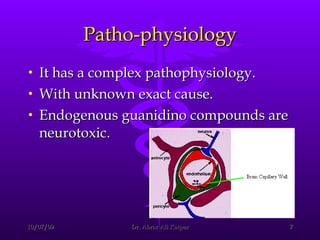
Patho-physiology It has a complex pathophysiology. With unknown exact cause. Endogenous guanidino compounds are neurotoxic.
Accumulating metabolites of proteins & amino acids affect the entire neuraxis.   Several organic substances accumulate Urea,  Guanidine compounds,  Uric acid,  Hippuric acid,  Various amino acids, Polypeptides,  Polyamines,  Phenols & conjugates of phenols, Phenolic and indolic acids,  Acetoin,  Glucuronic acid,  Carnitine,  Myoinositol,  Sulfates,  Phosphates, and middle molecules.
In terminal renal failure Increase levels in various regions of brain with uremia  Guanidinosuccinic acid & guanidine   >100-fold  Methylguanidine   >20-fold.  Creatinine     >5-fold  Disturbance in kynurenic pathway occurs,  Tryptophan is converted to neuroactive kynurenines.  Elevation of kynurenine, 2 kynurenines, 3-hydroxykynurenine, with chronic renal insufficiency.  Leads to alterations in cellular metabolism   cellular damage, and eventually cell death. Kynurenine can induce convultions.
Study shows In rats brain with RF Increased level CP = Creatine Phosphate. ATP = adinosine triphosphate  Glucose. Decreased levels ADP = Adinosine Diaphosphate  AMP = Adinosine Monophosphate  Lactate. This suggest that uremic brain less uses ATP and produce less ADP and AMP and lactate then normal brain. And is consistent of generalized decrease in metabolic brain function.
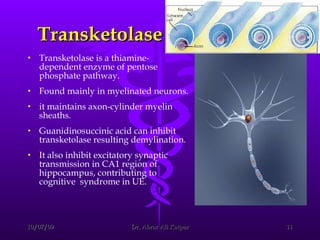
Transketolase Transketolase is a thiamine-dependent enzyme of pentose phosphate pathway. Found mainly in myelinated neurons. it maintains axon-cylinder myelin sheaths.  Guanidinosuccinic acid can inhibit transketolase resulting demylination.  It also inhibit excitatory synaptic transmission in CA1 region of hippocampus, contributing to cognitive  syndrome in UE.
Accumulation of diamethylarginine It’s a NOS ( nitric oxide synthase) inhibitor. Observed in uremic Pts leads to vasoconstriction. Induces hypertension. Increases ischemia & vulnerability to uremic brain.
Hormones  Increased levels. PTH Insulin Growth hormone Glucagon Thyrotropin Prolectin Luteinizing hormone Gastrin  PTH is thought to promote the entry of Ca into neurons specially in cerebral cortex, which leads to many changes observed.
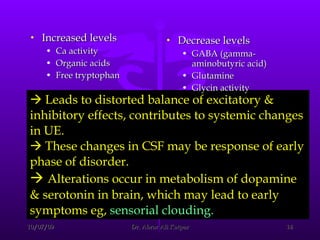
Leads to distorted balance of excitatory & inhibitory effects, contributes to systemic changes in UE.   These changes in CSF may be response of early phase of disorder.    Alterations occur in metabolism of dopamine & serotonin in brain, which may lead to early symptoms eg,  sensorial clouding. Increased levels Ca activity Organic acids Free tryptophan Decrease levels GABA (gamma-aminobutyric acid) Glutamine  Glycin activity
As uremia progresses  accumulation of guanidino compounds results in  activation of excitatory N-methyl-D-aspartate (NMDA) receptors &  inhibition of inhibitory GABA receptors, which may cause  myoclonus & seizures . The encephalopathy correlates roughly with BUN level, urea itself is not thought to be causative.
Abnormalities may be associated with UE Acidosis Hyponatremia Hyperkalemia Hypocalcaemia Hypermagnacemia Over hydration  Dehydration.
Frequency United States CrCl level < 10% of normal probably develop some degree of encephalopathy. In one pediatric study, encephalopathy occurred in 40%, with a BUN level > 90 mg/dL.
Mortality/Morbidity Symptoms include :- Somnolence & decreased mentation.  Asterixis usually present.  Symptoms are reversible following  Institution of dialysis  Renal transplantation . The severe complications   seizures  coma   leads to death.  Early recognition is crucial to prevent morbidity or mortality.
Race No racial predilection exists. Sex No association  Age Any age, mostly after 65 years as general.
Clinical History Symptoms begin insidiously  Not noticed by patients but by family members/caregivers.  In many cases, CNS impairment provides first indication of metabolic derangements.  Symptoms may progress slowly or rapidly.
Changes in sensorium include:-  Loss of memory,  Impaired concentration,  Depression,  Delusions,  Lethargy,  Irritability,  Fatigue,  Insomnia,  Psychosis, Stupor, Catatonia, & Coma.  Patients may complain of: Slurred speech,  Pruritus,  Muscle twitches, or  Restless legs.
History Early symptoms  Anorexia  Nausea  Restlessness  Drowsiness  Diminished ability to concentrate  Slowed cognitive functions   More severe symptoms  Vomiting  Emotional volatility  Decreased cognitive function  Disorientation  Confusion  Bizarre behavior
History As uremic encephalopathy progresses, patients may develop:- Myoclonus,  Asterixis,  Seizures,  Stupor &  Coma.
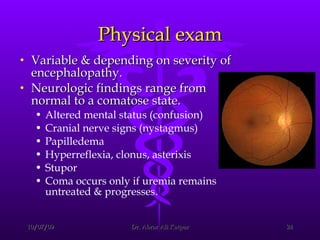
Physical exam Variable & depending on severity of encephalopathy.  Neurologic findings range from normal to a comatose state.  Altered mental status (confusion)  Cranial nerve signs (nystagmus)  Papilledema  Hyperreflexia, clonus, asterixis  Stupor  Coma occurs only if uremia remains untreated & progresses.
Findings Include :  Myoclonic jerks, twitches, or fasciculations (ie,  uremic twitch-convulsive syndrome  postulated by Adams et al in 1997)  Asterixis  Dysarthria  Agitation  Tetany  Seizures, usually generalized tonic-clonic
DD Encephalopathy, Hepatic Hyperparathyroidism Encephalopathy, Hypertensive Hypoglycemia Hypercalcemia Hyponatremia Hypermagnesemia Hypophosphatemia Hypernatremia Subdural Hematoma Hyperosmolar Coma  Wernicke-Korsakoff Syndrome Alzheimer Disease Alzheimer Disease in Individuals With Down Syndrome Aphasia Apraxia and Related Syndromes Complex Partial Seizures Dementia in Motor Neuron Disease Dementia With Lewy Bodies EEG in Dementia and Encephalopathy EEG in Status Epilepticus Frontal and Temporal Lobe Dementia Generalized EEG Waveform Abnormalities Huntington Disease Intracranial Hemorrhage Normal Pressure Hydrocephalus Pick Disease Status Epilepticus Subdural Hematoma Tonic-Clonic Seizures Transient Global Amnesia

Other Problems to Be Considered Drug intoxication CVA Encephalopathy from drugs normally excreted or metabolized by the kidney (ie, meperidine, cimetidine) Dementia Complex partial status epilepticus Dementia in Huntington disease Dementia in Parkinson disease Dementia in progressive supranuclear palsy Epileptic encephalopathies Vascular dementia EEG in coma Tonic seizures
Workup
Laboratory Studies 1. Electrolytes, BUN, creat, & glucose  A- Markedly elevated BUN & creatinine levels indicate UE.  B- Obtain serum electrolyte & glucose measurements to rule out other causes:- -hyponatremia, -hypernatremia,  - hyperglycemia &  -hyperosmolar syndromes
2. Obtain CBC to detect leukocytosis, which may suggest an infectious cause and determine whether anemia is present.  (Anemia may contribute to the severity of mental alterations.)  3. Obtain serum calcium, phosphate, and PTH levels to determine the presence of hypercalcemia, hypophosphatemia, and severe hyperparathyroidism, which cause metabolic encephalopathy.  4. Serum magnesium levels may be elevated in a patient with renal insufficiency, particularly if the patient is ingesting magnesium-containing antacids.  Hypermagnesemia may manifest as encephalopathy.  5. Order a toxicology screen in all patients.
6. Contributing to encephalopathy Medication levels  A- Determine detectabale drugs digoxin,  lithium etc.  B- Some medications cannot be detected & are excreted by kidney. eg,  penicillin, cimetidine,  meperidine,  Baclofen etc.
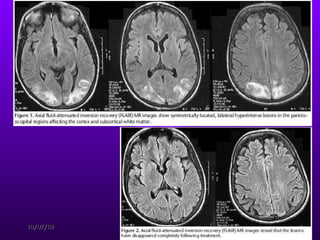
Imaging Studies Brain imaging is of limited value.  CT and MRI studies typically show cerebral atrophy & secondary ventricular dilatation.  These studies are valuable for excluding intracranial hemorrhage & subdural hematoma when patients have an acute change in mental status.  Case reports have documented increased signal intensity in the cortical and subcortical areas of the parietal and occipital lobes.  These findings are thought to reflect local edema that resolved after dialysis treatments.  Improvement on MRI has been correlated with improved serum creatinine and BUN levels.
Imaging Studies Severe symptoms  Obtain an MRI or head CT with severe neurologic symptoms to rule out structural abnormalities (eg, CVA, intracranial mass).  CT does not demonstrate any characteristic findings for UE.  With milder symptoms initially treat with dialysis &  observe for neurologic improvement.
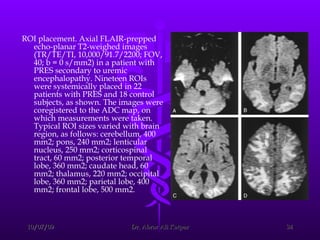
ROI placement. Axial FLAIR-prepped echo-planar T2-weighed images (TR/TE/TI, 10,000/91.7/2200; FOV, 40; b = 0 s/mm2) in a patient with PRES secondary to uremic encephalopathy. Nineteen ROIs were systemically placed in 22 patients with PRES and 18 control subjects, as shown. The images were coregistered to the ADC map, on which measurements were taken. Typical ROI sizes varied with brain region, as follows: cerebellum, 400 mm2; pons, 240 mm2; lenticular nucleus, 250 mm2; corticospinal tract, 60 mm2; posterior temporal lobe, 360 mm2; caudate head, 60 mm2; thalamus, 220 mm2; occipital lobe, 360 mm2; parietal lobe, 400 mm2; frontal lobe, 500 mm2.
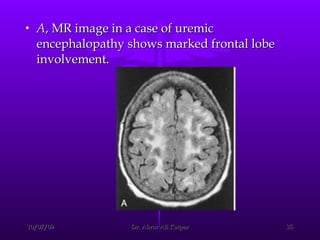
A , MR image in a case of uremic encephalopathy shows marked frontal lobe involvement.
 
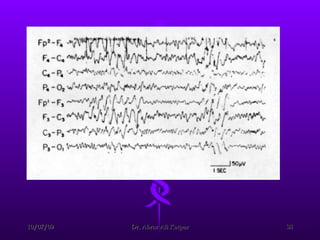
Other Tests Electroencephalogram  An EEG is commonly performed on patients with metabolic encephalopathy.  Findings typically include the following:  (1) slowing and loss of alpha frequency waves,  (2) disorganization,  (3) intermittent bursts of theta and delta waves with slow background activity.
 
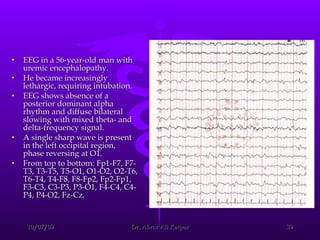
EEG in a 56-year-old man with uremic encephalopathy.  He became increasingly lethargic, requiring intubation.  EEG shows absence of a posterior dominant alpha rhythm and diffuse bilateral slowing with mixed theta- and delta-frequency signal.  A single sharp wave is present in the left occipital region, phase reversing at O1.  From top to bottom: Fp1-F7, F7-T3, T3-T5, T5-O1, O1-O2, O2-T6, T6-T4, T4-F8, F8-Fp2, Fp2-Fp1, F3-C3, C3-P3, P3-O1, F4-C4, C4-P4, P4-O2, Fz-Cz.
Reduction in frequency of EEG waves correlates with the decrease in renal function and the alterations in cerebral function.  After the initial period of dialysis, clinical stabilization may occur while the EEG findings do not improve. Eventually, EEG results move toward normal.  Aside from the routine EEG, evoked potentials (EPs) (ie, EEG signals that occur at a reproducible time after the brain receives a sensory stimulus [eg, visual, auditory, somatosensory]) may be helpful in evaluating uremic encephalopathy.  CRF prolongs latency of the cortical visual-evoked response.  Auditory-evoked responses are generally not altered in uremia, but delays in the cortical potential of the somatosensory-evoked response do occur.
Cognitive function tests Several cognitive function tests are used to evaluate UE.  Uremia may result in worse performance on  The trail-making test:-   which measures psychomotor speed. The continuous memory test:-   which measures short-term recognition. The choice reaction time test:-   which measures simple decision making.   Alterations in choice reaction time appear to correlate best with renal failure.
Histologic Findings Brain histologic findings include:-  Meningeal fibrosis,  Glial changes,  Edema,  Vascular degeneration,  Focal & diffuse neuronal degeneration, and  Focal demyelination.  Small infarcts are also seen & are probably due to HTN or focal necrosis.  Cerebellar acute granule cell necrosis is observed.
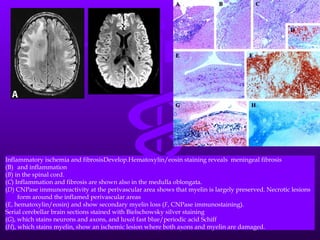
Inflammatory ischemia and fibrosisDevelop.Hematoxylin/eosin staining reveals  meningeal fibrosis  and inflammation  ( B ) in the spinal cord.  ( C ) Inflammation and fibrosis are shown also in the medulla oblongata.  ( D ) CNPase immunoreactivity at the perivascular area shows that myelin is largely preserved. Necrotic lesions form around the inflamed perivascular areas  ( E , hematoxylin/eosin) and show secondary myelin loss ( F , CNPase immunostaining).  Serial cerebellar brain sections stained with Bielschowsky silver staining  ( G ), which stains neurons and axons, and luxol fast blue/periodic acid Schiff  ( H ), which stains myelin, show an ischemic lesion where both axons and myelin are damaged.
 
Procedures Lumbar puncture  Not routinely performed; however,  it is indicated to find other causes if a patient's mental status does not improve after  initiation of dialysis .  No specific CSF finding indicates UE.
Lumbar  puncture
Treatment
Medical Care No medications are specific. Care includes correcting metabolic disturbance  In ARF or CRF indication for early initiation of :- Hemodialysis,  Peritoneal dialysis,  Continuous renal replacement therapy.  After beginning dialysis, patient generally improves clinically. Note: EEG findings may not improve immediately.  In ESRD, EEG improve after several months but may not completely normalize.
Address the following factors,  Adequacy of dialysis  Correction of anemia  Regulation of calcium & phosphate metabolism. Medical parathyroidectomy. Infections need to be treated appropriately.
Seizures  May be treated with anticonvulsants.  These drugs should be administered at lower-than-usual doses to accommodate the low albumin levels observed in CRF.  Low albumin levels can lead to higher levels of unbound anticonvulsant.  The unbound drug is therapeutically active fraction.
Consultations your patient needs Nephrologist  Vascular surgeon   for placement of vascular access in patients with ESRD.   Neurologist   if symptoms do not improve upon initiation of dialysis therapy. Dietitian  the one familiar with renal diseases. Specialist in critical care medicine   Neurosurgeon   Neurosurgical intervention for intracranial hemorrhage or subdural hematoma. Infectious disease specialist:   Bacterial meningitis remains a high cause of mortality in hemodialyzed patients, often because of delay in treatment.
Diet To avoid malnutrition,  Maintain adequate protein intake (>1 g/kg/d). Low-salt, low-protein (ie, renal) diet . Activity Instruct pts with significant symptoms to continue bed rest.
Follow-up
Further Inpatient Care:- Admit for dialysis & further workup.  Patients need close follow-up in acute stage of uremic encephalopathy.  After underlying problem is treated properly, the symptoms should resolve.  Levels of anticonvulsant drugs must be closely monitored to prevent toxicity.  In cases of intracranial hemorrhage, serial head neuroimaging may be necessary.   Further Outpatient Care Schedule maintenance HD for ESRD.  Carefully monitor mental status. Inpatient & Outpatient Medications Administer medications (eg, iron, erythropoietin, phosphate binders, vitamin D analogues) for patients with ESRD to optimize their quality of life.  Avoid sedatives.
Transfer & Deterrence/Prevention Transfer Patients may require transfer to a facility that can provide emergent  hemodialysis .  Transfer to a facility with staff & equipment for further evaluation & care may be necessary.  As always, trained personnel with appropriate monitoring should perform the transfer. Deterrence/Prevention Refer patients with chronic renal insufficiency to a  Nephrologist  for regular monitoring of CrCl so that dialysis may be initiated before encephalopathy develops.
Complications Prognosis Patient Education Complications If untreated Seizures  Coma  Death  Prognosis The prognosis is generally favorable if treatment is successful. With prompt dialytic therapy, the mortality rate is low. Patient Education To ensure that treatment is initiated early, instruct patients & their family members & caregivers about the need for prompt medical evaluation when mental status changes occur.
Medicolegal Pitfalls Failure to recognize RF as the cause of encephalopathy in a patient who presents with altered mental status. Failure to promptly initiate dialysis in a patient with UE. Failure to adequately monitor drug levels may lead to toxicity & further complications. Accidental falls may occur & can lead to litigation.  The slow onset of symptoms may lead to complications that might be grounds for litigation.
 
 
Thank You

Uremic Encephalopathy

  • 1.
  • 2.
  • 3.
    Uremic Encephalopathy Dr.Abrar Ali Katpar Resident Nephrology King Khalid Hospital, Hail, K.S.A
  • 4.
    Background Uremia isfinal stage of progressive renal insufficiency & resultant multiorgan failure. It results from accumulating metabolites of proteins & amino acids & concomitant failure of renal catabolic, metabolic, and endocrinologic processes. No single metabolite has been identified as the sole cause of uremia. Uremic encephalopathy (UE) is one of many manifestations of renal failure (RF).
  • 5.
    Introduction Uremic encephalopathy is an organic brain disorder. Occurs due to build up of toxins which are normally cleared by kidneys. It develops in pts with RF, usually when creatinine clearance levels fall & remain below 15 mL/min. Manifestations vary from Mild symptoms (eg, lassitude, fatigue) to Severe symptoms (eg, seizures, coma).
  • 6.
    Severity & progressiondepend on rate of decline in renal function. Symptoms are usually worse in ARF. Prompt identification of uremia as the cause of encephalopathy is essential because symptoms are readily reversible following initiation of dialysis.
  • 7.
    Patho-physiology It hasa complex pathophysiology. With unknown exact cause. Endogenous guanidino compounds are neurotoxic.
  • 8.
    Accumulating metabolites ofproteins & amino acids affect the entire neuraxis. Several organic substances accumulate Urea, Guanidine compounds, Uric acid, Hippuric acid, Various amino acids, Polypeptides, Polyamines, Phenols & conjugates of phenols, Phenolic and indolic acids, Acetoin, Glucuronic acid, Carnitine, Myoinositol, Sulfates, Phosphates, and middle molecules.
  • 9.
    In terminal renalfailure Increase levels in various regions of brain with uremia Guanidinosuccinic acid & guanidine  >100-fold Methylguanidine  >20-fold. Creatinine   >5-fold Disturbance in kynurenic pathway occurs, Tryptophan is converted to neuroactive kynurenines. Elevation of kynurenine, 2 kynurenines, 3-hydroxykynurenine, with chronic renal insufficiency.  Leads to alterations in cellular metabolism  cellular damage, and eventually cell death. Kynurenine can induce convultions.
  • 10.
    Study shows Inrats brain with RF Increased level CP = Creatine Phosphate. ATP = adinosine triphosphate Glucose. Decreased levels ADP = Adinosine Diaphosphate AMP = Adinosine Monophosphate Lactate. This suggest that uremic brain less uses ATP and produce less ADP and AMP and lactate then normal brain. And is consistent of generalized decrease in metabolic brain function.
  • 11.
    Transketolase Transketolase isa thiamine-dependent enzyme of pentose phosphate pathway. Found mainly in myelinated neurons. it maintains axon-cylinder myelin sheaths. Guanidinosuccinic acid can inhibit transketolase resulting demylination. It also inhibit excitatory synaptic transmission in CA1 region of hippocampus, contributing to cognitive syndrome in UE.
  • 12.
    Accumulation of diamethylarginineIt’s a NOS ( nitric oxide synthase) inhibitor. Observed in uremic Pts leads to vasoconstriction. Induces hypertension. Increases ischemia & vulnerability to uremic brain.
  • 13.
    Hormones Increasedlevels. PTH Insulin Growth hormone Glucagon Thyrotropin Prolectin Luteinizing hormone Gastrin PTH is thought to promote the entry of Ca into neurons specially in cerebral cortex, which leads to many changes observed.
  • 14.
    Leads to distortedbalance of excitatory & inhibitory effects, contributes to systemic changes in UE.  These changes in CSF may be response of early phase of disorder.  Alterations occur in metabolism of dopamine & serotonin in brain, which may lead to early symptoms eg, sensorial clouding. Increased levels Ca activity Organic acids Free tryptophan Decrease levels GABA (gamma-aminobutyric acid) Glutamine Glycin activity
  • 15.
    As uremia progresses accumulation of guanidino compounds results in activation of excitatory N-methyl-D-aspartate (NMDA) receptors & inhibition of inhibitory GABA receptors, which may cause myoclonus & seizures . The encephalopathy correlates roughly with BUN level, urea itself is not thought to be causative.
  • 16.
    Abnormalities may beassociated with UE Acidosis Hyponatremia Hyperkalemia Hypocalcaemia Hypermagnacemia Over hydration Dehydration.
  • 17.
    Frequency United StatesCrCl level < 10% of normal probably develop some degree of encephalopathy. In one pediatric study, encephalopathy occurred in 40%, with a BUN level > 90 mg/dL.
  • 18.
    Mortality/Morbidity Symptoms include:- Somnolence & decreased mentation. Asterixis usually present. Symptoms are reversible following Institution of dialysis Renal transplantation . The severe complications  seizures  coma  leads to death. Early recognition is crucial to prevent morbidity or mortality.
  • 19.
    Race No racialpredilection exists. Sex No association Age Any age, mostly after 65 years as general.
  • 20.
    Clinical History Symptomsbegin insidiously Not noticed by patients but by family members/caregivers. In many cases, CNS impairment provides first indication of metabolic derangements. Symptoms may progress slowly or rapidly.
  • 21.
    Changes in sensoriuminclude:- Loss of memory, Impaired concentration, Depression, Delusions, Lethargy, Irritability, Fatigue, Insomnia, Psychosis, Stupor, Catatonia, & Coma. Patients may complain of: Slurred speech, Pruritus, Muscle twitches, or Restless legs.
  • 22.
    History Early symptoms Anorexia Nausea Restlessness Drowsiness Diminished ability to concentrate Slowed cognitive functions More severe symptoms Vomiting Emotional volatility Decreased cognitive function Disorientation Confusion Bizarre behavior
  • 23.
    History As uremicencephalopathy progresses, patients may develop:- Myoclonus, Asterixis, Seizures, Stupor & Coma.
  • 24.
    Physical exam Variable& depending on severity of encephalopathy. Neurologic findings range from normal to a comatose state. Altered mental status (confusion) Cranial nerve signs (nystagmus) Papilledema Hyperreflexia, clonus, asterixis Stupor Coma occurs only if uremia remains untreated & progresses.
  • 25.
    Findings Include : Myoclonic jerks, twitches, or fasciculations (ie, uremic twitch-convulsive syndrome postulated by Adams et al in 1997) Asterixis Dysarthria Agitation Tetany Seizures, usually generalized tonic-clonic
  • 26.
    DD Encephalopathy, HepaticHyperparathyroidism Encephalopathy, Hypertensive Hypoglycemia Hypercalcemia Hyponatremia Hypermagnesemia Hypophosphatemia Hypernatremia Subdural Hematoma Hyperosmolar Coma Wernicke-Korsakoff Syndrome Alzheimer Disease Alzheimer Disease in Individuals With Down Syndrome Aphasia Apraxia and Related Syndromes Complex Partial Seizures Dementia in Motor Neuron Disease Dementia With Lewy Bodies EEG in Dementia and Encephalopathy EEG in Status Epilepticus Frontal and Temporal Lobe Dementia Generalized EEG Waveform Abnormalities Huntington Disease Intracranial Hemorrhage Normal Pressure Hydrocephalus Pick Disease Status Epilepticus Subdural Hematoma Tonic-Clonic Seizures Transient Global Amnesia
  • 27.
    Other Problems toBe Considered Drug intoxication CVA Encephalopathy from drugs normally excreted or metabolized by the kidney (ie, meperidine, cimetidine) Dementia Complex partial status epilepticus Dementia in Huntington disease Dementia in Parkinson disease Dementia in progressive supranuclear palsy Epileptic encephalopathies Vascular dementia EEG in coma Tonic seizures
  • 28.
  • 29.
    Laboratory Studies 1.Electrolytes, BUN, creat, & glucose A- Markedly elevated BUN & creatinine levels indicate UE. B- Obtain serum electrolyte & glucose measurements to rule out other causes:- -hyponatremia, -hypernatremia, - hyperglycemia & -hyperosmolar syndromes
  • 30.
    2. Obtain CBCto detect leukocytosis, which may suggest an infectious cause and determine whether anemia is present. (Anemia may contribute to the severity of mental alterations.) 3. Obtain serum calcium, phosphate, and PTH levels to determine the presence of hypercalcemia, hypophosphatemia, and severe hyperparathyroidism, which cause metabolic encephalopathy. 4. Serum magnesium levels may be elevated in a patient with renal insufficiency, particularly if the patient is ingesting magnesium-containing antacids. Hypermagnesemia may manifest as encephalopathy. 5. Order a toxicology screen in all patients.
  • 31.
    6. Contributing toencephalopathy Medication levels A- Determine detectabale drugs digoxin, lithium etc. B- Some medications cannot be detected & are excreted by kidney. eg, penicillin, cimetidine, meperidine, Baclofen etc.
  • 32.
    Imaging Studies Brainimaging is of limited value. CT and MRI studies typically show cerebral atrophy & secondary ventricular dilatation. These studies are valuable for excluding intracranial hemorrhage & subdural hematoma when patients have an acute change in mental status. Case reports have documented increased signal intensity in the cortical and subcortical areas of the parietal and occipital lobes. These findings are thought to reflect local edema that resolved after dialysis treatments. Improvement on MRI has been correlated with improved serum creatinine and BUN levels.
  • 33.
    Imaging Studies Severesymptoms Obtain an MRI or head CT with severe neurologic symptoms to rule out structural abnormalities (eg, CVA, intracranial mass). CT does not demonstrate any characteristic findings for UE. With milder symptoms initially treat with dialysis & observe for neurologic improvement.
  • 34.
    ROI placement. AxialFLAIR-prepped echo-planar T2-weighed images (TR/TE/TI, 10,000/91.7/2200; FOV, 40; b = 0 s/mm2) in a patient with PRES secondary to uremic encephalopathy. Nineteen ROIs were systemically placed in 22 patients with PRES and 18 control subjects, as shown. The images were coregistered to the ADC map, on which measurements were taken. Typical ROI sizes varied with brain region, as follows: cerebellum, 400 mm2; pons, 240 mm2; lenticular nucleus, 250 mm2; corticospinal tract, 60 mm2; posterior temporal lobe, 360 mm2; caudate head, 60 mm2; thalamus, 220 mm2; occipital lobe, 360 mm2; parietal lobe, 400 mm2; frontal lobe, 500 mm2.
  • 35.
    A , MRimage in a case of uremic encephalopathy shows marked frontal lobe involvement.
  • 36.
  • 37.
    Other Tests Electroencephalogram An EEG is commonly performed on patients with metabolic encephalopathy. Findings typically include the following: (1) slowing and loss of alpha frequency waves, (2) disorganization, (3) intermittent bursts of theta and delta waves with slow background activity.
  • 38.
  • 39.
    EEG in a56-year-old man with uremic encephalopathy. He became increasingly lethargic, requiring intubation. EEG shows absence of a posterior dominant alpha rhythm and diffuse bilateral slowing with mixed theta- and delta-frequency signal. A single sharp wave is present in the left occipital region, phase reversing at O1. From top to bottom: Fp1-F7, F7-T3, T3-T5, T5-O1, O1-O2, O2-T6, T6-T4, T4-F8, F8-Fp2, Fp2-Fp1, F3-C3, C3-P3, P3-O1, F4-C4, C4-P4, P4-O2, Fz-Cz.
  • 40.
    Reduction in frequencyof EEG waves correlates with the decrease in renal function and the alterations in cerebral function. After the initial period of dialysis, clinical stabilization may occur while the EEG findings do not improve. Eventually, EEG results move toward normal. Aside from the routine EEG, evoked potentials (EPs) (ie, EEG signals that occur at a reproducible time after the brain receives a sensory stimulus [eg, visual, auditory, somatosensory]) may be helpful in evaluating uremic encephalopathy. CRF prolongs latency of the cortical visual-evoked response. Auditory-evoked responses are generally not altered in uremia, but delays in the cortical potential of the somatosensory-evoked response do occur.
  • 41.
    Cognitive function testsSeveral cognitive function tests are used to evaluate UE. Uremia may result in worse performance on The trail-making test:- which measures psychomotor speed. The continuous memory test:- which measures short-term recognition. The choice reaction time test:- which measures simple decision making. Alterations in choice reaction time appear to correlate best with renal failure.
  • 42.
    Histologic Findings Brainhistologic findings include:- Meningeal fibrosis, Glial changes, Edema, Vascular degeneration, Focal & diffuse neuronal degeneration, and Focal demyelination. Small infarcts are also seen & are probably due to HTN or focal necrosis. Cerebellar acute granule cell necrosis is observed.
  • 43.
    Inflammatory ischemia andfibrosisDevelop.Hematoxylin/eosin staining reveals meningeal fibrosis and inflammation ( B ) in the spinal cord. ( C ) Inflammation and fibrosis are shown also in the medulla oblongata. ( D ) CNPase immunoreactivity at the perivascular area shows that myelin is largely preserved. Necrotic lesions form around the inflamed perivascular areas ( E , hematoxylin/eosin) and show secondary myelin loss ( F , CNPase immunostaining). Serial cerebellar brain sections stained with Bielschowsky silver staining ( G ), which stains neurons and axons, and luxol fast blue/periodic acid Schiff ( H ), which stains myelin, show an ischemic lesion where both axons and myelin are damaged.
  • 44.
  • 45.
    Procedures Lumbar puncture Not routinely performed; however, it is indicated to find other causes if a patient's mental status does not improve after initiation of dialysis . No specific CSF finding indicates UE.
  • 46.
  • 47.
  • 48.
    Medical Care Nomedications are specific. Care includes correcting metabolic disturbance In ARF or CRF indication for early initiation of :- Hemodialysis, Peritoneal dialysis, Continuous renal replacement therapy. After beginning dialysis, patient generally improves clinically. Note: EEG findings may not improve immediately. In ESRD, EEG improve after several months but may not completely normalize.
  • 49.
    Address the followingfactors, Adequacy of dialysis Correction of anemia Regulation of calcium & phosphate metabolism. Medical parathyroidectomy. Infections need to be treated appropriately.
  • 50.
    Seizures Maybe treated with anticonvulsants. These drugs should be administered at lower-than-usual doses to accommodate the low albumin levels observed in CRF. Low albumin levels can lead to higher levels of unbound anticonvulsant. The unbound drug is therapeutically active fraction.
  • 51.
    Consultations your patientneeds Nephrologist Vascular surgeon for placement of vascular access in patients with ESRD. Neurologist if symptoms do not improve upon initiation of dialysis therapy. Dietitian the one familiar with renal diseases. Specialist in critical care medicine Neurosurgeon Neurosurgical intervention for intracranial hemorrhage or subdural hematoma. Infectious disease specialist: Bacterial meningitis remains a high cause of mortality in hemodialyzed patients, often because of delay in treatment.
  • 52.
    Diet To avoidmalnutrition, Maintain adequate protein intake (>1 g/kg/d). Low-salt, low-protein (ie, renal) diet . Activity Instruct pts with significant symptoms to continue bed rest.
  • 53.
  • 54.
    Further Inpatient Care:-Admit for dialysis & further workup. Patients need close follow-up in acute stage of uremic encephalopathy. After underlying problem is treated properly, the symptoms should resolve. Levels of anticonvulsant drugs must be closely monitored to prevent toxicity. In cases of intracranial hemorrhage, serial head neuroimaging may be necessary. Further Outpatient Care Schedule maintenance HD for ESRD. Carefully monitor mental status. Inpatient & Outpatient Medications Administer medications (eg, iron, erythropoietin, phosphate binders, vitamin D analogues) for patients with ESRD to optimize their quality of life. Avoid sedatives.
  • 55.
    Transfer & Deterrence/PreventionTransfer Patients may require transfer to a facility that can provide emergent hemodialysis . Transfer to a facility with staff & equipment for further evaluation & care may be necessary. As always, trained personnel with appropriate monitoring should perform the transfer. Deterrence/Prevention Refer patients with chronic renal insufficiency to a Nephrologist for regular monitoring of CrCl so that dialysis may be initiated before encephalopathy develops.
  • 56.
    Complications Prognosis PatientEducation Complications If untreated Seizures Coma Death Prognosis The prognosis is generally favorable if treatment is successful. With prompt dialytic therapy, the mortality rate is low. Patient Education To ensure that treatment is initiated early, instruct patients & their family members & caregivers about the need for prompt medical evaluation when mental status changes occur.
  • 57.
    Medicolegal Pitfalls Failureto recognize RF as the cause of encephalopathy in a patient who presents with altered mental status. Failure to promptly initiate dialysis in a patient with UE. Failure to adequately monitor drug levels may lead to toxicity & further complications. Accidental falls may occur & can lead to litigation. The slow onset of symptoms may lead to complications that might be grounds for litigation.
  • 58.
  • 59.
  • 60.