Hepatic
Encephalopathy.


     Daniel Vela-Duarte, MD
     Int. Medicine / Neurology
     Loyola University Medical Center
Case
   62 yo male with h/o ESLD 2/2 NASH and 1AT def,
    hepatorenal syndrome type II, DM II, who has presented
    multiple admissions for altered mental status, alternating
    somnolence, agitation and belligerence, diagnosed
    subsequently with hepatic encephalopathy and treated
    several times with large volume paracentesis and weekly
    albumin infusions.

   Pt was admitted for fluctuating changes in mental status,
    anuria, noted worsening renal function, fluid overload,
    hypotension and hemodialysis.
Question …
 What     is the best treatment to
       prevent recurrent hepatic
           encephalopathy?

   A. Lactulose 15ml BID / daily
   B. Lactulose 15ml BID / daily + Rifaximin 550mg BID /daily
   C. Rifaximin 550mg BID / daily
   D. Lactulose 15ml BID during hospitalization
   E. Neomycin 5 g / daily + Lactulose 15ml BID /daily
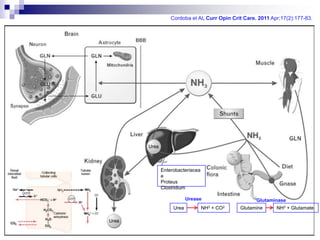
Cordoba et Al, Curr Opin Crit Care. 2011 Apr;17(2):177-83.


Enterobacteriacea
e
Proteus
Clostridium

            Urease                     Glutaminase
     Urea           NH3 + CO2   Glutamine      NH3 + Glutamate
Back to the Case
                                                   Intravascularly depleteted
   62 yo male with h/o ESLD 2/2                   (Peripheral /splanchnic pooling)
                                                   NASH and 1AT def,
    hepatorenal syndrome type II, DM II, who has presented
                                     Renin-Angiotensin-Aldost.
    multiple admissions for altered mental status, alternating
                                     Na / water retention
    somnolence, agitation and belligerence, diagnosed
    subsequently with hepatic encephalopathy and treated
                                     Intrarenal vasoconstriction
    several times with large volumeATN ?
                                     paracentesis and weekly
          ESLD =  Alb
    albumin infusions. of Ammonia
           -Impaired detox
          Renal Perfusion
          GFR
   Pt was admitted for fluctuating changes in mental status,
    anuria, noted worsening renal function, fluid overload,
    hypotension and emergent hemodialysis.


                   Schepke M, Nephrol Dial Transplant (2007) 22 [Suppl 8]: viii2–viii4
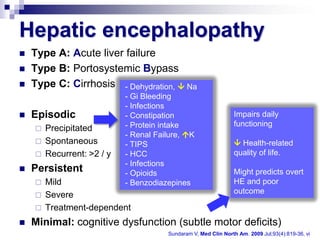
Hepatic encephalopathy
   Type A: Acute liver failure
   Type B: Portosystemic Bypass
   Type C: Cirrhosis - Dehydration,  Na
                            - Gi Bleeding
                            - Infections
   Episodic                - Constipation                      Impairs daily
                            - Protein intake                    functioning
       Precipitated
                            - Renal Failure, K
       Spontaneous         - TIPS                               Health-related
       Recurrent: >2 / y   - HCC                               quality of life.
                            - Infections
   Persistent              - Opioids                           Might predicts overt
       Mild                - Benzodiazepines                   HE and poor
       Severe                                                  outcome

       Treatment-dependent
   Minimal: cognitive dysfunction (subtle motor deficits)
                                       Sundaram V, Med Clin North Am. 2009 Jul;93(4):819-36, vi
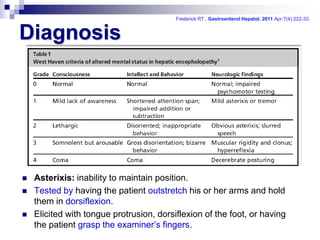
Frederick RT., Gastroenterol Hepatol. 2011 Apr;7(4):222-33.


Diagnosis


   Asterixis: inability to maintain position.
   Tested by having the patient outstretch his or her arms and hold
    them in dorsiflexion.
   Elicited with tongue protrusion, dorsiflexion of the foot, or having
    the patient grasp the examiner’s fingers.
Diagnosis
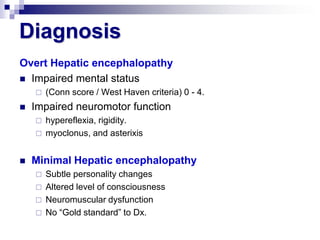
Overt Hepatic encephalopathy
 Impaired mental status
       (Conn score / West Haven criteria) 0 - 4.
   Impaired neuromotor function
       hypereflexia, rigidity.
       myoclonus, and asterixis


   Minimal Hepatic encephalopathy
       Subtle personality changes
       Altered level of consciousness
       Neuromuscular dysfunction
       No “Gold standard” to Dx.
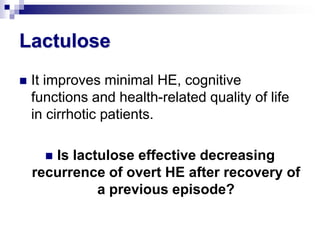
Lactulose
   It improves minimal HE, cognitive
    functions and health-related quality of life
    in cirrhotic patients.

      Is lactulose effective decreasing
    recurrence of overt HE after recovery of
              a previous episode?
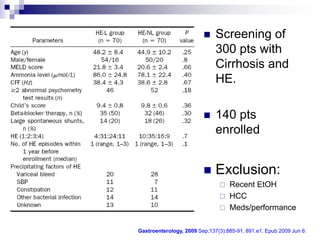
    Screening of
                              300 pts with
                              Cirrhosis and
                              HE.

                             140 pts
                              enrolled


                             Exclusion:
                                Recent EtOH
                                HCC
                                Meds/performance


Gastroenterology, 2009 Sep;137(3):885-91, 891.e1. Epub 2009 Jun 6.
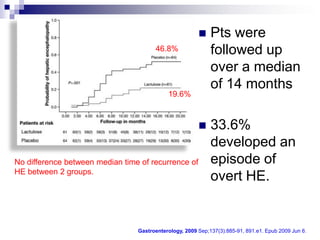
    Pts were
                                       46.8%                 followed up
                                                             over a median
                                                             of 14 months
                                            19.6%


                                                            33.6%
                                                             developed an
No difference between median time of recurrence of           episode of
HE between 2 groups.
                                                             overt HE.


                                 Gastroenterology, 2009 Sep;137(3):885-91, 891.e1. Epub 2009 Jun 6.
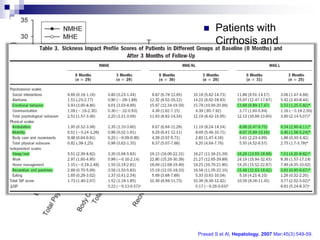
    Patients with
       Cirrhosis and
       MHE.
            (No recurrent HE)


      Improvement of
       quality of life by
       measurement of
       SIP score
       (Sickness impact
       profile)


Prasad S et Al, Hepatology. 2007 Mar;45(3):549-59.
Rifaximin
   Efficacy and safety of rifaximin, for the
    maintenance of remission from episodes
    of HE in outpatients with a recent hx of
    recurrent, overt HE (Prevention for 6m)
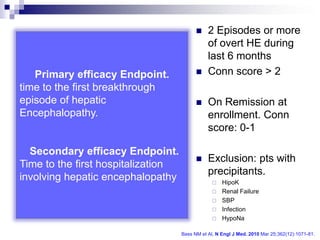
    2 Episodes or more
                                               of overt HE during
                                               last 6 months
   Primary efficacy Endpoint.                 Conn score > 2
time to the first breakthrough
episode of hepatic                            On Remission at
Encephalopathy.                                enrollment. Conn
                                               score: 0-1

  Secondary efficacy Endpoint.
                                              Exclusion: pts with
Time to the first hospitalization
                                               precipitants.
involving hepatic encephalopathy                    HipoK
                                                    Renal Failure
                                                    SBP
                                                    Infection
                                                    HypoNa

                                    Bass NM et Al, N Engl J Med. 2010 Mar 25;362(12):1071-81.
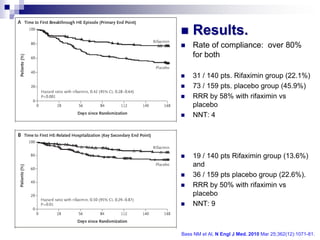
   Results.
   Rate of compliance: over 80%
    for both

   31 / 140 pts. Rifaximin group (22.1%)
   73 / 159 pts. placebo group (45.9%)
   RRR by 58% with rifaximin vs
    placebo
   NNT: 4


   19 / 140 pts Rifaximin group (13.6%)
    and
   36 / 159 pts placebo group (22.6%).
   RRR by 50% with rifaximin vs
    placebo
   NNT: 9


Bass NM et Al, N Engl J Med. 2010 Mar 25;362(12):1071-81.
Conclusions
   Rifaximin reduces the risk of a breakthrough episode of
    HE by 58% vs placebo (Lactulose only) during the at
    least 6 months of treatment.
   Rifaximin reduces the risk of a hospitalization involving
    HE by 50% vs placebo (Lactulose only) during the at
    least 6 months of treatment.

   Lactulose: 30 -60 ml / 2-3 doses, improves cognitive
    functions in patients with minimal HE after 3 months of
    treatment.
   Lactulose: 30 -60 ml / 2-3 doses, decreases the
    incidence of recurrent HE (RRR 58%)
Hepatic encephalopathy

  • 1.
    Hepatic Encephalopathy. Daniel Vela-Duarte, MD Int. Medicine / Neurology Loyola University Medical Center
  • 2.
    Case  62 yo male with h/o ESLD 2/2 NASH and 1AT def, hepatorenal syndrome type II, DM II, who has presented multiple admissions for altered mental status, alternating somnolence, agitation and belligerence, diagnosed subsequently with hepatic encephalopathy and treated several times with large volume paracentesis and weekly albumin infusions.  Pt was admitted for fluctuating changes in mental status, anuria, noted worsening renal function, fluid overload, hypotension and hemodialysis.
  • 3.
    Question …  What is the best treatment to prevent recurrent hepatic encephalopathy?  A. Lactulose 15ml BID / daily  B. Lactulose 15ml BID / daily + Rifaximin 550mg BID /daily  C. Rifaximin 550mg BID / daily  D. Lactulose 15ml BID during hospitalization  E. Neomycin 5 g / daily + Lactulose 15ml BID /daily
  • 4.
    Cordoba et Al,Curr Opin Crit Care. 2011 Apr;17(2):177-83. Enterobacteriacea e Proteus Clostridium Urease Glutaminase Urea NH3 + CO2 Glutamine NH3 + Glutamate
  • 5.
    Back to theCase Intravascularly depleteted  62 yo male with h/o ESLD 2/2 (Peripheral /splanchnic pooling) NASH and 1AT def, hepatorenal syndrome type II, DM II, who has presented  Renin-Angiotensin-Aldost. multiple admissions for altered mental status, alternating  Na / water retention somnolence, agitation and belligerence, diagnosed subsequently with hepatic encephalopathy and treated  Intrarenal vasoconstriction several times with large volumeATN ? paracentesis and weekly ESLD =  Alb albumin infusions. of Ammonia -Impaired detox  Renal Perfusion  GFR  Pt was admitted for fluctuating changes in mental status, anuria, noted worsening renal function, fluid overload, hypotension and emergent hemodialysis. Schepke M, Nephrol Dial Transplant (2007) 22 [Suppl 8]: viii2–viii4
  • 6.
    Hepatic encephalopathy  Type A: Acute liver failure  Type B: Portosystemic Bypass  Type C: Cirrhosis - Dehydration,  Na - Gi Bleeding - Infections  Episodic - Constipation Impairs daily - Protein intake functioning  Precipitated - Renal Failure, K  Spontaneous - TIPS  Health-related  Recurrent: >2 / y - HCC quality of life. - Infections  Persistent - Opioids Might predicts overt  Mild - Benzodiazepines HE and poor  Severe outcome  Treatment-dependent  Minimal: cognitive dysfunction (subtle motor deficits) Sundaram V, Med Clin North Am. 2009 Jul;93(4):819-36, vi
  • 7.
    Frederick RT., GastroenterolHepatol. 2011 Apr;7(4):222-33. Diagnosis  Asterixis: inability to maintain position.  Tested by having the patient outstretch his or her arms and hold them in dorsiflexion.  Elicited with tongue protrusion, dorsiflexion of the foot, or having the patient grasp the examiner’s fingers.
  • 8.
    Diagnosis Overt Hepatic encephalopathy Impaired mental status  (Conn score / West Haven criteria) 0 - 4.  Impaired neuromotor function  hypereflexia, rigidity.  myoclonus, and asterixis  Minimal Hepatic encephalopathy  Subtle personality changes  Altered level of consciousness  Neuromuscular dysfunction  No “Gold standard” to Dx.
  • 9.
    Lactulose  It improves minimal HE, cognitive functions and health-related quality of life in cirrhotic patients. Is lactulose effective decreasing recurrence of overt HE after recovery of a previous episode?
  • 10.
    Screening of 300 pts with Cirrhosis and HE.  140 pts enrolled  Exclusion:  Recent EtOH  HCC  Meds/performance Gastroenterology, 2009 Sep;137(3):885-91, 891.e1. Epub 2009 Jun 6.
  • 11.
    Pts were 46.8% followed up over a median of 14 months 19.6%  33.6% developed an No difference between median time of recurrence of episode of HE between 2 groups. overt HE. Gastroenterology, 2009 Sep;137(3):885-91, 891.e1. Epub 2009 Jun 6.
  • 12.
    Patients with Cirrhosis and MHE.  (No recurrent HE)  Improvement of quality of life by measurement of SIP score (Sickness impact profile) Prasad S et Al, Hepatology. 2007 Mar;45(3):549-59.
  • 13.
    Rifaximin  Efficacy and safety of rifaximin, for the maintenance of remission from episodes of HE in outpatients with a recent hx of recurrent, overt HE (Prevention for 6m)
  • 14.
    2 Episodes or more of overt HE during last 6 months Primary efficacy Endpoint.  Conn score > 2 time to the first breakthrough episode of hepatic  On Remission at Encephalopathy. enrollment. Conn score: 0-1 Secondary efficacy Endpoint.  Exclusion: pts with Time to the first hospitalization precipitants. involving hepatic encephalopathy  HipoK  Renal Failure  SBP  Infection  HypoNa Bass NM et Al, N Engl J Med. 2010 Mar 25;362(12):1071-81.
  • 15.
    Results.  Rate of compliance: over 80% for both  31 / 140 pts. Rifaximin group (22.1%)  73 / 159 pts. placebo group (45.9%)  RRR by 58% with rifaximin vs placebo  NNT: 4  19 / 140 pts Rifaximin group (13.6%) and  36 / 159 pts placebo group (22.6%).  RRR by 50% with rifaximin vs placebo  NNT: 9 Bass NM et Al, N Engl J Med. 2010 Mar 25;362(12):1071-81.
  • 16.
    Conclusions  Rifaximin reduces the risk of a breakthrough episode of HE by 58% vs placebo (Lactulose only) during the at least 6 months of treatment.  Rifaximin reduces the risk of a hospitalization involving HE by 50% vs placebo (Lactulose only) during the at least 6 months of treatment.  Lactulose: 30 -60 ml / 2-3 doses, improves cognitive functions in patients with minimal HE after 3 months of treatment.  Lactulose: 30 -60 ml / 2-3 doses, decreases the incidence of recurrent HE (RRR 58%)
Editor's Notes

  • #5 CurrOpinCrit Care. 2011 Apr;17(2):177-83.
  • #8 Frederick RT., Gastroenterol Hepatol. 2011 Apr;7(4):222-33.