Department of Computer Science and Engineering
Hamdard University Bangladesh
All Types of Models
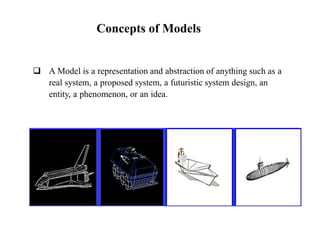
 A Model is a representation and abstraction of anything such as a
real system, a proposed system, a futuristic system design, an
entity, a phenomenon, or an idea.
Concepts of Models
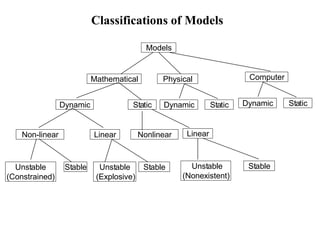
Models
Mathematical Physical
Dynamic Static Dynamic Static
Non-linear Linear Nonlinear Linear
Unstable
(Constrained)
Stable Unstable
(Nonexistent)
StableUnstable
(Explosive)
Stable
Computer
Dynamic Static
Classifications of Models
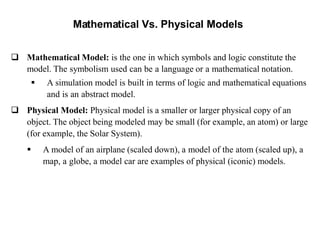
 Mathematical Model: is the one in which symbols and logic constitute the
model. The symbolism used can be a language or a mathematical notation.
 A simulation model is built in terms of logic and mathematical equations
and is an abstract model.
 Physical Model: Physical model is a smaller or larger physical copy of an
object. The object being modeled may be small (for example, an atom) or large
(for example, the Solar System).
 A model of an airplane (scaled down), a model of the atom (scaled up), a
map, a globe, a model car are examples of physical (iconic) models.
Mathematical Vs. Physical Models
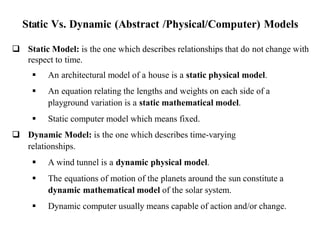
 Static Model: is the one which describes relationships that do not change with
respect to time.
 An architectural model of a house is a static physical model.
 An equation relating the lengths and weights on each side of a
playground variation is a static mathematical model.
 Static computer model which means fixed.
 Dynamic Model: is the one which describes time-varying
relationships.
 A wind tunnel is a dynamic physical model.
 The equations of motion of the planets around the sun constitute a
dynamic mathematical model of the solar system.
 Dynamic computer usually means capable of action and/or change.
Static Vs. Dynamic (Abstract /Physical/Computer) Models
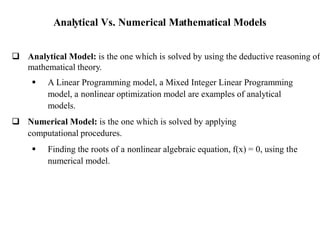
 Analytical Model: is the one which is solved by using the deductive reasoning of
mathematical theory.
 A Linear Programming model, a Mixed Integer Linear Programming
model, a nonlinear optimization model are examples of analytical
models.
 Numerical Model: is the one which is solved by applying
computational procedures.
 Finding the roots of a nonlinear algebraic equation, f(x) = 0, using the
numerical model.
Analytical Vs. Numerical Mathematical Models
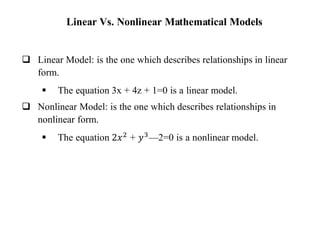
 Linear Model: is the one which describes relationships in linear
form.
 The equation 3x + 4z + 1=0 is a linear model.
 Nonlinear Model: is the one which describes relationships in
nonlinear form.
 The equation 2𝑥2 + 𝑦3—2=0 is a nonlinear model.
Linear Vs. Nonlinear Mathematical Models
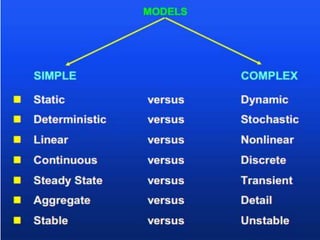
 Stable Model: is the one which tends to return to its initial condition
after being disturbed.
 Like a simple pendulum.
 Unstable Model: is the one which may or may not come back to its
initial condition after being disturbed.
Stable Or Unstable Mathematical Models
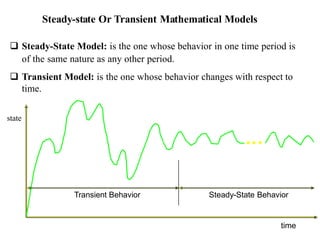
 Steady-State Model: is the one whose behavior in one time period is
of the same nature as any other period.
 Transient Model: is the one whose behavior changes with respect to
time.
time
Transient Behavior Steady-State Behavior
Steady-state Or Transient Mathematical Models
state
 Descriptive Model: a system that represent a relationship but does not
indicate any course of action.
 The equation F (force) = M (mass) x A (acceleration) is a descriptive
model.
 All simulation models are descriptive models.
 Prescriptive or Normative Model: a system in that it prescribes the course
of action that the decision maker should take to achieve a defined objective.
 Decision analysis models are prescriptive.
Descriptive Vs. Prescriptive (Normative) Models
 If the regression model includes not only the current but
also the lagged (past) values of the explanatory variables
(the X’s) it is called a distributed-lag model.
 If the model includes one or more lagged values of the
dependent variable among its explanatory variables, it is
called an autoregressive model. This model is know as a
dynamic model.
Distributed-lag Model
Cobweb Model
 It is an economic model.
 In the model of supply and demand, the price adjusts so that the quantity
supplied and quantity demand are equal.
 The equilibrium is not always clear, so that some slopes are unstable.
Thats All !
Thanks for
listening...

All types of model(Simulation & Modelling) #ShareThisIfYouLike

  • 1.
    Department of ComputerScience and Engineering Hamdard University Bangladesh All Types of Models
  • 2.
     A Modelis a representation and abstraction of anything such as a real system, a proposed system, a futuristic system design, an entity, a phenomenon, or an idea. Concepts of Models
  • 3.
    Models Mathematical Physical Dynamic StaticDynamic Static Non-linear Linear Nonlinear Linear Unstable (Constrained) Stable Unstable (Nonexistent) StableUnstable (Explosive) Stable Computer Dynamic Static Classifications of Models
  • 4.
     Mathematical Model:is the one in which symbols and logic constitute the model. The symbolism used can be a language or a mathematical notation.  A simulation model is built in terms of logic and mathematical equations and is an abstract model.  Physical Model: Physical model is a smaller or larger physical copy of an object. The object being modeled may be small (for example, an atom) or large (for example, the Solar System).  A model of an airplane (scaled down), a model of the atom (scaled up), a map, a globe, a model car are examples of physical (iconic) models. Mathematical Vs. Physical Models
  • 5.
     Static Model:is the one which describes relationships that do not change with respect to time.  An architectural model of a house is a static physical model.  An equation relating the lengths and weights on each side of a playground variation is a static mathematical model.  Static computer model which means fixed.  Dynamic Model: is the one which describes time-varying relationships.  A wind tunnel is a dynamic physical model.  The equations of motion of the planets around the sun constitute a dynamic mathematical model of the solar system.  Dynamic computer usually means capable of action and/or change. Static Vs. Dynamic (Abstract /Physical/Computer) Models
  • 6.
     Analytical Model:is the one which is solved by using the deductive reasoning of mathematical theory.  A Linear Programming model, a Mixed Integer Linear Programming model, a nonlinear optimization model are examples of analytical models.  Numerical Model: is the one which is solved by applying computational procedures.  Finding the roots of a nonlinear algebraic equation, f(x) = 0, using the numerical model. Analytical Vs. Numerical Mathematical Models
  • 7.
     Linear Model:is the one which describes relationships in linear form.  The equation 3x + 4z + 1=0 is a linear model.  Nonlinear Model: is the one which describes relationships in nonlinear form.  The equation 2𝑥2 + 𝑦3—2=0 is a nonlinear model. Linear Vs. Nonlinear Mathematical Models
  • 8.
     Stable Model:is the one which tends to return to its initial condition after being disturbed.  Like a simple pendulum.  Unstable Model: is the one which may or may not come back to its initial condition after being disturbed. Stable Or Unstable Mathematical Models
  • 9.
     Steady-State Model:is the one whose behavior in one time period is of the same nature as any other period.  Transient Model: is the one whose behavior changes with respect to time. time Transient Behavior Steady-State Behavior Steady-state Or Transient Mathematical Models state
  • 10.
     Descriptive Model:a system that represent a relationship but does not indicate any course of action.  The equation F (force) = M (mass) x A (acceleration) is a descriptive model.  All simulation models are descriptive models.  Prescriptive or Normative Model: a system in that it prescribes the course of action that the decision maker should take to achieve a defined objective.  Decision analysis models are prescriptive. Descriptive Vs. Prescriptive (Normative) Models
  • 12.
     If theregression model includes not only the current but also the lagged (past) values of the explanatory variables (the X’s) it is called a distributed-lag model.  If the model includes one or more lagged values of the dependent variable among its explanatory variables, it is called an autoregressive model. This model is know as a dynamic model. Distributed-lag Model
  • 13.
    Cobweb Model  Itis an economic model.  In the model of supply and demand, the price adjusts so that the quantity supplied and quantity demand are equal.  The equilibrium is not always clear, so that some slopes are unstable.
  • 14.
    Thats All ! Thanksfor listening...