Welcome
To
My Presentation
Presentation on
How discrete-event simulation software works and
why it matters
What is discrete-event simulation ?
A discrete-event simulation (DES) models is the operation of a system as a discrete sequence of events
in time. Each event occurs at a particular instant in time and marks a change of state in the system.
Between consecutive events, no change in the system is assumed to occur; thus the simulation can
directly jump in time from one event to the next.
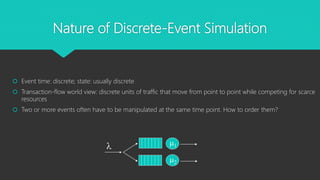
Nature of Discrete-Event Simulation
 Event time: discrete; state: usually discrete
 Transaction-flow world view: discrete units of traffic that move from point to point while competing for scarce
resources
 Two or more events often have to be manipulated at the same time point. How to order them?
m1
m2
l
Discrete-Event Modeling Languages
 There are different implementations, which aim to provide convenience for modelers.
 Arena for example, provides graphical user interface for the users to input the simulation model.
Basic Simulation Constructs
Topics includes -
 Entity – a unit of traffic
 Resources – service machine
 Control Elements – support delay or logical alternatives
 Operations - an action for an entity
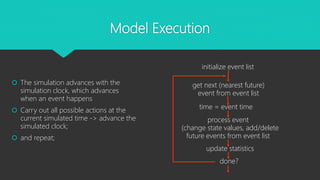
Model Execution
 The simulation advances with the
simulation clock, which advances
when an event happens
 Carry out all possible actions at the
current simulated time -> advance the
simulated clock;
 and repeat;
initialize event list
get next (nearest future)
event from event list
time = event time
process event
(change state values, add/delete
future events from event list
update statistics
done?
Entity States
 Active State: current moving state
 Ready State: ready but wait due to limited resource
 Time-Delayed State: entity waiting for a known future time so they can enter ready state
 Condition-Delayed State: remove automatically when conditions permit
 Dormant State: modelers set it
Entity Management Structure
 Active State – kept in a list
 Ready State – in current event list
 Time-Delayed State – in future event list
 Conditional-Delayed State – delay list
 Dormant State – user-managed list
 All these lists are used to store data and provide easy access to their elements
Different Implementation in Tools
 The paper together with its WSC96’ version gives 6 representative implementations.
Two examples here -
 AutoMod, version 9 (Phillips 1997)
 Siman, the core of Arena
AutoMod Language
Generic Term AutoMod Equivalent
External Entity Load
Internal Entity Logical Load
Resource Resource; Queue; Block
Control Element Counter;
Process Traffic Limit
Operation Action
Current Events List Current Event List
Future Events List Future Event List
Delay List Delay List;
Condition Delay List;
Load Ready List
User-Managed List Order List
Why It Matters
 Trying to re-capture a resource immediately
 The first in line is still delayed
 Yielding control
 Conditions involving the clock
 Mix Mode Waiting
Group Members
 Rawnat Jahan Anika [183 019 042]
 Subho Mrong [163 019 042]
Thank You!

Discrete event-simulation

  • 1.
  • 2.
    Presentation on How discrete-eventsimulation software works and why it matters
  • 3.
    What is discrete-eventsimulation ? A discrete-event simulation (DES) models is the operation of a system as a discrete sequence of events in time. Each event occurs at a particular instant in time and marks a change of state in the system. Between consecutive events, no change in the system is assumed to occur; thus the simulation can directly jump in time from one event to the next.
  • 4.
    Nature of Discrete-EventSimulation  Event time: discrete; state: usually discrete  Transaction-flow world view: discrete units of traffic that move from point to point while competing for scarce resources  Two or more events often have to be manipulated at the same time point. How to order them? m1 m2 l
  • 5.
    Discrete-Event Modeling Languages There are different implementations, which aim to provide convenience for modelers.  Arena for example, provides graphical user interface for the users to input the simulation model.
  • 6.
    Basic Simulation Constructs Topicsincludes -  Entity – a unit of traffic  Resources – service machine  Control Elements – support delay or logical alternatives  Operations - an action for an entity
  • 7.
    Model Execution  Thesimulation advances with the simulation clock, which advances when an event happens  Carry out all possible actions at the current simulated time -> advance the simulated clock;  and repeat; initialize event list get next (nearest future) event from event list time = event time process event (change state values, add/delete future events from event list update statistics done?
  • 8.
    Entity States  ActiveState: current moving state  Ready State: ready but wait due to limited resource  Time-Delayed State: entity waiting for a known future time so they can enter ready state  Condition-Delayed State: remove automatically when conditions permit  Dormant State: modelers set it
  • 9.
    Entity Management Structure Active State – kept in a list  Ready State – in current event list  Time-Delayed State – in future event list  Conditional-Delayed State – delay list  Dormant State – user-managed list  All these lists are used to store data and provide easy access to their elements
  • 10.
    Different Implementation inTools  The paper together with its WSC96’ version gives 6 representative implementations. Two examples here -  AutoMod, version 9 (Phillips 1997)  Siman, the core of Arena
  • 11.
    AutoMod Language Generic TermAutoMod Equivalent External Entity Load Internal Entity Logical Load Resource Resource; Queue; Block Control Element Counter; Process Traffic Limit Operation Action Current Events List Current Event List Future Events List Future Event List Delay List Delay List; Condition Delay List; Load Ready List User-Managed List Order List
  • 12.
    Why It Matters Trying to re-capture a resource immediately  The first in line is still delayed  Yielding control  Conditions involving the clock  Mix Mode Waiting
  • 13.
    Group Members  RawnatJahan Anika [183 019 042]  Subho Mrong [163 019 042]
  • 14.