Copyright © Osman Balci
Introduction to Modeling and Simulation
Modeling Fundamentals:
Concepts of Models and Systems
Concepts of Modeling
Classifications of Models
OSMAN BALCI
Professor
Department of Computer Science
Virginia Polytechnic Institute and State University (Virginia Tech)
Blacksburg, VA 24061, USA
https://manta.cs.vt.edu/balci
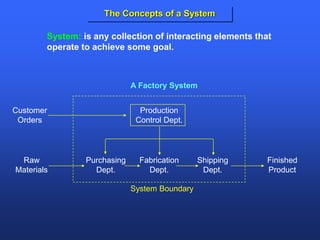
System: is any collection of interacting elements that
operate to achieve some goal.
Production
Control Dept.
Fabrication
Dept.
Purchasing
Dept.
Shipping
Dept.
Finished
Product
Customer
Orders
Raw
Materials
A Factory System
System Boundary
The Concepts of a System
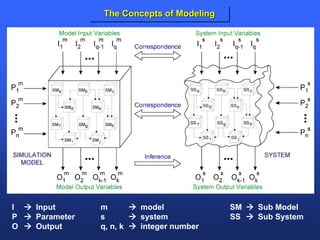
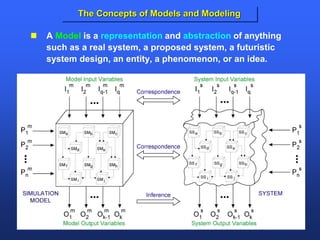
The Concepts of Modeling
I  Input
P  Parameter
O  Output
SM  Sub Model
SS  Sub System
m  model
s  system
q, n, k  integer number
Definitions
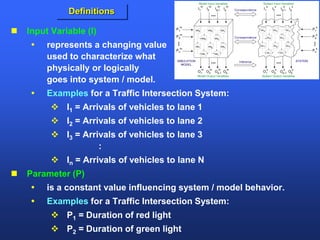
 Input Variable (I)
 represents a changing value
used to characterize what
physically or logically
goes into system / model.
 Examples for a Traffic Intersection System:
 I1 = Arrivals of vehicles to lane 1
 I2 = Arrivals of vehicles to lane 2
 I3 = Arrivals of vehicles to lane 3
:
 In = Arrivals of vehicles to lane N
 Parameter (P)
 is a constant value influencing system / model behavior.
 Examples for a Traffic Intersection System:
 P1 = Duration of red light
 P2 = Duration of green light
Definitions
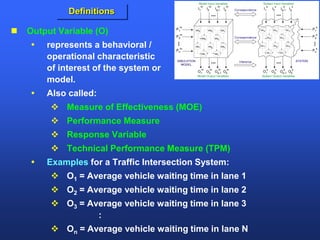
 Output Variable (O)
 represents a behavioral /
operational characteristic
of interest of the system or
model.
 Also called:
 Measure of Effectiveness (MOE)
 Performance Measure
 Response Variable
 Technical Performance Measure (TPM)
 Examples for a Traffic Intersection System:
 O1 = Average vehicle waiting time in lane 1
 O2 = Average vehicle waiting time in lane 2
 O3 = Average vehicle waiting time in lane 3
:
 On = Average vehicle waiting time in lane N
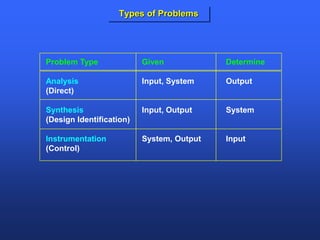
Problem Type Given Determine
Analysis Input, System Output
(Direct)
Synthesis Input, Output System
(Design Identification)
Instrumentation System, Output Input
(Control)
Types of Problems
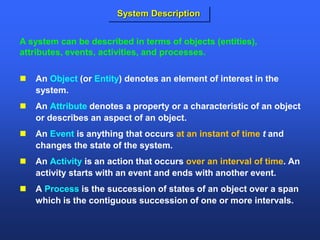
 An Object (or Entity) denotes an element of interest in the
system.
 An Attribute denotes a property or a characteristic of an object
or describes an aspect of an object.
 An Event is anything that occurs at an instant of time t and
changes the state of the system.
 An Activity is an action that occurs over an interval of time. An
activity starts with an event and ends with another event.
 A Process is the succession of states of an object over a span
which is the contiguous succession of one or more intervals.
A system can be described in terms of objects (entities),
attributes, events, activities, and processes.
System Description
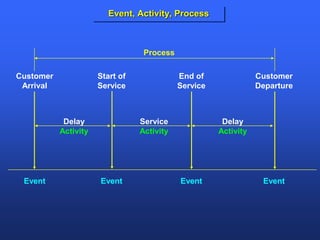
Customer
Arrival
Start of
Service
End of
Service
Customer
Departure
Event Event Event Event
Delay
Activity
Service
Activity
Delay
Activity
Process
Event, Activity, Process
 The State of an Object is the enumeration of all attribute
values of that object at a particular instant of time.
 The State of a System is the exhaustive enumeration of all
attribute values (of all objects) at a particular instant of
time.
State
 Endogenous Activity: is produced within the system
resulting from internal causes.
 Exogenous Activity: is produced within the system
environment and affects the system. Exogenous activities
are inputs to a system.
 Deterministic Activity: is an activity the outcome of which
can be described completely in terms of its input.
 Stochastic Activity: is an activity the outcome of which
varies randomly.
Activity Types
 Open System: is a system which has exogenous
activities.
 Closed System: is a system which has no inputs
(exogenous activities) and no outputs.
 Continuous System: is a system in which the changes
are predominantly smooth such as a missile system.
 Discrete System: is a system in which the changes are
predominantly discontinuous such as a factory
system.
 Adaptive System: is a system which reacts to changes
in its environment.
 Nonadaptive System: is a system which does not
react to changes in its environment.
System Types
 A Model is a representation and abstraction of anything
such as a real system, a proposed system, a futuristic
system design, an entity, a phenomenon, or an idea.
The Concepts of Models and Modeling
Art of Modeling
 Modeling is an artful balancing of opposites;
Art of Modeling
 on the one hand, a model should not contain unnecessary details
and become needlessly complex and difficult to analyze,
Art of Modeling
 on the other hand, it should not exclude the
essential details of what it represents.
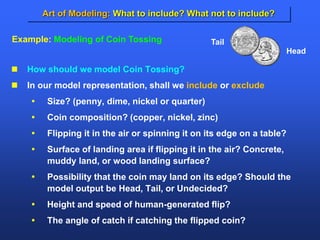
Art of Modeling: What to include? What not to include?
 How should we model Coin Tossing?
 In our model representation, shall we include or exclude
 Size? (penny, dime, nickel or quarter)
 Coin composition? (copper, nickel, zinc)
 Flipping it in the air or spinning it on its edge on a table?
 Surface of landing area if flipping it in the air? Concrete,
muddy land, or wood landing surface?
 Possibility that the coin may land on its edge? Should the
model output be Head, Tail, or Undecided?
 Height and speed of human-generated flip?
 The angle of catch if catching the flipped coin?
Tail
Head
Example: Modeling of Coin Tossing
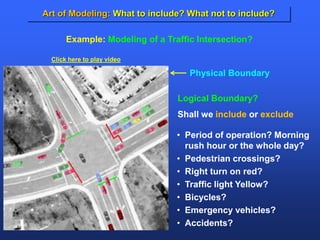
Art of Modeling: What to include? What not to include?
Example: Modeling of a Traffic Intersection?
Physical Boundary
Logical Boundary?
Shall we include or exclude
• Period of operation? Morning
rush hour or the whole day?
• Pedestrian crossings?
• Right turn on red?
• Traffic light Yellow?
• Bicycles?
• Emergency vehicles?
• Accidents?
Click here to play video
Fundamentals of Modeling
 Successfully accomplishing the artful balancing of
opposites requires significant experience and
knowledge not only in M&S, but also in the problem
domain.
 In modeling studies, it is well to remember the dictum
“nobody solves the problem; rather, everybody solves
the model that he or she has constructed of the
problem.” Hence, if the model does not represent the
problem with sufficient accuracy, the modeling
exercise turns itself into
 “junk-input junk-output” or “garbage-in garbage-out”.
 We never build a perfect model. A model is built for a
specific purpose and its accuracy is judged with
respect to that purpose.
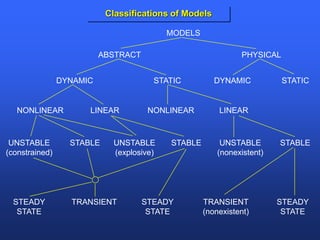
MODELS
ABSTRACT PHYSICAL
DYNAMIC STATIC DYNAMIC STATIC
NONLINEAR LINEAR NONLINEAR LINEAR
UNSTABLE
(constrained)
STABLE UNSTABLE
(nonexistent)
STABLE
STEADY
STATE
TRANSIENT STEADY
STATE
TRANSIENT
(nonexistent)
STEADY
STATE
UNSTABLE
(explosive)
STABLE
Classifications of Models
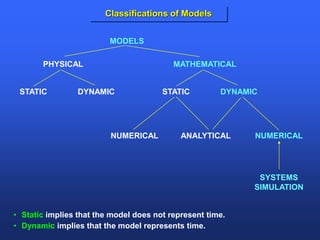
MODELS
PHYSICAL MATHEMATICAL
STATIC DYNAMIC
STATIC DYNAMIC
ANALYTICAL NUMERICAL
NUMERICAL
SYSTEMS
SIMULATION
Classifications of Models
• Static implies that the model does not represent time.
• Dynamic implies that the model represents time.
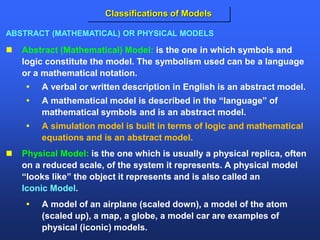
 Abstract (Mathematical) Model: is the one in which symbols and
logic constitute the model. The symbolism used can be a language
or a mathematical notation.
 A verbal or written description in English is an abstract model.
 A mathematical model is described in the “language” of
mathematical symbols and is an abstract model.
 A simulation model is built in terms of logic and mathematical
equations and is an abstract model.
 Physical Model: is the one which is usually a physical replica, often
on a reduced scale, of the system it represents. A physical model
“looks like” the object it represents and is also called an
Iconic Model.
 A model of an airplane (scaled down), a model of the atom
(scaled up), a map, a globe, a model car are examples of
physical (iconic) models.
ABSTRACT (MATHEMATICAL) OR PHYSICAL MODELS
Classifications of Models
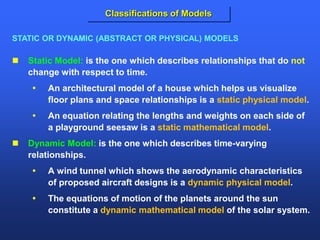
 Static Model: is the one which describes relationships that do not
change with respect to time.
 An architectural model of a house which helps us visualize
floor plans and space relationships is a static physical model.
 An equation relating the lengths and weights on each side of
a playground seesaw is a static mathematical model.
 Dynamic Model: is the one which describes time-varying
relationships.
 A wind tunnel which shows the aerodynamic characteristics
of proposed aircraft designs is a dynamic physical model.
 The equations of motion of the planets around the sun
constitute a dynamic mathematical model of the solar system.
STATIC OR DYNAMIC (ABSTRACT OR PHYSICAL) MODELS
Classifications of Models
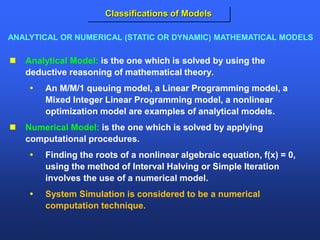
 Analytical Model: is the one which is solved by using the
deductive reasoning of mathematical theory.
 An M/M/1 queuing model, a Linear Programming model, a
Mixed Integer Linear Programming model, a nonlinear
optimization model are examples of analytical models.
 Numerical Model: is the one which is solved by applying
computational procedures.
 Finding the roots of a nonlinear algebraic equation, f(x) = 0,
using the method of Interval Halving or Simple Iteration
involves the use of a numerical model.
 System Simulation is considered to be a numerical
computation technique.
ANALYTICAL OR NUMERICAL (STATIC OR DYNAMIC) MATHEMATICAL MODELS
Classifications of Models
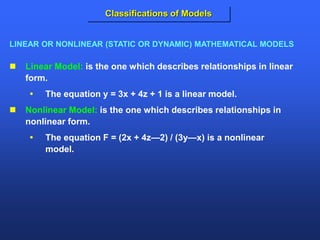
 Linear Model: is the one which describes relationships in linear
form.
 The equation y = 3x + 4z + 1 is a linear model.
 Nonlinear Model: is the one which describes relationships in
nonlinear form.
 The equation F = (2x + 4z—2) / (3y—x) is a nonlinear
model.
LINEAR OR NONLINEAR (STATIC OR DYNAMIC) MATHEMATICAL MODELS
Classifications of Models
 Stable Model: is the one which tends to return to its initial
condition after being disturbed.
 Like a simple pendulum that is set in motion, it may overshoot
and oscillate, but the disturbances decline and die out.
 Unstable Model: is the one which may or may not come back to its
initial condition after being disturbed.
STABLE OR UNSTABLE MATHEMATICAL MODELS
Classifications of Models
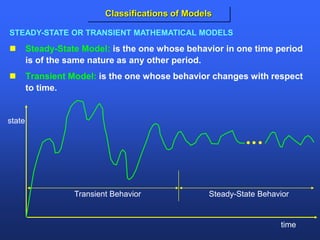
 Steady-State Model: is the one whose behavior in one time period
is of the same nature as any other period.
 Transient Model: is the one whose behavior changes with respect
to time.
STEADY-STATE OR TRANSIENT MATHEMATICAL MODELS
state
time
Transient Behavior Steady-State Behavior
Classifications of Models
 Descriptive Model: is a model which describes the behavior of a
system without any value judgment on the “goodness” or
“badness” of such behavior.
 The equation F (orce) = M (ass) x A (cceleration) is a
descriptive model.
 All simulation models are descriptive models.
 Prescriptive or Normative Model: is a model which describes the
behavior of a system with a value judgment on the “goodness” or
“badness” of such behavior.
 A Linear Programming model, a Mixed Integer Linear
Programming model and a nonlinear optimization model are
examples of prescriptive models. When solved, these models
provide a description of the solution as optimal, suboptimal,
feasible, infeasible, etc.
DESCRIPTIVE OR PRESCRIPTIVE (NORMATIVE) MODELS
Classifications of Models
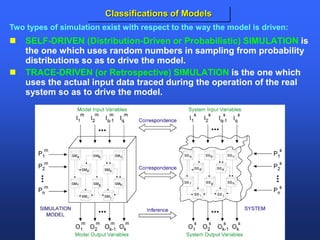
 SELF-DRIVEN (Distribution-Driven or Probabilistic) SIMULATION is
the one which uses random numbers in sampling from probability
distributions so as to drive the model.
 TRACE-DRIVEN (or Retrospective) SIMULATION is the one which
uses the actual input data traced during the operation of the real
system so as to drive the model.
Two types of simulation exist with respect to the way the model is driven:
Classifications of Models
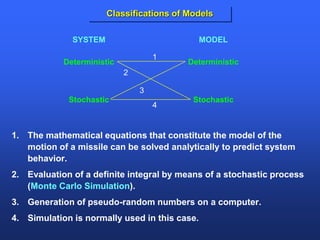
1. The mathematical equations that constitute the model of the
motion of a missile can be solved analytically to predict system
behavior.
2. Evaluation of a definite integral by means of a stochastic process
(Monte Carlo Simulation).
3. Generation of pseudo-random numbers on a computer.
4. Simulation is normally used in this case.
SYSTEM MODEL
Deterministic
Stochastic
Deterministic
Stochastic
1
2
3
4
Classifications of Models
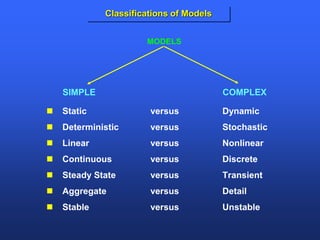
 Static versus Dynamic
 Deterministic versus Stochastic
 Linear versus Nonlinear
 Continuous versus Discrete
 Steady State versus Transient
 Aggregate versus Detail
 Stable versus Unstable
MODELS
SIMPLE COMPLEX
Classifications of Models

BalciSlides-02-ModelingFundamentals.pdf which says about modeling

  • 1.
    Copyright © OsmanBalci Introduction to Modeling and Simulation Modeling Fundamentals: Concepts of Models and Systems Concepts of Modeling Classifications of Models OSMAN BALCI Professor Department of Computer Science Virginia Polytechnic Institute and State University (Virginia Tech) Blacksburg, VA 24061, USA https://manta.cs.vt.edu/balci
  • 2.
    System: is anycollection of interacting elements that operate to achieve some goal. Production Control Dept. Fabrication Dept. Purchasing Dept. Shipping Dept. Finished Product Customer Orders Raw Materials A Factory System System Boundary The Concepts of a System
  • 3.
    The Concepts ofModeling I  Input P  Parameter O  Output SM  Sub Model SS  Sub System m  model s  system q, n, k  integer number
  • 4.
    Definitions  Input Variable(I)  represents a changing value used to characterize what physically or logically goes into system / model.  Examples for a Traffic Intersection System:  I1 = Arrivals of vehicles to lane 1  I2 = Arrivals of vehicles to lane 2  I3 = Arrivals of vehicles to lane 3 :  In = Arrivals of vehicles to lane N  Parameter (P)  is a constant value influencing system / model behavior.  Examples for a Traffic Intersection System:  P1 = Duration of red light  P2 = Duration of green light
  • 5.
    Definitions  Output Variable(O)  represents a behavioral / operational characteristic of interest of the system or model.  Also called:  Measure of Effectiveness (MOE)  Performance Measure  Response Variable  Technical Performance Measure (TPM)  Examples for a Traffic Intersection System:  O1 = Average vehicle waiting time in lane 1  O2 = Average vehicle waiting time in lane 2  O3 = Average vehicle waiting time in lane 3 :  On = Average vehicle waiting time in lane N
  • 6.
    Problem Type GivenDetermine Analysis Input, System Output (Direct) Synthesis Input, Output System (Design Identification) Instrumentation System, Output Input (Control) Types of Problems
  • 7.
     An Object(or Entity) denotes an element of interest in the system.  An Attribute denotes a property or a characteristic of an object or describes an aspect of an object.  An Event is anything that occurs at an instant of time t and changes the state of the system.  An Activity is an action that occurs over an interval of time. An activity starts with an event and ends with another event.  A Process is the succession of states of an object over a span which is the contiguous succession of one or more intervals. A system can be described in terms of objects (entities), attributes, events, activities, and processes. System Description
  • 8.
    Customer Arrival Start of Service End of Service Customer Departure EventEvent Event Event Delay Activity Service Activity Delay Activity Process Event, Activity, Process
  • 9.
     The Stateof an Object is the enumeration of all attribute values of that object at a particular instant of time.  The State of a System is the exhaustive enumeration of all attribute values (of all objects) at a particular instant of time. State
  • 10.
     Endogenous Activity:is produced within the system resulting from internal causes.  Exogenous Activity: is produced within the system environment and affects the system. Exogenous activities are inputs to a system.  Deterministic Activity: is an activity the outcome of which can be described completely in terms of its input.  Stochastic Activity: is an activity the outcome of which varies randomly. Activity Types
  • 11.
     Open System:is a system which has exogenous activities.  Closed System: is a system which has no inputs (exogenous activities) and no outputs.  Continuous System: is a system in which the changes are predominantly smooth such as a missile system.  Discrete System: is a system in which the changes are predominantly discontinuous such as a factory system.  Adaptive System: is a system which reacts to changes in its environment.  Nonadaptive System: is a system which does not react to changes in its environment. System Types
  • 12.
     A Modelis a representation and abstraction of anything such as a real system, a proposed system, a futuristic system design, an entity, a phenomenon, or an idea. The Concepts of Models and Modeling
  • 13.
    Art of Modeling Modeling is an artful balancing of opposites;
  • 14.
    Art of Modeling on the one hand, a model should not contain unnecessary details and become needlessly complex and difficult to analyze,
  • 15.
    Art of Modeling on the other hand, it should not exclude the essential details of what it represents.
  • 16.
    Art of Modeling:What to include? What not to include?  How should we model Coin Tossing?  In our model representation, shall we include or exclude  Size? (penny, dime, nickel or quarter)  Coin composition? (copper, nickel, zinc)  Flipping it in the air or spinning it on its edge on a table?  Surface of landing area if flipping it in the air? Concrete, muddy land, or wood landing surface?  Possibility that the coin may land on its edge? Should the model output be Head, Tail, or Undecided?  Height and speed of human-generated flip?  The angle of catch if catching the flipped coin? Tail Head Example: Modeling of Coin Tossing
  • 17.
    Art of Modeling:What to include? What not to include? Example: Modeling of a Traffic Intersection? Physical Boundary Logical Boundary? Shall we include or exclude • Period of operation? Morning rush hour or the whole day? • Pedestrian crossings? • Right turn on red? • Traffic light Yellow? • Bicycles? • Emergency vehicles? • Accidents? Click here to play video
  • 18.
    Fundamentals of Modeling Successfully accomplishing the artful balancing of opposites requires significant experience and knowledge not only in M&S, but also in the problem domain.  In modeling studies, it is well to remember the dictum “nobody solves the problem; rather, everybody solves the model that he or she has constructed of the problem.” Hence, if the model does not represent the problem with sufficient accuracy, the modeling exercise turns itself into  “junk-input junk-output” or “garbage-in garbage-out”.  We never build a perfect model. A model is built for a specific purpose and its accuracy is judged with respect to that purpose.
  • 19.
    MODELS ABSTRACT PHYSICAL DYNAMIC STATICDYNAMIC STATIC NONLINEAR LINEAR NONLINEAR LINEAR UNSTABLE (constrained) STABLE UNSTABLE (nonexistent) STABLE STEADY STATE TRANSIENT STEADY STATE TRANSIENT (nonexistent) STEADY STATE UNSTABLE (explosive) STABLE Classifications of Models
  • 20.
    MODELS PHYSICAL MATHEMATICAL STATIC DYNAMIC STATICDYNAMIC ANALYTICAL NUMERICAL NUMERICAL SYSTEMS SIMULATION Classifications of Models • Static implies that the model does not represent time. • Dynamic implies that the model represents time.
  • 21.
     Abstract (Mathematical)Model: is the one in which symbols and logic constitute the model. The symbolism used can be a language or a mathematical notation.  A verbal or written description in English is an abstract model.  A mathematical model is described in the “language” of mathematical symbols and is an abstract model.  A simulation model is built in terms of logic and mathematical equations and is an abstract model.  Physical Model: is the one which is usually a physical replica, often on a reduced scale, of the system it represents. A physical model “looks like” the object it represents and is also called an Iconic Model.  A model of an airplane (scaled down), a model of the atom (scaled up), a map, a globe, a model car are examples of physical (iconic) models. ABSTRACT (MATHEMATICAL) OR PHYSICAL MODELS Classifications of Models
  • 22.
     Static Model:is the one which describes relationships that do not change with respect to time.  An architectural model of a house which helps us visualize floor plans and space relationships is a static physical model.  An equation relating the lengths and weights on each side of a playground seesaw is a static mathematical model.  Dynamic Model: is the one which describes time-varying relationships.  A wind tunnel which shows the aerodynamic characteristics of proposed aircraft designs is a dynamic physical model.  The equations of motion of the planets around the sun constitute a dynamic mathematical model of the solar system. STATIC OR DYNAMIC (ABSTRACT OR PHYSICAL) MODELS Classifications of Models
  • 23.
     Analytical Model:is the one which is solved by using the deductive reasoning of mathematical theory.  An M/M/1 queuing model, a Linear Programming model, a Mixed Integer Linear Programming model, a nonlinear optimization model are examples of analytical models.  Numerical Model: is the one which is solved by applying computational procedures.  Finding the roots of a nonlinear algebraic equation, f(x) = 0, using the method of Interval Halving or Simple Iteration involves the use of a numerical model.  System Simulation is considered to be a numerical computation technique. ANALYTICAL OR NUMERICAL (STATIC OR DYNAMIC) MATHEMATICAL MODELS Classifications of Models
  • 24.
     Linear Model:is the one which describes relationships in linear form.  The equation y = 3x + 4z + 1 is a linear model.  Nonlinear Model: is the one which describes relationships in nonlinear form.  The equation F = (2x + 4z—2) / (3y—x) is a nonlinear model. LINEAR OR NONLINEAR (STATIC OR DYNAMIC) MATHEMATICAL MODELS Classifications of Models
  • 25.
     Stable Model:is the one which tends to return to its initial condition after being disturbed.  Like a simple pendulum that is set in motion, it may overshoot and oscillate, but the disturbances decline and die out.  Unstable Model: is the one which may or may not come back to its initial condition after being disturbed. STABLE OR UNSTABLE MATHEMATICAL MODELS Classifications of Models
  • 26.
     Steady-State Model:is the one whose behavior in one time period is of the same nature as any other period.  Transient Model: is the one whose behavior changes with respect to time. STEADY-STATE OR TRANSIENT MATHEMATICAL MODELS state time Transient Behavior Steady-State Behavior Classifications of Models
  • 27.
     Descriptive Model:is a model which describes the behavior of a system without any value judgment on the “goodness” or “badness” of such behavior.  The equation F (orce) = M (ass) x A (cceleration) is a descriptive model.  All simulation models are descriptive models.  Prescriptive or Normative Model: is a model which describes the behavior of a system with a value judgment on the “goodness” or “badness” of such behavior.  A Linear Programming model, a Mixed Integer Linear Programming model and a nonlinear optimization model are examples of prescriptive models. When solved, these models provide a description of the solution as optimal, suboptimal, feasible, infeasible, etc. DESCRIPTIVE OR PRESCRIPTIVE (NORMATIVE) MODELS Classifications of Models
  • 28.
     SELF-DRIVEN (Distribution-Drivenor Probabilistic) SIMULATION is the one which uses random numbers in sampling from probability distributions so as to drive the model.  TRACE-DRIVEN (or Retrospective) SIMULATION is the one which uses the actual input data traced during the operation of the real system so as to drive the model. Two types of simulation exist with respect to the way the model is driven: Classifications of Models
  • 29.
    1. The mathematicalequations that constitute the model of the motion of a missile can be solved analytically to predict system behavior. 2. Evaluation of a definite integral by means of a stochastic process (Monte Carlo Simulation). 3. Generation of pseudo-random numbers on a computer. 4. Simulation is normally used in this case. SYSTEM MODEL Deterministic Stochastic Deterministic Stochastic 1 2 3 4 Classifications of Models
  • 30.
     Static versusDynamic  Deterministic versus Stochastic  Linear versus Nonlinear  Continuous versus Discrete  Steady State versus Transient  Aggregate versus Detail  Stable versus Unstable MODELS SIMPLE COMPLEX Classifications of Models