PORIFERA
General characteristics:
 -They feed through pores on their outer walls.
 -Cells are not organised to tissues or organs.
 - Different cells perform different functions.
 -They are both asexual and sexual.
 -Their skeleton is made up of collagen and
spicules.
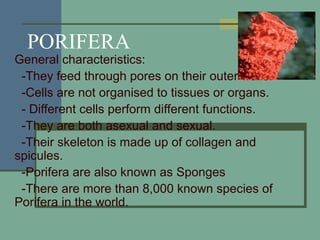
 -Porifera are also known as Sponges
 -There are more than 8,000 known species of
Porifera in the world.
 Classification of porifera:
      There are about 5,000 species of sponge, mostly marine and few freshwater
         species. In sea they occur up to a depth of 8,500 m and mostly flourish in warm
         waters. Size can vary from a few cm to several metres. The body shape is highly
         variable.


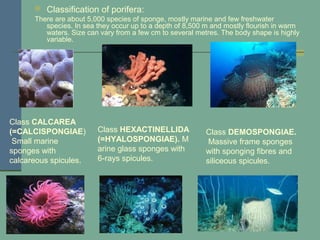
Class CALCAREA
(=CALCISPONGIAE)         Class HEXACTINELLIDA              Class DEMOSPONGIAE.
 Small marine            (=HYALOSPONGIAE). M                Massive frame sponges
sponges with             arine glass sponges with          with sponging fibres and
calcareous spicules.     6-rays spicules.                  siliceous spicules.
CNIDARIA
 General characteristics:

    - All Cnidaria are armed with stinging cells called nematocysts.

    - There are four major groups of Cnidaria: Anthozoa, Cubozoa, Hydrozoa, and
   Scyphozoa.

    -They have radial symmetry.

    - At some point in their lives they develop a medusa and a polyp stage.

    -Medusa- a free-swimming bell, shaped stage, with tentacles extending below the bell.

    -Polyp- Vase shaped, sedentary stage of Cnidarian life cycle.

   -They have a gastrovascular cavity that serves as a mouth for eating prey and as an anus.

   -They are free-swimming and floating at different stages in their life.
 Classification of cnidaria:

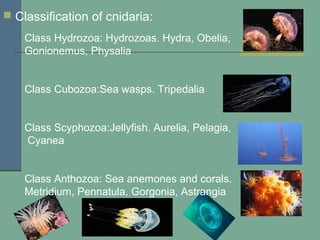
    Class Hydrozoa: Hydrozoas. Hydra, Obelia,
    Gonionemus, Physalia


    Class Cubozoa:Sea wasps. Tripedalia


    Class Scyphozoa:Jellyfish. Aurelia, Pelagia,
    Cyanea


    Class Anthozoa: Sea anemones and corals.
    Metridium, Pennatula, Gorgonia, Astrangia
By:
Lizaveta Ramanouskaya
Cristina Gómez Herrero
By:
Lizaveta Ramanouskaya
Cristina Gómez Herrero

Porifera

  • 1.
    PORIFERA General characteristics: -Theyfeed through pores on their outer walls. -Cells are not organised to tissues or organs. - Different cells perform different functions. -They are both asexual and sexual. -Their skeleton is made up of collagen and spicules. -Porifera are also known as Sponges -There are more than 8,000 known species of Porifera in the world.
  • 2.
     Classification ofporifera: There are about 5,000 species of sponge, mostly marine and few freshwater species. In sea they occur up to a depth of 8,500 m and mostly flourish in warm waters. Size can vary from a few cm to several metres. The body shape is highly variable. Class CALCAREA (=CALCISPONGIAE) Class HEXACTINELLIDA Class DEMOSPONGIAE. Small marine (=HYALOSPONGIAE). M Massive frame sponges sponges with arine glass sponges with with sponging fibres and calcareous spicules. 6-rays spicules. siliceous spicules.
  • 3.
    CNIDARIA  General characteristics: - All Cnidaria are armed with stinging cells called nematocysts. - There are four major groups of Cnidaria: Anthozoa, Cubozoa, Hydrozoa, and Scyphozoa. -They have radial symmetry. - At some point in their lives they develop a medusa and a polyp stage. -Medusa- a free-swimming bell, shaped stage, with tentacles extending below the bell. -Polyp- Vase shaped, sedentary stage of Cnidarian life cycle. -They have a gastrovascular cavity that serves as a mouth for eating prey and as an anus. -They are free-swimming and floating at different stages in their life.
  • 4.
     Classification ofcnidaria: Class Hydrozoa: Hydrozoas. Hydra, Obelia, Gonionemus, Physalia Class Cubozoa:Sea wasps. Tripedalia Class Scyphozoa:Jellyfish. Aurelia, Pelagia, Cyanea Class Anthozoa: Sea anemones and corals. Metridium, Pennatula, Gorgonia, Astrangia
  • 5.
  • 6.