HETEROCYST
DIFFERENTIATION
PRESENTED BY
SWEKSHA SINGH
M.SC BOTANY
1ST SEMESTER
© 2009 Killpack Group All Rights Reserved
OVERVIEW
 Characteristic feature of cynobacteria.
 Heterocyst
 Types of Nitrogen fixing cyno
bacteria
 Akinete
 Heterocyst differentiation in
cynobacteria (Blue green algae)
© 2009 Killpack Group All Rights Reserved
CHARACTERISTICS FEATURE
OF CYNOBACTERIA.
 Cynobacteria are photosynthetic ,gram negative
prokaryotes.
 Cynobacteria differ from photosynthetic bacteria in
that the photosynthesis of cynobacteria result in
release of oxygen derived from the splitting of
water molecule in manner very similar to
eukaryotic algae and higher plant.
 Cynobacteria produce unique structure, called
heterocyst which function as the site for nitrogen
fixation.
© 2009 Killpack Group All Rights Reserved
HETEROCYST
 Heterocyst are differentiated cell that are specialized
for fixation of nitrogen in an aerobic environment.
 In heterocyst in the light photosystem 1generated
ATP, but no production of O2 take place .
 The reductant move into heterocyst from vegetative
cell, in return fixed nitrogen move from heterocyst to
vegetative cell.
© 2009 Killpack Group All Rights Reserved
 Nitrogenase in the heterocyst is protected from
inactivation by O2 by a variety of means, by
enhancing respiration and by barring, the
heterocyst envelope.
 In order to avoid inactivation of nitrogenase by
oxygen ,heterocyst stops synthesizing oxygen and
limit the entry of that gas, presumably because the
vander waal radii of nitrogen and oxygen are
similar 1.5A and 1.4A.
© 2009 Killpack Group All Rights Reserved
NITROGEN
FIXATION
 Cynobacteria are truly autotropic in nature that they
can fix not only CO2 but also gaseous nitrogen.
 Cynobacteria which can fix nitrogen can be broadly
.
© 2009 Killpack Group All Rights Reserved
CLASSIFICATION
 Type 1 ,
include unicellular form such as Aphanothece and
Gloeocapsa which can fix nitrgen both in aerobic
and anaerobic (microaerophilic) condition.
 Type 2,
include nonheterocystous filamentous form , such as
Oscillatoria , which can fix it only under anaerobic
condition .
 Type 3,
the most important group , contain many heterocystous
fillamentous form which can fix nitrogen both
aerobically and anaerobically
© 2009 Killpack Group All Rights Reserved
AKINETE
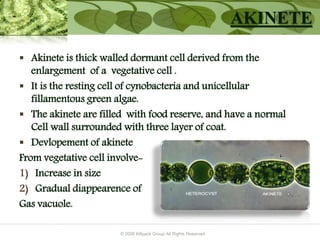
 Akinete is thick walled dormant cell derived from the
enlargement of a vegetative cell .
 It is the resting cell of cynobacteria and unicellular
fillamentous green algae.
 The akinete are filled with food reserve, and have a normal
Cell wall surrounded with three layer of coat.
 Devlopement of akinete
From vegetative cell involve-
1) Increase in size
2) Gradual diappearence of
Gas vacuole.
© 2009 Killpack Group All Rights Reserved
Introduction - Heterocyst
Differentiation
 Important reasons for differentiation:
 Adaption to environmental conditions
 Expressing different functions at different times in the life cycle
 Thus differentiation can be triggered by:
 Environmental signal
 The specialized cell types is the outcome of complex regulatory
pathways:
 Altered gene expression
 differential protein stability
 differential protein localization
© 2009 Killpack Group All Rights Reserved
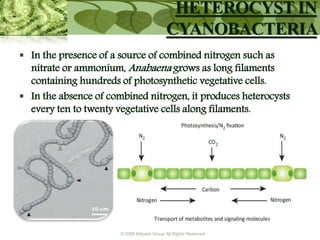
 In the presence of a source of combined nitrogen such as
nitrate or ammonium, Anabaena grows as long filaments
containing hundreds of photosynthetic vegetative cells.
 In the absence of combined nitrogen, it produces heterocysts
every ten to twenty vegetative cells along filaments.
HETEROCYST IN
CYANOBACTERIA
© 2009 Killpack Group All Rights Reserved
 Oxygen-producing photosystem PSII is dismantled during
differentiation and heterocysts devlopement.
 Morphological changes include the deposition of two additional
envelope layers around the heterocyst: an inner “laminated” layer
composed of two heterocyst specific glycolipids (HGL)and an
outer polysaccharide layer (HEP).
 Heterocysts and vegetative cells are mutually interdependent.
Because they lack photosystem II and carbon fixation, heterocysts
are dependent on vegetative cells for a source of reductant and
carbon, which is probably partially supplied as sucrose.
HETEROCYST IN
ANABAENA
© 2009 Killpack Group All Rights Reserved
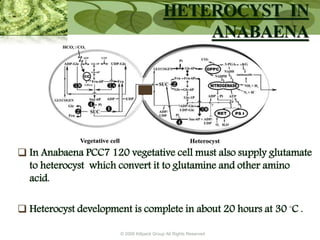
 In Anabaena PCC7 120 vegetative cell must also supply glutamate
to heterocyst which convert it to glutamine and other amino
acid.
 Heterocyst development is complete in about 20 hours at 30 ◦C .
HETEROCYST IN
ANABAENA
© 2009 Killpack Group All Rights Reserved
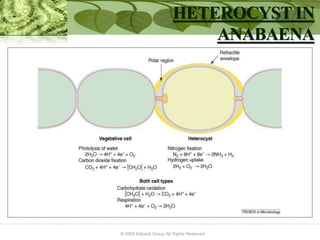
HETEROCYST IN
ANABAENA
© 2009 Killpack Group All Rights Reserved
In cyanobacteria, 2-oxoglutarate, an intermediate in
the Krebs cycle, constitutes the signal for nitrogen
deprivation.
The Krebs cycle in cyanobacteria is incomplete because
of the lack of 2-oxoglutarate dehydrogenase  2-
oxoglutarate’s main function is to serve as a precursor
in a variety of biosynthetic reactions. It is the primary
carbon skeleton for incorporation of ammonium and is
considered the metabolic junction between carbon and
nitrogen balance in cyanobacteria.
HETEROCYST IN
ANABAENA
© 2009 Killpack Group All Rights Reserved
Nitrogen limiting conditions result in an increase in
the levels of 2-oxoglutarate.
NtcA, a transcriptional regulator belonging to the CRP
(cyclic AMP receptor protein) family of proteins, senses
2-oxoglutarate levels.
In Anabaena PCC 7120, NtcA is required for the
expression of the genes in pathways for ammonium and
nitrate assimilation, as well as heterocyst development.

Het R is the master regulator of heterocyst
devlopement and play a key role in differentiation
Heterocyst  differentiation

Heterocyst differentiation

  • 1.
  • 2.
    © 2009 KillpackGroup All Rights Reserved OVERVIEW  Characteristic feature of cynobacteria.  Heterocyst  Types of Nitrogen fixing cyno bacteria  Akinete  Heterocyst differentiation in cynobacteria (Blue green algae)
  • 3.
    © 2009 KillpackGroup All Rights Reserved CHARACTERISTICS FEATURE OF CYNOBACTERIA.  Cynobacteria are photosynthetic ,gram negative prokaryotes.  Cynobacteria differ from photosynthetic bacteria in that the photosynthesis of cynobacteria result in release of oxygen derived from the splitting of water molecule in manner very similar to eukaryotic algae and higher plant.  Cynobacteria produce unique structure, called heterocyst which function as the site for nitrogen fixation.
  • 4.
    © 2009 KillpackGroup All Rights Reserved HETEROCYST  Heterocyst are differentiated cell that are specialized for fixation of nitrogen in an aerobic environment.  In heterocyst in the light photosystem 1generated ATP, but no production of O2 take place .  The reductant move into heterocyst from vegetative cell, in return fixed nitrogen move from heterocyst to vegetative cell.
  • 5.
    © 2009 KillpackGroup All Rights Reserved  Nitrogenase in the heterocyst is protected from inactivation by O2 by a variety of means, by enhancing respiration and by barring, the heterocyst envelope.  In order to avoid inactivation of nitrogenase by oxygen ,heterocyst stops synthesizing oxygen and limit the entry of that gas, presumably because the vander waal radii of nitrogen and oxygen are similar 1.5A and 1.4A.
  • 6.
    © 2009 KillpackGroup All Rights Reserved NITROGEN FIXATION  Cynobacteria are truly autotropic in nature that they can fix not only CO2 but also gaseous nitrogen.  Cynobacteria which can fix nitrogen can be broadly .
  • 7.
    © 2009 KillpackGroup All Rights Reserved CLASSIFICATION  Type 1 , include unicellular form such as Aphanothece and Gloeocapsa which can fix nitrgen both in aerobic and anaerobic (microaerophilic) condition.  Type 2, include nonheterocystous filamentous form , such as Oscillatoria , which can fix it only under anaerobic condition .  Type 3, the most important group , contain many heterocystous fillamentous form which can fix nitrogen both aerobically and anaerobically
  • 8.
    © 2009 KillpackGroup All Rights Reserved AKINETE  Akinete is thick walled dormant cell derived from the enlargement of a vegetative cell .  It is the resting cell of cynobacteria and unicellular fillamentous green algae.  The akinete are filled with food reserve, and have a normal Cell wall surrounded with three layer of coat.  Devlopement of akinete From vegetative cell involve- 1) Increase in size 2) Gradual diappearence of Gas vacuole.
  • 9.
    © 2009 KillpackGroup All Rights Reserved Introduction - Heterocyst Differentiation  Important reasons for differentiation:  Adaption to environmental conditions  Expressing different functions at different times in the life cycle  Thus differentiation can be triggered by:  Environmental signal  The specialized cell types is the outcome of complex regulatory pathways:  Altered gene expression  differential protein stability  differential protein localization
  • 10.
    © 2009 KillpackGroup All Rights Reserved  In the presence of a source of combined nitrogen such as nitrate or ammonium, Anabaena grows as long filaments containing hundreds of photosynthetic vegetative cells.  In the absence of combined nitrogen, it produces heterocysts every ten to twenty vegetative cells along filaments. HETEROCYST IN CYANOBACTERIA
  • 11.
    © 2009 KillpackGroup All Rights Reserved  Oxygen-producing photosystem PSII is dismantled during differentiation and heterocysts devlopement.  Morphological changes include the deposition of two additional envelope layers around the heterocyst: an inner “laminated” layer composed of two heterocyst specific glycolipids (HGL)and an outer polysaccharide layer (HEP).  Heterocysts and vegetative cells are mutually interdependent. Because they lack photosystem II and carbon fixation, heterocysts are dependent on vegetative cells for a source of reductant and carbon, which is probably partially supplied as sucrose. HETEROCYST IN ANABAENA
  • 12.
    © 2009 KillpackGroup All Rights Reserved  In Anabaena PCC7 120 vegetative cell must also supply glutamate to heterocyst which convert it to glutamine and other amino acid.  Heterocyst development is complete in about 20 hours at 30 ◦C . HETEROCYST IN ANABAENA
  • 13.
    © 2009 KillpackGroup All Rights Reserved HETEROCYST IN ANABAENA
  • 14.
    © 2009 KillpackGroup All Rights Reserved In cyanobacteria, 2-oxoglutarate, an intermediate in the Krebs cycle, constitutes the signal for nitrogen deprivation. The Krebs cycle in cyanobacteria is incomplete because of the lack of 2-oxoglutarate dehydrogenase  2- oxoglutarate’s main function is to serve as a precursor in a variety of biosynthetic reactions. It is the primary carbon skeleton for incorporation of ammonium and is considered the metabolic junction between carbon and nitrogen balance in cyanobacteria. HETEROCYST IN ANABAENA
  • 15.
    © 2009 KillpackGroup All Rights Reserved Nitrogen limiting conditions result in an increase in the levels of 2-oxoglutarate. NtcA, a transcriptional regulator belonging to the CRP (cyclic AMP receptor protein) family of proteins, senses 2-oxoglutarate levels. In Anabaena PCC 7120, NtcA is required for the expression of the genes in pathways for ammonium and nitrate assimilation, as well as heterocyst development. Het R is the master regulator of heterocyst devlopement and play a key role in differentiation

Editor's Notes

  • #9 Cyanobacteria use two mechanisms to separate these activities: a biological circadian clock to separate them temporally, and multicellularity and cellular differentiation to separate them spatially az cold spring harb For example, the unicellular Cyanothece sp. strain ATCC 51142 stores glycogen during the day and fixes nitrogen at night (Toepel et al. 2008), whereas the filamentous Trichodesmium erythraeum IMS101 fixes nitrogen during the day in groups of specialized cells (Sandh et al. 2009).
  • #11 ax az trends in microbiology volume 20 matn az cold spring harb Heterocysts are typically distinguishable from vegetative cells: larger rounder shape diminished pigmentation thicker cell envelopes prominent cyanophycin granules at poles adjacent to vegetative cells
  • #12 The additional envelope layers surrounding heterocysts help to protect the enzyme nitrogenase from oxygen hame az cold sping harb  Nitrogenase, sequestered within these cells, transforms dinitrogen into ammonium at the expense of ATP and reductant—both generated by carbohydrate metabolism, a process that is supplemented, in the light, by the activity of PS I. Carbohydrate, probably in the form of sucrose, is synthesized in vegetative cells and moves into heterocysts. In return, nitrogen fixed in heterocysts moves into the vegetative cells, at least in part in the form of amino acids. az wiki
  • #13 cold sprin va Photosynthetic C fixation through the Calvin cycle (CC) occurs in the vegetative cells and could lead to Suc and glycogen biosynthesis. Heterocysts act as an important sink for carbohydrates from vegetative cells and as a source of fixed N (Wolk et al., 1994). In heterocysts, which could also synthesize glycogen and Suc, the reductants for N2 and O2 reduction are generated by the activity of the oxidative pentose-P cycle (OPPC), the NADPH heterocyst-specific ferrodoxin, and respiratory electron transport (RET), as well as the ATP synthesis by cyclic phosphorylation (PSI). Suc enzymes are indicated as (1) SuS; (2) A/N-Inv; (3A) SPS-A; (3B) SPS-B; and (4) SPP. αKG, α-Ketoglutarate. az http://www.plantphysiol.org/content/143/3/1385/F8.expansion
  • #14 in va badi az http://www.google.com/imgres?imgurl=http://www.cell.com/cms/attachment/586014/4444749/gr1.jpg&imgrefurl=http://www.cell.com/AJHG/fulltext/S0966-842X(07)00128-X&h=428&w=813&tbnid=gITK9mGkg9CpBM:&zoom=1&docid=baYaFDGHB99A6M&ei=XoKRVJzeLIrzUuDagdgG&tbm=isch
  • #15 combined nitrogen such as ammonium or nitrate inhibits the differentiation of heterocysts An artificial analog of 2-oxoglutarate, 2,2-difluoropentanoic acid, DFPA, added to medium resulted in heterocyst development even in the presence of ammonium Nitrogenlimiting conditions result in an increase in the levels of 2-oxoglutarate showing that 2-oxoglutarate plays a key role in controlling heterocyst development (Laurent et al. 2005).. NtcA is conserved in all cyanobacteria and regulates a number of genes involved in carbon and nitrogen metabolism