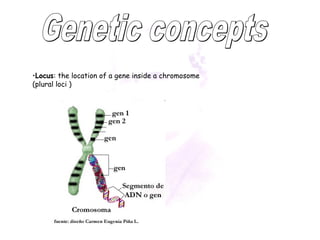
•Locus: the location of a gene inside a chromosome 
(plural loci )
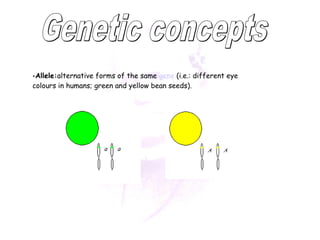
•Allele:alternative forms of the same gene (i.e.: different eye 
colours in humans; green and yellow bean seeds).
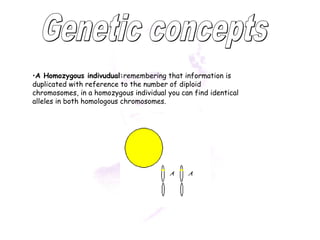
•A Homozygous indivudual:remembering that information is 
duplicated with reference to the number of diploid 
chromosomes, in a homozygous individual you can find identical 
alleles in both homologous chromosomes.
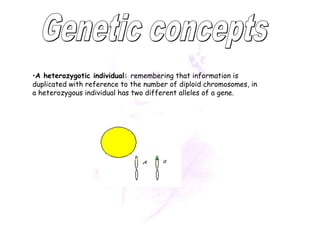
•A heterozygotic individual: remembering that information is 
duplicated with reference to the number of diploid chromosomes, in 
a heterozygous individual has two different alleles of a gene.
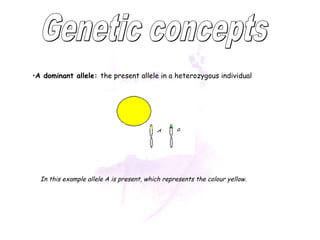
•A dominant allele: the present allele in a heterozygous individual 
In this example allele A is present, which represents the colour yellow.
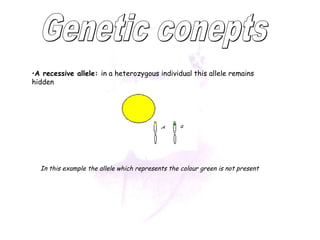
•A recessive allele: in a heterozygous individual this allele remains 
hidden 
In this example the allele which represents the colour green is not present
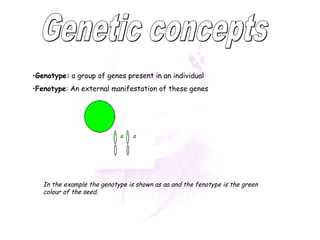
•Genotype: a group of genes present in an individual 
•Fenotype: An external manifestation of these genes 
In the example the genotype is shown as aa and the fenotype is the green 
colour of the seed.
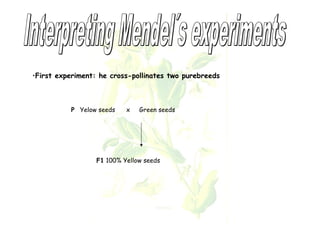
•First experiment: he cross-pollinates two purebreeds 
P Yelow seeds x Green seeds 
F1 100% Yellow seeds
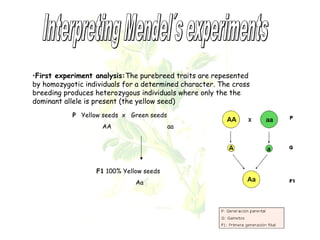
•First experiment analysis:The purebreed traits are repesented 
by homozygotic individuals for a determined character. The cross 
breeding produces heterozygous individuals where only the the 
dominant allele is present (the yellow seed) 
P Yellow seeds x Green seeds 
AA aa 
F1 100% Yellow seeds 
Aa
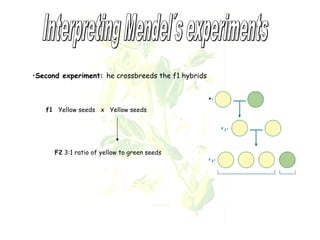
•Second experiment: he crossbreeds the f1 hybrids 
f1 Yellow seeds x Yellow seeds 
F2 3:1 ratio of yellow to green seeds
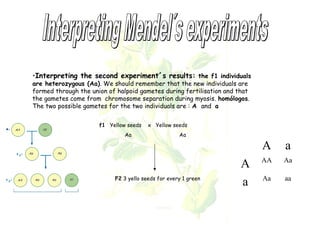
•Interpreting the second experiment´s results: the f1 individuals 
are heterozygous (Aa). We should remember that the new individuals are 
formed through the union of halpoid gametes during fertilisation and that 
the gametes come from chromosome separation during myosis. homólogos. 
The two possible gametes for the two individuals are : A and a 
A a 
A AA Aa 
a Aa aa 
f1 Yellow seeds x Yellow seeds 
Aa Aa 
F2 3 yello seeds for every 1 green
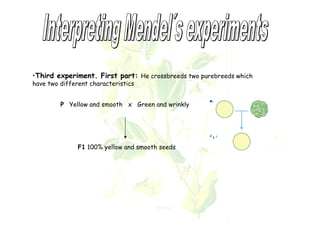
•Third experiment. First part: He crossbreeds two purebreeds which 
have two different characteristics 
P Yellow and smooth x Green and wrinkly 
F1 100% yellow and smooth seeds
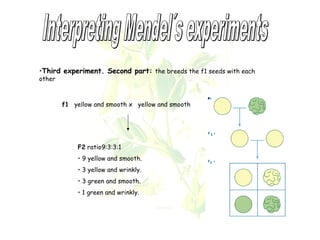
•Third experiment. Second part: the breeds the f1 seeds with each 
other 
f1 yellow and smooth x yellow and smooth 
F2 ratio9:3:3:1 
• 9 yellow and smooth. 
• 3 yellow and wrinkly. 
• 3 green and smooth. 
• 1 green and wrinkly.
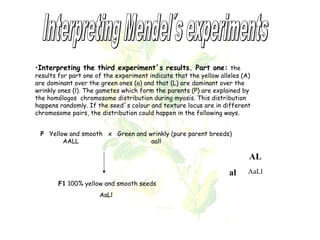
•Interpreting the third experiment´s results. Part one: the 
results for part one of the experiment indicate that the yellow alleles (A) 
are dominant over the green ones (a) and that (L) are dominant over the 
wrinkly ones (l). The gametes which form the parents (P) are explained by 
the homólogos chromosome distribution during myosis. This distribution 
happens randomly. If the seed´s colour and texture locus are in different 
chromosome pairs, the distribution could happen in the following ways. 
P Yellow and smooth x Green and wrinkly (pure parent breeds) 
AALL aall 
F1 100% yellow and smooth seeds 
AaLl 
AL 
al AaLl
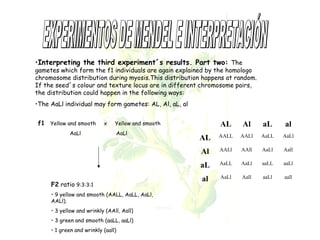
•Interpreting the third experiment´s results. Part two: The 
gametes which form the f1 individuals are again explained by the homologo 
chromosome distribution during myosis.This distribution happens at random. 
If the seed´s colour and texture locus are in different chromosome pairs, 
the distribution could happen in the following ways: 
•The AaLl individual may form gametes: AL, Al, aL, al 
AL Al aL al 
AL AALL AALl AaLL AaLl 
Al AALl AAll AaLl Aall 
aL AaLL AaLl aaLL aaLl 
al AaLl Aall aaLl aall 
f1 Yellow and smooth x Yellow and smooth 
AaLl AaLl 
F2 ratio 9:3:3:1 
• 9 yellow and smooth (AALL, AaLL, AaLl, 
AALl). 
• 3 yellow and wrinkly (AAll, Aall) 
• 3 green and smooth (aaLL, aaLl) 
• 1 green and wrinkly (aall)
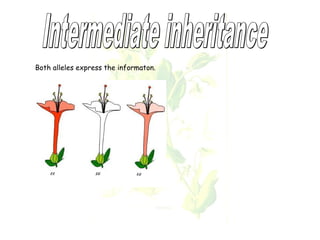
Both alleles express the informaton.
Both alleles are visible in the phenotype.
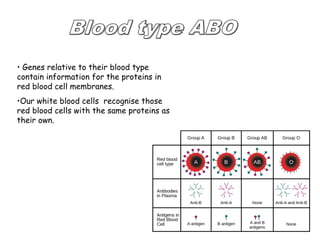
• Genes relative to their blood type 
contain information for the proteins in 
red blood cell membranes. 
•Our white blood cells recognise those 
red blood cells with the same proteins as 
their own.
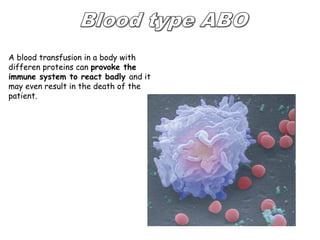
A blood transfusion in a body with 
differen proteins can provoke the 
immune system to react badly and it 
may even result in the death of the 
patient.
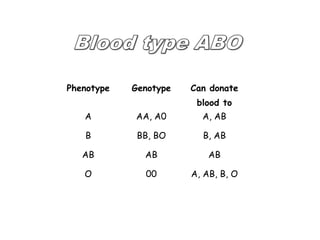
Phenotype Genotype Can donate 
blood to 
A AA, A0 A, AB 
B BB, BO B, AB 
AB AB AB 
O 00 A, AB, B, O
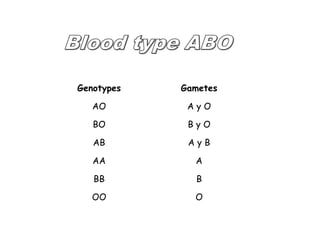
Genotypes Gametes 
AO A y O 
BO B y O 
AB A y B 
AA A 
BB B 
OO O
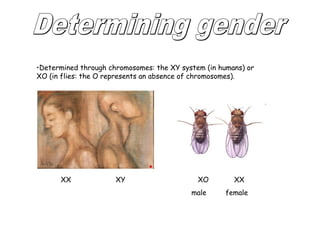
•Determined through chromosomes: the XY system (in humans) or 
XO (in flies: the O represents an absence of chromosomes). 
XX XY XO XX 
male female
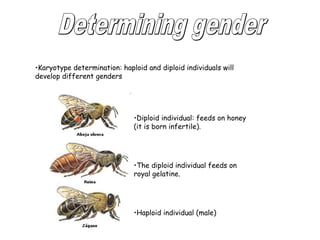
•Karyotype determination: haploid and diploid individuals will 
develop different genders 
•Diploid individual: feeds on honey 
(it is born infertile). 
•The diploid individual feeds on 
royal gelatine. 
•Haploid individual (male)
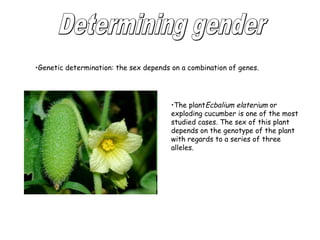
•Genetic determination: the sex depends on a combination of genes. 
•The plantEcbalium elaterium or 
exploding cucumber is one of the most 
studied cases. The sex of this plant 
depends on the genotype of the plant 
with regards to a series of three 
alleles.
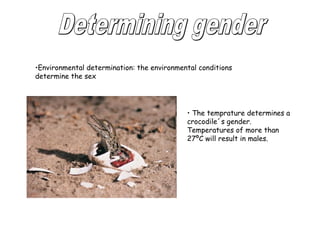
•Environmental determination: the environmental conditions 
determine the sex 
• The temprature determines a 
crocodile´s gender. 
Temperatures of more than 
27ºC will result in males.
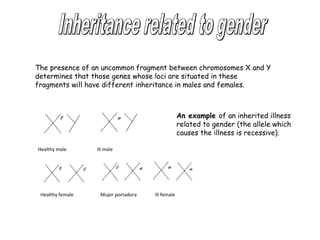
The presence of an uncommon fragment between chromosomes X and Y 
determines that those genes whose loci are situated in these 
fragments will have different inheritance in males and females. 
Healthy male Ill male 
Healthy female Mujer portadora Ill female 
An example of an inherited illness 
related to gender (the allele which 
causes the illness is recessive).

Mendelian genetics

  • 1.
    •Locus: the locationof a gene inside a chromosome (plural loci )
  • 2.
    •Allele:alternative forms ofthe same gene (i.e.: different eye colours in humans; green and yellow bean seeds).
  • 3.
    •A Homozygous indivudual:rememberingthat information is duplicated with reference to the number of diploid chromosomes, in a homozygous individual you can find identical alleles in both homologous chromosomes.
  • 4.
    •A heterozygotic individual:remembering that information is duplicated with reference to the number of diploid chromosomes, in a heterozygous individual has two different alleles of a gene.
  • 5.
    •A dominant allele:the present allele in a heterozygous individual In this example allele A is present, which represents the colour yellow.
  • 6.
    •A recessive allele:in a heterozygous individual this allele remains hidden In this example the allele which represents the colour green is not present
  • 7.
    •Genotype: a groupof genes present in an individual •Fenotype: An external manifestation of these genes In the example the genotype is shown as aa and the fenotype is the green colour of the seed.
  • 8.
    •First experiment: hecross-pollinates two purebreeds P Yelow seeds x Green seeds F1 100% Yellow seeds
  • 9.
    •First experiment analysis:Thepurebreed traits are repesented by homozygotic individuals for a determined character. The cross breeding produces heterozygous individuals where only the the dominant allele is present (the yellow seed) P Yellow seeds x Green seeds AA aa F1 100% Yellow seeds Aa
  • 10.
    •Second experiment: hecrossbreeds the f1 hybrids f1 Yellow seeds x Yellow seeds F2 3:1 ratio of yellow to green seeds
  • 11.
    •Interpreting the secondexperiment´s results: the f1 individuals are heterozygous (Aa). We should remember that the new individuals are formed through the union of halpoid gametes during fertilisation and that the gametes come from chromosome separation during myosis. homólogos. The two possible gametes for the two individuals are : A and a A a A AA Aa a Aa aa f1 Yellow seeds x Yellow seeds Aa Aa F2 3 yello seeds for every 1 green
  • 12.
    •Third experiment. Firstpart: He crossbreeds two purebreeds which have two different characteristics P Yellow and smooth x Green and wrinkly F1 100% yellow and smooth seeds
  • 13.
    •Third experiment. Secondpart: the breeds the f1 seeds with each other f1 yellow and smooth x yellow and smooth F2 ratio9:3:3:1 • 9 yellow and smooth. • 3 yellow and wrinkly. • 3 green and smooth. • 1 green and wrinkly.
  • 14.
    •Interpreting the thirdexperiment´s results. Part one: the results for part one of the experiment indicate that the yellow alleles (A) are dominant over the green ones (a) and that (L) are dominant over the wrinkly ones (l). The gametes which form the parents (P) are explained by the homólogos chromosome distribution during myosis. This distribution happens randomly. If the seed´s colour and texture locus are in different chromosome pairs, the distribution could happen in the following ways. P Yellow and smooth x Green and wrinkly (pure parent breeds) AALL aall F1 100% yellow and smooth seeds AaLl AL al AaLl
  • 15.
    •Interpreting the thirdexperiment´s results. Part two: The gametes which form the f1 individuals are again explained by the homologo chromosome distribution during myosis.This distribution happens at random. If the seed´s colour and texture locus are in different chromosome pairs, the distribution could happen in the following ways: •The AaLl individual may form gametes: AL, Al, aL, al AL Al aL al AL AALL AALl AaLL AaLl Al AALl AAll AaLl Aall aL AaLL AaLl aaLL aaLl al AaLl Aall aaLl aall f1 Yellow and smooth x Yellow and smooth AaLl AaLl F2 ratio 9:3:3:1 • 9 yellow and smooth (AALL, AaLL, AaLl, AALl). • 3 yellow and wrinkly (AAll, Aall) • 3 green and smooth (aaLL, aaLl) • 1 green and wrinkly (aall)
  • 16.
    Both alleles expressthe informaton.
  • 17.
    Both alleles arevisible in the phenotype.
  • 18.
    • Genes relativeto their blood type contain information for the proteins in red blood cell membranes. •Our white blood cells recognise those red blood cells with the same proteins as their own.
  • 19.
    A blood transfusionin a body with differen proteins can provoke the immune system to react badly and it may even result in the death of the patient.
  • 20.
    Phenotype Genotype Candonate blood to A AA, A0 A, AB B BB, BO B, AB AB AB AB O 00 A, AB, B, O
  • 21.
    Genotypes Gametes AOA y O BO B y O AB A y B AA A BB B OO O
  • 22.
    •Determined through chromosomes:the XY system (in humans) or XO (in flies: the O represents an absence of chromosomes). XX XY XO XX male female
  • 23.
    •Karyotype determination: haploidand diploid individuals will develop different genders •Diploid individual: feeds on honey (it is born infertile). •The diploid individual feeds on royal gelatine. •Haploid individual (male)
  • 24.
    •Genetic determination: thesex depends on a combination of genes. •The plantEcbalium elaterium or exploding cucumber is one of the most studied cases. The sex of this plant depends on the genotype of the plant with regards to a series of three alleles.
  • 25.
    •Environmental determination: theenvironmental conditions determine the sex • The temprature determines a crocodile´s gender. Temperatures of more than 27ºC will result in males.
  • 26.
    The presence ofan uncommon fragment between chromosomes X and Y determines that those genes whose loci are situated in these fragments will have different inheritance in males and females. Healthy male Ill male Healthy female Mujer portadora Ill female An example of an inherited illness related to gender (the allele which causes the illness is recessive).