Chemistry I Stage II 
Ms. Claudia Barahona 
Elements & compounds in our surroundings
Stage I1 Chemical reactions in our surroundings 
Formative Objective: The student identifies the chemical name and formula of elements and compounds present in our daily lives, to reflect on the effects and importance of these substances in our bodies and surroundings. 
Elaborated by: QFB. Claudia Barahona
TOPICS 
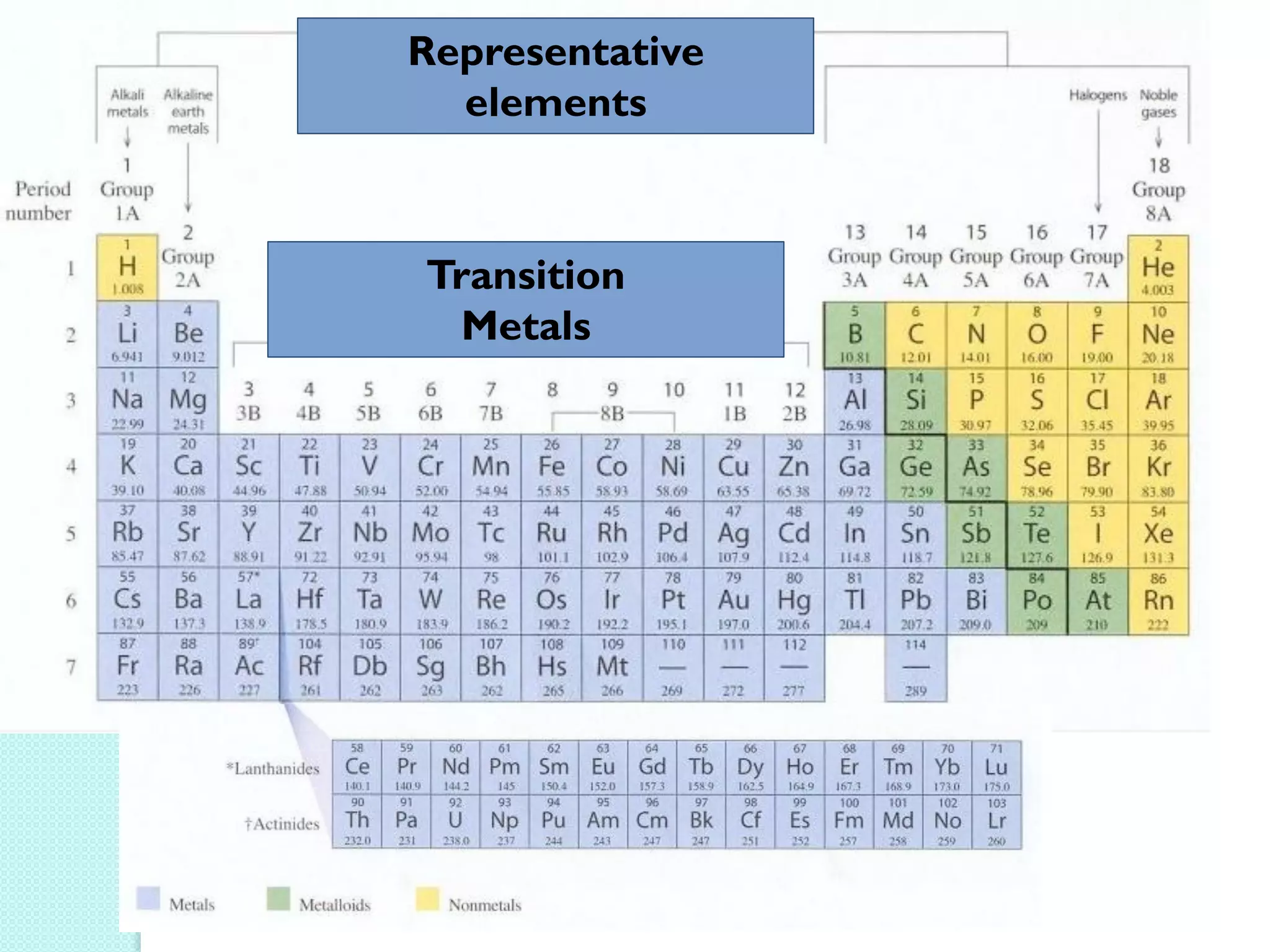
Classification of elements in : metals, nonmetals and metalloids 
Classification of compounds by the number of elements and chemical function. 
Elements present in the human body and acquisition sources. 
The effects and uses of chemical compounds in our daily lives 
Elaborated by: QFB. Claudia Barahona
COMPETENCES 
Generic Competences: 
4. Listens, interprets, and emits pertinent messages in different situations using mediums, codes and appropriate tools. 
 Express ideas and concepts through 
 Identifies the main ideas in a text or an oral speech, and deduce conclusions from them. 
5. Develops innovations and proposes solutions from established methods. 
 Follows directions and procedures objective. 
 Synthesizes evidences obtained with experimentation to produce 
 Uses the information and communication technologies to 
Disciplinary Competences: 
2. The student bases opinions about the impact of science and technology in his daily life assuming ethical considerations. 
10. The Student relates the symbolic expressions of a phenomenon of the sight or using scientific instruments or models.
Activity 2.1 Exploring your knowledge
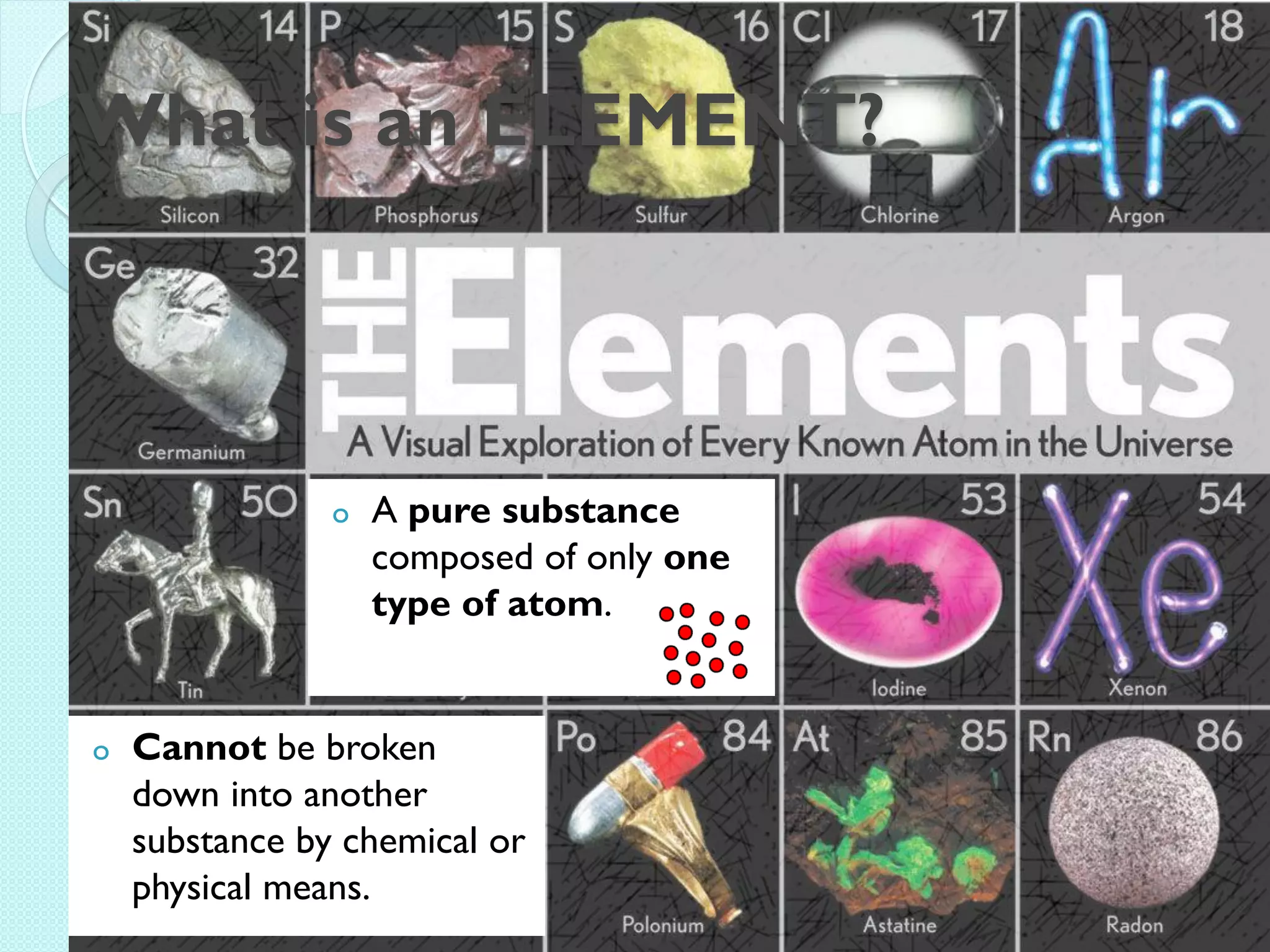
What is an ELEMENT? 
oA pure substance composed of only one type of atom. 
oCannot be broken down into another substance by chemical or physical means.
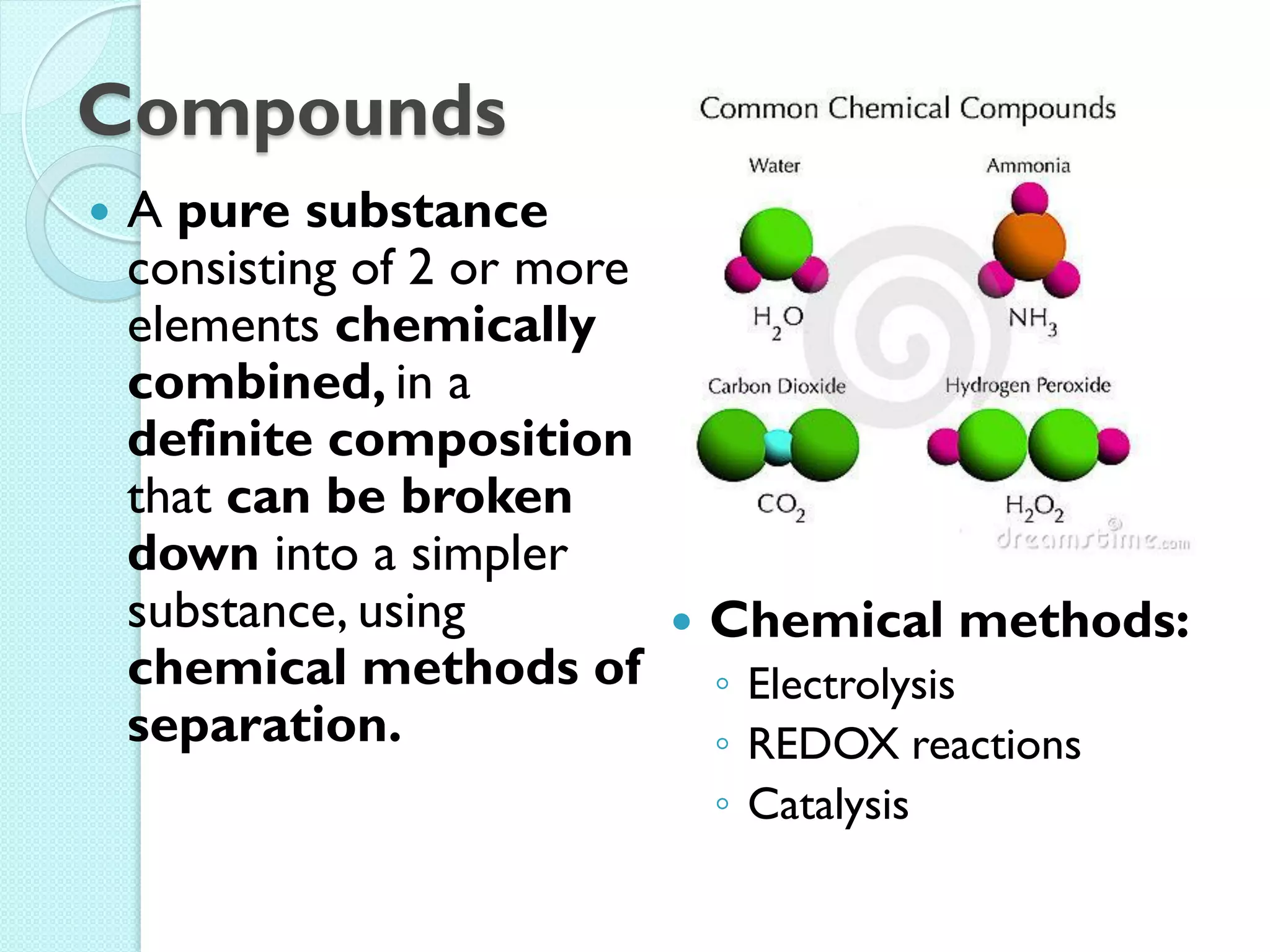
Compounds 
A pure substance consisting of 2 or more elements chemically combined, in a definite composition that can be broken down into a simpler substance, using chemical methods of separation. 
Chemical methods: 
◦Electrolysis 
◦REDOX reactions 
◦Catalysis
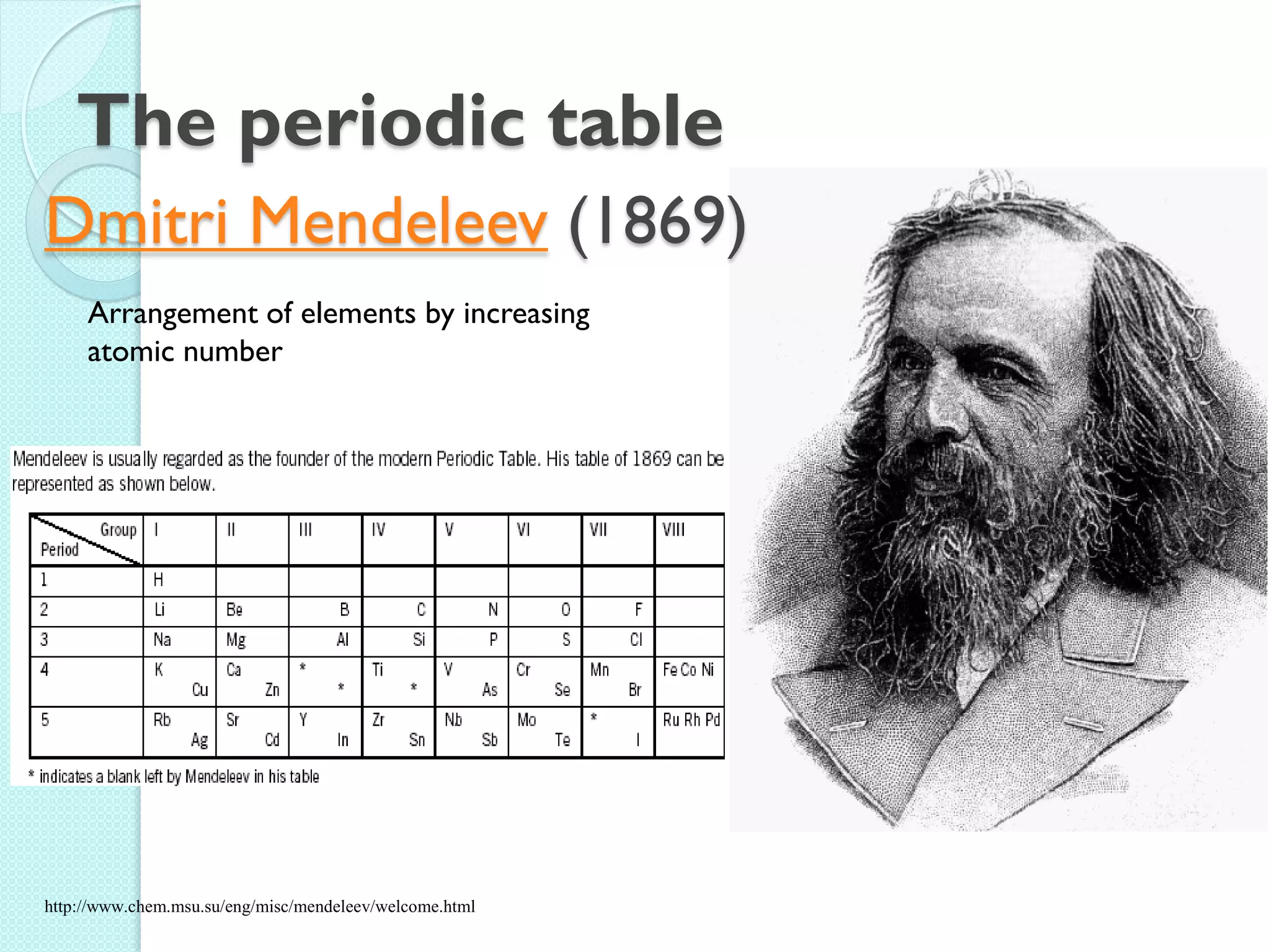
Dmitri Mendeleev (1869) 
http://www.chem.msu.su/eng/misc/mendeleev/welcome.html 
The periodic table 
Arrangement of elements by increasing 
atomic number
http://www.chem.msu.su/eng/misc/mendeleev/welcome.html 
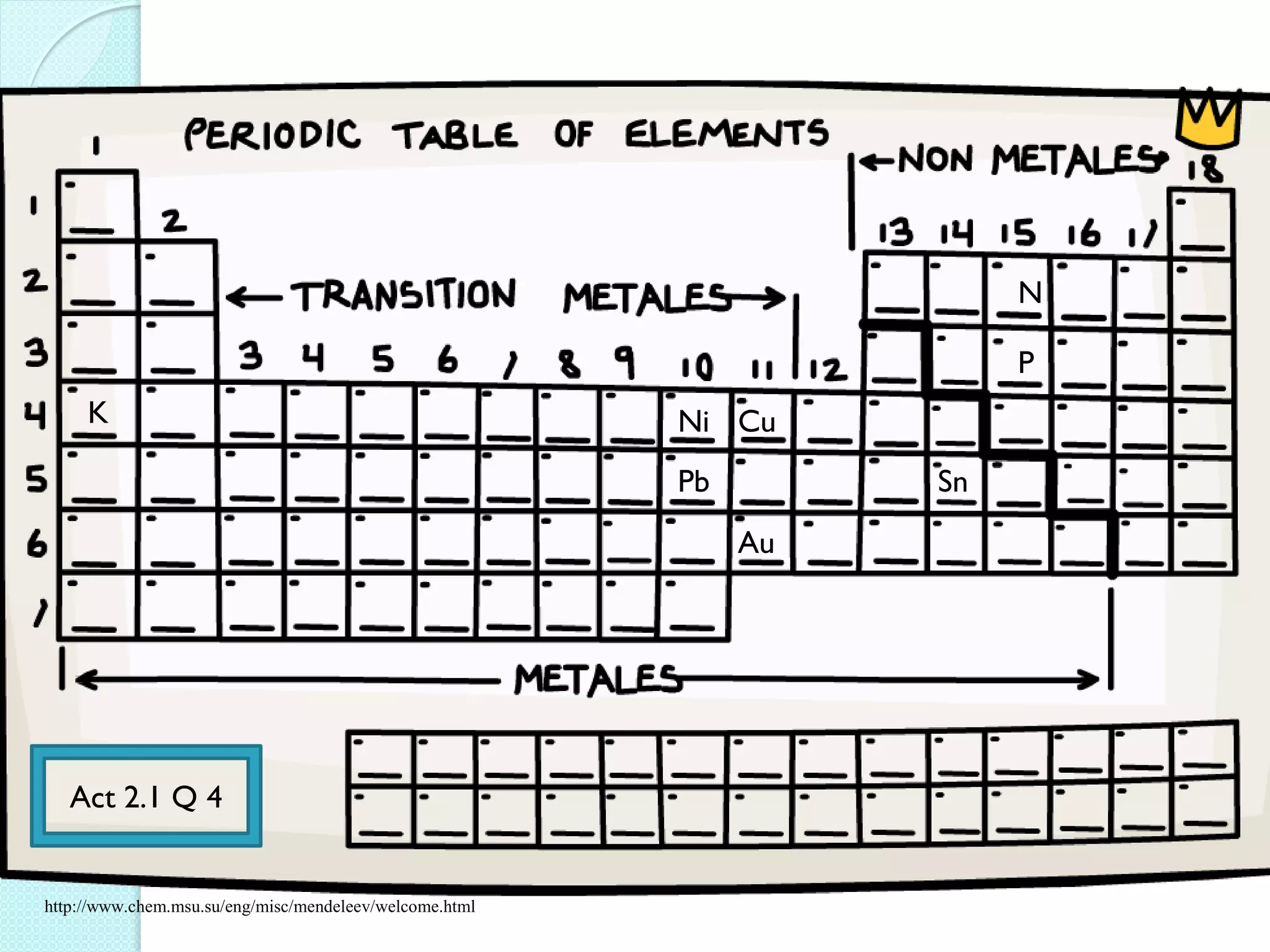
K 
Au 
P 
Sn 
Cu 
Ni 
Pb 
N 
Act 2.1 Q 4
Representative elements 
Transition 
Metals
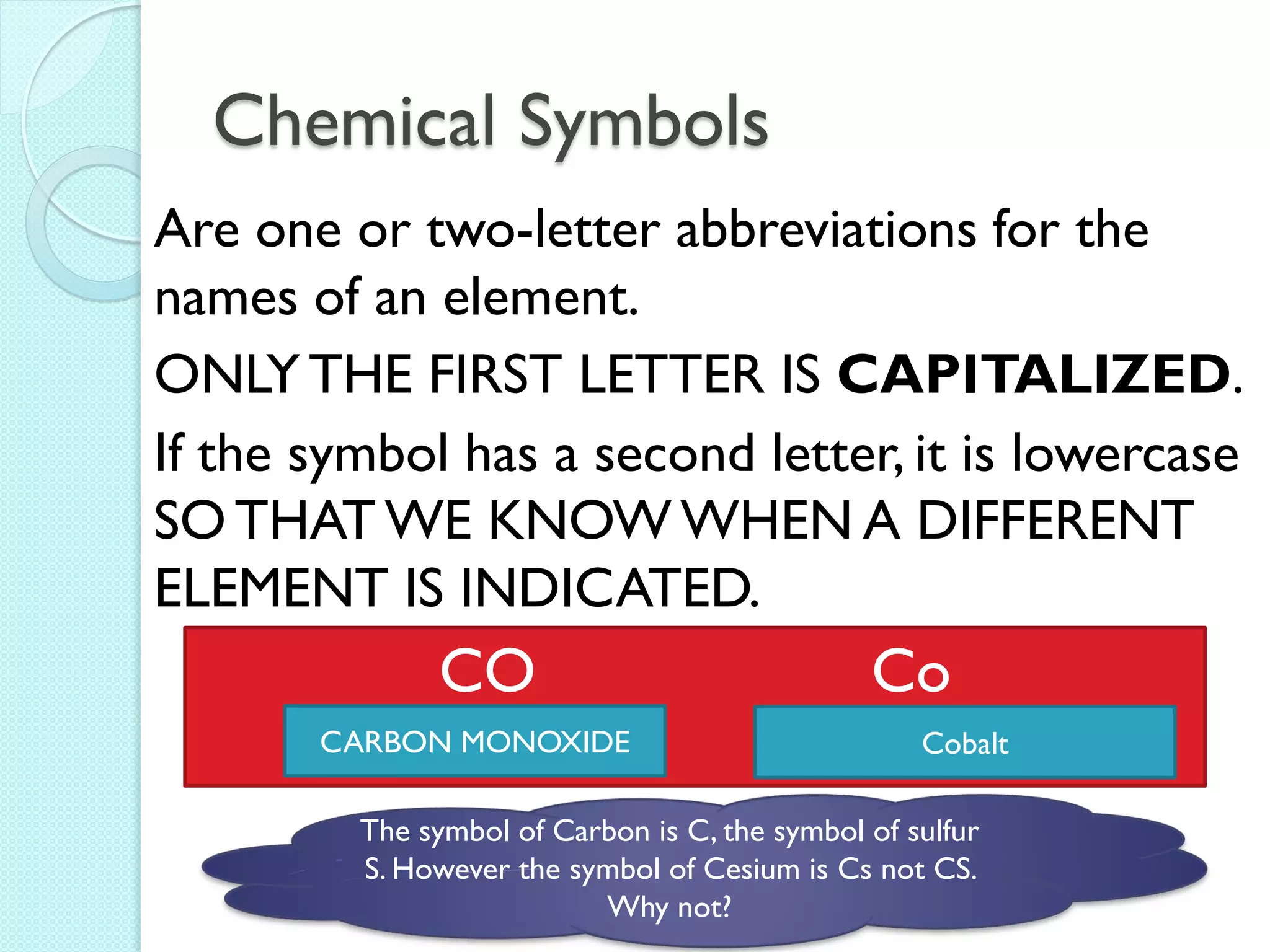
Chemical Symbols 
Are one or two-letter abbreviations for the names of an element. 
ONLY THE FIRST LETTER IS CAPITALIZED. 
If the symbol has a second letter, it is lowercase SO THAT WE KNOW WHEN A DIFFERENT ELEMENT IS INDICATED. 
CO Co 
CARBON MONOXIDE 
Cobalt 
The symbol of Carbon is C, the symbol of sulfur S. However the symbol of Cesium is Cs not CS. Why not?
Origin of some of the elements name 
Most of the chemical symbols use letters from the current name, some are derived from their ancient name. 
Other elements are named after planets, mythological figures, colors, minerals, geographical location and famous people. 
Act 2.1 
Part II
Activity 2.2 Acquisition of knowledge 
Vocabulary terms
Vocabulary terms 
1.Periodic table 
2.Period 
3.Group or family 
4.Chemical symbols 
5.Representative elements 
6.Transition elements 
7.Metals 
8.Nonmetals 
9.Metalloids 
10.Malleable 
11.Ductile 
12.Element 
13.Compound 
14.Binary compound 
15.Ternary compound 
16.Polyatomic compound 
17.Acids 
18.Bases 
19.Oxides 
20.Salts 
21.Valence electrons 
22.Ionic bond 
23.Covalent bond
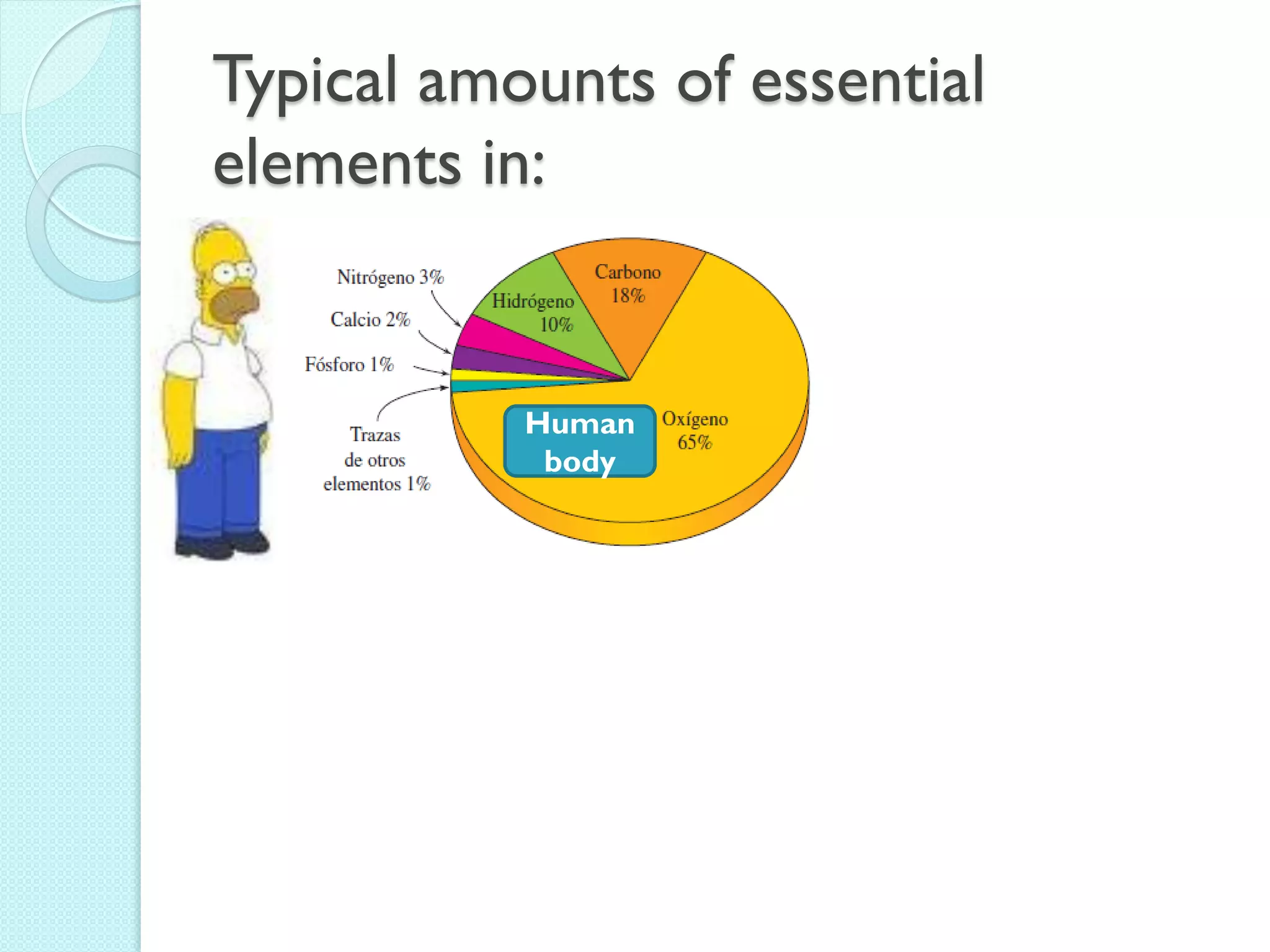
Typical amounts of essential elements in: 
Human body
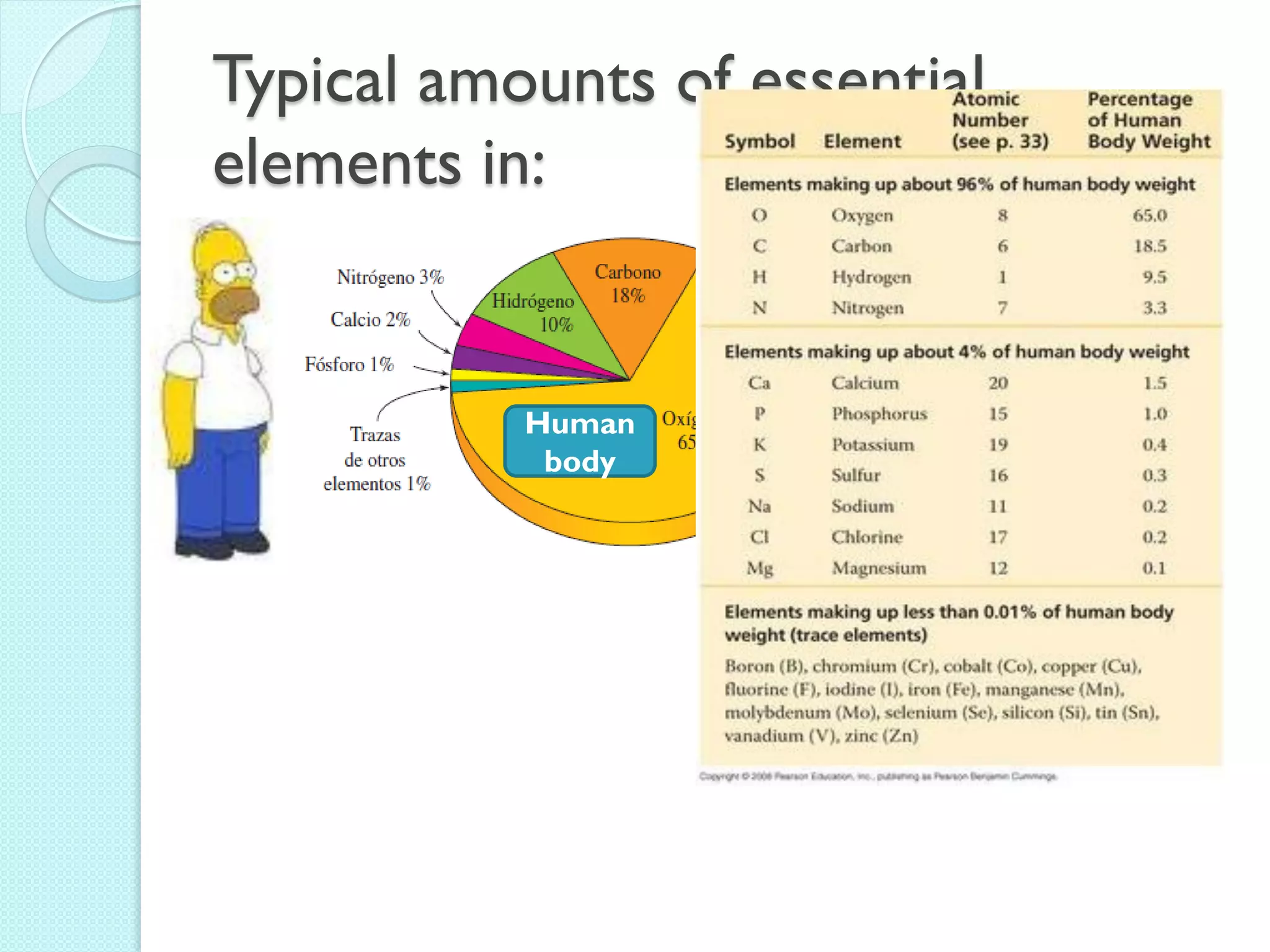
Typical amounts of essential elements in: 
Human body
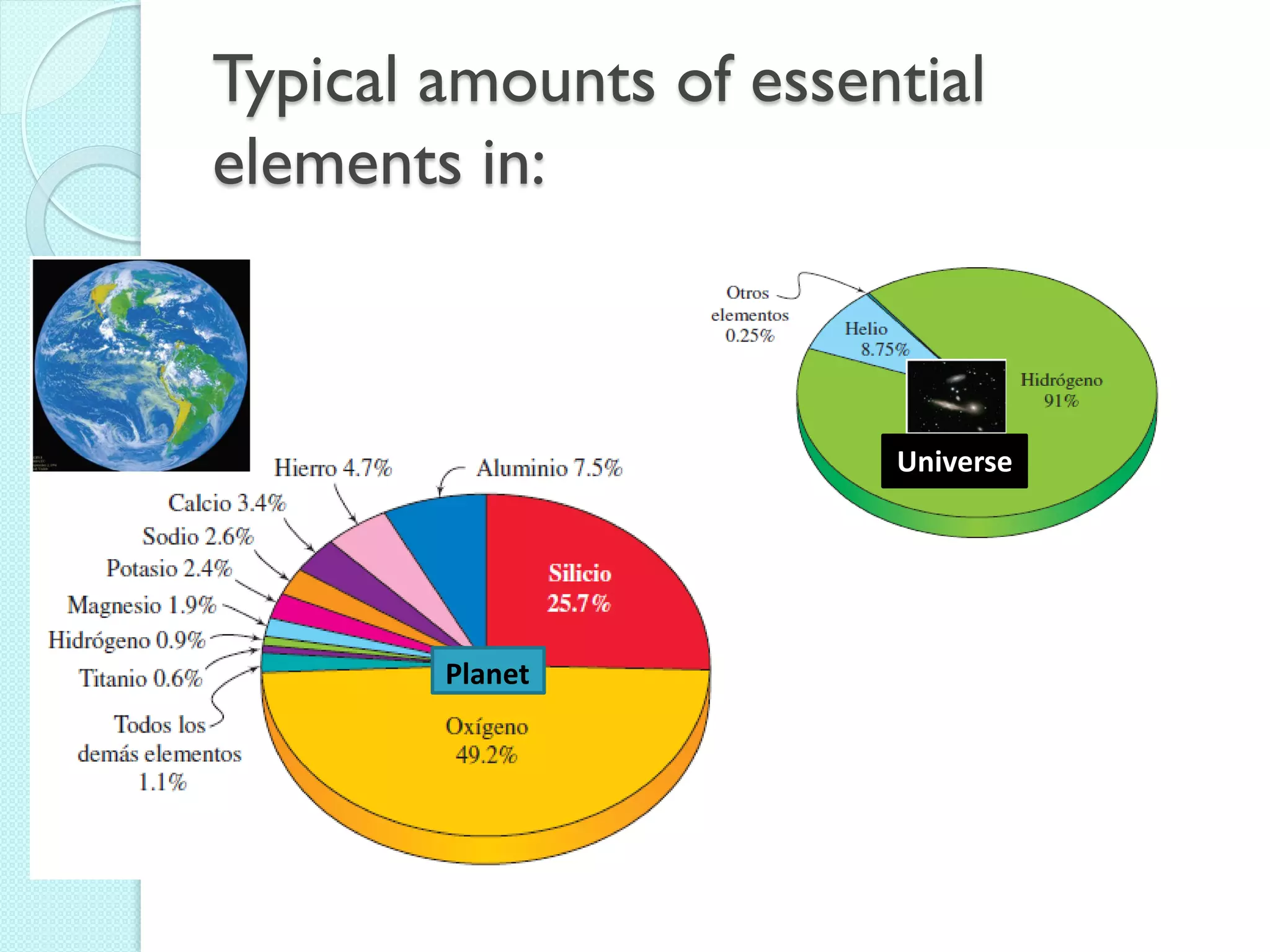
Typical amounts of essential elements in: 
Planet 
Universe
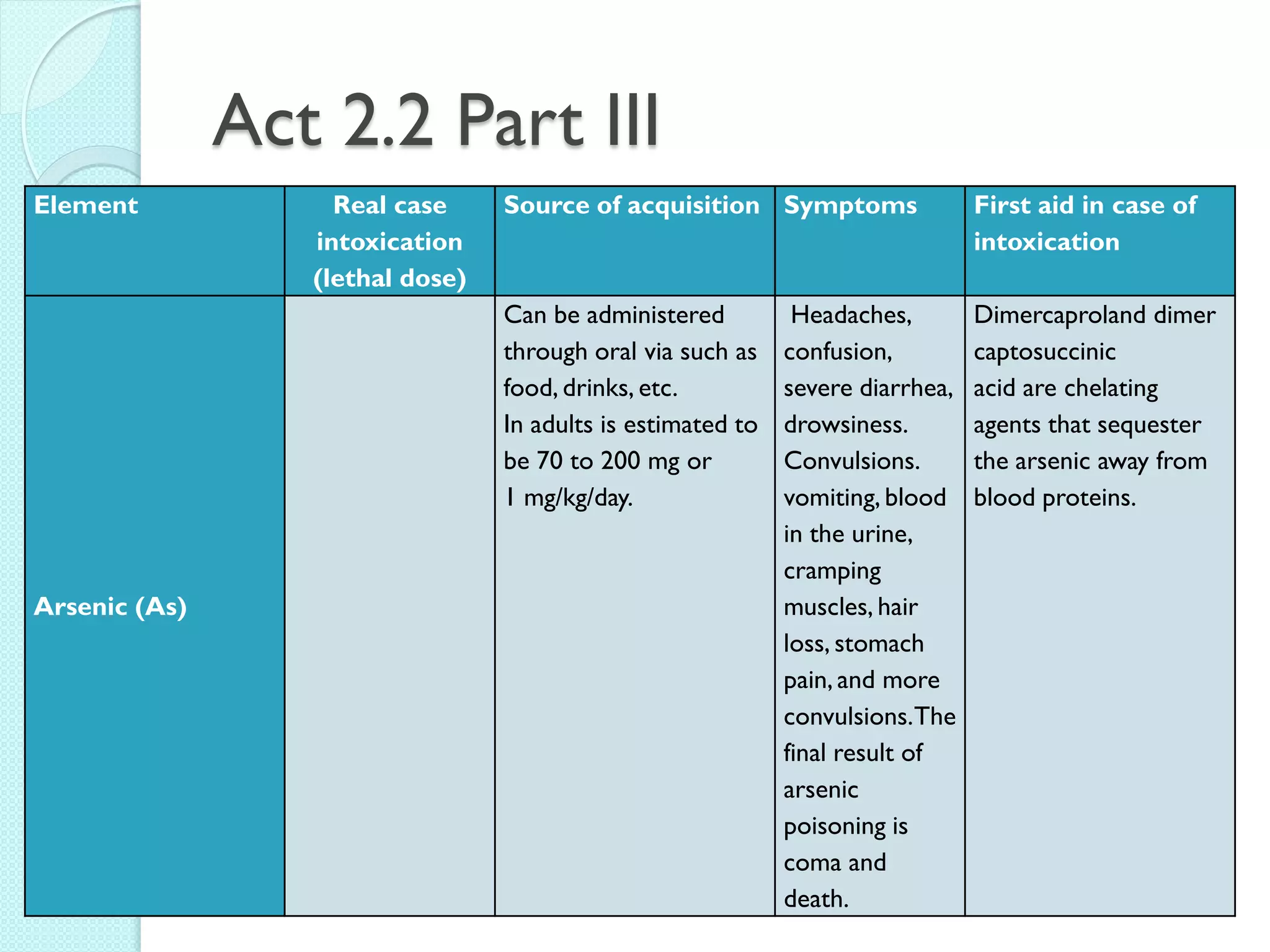
Act 2.2 Part III 
Element 
Real case intoxication (lethal dose) 
Source of acquisition 
Symptoms 
First aid in case of intoxication 
Arsenic (As) 
Can be administered through oral via such as food, drinks, etc. 
In adults is estimated to be 70 to 200 mg or 1 mg/kg/day. 
Headaches, confusion, severe diarrhea, drowsiness. Convulsions. 
vomiting, blood in the urine, cramping muscles, hair loss, stomach pain, and more convulsions. The final result of arsenic poisoning is coma and death. 
Dimercaproland dimercaptosuccinic acid are chelating agents that sequester the arsenic away from blood proteins.
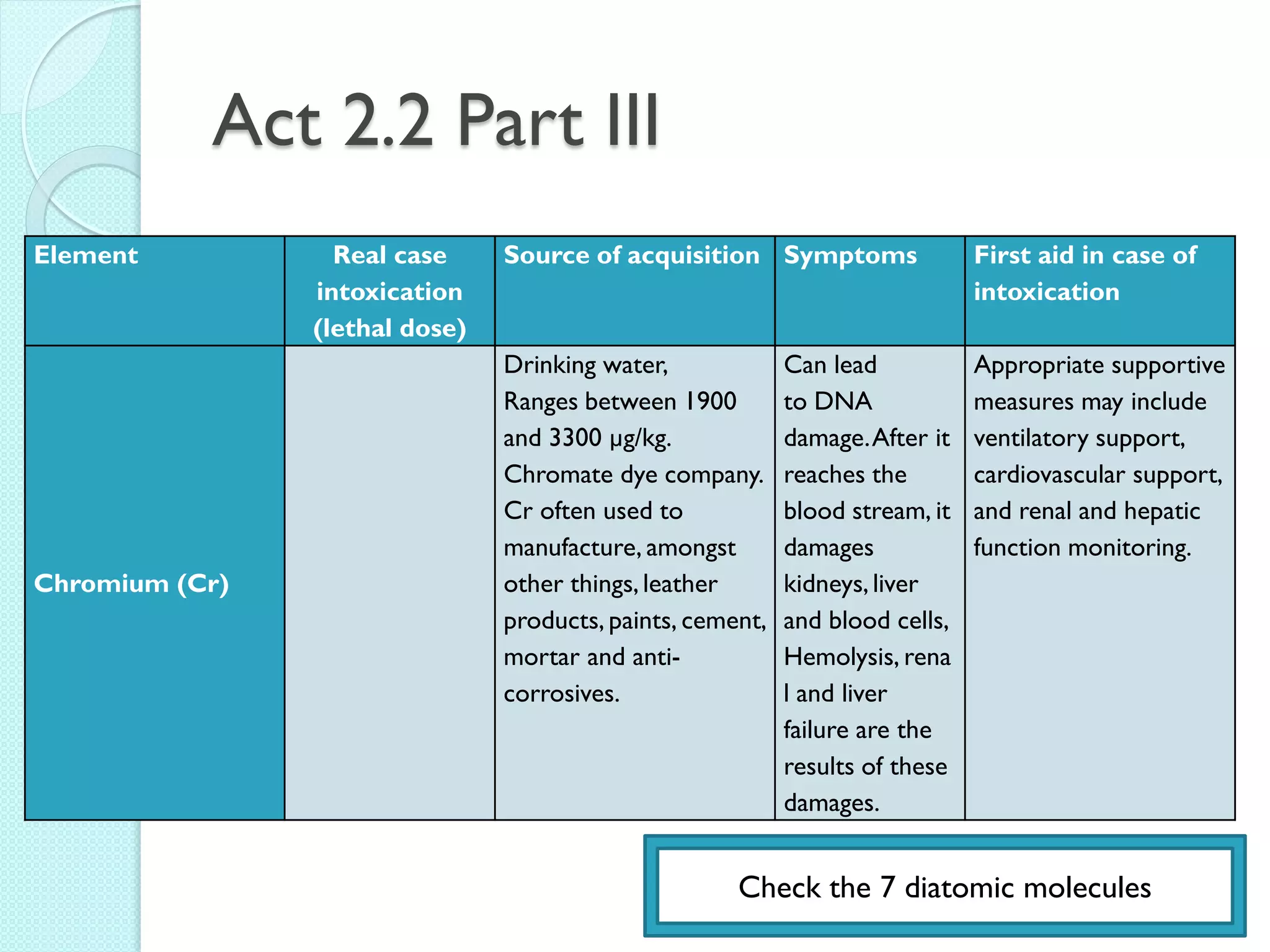
Act 2.2 Part III 
Element 
Real case intoxication (lethal dose) 
Source of acquisition 
Symptoms 
First aid in case of intoxication 
Chromium (Cr) 
Drinking water, 
Ranges between 1900 and 3300 μg/kg. 
Chromate dye company. Cr often used to manufacture, amongst other things, leather products, paints, cement, mortar and anti- corrosives. 
Can lead to DNA damage. After it reaches the blood stream, it damages kidneys, liver and blood cells, Hemolysis, renal and liver failure are the results of these damages. 
Appropriate supportive measures may include ventilatory support, cardiovascular support, and renal and hepatic function monitoring. 
Check the 7 diatomic molecules
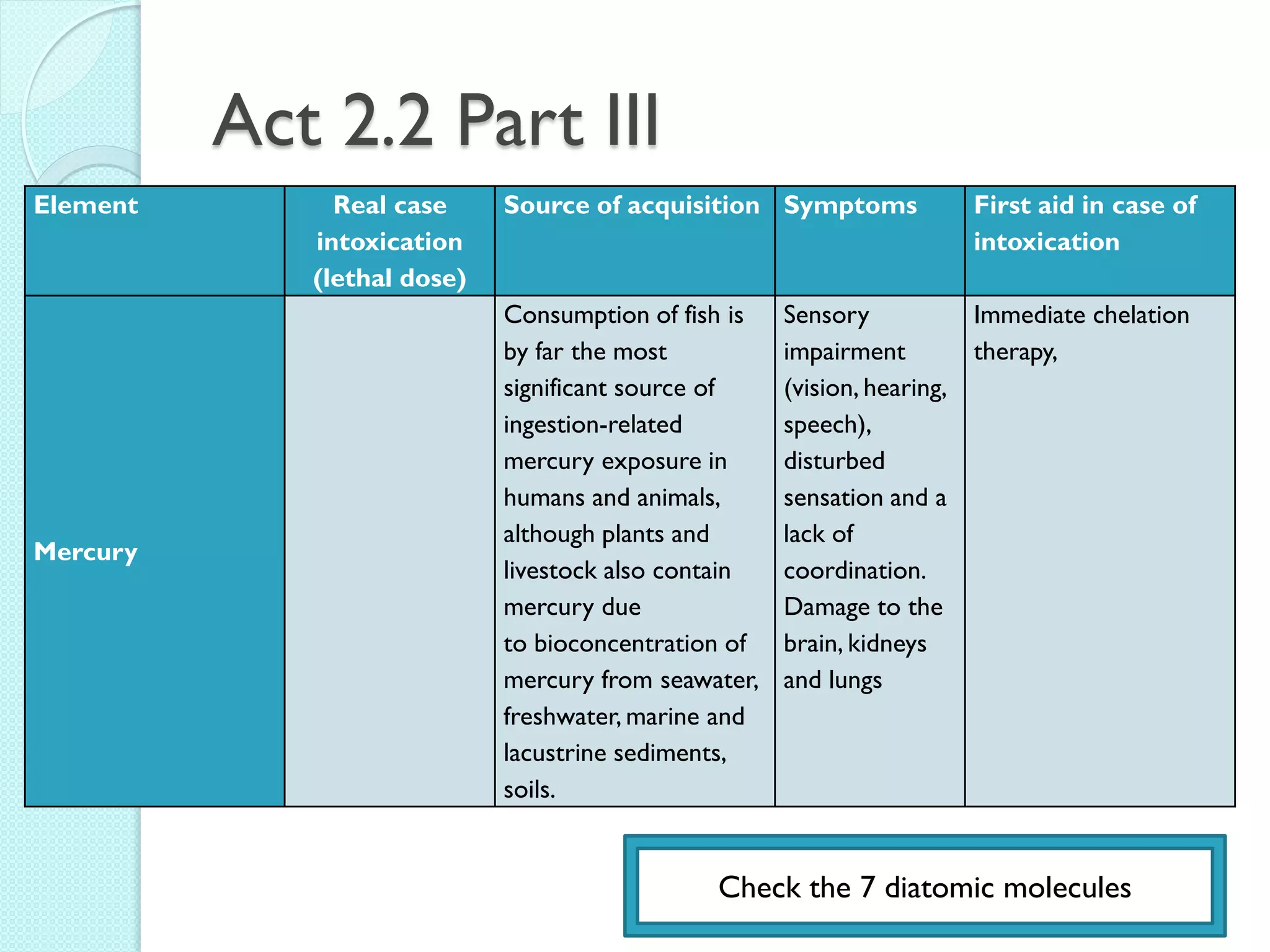
Act 2.2 Part III 
Element 
Real case intoxication (lethal dose) 
Source of acquisition 
Symptoms 
First aid in case of intoxication 
Mercury 
Consumption of fish is by far the most significant source of ingestion-related mercury exposure in humans and animals, although plants and livestock also contain mercury due to bioconcentration of mercury from seawater, freshwater, marine and lacustrine sediments, soils. 
Sensory impairment (vision, hearing, speech), disturbed sensation and a lack of coordination. Damage to the brain, kidneys and lungs 
Immediate chelation therapy, 
Check the 7 diatomic molecules
The Periodic Table 
 A map of the building block of matter. 
1 
IA 
18 
VIIIA 
1 
1 
H 
1.00797 
2 
IIA Periodic Table 13 
IIIA 
14 
IVA 
15 
VA 
16 
VIA 
17 
VIIA 
2 
He 
4.0026 
2 
3 
Li 
6.939 
4 
Be 
9.0122 
5 
B 
10.811 
6 
C 
12.0112 
7 
N 
14.0067 
8 
O 
15.9994 
9 
F 
18.9984 
10 
Ne 
20.179 
3 
11 
Na 
22.9898 
12 
Mg 
24.305 
3 
IIIB 
4 
IVB 
5 
VB 
6 
VIB 
7 
VIIB 
8 9 
VIIIB 
10 11 
IB 
12 
IIB 
13 
Al 
26.9815 
14 
Si 
28.086 
15 
P 
30.9738 
16 
S 
32.064 
17 
Cl 
35.453 
18 
Ar 
39.948 
4 
19 
K 
39.102 
20 
Ca 
40.08 
21 
Sc 
44.956 
22 
Ti 
47.90 
23 
V 
50.942 
24 
Cr 
51.996 
25 
Mn 
54.9380 
26 
Fe 
55.847 
27 
Co 
58.9332 
28 
Ni 
58.71 
29 
Cu 
63.54 
30 
Zn 
65.37 
31 
Ga 
65.37 
32 
Ge 
72.59 
33 
As 
74.9216 
34 
Se 
78.96 
35 
Br 
79.909 
36 
Kr 
83.80 
5 
37 
Rb 
85.47 
38 
Sr 
87.62 
39 
Y 
88.905 
40 
Zr 
91.22 
41 
Nb 
92.906 
42 
Mo 
95.94 
43 
Tc 
[99] 
44 
Ru 
101.07 
45 
Rh 
102.905 
46 
Pd 
106.4 
47 
Ag 
107.870 
48 
Cd 
112.40 
49 
In 
114.82 
50 
Sn 
118.69 
51 
Sb 
121.75 
52 
Te 
127.60 
53 
I 
126.904 
54 
Xe 
131.30 
6 
55 
Cs 
132.905 
56 
Ba 
137.34 
57 
La 
138.91 
72 
Hf 
178.49 
73 
Ta 
180.948 
74 
W 
183.85 
75 
Re 
186.2 
76 
Os 
190.2 
77 
Ir 
192.2 
78 
Pt 
195.09 
79 
Au 
196.967 
80 
Hg 
200.59 
81 
Tl 
204.37 
82 
Pb 
207.19 
83 
Bi 
208.980 
84 
Po 
[210] 
85 
At 
[210] 
86 
Rn 
[222] 
7 
87 
Fr 
[223] 
88 
Ra 
[226] 
89 
Ac 
[227] 
104 
Ku 
[260] 
105 106 107 108 109 
http://www.chemsoc.org/viselements/pages/periodic_table.html
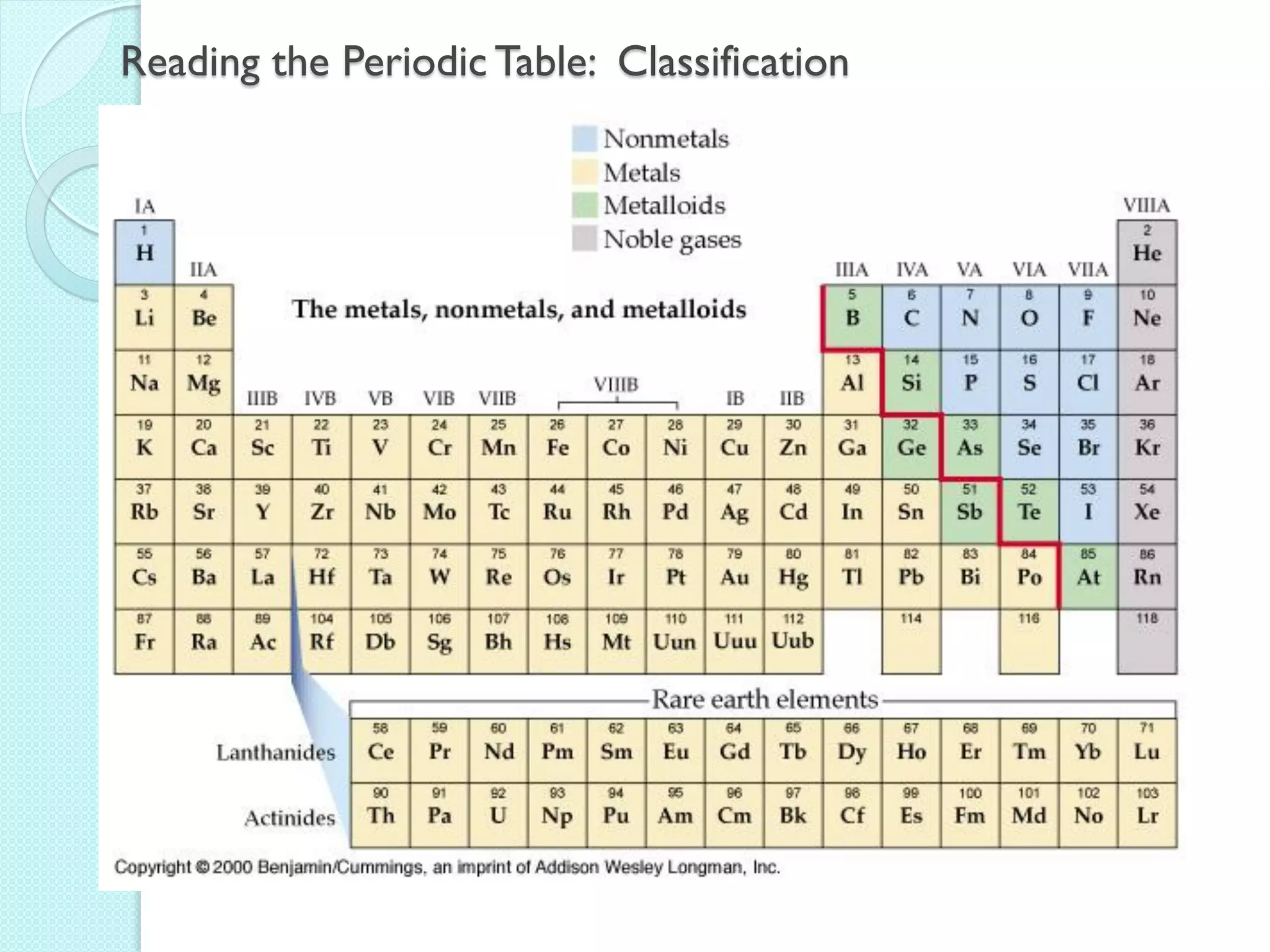
Reading the Periodic Table: Classification 
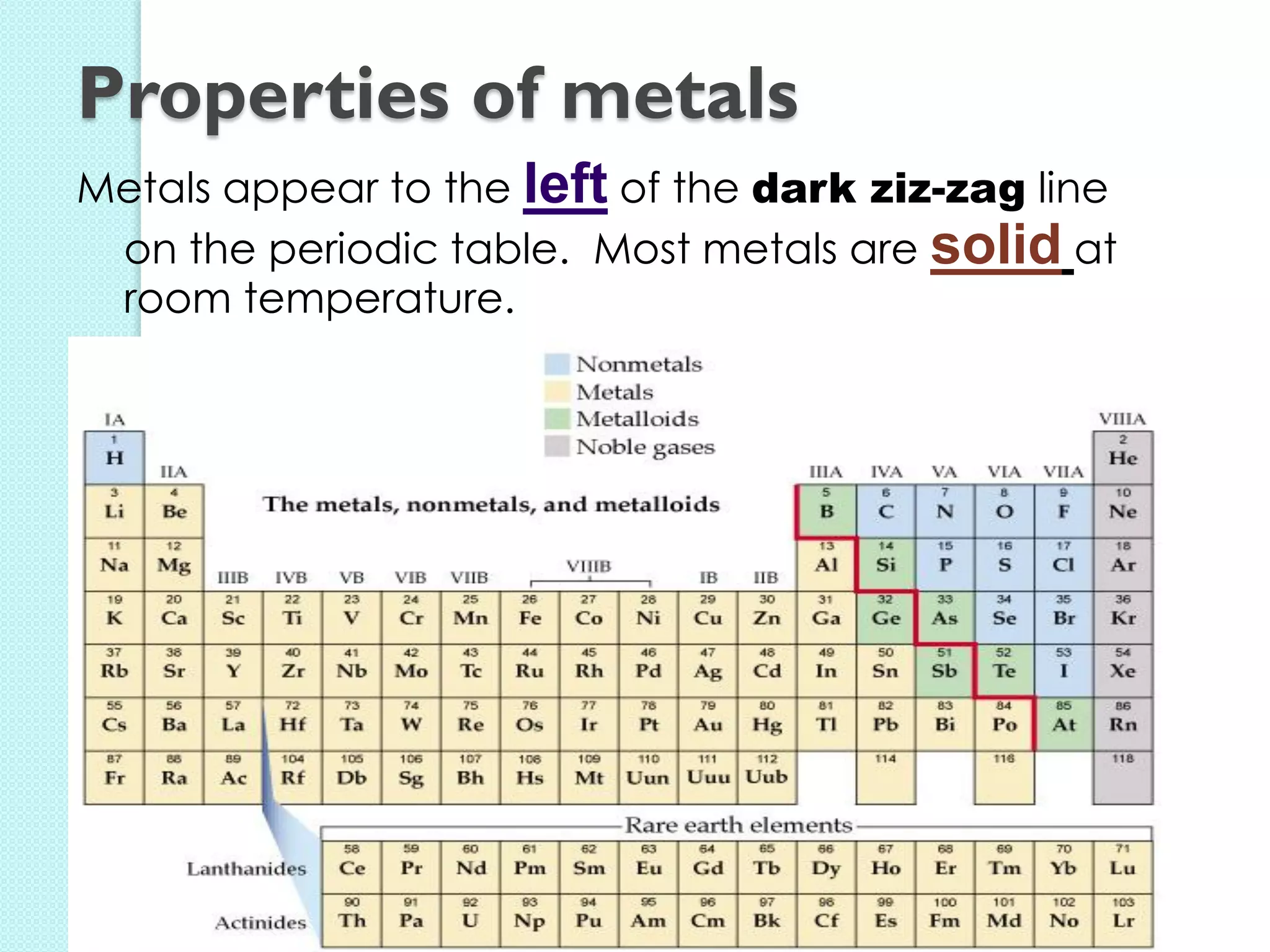
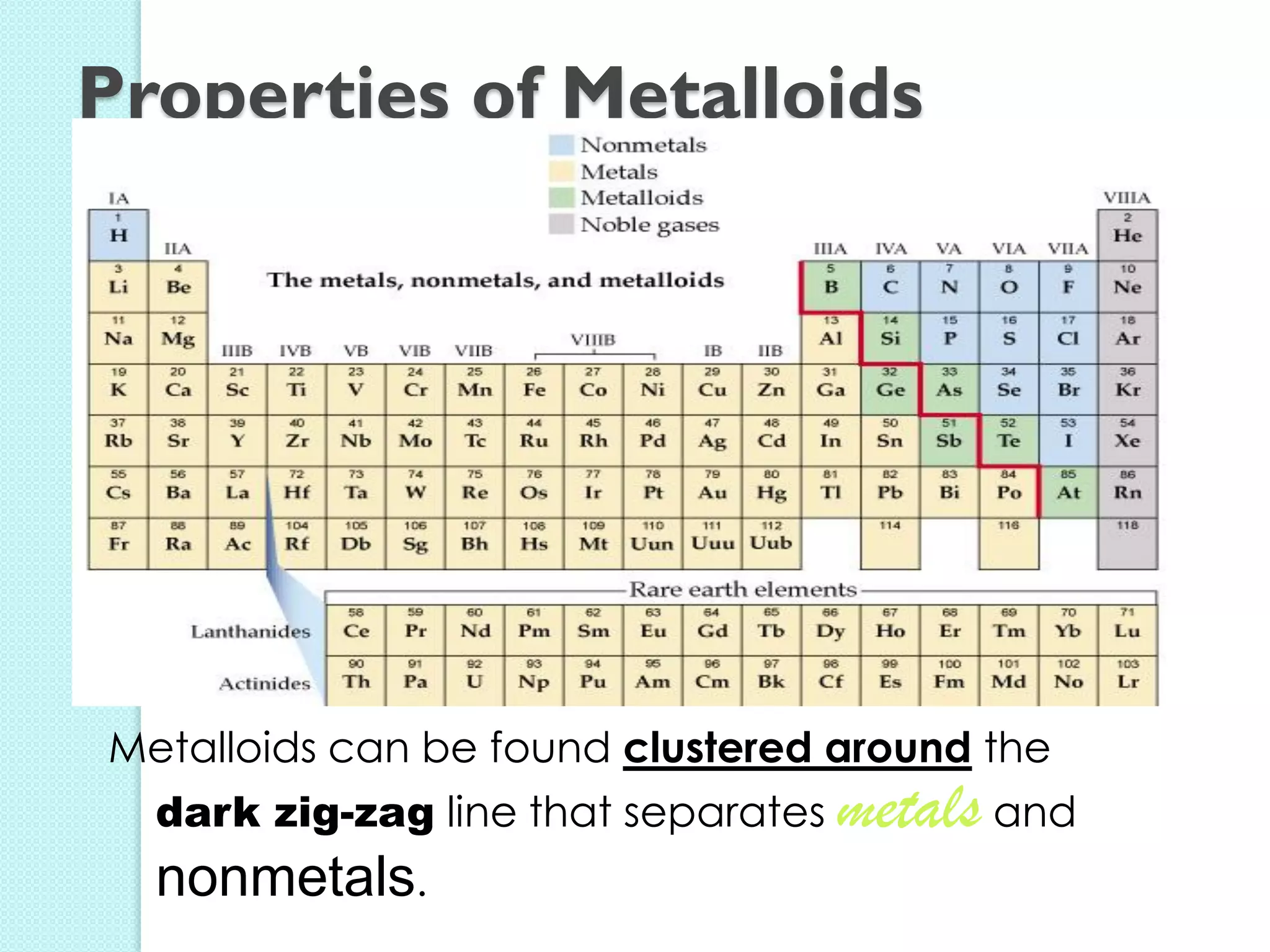
Nonmetals, Metals, Metalloids, Noble gases
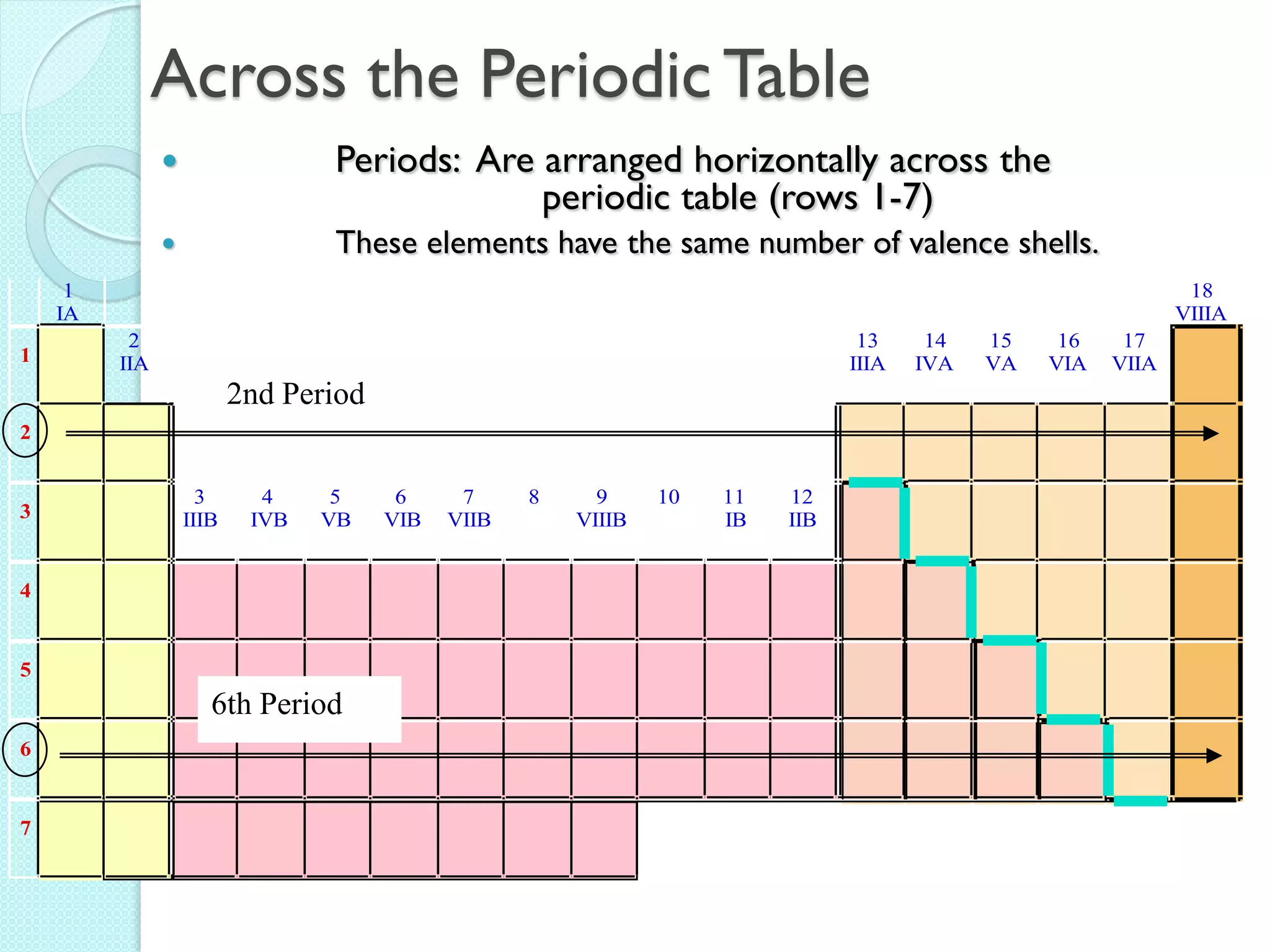
Across the Periodic Table 
 Periods: Are arranged horizontally across the 
periodic table (rows 1-7) 
 These elements have the same number of valence shells. 
1 
IA 
18 
VIIIA 
1 
2 
IIA 
13 
IIIA 
14 
IVA 
15 
VA 
16 
VIA 
17 
VIIA 
2 
3 
3 
IIIB 
4 
IVB 
5 
VB 
6 
VIB 
7 
VIIB 
8 9 
VIIIB 
10 11 
IB 
12 
IIB 
4 
5 
6 
7 
2nd Period 
6th Period
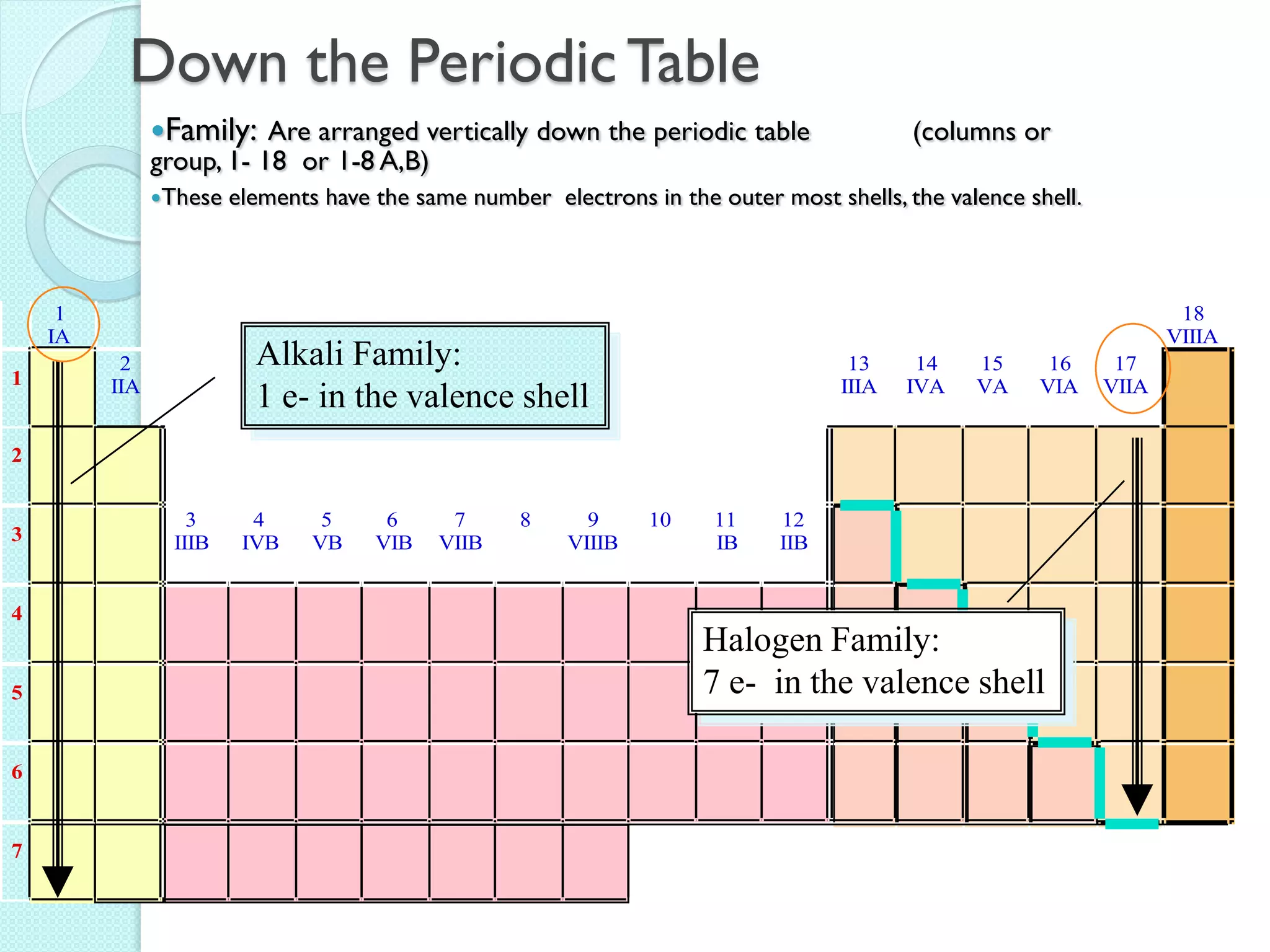
Down the Periodic Table 
Family: Are arranged vertically down the periodic table (columns or 
group, 1- 18 or 1-8 A,B) 
These elements have the same number electrons in the outer most shells, the valence shell. 
1 
IA 
18 
VIIIA 
1 
2 
IIA 
13 
IIIA 
14 
IVA 
15 
VA 
16 
VIA 
17 
VIIA 
2 
3 
3 
IIIB 
4 
IVB 
5 
VB 
6 
VIB 
7 
VIIB 
8 9 
VIIIB 
10 11 
IB 
12 
IIB 
4 
5 
6 
7 
Alkali Family: 
1 e- in the valence shell 
Halogen Family: 
7 e- in the valence shell
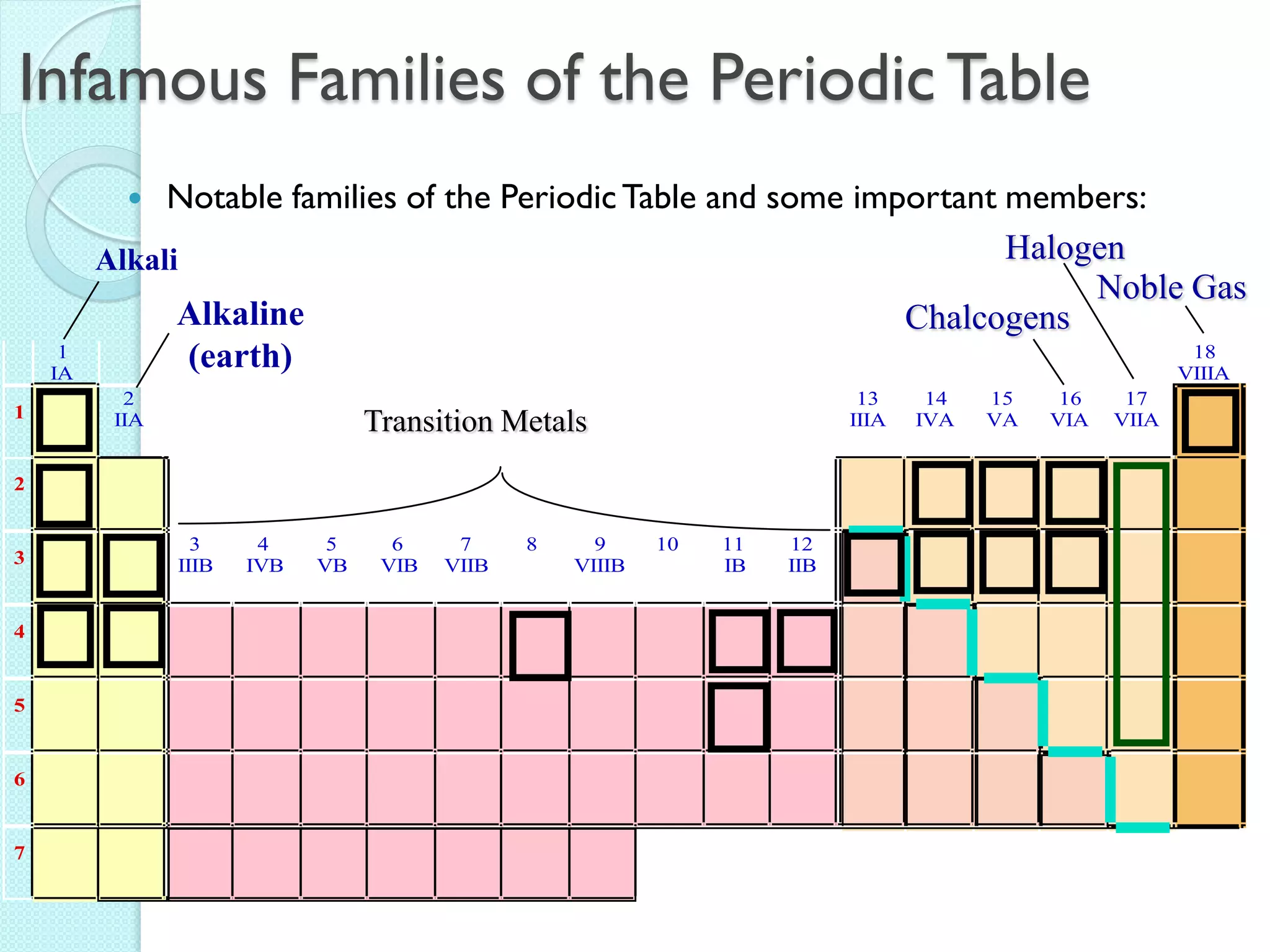
Infamous Families of the Periodic Table 
 Notable families of the Periodic Table and some important members: 
1 
IA 
18 
VIIIA 
1 
2 
IIA 
13 
IIIA 
14 
IVA 
15 
VA 
16 
VIA 
17 
VIIA 
2 
3 
3 
IIIB 
4 
IVB 
5 
VB 
6 
VIB 
7 
VIIB 
8 9 
VIIIB 
10 11 
IB 
12 
IIB 
4 
5 
6 
7 
Alkali 
Alkaline 
(earth) 
Transition Metals 
Noble Gas 
Halogen 
Chalcogens
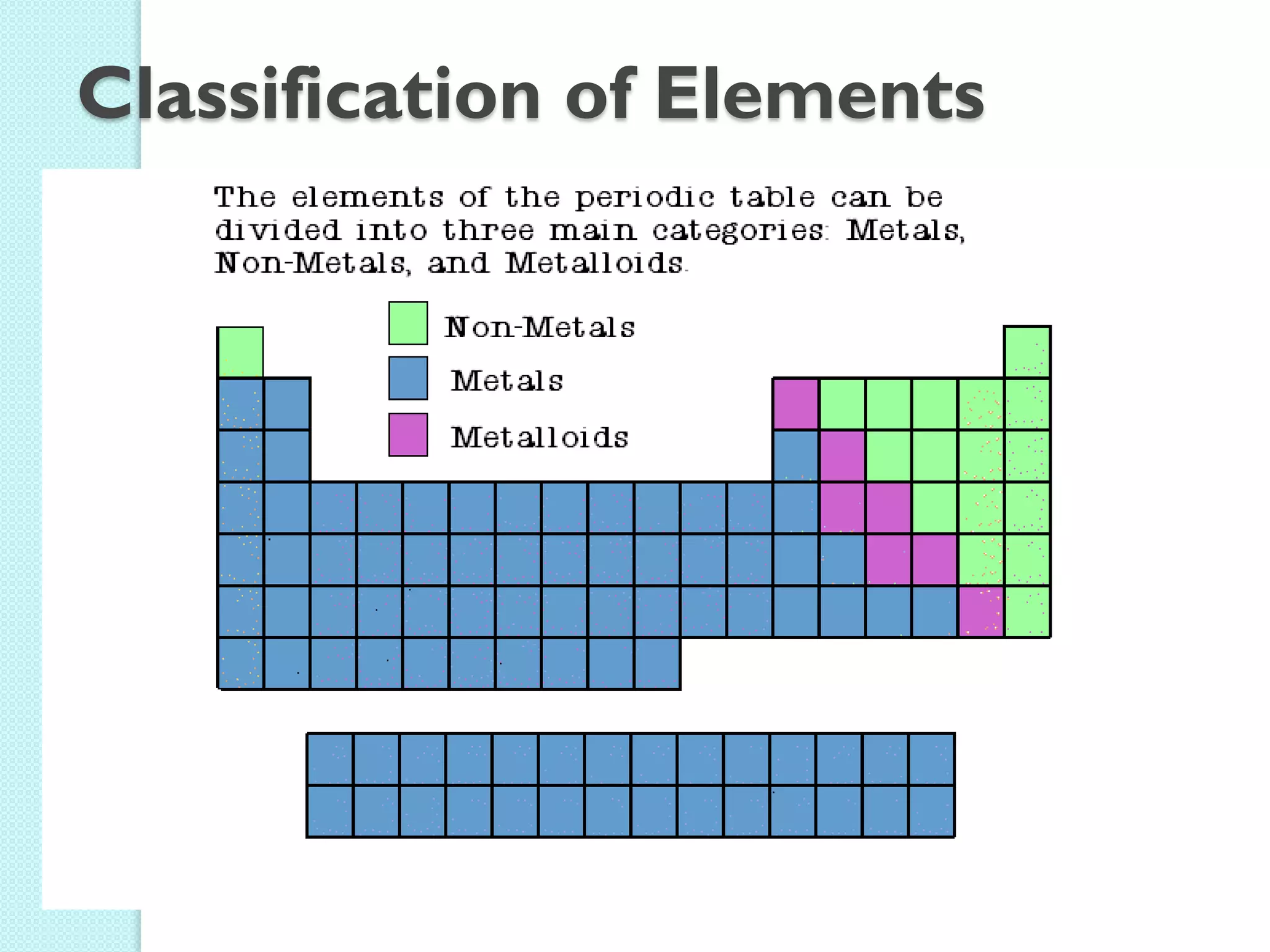
Classification of Elements
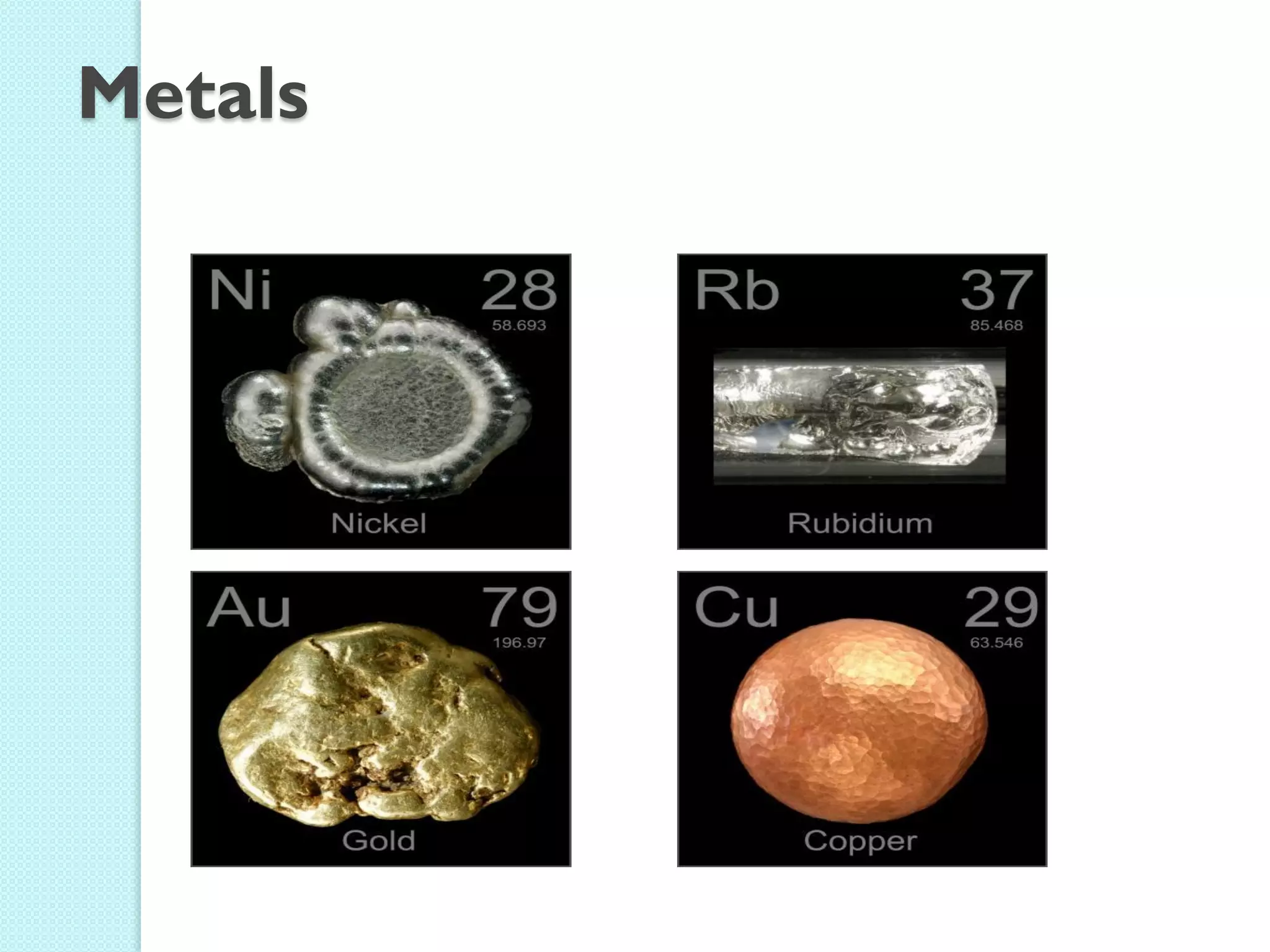
Metals
Metals appear to the left of the dark ziz-zag line on the periodic table. Most metals are solid at room temperature. 
Properties of metals
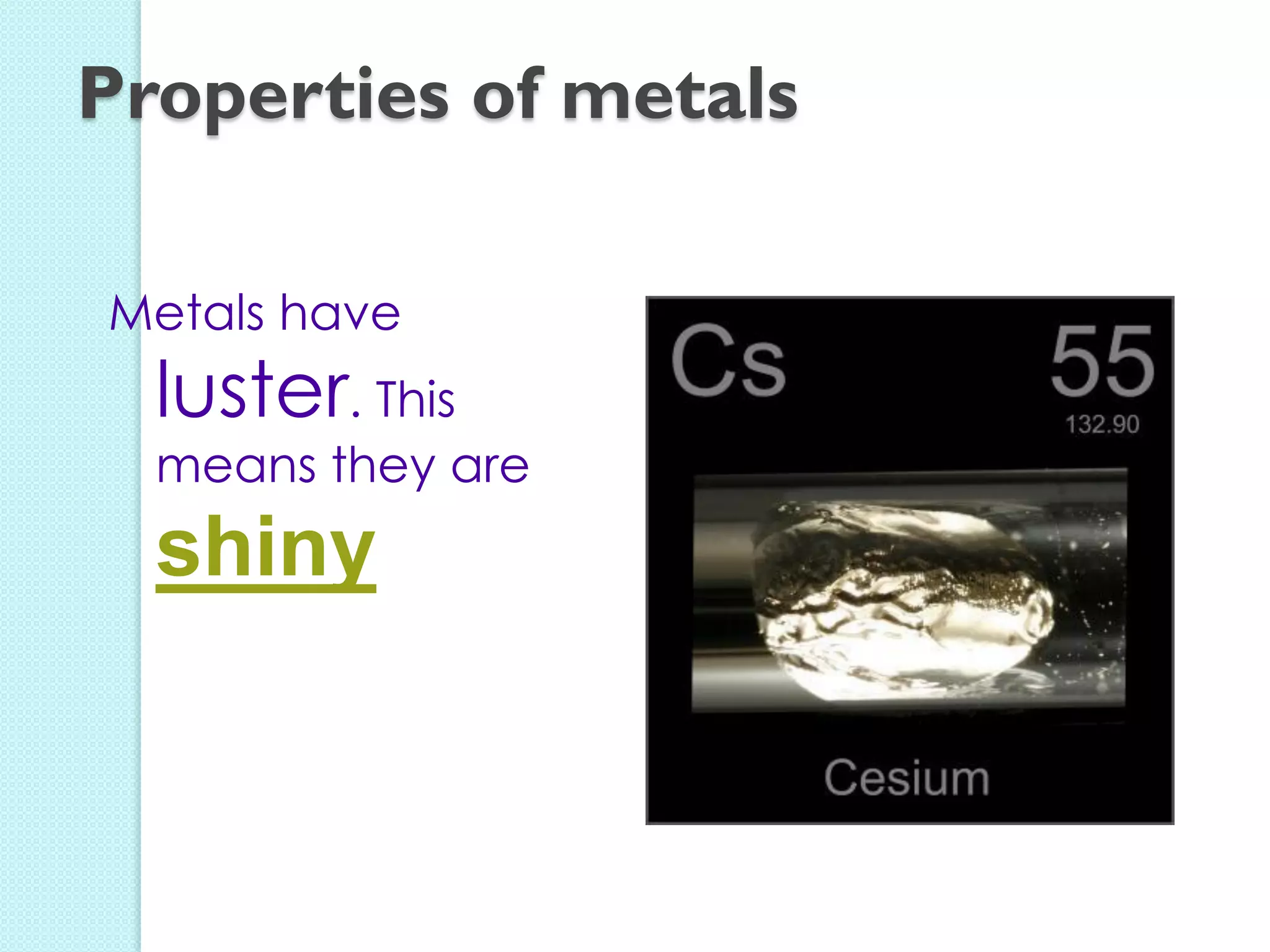
Metals have luster. This means they are shiny 
Properties of metals
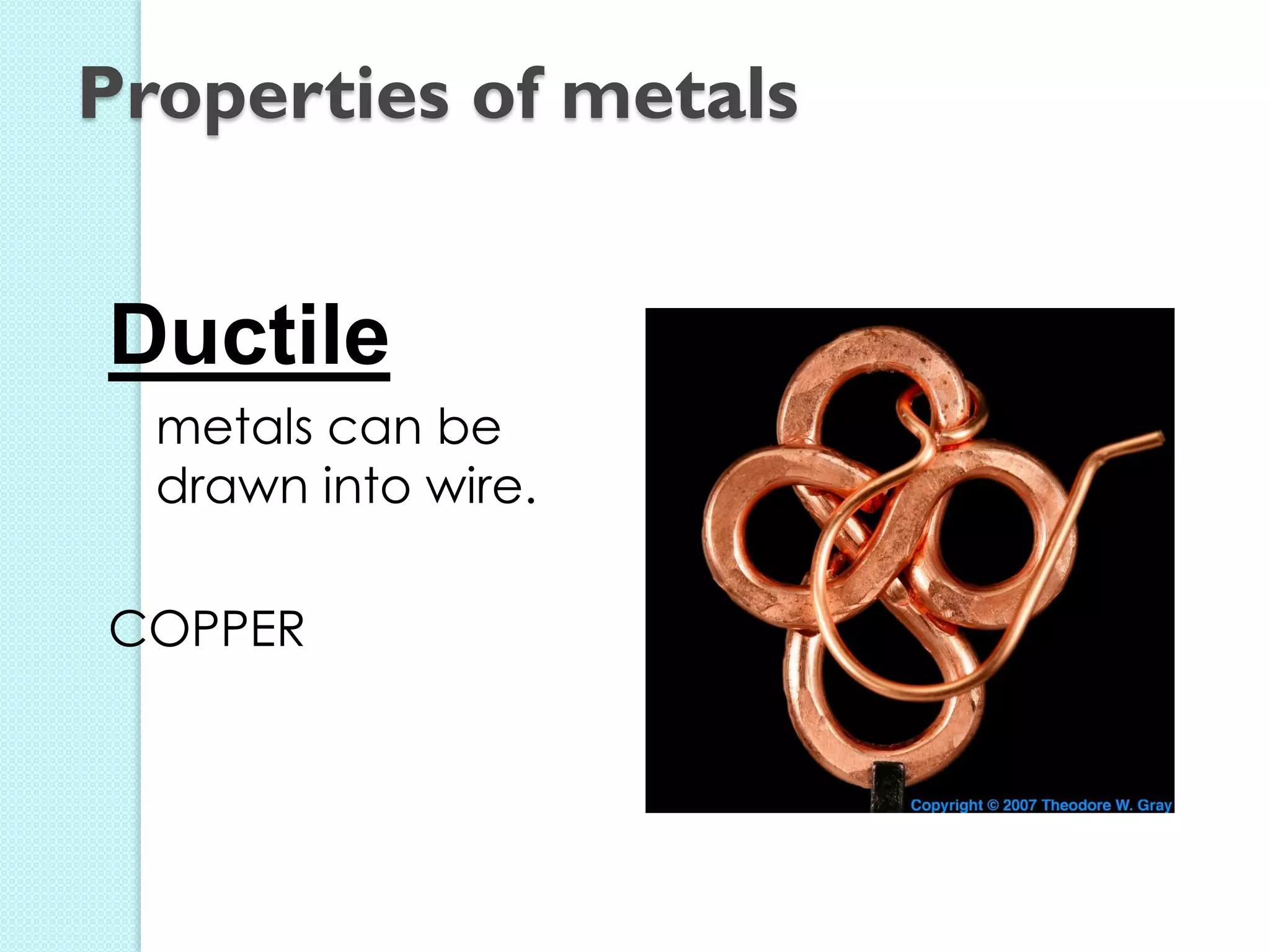
Ductile 
metals can be drawn into wire. 
COPPER 
Properties of metals
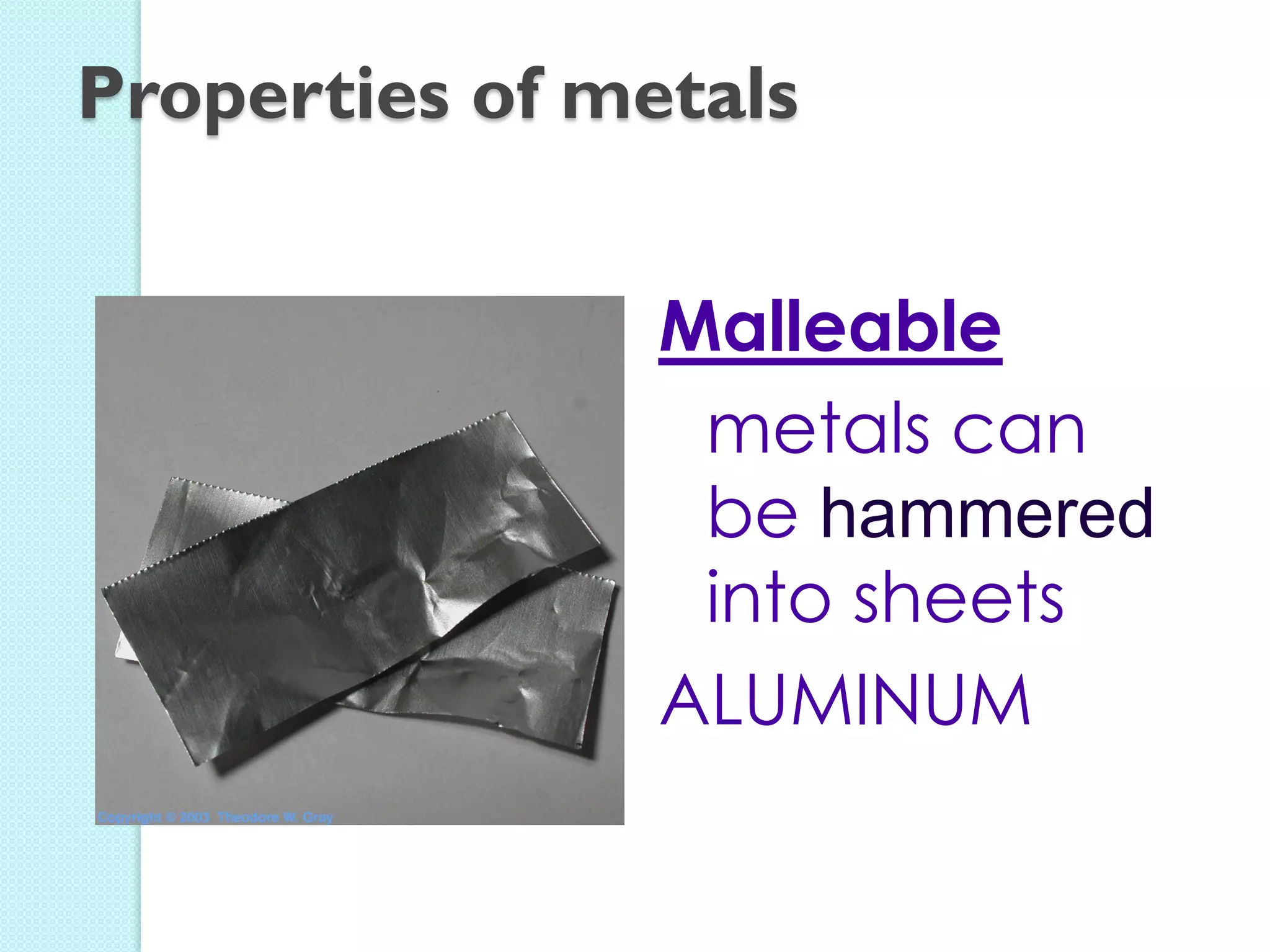
Malleable 
metals can be hammered into sheets 
ALUMINUM 
Properties of metals
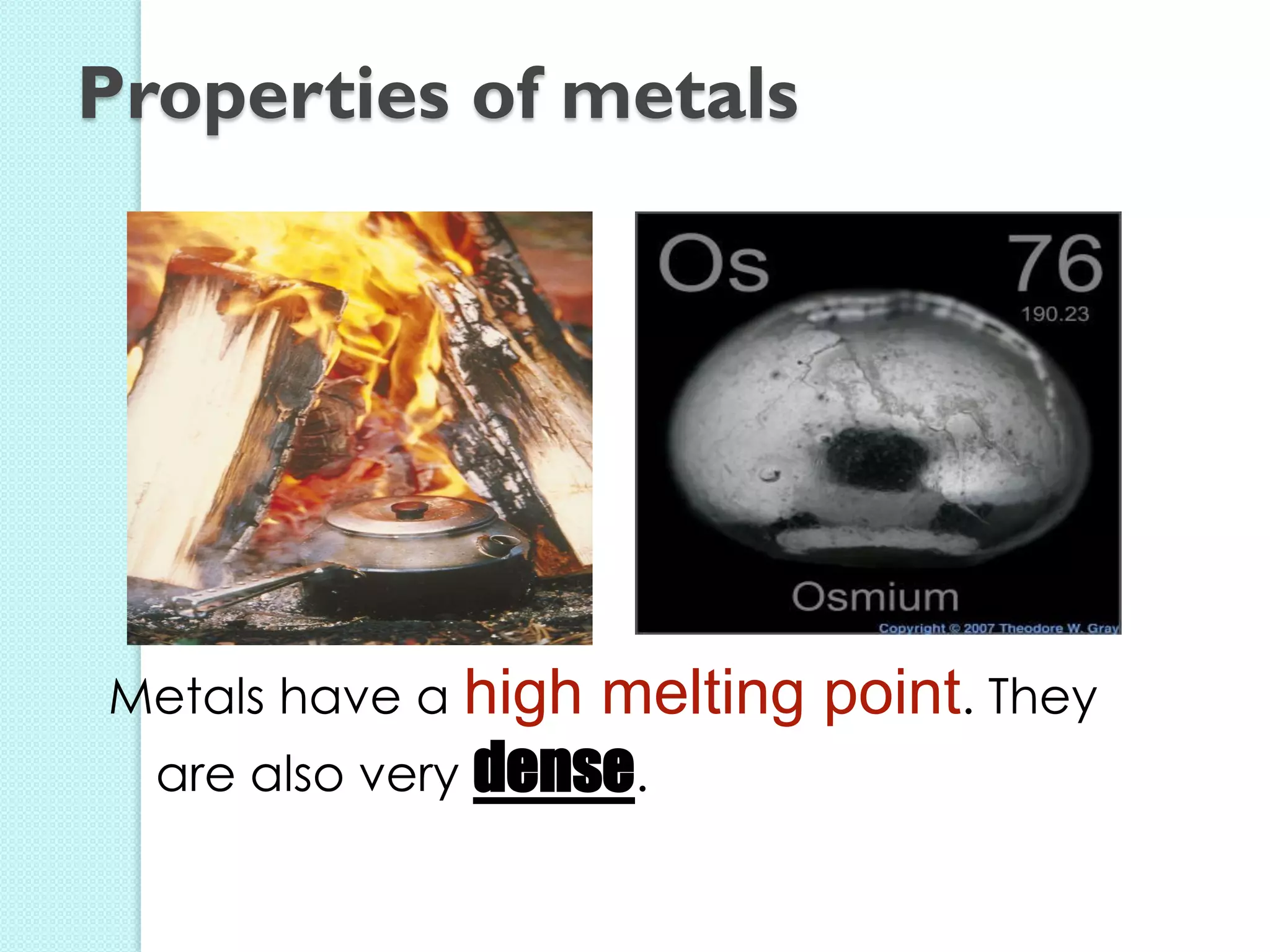
Metals have a high melting point. They are also very dense. 
Properties of metals
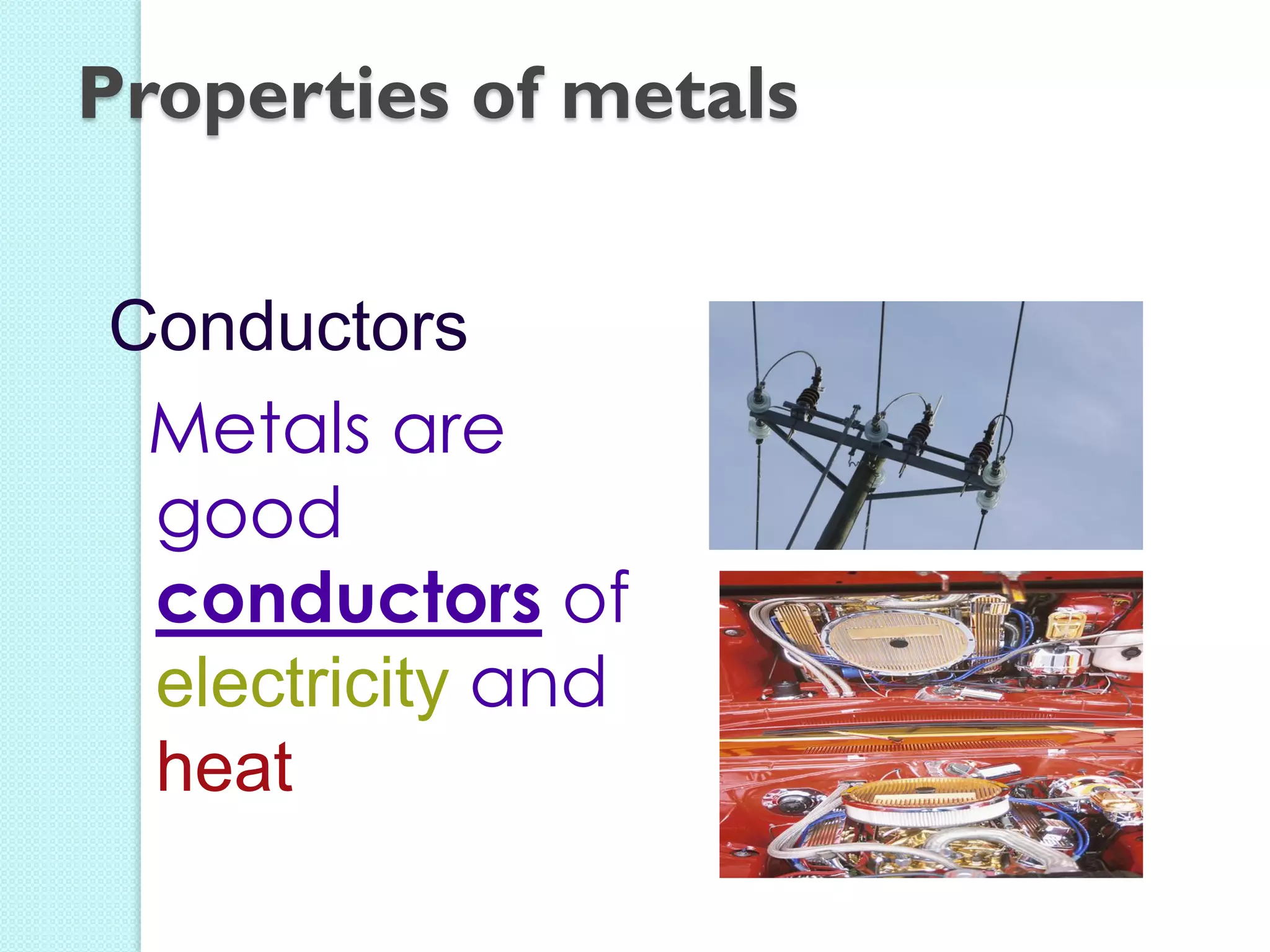
Conductors 
Metals are good conductors of electricity and heat 
Properties of metals
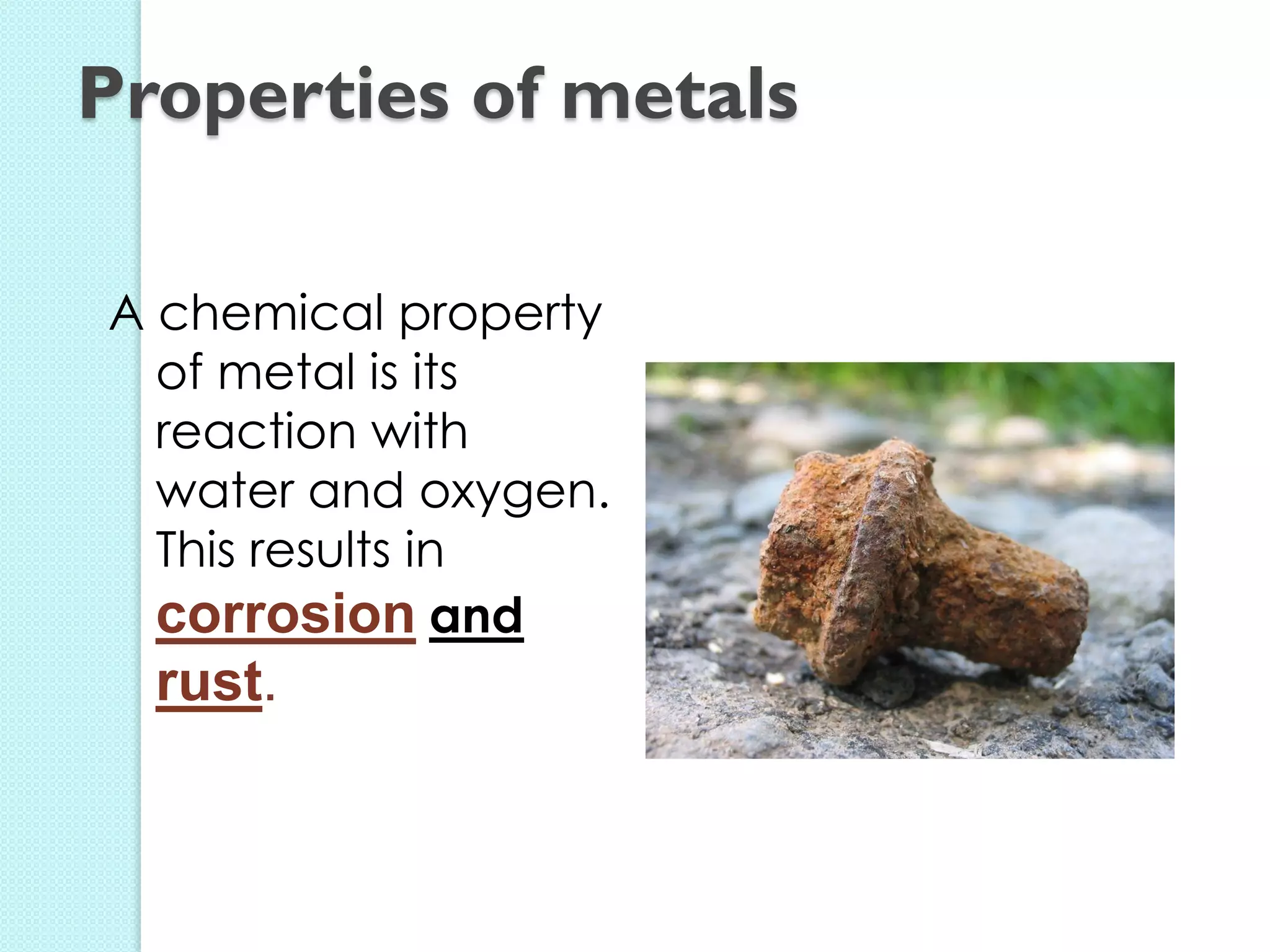
A chemical property of metal is its reaction with water and oxygen. This results in corrosion and rust. 
Properties of metals
Properties of metals 
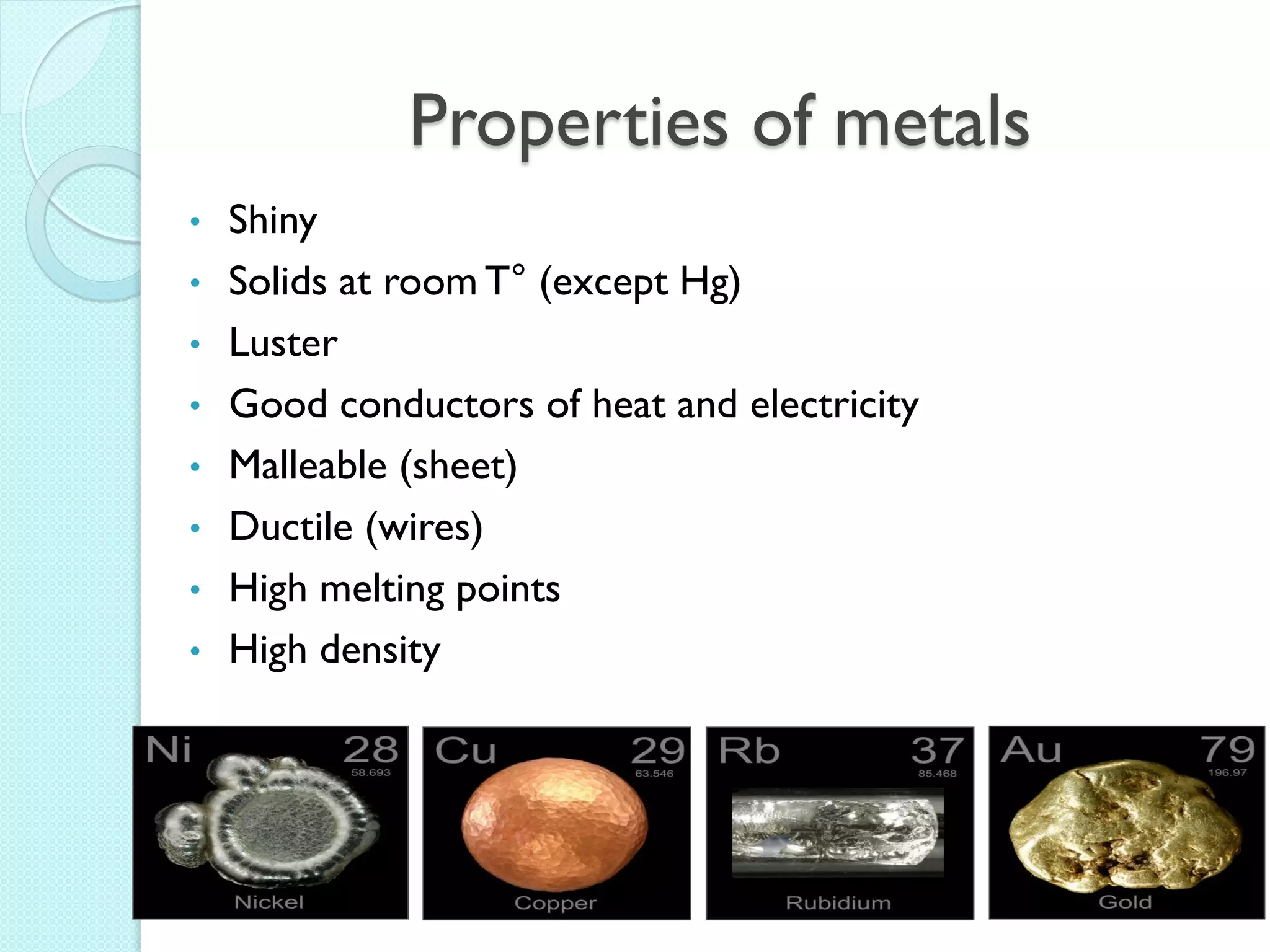
•Shiny 
•Solids at room T° (except Hg) 
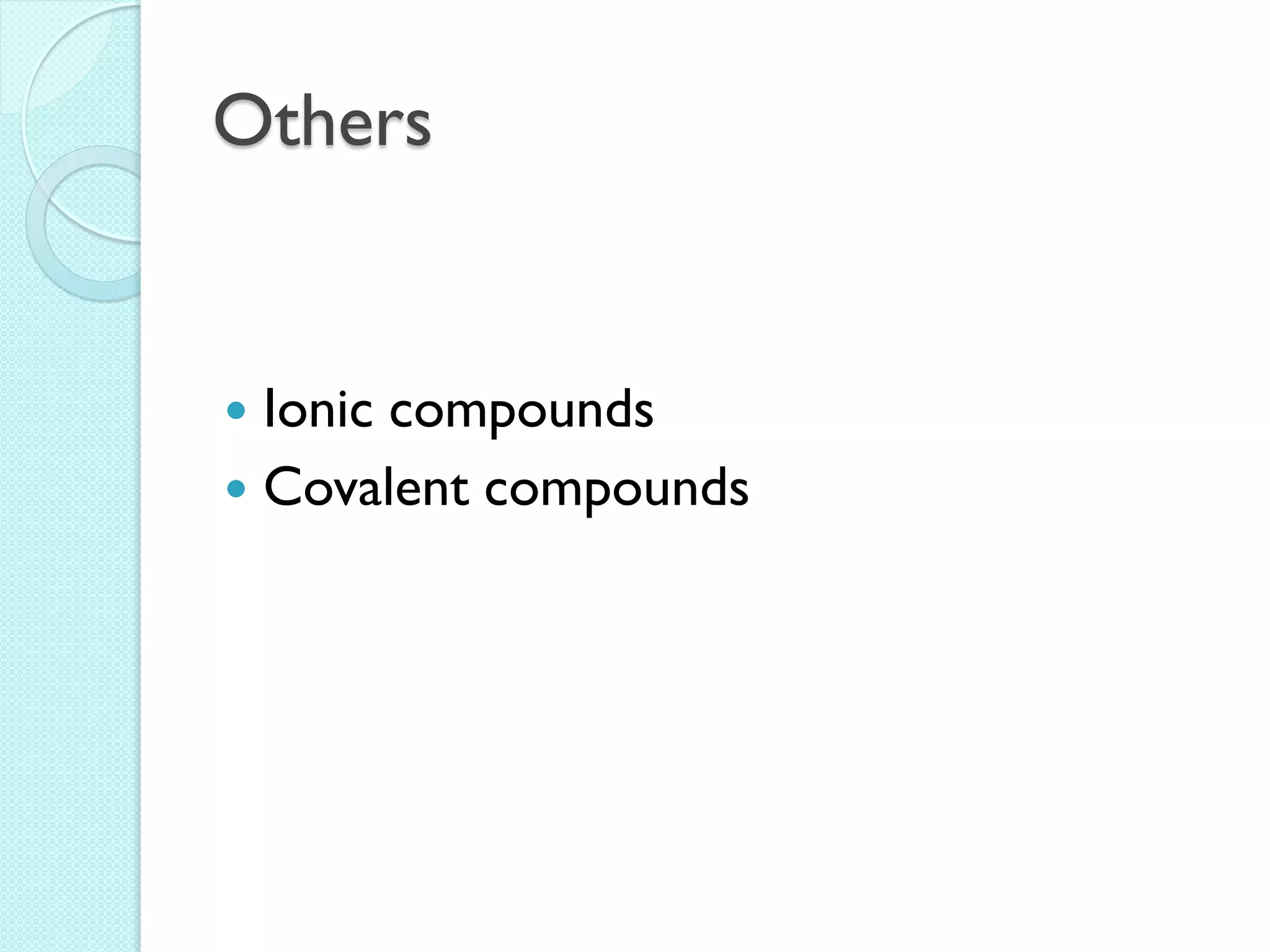
•Luster 
•Good conductors of heat and electricity 
•Malleable (sheet) 
•Ductile (wires) 
•High melting points 
•High density
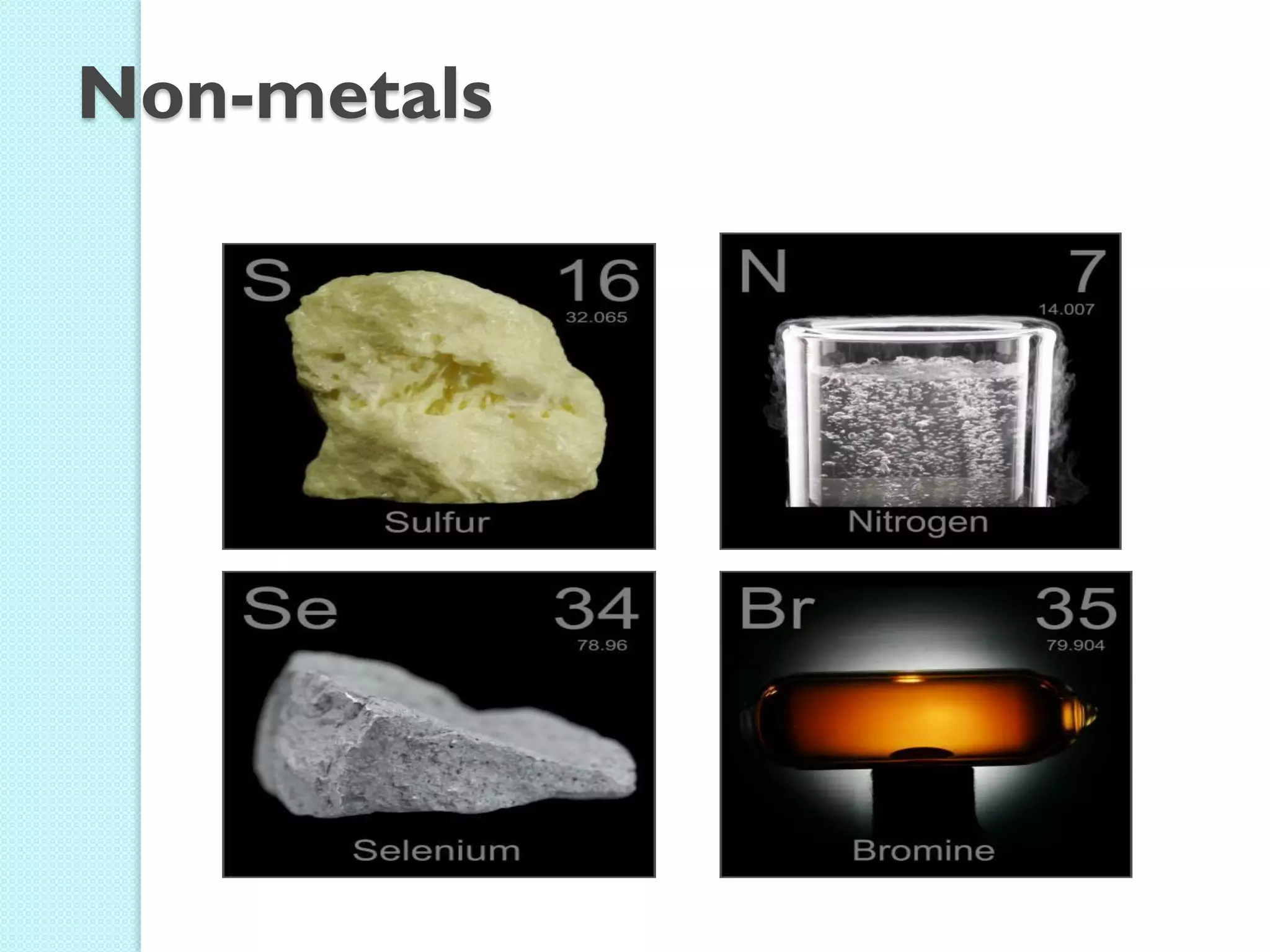
Non-metals
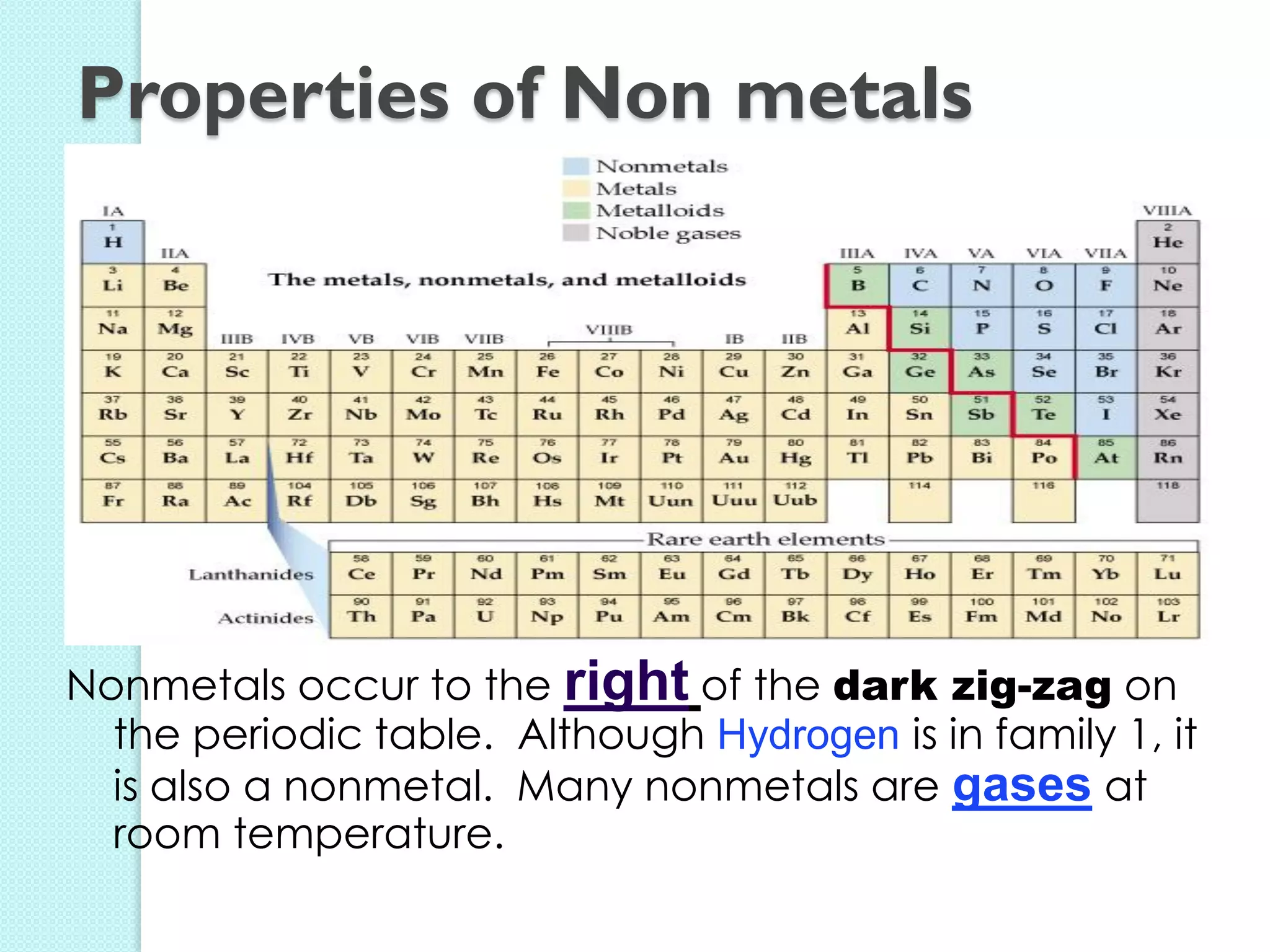
Nonmetals occur to the right of the dark zig-zag on the periodic table. Although Hydrogen is in family 1, it is also a nonmetal. Many nonmetals are gases at room temperature. 
Properties of Non metals
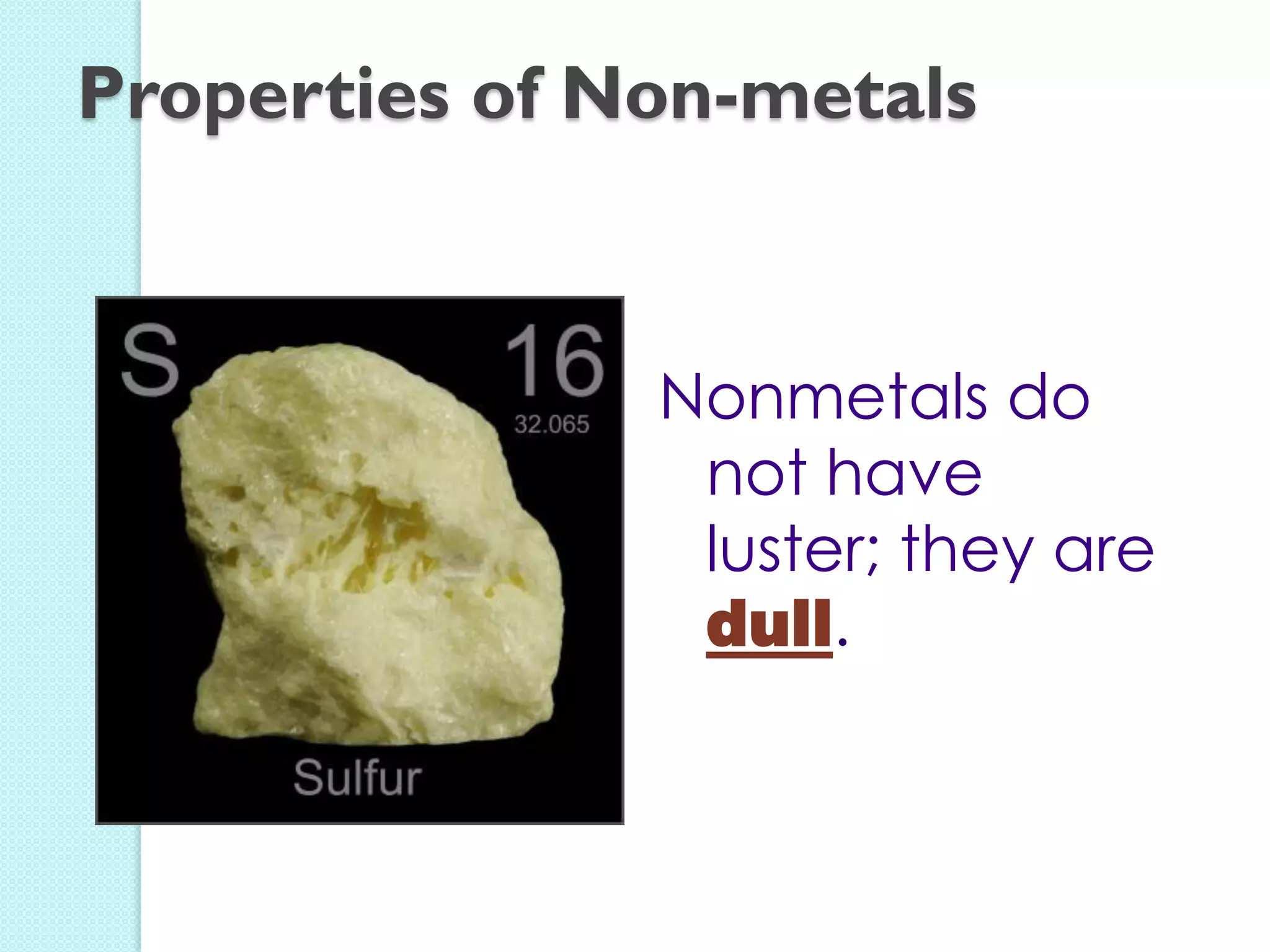
Nonmetals do not have luster; they are dull. 
Properties of Non-metals
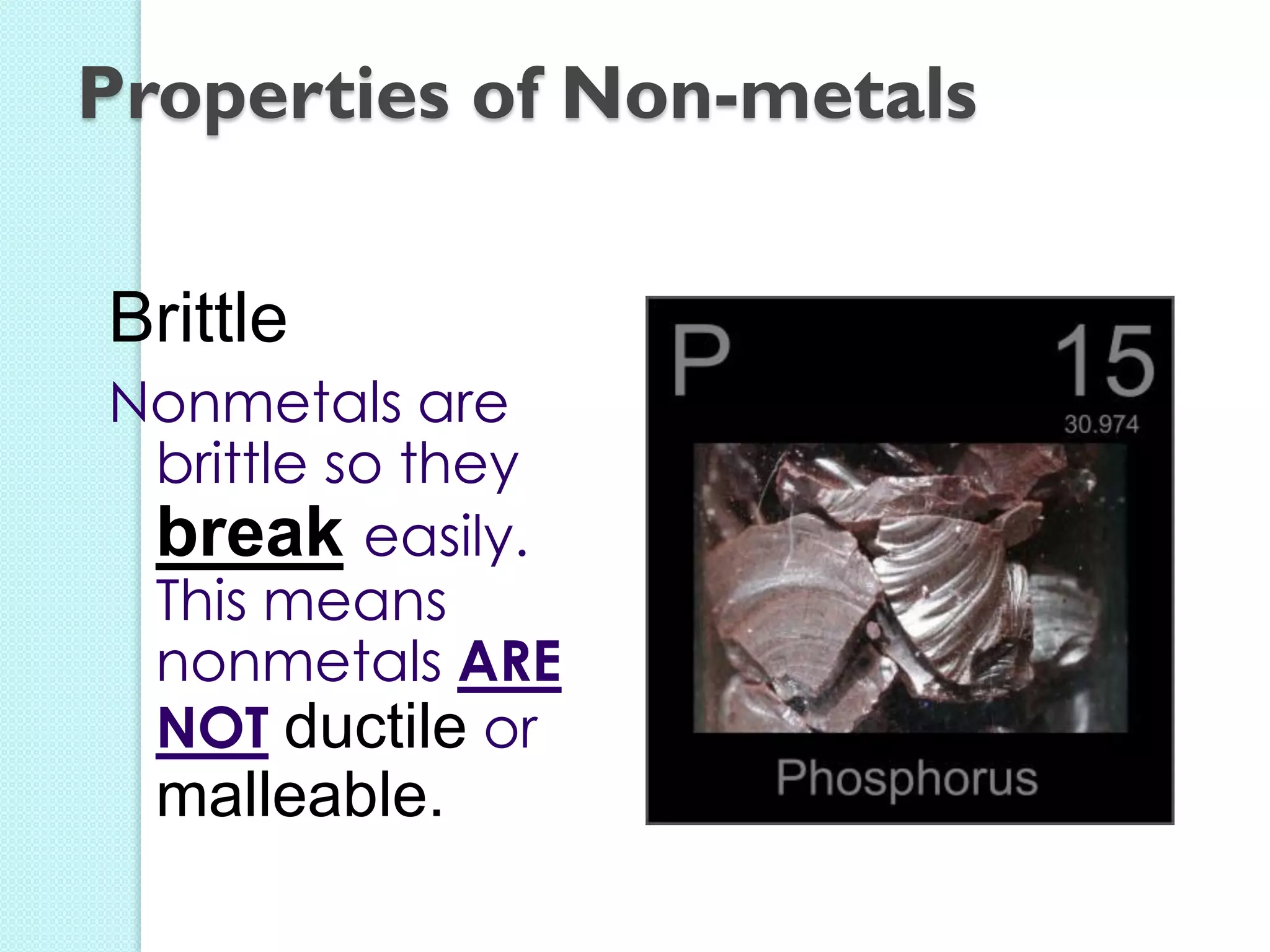
Brittle 
Nonmetals are brittle so they break easily. This means nonmetals ARE NOT ductile or malleable. 
Properties of Non-metals
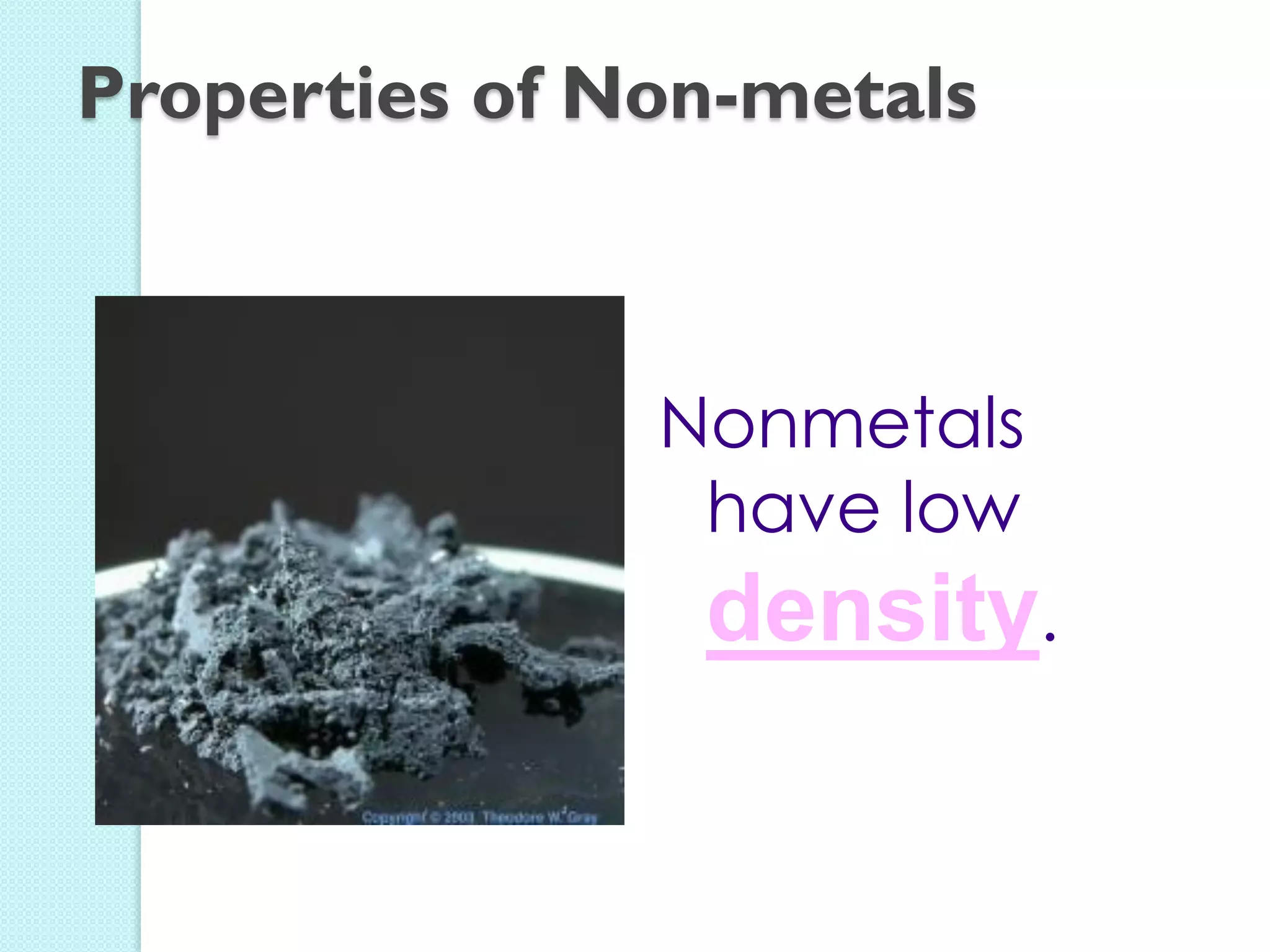
Nonmetals have low density. 
Properties of Non-metals
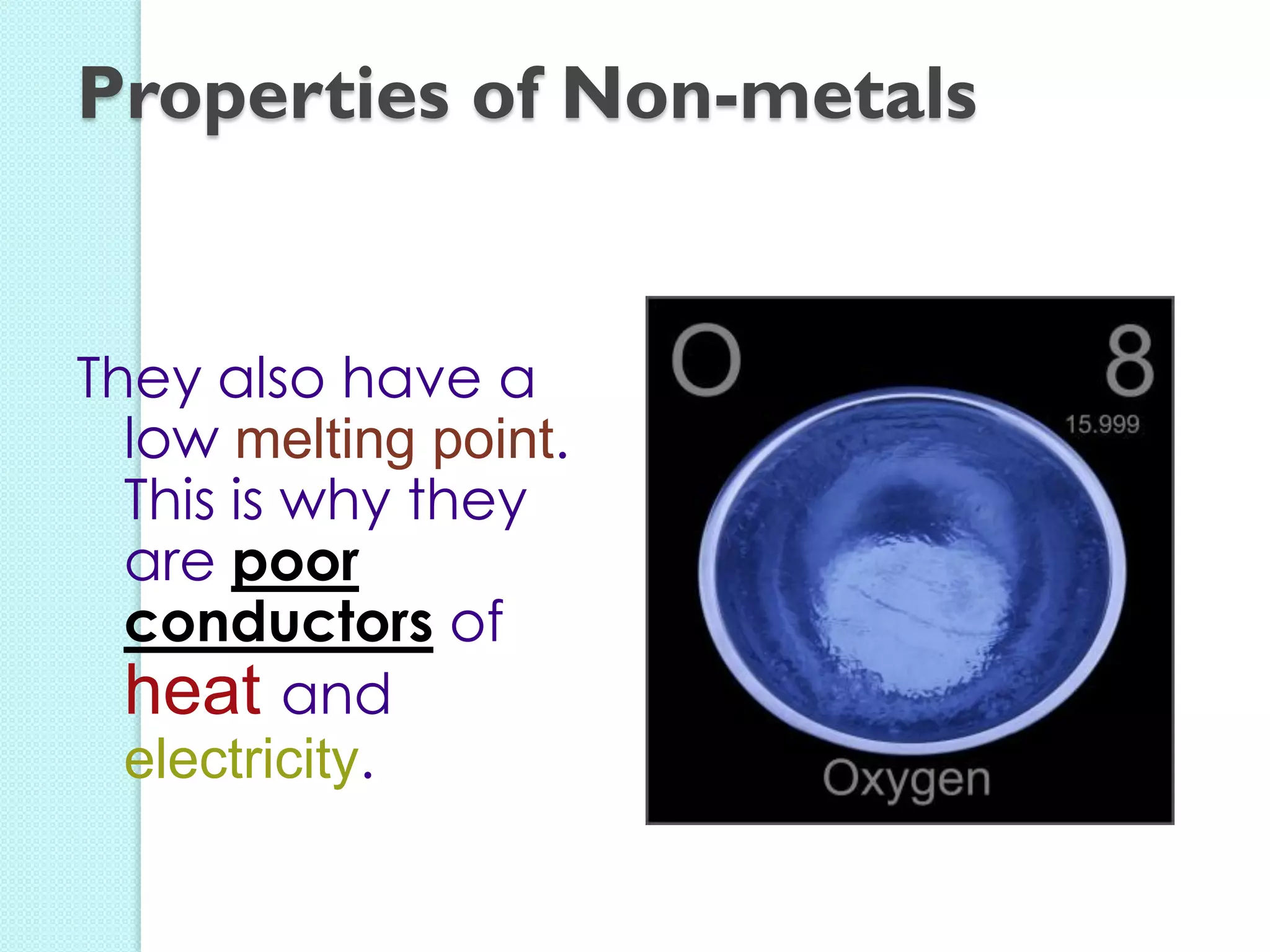
They also have a low melting point. This is why they are poor conductors of heat and electricity. 
Properties of Non-metals
Properties of nonmetals 
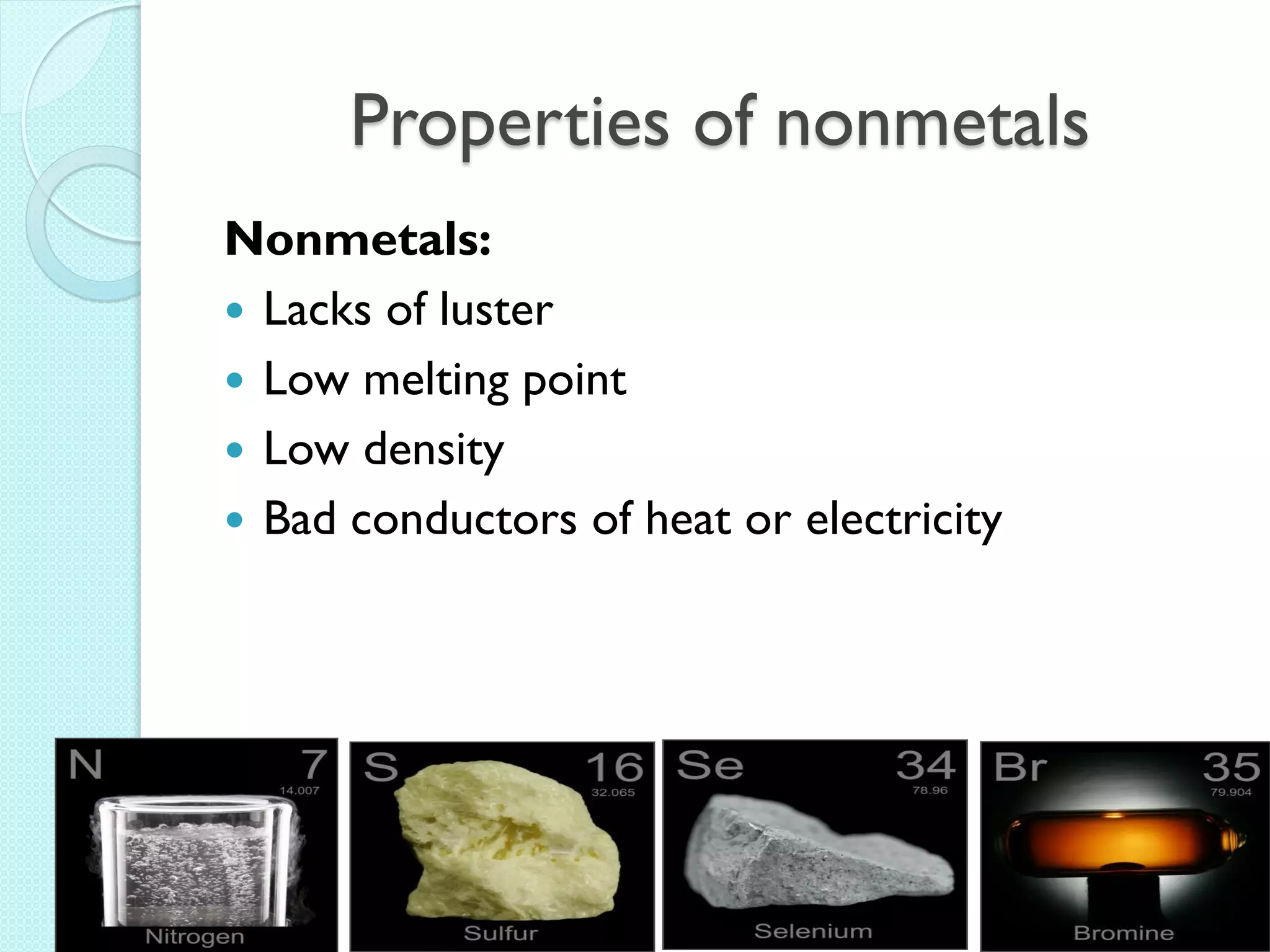
Nonmetals: 
Lacks of luster 
Low melting point 
Low density 
Bad conductors of heat or electricity
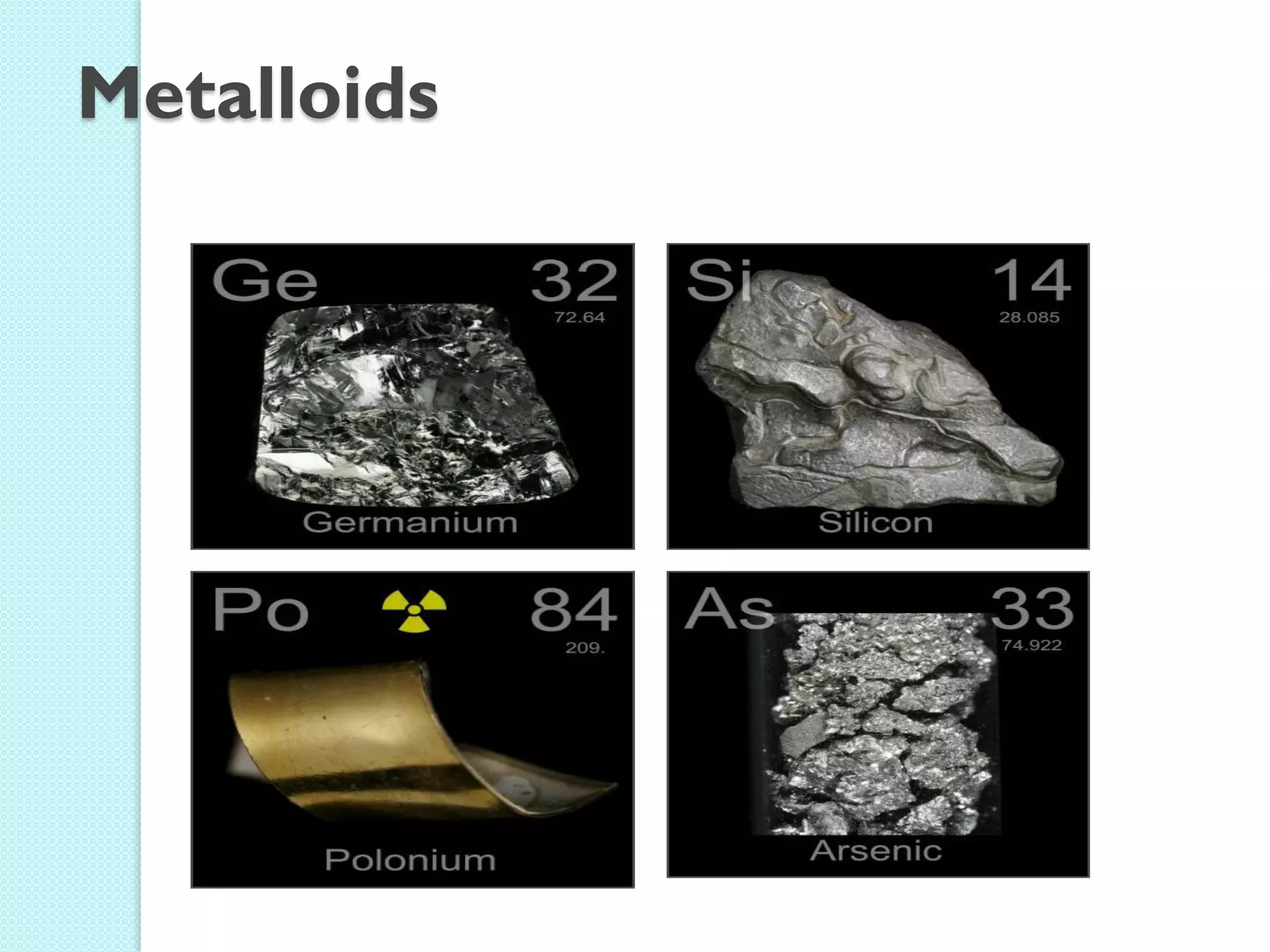
Metalloids
Metalloids can be found clustered around the dark zig-zag line that separates metals and nonmetals. 
Properties of Metalloids
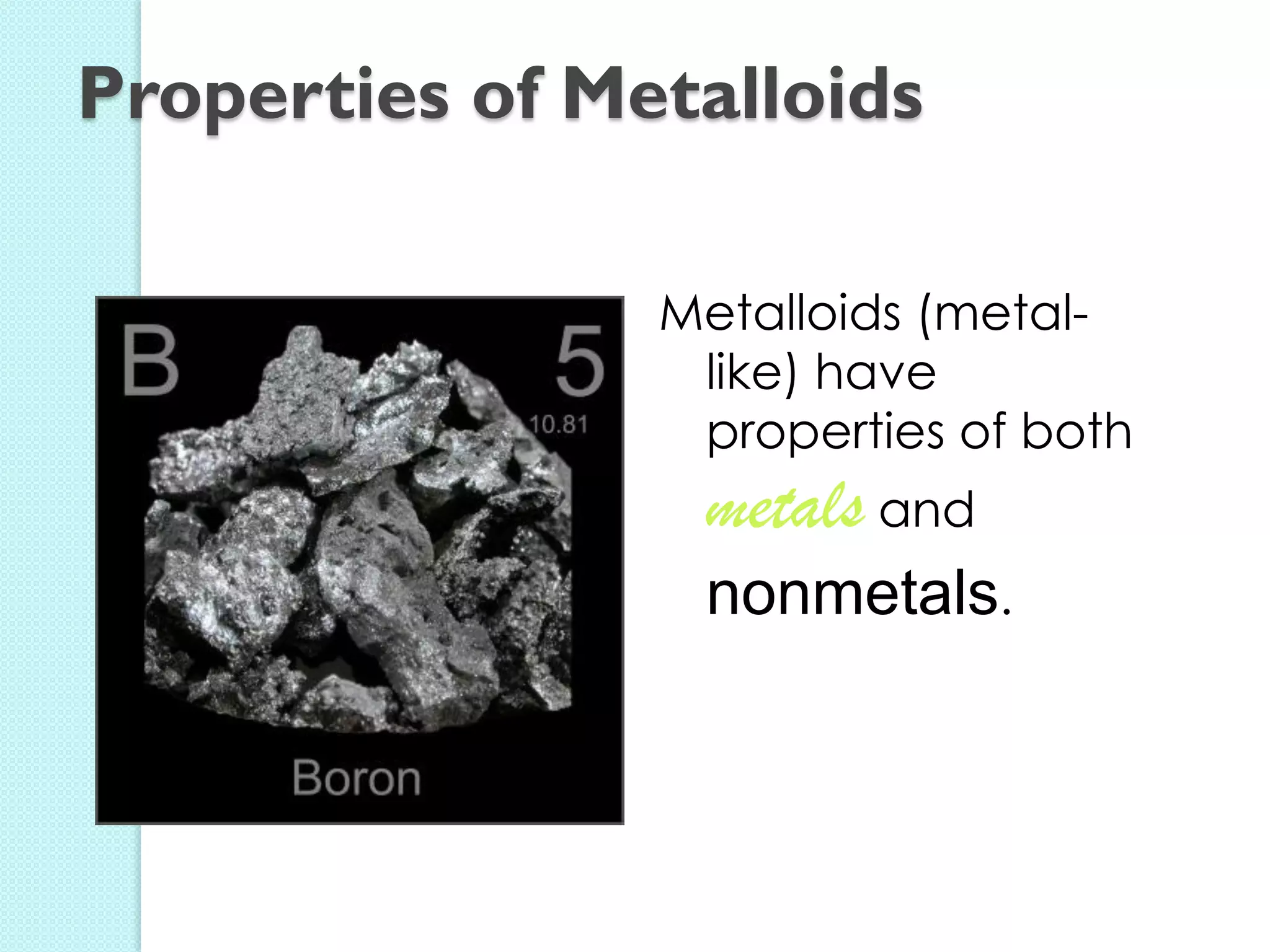
Metalloids (metal- like) have properties of both metals and nonmetals. 
Properties of Metalloids
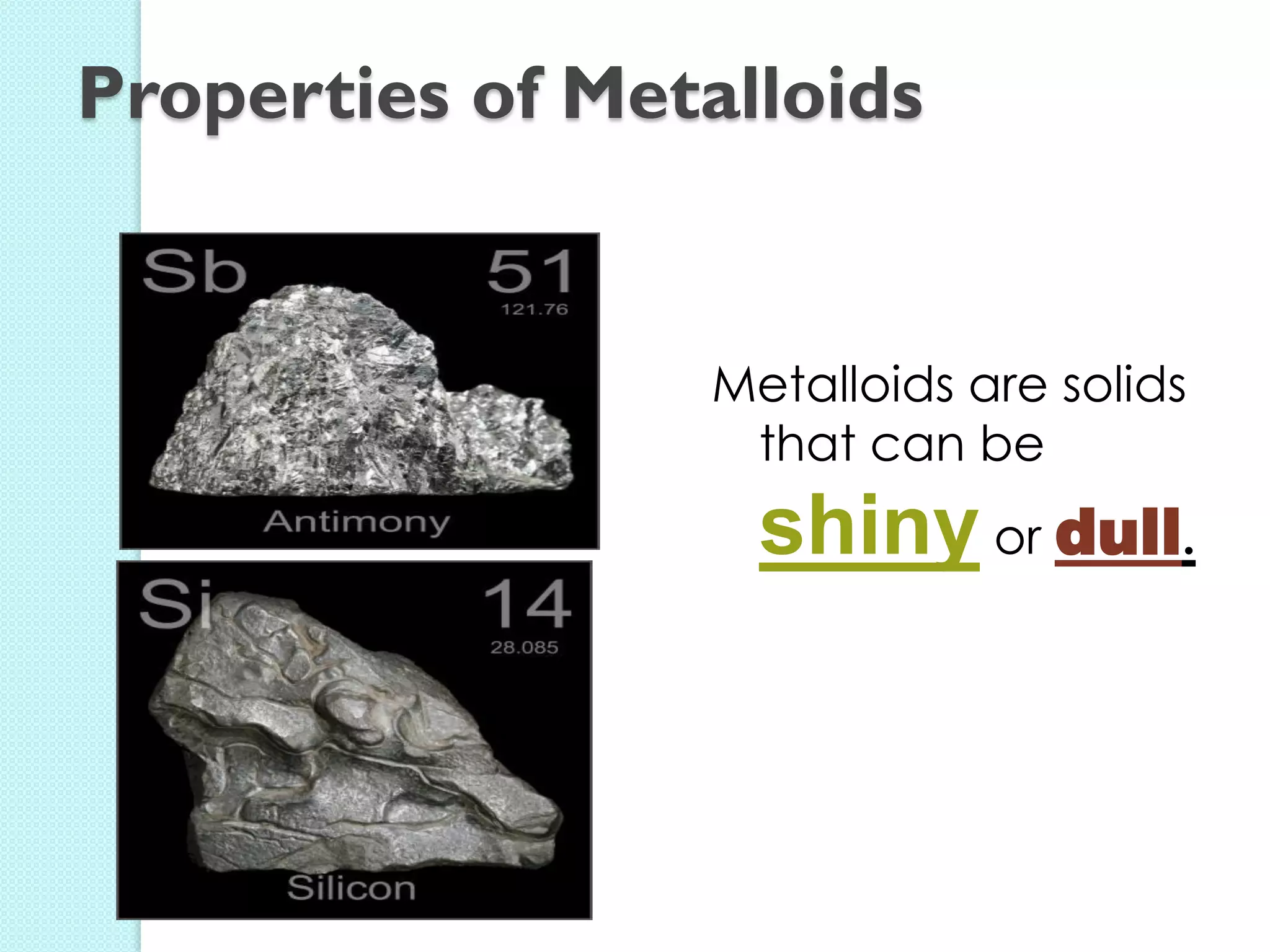
Metalloids are solids that can be shiny or dull. 
Properties of Metalloids
They conduct electricity and heat better than nonmetals but not as well as metals. 
Properties of Metalloids
Properties of Metalloids 
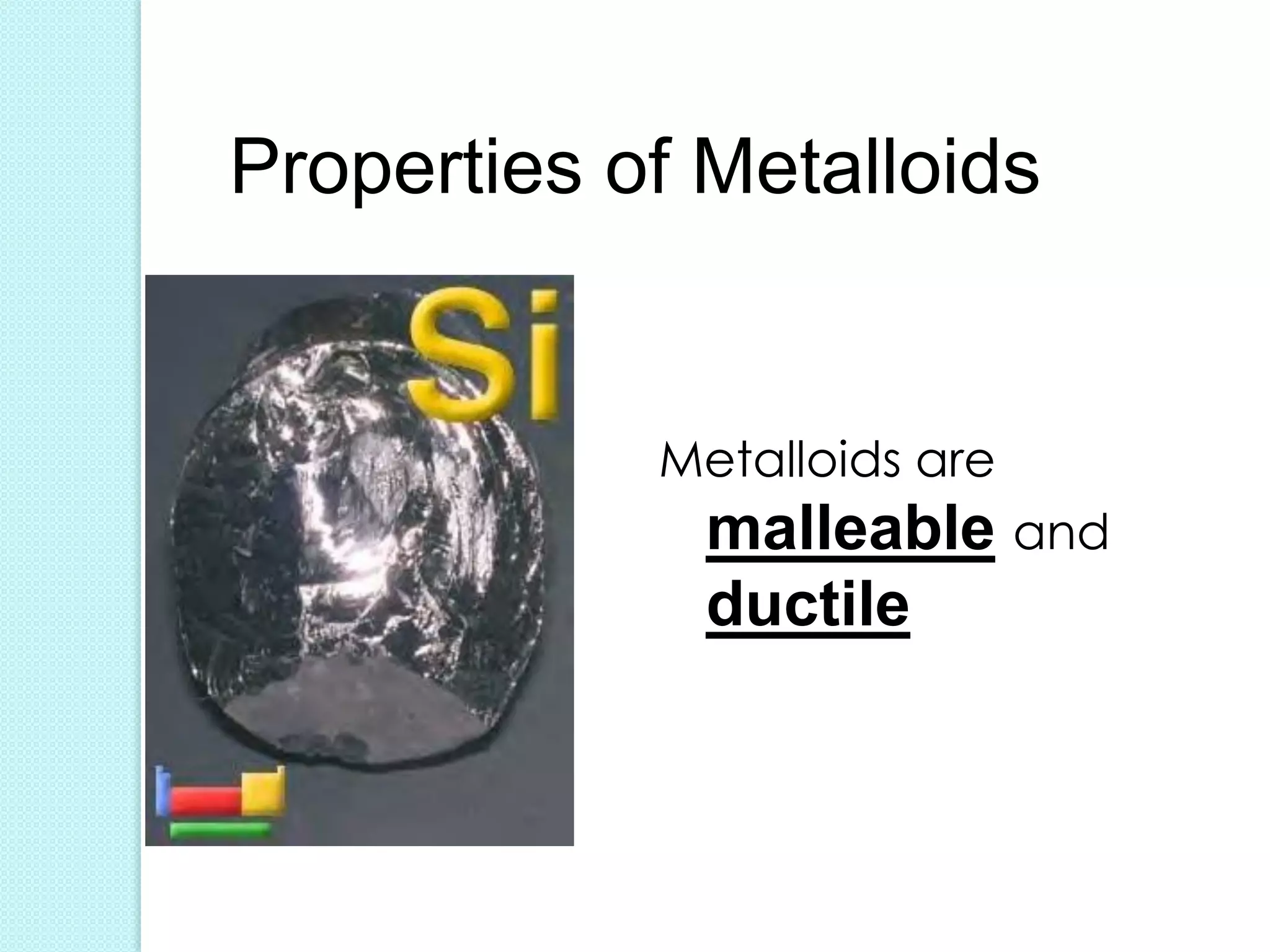
Metalloids are malleable and ductile
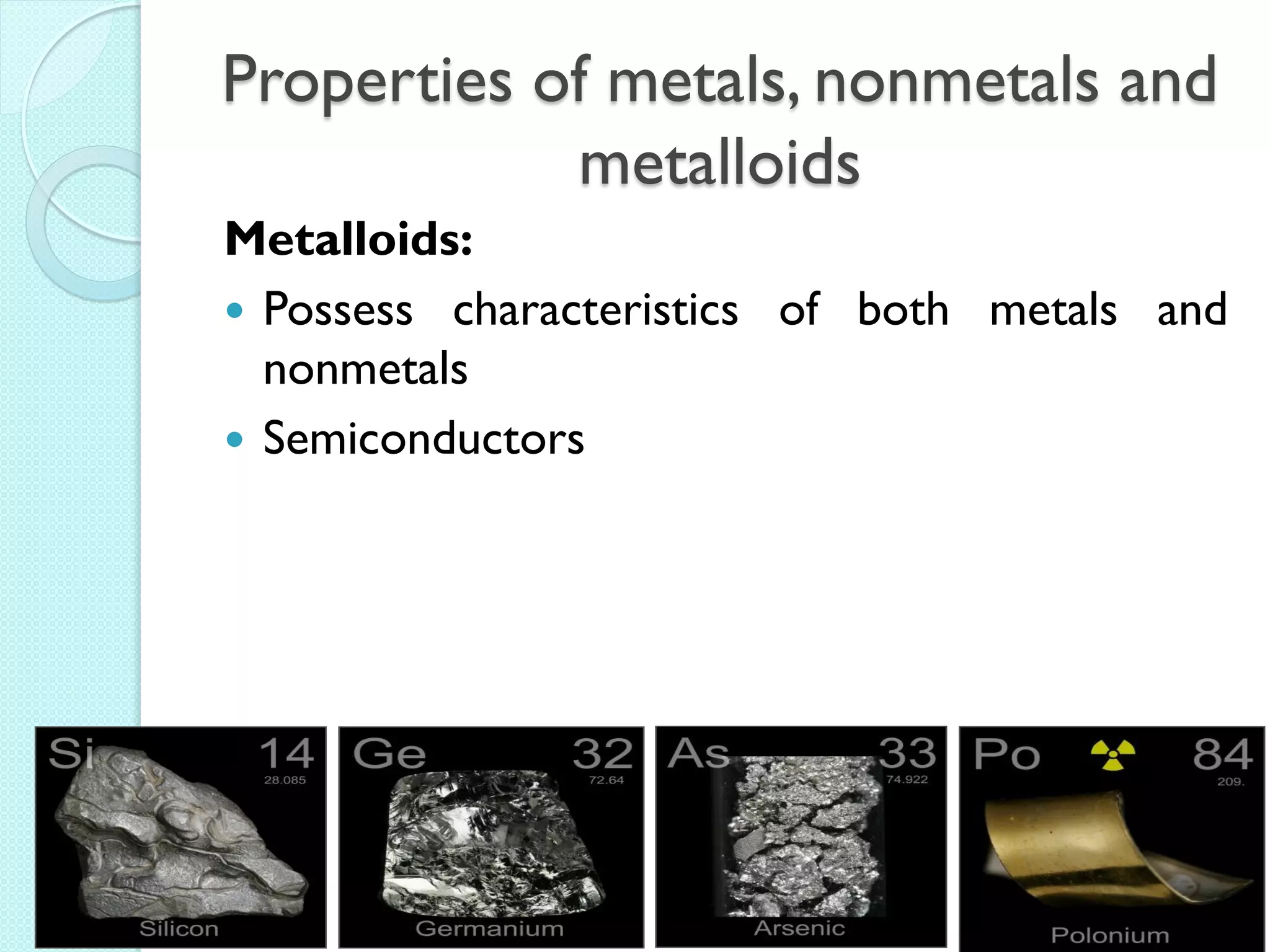
Properties of metals, nonmetals and metalloids 
Metalloids: 
Possess characteristics of both metals and nonmetals 
Semiconductors
Summary
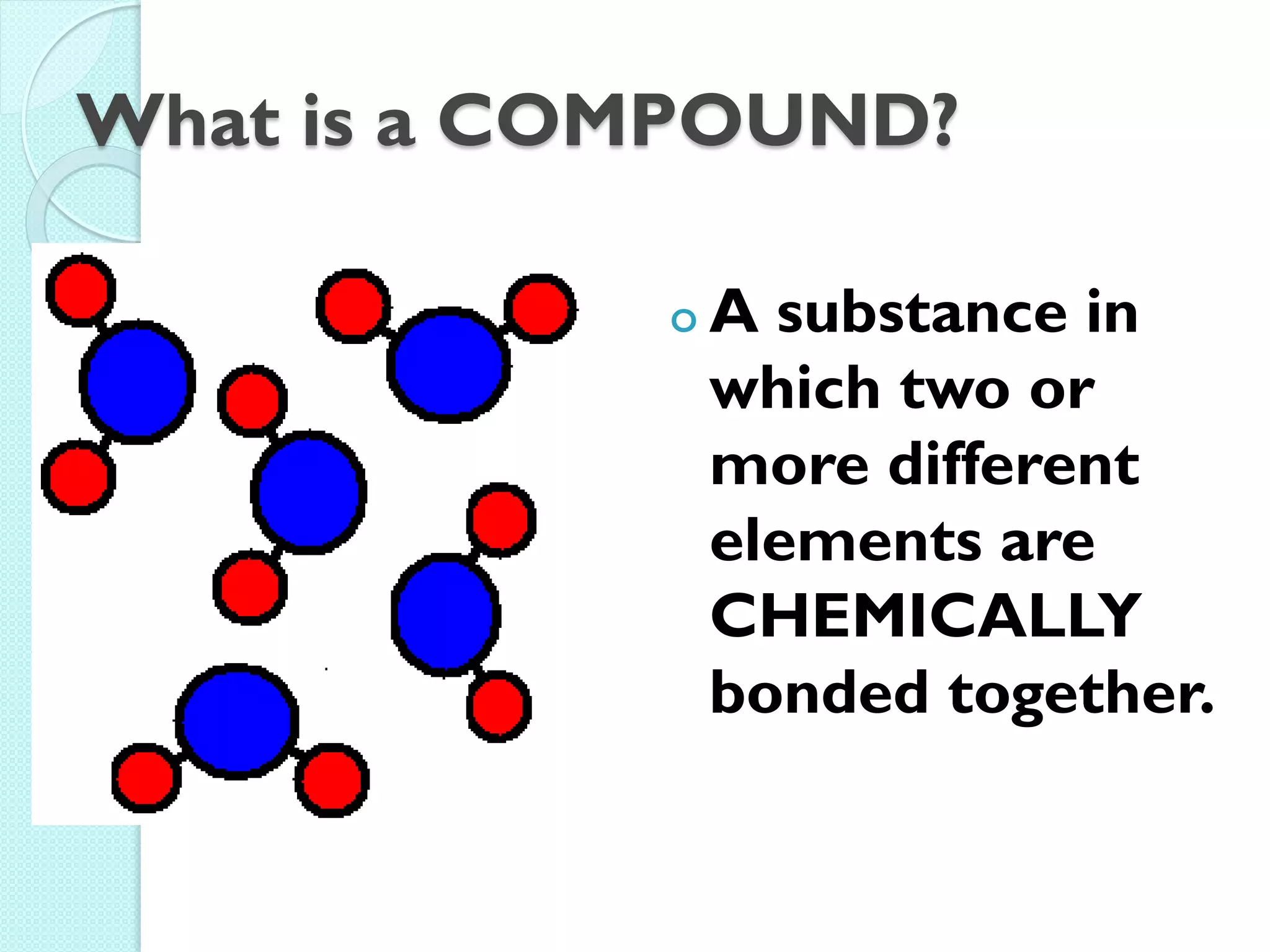
What is a COMPOUND? 
oA substance in which two or more different elements are CHEMICALLY bonded together.
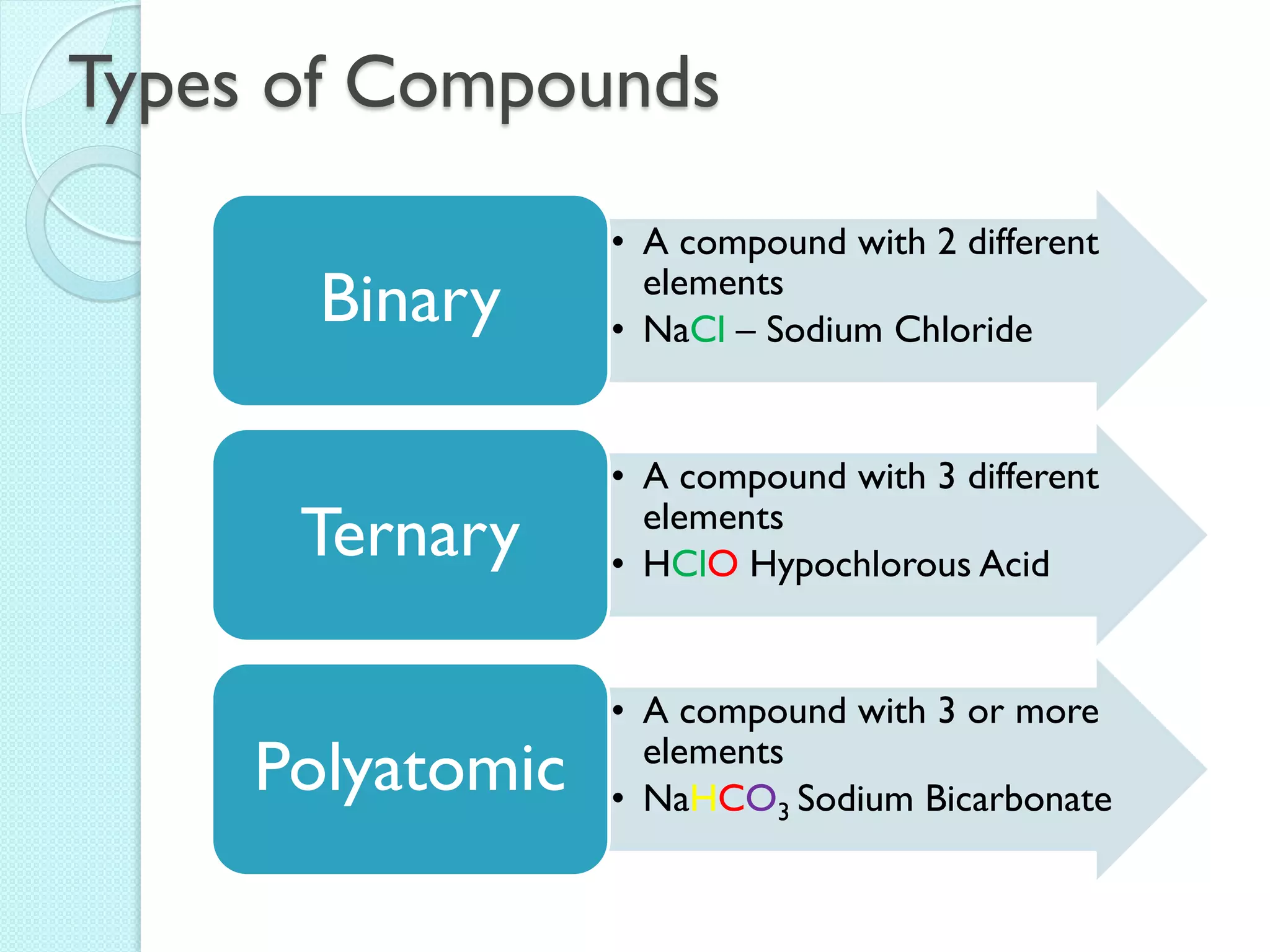
Types of Compounds 
•A compound with 2 different elements 
•NaCl – Sodium Chloride 
Binary 
•A compound with 3 different elements 
•HClO Hypochlorous Acid 
Ternary 
•A compound with 3 or more elements 
•NaHCO3 Sodium Bicarbonate 
Polyatomic
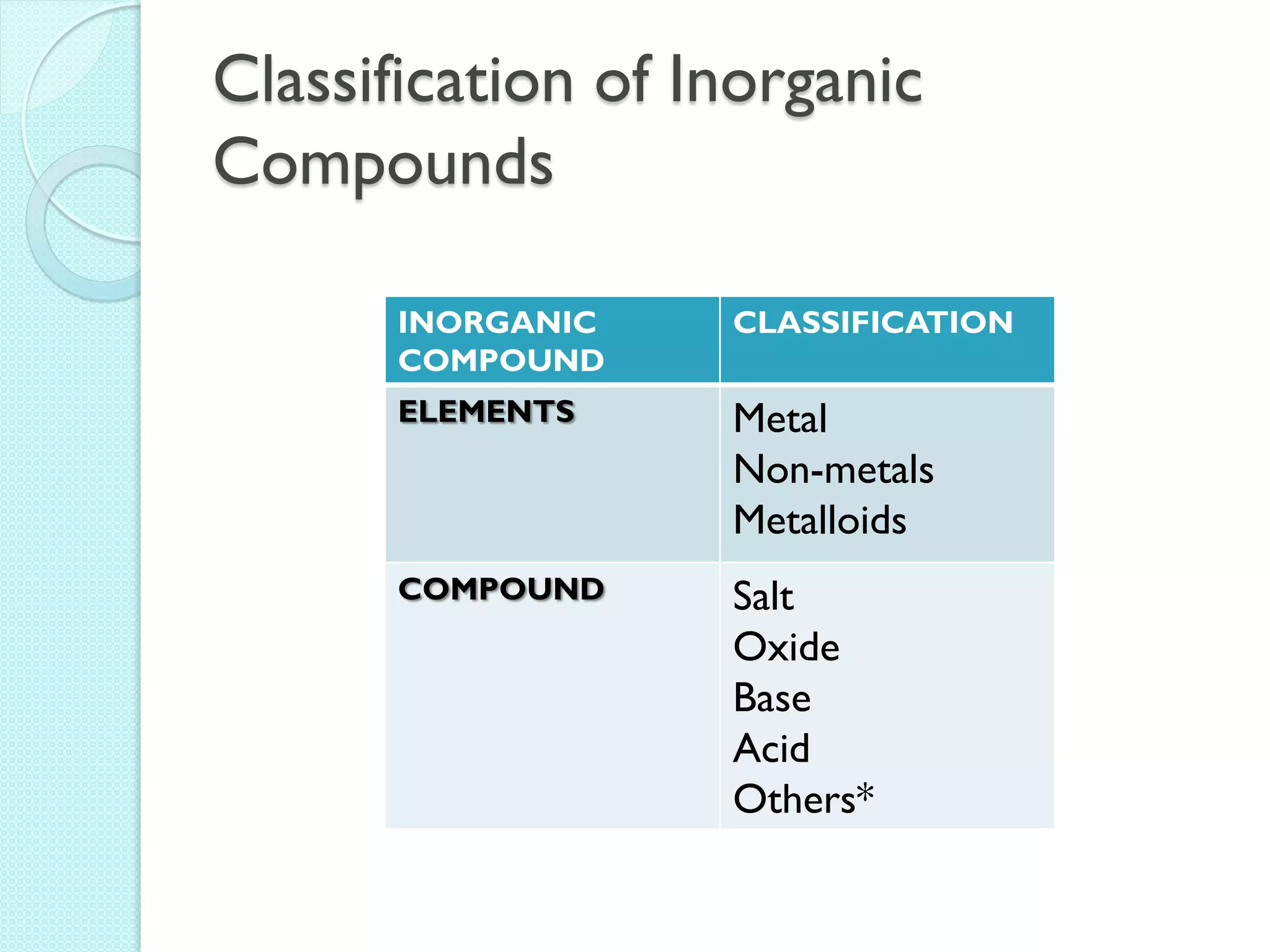
Classification of Inorganic Compounds 
INORGANIC COMPOUND 
CLASSIFICATION 
ELEMENTS 
Metal 
Non-metals 
Metalloids 
COMPOUND 
Salt 
Oxide 
Base 
Acid 
Others*
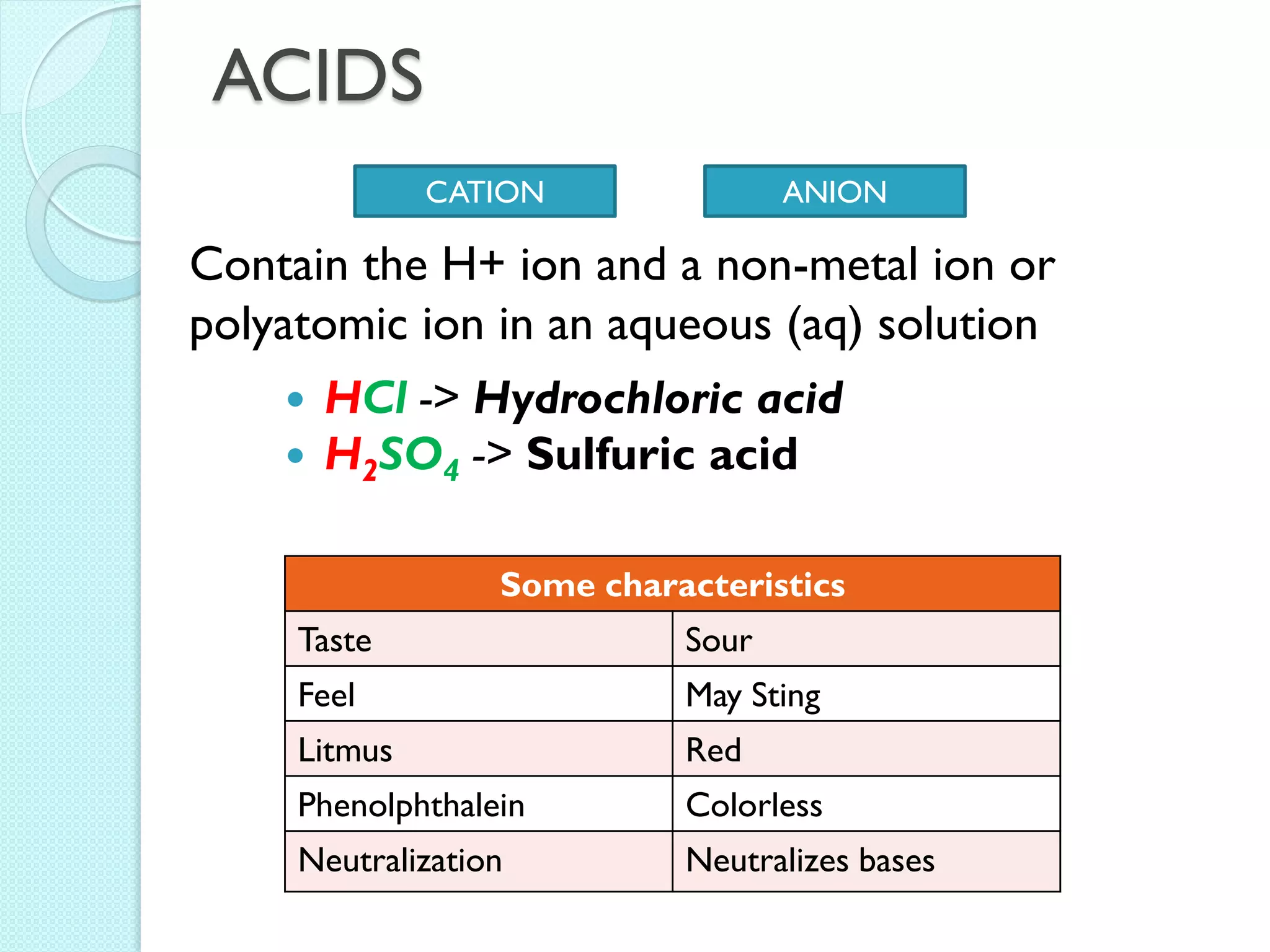
ACIDS 
Contain the H+ ion and a non-metal ion or polyatomic ion in an aqueous (aq) solution 
CATION 
ANION 
HCl -> Hydrochloric acid 
H2SO4 -> Sulfuric acid 
Some characteristics 
Taste 
Sour 
Feel 
May Sting 
Litmus 
Red 
Phenolphthalein 
Colorless 
Neutralization 
Neutralizes bases
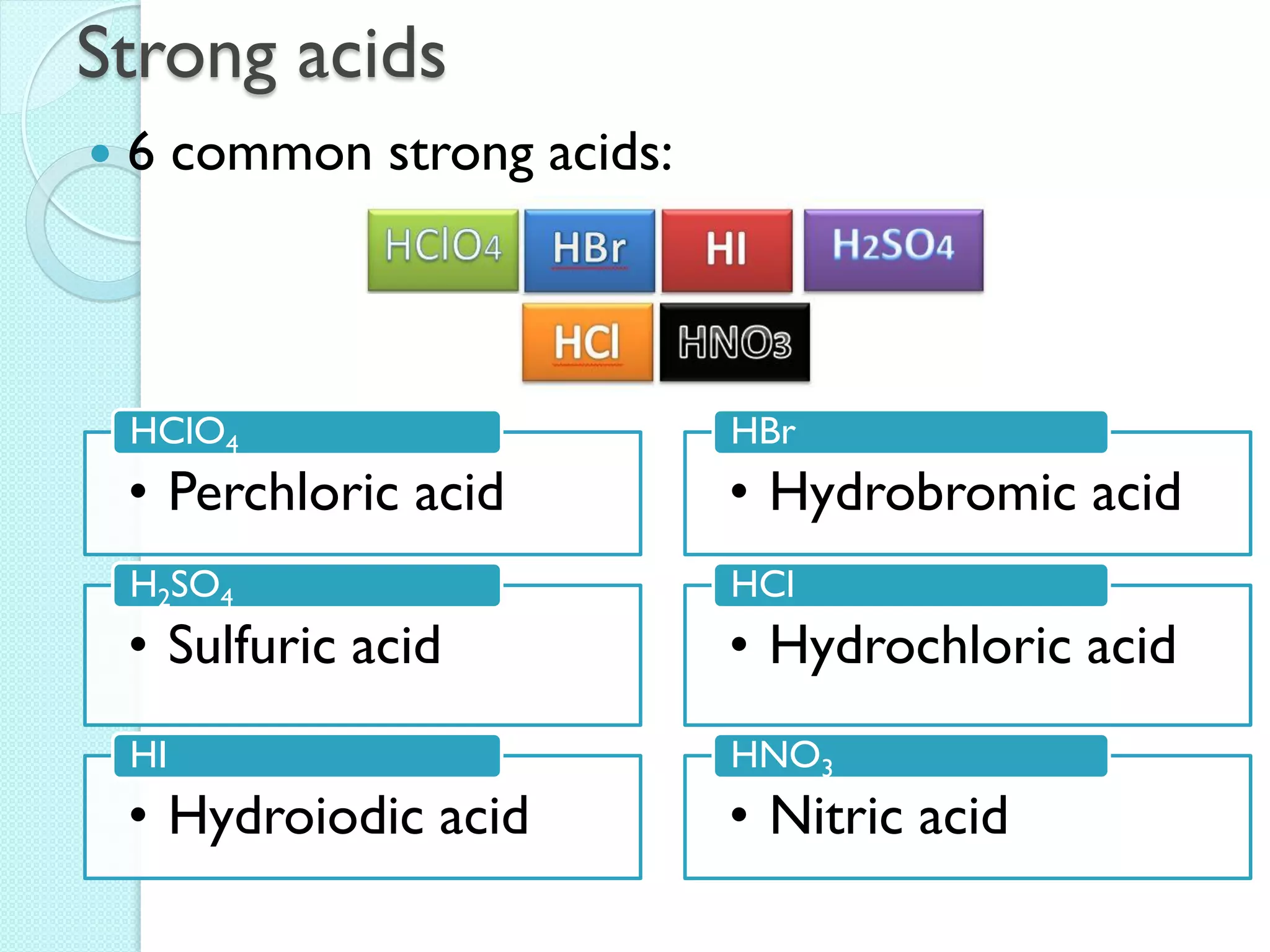
Strong acids 
6 common strong acids: 
•Perchloric acid 
HClO4 
•Sulfuric acid 
H2SO4 
•Hydroiodic acid 
HI 
•Hydrobromic acid 
HBr 
•Hydrochloric acid 
HCl 
•Nitric acid 
HNO3
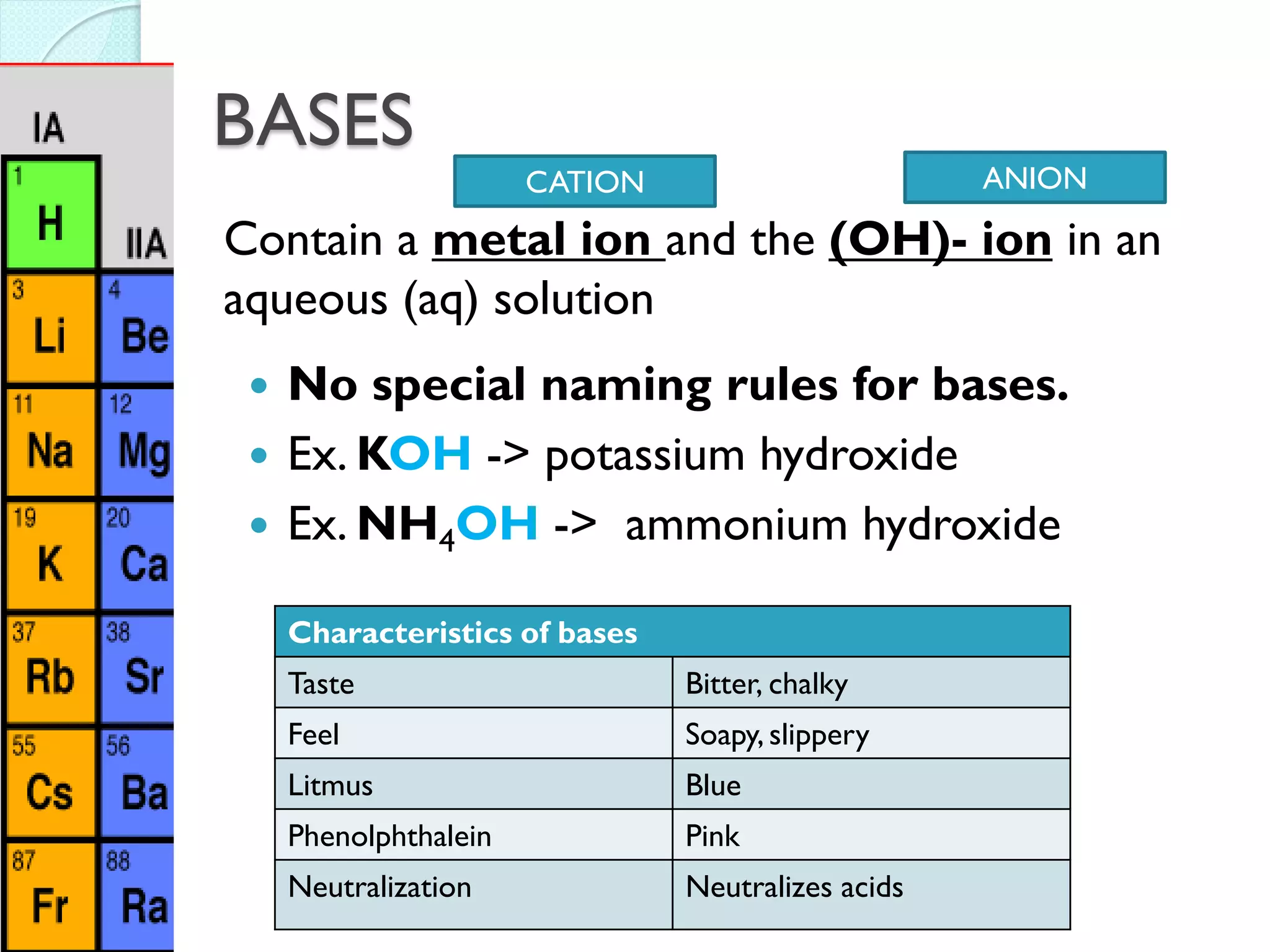
BASES 
Contain a metal ion and the (OH)- ion in an aqueous (aq) solution 
CATION 
ANION 
Characteristics of bases 
Taste 
Bitter, chalky 
Feel 
Soapy, slippery 
Litmus 
Blue 
Phenolphthalein 
Pink 
Neutralization 
Neutralizes acids 
No special naming rules for bases. 
Ex. KOH -> potassium hydroxide 
Ex. NH4OH -> ammonium hydroxide
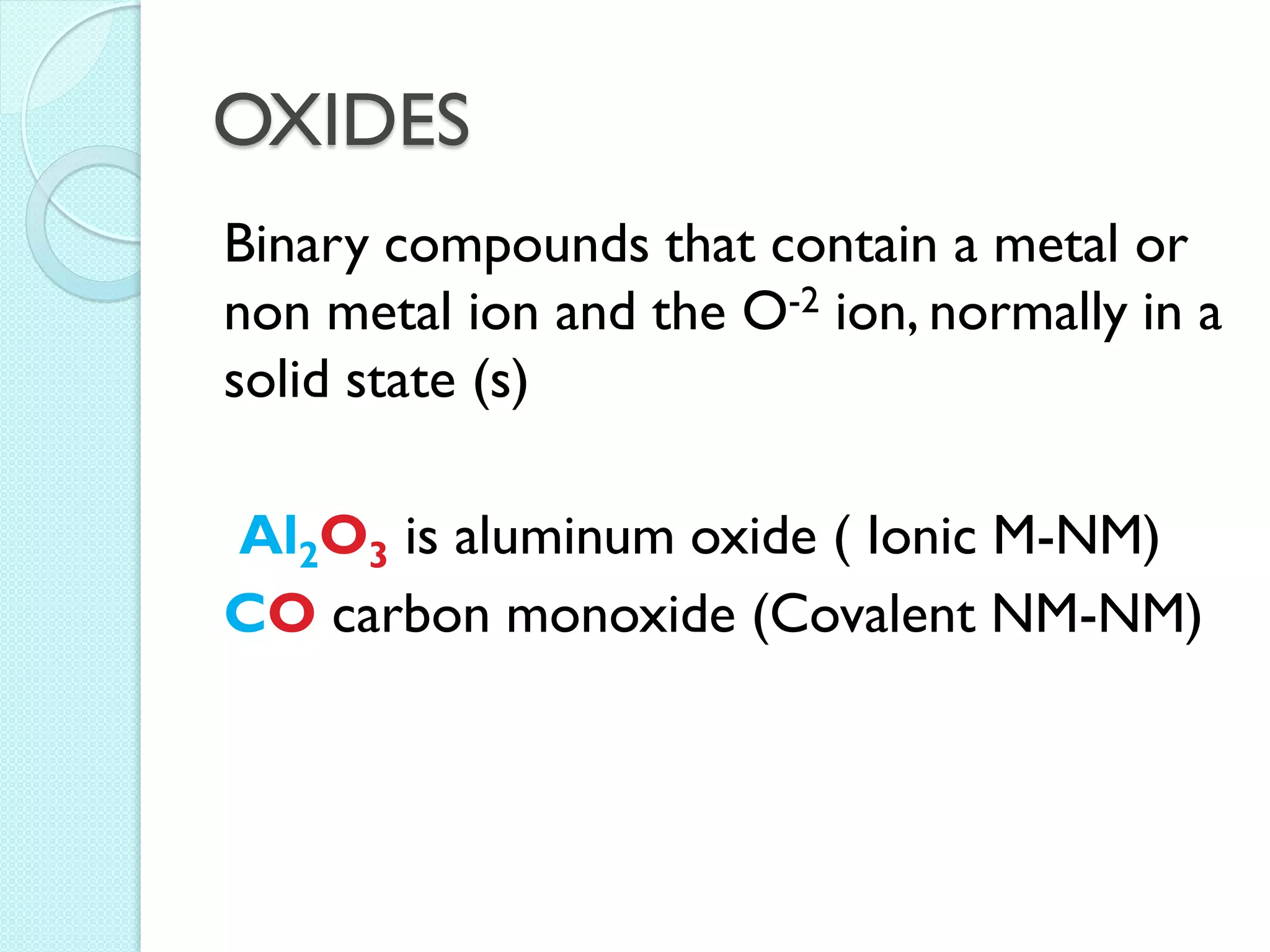
OXIDES 
Binary compounds that contain a metal or non metal ion and the O-2 ion, normally in a solid state (s) 
Al2O3 is aluminum oxide ( Ionic M-NM) 
CO carbon monoxide (Covalent NM-NM)
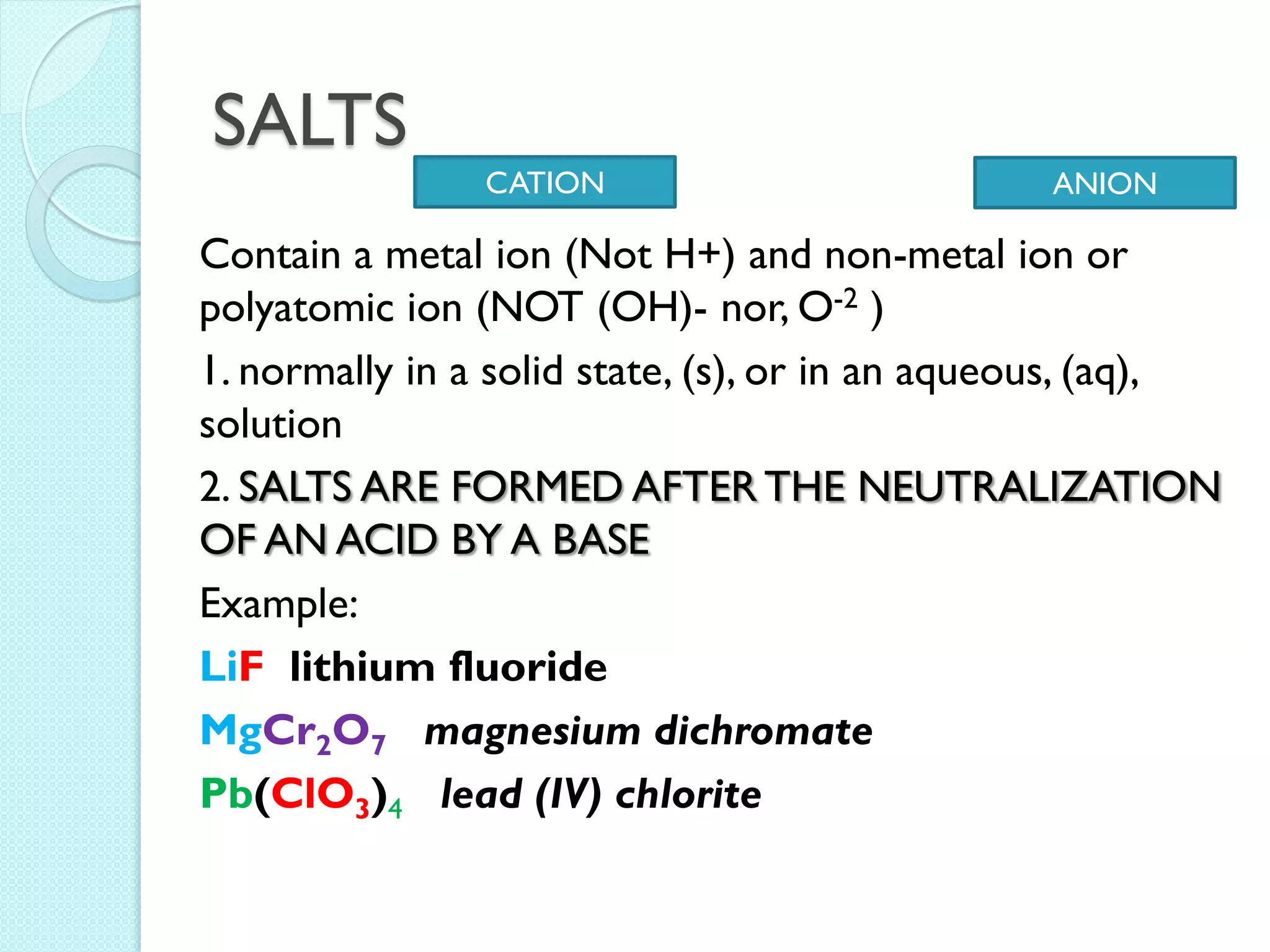
SALTS 
Contain a metal ion (Not H+) and non-metal ion or polyatomic ion (NOT (OH)- nor, O-2 ) 
1. normally in a solid state, (s), or in an aqueous, (aq), solution 
2. SALTS ARE FORMED AFTER THE NEUTRALIZATION OF AN ACID BY A BASE 
Example: 
LiF lithium fluoride 
MgCr2O7 magnesium dichromate 
Pb(ClO3)4 lead (IV) chlorite 
CATION 
ANION
Others 
Ionic compounds 
Covalent compounds
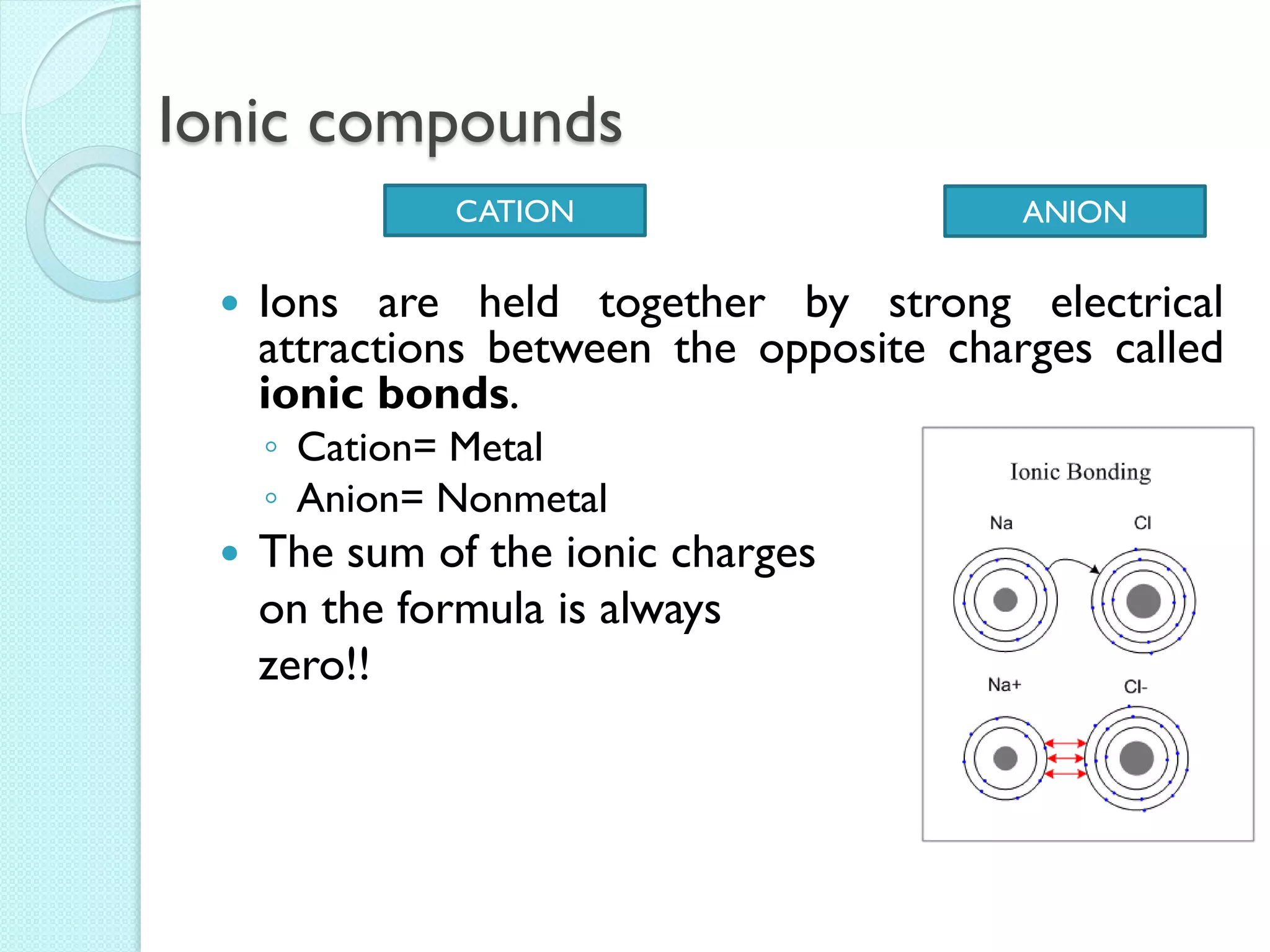
Ionic compounds 
Ions are held together by strong electrical attractions between the opposite charges called ionic bonds. 
◦Cation= Metal 
◦Anion= Nonmetal 
The sum of the ionic charges 
on the formula is always 
zero!! 
CATION 
ANION
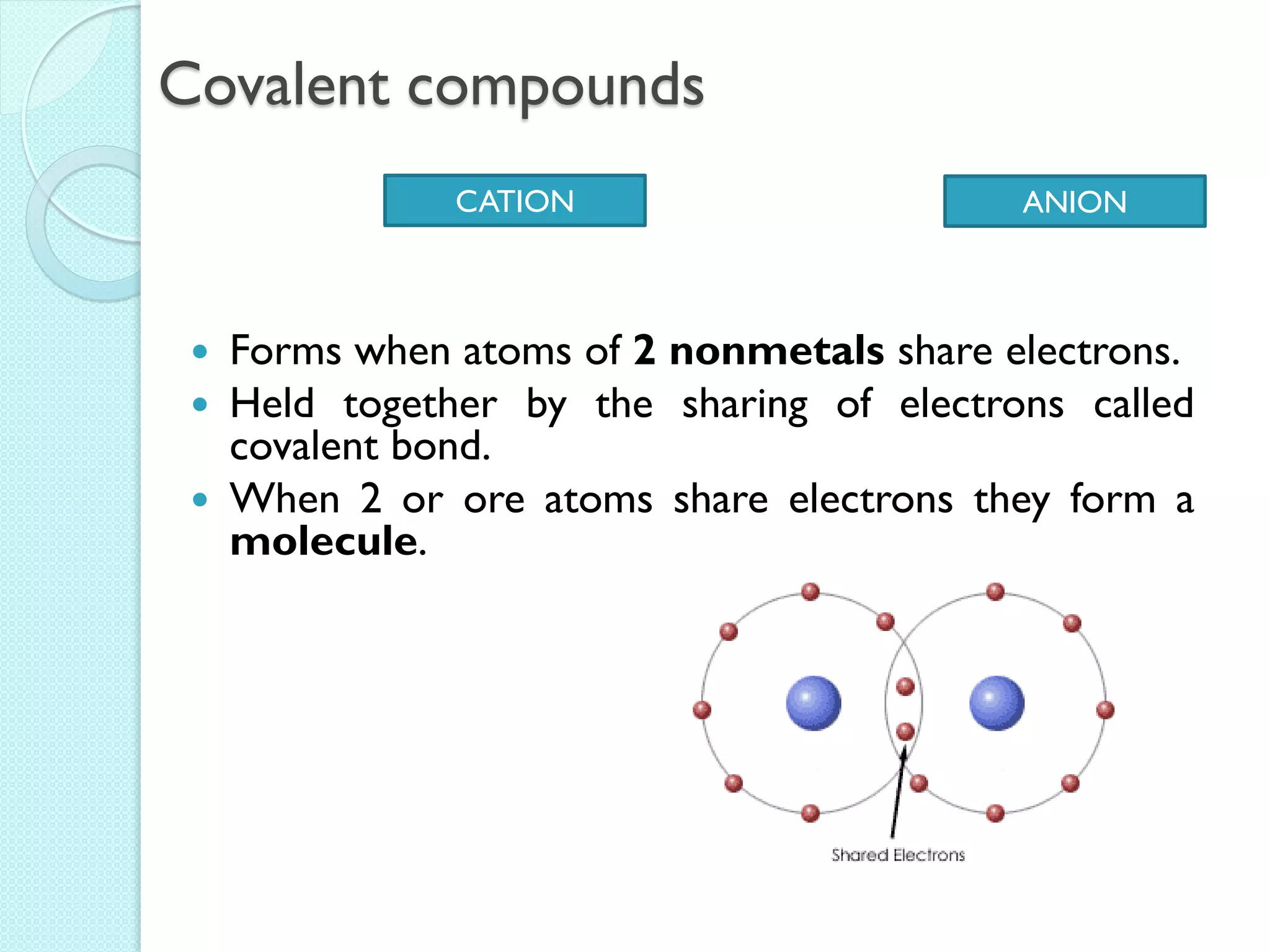
Covalent compounds 
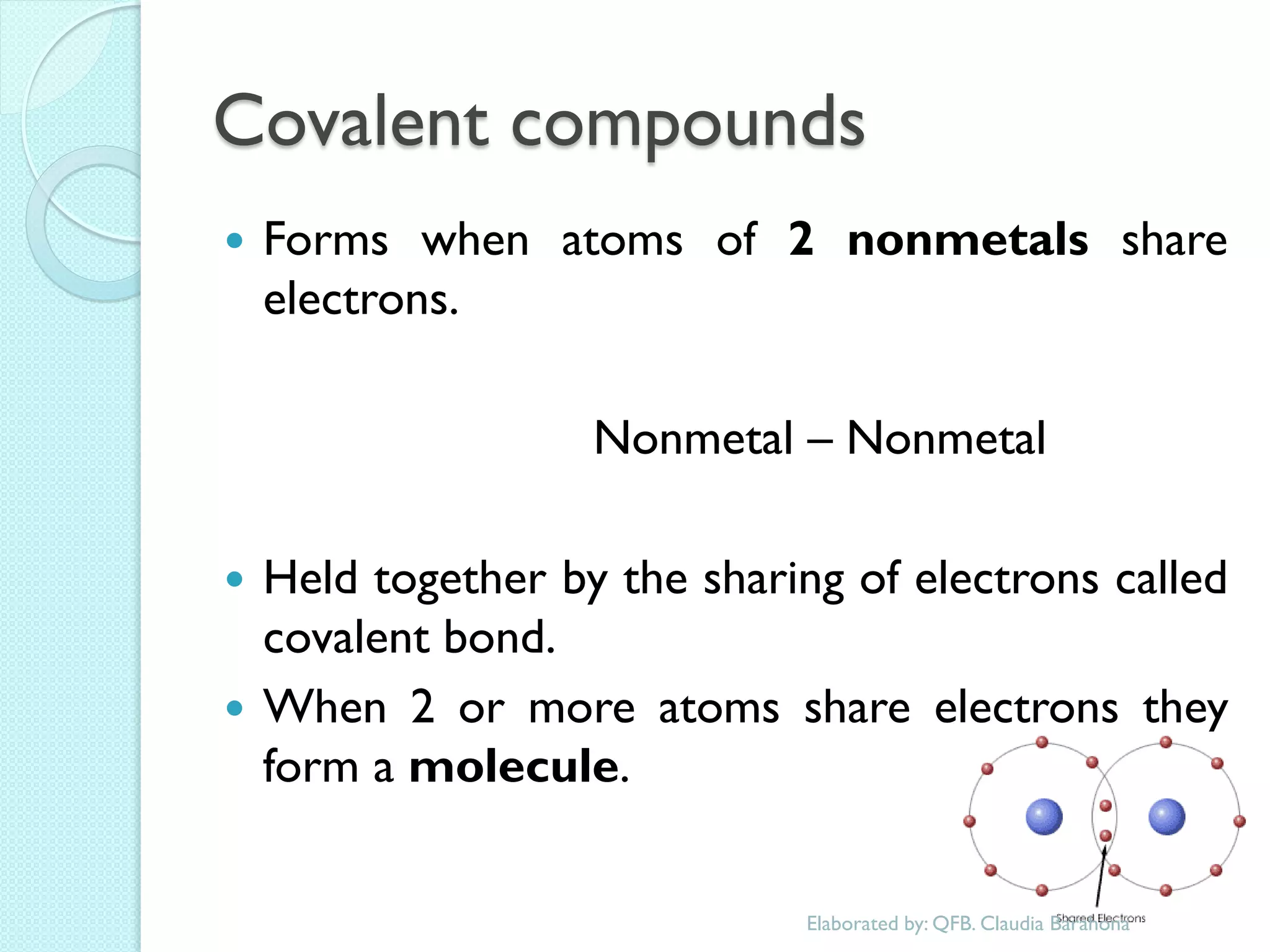
Forms when atoms of 2 nonmetals share electrons. 
Held together by the sharing of electrons called covalent bond. 
When 2 or ore atoms share electrons they form a molecule. 
CATION 
ANION
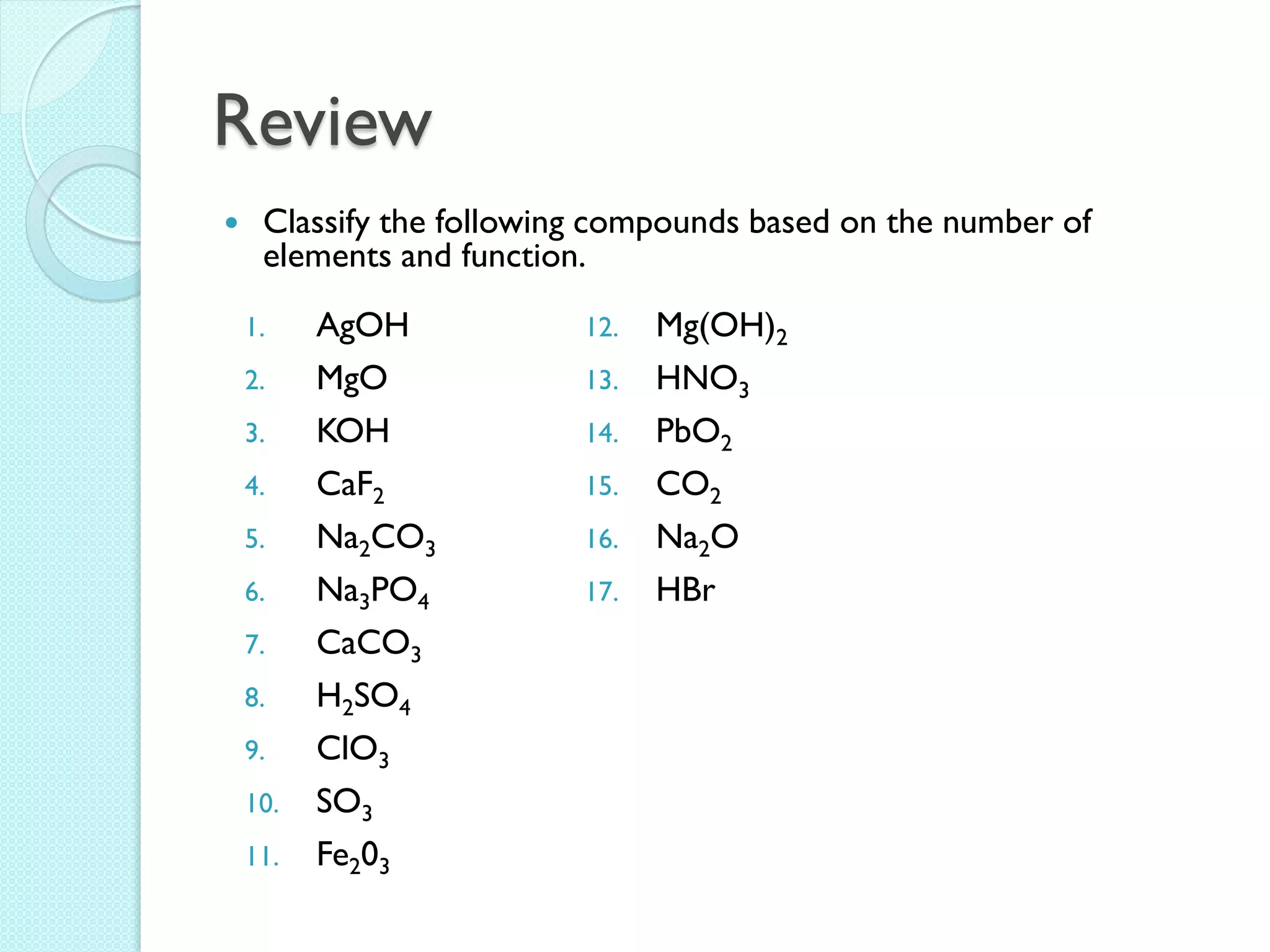
Review 
Classify the following compounds based on the number of elements and function. 
1.AgOH 
2.MgO 
3.KOH 
4.CaF2 
5.Na2CO3 
6.Na3PO4 
7.CaCO3 
8.H2SO4 
9.ClO3 
10.SO3 
11.Fe203 
12.Mg(OH)2 
13.HNO3 
14.PbO2 
15.CO2 
16.Na2O 
17.HBr
Activity 2.4 
Check
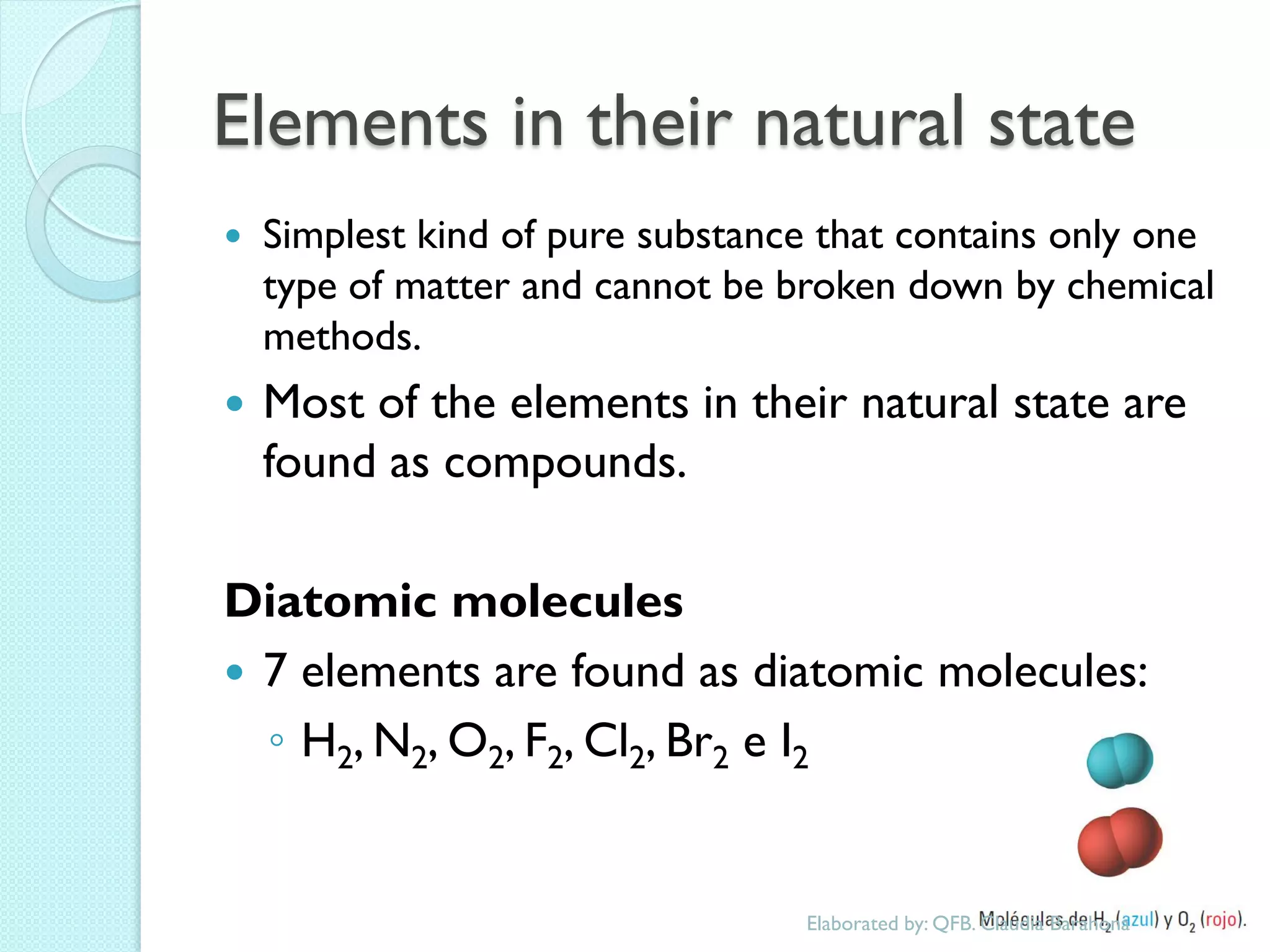
Elements in their natural state 
Simplest kind of pure substance that contains only one type of matter and cannot be broken down by chemical methods. 
Most of the elements in their natural state are found as compounds. 
Diatomic molecules 
7 elements are found as diatomic molecules: 
◦H2, N2, O2, F2, Cl2, Br2 e I2 
Elaborated by: QFB. Claudia Barahona
Chemical compounds by number of elements 
Elaborated by: QFB. Claudia Barahona
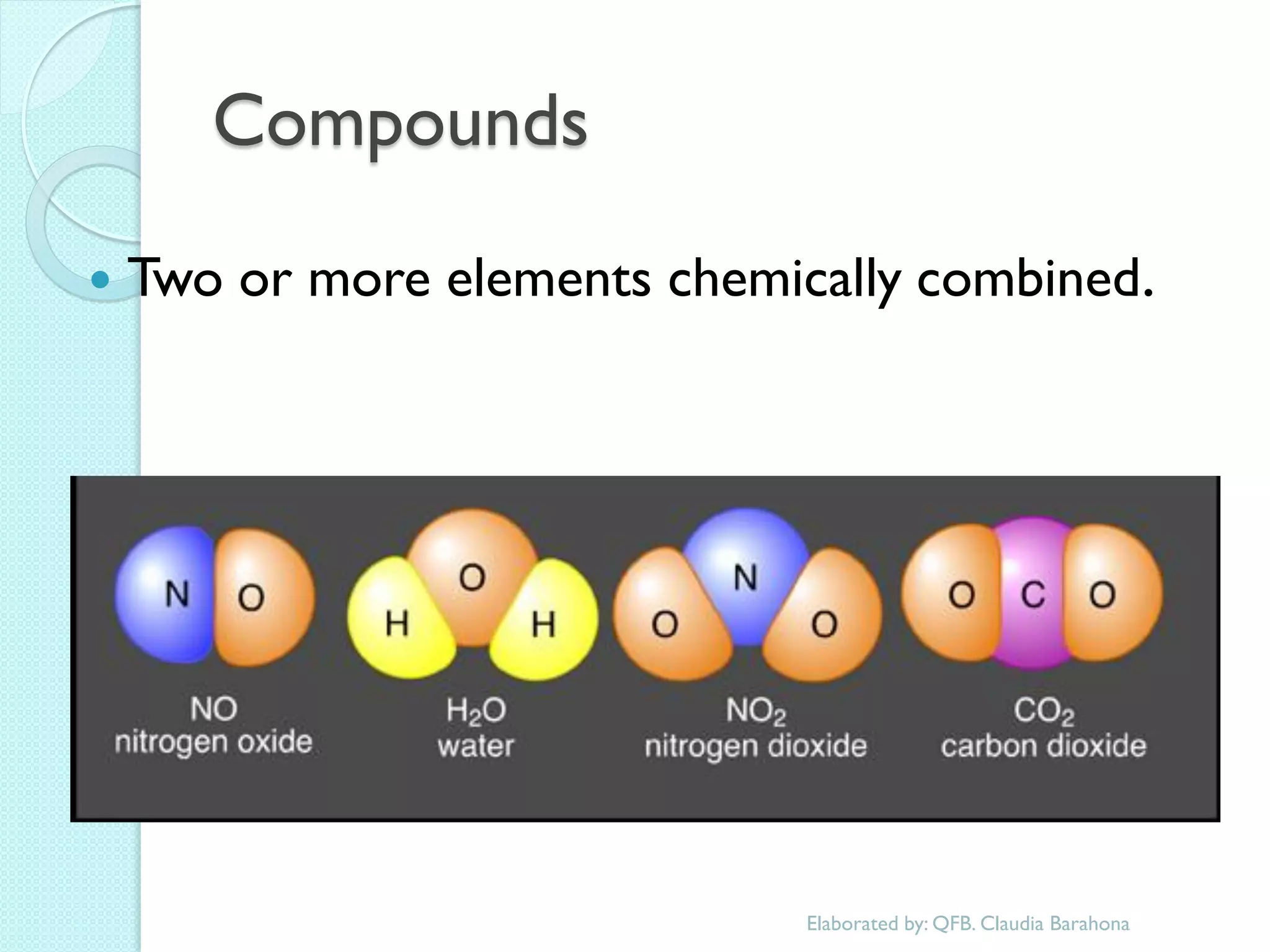
Compounds 
Two or more elements chemically combined. 
Elaborated by: QFB. Claudia Barahona
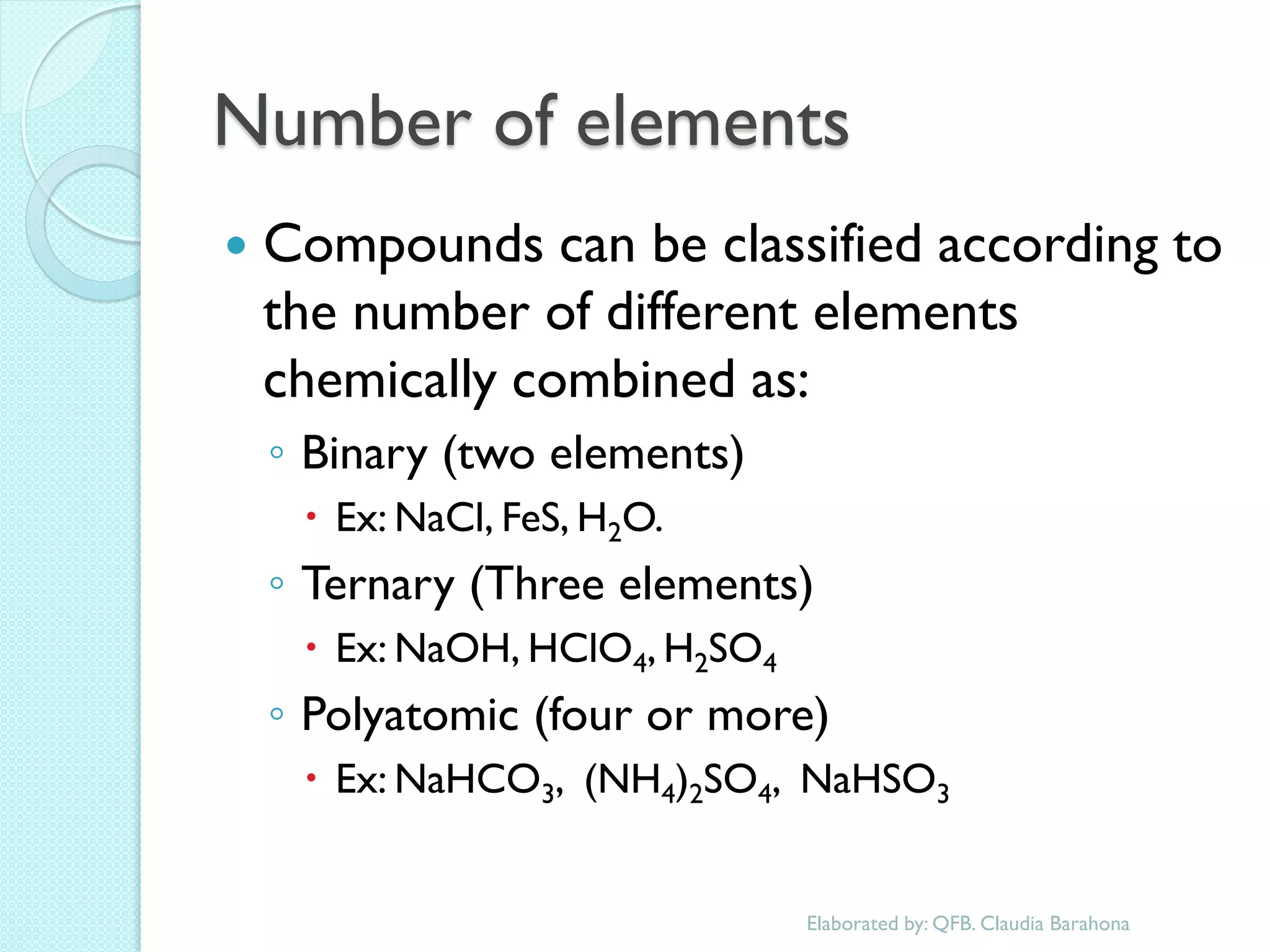
Number of elements 
Compounds can be classified according to the number of different elements chemically combined as: 
◦Binary (two elements) 
Ex: NaCl, FeS, H2O. 
◦Ternary (Three elements) 
Ex: NaOH, HClO4, H2SO4 
◦Polyatomic (four or more) 
Ex: NaHCO3, (NH4)2SO4, NaHSO3 
Elaborated by: QFB. Claudia Barahona
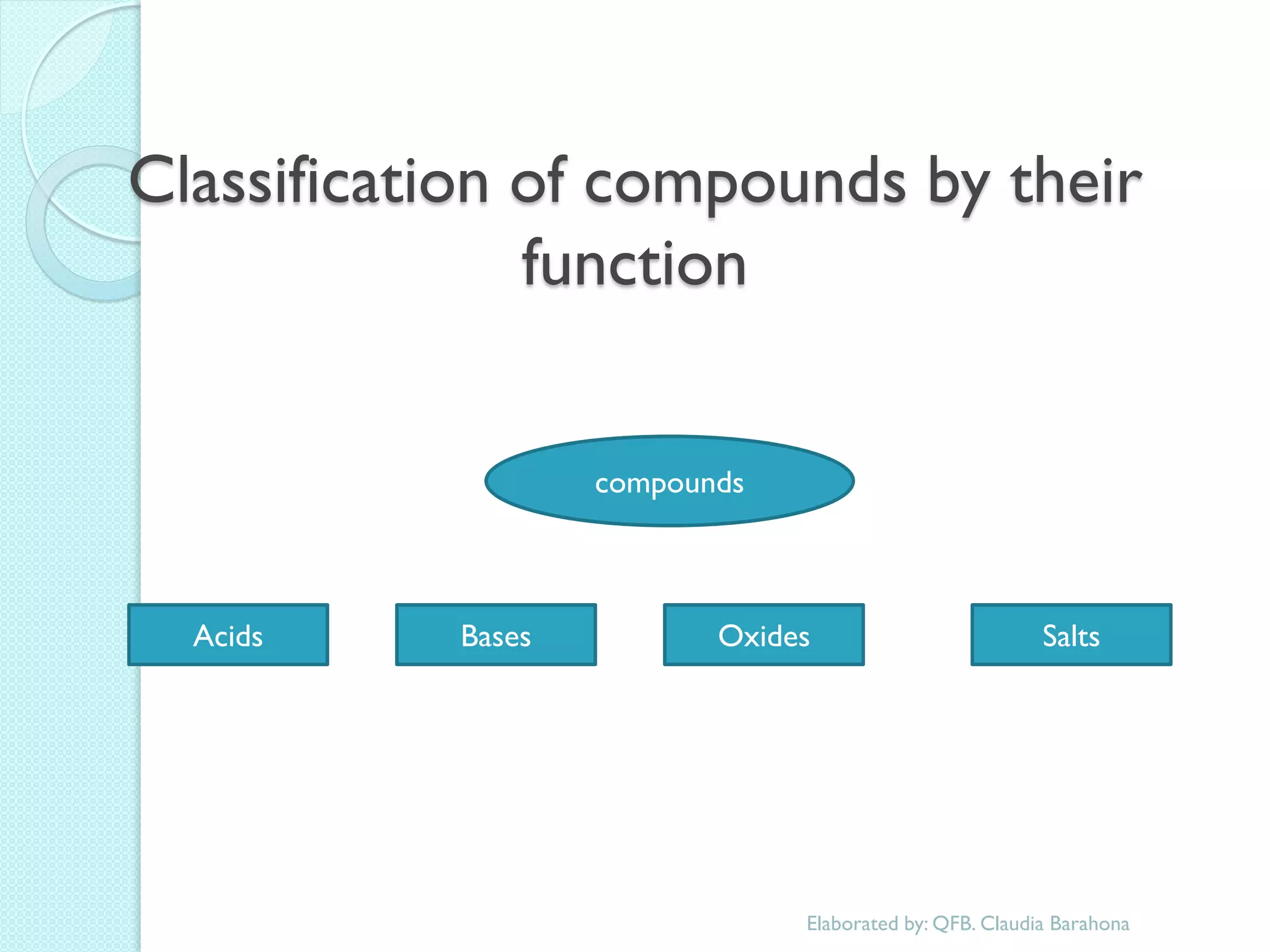
Classification of compounds by their function 
compounds 
Acids 
Bases 
Oxides 
Salts 
Elaborated by: QFB. Claudia Barahona
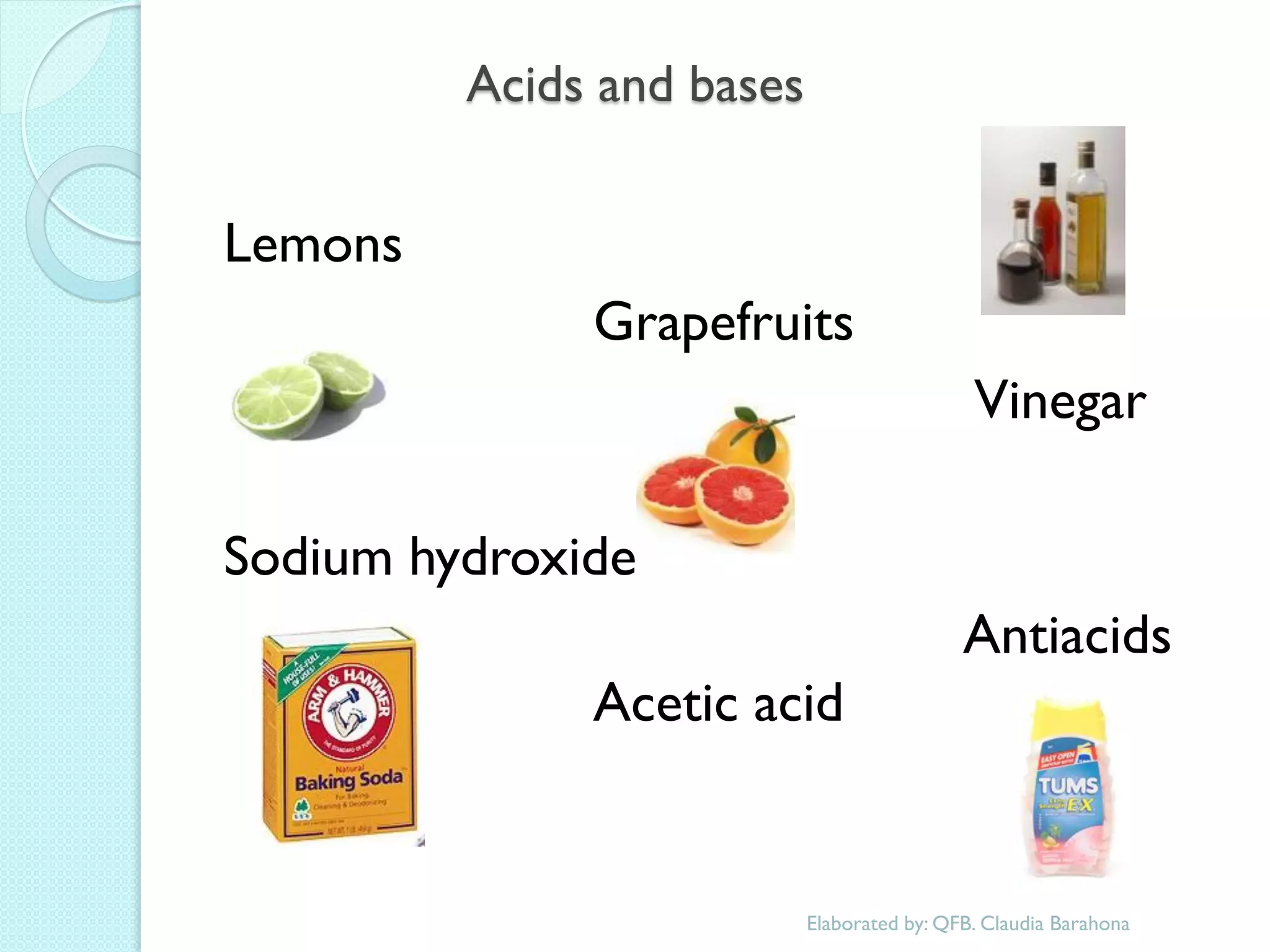
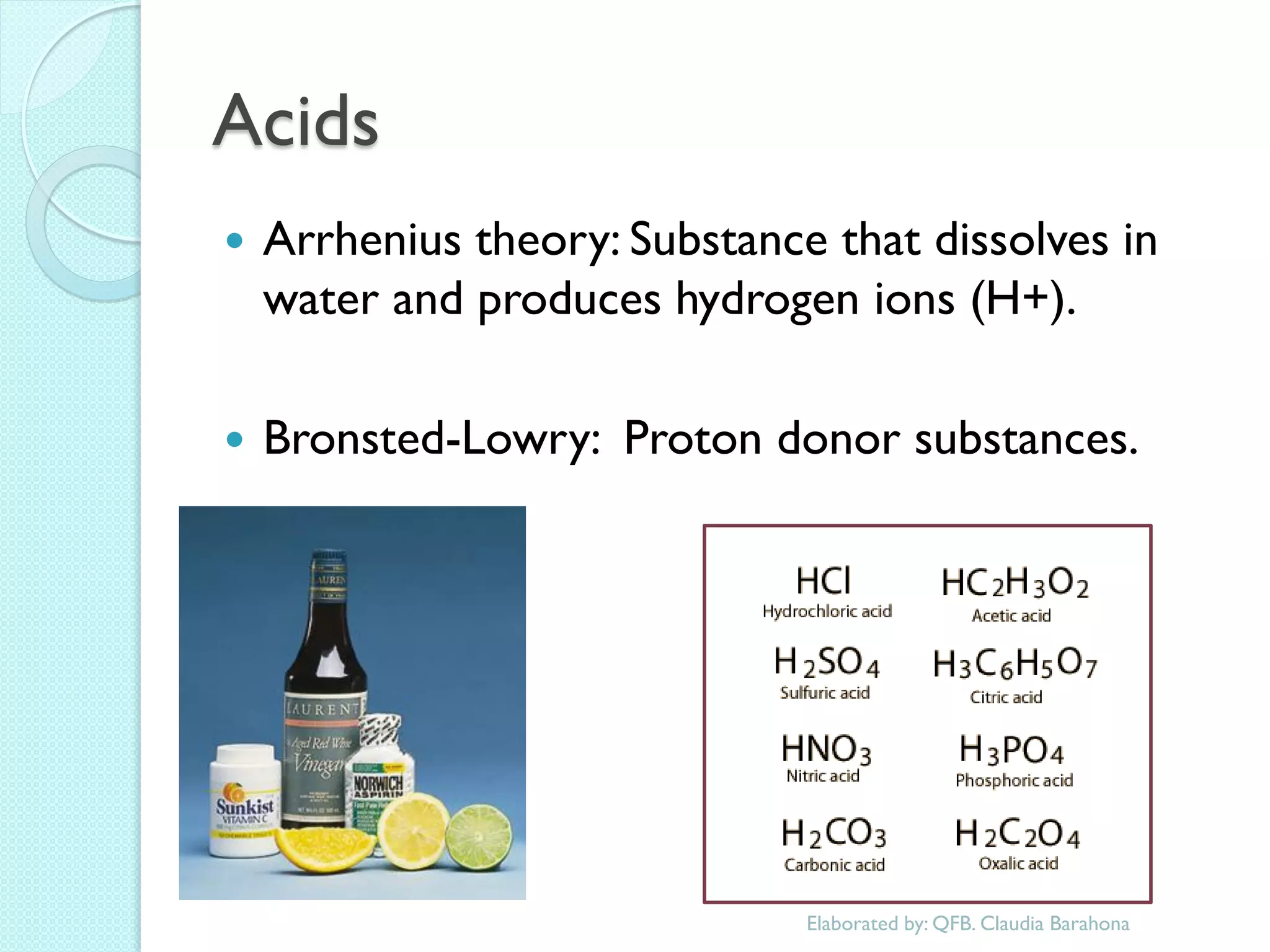
Acids and bases 
Lemons 
Grapefruits 
Vinegar 
Sodium hydroxide 
Antiacids Acetic acid 
Elaborated by: QFB. Claudia Barahona
Acids 
Arrhenius theory: Substance that dissolves in water and produces hydrogen ions (H+). 
Bronsted-Lowry: Proton donor substances. 
Elaborated by: QFB. Claudia Barahona
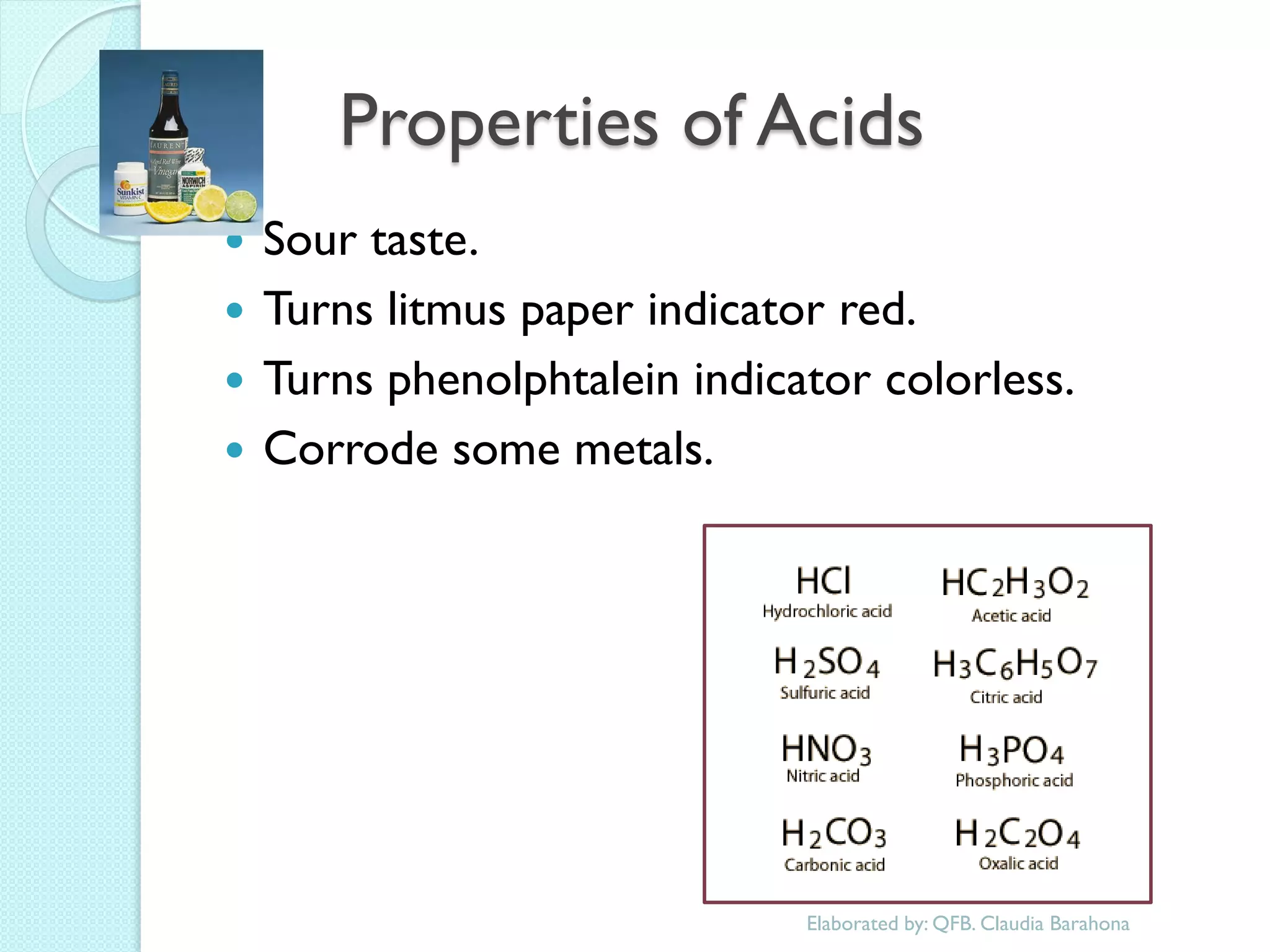
Properties of Acids 
Sour taste. 
Turns litmus paper indicator red. 
Turns phenolphtalein indicator colorless. 
Corrode some metals. 
Elaborated by: QFB. Claudia Barahona
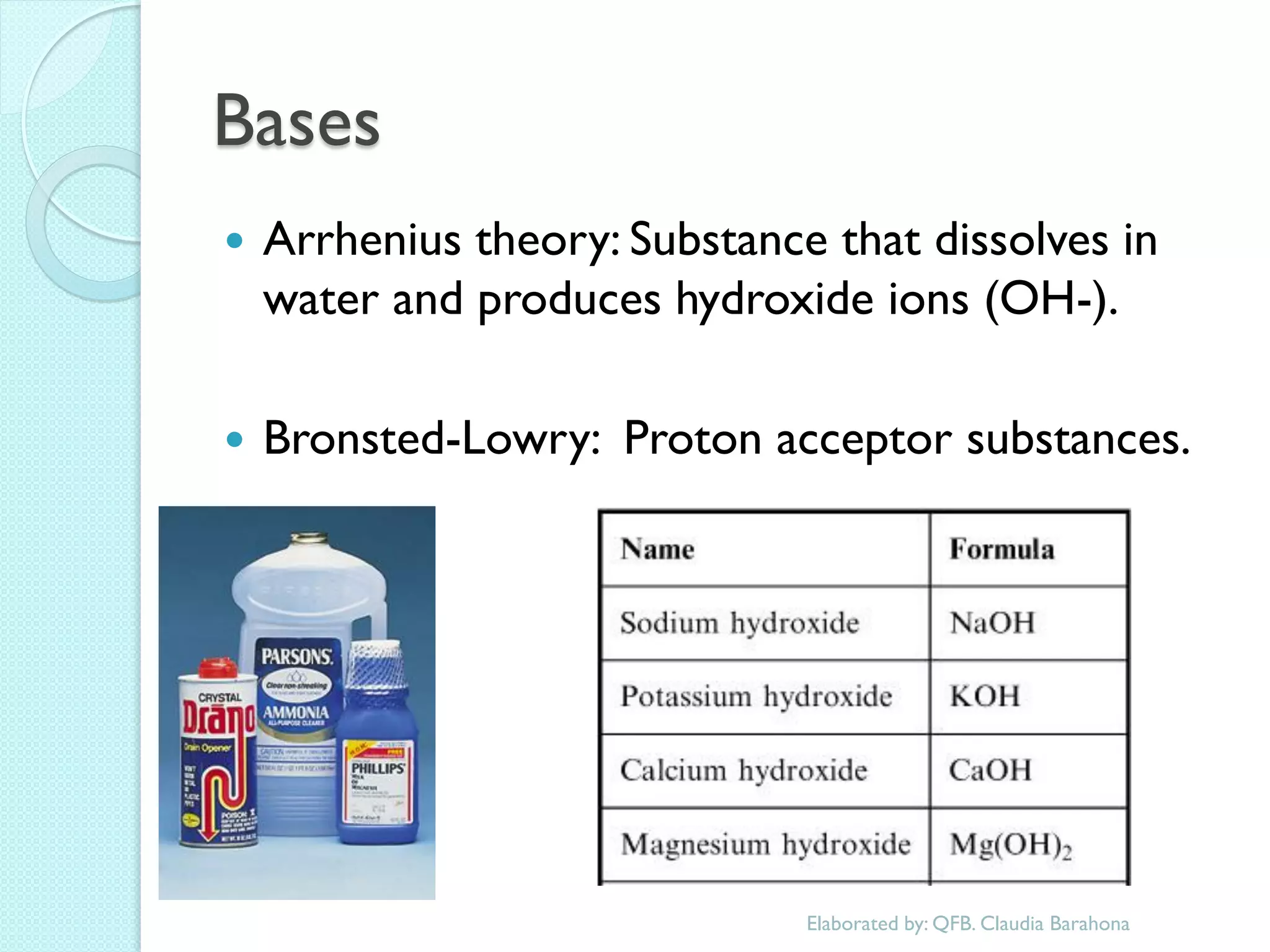
Bases 
Arrhenius theory: Substance that dissolves in water and produces hydroxide ions (OH-). 
Bronsted-Lowry: Proton acceptor substances. 
Elaborated by: QFB. Claudia Barahona
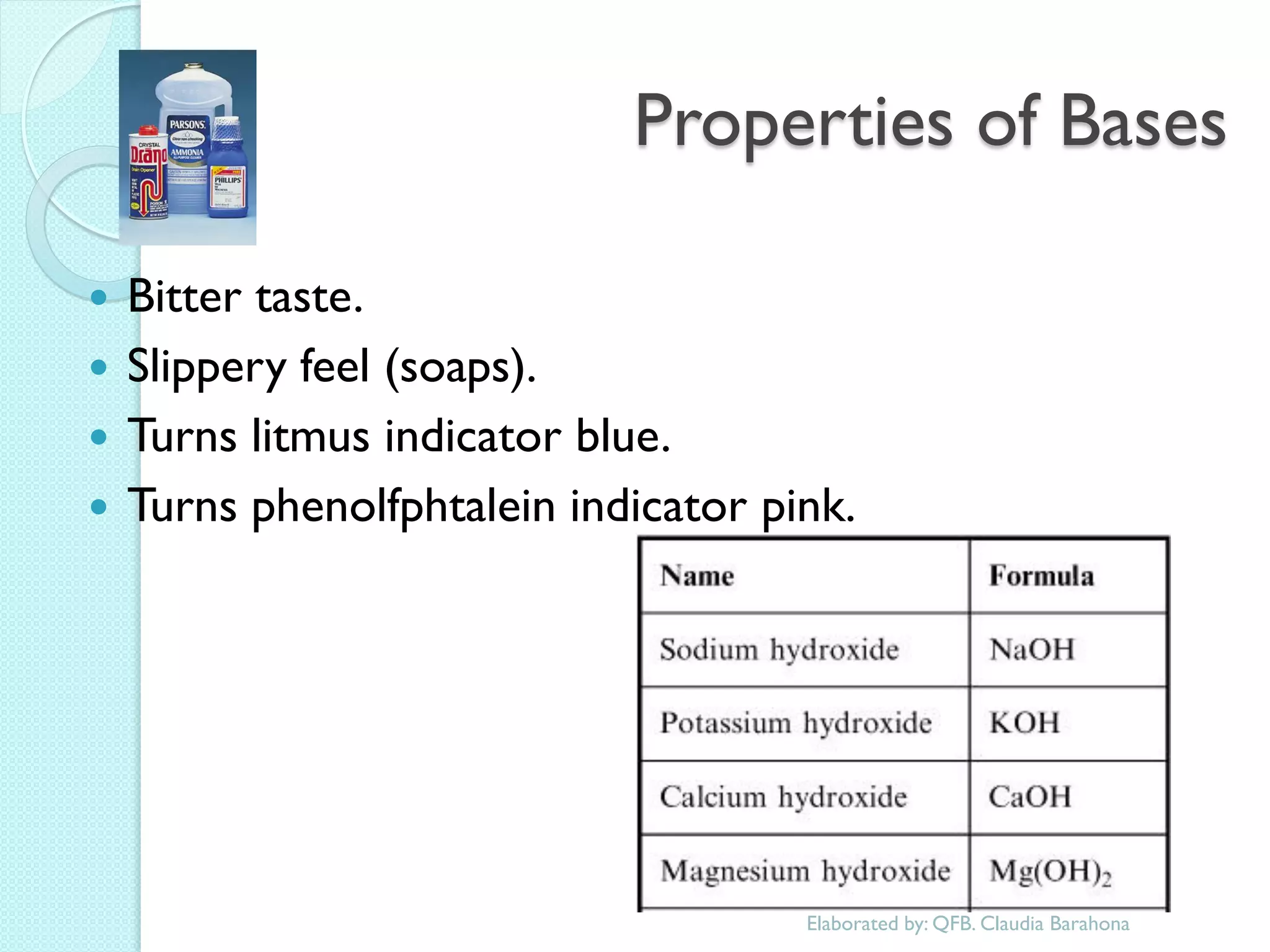
Properties of Bases 
Bitter taste. 
Slippery feel (soaps). 
Turns litmus indicator blue. 
Turns phenolfphtalein indicator pink. 
Elaborated by: QFB. Claudia Barahona
Oxides 
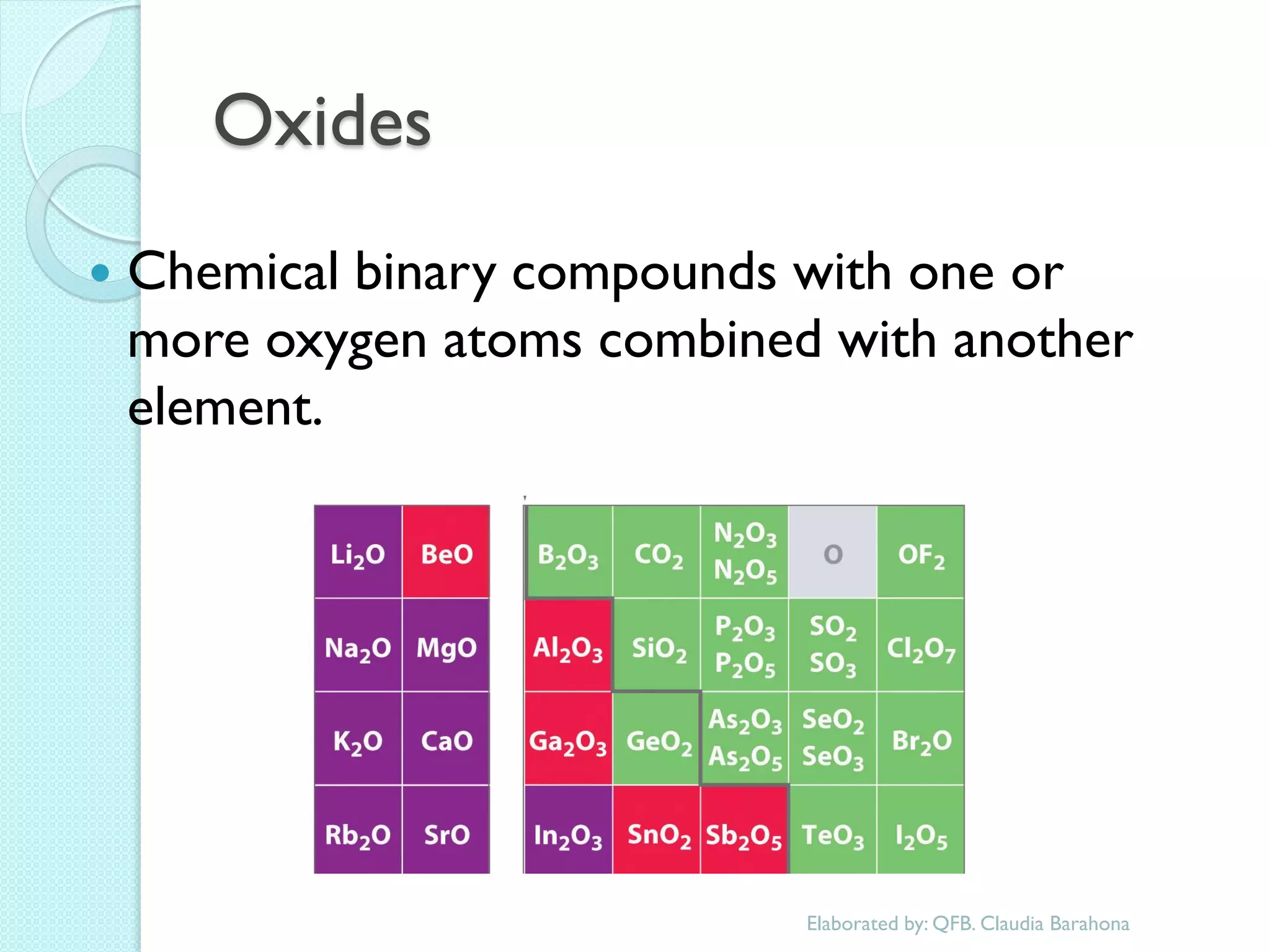
Chemical binary compounds with one or more oxygen atoms combined with another element. 
Elaborated by: QFB. Claudia Barahona
Salts 
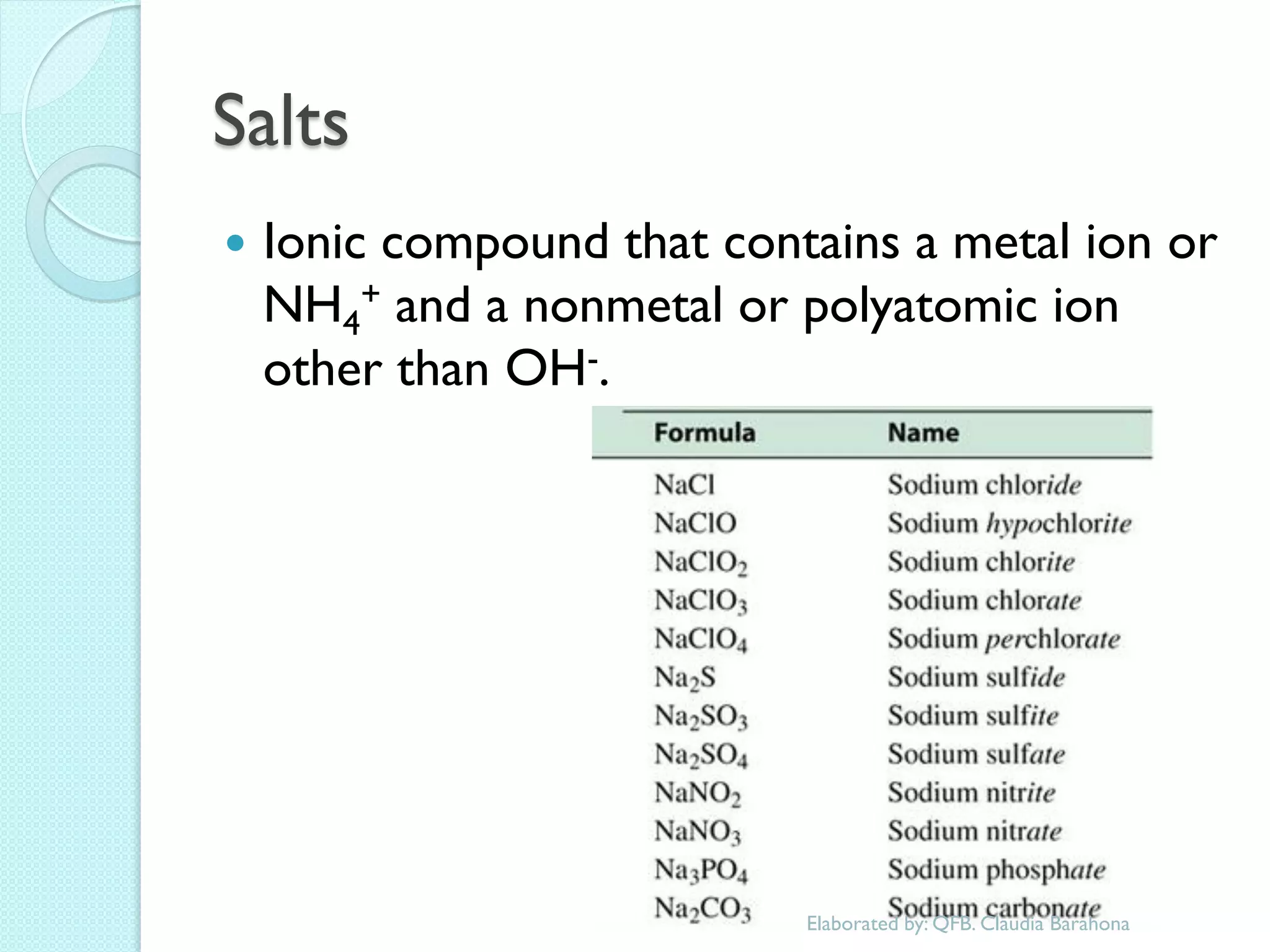
Ionic compound that contains a metal ion or NH4+ and a nonmetal or polyatomic ion other than OH-. 
Elaborated by: QFB. Claudia Barahona
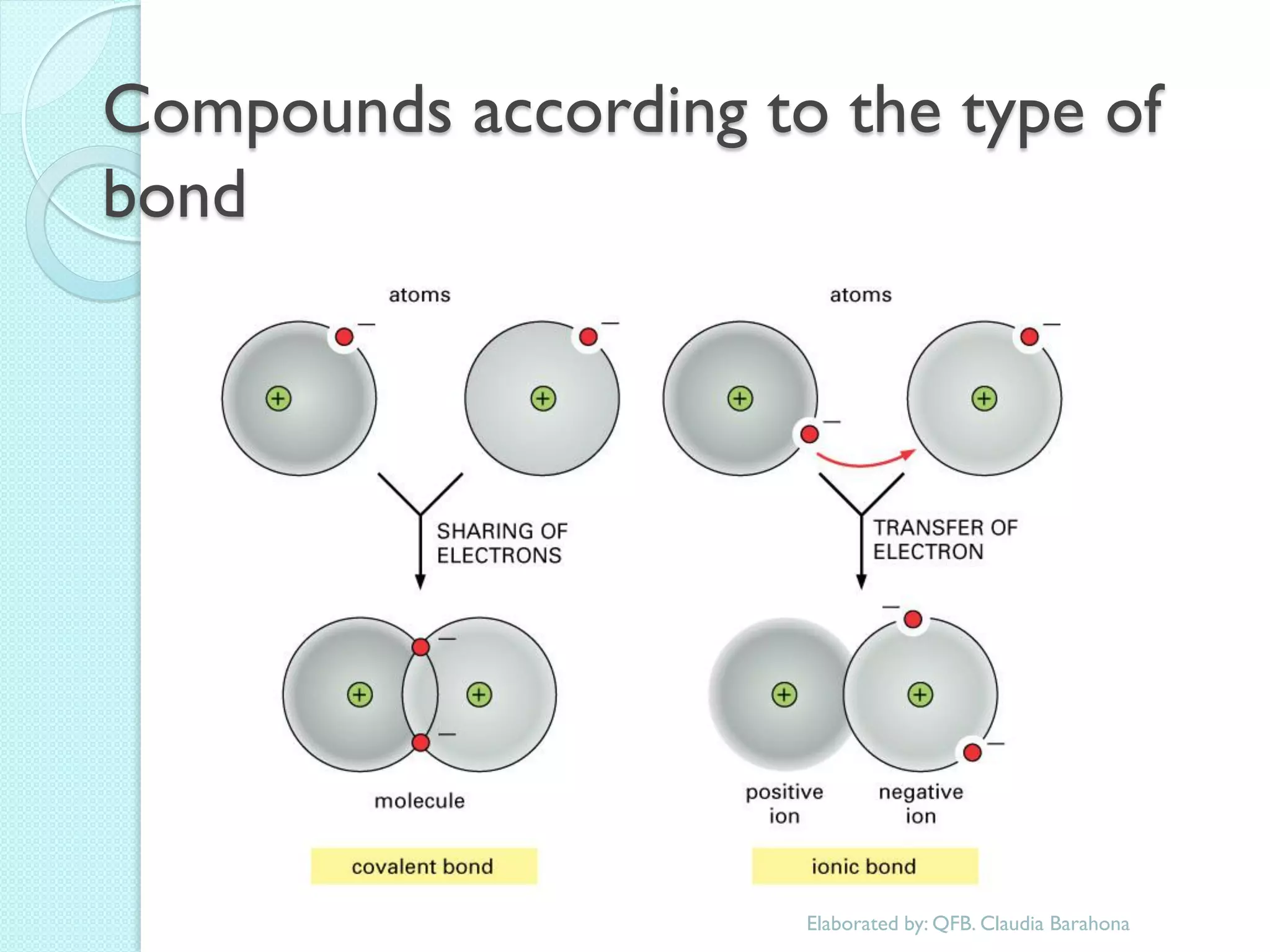
Chemical compounds by type of bond 
Elaborated by: QFB. Claudia Barahona
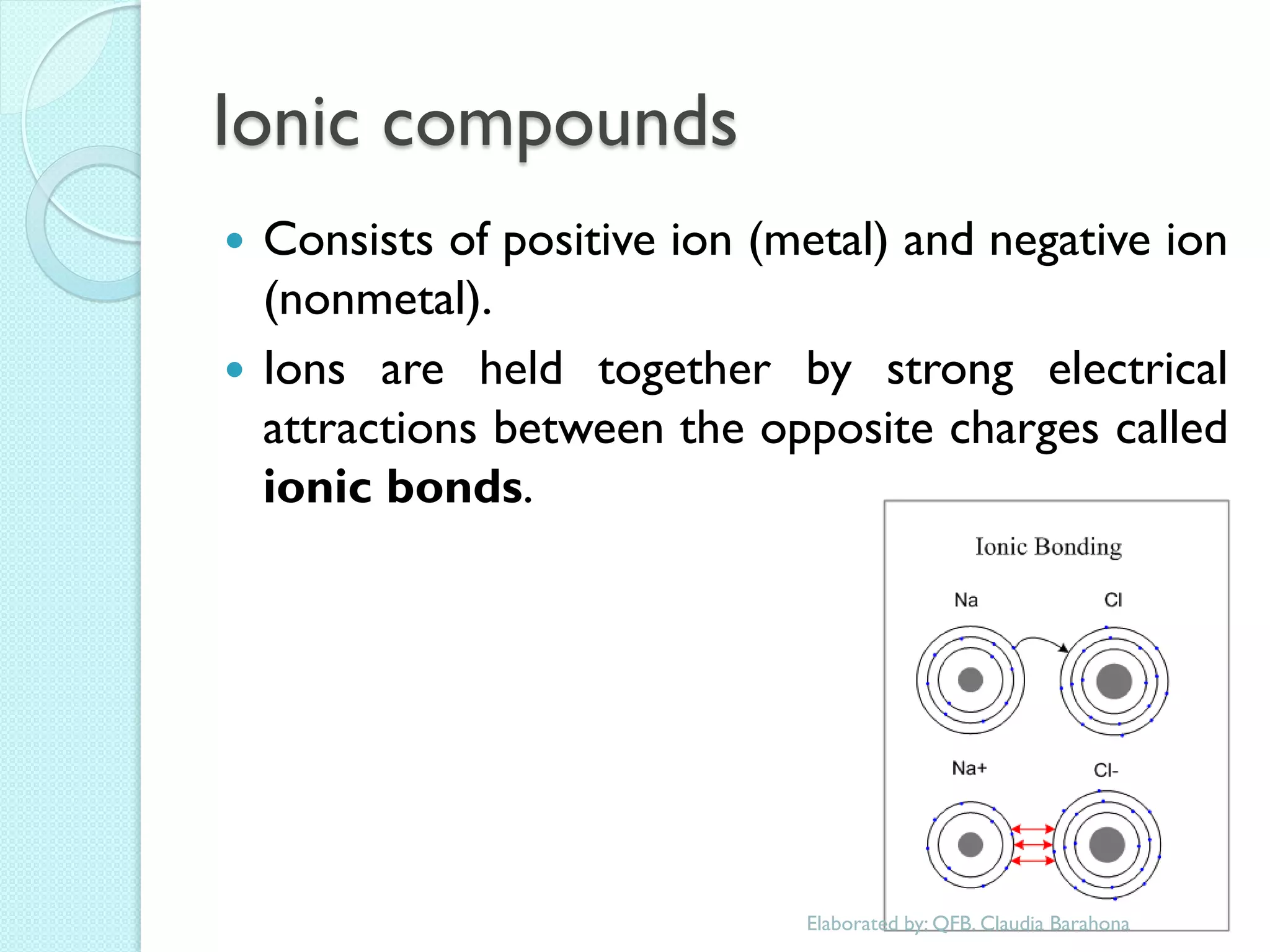
Ionic compounds 
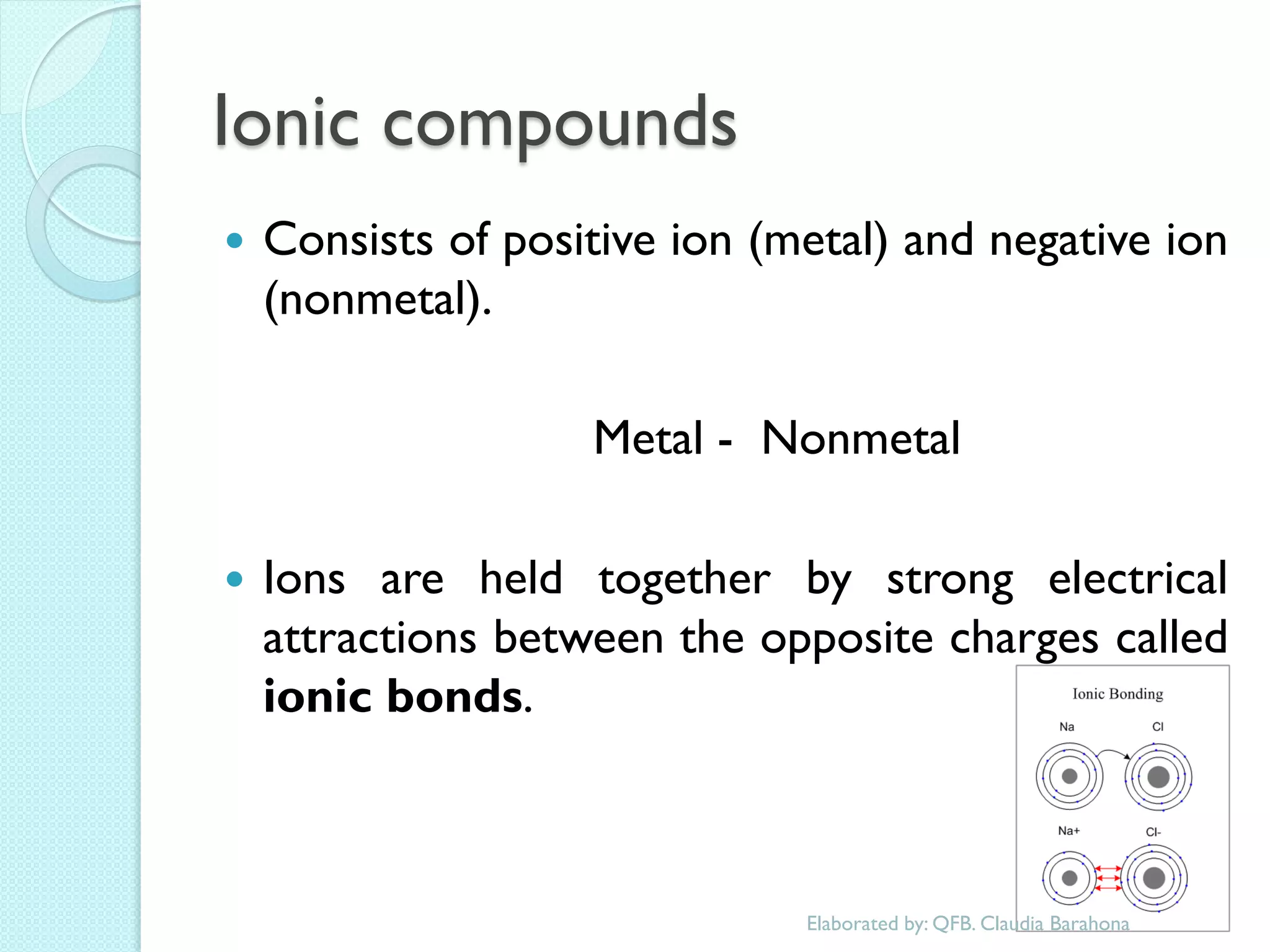
Consists of positive ion (metal) and negative ion (nonmetal). 
Metal - Nonmetal 
Ions are held together by strong electrical attractions between the opposite charges called ionic bonds. 
Elaborated by: QFB. Claudia Barahona
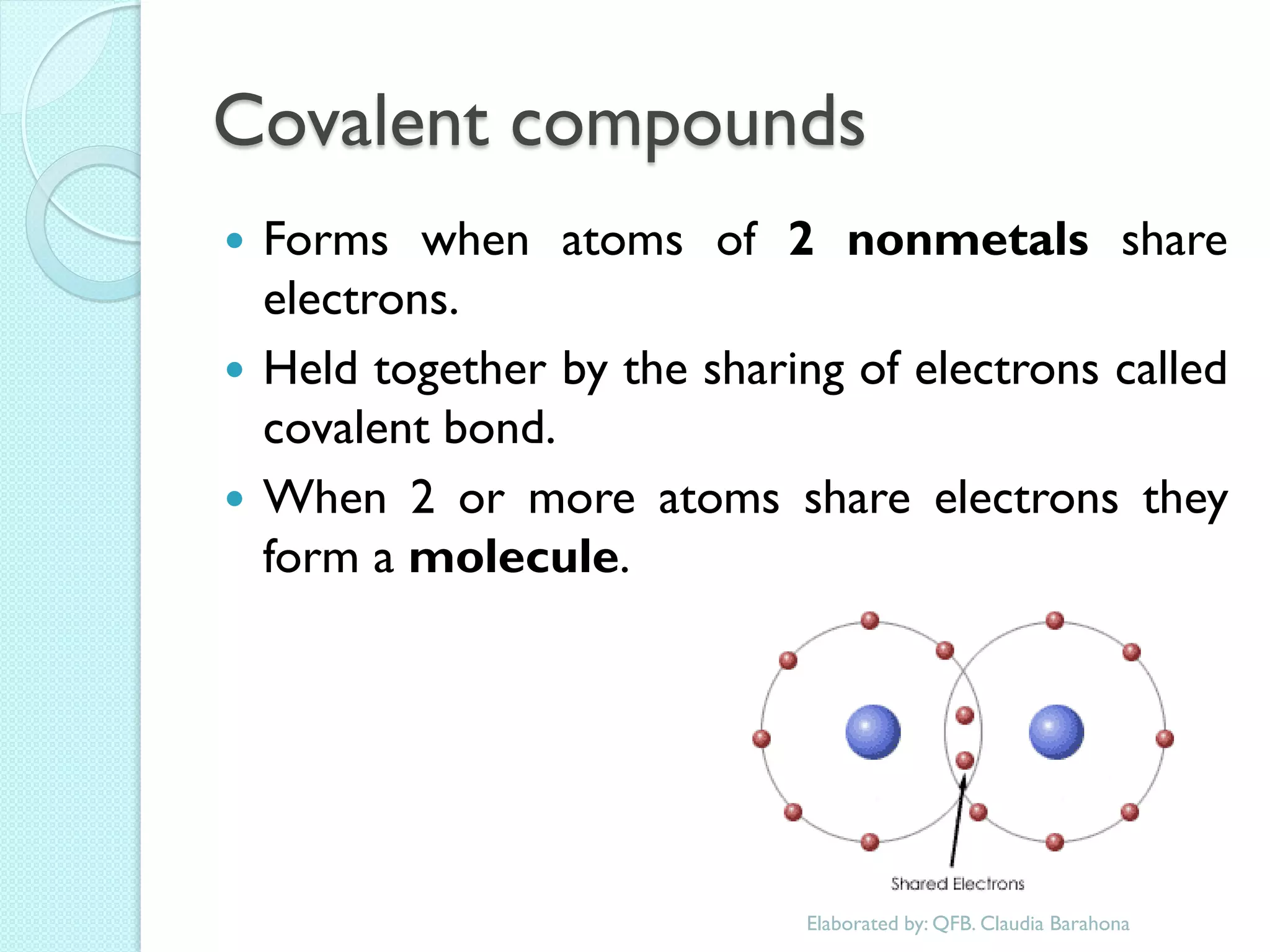
Covalent compounds 
Forms when atoms of 2 nonmetals share electrons. 
Nonmetal – Nonmetal 
Held together by the sharing of electrons called covalent bond. 
When 2 or more atoms share electrons they form a molecule. 
Elaborated by: QFB. Claudia Barahona
Electronegativity 
Relative ability of an atom to attract the share electrons by itself. 
In a period, it increases. 
In a group it decreases. 
Nonmetals, Fluorine 4.0 and oxygen 3.5 have the highest electronegativites. 
Metals Cesium and Francium have the lowest electronegativities. 
Elaborated by: QFB. Claudia Barahona
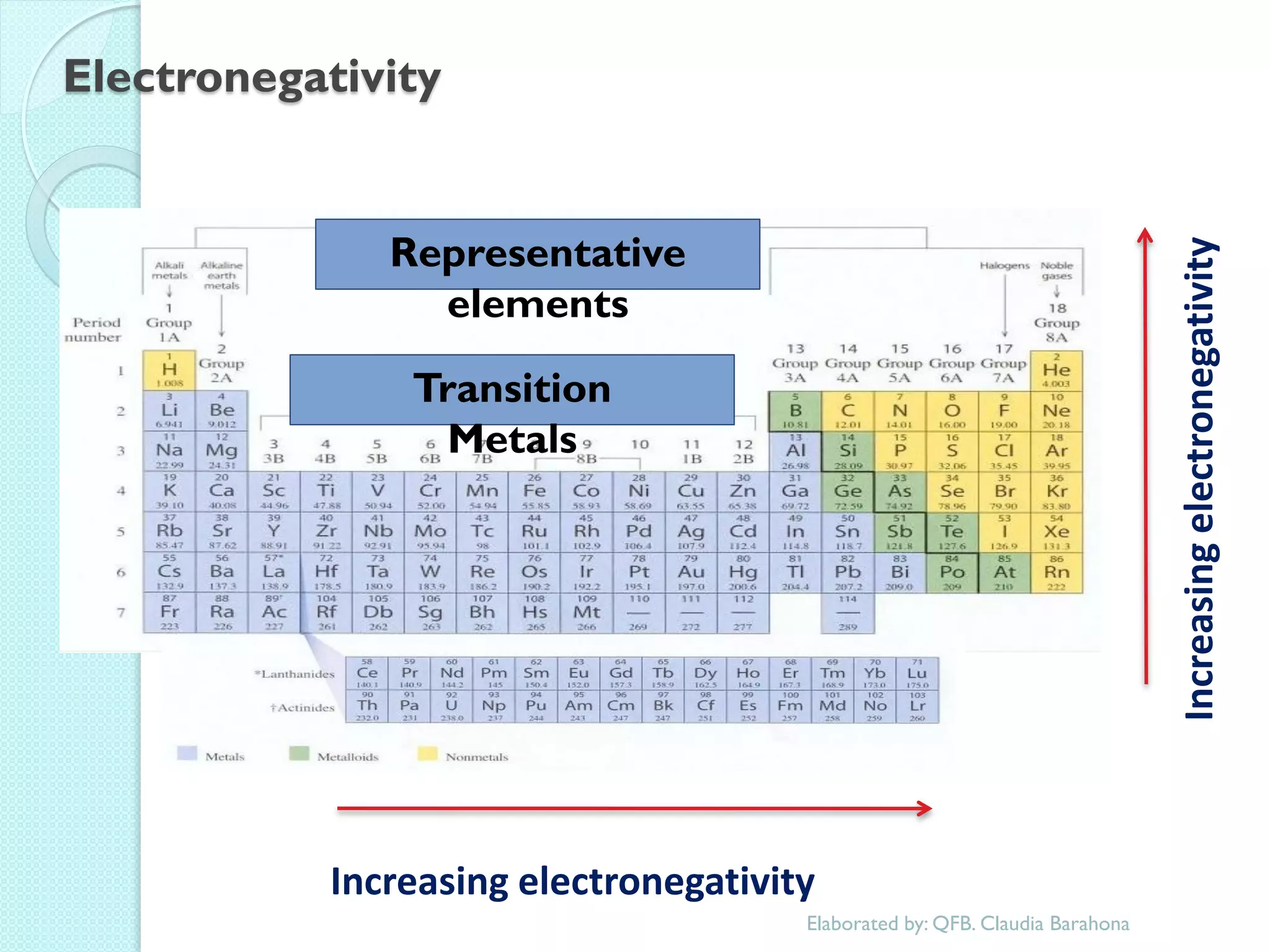
Electronegativity 
Increasing electronegativity 
Representative elements 
Transition Metals 
Elaborated by: QFB. Claudia Barahona
Polarity 
•Describes how electrons are shared between atoms . 
•Electrons are not always shared equally between two bonding atoms. 
•One atom might exert more of a force on the electron than the other, electronegativity. 
•The unequal sharing of electrons within a bond leads to the formation of polarity. 
Elaborated by: QFB. Claudia Barahona
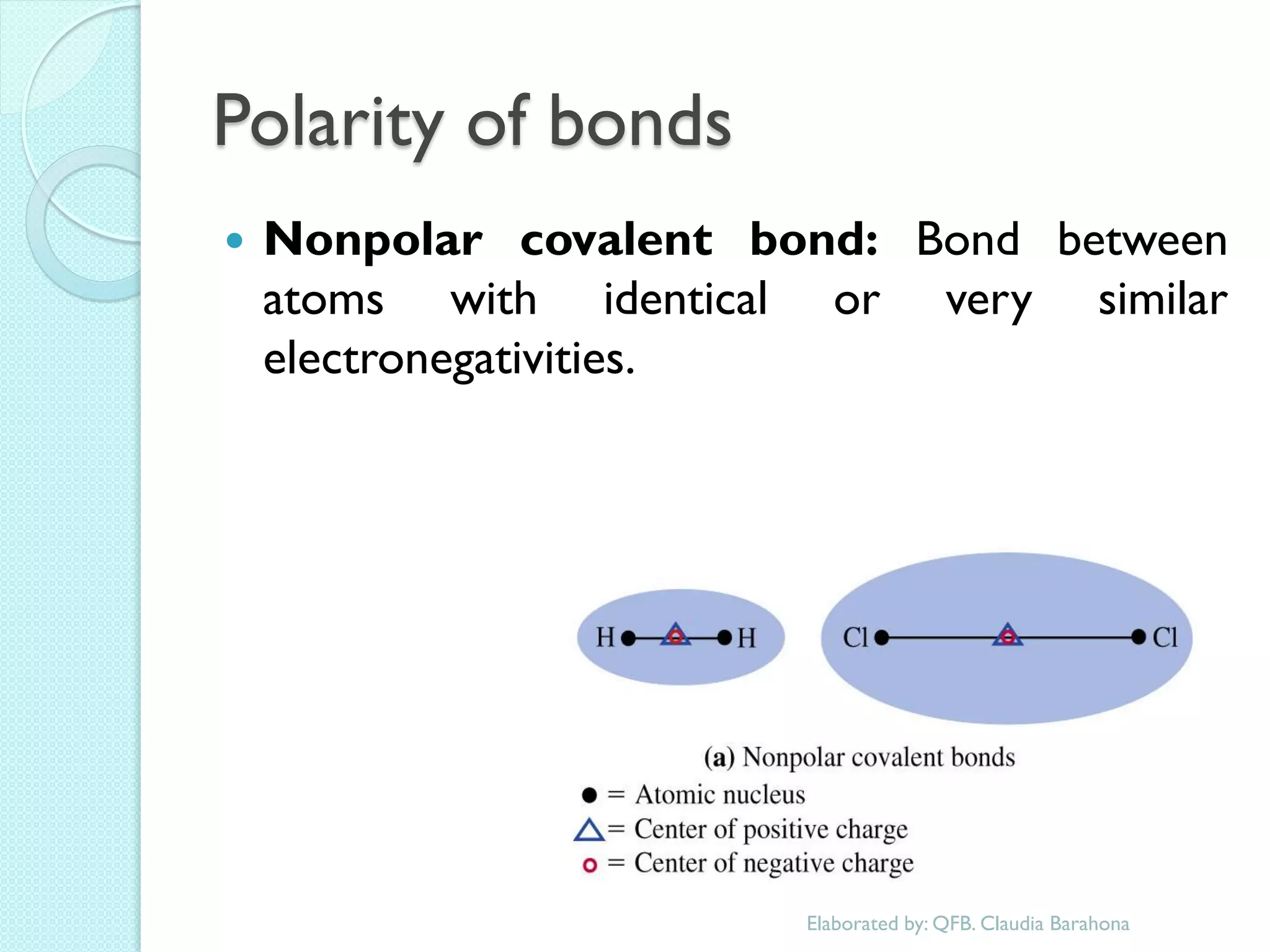
Polarity of bonds 
Nonpolar covalent bond: Bond between atoms with identical or very similar electronegativities. 
Elaborated by: QFB. Claudia Barahona
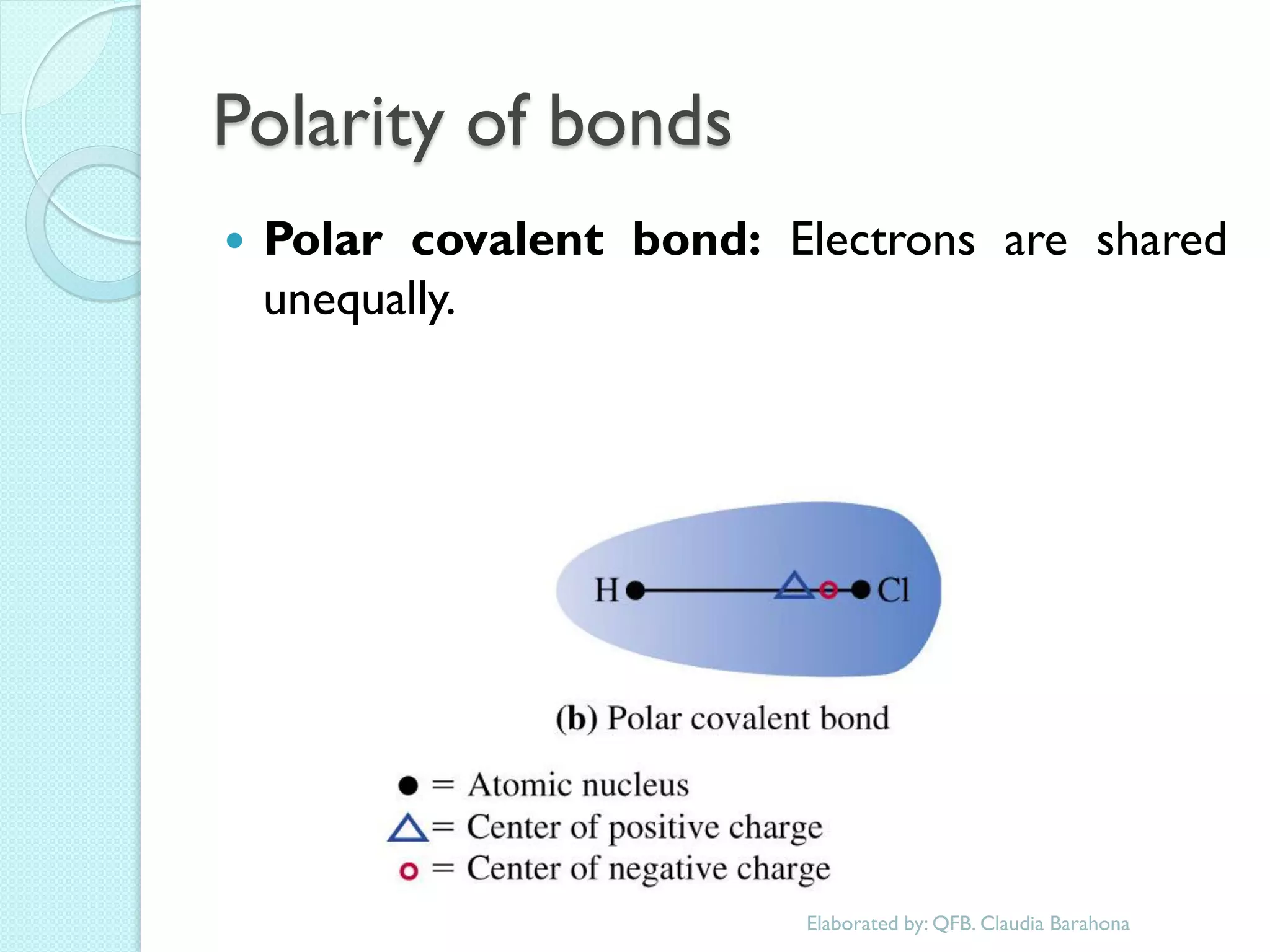
Polarity of bonds 
Polar covalent bond: Electrons are shared unequally. 
Elaborated by: QFB. Claudia Barahona
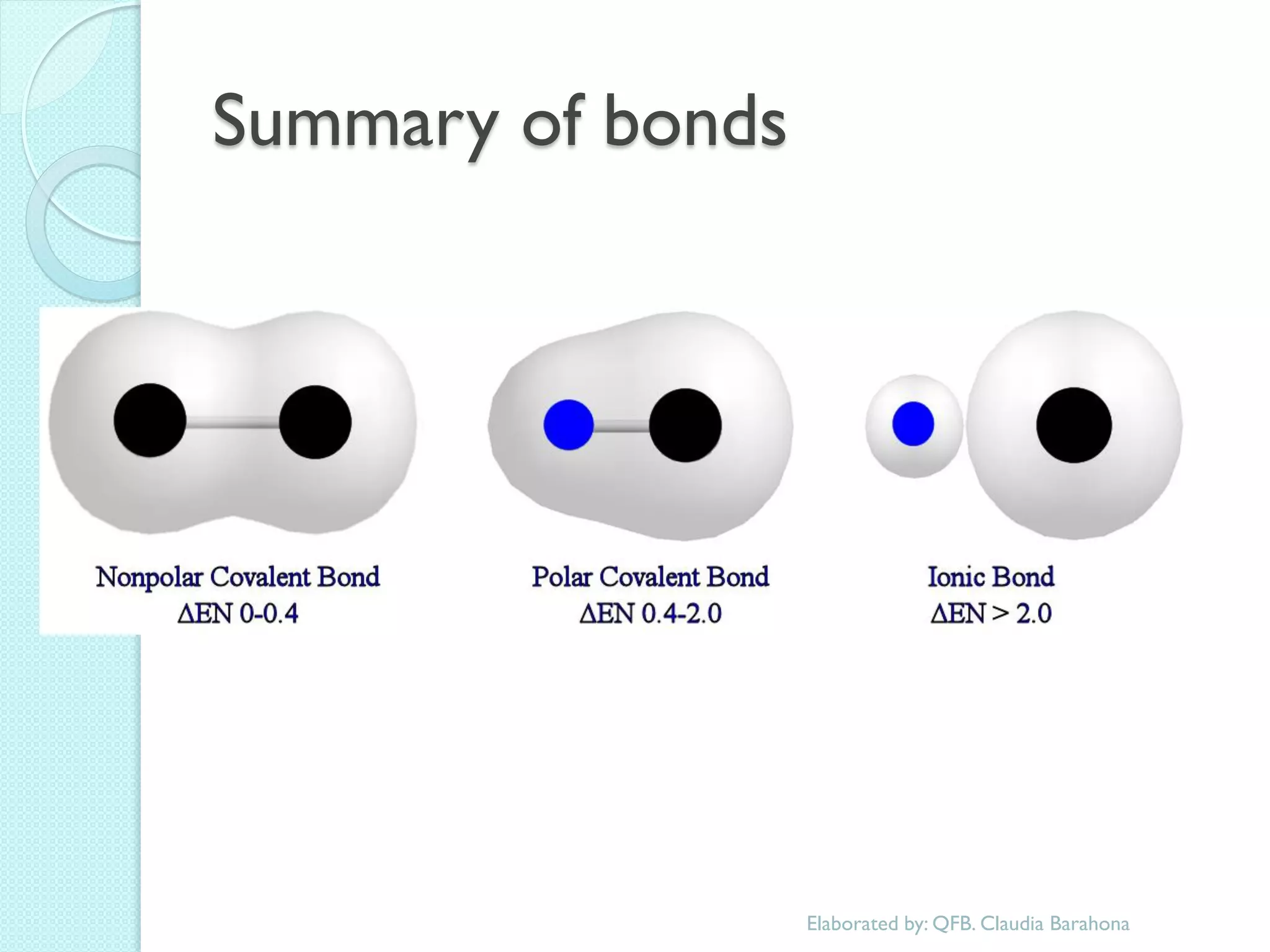
Summary of bonds 
Elaborated by: QFB. Claudia Barahona
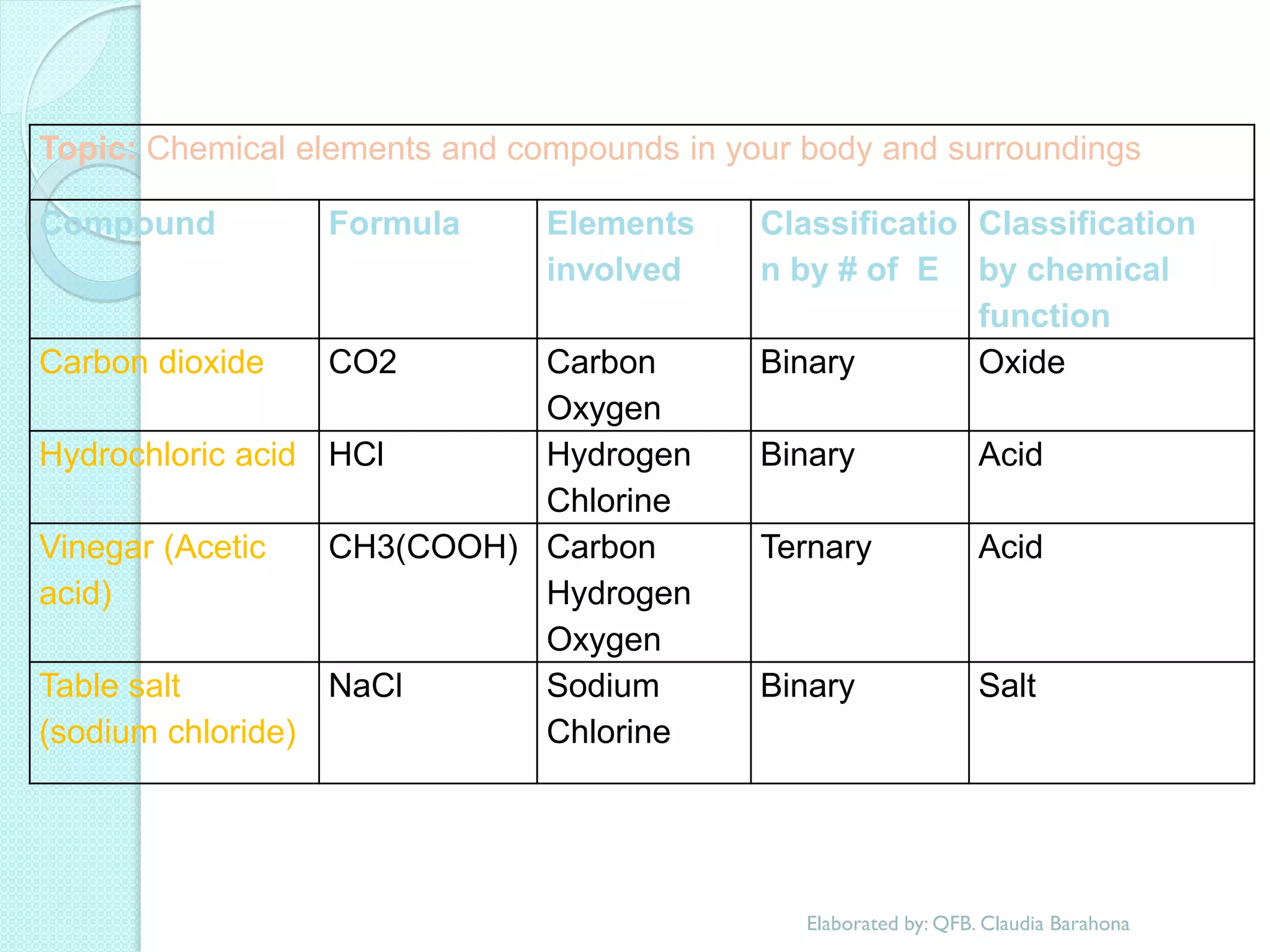
Topic: Chemical elements and compounds in your body and surroundings 
Compound 
Formula 
Elements involved 
Classification by # of E 
Classification by chemical function 
Carbon dioxide 
CO2 
Carbon 
Oxygen 
Binary 
Oxide 
Hydrochloric acid 
HCl 
Hydrogen 
Chlorine 
Binary 
Acid 
Vinegar (Acetic acid) 
CH3(COOH) 
Carbon 
Hydrogen 
Oxygen 
Ternary 
Acid 
Table salt (sodium chloride) 
NaCl 
Sodium 
Chlorine 
Binary 
Salt 
Elaborated by: QFB. Claudia Barahona
Topic: Chemical elements and compounds in your body and surroundings 
Compound 
Formula 
Elements involved 
Classification by # of E 
Classification by chemical function 
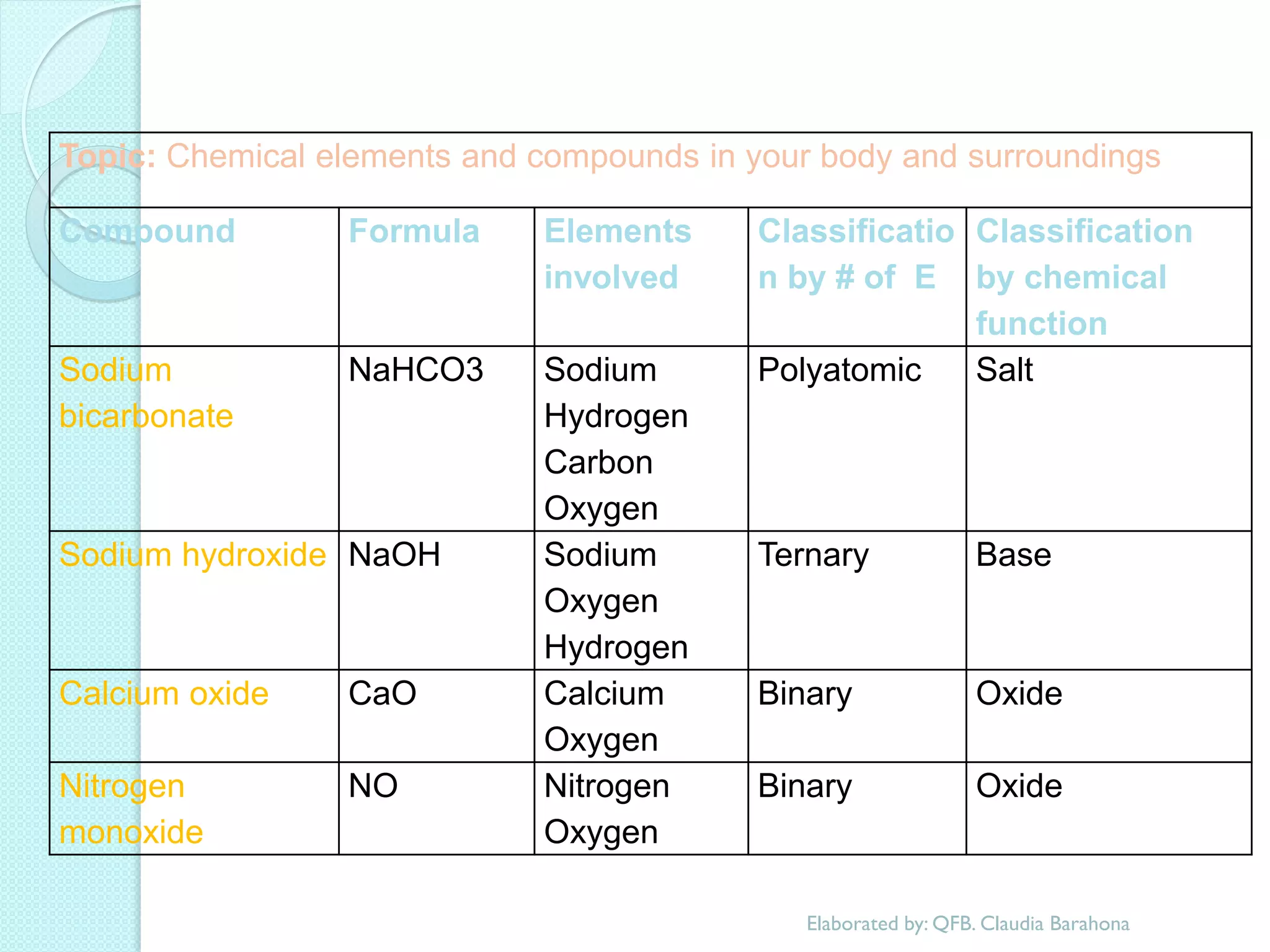
Sodium bicarbonate 
NaHCO3 
Sodium 
Hydrogen 
Carbon 
Oxygen 
Polyatomic 
Salt 
Sodium hydroxide 
NaOH 
Sodium 
Oxygen 
Hydrogen 
Ternary 
Base 
Calcium oxide 
CaO 
Calcium 
Oxygen 
Binary 
Oxide 
Nitrogen monoxide 
NO 
Nitrogen 
Oxygen 
Binary 
Oxide 
Elaborated by: QFB. Claudia Barahona
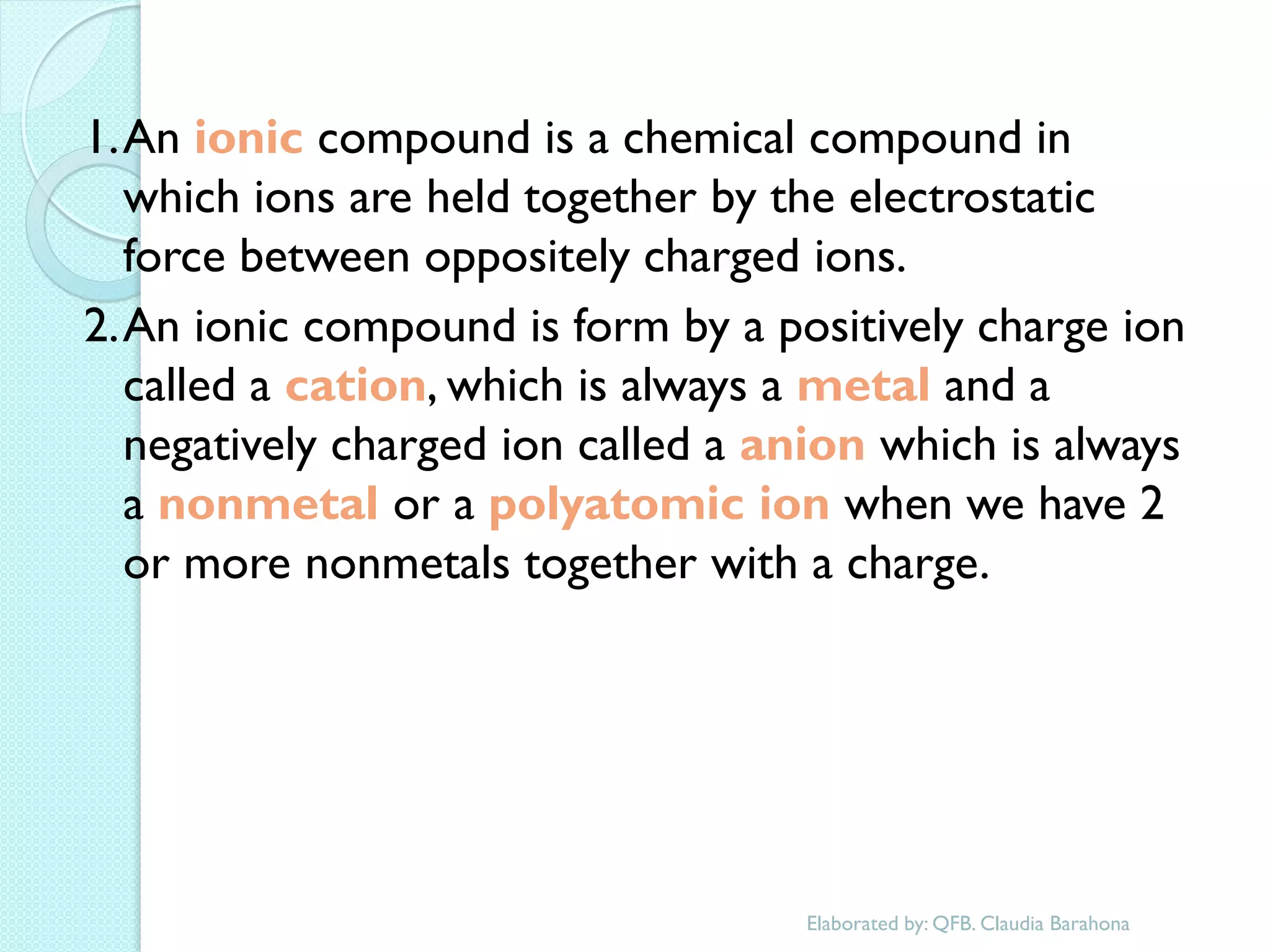
1. An ionic compound is a chemical compound in which ions are held together by the electrostatic force between oppositely charged ions. 
2. An ionic compound is form by a positively charge ion called a cation, which is always a metal and a negatively charged ion called a anion which is always a nonmetal or a polyatomic ion when we have 2 or more nonmetals together with a charge. 
Elaborated by: QFB. Claudia Barahona
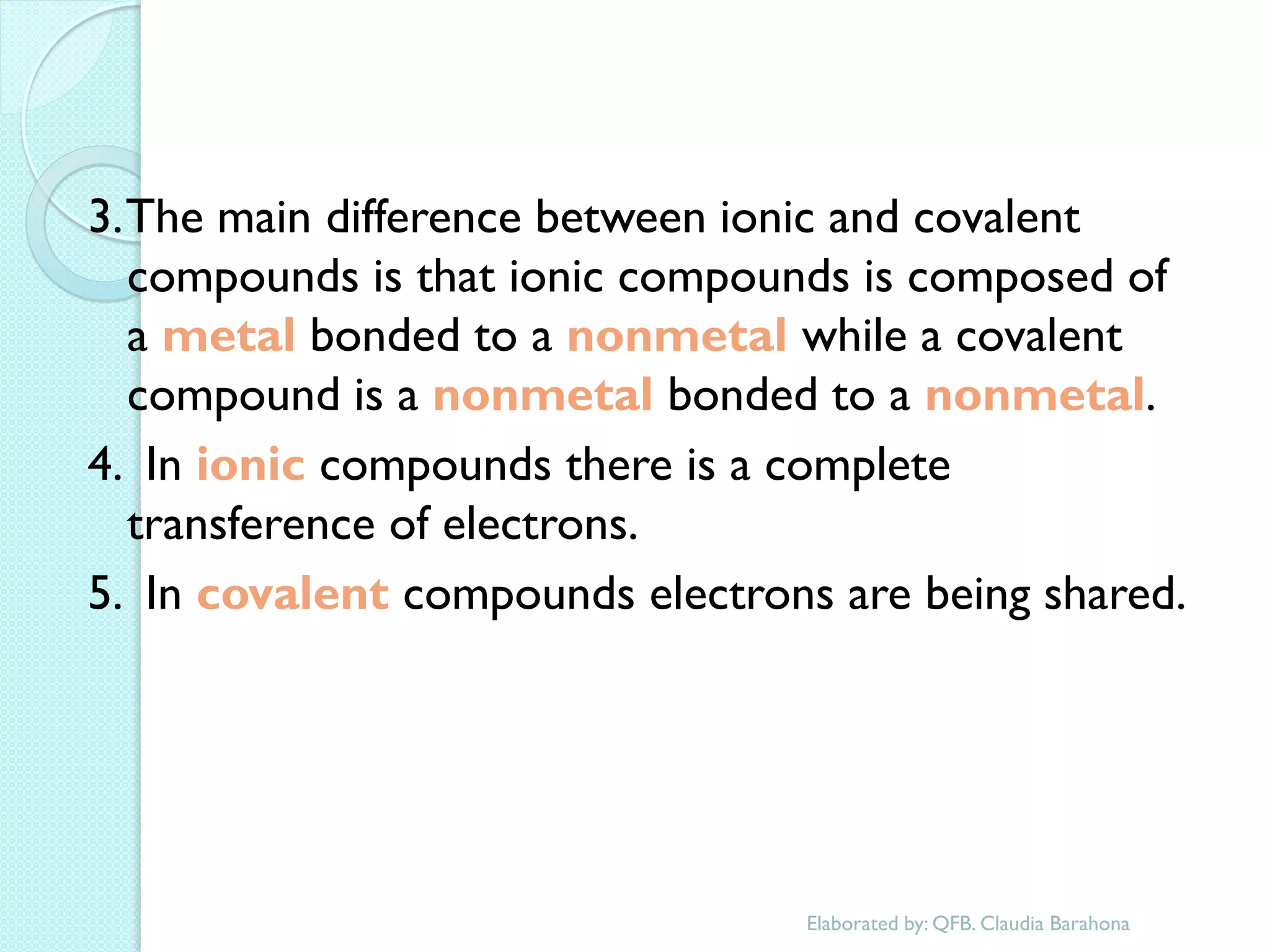
3. The main difference between ionic and covalent compounds is that ionic compounds is composed of a metal bonded to a nonmetal while a covalent compound is a nonmetal bonded to a nonmetal. 
4. In ionic compounds there is a complete transference of electrons. 
5. In covalent compounds electrons are being shared. 
Elaborated by: QFB. Claudia Barahona
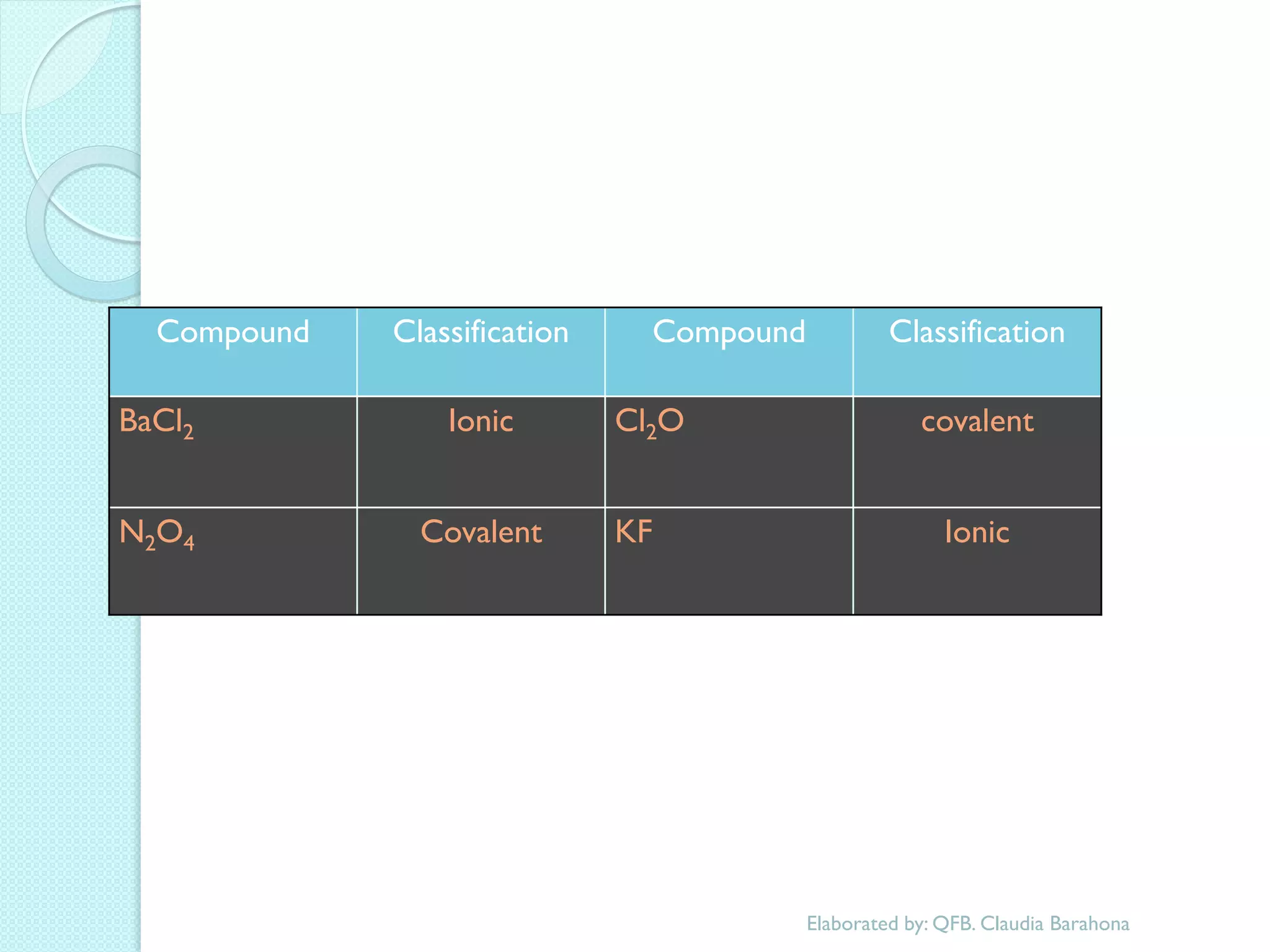
Compound 
Classification 
Compound 
Classification 
BaCl2 
Ionic 
Cl2O 
covalent 
N2O4 
Covalent 
KF 
Ionic 
Elaborated by: QFB. Claudia Barahona
Compounds according to the type of bond 
Elaborated by: QFB. Claudia Barahona
Ionic compounds 
Consists of positive ion (metal) and negative ion (nonmetal). 
Ions are held together by strong electrical attractions between the opposite charges called ionic bonds. 
Elaborated by: QFB. Claudia Barahona
Covalent compounds 
Forms when atoms of 2 nonmetals share electrons. 
Held together by the sharing of electrons called covalent bond. 
When 2 or more atoms share electrons they form a molecule. 
Elaborated by: QFB. Claudia Barahona
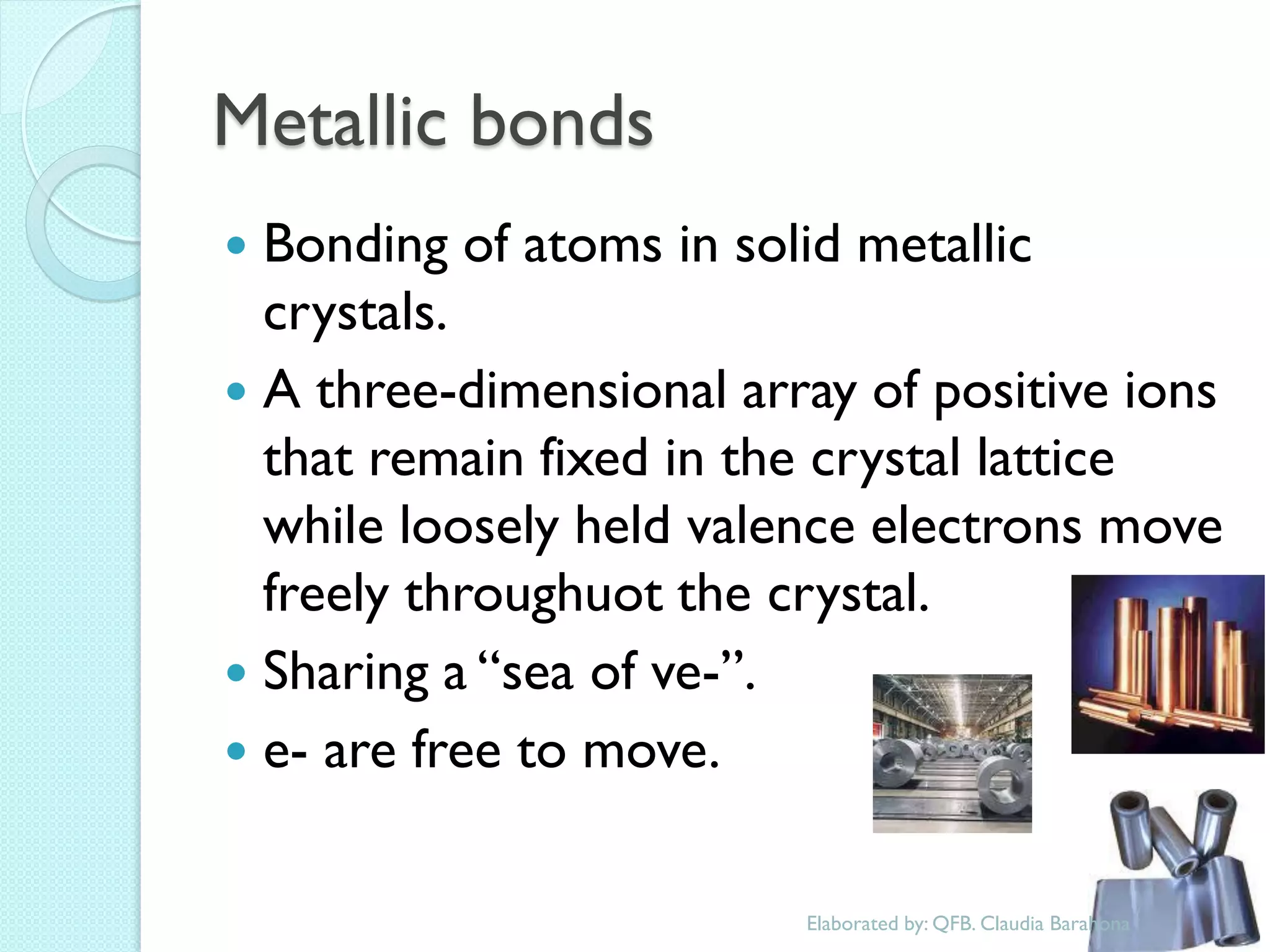
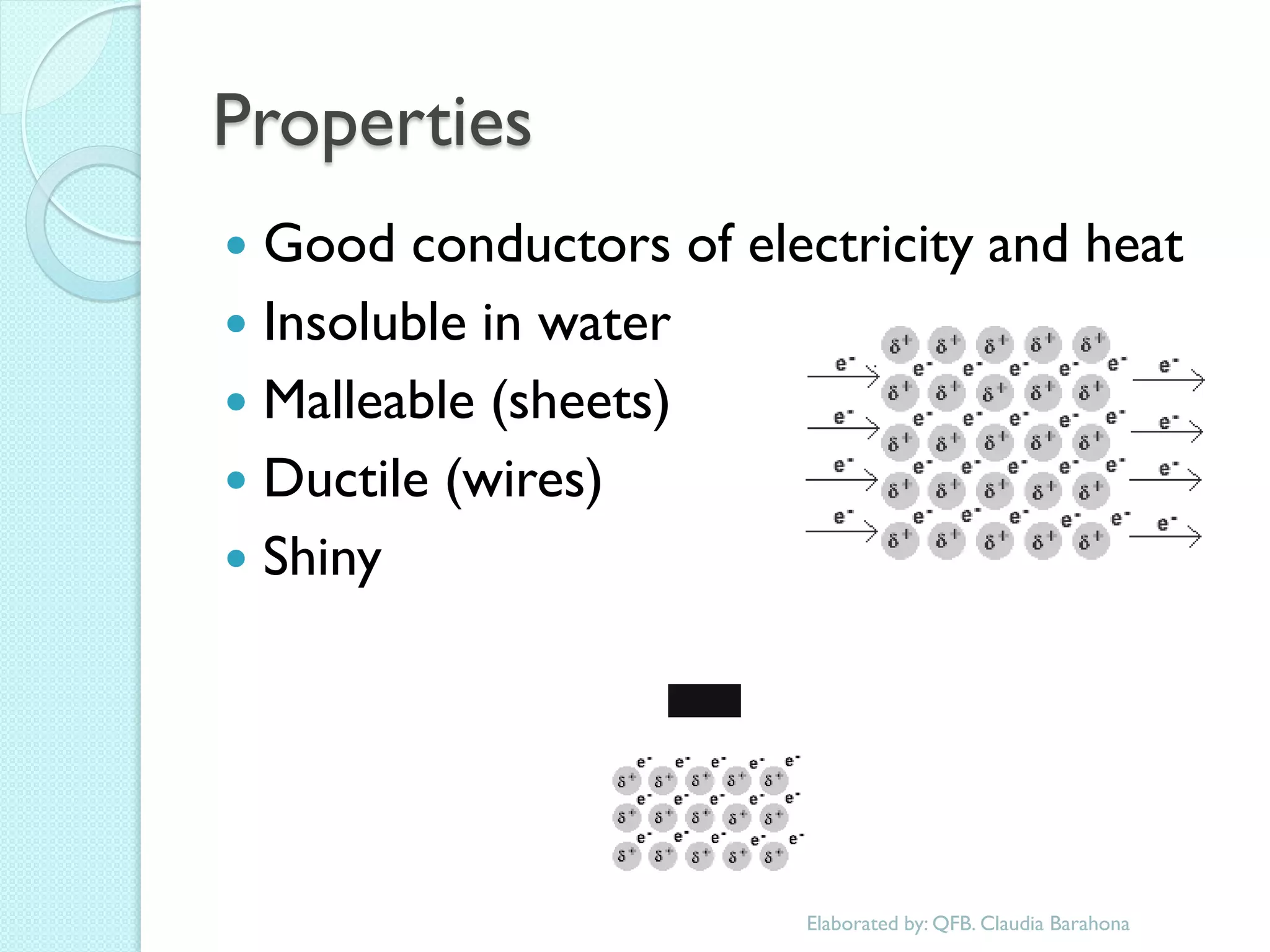
Metallic bonds 
Bonding of atoms in solid metallic crystals. 
A three-dimensional array of positive ions that remain fixed in the crystal lattice while loosely held valence electrons move freely throughuot the crystal. 
Sharing a “sea of ve-”. 
e- are free to move. 
Elaborated by: QFB. Claudia Barahona
Properties 
Good conductors of electricity and heat 
Insoluble in water 
Malleable (sheets) 
Ductile (wires) 
Shiny 
Elaborated by: QFB. Claudia Barahona
END OF STAGE 2

Elements and compounds in our surroundings

  • 1.
    Chemistry I StageII Ms. Claudia Barahona Elements & compounds in our surroundings
  • 2.
    Stage I1 Chemicalreactions in our surroundings Formative Objective: The student identifies the chemical name and formula of elements and compounds present in our daily lives, to reflect on the effects and importance of these substances in our bodies and surroundings. Elaborated by: QFB. Claudia Barahona
  • 3.
    TOPICS Classification ofelements in : metals, nonmetals and metalloids Classification of compounds by the number of elements and chemical function. Elements present in the human body and acquisition sources. The effects and uses of chemical compounds in our daily lives Elaborated by: QFB. Claudia Barahona
  • 4.
    COMPETENCES Generic Competences: 4. Listens, interprets, and emits pertinent messages in different situations using mediums, codes and appropriate tools.  Express ideas and concepts through  Identifies the main ideas in a text or an oral speech, and deduce conclusions from them. 5. Develops innovations and proposes solutions from established methods.  Follows directions and procedures objective.  Synthesizes evidences obtained with experimentation to produce  Uses the information and communication technologies to Disciplinary Competences: 2. The student bases opinions about the impact of science and technology in his daily life assuming ethical considerations. 10. The Student relates the symbolic expressions of a phenomenon of the sight or using scientific instruments or models.
  • 5.
    Activity 2.1 Exploringyour knowledge
  • 6.
    What is anELEMENT? oA pure substance composed of only one type of atom. oCannot be broken down into another substance by chemical or physical means.
  • 7.
    Compounds A puresubstance consisting of 2 or more elements chemically combined, in a definite composition that can be broken down into a simpler substance, using chemical methods of separation. Chemical methods: ◦Electrolysis ◦REDOX reactions ◦Catalysis
  • 8.
    Dmitri Mendeleev (1869) http://www.chem.msu.su/eng/misc/mendeleev/welcome.html The periodic table Arrangement of elements by increasing atomic number
  • 9.
  • 10.
  • 11.
    Chemical Symbols Areone or two-letter abbreviations for the names of an element. ONLY THE FIRST LETTER IS CAPITALIZED. If the symbol has a second letter, it is lowercase SO THAT WE KNOW WHEN A DIFFERENT ELEMENT IS INDICATED. CO Co CARBON MONOXIDE Cobalt The symbol of Carbon is C, the symbol of sulfur S. However the symbol of Cesium is Cs not CS. Why not?
  • 12.
    Origin of someof the elements name Most of the chemical symbols use letters from the current name, some are derived from their ancient name. Other elements are named after planets, mythological figures, colors, minerals, geographical location and famous people. Act 2.1 Part II
  • 13.
    Activity 2.2 Acquisitionof knowledge Vocabulary terms
  • 14.
    Vocabulary terms 1.Periodictable 2.Period 3.Group or family 4.Chemical symbols 5.Representative elements 6.Transition elements 7.Metals 8.Nonmetals 9.Metalloids 10.Malleable 11.Ductile 12.Element 13.Compound 14.Binary compound 15.Ternary compound 16.Polyatomic compound 17.Acids 18.Bases 19.Oxides 20.Salts 21.Valence electrons 22.Ionic bond 23.Covalent bond
  • 15.
    Typical amounts ofessential elements in: Human body
  • 16.
    Typical amounts ofessential elements in: Human body
  • 17.
    Typical amounts ofessential elements in: Planet Universe
  • 18.
    Act 2.2 PartIII Element Real case intoxication (lethal dose) Source of acquisition Symptoms First aid in case of intoxication Arsenic (As) Can be administered through oral via such as food, drinks, etc. In adults is estimated to be 70 to 200 mg or 1 mg/kg/day. Headaches, confusion, severe diarrhea, drowsiness. Convulsions. vomiting, blood in the urine, cramping muscles, hair loss, stomach pain, and more convulsions. The final result of arsenic poisoning is coma and death. Dimercaproland dimercaptosuccinic acid are chelating agents that sequester the arsenic away from blood proteins.
  • 19.
    Act 2.2 PartIII Element Real case intoxication (lethal dose) Source of acquisition Symptoms First aid in case of intoxication Chromium (Cr) Drinking water, Ranges between 1900 and 3300 μg/kg. Chromate dye company. Cr often used to manufacture, amongst other things, leather products, paints, cement, mortar and anti- corrosives. Can lead to DNA damage. After it reaches the blood stream, it damages kidneys, liver and blood cells, Hemolysis, renal and liver failure are the results of these damages. Appropriate supportive measures may include ventilatory support, cardiovascular support, and renal and hepatic function monitoring. Check the 7 diatomic molecules
  • 20.
    Act 2.2 PartIII Element Real case intoxication (lethal dose) Source of acquisition Symptoms First aid in case of intoxication Mercury Consumption of fish is by far the most significant source of ingestion-related mercury exposure in humans and animals, although plants and livestock also contain mercury due to bioconcentration of mercury from seawater, freshwater, marine and lacustrine sediments, soils. Sensory impairment (vision, hearing, speech), disturbed sensation and a lack of coordination. Damage to the brain, kidneys and lungs Immediate chelation therapy, Check the 7 diatomic molecules
  • 21.
    The Periodic Table  A map of the building block of matter. 1 IA 18 VIIIA 1 1 H 1.00797 2 IIA Periodic Table 13 IIIA 14 IVA 15 VA 16 VIA 17 VIIA 2 He 4.0026 2 3 Li 6.939 4 Be 9.0122 5 B 10.811 6 C 12.0112 7 N 14.0067 8 O 15.9994 9 F 18.9984 10 Ne 20.179 3 11 Na 22.9898 12 Mg 24.305 3 IIIB 4 IVB 5 VB 6 VIB 7 VIIB 8 9 VIIIB 10 11 IB 12 IIB 13 Al 26.9815 14 Si 28.086 15 P 30.9738 16 S 32.064 17 Cl 35.453 18 Ar 39.948 4 19 K 39.102 20 Ca 40.08 21 Sc 44.956 22 Ti 47.90 23 V 50.942 24 Cr 51.996 25 Mn 54.9380 26 Fe 55.847 27 Co 58.9332 28 Ni 58.71 29 Cu 63.54 30 Zn 65.37 31 Ga 65.37 32 Ge 72.59 33 As 74.9216 34 Se 78.96 35 Br 79.909 36 Kr 83.80 5 37 Rb 85.47 38 Sr 87.62 39 Y 88.905 40 Zr 91.22 41 Nb 92.906 42 Mo 95.94 43 Tc [99] 44 Ru 101.07 45 Rh 102.905 46 Pd 106.4 47 Ag 107.870 48 Cd 112.40 49 In 114.82 50 Sn 118.69 51 Sb 121.75 52 Te 127.60 53 I 126.904 54 Xe 131.30 6 55 Cs 132.905 56 Ba 137.34 57 La 138.91 72 Hf 178.49 73 Ta 180.948 74 W 183.85 75 Re 186.2 76 Os 190.2 77 Ir 192.2 78 Pt 195.09 79 Au 196.967 80 Hg 200.59 81 Tl 204.37 82 Pb 207.19 83 Bi 208.980 84 Po [210] 85 At [210] 86 Rn [222] 7 87 Fr [223] 88 Ra [226] 89 Ac [227] 104 Ku [260] 105 106 107 108 109 http://www.chemsoc.org/viselements/pages/periodic_table.html
  • 22.
    Reading the PeriodicTable: Classification Nonmetals, Metals, Metalloids, Noble gases
  • 23.
    Across the PeriodicTable  Periods: Are arranged horizontally across the periodic table (rows 1-7)  These elements have the same number of valence shells. 1 IA 18 VIIIA 1 2 IIA 13 IIIA 14 IVA 15 VA 16 VIA 17 VIIA 2 3 3 IIIB 4 IVB 5 VB 6 VIB 7 VIIB 8 9 VIIIB 10 11 IB 12 IIB 4 5 6 7 2nd Period 6th Period
  • 24.
    Down the PeriodicTable Family: Are arranged vertically down the periodic table (columns or group, 1- 18 or 1-8 A,B) These elements have the same number electrons in the outer most shells, the valence shell. 1 IA 18 VIIIA 1 2 IIA 13 IIIA 14 IVA 15 VA 16 VIA 17 VIIA 2 3 3 IIIB 4 IVB 5 VB 6 VIB 7 VIIB 8 9 VIIIB 10 11 IB 12 IIB 4 5 6 7 Alkali Family: 1 e- in the valence shell Halogen Family: 7 e- in the valence shell
  • 25.
    Infamous Families ofthe Periodic Table  Notable families of the Periodic Table and some important members: 1 IA 18 VIIIA 1 2 IIA 13 IIIA 14 IVA 15 VA 16 VIA 17 VIIA 2 3 3 IIIB 4 IVB 5 VB 6 VIB 7 VIIB 8 9 VIIIB 10 11 IB 12 IIB 4 5 6 7 Alkali Alkaline (earth) Transition Metals Noble Gas Halogen Chalcogens
  • 26.
  • 27.
  • 28.
    Metals appear tothe left of the dark ziz-zag line on the periodic table. Most metals are solid at room temperature. Properties of metals
  • 29.
    Metals have luster.This means they are shiny Properties of metals
  • 30.
    Ductile metals canbe drawn into wire. COPPER Properties of metals
  • 31.
    Malleable metals canbe hammered into sheets ALUMINUM Properties of metals
  • 32.
    Metals have ahigh melting point. They are also very dense. Properties of metals
  • 33.
    Conductors Metals aregood conductors of electricity and heat Properties of metals
  • 34.
    A chemical propertyof metal is its reaction with water and oxygen. This results in corrosion and rust. Properties of metals
  • 35.
    Properties of metals •Shiny •Solids at room T° (except Hg) •Luster •Good conductors of heat and electricity •Malleable (sheet) •Ductile (wires) •High melting points •High density
  • 36.
  • 37.
    Nonmetals occur tothe right of the dark zig-zag on the periodic table. Although Hydrogen is in family 1, it is also a nonmetal. Many nonmetals are gases at room temperature. Properties of Non metals
  • 38.
    Nonmetals do nothave luster; they are dull. Properties of Non-metals
  • 39.
    Brittle Nonmetals arebrittle so they break easily. This means nonmetals ARE NOT ductile or malleable. Properties of Non-metals
  • 40.
    Nonmetals have lowdensity. Properties of Non-metals
  • 41.
    They also havea low melting point. This is why they are poor conductors of heat and electricity. Properties of Non-metals
  • 42.
    Properties of nonmetals Nonmetals: Lacks of luster Low melting point Low density Bad conductors of heat or electricity
  • 43.
  • 44.
    Metalloids can befound clustered around the dark zig-zag line that separates metals and nonmetals. Properties of Metalloids
  • 45.
    Metalloids (metal- like)have properties of both metals and nonmetals. Properties of Metalloids
  • 46.
    Metalloids are solidsthat can be shiny or dull. Properties of Metalloids
  • 47.
    They conduct electricityand heat better than nonmetals but not as well as metals. Properties of Metalloids
  • 48.
    Properties of Metalloids Metalloids are malleable and ductile
  • 49.
    Properties of metals,nonmetals and metalloids Metalloids: Possess characteristics of both metals and nonmetals Semiconductors
  • 50.
  • 51.
    What is aCOMPOUND? oA substance in which two or more different elements are CHEMICALLY bonded together.
  • 52.
    Types of Compounds •A compound with 2 different elements •NaCl – Sodium Chloride Binary •A compound with 3 different elements •HClO Hypochlorous Acid Ternary •A compound with 3 or more elements •NaHCO3 Sodium Bicarbonate Polyatomic
  • 53.
    Classification of InorganicCompounds INORGANIC COMPOUND CLASSIFICATION ELEMENTS Metal Non-metals Metalloids COMPOUND Salt Oxide Base Acid Others*
  • 54.
    ACIDS Contain theH+ ion and a non-metal ion or polyatomic ion in an aqueous (aq) solution CATION ANION HCl -> Hydrochloric acid H2SO4 -> Sulfuric acid Some characteristics Taste Sour Feel May Sting Litmus Red Phenolphthalein Colorless Neutralization Neutralizes bases
  • 55.
    Strong acids 6common strong acids: •Perchloric acid HClO4 •Sulfuric acid H2SO4 •Hydroiodic acid HI •Hydrobromic acid HBr •Hydrochloric acid HCl •Nitric acid HNO3
  • 56.
    BASES Contain ametal ion and the (OH)- ion in an aqueous (aq) solution CATION ANION Characteristics of bases Taste Bitter, chalky Feel Soapy, slippery Litmus Blue Phenolphthalein Pink Neutralization Neutralizes acids No special naming rules for bases. Ex. KOH -> potassium hydroxide Ex. NH4OH -> ammonium hydroxide
  • 57.
    OXIDES Binary compoundsthat contain a metal or non metal ion and the O-2 ion, normally in a solid state (s) Al2O3 is aluminum oxide ( Ionic M-NM) CO carbon monoxide (Covalent NM-NM)
  • 58.
    SALTS Contain ametal ion (Not H+) and non-metal ion or polyatomic ion (NOT (OH)- nor, O-2 ) 1. normally in a solid state, (s), or in an aqueous, (aq), solution 2. SALTS ARE FORMED AFTER THE NEUTRALIZATION OF AN ACID BY A BASE Example: LiF lithium fluoride MgCr2O7 magnesium dichromate Pb(ClO3)4 lead (IV) chlorite CATION ANION
  • 59.
    Others Ionic compounds Covalent compounds
  • 60.
    Ionic compounds Ionsare held together by strong electrical attractions between the opposite charges called ionic bonds. ◦Cation= Metal ◦Anion= Nonmetal The sum of the ionic charges on the formula is always zero!! CATION ANION
  • 61.
    Covalent compounds Formswhen atoms of 2 nonmetals share electrons. Held together by the sharing of electrons called covalent bond. When 2 or ore atoms share electrons they form a molecule. CATION ANION
  • 62.
    Review Classify thefollowing compounds based on the number of elements and function. 1.AgOH 2.MgO 3.KOH 4.CaF2 5.Na2CO3 6.Na3PO4 7.CaCO3 8.H2SO4 9.ClO3 10.SO3 11.Fe203 12.Mg(OH)2 13.HNO3 14.PbO2 15.CO2 16.Na2O 17.HBr
  • 63.
  • 64.
    Elements in theirnatural state Simplest kind of pure substance that contains only one type of matter and cannot be broken down by chemical methods. Most of the elements in their natural state are found as compounds. Diatomic molecules 7 elements are found as diatomic molecules: ◦H2, N2, O2, F2, Cl2, Br2 e I2 Elaborated by: QFB. Claudia Barahona
  • 65.
    Chemical compounds bynumber of elements Elaborated by: QFB. Claudia Barahona
  • 66.
    Compounds Two ormore elements chemically combined. Elaborated by: QFB. Claudia Barahona
  • 67.
    Number of elements Compounds can be classified according to the number of different elements chemically combined as: ◦Binary (two elements) Ex: NaCl, FeS, H2O. ◦Ternary (Three elements) Ex: NaOH, HClO4, H2SO4 ◦Polyatomic (four or more) Ex: NaHCO3, (NH4)2SO4, NaHSO3 Elaborated by: QFB. Claudia Barahona
  • 68.
    Classification of compoundsby their function compounds Acids Bases Oxides Salts Elaborated by: QFB. Claudia Barahona
  • 69.
    Acids and bases Lemons Grapefruits Vinegar Sodium hydroxide Antiacids Acetic acid Elaborated by: QFB. Claudia Barahona
  • 70.
    Acids Arrhenius theory:Substance that dissolves in water and produces hydrogen ions (H+). Bronsted-Lowry: Proton donor substances. Elaborated by: QFB. Claudia Barahona
  • 71.
    Properties of Acids Sour taste. Turns litmus paper indicator red. Turns phenolphtalein indicator colorless. Corrode some metals. Elaborated by: QFB. Claudia Barahona
  • 72.
    Bases Arrhenius theory:Substance that dissolves in water and produces hydroxide ions (OH-). Bronsted-Lowry: Proton acceptor substances. Elaborated by: QFB. Claudia Barahona
  • 73.
    Properties of Bases Bitter taste. Slippery feel (soaps). Turns litmus indicator blue. Turns phenolfphtalein indicator pink. Elaborated by: QFB. Claudia Barahona
  • 74.
    Oxides Chemical binarycompounds with one or more oxygen atoms combined with another element. Elaborated by: QFB. Claudia Barahona
  • 75.
    Salts Ionic compoundthat contains a metal ion or NH4+ and a nonmetal or polyatomic ion other than OH-. Elaborated by: QFB. Claudia Barahona
  • 76.
    Chemical compounds bytype of bond Elaborated by: QFB. Claudia Barahona
  • 77.
    Ionic compounds Consistsof positive ion (metal) and negative ion (nonmetal). Metal - Nonmetal Ions are held together by strong electrical attractions between the opposite charges called ionic bonds. Elaborated by: QFB. Claudia Barahona
  • 78.
    Covalent compounds Formswhen atoms of 2 nonmetals share electrons. Nonmetal – Nonmetal Held together by the sharing of electrons called covalent bond. When 2 or more atoms share electrons they form a molecule. Elaborated by: QFB. Claudia Barahona
  • 79.
    Electronegativity Relative abilityof an atom to attract the share electrons by itself. In a period, it increases. In a group it decreases. Nonmetals, Fluorine 4.0 and oxygen 3.5 have the highest electronegativites. Metals Cesium and Francium have the lowest electronegativities. Elaborated by: QFB. Claudia Barahona
  • 80.
    Electronegativity Increasing electronegativity Increasing electronegativity Representative elements Transition Metals Elaborated by: QFB. Claudia Barahona
  • 81.
    Polarity •Describes howelectrons are shared between atoms . •Electrons are not always shared equally between two bonding atoms. •One atom might exert more of a force on the electron than the other, electronegativity. •The unequal sharing of electrons within a bond leads to the formation of polarity. Elaborated by: QFB. Claudia Barahona
  • 82.
    Polarity of bonds Nonpolar covalent bond: Bond between atoms with identical or very similar electronegativities. Elaborated by: QFB. Claudia Barahona
  • 83.
    Polarity of bonds Polar covalent bond: Electrons are shared unequally. Elaborated by: QFB. Claudia Barahona
  • 84.
    Summary of bonds Elaborated by: QFB. Claudia Barahona
  • 85.
    Topic: Chemical elementsand compounds in your body and surroundings Compound Formula Elements involved Classification by # of E Classification by chemical function Carbon dioxide CO2 Carbon Oxygen Binary Oxide Hydrochloric acid HCl Hydrogen Chlorine Binary Acid Vinegar (Acetic acid) CH3(COOH) Carbon Hydrogen Oxygen Ternary Acid Table salt (sodium chloride) NaCl Sodium Chlorine Binary Salt Elaborated by: QFB. Claudia Barahona
  • 86.
    Topic: Chemical elementsand compounds in your body and surroundings Compound Formula Elements involved Classification by # of E Classification by chemical function Sodium bicarbonate NaHCO3 Sodium Hydrogen Carbon Oxygen Polyatomic Salt Sodium hydroxide NaOH Sodium Oxygen Hydrogen Ternary Base Calcium oxide CaO Calcium Oxygen Binary Oxide Nitrogen monoxide NO Nitrogen Oxygen Binary Oxide Elaborated by: QFB. Claudia Barahona
  • 87.
    1. An ioniccompound is a chemical compound in which ions are held together by the electrostatic force between oppositely charged ions. 2. An ionic compound is form by a positively charge ion called a cation, which is always a metal and a negatively charged ion called a anion which is always a nonmetal or a polyatomic ion when we have 2 or more nonmetals together with a charge. Elaborated by: QFB. Claudia Barahona
  • 88.
    3. The maindifference between ionic and covalent compounds is that ionic compounds is composed of a metal bonded to a nonmetal while a covalent compound is a nonmetal bonded to a nonmetal. 4. In ionic compounds there is a complete transference of electrons. 5. In covalent compounds electrons are being shared. Elaborated by: QFB. Claudia Barahona
  • 89.
    Compound Classification Compound Classification BaCl2 Ionic Cl2O covalent N2O4 Covalent KF Ionic Elaborated by: QFB. Claudia Barahona
  • 90.
    Compounds according tothe type of bond Elaborated by: QFB. Claudia Barahona
  • 91.
    Ionic compounds Consistsof positive ion (metal) and negative ion (nonmetal). Ions are held together by strong electrical attractions between the opposite charges called ionic bonds. Elaborated by: QFB. Claudia Barahona
  • 92.
    Covalent compounds Formswhen atoms of 2 nonmetals share electrons. Held together by the sharing of electrons called covalent bond. When 2 or more atoms share electrons they form a molecule. Elaborated by: QFB. Claudia Barahona
  • 93.
    Metallic bonds Bondingof atoms in solid metallic crystals. A three-dimensional array of positive ions that remain fixed in the crystal lattice while loosely held valence electrons move freely throughuot the crystal. Sharing a “sea of ve-”. e- are free to move. Elaborated by: QFB. Claudia Barahona
  • 94.
    Properties Good conductorsof electricity and heat Insoluble in water Malleable (sheets) Ductile (wires) Shiny Elaborated by: QFB. Claudia Barahona
  • 95.