Unit 2 Part 4 Organization of the Modern Periodic Table
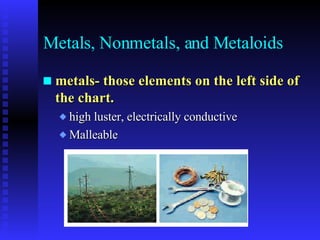
Metals, Nonmetals, and Metaloids metals- those elements on the left side of the chart.   high luster, electrically conductive Malleable
nonmetals- those elements on the right side of the chart. no luster brittle, nonmalleable non conductive metaloids- elements with properties of both metals and nonmetals.
The Representative Elements
The Transition Metals
Inner Transition Metals
Hydrogen Although in Group 1A, hydrogen shares few properties with other elements in the group. Hydrogen is the most abundant element in the universe. Over 90% of  the mass in the universe is hydrogen. Hydrogen can behave like a metal or a non- metal.
The Alkali Metals Alkali (arabic al-qili – meaning “ashes of a saltwort plant”)  These Group 1A elements react with water to form alkaline (basic) solutions. Most are soft enough to cut with a knife
Lithium Least reactive in group. Similar to Magnesium  Common Compounds: Lithium Hydride – Batteries Lithium Carbonate – treat bipolar disorder.
Sodium and Potassium Most abundant of the Group 1A elements Both react “vigorously” with water. Common Compounds Sodium chloride – table salt Potassium chloride – “salt” substitute. Potassium Nitrate – explosive.
The Alkali Earth Metals Alchemy used the word “earth” to describe elements that did not melt in fire. Most compounds of  this group do not dissolve in water.
Beryllium Used to control nuclear reactions Used to make tools for the petroleum industry
Calcium Essential in humans for bones and teeth. Calcium Carbonate – antacid, major component of limestone, chalk, and marble. Lime – calcium oxide. Magnesium Useful in the construction of strong and lightweight alloys. Magnesium oxide – high melting point
Strontium Fireworks “red” color Barium Used to color glass. Some compounds used for medical diagnostics. Radium Highly radioactive – once used to paint the hands on watches to glow in the dark.
The Boron Group These elements are always found combined with other elements in nature. Boron Least representative. Borax –  Borosilicate glass – withstands high temperature differences.
Aluminum Most abundant metal in the earth’s crust. Bauxite – ore of aluminum oxide. It is used as an abrasive. Gallium Gallium Arsenide – converts solar energy from electricity. Gallium based laser – “blue-ray” DVD players.
The Carbon Group Wide range of properties within one group. Carbon Organic and biological chemistry. Inorganic compounds.
Compounds of itself. Graphite, Coal, Diamond. Allotropes – same elements in the same state with different structures and properties.
Silicon Used in computer chips and solar cells.  Silca – silicon dioxide. Major component of sand. Lead Lead was one of the first metals separated from ore. Once used for plumbing, now known to cause brain damage. Car batteries.
The Nitrogen Group Nitrogen- colorless, odorless gas; makes up 78% of Earth’s atmosphere. Common element in explosives. Phosphorus – essential for plant growth. Antimony, Arsenic, and bismuth  Arsenic sulfide – toxic but used at one time to treat illness
Antimony sulfide – makeup to darken eybrows. Bismuth- “Pepto-bismol” and in Wood’s alloy (fire sprinklers)
The Oxygen Group (Chalcogens) Oxygen Two common allotropes O 2  – 21% of the earth’s atmosphere O 3  – unstable gas that decomposes under heat and UV radiation The most abundant element in earth’s crust.
Sulfur Yellow with multiple allotropes Sulfur dioxide – emission responsible for acid rain Hydrogen sulfide – “rotten egg” smell. Silver sulfide – silver tarnish
Selenium Sodium Selenate  -  found in multivitamins. Works with Vitamin E to prevent cell damage. Locoweed – contains toxic concentrations of selenium. Used in solar panels, photocopiers, and microprocessors
Polonium Rare Radioactive Extremely Toxic Discovered by Marie and Piere Curie (1898). Named for her homeland (Poland)
The Halogens Flourine The most reactive nonmetal. Added to toothpaste and drinking water to prevent decay. Chlorine Although a toxic gas, is used to disinfect sewage and drinking water.
Bromine and Iodine Sodium Bromide, and Sodium Iodine coat photographic film. Goiter – condition where body is deprived of iodine. Ex: Iodized salt. Water purification tablets.
The Noble Gases Colorless and non reactive Helium Used by divers to prevent the bends. Found on earth in Natural gas wells. Texas is a leading supplier of Helium.
Neon, Argon, and Krypton Light displays Argon is used in high temperature welding to prevent combustion.
Radon Radioactive gas
Transition Metals “ B” Groups Most are solids at room temperature with high melting points. The more unpaired electrons the greater the hardness and higher the melting point. Can vary in their loss of electrons
Inner Transition Metals Lanthanide Series “ Silvery” metals with high melting points. Typically found mixed together in nature and very difficult to refine. Neodymium and Praseodymium – Welder’s Glasses Yttrium oxide and europium oxide – TVs and CRTs Lanthanide – used in projectors and sunglasses
Actinide Series Radioactive Only 3 exist in nature  Transuranium element – synthetic elements exist beyond Atomic number 92. Plutonium – nuclear “fuel” for power plants. Americium – smoke detectors.

Chemistry Unit 2 Part 5 - The Representative Elements

  • 1.
    Unit 2 Part4 Organization of the Modern Periodic Table
  • 2.
    Metals, Nonmetals, andMetaloids metals- those elements on the left side of the chart. high luster, electrically conductive Malleable
  • 3.
    nonmetals- those elementson the right side of the chart. no luster brittle, nonmalleable non conductive metaloids- elements with properties of both metals and nonmetals.
  • 4.
  • 5.
  • 6.
  • 7.
    Hydrogen Although inGroup 1A, hydrogen shares few properties with other elements in the group. Hydrogen is the most abundant element in the universe. Over 90% of the mass in the universe is hydrogen. Hydrogen can behave like a metal or a non- metal.
  • 8.
    The Alkali MetalsAlkali (arabic al-qili – meaning “ashes of a saltwort plant”) These Group 1A elements react with water to form alkaline (basic) solutions. Most are soft enough to cut with a knife
  • 9.
    Lithium Least reactivein group. Similar to Magnesium Common Compounds: Lithium Hydride – Batteries Lithium Carbonate – treat bipolar disorder.
  • 10.
    Sodium and PotassiumMost abundant of the Group 1A elements Both react “vigorously” with water. Common Compounds Sodium chloride – table salt Potassium chloride – “salt” substitute. Potassium Nitrate – explosive.
  • 11.
    The Alkali EarthMetals Alchemy used the word “earth” to describe elements that did not melt in fire. Most compounds of this group do not dissolve in water.
  • 12.
    Beryllium Used tocontrol nuclear reactions Used to make tools for the petroleum industry
  • 13.
    Calcium Essential inhumans for bones and teeth. Calcium Carbonate – antacid, major component of limestone, chalk, and marble. Lime – calcium oxide. Magnesium Useful in the construction of strong and lightweight alloys. Magnesium oxide – high melting point
  • 14.
    Strontium Fireworks “red”color Barium Used to color glass. Some compounds used for medical diagnostics. Radium Highly radioactive – once used to paint the hands on watches to glow in the dark.
  • 15.
    The Boron GroupThese elements are always found combined with other elements in nature. Boron Least representative. Borax – Borosilicate glass – withstands high temperature differences.
  • 16.
    Aluminum Most abundantmetal in the earth’s crust. Bauxite – ore of aluminum oxide. It is used as an abrasive. Gallium Gallium Arsenide – converts solar energy from electricity. Gallium based laser – “blue-ray” DVD players.
  • 17.
    The Carbon GroupWide range of properties within one group. Carbon Organic and biological chemistry. Inorganic compounds.
  • 18.
    Compounds of itself.Graphite, Coal, Diamond. Allotropes – same elements in the same state with different structures and properties.
  • 19.
    Silicon Used incomputer chips and solar cells. Silca – silicon dioxide. Major component of sand. Lead Lead was one of the first metals separated from ore. Once used for plumbing, now known to cause brain damage. Car batteries.
  • 20.
    The Nitrogen GroupNitrogen- colorless, odorless gas; makes up 78% of Earth’s atmosphere. Common element in explosives. Phosphorus – essential for plant growth. Antimony, Arsenic, and bismuth Arsenic sulfide – toxic but used at one time to treat illness
  • 21.
    Antimony sulfide –makeup to darken eybrows. Bismuth- “Pepto-bismol” and in Wood’s alloy (fire sprinklers)
  • 22.
    The Oxygen Group(Chalcogens) Oxygen Two common allotropes O 2 – 21% of the earth’s atmosphere O 3 – unstable gas that decomposes under heat and UV radiation The most abundant element in earth’s crust.
  • 23.
    Sulfur Yellow withmultiple allotropes Sulfur dioxide – emission responsible for acid rain Hydrogen sulfide – “rotten egg” smell. Silver sulfide – silver tarnish
  • 24.
    Selenium Sodium Selenate - found in multivitamins. Works with Vitamin E to prevent cell damage. Locoweed – contains toxic concentrations of selenium. Used in solar panels, photocopiers, and microprocessors
  • 25.
    Polonium Rare RadioactiveExtremely Toxic Discovered by Marie and Piere Curie (1898). Named for her homeland (Poland)
  • 26.
    The Halogens FlourineThe most reactive nonmetal. Added to toothpaste and drinking water to prevent decay. Chlorine Although a toxic gas, is used to disinfect sewage and drinking water.
  • 27.
    Bromine and IodineSodium Bromide, and Sodium Iodine coat photographic film. Goiter – condition where body is deprived of iodine. Ex: Iodized salt. Water purification tablets.
  • 28.
    The Noble GasesColorless and non reactive Helium Used by divers to prevent the bends. Found on earth in Natural gas wells. Texas is a leading supplier of Helium.
  • 29.
    Neon, Argon, andKrypton Light displays Argon is used in high temperature welding to prevent combustion.
  • 30.
  • 31.
    Transition Metals “B” Groups Most are solids at room temperature with high melting points. The more unpaired electrons the greater the hardness and higher the melting point. Can vary in their loss of electrons
  • 32.
    Inner Transition MetalsLanthanide Series “ Silvery” metals with high melting points. Typically found mixed together in nature and very difficult to refine. Neodymium and Praseodymium – Welder’s Glasses Yttrium oxide and europium oxide – TVs and CRTs Lanthanide – used in projectors and sunglasses
  • 33.
    Actinide Series RadioactiveOnly 3 exist in nature Transuranium element – synthetic elements exist beyond Atomic number 92. Plutonium – nuclear “fuel” for power plants. Americium – smoke detectors.