SESSION	ID:SESSION	ID:
#RSAC
Konstantinos	Karagiannis
Hacking	Blockchain
PDAC-T10F
Chief	Technology	Officer,	Security	Consulting
BT	Americas
@konstanthacker
#RSAC
Another	sea	change	upon	us
#RSAC
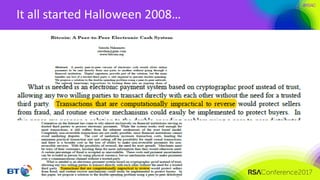
It	all	started	Halloween	2008…
3
#RSAC
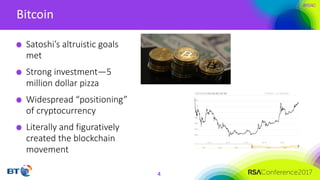
Bitcoin
4
Satoshi’s	altruistic	goals	
met
Strong	investment—5	
million	dollar	pizza
Widespread	“positioning”	
of	cryptocurrency
Literally	and	figuratively	
created	the	blockchain
movement
#RSAC
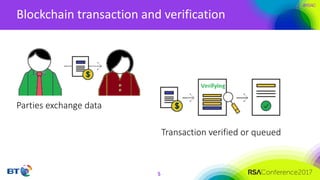
Blockchain transaction	and	verification
5
Parties	exchange	data
Transaction	verified	or	queued
#RSAC
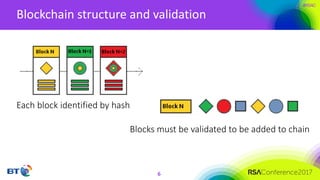
Blockchain structure	and	validation
6
Each	block	identified	by	hash
Blocks	must	be	validated	to	be	added	to	chain
#RSAC
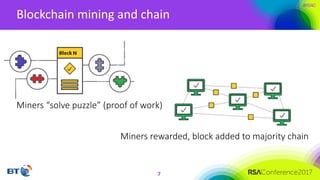
Blockchain mining and	chain
7
Miners	“solve	puzzle”	(proof	of	work)
Miners	rewarded,	block	added	to	majority	chain
#RSAC
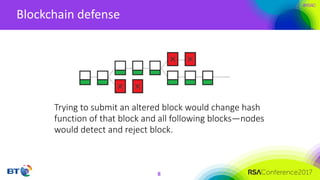
Blockchain defense
8
Trying	to	submit	an	altered	block	would	change	hash	
function	of	that	block	and	all	following	blocks—nodes	
would	detect	and	reject	block.
#RSAC
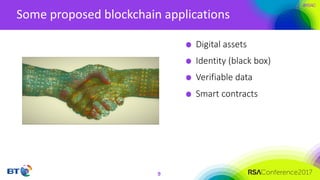
Some	proposed	blockchain applications
9
Digital	assets
Identity	(black	box)
Verifiable	data
Smart	contracts
#RSAC
Attacks	past	and	present
#RSAC
Quick	caveat
11
Not	allowed	to	discuss	
vulnerabilities	found	during	ethical	
hacks	of	BT-client	financial	
applications	
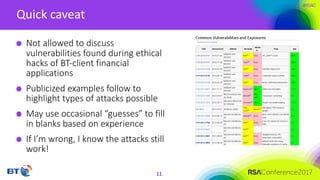
Publicized	examples	follow	to	
highlight	types	of	attacks	possible
May	use	occasional	“guesses”	to	fill	
in	blanks	based	on	experience
If	I’m	wrong,	I	know	the	attacks	still	
work!
#RSAC
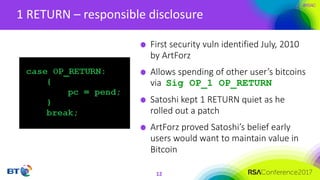
1	RETURN	– responsible	disclosure
12
First	security	vuln identified	July,	2010	
by	ArtForz
Allows	spending	of	other	user’s	bitcoins	
via		Sig OP_1 OP_RETURN
Satoshi	kept	1	RETURN	quiet	as	he	
rolled	out	a	patch
ArtForz proved	Satoshi’s	belief	early	
users	would	want	to	maintain	value	in	
Bitcoin
#RSAC
Attacks	against	blockchain infrastructure
13
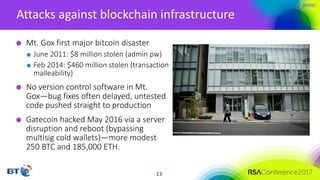
Mt.	Gox first	major	bitcoin	disaster
June	2011:	$8	million	stolen	(admin	pw)
Feb	2014:	$460	million	stolen	(transaction	
malleability)
No	version	control	software	in	Mt.	
Gox—bug	fixes	often	delayed,	untested	
code	pushed	straight	to	production
Gatecoin hacked	May	2016	via	a	server	
disruption	and	reboot	(bypassing	
multisig cold	wallets)—more	modest	
250	BTC	and	185,000	ETH.
#RSAC
Attacks	against	code
14
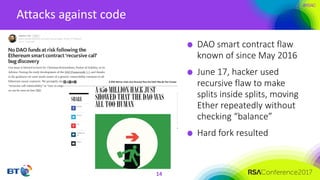
DAO	smart	contract	flaw	
known	of	since	May	2016
June	17,	hacker	used	
recursive	flaw	to	make	
splits	inside	splits,	moving	
Ether	repeatedly	without	
checking	“balance”
Hard	fork	resulted
#RSAC
Attacks	against	blockchain sites
15
2013,	payments	processor	Inputs.io	site	
compromised—for	$1	million	(social	
engineering)
Steemit blockchain-based	blogging	
platform	web	site	authentication	
targeted	July	(no	2FA)—$85,000	funds	
stolen	by	transactions	(hard	fork	after)
Reports	of	Coinbase hacking	incidents	
appear	on	the	net	regularly.	Insured	
against	mass	breach,	not	individual	
credential	attacks
#RSAC
Attacks	against	hot	wallets
16
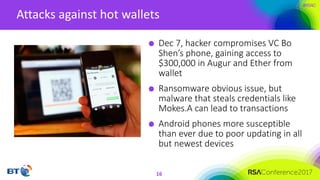
Dec	7,	hacker	compromises	VC	Bo	
Shen’s	phone,	gaining	access	to	
$300,000	in	Augur	and	Ether	from	
wallet
Ransomware	obvious	issue,	but	
malware	that	steals	credentials	like	
Mokes.A can	lead	to	transactions
Android	phones	more	susceptible	
than	ever	due	to	poor	updating	in	all	
but	newest	devices
#RSAC
Attacks	against	cold	wallets
17
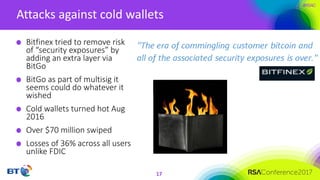
Bitfinex tried	to	remove	risk	
of	“security	exposures”	by	
adding	an	extra	layer	via	
BitGo
BitGo as	part	of	multisig it	
seems	could	do	whatever	it	
wished
Cold	wallets	turned	hot	Aug	
2016
Over	$70	million	swiped
Losses	of	36%	across	all	users	
unlike	FDIC
#RSAC
Attacks	against	nodes
18
Major	node	attack	thwarted	Aug	
2010—Bitcoin	block	74638	flaw	could	
generate	184	Billion	transactions!
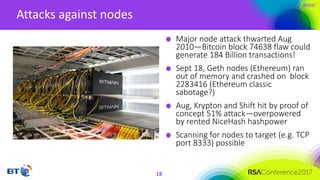
Sept	18,	Geth nodes	(Ethereum)	ran	
out	of	memory	and	crashed	on		block	
2283416	(Ethereum classic	
sabotage?)
Aug,	Krypton	and	Shift	hit	by	proof	of	
concept	51%	attack—overpowered	
by	rented	NiceHash hashpower
Scanning	for	nodes	to	target	(e.g.	TCP	
port	8333)	possible
#RSAC
Traditional	risks	to	new	applications
19
Digital	assets
Ownership
Identity
Black	box	interactions	at	risk
Verifiable	data
Malicious	transactions
Smart	contracts
Code	flaws,	repudiation
#RSAC
Coming	attacks	against	
blockchain’s biggest	flaw
#RSAC
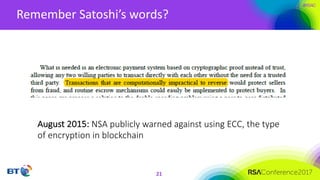
Remember	Satoshi’s	words?
21
August	2015:	NSA	publicly	warned	against	using	ECC,	the	type	
of	encryption	in	blockchain
#RSAC
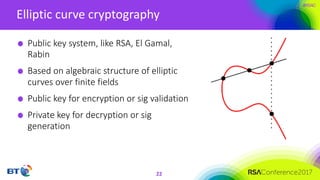
Elliptic	curve	cryptography
22
Public	key	system,	like	RSA,	El	Gamal,	
Rabin
Based	on	algebraic	structure	of	elliptic	
curves	over	finite	fields
Public	key	for	encryption	or	sig	validation
Private	key	for	decryption	or	sig	
generation
#RSAC
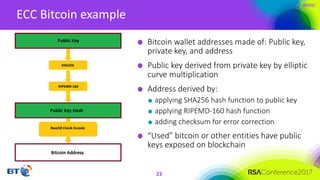
ECC	Bitcoin	example
23
Bitcoin	wallet	addresses	made	of:	Public	key,	
private	key,	and	address
Public	key	derived	from	private	key	by	elliptic	
curve	multiplication
Address	derived	by:
applying	SHA256	hash	function	to	public	key
applying	RIPEMD-160	hash	function
adding	checksum	for	error	correction
“Used”	bitcoin	or	other	entities	have	public	
keys	exposed	on	blockchain
#RSAC
Quantum	threat	looming
24
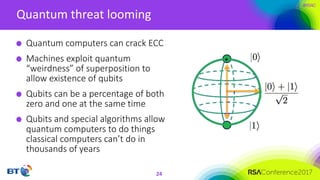
Quantum	computers	can	crack	ECC
Machines	exploit	quantum	
“weirdness”	of	superposition	to	
allow	existence	of	qubits
Qubits	can	be	a	percentage	of	both	
zero	and	one	at	the	same	time
Qubits	and	special	algorithms	allow	
quantum	computers	to	do	things	
classical	computers	can’t	do	in	
thousands	of	years
#RSAC
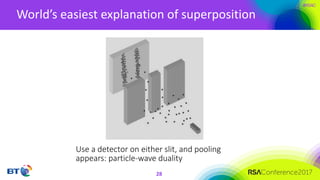
World’s	easiest	explanation	of	superposition
25
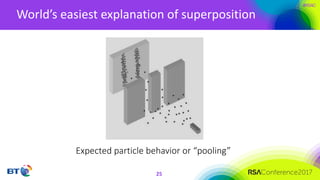
Expected	particle	behavior	or	“pooling”
#RSAC
World’s	easiest	explanation	of	superposition
26
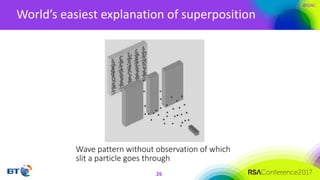
Wave	pattern	without	observation	of	which	
slit	a	particle	goes	through
#RSAC
World’s	easiest	explanation	of	superposition
27
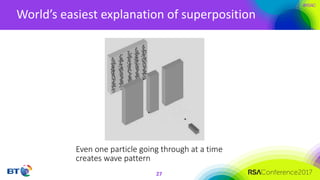
Even	one	particle	going	through	at	a	time	
creates	wave	pattern
#RSAC
World’s	easiest	explanation	of	superposition
28
Use	a	detector	on	either	slit,	and	pooling	
appears:	particle-wave	duality
#RSAC
Maintaining	superposition
29
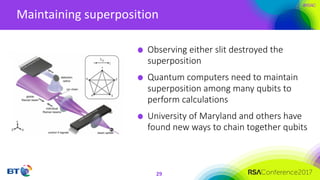
Observing	either	slit	destroyed	the	
superposition
Quantum	computers	need	to	maintain	
superposition	among	many	qubits	to	
perform	calculations
University	of	Maryland	and	others	have	
found	new	ways	to	chain	together	qubits
#RSAC
With	enough	stable	qubits…
30
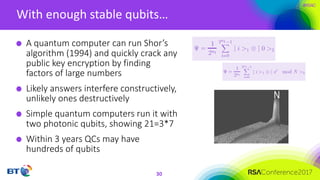
A	quantum	computer	can	run	Shor’s	
algorithm	(1994)	and	quickly	crack	any	
public	key	encryption	by	finding	
factors	of	large	numbers
Likely	answers	interfere	constructively,	
unlikely	ones	destructively
Simple	quantum	computers	run	it	with	
two	photonic	qubits,	showing	21=3*7
Within	3	years	QCs	may	have	
hundreds	of	qubits
#RSAC
Bitcoin	example	within	3	years
31
Bitcoin	transaction	includes	a	signature	
and	a	public	key	to	verify	owner
That	publicly	available	information	is	all	a	
quantum	computer	needs	to	get	private	
key	and	“become”	another	user
This	type	of	attack	can	be	done	passively	
(offline)	by	downloading	any	type	of	
blockchain
No	reuse?
#RSAC
Lamport signatures—a	stopgap?
32
Public	key	consists	of	320	hashes	rather	than	an	
elliptic	curve	point
Address	is	SHA256+RIPEMD-160	hash	of	public	key
Transaction	includes	public	key	and	signature—
verifiers	check	if:
public	key	matches	address
signature	matches	message	and	public	key
Even	with	Grover’s	algorithm,	it	takes	2^80	steps	to	
construct	a	fraudulent	transaction	or	2^80	*	80	
steps	to	crack	all	hashes	(trillions	of	trillions)
#RSAC
Post-quantum	crypto
33
Code	based
Hash	based
Lattice	based
Multivariate	quadratic	equations
One	time	pad
liboqs,	open	source	C	library	
(https://openquantumsafe.org/
have	fork	for	SSL	as	well)
#RSAC
Apply	these	warnings!
34
As	soon	as	possible,	take	a	new	look	at	any	blockchain applications	
you’re	developing	or	using	in	your	company
Be	sure	any	of	these	applications	actually	need	to	be	blockchain
based,	considering:
security
permanence	of	data	(being	able	to	make	changes	can	be	a	good	thing)
whether	current	technology	may	be	superior	(not	everything	should	be	bc)
Is	your	blockchain app	an	overlay	to	a	proven	blockchain and	protocol,	
or	is	it	potentially	too	untested	for	critical	applications?
#RSAC
Apply	these	warnings!
35
Within	the	next	three	months	prioritize	testing	the	security	of	
blockchain applications	by	their	criticality	to	your	business
Perform	ethical	hacking	engagements	against	the	implementation of	
your	platform—remember	all	the	basic	flaws	that	undo	even	sound	
crypto
Make	sure	your	ethical	hackers	have	actually	worked	with	blockchain
protocols	before—this	isn’t	the	time	for	a	vendor	to	learn	on	your	
dime
#RSAC
Apply	these	warnings!
36
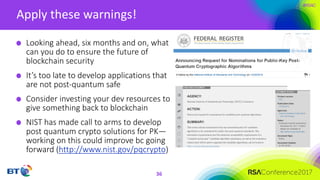
Looking	ahead,	six	months	and	on,	what	
can	you	do	to	ensure	the	future	of	
blockchain security
It’s	too	late	to	develop	applications	that	
are	not	post-quantum	safe
Consider	investing	your	dev	resources	to	
give	something	back	to	blockchain
NIST	has	made	call	to	arms	to	develop	
post	quantum	crypto	solutions	for	PK—
working	on	this	could	improve	bc going	
forward (http://www.nist.gov/​pqcrypto)
#RSAC
Questions?	Please	join	me	for	a	“focus	
on”	session	(FON4-T11)	today	in	
Moscone West	2024	from	3:45	to	4:15
@konstanthacker

Hacking Blockchain