Social Engineering
What it is, and why we should be using it…
Hi… I’m Bob.
• Formerly a Network Engineer for over 15 years
• Ran the network that processed ~50% of the
gene sequencing of the Human Genome Project
for the US Government.
• Worked in Education (MIT), Government (USDOT),
Retail (TJX), Manufacturing, Healthcare, and
several other Industries.
• Moved to Security Research/Engineering several
years ago.
• Received Training in Social Engineering and
Penetration Testing.
• Participated in the DefCon 22 Social Engineering
Capture the flag as a volunteer with only 20 hours
to gather information on my focus company, one
of the top 2 Home improvement retailers.
• Participated as a full contestant in the DefCon 23
SECTF, Place 4th overall. Company focus was
one of the Top US ISPs
What is Social Engineering
What is it
What are the different types of SE
How does it work
How can we make it work for us
What is it?
In the context of Information Security, Social
Engineering (SE) can be defined as:
A combination of Social, Psychological and Information gathering techniques that
are used to manipulate people to gain access to information or locations that you
are not authorized to access.
In other words, SE Targets the weaknesses of Human nature as a bridge to exploit
weakness in an organizations security. By exploiting the human element, it’s
possible to gain access to vast amounts of sensitive information, often without the
victims knowledge. This information can then be used for other nefarious purposes.
Social Engineering is not a “New Thing”. Social engineering has been around for
Hundreds, if not Thousands of years, quite possibly since the beginnings of
civilization itself. It has only been with the advent of Computers and Information
Technology that we have given these techniques a new name and description. A
Social Engineer was previously known as a Con Artist, Swindler, Scammer,
Charlatan, Rogue along with Dozens of other names going back through History…
Types of Social Engineering
• Phishing:
• Trolling
• Spear Phishing
• Whaling
• Vishing
• Vishing
• SMSishing
• Impersonations
• Impersonation
• Physical Security
Compromise
• Baiting
Phishing
Trolling
A Trolling attack is where the
Attacker has “Spammed” the users
of the company attempting to get as
many “clicks” as possible.
Spear-Phishing
Spear-Phishing is a method that
Attackers use that focuses on
specific individuals correlating
information found on the web via
social sites (Facebook, LinkedIn,
etc), and elsewhere on the web to
focus the attack.
Whaling
Whaling is an attack that like Spear-
Phishing, but the focus of the attack
is the Sr. Management Group (CEO,
CFO, CIO, Board of Directors, etc)
Vishing
Vishing (Voice Attack)
This is a directed call to an individual
or group attempting to gain
information or some other advantage
to allow the attacker to penetrate the
company’s defense.
SMSishing (Text Attack)
in this attack vector, the attacker uses
a text to attempt to gain information
or perhaps send a link that the
receiver could follow that could lead
to a compromise of the phone, or their
computer.
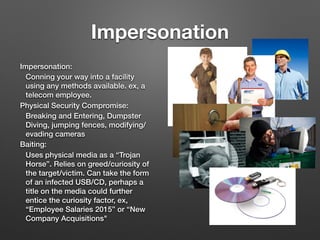
Impersonation
Impersonation:
Conning your way into a facility
using any methods available. ex, a
telecom employee.
Physical Security Compromise:
Breaking and Entering, Dumpster
Diving, jumping fences, modifying/
evading cameras
Baiting:
Uses physical media as a “Trojan
Horse”. Relies on greed/curiosity of
the target/victim. Can take the form
of an infected USB/CD, perhaps a
title on the media could further
entice the curiosity factor, ex,
“Employee Salaries 2015” or “New
Company Acquisitions"
How does it work
And Why
People Are Vulnerable
• People Are Inherently Lazy
• People Want to be Helpful
• People are Curious
• People Want to be Noticed
• Social Engineering IS the path of least resistance! and
therefore it should be one of the Biggest issues in
Information Security!
• Vulnerabilities in
Information System are:
• Reviewed
• Scanned
• Penetration tested
• Remediated
But how can we Measure and
Remediate Vulnerability in People?
Vulnerabilities
Only through Education, Training and Understanding…
All Of Us!
Who is Targeted by Social
Engineering?
Things we should NOT do.
• Don’t Shame
• Don’t Blame
• Don’t make your employees feel stupid
• Don’t make your employees feel bad for their behavior
• Companies, and people, typically avoid testing because
it makes them feel Vulnerable, we need to change that
mentality to having them feel Empowered.
Things We Should Do:
Teach your users:
• Don’t open an email from an unknown
sender, and even if you know the sender,
think about the email and ensure the
request is reasonable/expected.
• Never click on an emailed links, even from
a known source. It’s best practice to open
a browser and navigate to a known good
website, login manually, and navigate to
the page described via the browser.
• Exercise care when opening attachments.
Never “double click” any attachment even
from a known source. If the email is from
a known source but unexpected, contact
them to confirm that they in fact sent it.
Things We Should Do:
Educate your users to:
• Begin to recognize the different
signs of Phishing emails. Even
though the SEs are getting better,
most Phishing still exhibits the
telltale signs. Misspelling,
Incorrect sentence structure and
incorrect/spoofed links
• Be aware and mindful when on
the phone, that all may not be as
it seems. If you don’t know the
person, and their identity cannot
be proven, Maybe you shouldn’t
give them the keys to the
kingdom…
Things We Should Do:
Create Company Policies:
• Have Policies and procedures that make it harder for SEs to attack and gain
information.
• Use Gamification to engage end users to be your “eyes and ears” into social
engineering attacks. Maybe offer a day off for a confirmed find.
• If your not an easy target, then the SEs and Hackers may move on to an easier one…
How can we make SE work
for Us?
• Open Source Intelligence (OSINT)
is intel that is in the open and
exposed to information gathering
techniques. Social Engineers use
this kind of information in their
attacks.
• Many of the Tools that social
Engineers use are Free or low
cost, and are downloadable on
the internet.
• By either employing an SE firm to
test, or do the testing yourself,
you can begin to understand the
scope of your organizations
vulnerability to SE attacks.
OSINT
Open Source Intelligence
Open-source intelligence (OSINT)
is intelligence collected from
publicly available sources such as
Social Media, and Corporate
Public facing servers (DMZ). In
the Intelligence Communities, the
term "open" refers to overt,
publicly available sources, as
opposed to covert or clandestine
sources.
OSINT it is in no way related to
open source software.
What are some of the things you
can expect to find with OSINT?
• IP Address Blocks, DNS
Information
• Phone Numbers (Internal and
external)
• Email Addresses and their
layout standard
• User Names and Passwords
• Financial Information
• Policies and Procedures
• Pictures with actionable Intel
• Access control Documentation
• “Compliance” type information
(PII/PCI/HIPPA, etc)
• Information on company
hardware, specs/vendors/
quantity
• Maps and/or design
documentation (Reporting
Structure, Network and Facility)
• 3rd party vendor information
• Company badge information
• Network and computer
information (OS, Software/
versions, Hardware/Appliances,
Geolocation, Metadata)
Tools that SEs use:
• SET (TrustedSec’s amazing Social Engineering Toolkit)
• Foca (Network Infrastructure mapper and metadata analyzer)
• Maltego (Information Visualization and gathering app)
• Metasploit (Both Pro and Community)
• IconoSquare (An Instagram photo analytics processor)
• Recon-NG (Fantastic Recon framework with many integrations to social sites)
• Dozens of others:
• TheHarvester
• Shodan
• Veil Framework
• Metagoofil
• Strings
• PDFGrep
• ExifTool
• ImagePicker
• WGET
• GeoSetter
• Google Hacking-DataBase
• Beef
• HoneyD
• Cree.py
• WhoIs
• CeWL
• DNSRecon
• Ninja Phishing Framework
• and More being created every hour
of every day
Before you Start
• If you are Hiring, check
references. Many “Pen Testing
firms” are now claiming to do
Social Engineering. Require
documentation on their
process and procedures,
request proof, and examples
of their work…
• If you are doing this on your
own, Make sure to Learn First.
• In either case, As always in
Pen-testing, Line up your “Get
out of Jail Free cards”. Define
Scope, Define procedures, and
document EVERYTHING…
Social Engineering Process
• Recon and Information
Gathering
• Pretexting
• Exploitation
• Post Exploitation
Recon and Information
Gathering
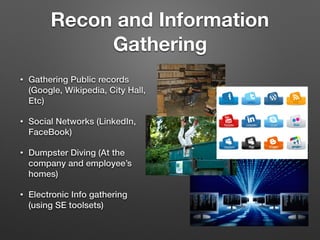
• Gathering Public records
(Google, Wikipedia, City Hall,
Etc)
• Social Networks (LinkedIn,
FaceBook)
• Dumpster Diving (At the
company and employee’s
homes)
• Electronic Info gathering
(using SE toolsets)
Pretexting
• Create Believable Scenarios
• Choose Believable personas,
or actual persons to imitate
• PRACTICE, Practice, Practice!
Confidence is the key. If you
cannot believe in yourself, how
can you expect others to
believe you…
Exploitation
• Execute your scenarios
• Attack!
Post Exploitation Cleanup
• Document your compromises
• Compile Information
• Prepare your Reports
• Prepare Remediation efforts
• Remediate Systems
• Educate Users
• Perfect Policies
• Rinse and repeat, This should
be an ongoing campaign and
quarterly is better than yearly.
Summary
• There is an astounding amount of OSINT that is leaking
from our companies and our employees
• Employees are a vulnerability
• Physical access to our facilities is in most cases is easily
achievable
• These things are fixable with effort
What are the Fixes?
• Run Social Engineering
Campaigns against your
company
• Educate your Employees on
being less Vulnerable to SE
attempts
• Toughen Access to your
facilities
• Provide continuous training to
your employees, and create
and continue a campaign of
Social Engineering
assessments…
Thank You for your time and attention
Bob Hood
Principle Security Research Engineer, PTC
VP Operations, Principle Social Engineer, BitSafe.Systems
Email(s):
rhood@ptc.com - bob@bitsafe.systems
LinkedIn : http://tinyurl.com/BobHoodLinkedIn
Twitter: @RobertLHood

Social engineering

  • 1.
    Social Engineering What itis, and why we should be using it…
  • 2.
    Hi… I’m Bob. •Formerly a Network Engineer for over 15 years • Ran the network that processed ~50% of the gene sequencing of the Human Genome Project for the US Government. • Worked in Education (MIT), Government (USDOT), Retail (TJX), Manufacturing, Healthcare, and several other Industries. • Moved to Security Research/Engineering several years ago. • Received Training in Social Engineering and Penetration Testing. • Participated in the DefCon 22 Social Engineering Capture the flag as a volunteer with only 20 hours to gather information on my focus company, one of the top 2 Home improvement retailers. • Participated as a full contestant in the DefCon 23 SECTF, Place 4th overall. Company focus was one of the Top US ISPs
  • 3.
    What is SocialEngineering What is it What are the different types of SE How does it work How can we make it work for us
  • 4.
    What is it? Inthe context of Information Security, Social Engineering (SE) can be defined as: A combination of Social, Psychological and Information gathering techniques that are used to manipulate people to gain access to information or locations that you are not authorized to access. In other words, SE Targets the weaknesses of Human nature as a bridge to exploit weakness in an organizations security. By exploiting the human element, it’s possible to gain access to vast amounts of sensitive information, often without the victims knowledge. This information can then be used for other nefarious purposes. Social Engineering is not a “New Thing”. Social engineering has been around for Hundreds, if not Thousands of years, quite possibly since the beginnings of civilization itself. It has only been with the advent of Computers and Information Technology that we have given these techniques a new name and description. A Social Engineer was previously known as a Con Artist, Swindler, Scammer, Charlatan, Rogue along with Dozens of other names going back through History…
  • 5.
    Types of SocialEngineering • Phishing: • Trolling • Spear Phishing • Whaling • Vishing • Vishing • SMSishing • Impersonations • Impersonation • Physical Security Compromise • Baiting
  • 6.
    Phishing Trolling A Trolling attackis where the Attacker has “Spammed” the users of the company attempting to get as many “clicks” as possible. Spear-Phishing Spear-Phishing is a method that Attackers use that focuses on specific individuals correlating information found on the web via social sites (Facebook, LinkedIn, etc), and elsewhere on the web to focus the attack. Whaling Whaling is an attack that like Spear- Phishing, but the focus of the attack is the Sr. Management Group (CEO, CFO, CIO, Board of Directors, etc)
  • 7.
    Vishing Vishing (Voice Attack) Thisis a directed call to an individual or group attempting to gain information or some other advantage to allow the attacker to penetrate the company’s defense. SMSishing (Text Attack) in this attack vector, the attacker uses a text to attempt to gain information or perhaps send a link that the receiver could follow that could lead to a compromise of the phone, or their computer.
  • 8.
    Impersonation Impersonation: Conning your wayinto a facility using any methods available. ex, a telecom employee. Physical Security Compromise: Breaking and Entering, Dumpster Diving, jumping fences, modifying/ evading cameras Baiting: Uses physical media as a “Trojan Horse”. Relies on greed/curiosity of the target/victim. Can take the form of an infected USB/CD, perhaps a title on the media could further entice the curiosity factor, ex, “Employee Salaries 2015” or “New Company Acquisitions"
  • 9.
    How does itwork And Why
  • 10.
    People Are Vulnerable •People Are Inherently Lazy • People Want to be Helpful • People are Curious • People Want to be Noticed • Social Engineering IS the path of least resistance! and therefore it should be one of the Biggest issues in Information Security!
  • 11.
    • Vulnerabilities in InformationSystem are: • Reviewed • Scanned • Penetration tested • Remediated But how can we Measure and Remediate Vulnerability in People? Vulnerabilities Only through Education, Training and Understanding…
  • 12.
    All Of Us! Whois Targeted by Social Engineering?
  • 13.
    Things we shouldNOT do. • Don’t Shame • Don’t Blame • Don’t make your employees feel stupid • Don’t make your employees feel bad for their behavior • Companies, and people, typically avoid testing because it makes them feel Vulnerable, we need to change that mentality to having them feel Empowered.
  • 14.
    Things We ShouldDo: Teach your users: • Don’t open an email from an unknown sender, and even if you know the sender, think about the email and ensure the request is reasonable/expected. • Never click on an emailed links, even from a known source. It’s best practice to open a browser and navigate to a known good website, login manually, and navigate to the page described via the browser. • Exercise care when opening attachments. Never “double click” any attachment even from a known source. If the email is from a known source but unexpected, contact them to confirm that they in fact sent it.
  • 15.
    Things We ShouldDo: Educate your users to: • Begin to recognize the different signs of Phishing emails. Even though the SEs are getting better, most Phishing still exhibits the telltale signs. Misspelling, Incorrect sentence structure and incorrect/spoofed links • Be aware and mindful when on the phone, that all may not be as it seems. If you don’t know the person, and their identity cannot be proven, Maybe you shouldn’t give them the keys to the kingdom…
  • 16.
    Things We ShouldDo: Create Company Policies: • Have Policies and procedures that make it harder for SEs to attack and gain information. • Use Gamification to engage end users to be your “eyes and ears” into social engineering attacks. Maybe offer a day off for a confirmed find. • If your not an easy target, then the SEs and Hackers may move on to an easier one…
  • 17.
    How can wemake SE work for Us? • Open Source Intelligence (OSINT) is intel that is in the open and exposed to information gathering techniques. Social Engineers use this kind of information in their attacks. • Many of the Tools that social Engineers use are Free or low cost, and are downloadable on the internet. • By either employing an SE firm to test, or do the testing yourself, you can begin to understand the scope of your organizations vulnerability to SE attacks.
  • 18.
    OSINT Open Source Intelligence Open-sourceintelligence (OSINT) is intelligence collected from publicly available sources such as Social Media, and Corporate Public facing servers (DMZ). In the Intelligence Communities, the term "open" refers to overt, publicly available sources, as opposed to covert or clandestine sources. OSINT it is in no way related to open source software.
  • 19.
    What are someof the things you can expect to find with OSINT? • IP Address Blocks, DNS Information • Phone Numbers (Internal and external) • Email Addresses and their layout standard • User Names and Passwords • Financial Information • Policies and Procedures • Pictures with actionable Intel • Access control Documentation • “Compliance” type information (PII/PCI/HIPPA, etc) • Information on company hardware, specs/vendors/ quantity • Maps and/or design documentation (Reporting Structure, Network and Facility) • 3rd party vendor information • Company badge information • Network and computer information (OS, Software/ versions, Hardware/Appliances, Geolocation, Metadata)
  • 20.
    Tools that SEsuse: • SET (TrustedSec’s amazing Social Engineering Toolkit) • Foca (Network Infrastructure mapper and metadata analyzer) • Maltego (Information Visualization and gathering app) • Metasploit (Both Pro and Community) • IconoSquare (An Instagram photo analytics processor) • Recon-NG (Fantastic Recon framework with many integrations to social sites) • Dozens of others: • TheHarvester • Shodan • Veil Framework • Metagoofil • Strings • PDFGrep • ExifTool • ImagePicker • WGET • GeoSetter • Google Hacking-DataBase • Beef • HoneyD • Cree.py • WhoIs • CeWL • DNSRecon • Ninja Phishing Framework • and More being created every hour of every day
  • 21.
    Before you Start •If you are Hiring, check references. Many “Pen Testing firms” are now claiming to do Social Engineering. Require documentation on their process and procedures, request proof, and examples of their work… • If you are doing this on your own, Make sure to Learn First. • In either case, As always in Pen-testing, Line up your “Get out of Jail Free cards”. Define Scope, Define procedures, and document EVERYTHING…
  • 22.
    Social Engineering Process •Recon and Information Gathering • Pretexting • Exploitation • Post Exploitation
  • 23.
    Recon and Information Gathering •Gathering Public records (Google, Wikipedia, City Hall, Etc) • Social Networks (LinkedIn, FaceBook) • Dumpster Diving (At the company and employee’s homes) • Electronic Info gathering (using SE toolsets)
  • 24.
    Pretexting • Create BelievableScenarios • Choose Believable personas, or actual persons to imitate • PRACTICE, Practice, Practice! Confidence is the key. If you cannot believe in yourself, how can you expect others to believe you…
  • 25.
    Exploitation • Execute yourscenarios • Attack!
  • 26.
    Post Exploitation Cleanup •Document your compromises • Compile Information • Prepare your Reports • Prepare Remediation efforts • Remediate Systems • Educate Users • Perfect Policies • Rinse and repeat, This should be an ongoing campaign and quarterly is better than yearly.
  • 27.
    Summary • There isan astounding amount of OSINT that is leaking from our companies and our employees • Employees are a vulnerability • Physical access to our facilities is in most cases is easily achievable • These things are fixable with effort
  • 28.
    What are theFixes? • Run Social Engineering Campaigns against your company • Educate your Employees on being less Vulnerable to SE attempts • Toughen Access to your facilities • Provide continuous training to your employees, and create and continue a campaign of Social Engineering assessments…
  • 29.
    Thank You foryour time and attention Bob Hood Principle Security Research Engineer, PTC VP Operations, Principle Social Engineer, BitSafe.Systems Email(s): rhood@ptc.com - bob@bitsafe.systems LinkedIn : http://tinyurl.com/BobHoodLinkedIn Twitter: @RobertLHood