Malware forensic
Created by sumera hangi
Rollno = 6
CONTENTS
 WHAT IS MALWARE & WHAT CAN MALWARE DO?
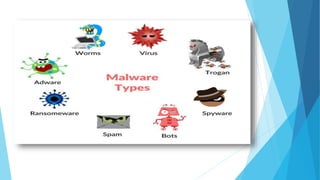
 TYPES OF MALWARE
 FROM MALWARE ANALYSIS TO MALWARE FORENSICS
 MALWARE FORENSIC
 SYMPTOMS OF INFECTED SYSTEMS
 PROCEDURE/INVESTIGATIVE APPROACH STATIC & DYNAMIC
ANALYSIS
 MALWARE ANALYSIS TOOLS
 KEY DIFFERENCE BETWEEN STATIC & DYNAMIC
 THE CONCLUSION
WHAT IS MALWARE & WHAT
CAN MALWARE DO?
Malware or Malicious software is a program that runs as
an executable file such as script, code, or any other
software.
From Malware
Analysis To Malware
Forensics
 Malware analysis is the practice of
determining the functionality,
source and possible impact of a
given malware such as a virus,
worm, Trojan horse, rootkit, or
backdoor.
 Result of malware analysis must be
accurate
 As a result, malware analysis has
become a forensic discipline
MALWARE FORENSIC
 It is a way of finding, analyzing & investigating
various properties of malware to seek out the
culprits and reason for the attack.
 Includes tasks like checking out the malicious
code, determining its entry, method of
propagation, impact on the system, ports it tries to
use etc.
 Detection -1st Step
 Static Analysis
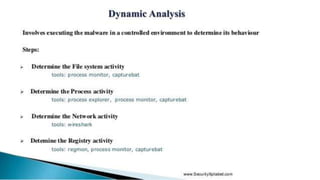
 Dynamic Analysis
SYMPTOMS OF
INFECTED SYSTEMS
Your system will showcase
unexpected & unpredictable
behavior.
PROCEDURE/INVESTIGATIVE
APPROACH STATIC ANALYSIS
Steps:
 Collect information
 Set up network connection
 Monitor the process action
 Record network
 Determine the files
 Debugging
 Sandboxes /Testing
KEY DIFFERENCE
STATIC MALWARE
 Static malware analysis is signature
based
 The code is not executed during
static analysis
 Static analysis is simple and just
observes the behavior of the
malware and attempts to analyze
its capabilities.
 Static analysis works for the
common malware
 Static analysis works for the
common malware
DYNAMIC MALWARE
 Dynamic analysis is behavior-base
 The malware code is run in a
sandbox environment.
 Dynamic analysis performs a more
thorough kind of analysis of the
actions, the functionalities and the
impact of the malware, with the
analyst studying it at each and
every phase of its deployment and
functioning.
 Dynamic analysis, being behavior-
based, is needed for the more
sophisticated and advanced kind of
malware
The conclusion
 Malware analysis is of utmost importance since it helps understand malware
infections and stop malware from spreading into other systems, files,
directories etc.
 Malware analysis, static as well as dynamic, helps understand malware and
their functioning in a better way and also helps us prevent further attacks in
a very effective manner.

Malware forensic

  • 1.
    Malware forensic Created bysumera hangi Rollno = 6
  • 2.
    CONTENTS  WHAT ISMALWARE & WHAT CAN MALWARE DO?  TYPES OF MALWARE  FROM MALWARE ANALYSIS TO MALWARE FORENSICS  MALWARE FORENSIC  SYMPTOMS OF INFECTED SYSTEMS  PROCEDURE/INVESTIGATIVE APPROACH STATIC & DYNAMIC ANALYSIS  MALWARE ANALYSIS TOOLS  KEY DIFFERENCE BETWEEN STATIC & DYNAMIC  THE CONCLUSION
  • 3.
    WHAT IS MALWARE& WHAT CAN MALWARE DO? Malware or Malicious software is a program that runs as an executable file such as script, code, or any other software.
  • 5.
    From Malware Analysis ToMalware Forensics  Malware analysis is the practice of determining the functionality, source and possible impact of a given malware such as a virus, worm, Trojan horse, rootkit, or backdoor.  Result of malware analysis must be accurate  As a result, malware analysis has become a forensic discipline
  • 6.
    MALWARE FORENSIC  Itis a way of finding, analyzing & investigating various properties of malware to seek out the culprits and reason for the attack.  Includes tasks like checking out the malicious code, determining its entry, method of propagation, impact on the system, ports it tries to use etc.  Detection -1st Step  Static Analysis  Dynamic Analysis
  • 7.
    SYMPTOMS OF INFECTED SYSTEMS Yoursystem will showcase unexpected & unpredictable behavior.
  • 8.
    PROCEDURE/INVESTIGATIVE APPROACH STATIC ANALYSIS Steps: Collect information  Set up network connection  Monitor the process action  Record network  Determine the files  Debugging  Sandboxes /Testing
  • 11.
    KEY DIFFERENCE STATIC MALWARE Static malware analysis is signature based  The code is not executed during static analysis  Static analysis is simple and just observes the behavior of the malware and attempts to analyze its capabilities.  Static analysis works for the common malware  Static analysis works for the common malware DYNAMIC MALWARE  Dynamic analysis is behavior-base  The malware code is run in a sandbox environment.  Dynamic analysis performs a more thorough kind of analysis of the actions, the functionalities and the impact of the malware, with the analyst studying it at each and every phase of its deployment and functioning.  Dynamic analysis, being behavior- based, is needed for the more sophisticated and advanced kind of malware
  • 12.
    The conclusion  Malwareanalysis is of utmost importance since it helps understand malware infections and stop malware from spreading into other systems, files, directories etc.  Malware analysis, static as well as dynamic, helps understand malware and their functioning in a better way and also helps us prevent further attacks in a very effective manner.