Clinical examination
Plan of Conduction & Scheme of Recording
Chiranjeevi Kumar
Department of Physiology
AIIMS Bhopal
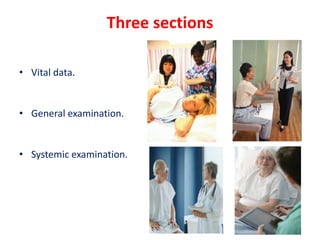
Three sections
• Vital data.
• General examination.
• Systemic examination.
Vital Data
• Name Of The Institution :
• Name Of The Doctor:
• Ward No:
• Cot No :
• Case No :
• Date:
• Name Of The Patient :
• Age :
• Sex :
• Religion :
• Caste :
• Married Or Single :
• Children :
• Occupation :
• Income
• Address
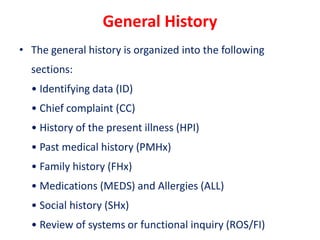
General History
• The general history is organized into the following
sections:
• Identifying data (ID)
• Chief complaint (CC)
• History of the present illness (HPI)
• Past medical history (PMHx)
• Family history (FHx)
• Medications (MEDS) and Allergies (ALL)
• Social history (SHx)
• Review of systems or functional inquiry (ROS/FI)
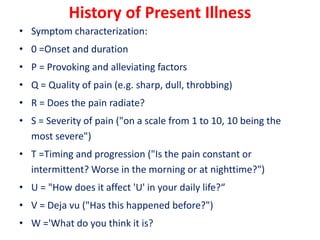
History of Present Illness
• Symptom characterization:
• 0 =Onset and duration
• P = Provoking and alleviating factors
• Q = Quality of pain (e.g. sharp, dull, throbbing)
• R = Does the pain radiate?
• S = Severity of pain ("on a scale from 1 to 10, 10 being the
most severe")
• T =Timing and progression ("Is the pain constant or
intermittent? Worse in the morning or at nighttime?")
• U = "How does it affect 'U' in your daily life?“
• V = Deja vu ("Has this happened before?")
• W ='What do you think it is?
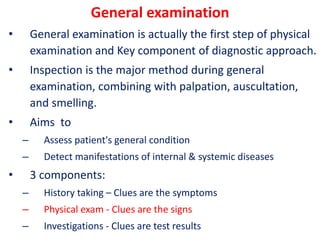
General examination
• General examination is actually the first step of physical
examination and Key component of diagnostic approach.
• Inspection is the major method during general
examination, combining with palpation, auscultation,
and smelling.
• Aims to
– Assess patient's general condition
– Detect manifestations of internal & systemic diseases
• 3 components:
– History taking – Clues are the symptoms
– Physical exam - Clues are the signs
– Investigations - Clues are test results
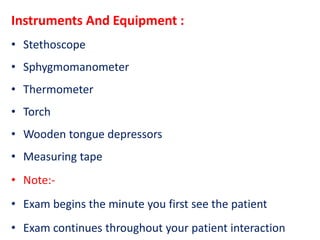
Instruments And Equipment :
• Stethoscope
• Sphygmomanometer
• Thermometer
• Torch
• Wooden tongue depressors
• Measuring tape
• Note:-
• Exam begins the minute you first see the patient
• Exam continues throughout your patient interaction
Prerequisites:
• Examination environment
• Hand Washing
• Proper light
• Privacy & Confidentiality
• Presence of a chaperon when examining female
patients
• Correct position of Doctor & Patient - Ideally examiner
should be on right side of patient
• Proper Exposure
• Ensure your hands are warm
General examination
– General Appearance
– Hands and arms
– Skin
– Face
– Eyes
– Mouth
– Neck
– Oedema
– Lymph nodes
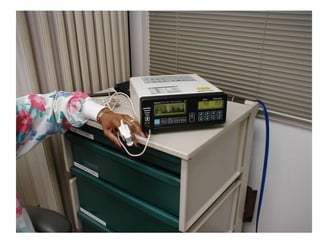
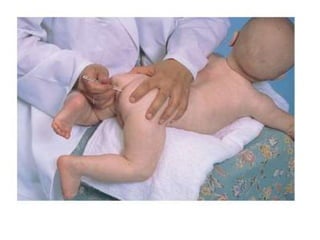
–Vital Signs
• Temperature
• Pulse
• Respiration Rate
• Blood Pressure
General Appearance
• General state of health: Healthy/ill/comfortable/Distressed
• Body Built and Nutritional status
– Height
– Weight
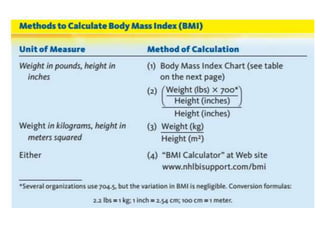
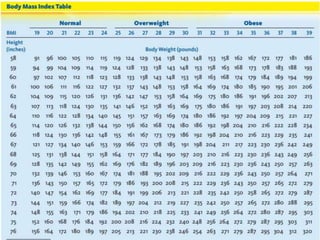
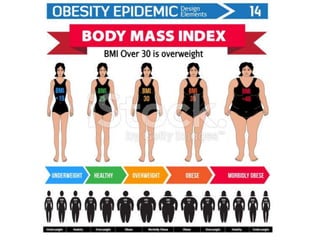
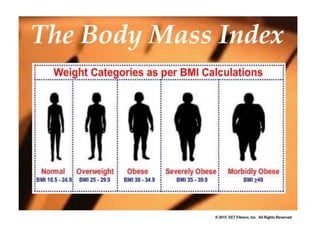
– BMI
– Obese/lean
– Tall/short
– Muscular/Asthenic/Cachexic
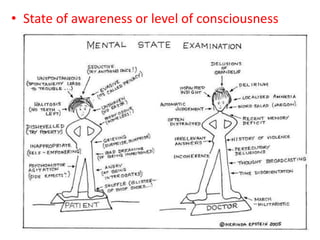
• State of awareness or level of consciousness
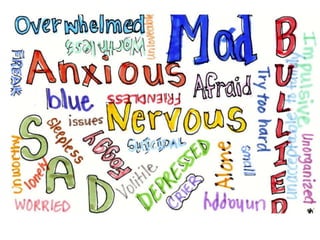
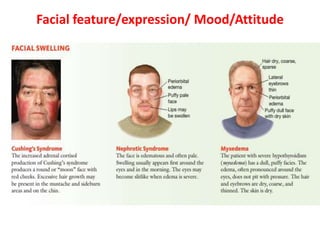
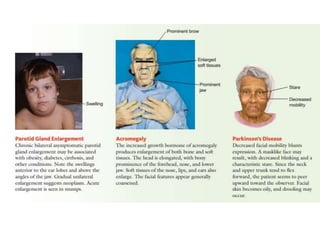
• Facial feature/expression/ Mood/Attitude
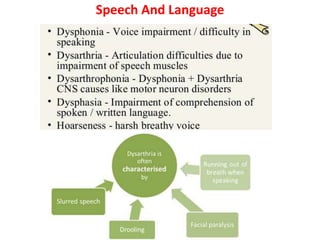
• Speech(tone/voice)
• Position/posture and Gait
• Personal Hygiene
• Breath/Odor
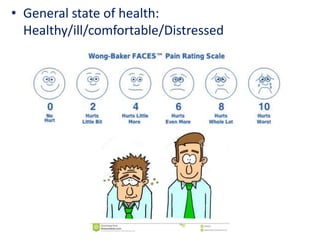
• General state of health:
Healthy/ill/comfortable/Distressed
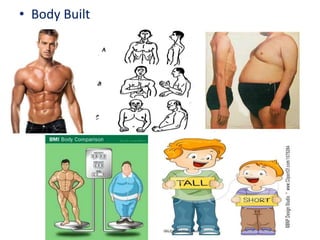
• Body Built
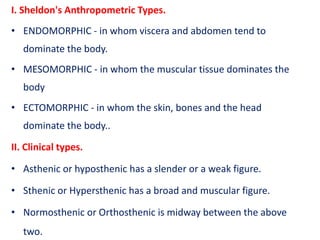
I. Sheldon's Anthropometric Types.
• ENDOMORPHIC - in whom viscera and abdomen tend to
dominate the body.
• MESOMORPHIC - in whom the muscular tissue dominates the
body
• ECTOMORPHIC - in whom the skin, bones and the head
dominate the body..
II. Clinical types.
• Asthenic or hyposthenic has a slender or a weak figure.
• Sthenic or Hypersthenic has a broad and muscular figure.
• Normosthenic or Orthosthenic is midway between the above
two.
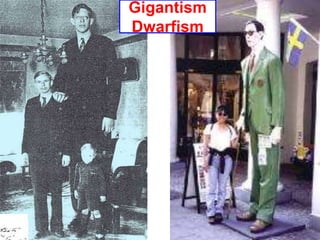
Gigantism
Dwarfism
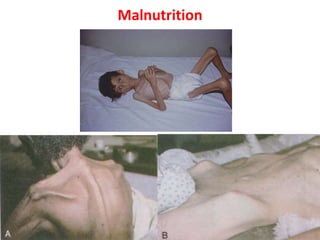
Malnutrition
• State of awareness or level of consciousness
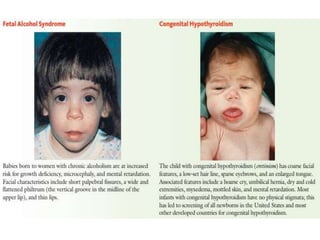
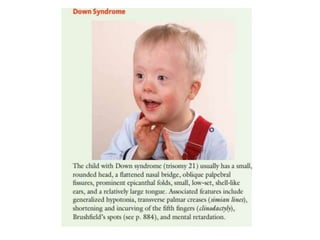
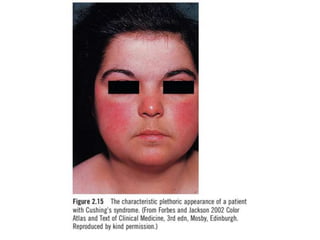
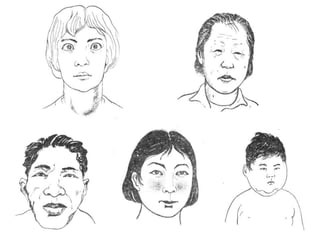
Facial feature/expression/ Mood/Attitude
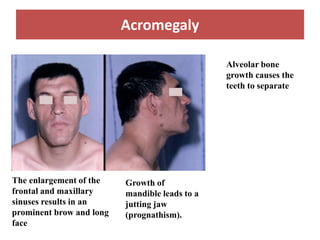
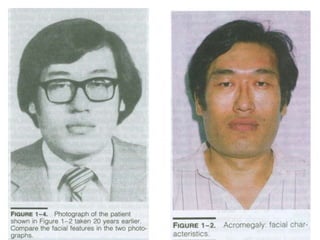
Acromegaly
The enlargement of the
frontal and maxillary
sinuses results in an
prominent brow and long
face
Growth of
mandible leads to a
jutting jaw
(prognathism).
Alveolar bone
growth causes the
teeth to separate
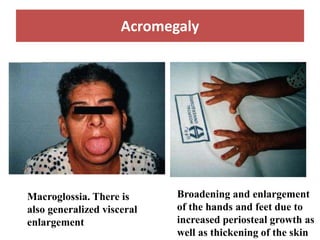
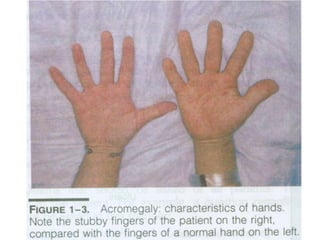
Acromegaly
Macroglossia. There is
also generalized visceral
enlargement
Broadening and enlargement
of the hands and feet due to
increased periosteal growth as
well as thickening of the skin
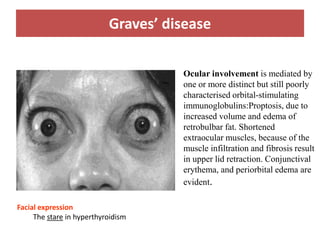
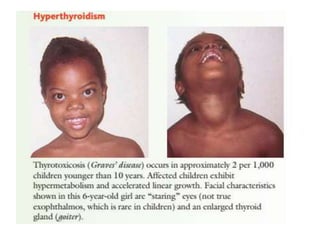
Graves’ disease
Ocular involvement is mediated by
one or more distinct but still poorly
characterised orbital-stimulating
immunoglobulins:Proptosis, due to
increased volume and edema of
retrobulbar fat. Shortened
extraocular muscles, because of the
muscle infiltration and fibrosis result
in upper lid retraction. Conjunctival
erythema, and periorbital edema are
evident.
Facial expression
The stare in hyperthyroidism
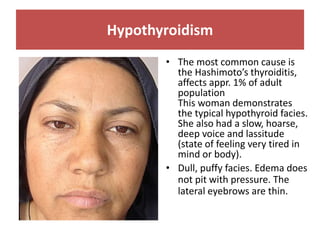
Hypothyroidism
• The most common cause is
the Hashimoto’s thyroiditis,
affects appr. 1% of adult
population
This woman demonstrates
the typical hypothyroid facies.
She also had a slow, hoarse,
deep voice and lassitude
(state of feeling very tired in
mind or body).
• Dull, puffy facies. Edema does
not pit with pressure. The
lateral eyebrows are thin.
Speech And Language
Position & Posture
• It refers to patient’s body status and the general way of
holding the body
• Divided into:
• Active
• Passive
• Compulsive
• Active position
The patient can move his/her body freely, without any
restriction
It can be seen in normal adult, patients with mild diseases
or at earlier stage of the diseases
• Passive position
The patient can’t adjust or move his/her body
It occurs in extremely sick or patients with unconsciousness
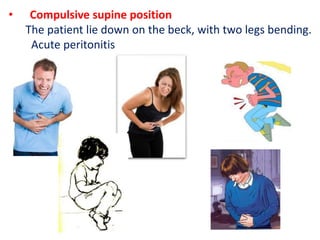
• Compulsive supine position
The patient lie down on the beck, with two legs bending.
Acute peritonitis
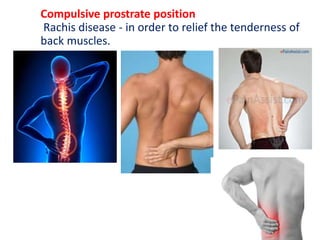
Compulsive prostrate position
Rachis disease - in order to relief the tenderness of
back muscles.
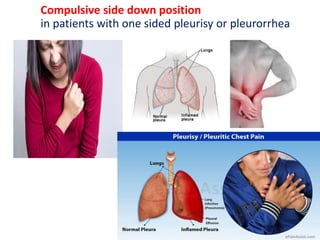
Compulsive side down position
in patients with one sided pleurisy or pleurorrhea
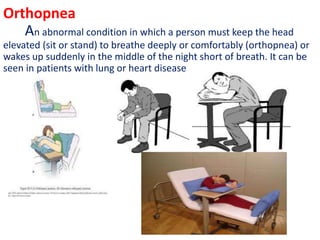
Orthopnea
An abnormal condition in which a person must keep the head
elevated (sit or stand) to breathe deeply or comfortably (orthopnea) or
wakes up suddenly in the middle of the night short of breath. It can be
seen in patients with lung or heart disease
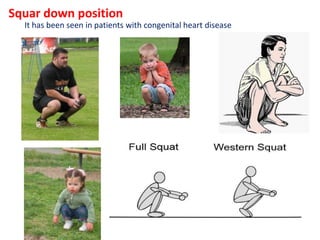
Squar down position
It has been seen in patients with congenital heart disease
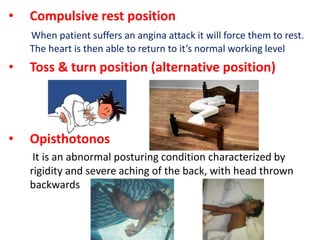
• Compulsive rest position
When patient suffers an angina attack it will force them to rest.
The heart is then able to return to it’s normal working level
• Toss & turn position (alternative position)
• Opisthotonos
It is an abnormal posturing condition characterized by
rigidity and severe aching of the back, with head thrown
backwards
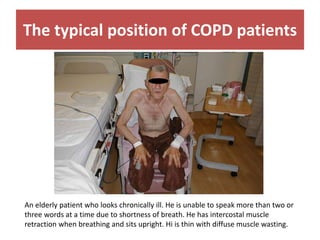
The typical position of COPD patients
An elderly patient who looks chronically ill. He is unable to speak more than two or
three words at a time due to shortness of breath. He has intercostal muscle
retraction when breathing and sits upright. Hi is thin with diffuse muscle wasting.
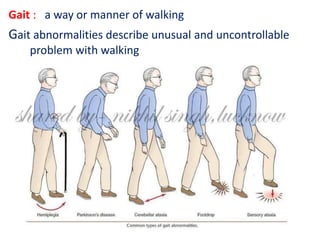
Gait : a way or manner of walking
Gait abnormalities describe unusual and uncontrollable
problem with walking
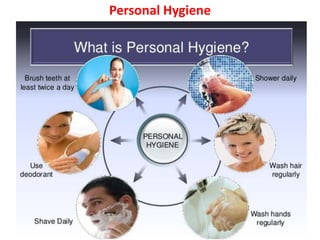
Personal Hygiene
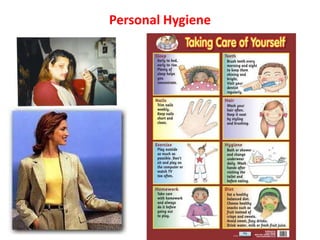
Personal Hygiene
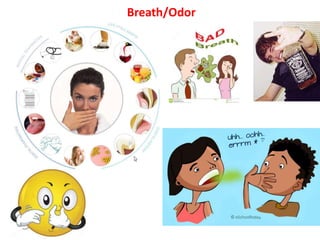
Breath/Odor
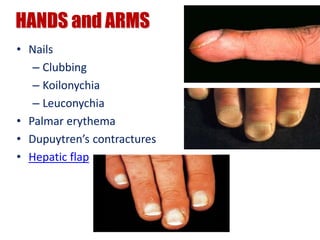
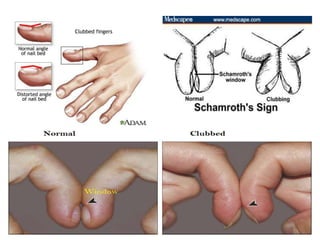
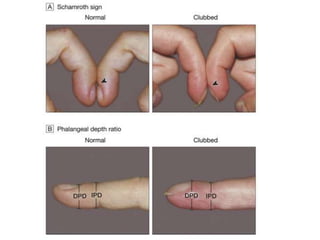
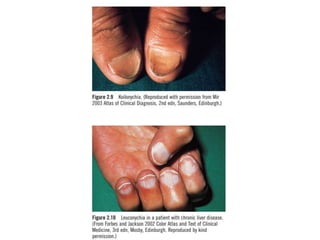
HANDS and ARMS
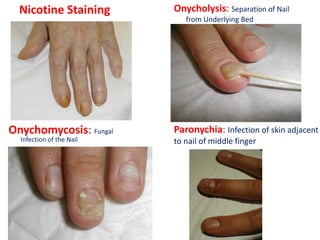
• Nails
– Clubbing
– Koilonychia
– Leuconychia
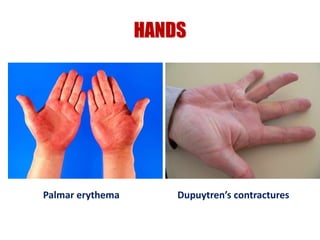
• Palmar erythema
• Dupuytren’s contractures
• Hepatic flap
Nicotine Staining Onycholysis: Separation of Nail
from Underlying Bed
Onychomycosis: Fungal
Infection of the Nail
Paronychia: Infection of skin adjacent
to nail of middle finger
HANDS
Palmar erythema Dupuytren’s contractures
ARMS
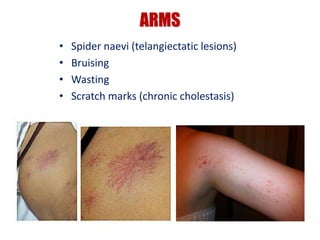
• Spider naevi (telangiectatic lesions)
• Bruising
• Wasting
• Scratch marks (chronic cholestasis)
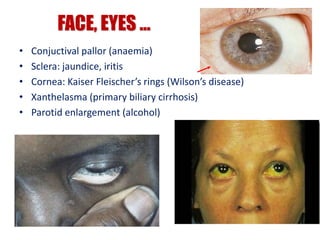
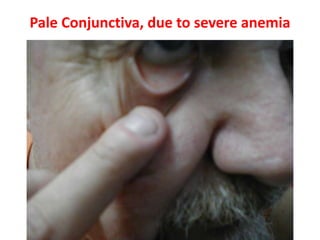
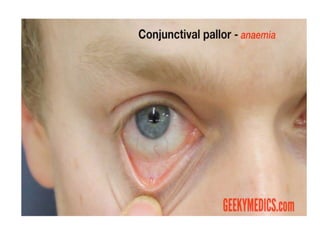
• Conjuctival pallor (anaemia)
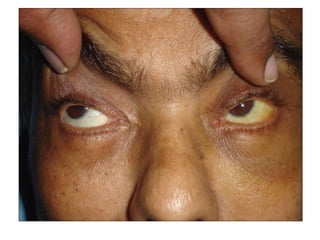
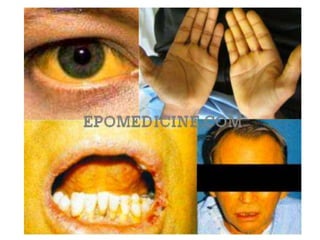
• Sclera: jaundice, iritis
• Cornea: Kaiser Fleischer’s rings (Wilson’s disease)
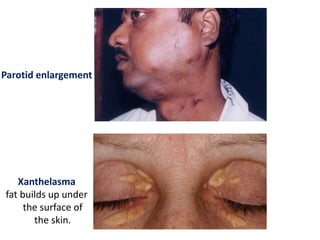
• Xanthelasma (primary biliary cirrhosis)
• Parotid enlargement (alcohol)
FACE, EYES …
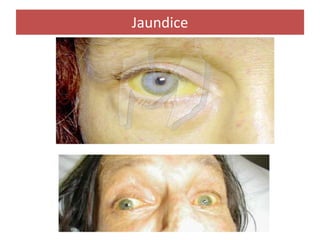
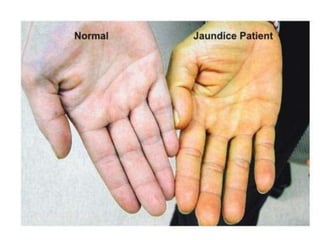
Jaundice
Pale Conjunctiva, due to severe anemia
Parotid enlargement
Xanthelasma
fat builds up under
the surface of
the skin.
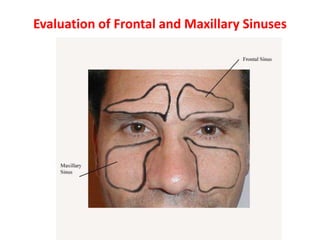
Evaluation of Frontal and Maxillary Sinuses
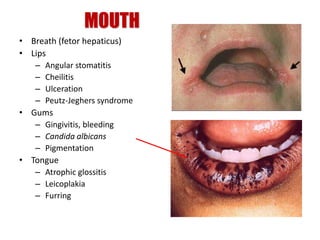
MOUTH
• Breath (fetor hepaticus)
• Lips
– Angular stomatitis
– Cheilitis
– Ulceration
– Peutz-Jeghers syndrome
• Gums
– Gingivitis, bleeding
– Candida albicans
– Pigmentation
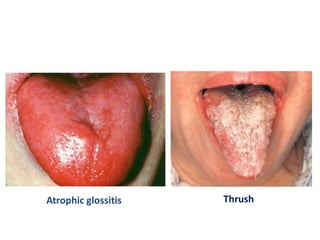
• Tongue
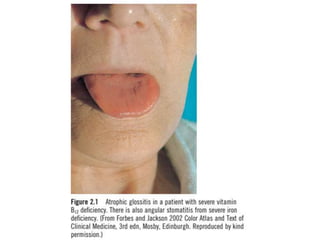
– Atrophic glossitis
– Leicoplakia
– Furring
Atrophic glossitis Thrush
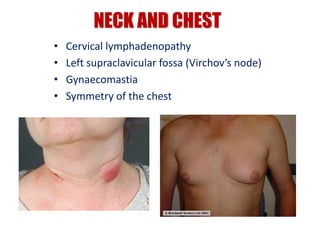
NECK AND CHEST
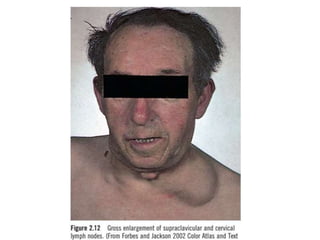
• Cervical lymphadenopathy
• Left supraclavicular fossa (Virchov’s node)
• Gynaecomastia
• Symmetry of the chest
Skin
• The skin is the largest organ of the body
• One of the best indicators of general health
• The examination of the skin is dependent on inspection, but
palpation of a skin lesion must also be performed
• The color changes include
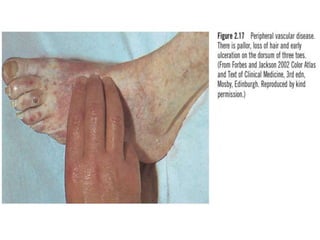
– Pallor
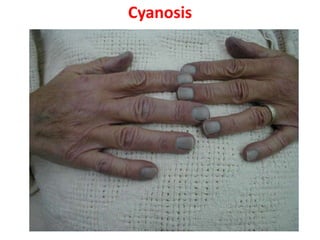
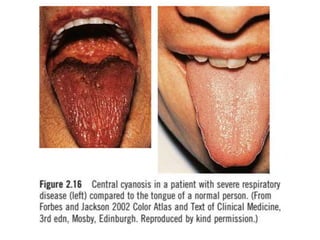
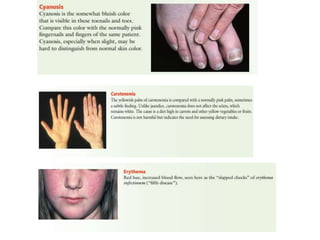
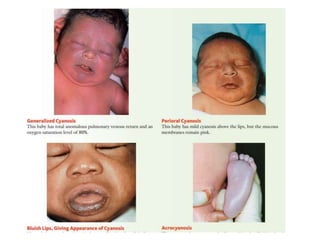
– Cyanosis
– Yellow skin (Icterus)
– Redness
– Pigmentation
– Discoloration
Cyanosis
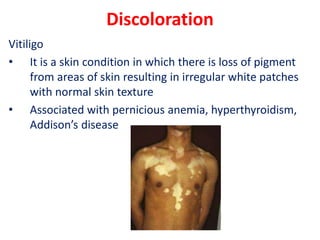
Discoloration
Vitiligo
• It is a skin condition in which there is loss of pigment
from areas of skin resulting in irregular white patches
with normal skin texture
• Associated with pernicious anemia, hyperthyroidism,
Addison’s disease
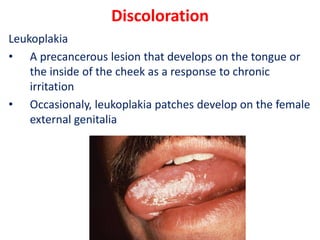
Discoloration
Leukoplakia
• A precancerous lesion that develops on the tongue or
the inside of the cheek as a response to chronic
irritation
• Occasionaly, leukoplakia patches develop on the female
external genitalia
Rashes
• Skin rashes are frequently one of the manifestation of systemic
diseases, and hence, they are important for the diagnosis of
some special diseases
• The different rashes may occur in infectious disease,
dermentological disease, drug or other allergic materials
• The rashes have some special regular patterns and sharps
• Types of rashes
– Macule
– Roseola
– Papules
– Maculopapulae
– Urticaria
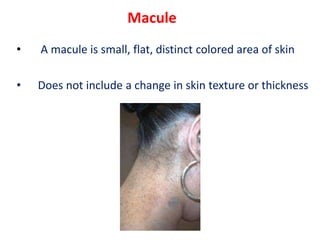
Macule
• A macule is small, flat, distinct colored area of skin
• Does not include a change in skin texture or thickness
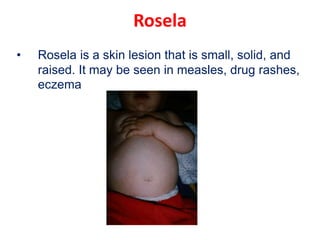
Rosela
• Rosela is a skin lesion that is small, solid, and
raised. It may be seen in measles, drug rashes,
eczema
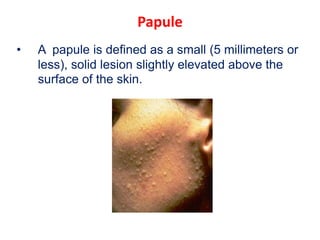
Papule
• A papule is defined as a small (5 millimeters or
less), solid lesion slightly elevated above the
surface of the skin.
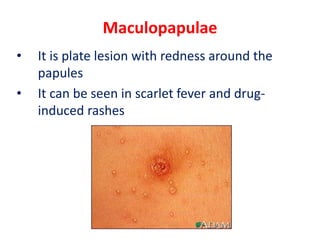
Maculopapulae
• It is plate lesion with redness around the
papules
• It can be seen in scarlet fever and drug-
induced rashes
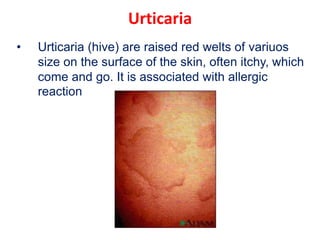
Urticaria
• Urticaria (hive) are raised red welts of variuos
size on the surface of the skin, often itchy, which
come and go. It is associated with allergic
reaction
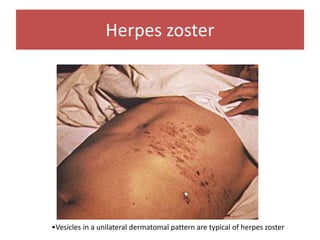
Herpes zoster
•Vesicles in a unilateral dermatomal pattern are typical of herpes zoster
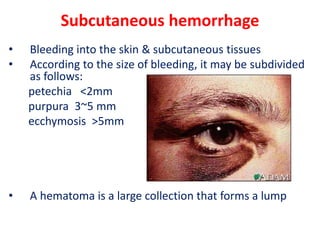
Subcutaneous hemorrhage
• Bleeding into the skin & subcutaneous tissues
• According to the size of bleeding, it may be subdivided
as follows:
petechia <2mm
purpura 3~5 mm
ecchymosis >5mm
• A hematoma is a large collection that forms a lump
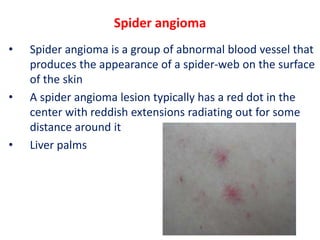
Spider angioma
• Spider angioma is a group of abnormal blood vessel that
produces the appearance of a spider-web on the surface
of the skin
• A spider angioma lesion typically has a red dot in the
center with reddish extensions radiating out for some
distance around it
• Liver palms
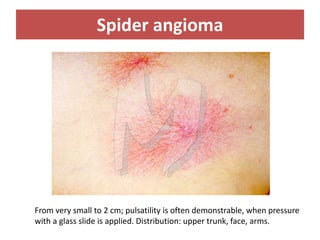
Spider angioma
From very small to 2 cm; pulsatility is often demonstrable, when pressure
with a glass slide is applied. Distribution: upper trunk, face, arms.
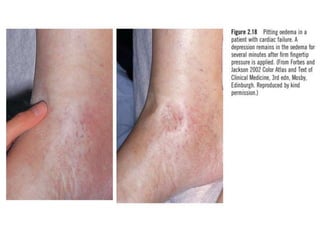
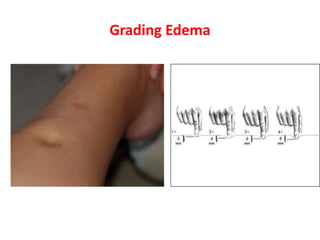
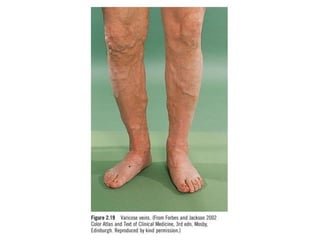
Edema
• Excessive build up of fluid in the tissues
• Either occurs throughout the body (generalized swelling)
or limited to a specific part of the body (localized swelling)
• It can be either pitting edema or non-pitting edema
• Mild : facial edema, peripheral edema
• Moderate: generalized edema
• Severe: generalized severe edema
Grading Edema
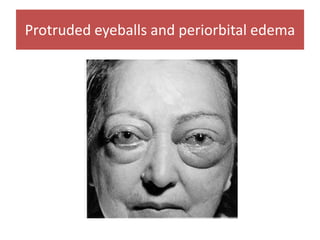
Protruded eyeballs and periorbital edema
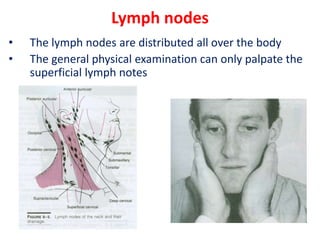
Lymph nodes
• The lymph nodes are distributed all over the body
• The general physical examination can only palpate the
superficial lymph notes
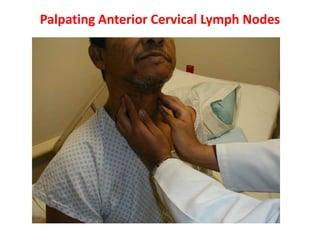
Palpating Anterior Cervical Lymph Nodes
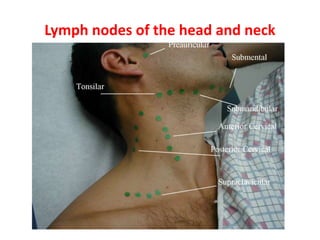
Lymph nodes of the head and neck
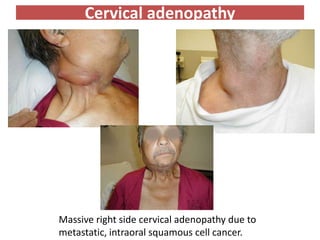
Cervical adenopathy
Massive right side cervical adenopathy due to
metastatic, intraoral squamous cell cancer.
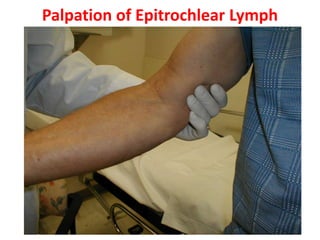
Palpation of Epitrochlear Lymph
Nodes
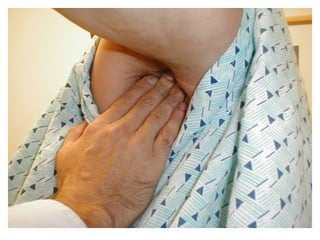
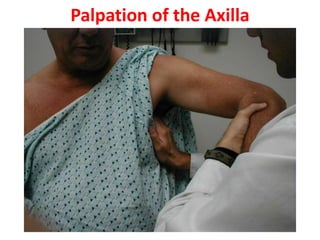
Palpation of the Axilla
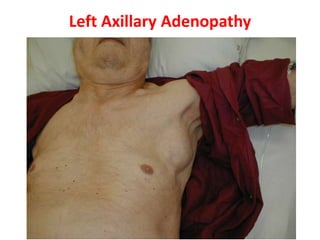
Left Axillary Adenopathy
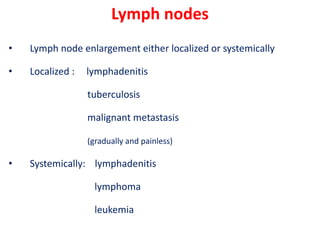
Lymph nodes
• Lymph node enlargement either localized or systemically
• Localized : lymphadenitis
tuberculosis
malignant metastasis
(gradually and painless)
• Systemically: lymphadenitis
lymphoma
leukemia
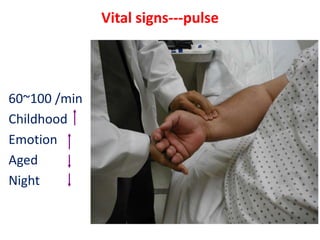
Vital signs---pulse
60~100 /min
Childhood
Emotion
Aged
Night
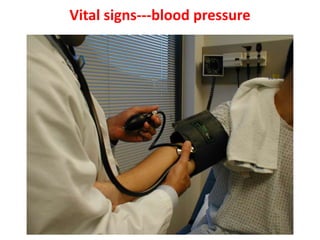
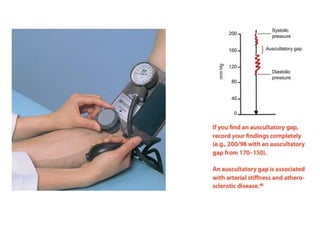
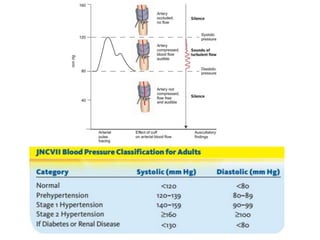
Vital signs---blood pressure
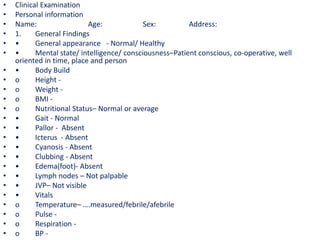
• Clinical Examination
• Personal information
• Name: Age: Sex: Address:
• 1. General Findings
• • General appearance - Normal/ Healthy
• • Mental state/ intelligence/ consciousness–Patient conscious, co-operative, well
oriented in time, place and person
• • Body Build
• o Height -
• o Weight -
• o BMI -
• o Nutritional Status– Normal or average
• • Gait - Normal
• • Pallor - Absent
• • Icterus - Absent
• • Cyanosis - Absent
• • Clubbing - Absent
• • Edema(foot)- Absent
• • Lymph nodes – Not palpable
• • JVP– Not visible
• • Vitals
• o Temperature– ….measured/febrile/afebrile
• o Pulse -
• o Respiration -
• o BP -
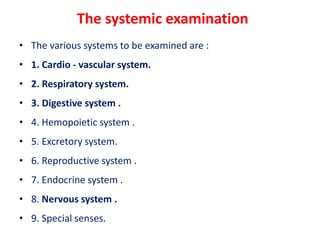
The systemic examination
• The various systems to be examined are :
• 1. Cardio - vascular system.
• 2. Respiratory system.
• 3. Digestive system .
• 4. Hemopoietic system .
• 5. Excretory system.
• 6. Reproductive system .
• 7. Endocrine system .
• 8. Nervous system .
• 9. Special senses.
Thank You

General examination

  • 1.
    Clinical examination Plan ofConduction & Scheme of Recording Chiranjeevi Kumar Department of Physiology AIIMS Bhopal
  • 2.
    Three sections • Vitaldata. • General examination. • Systemic examination.
  • 3.
    Vital Data • NameOf The Institution : • Name Of The Doctor: • Ward No: • Cot No : • Case No : • Date: • Name Of The Patient : • Age : • Sex : • Religion : • Caste : • Married Or Single : • Children : • Occupation : • Income • Address
  • 4.
    General History • Thegeneral history is organized into the following sections: • Identifying data (ID) • Chief complaint (CC) • History of the present illness (HPI) • Past medical history (PMHx) • Family history (FHx) • Medications (MEDS) and Allergies (ALL) • Social history (SHx) • Review of systems or functional inquiry (ROS/FI)
  • 5.
    History of PresentIllness • Symptom characterization: • 0 =Onset and duration • P = Provoking and alleviating factors • Q = Quality of pain (e.g. sharp, dull, throbbing) • R = Does the pain radiate? • S = Severity of pain ("on a scale from 1 to 10, 10 being the most severe") • T =Timing and progression ("Is the pain constant or intermittent? Worse in the morning or at nighttime?") • U = "How does it affect 'U' in your daily life?“ • V = Deja vu ("Has this happened before?") • W ='What do you think it is?
  • 6.
    General examination • Generalexamination is actually the first step of physical examination and Key component of diagnostic approach. • Inspection is the major method during general examination, combining with palpation, auscultation, and smelling. • Aims to – Assess patient's general condition – Detect manifestations of internal & systemic diseases • 3 components: – History taking – Clues are the symptoms – Physical exam - Clues are the signs – Investigations - Clues are test results
  • 7.
    Instruments And Equipment: • Stethoscope • Sphygmomanometer • Thermometer • Torch • Wooden tongue depressors • Measuring tape • Note:- • Exam begins the minute you first see the patient • Exam continues throughout your patient interaction
  • 8.
    Prerequisites: • Examination environment •Hand Washing • Proper light • Privacy & Confidentiality • Presence of a chaperon when examining female patients • Correct position of Doctor & Patient - Ideally examiner should be on right side of patient • Proper Exposure • Ensure your hands are warm
  • 9.
    General examination – GeneralAppearance – Hands and arms – Skin – Face – Eyes – Mouth – Neck – Oedema – Lymph nodes –Vital Signs • Temperature • Pulse • Respiration Rate • Blood Pressure
  • 10.
    General Appearance • Generalstate of health: Healthy/ill/comfortable/Distressed • Body Built and Nutritional status – Height – Weight – BMI – Obese/lean – Tall/short – Muscular/Asthenic/Cachexic • State of awareness or level of consciousness • Facial feature/expression/ Mood/Attitude • Speech(tone/voice) • Position/posture and Gait • Personal Hygiene • Breath/Odor
  • 11.
    • General stateof health: Healthy/ill/comfortable/Distressed
  • 12.
  • 13.
    I. Sheldon's AnthropometricTypes. • ENDOMORPHIC - in whom viscera and abdomen tend to dominate the body. • MESOMORPHIC - in whom the muscular tissue dominates the body • ECTOMORPHIC - in whom the skin, bones and the head dominate the body.. II. Clinical types. • Asthenic or hyposthenic has a slender or a weak figure. • Sthenic or Hypersthenic has a broad and muscular figure. • Normosthenic or Orthosthenic is midway between the above two.
  • 14.
  • 15.
  • 20.
    • State ofawareness or level of consciousness
  • 25.
  • 28.
    Acromegaly The enlargement ofthe frontal and maxillary sinuses results in an prominent brow and long face Growth of mandible leads to a jutting jaw (prognathism). Alveolar bone growth causes the teeth to separate
  • 29.
    Acromegaly Macroglossia. There is alsogeneralized visceral enlargement Broadening and enlargement of the hands and feet due to increased periosteal growth as well as thickening of the skin
  • 30.
    Graves’ disease Ocular involvementis mediated by one or more distinct but still poorly characterised orbital-stimulating immunoglobulins:Proptosis, due to increased volume and edema of retrobulbar fat. Shortened extraocular muscles, because of the muscle infiltration and fibrosis result in upper lid retraction. Conjunctival erythema, and periorbital edema are evident. Facial expression The stare in hyperthyroidism
  • 31.
    Hypothyroidism • The mostcommon cause is the Hashimoto’s thyroiditis, affects appr. 1% of adult population This woman demonstrates the typical hypothyroid facies. She also had a slow, hoarse, deep voice and lassitude (state of feeling very tired in mind or body). • Dull, puffy facies. Edema does not pit with pressure. The lateral eyebrows are thin.
  • 34.
  • 35.
    Position & Posture •It refers to patient’s body status and the general way of holding the body • Divided into: • Active • Passive • Compulsive • Active position The patient can move his/her body freely, without any restriction It can be seen in normal adult, patients with mild diseases or at earlier stage of the diseases • Passive position The patient can’t adjust or move his/her body It occurs in extremely sick or patients with unconsciousness
  • 36.
    • Compulsive supineposition The patient lie down on the beck, with two legs bending. Acute peritonitis
  • 37.
    Compulsive prostrate position Rachisdisease - in order to relief the tenderness of back muscles.
  • 38.
    Compulsive side downposition in patients with one sided pleurisy or pleurorrhea
  • 39.
    Orthopnea An abnormal conditionin which a person must keep the head elevated (sit or stand) to breathe deeply or comfortably (orthopnea) or wakes up suddenly in the middle of the night short of breath. It can be seen in patients with lung or heart disease
  • 40.
    Squar down position Ithas been seen in patients with congenital heart disease
  • 41.
    • Compulsive restposition When patient suffers an angina attack it will force them to rest. The heart is then able to return to it’s normal working level • Toss & turn position (alternative position) • Opisthotonos It is an abnormal posturing condition characterized by rigidity and severe aching of the back, with head thrown backwards
  • 42.
    The typical positionof COPD patients An elderly patient who looks chronically ill. He is unable to speak more than two or three words at a time due to shortness of breath. He has intercostal muscle retraction when breathing and sits upright. Hi is thin with diffuse muscle wasting.
  • 43.
    Gait : away or manner of walking Gait abnormalities describe unusual and uncontrollable problem with walking
  • 44.
  • 45.
  • 46.
  • 47.
    HANDS and ARMS •Nails – Clubbing – Koilonychia – Leuconychia • Palmar erythema • Dupuytren’s contractures • Hepatic flap
  • 51.
    Nicotine Staining Onycholysis:Separation of Nail from Underlying Bed Onychomycosis: Fungal Infection of the Nail Paronychia: Infection of skin adjacent to nail of middle finger
  • 52.
  • 56.
    ARMS • Spider naevi(telangiectatic lesions) • Bruising • Wasting • Scratch marks (chronic cholestasis)
  • 57.
    • Conjuctival pallor(anaemia) • Sclera: jaundice, iritis • Cornea: Kaiser Fleischer’s rings (Wilson’s disease) • Xanthelasma (primary biliary cirrhosis) • Parotid enlargement (alcohol) FACE, EYES …
  • 58.
  • 59.
    Pale Conjunctiva, dueto severe anemia
  • 64.
    Parotid enlargement Xanthelasma fat buildsup under the surface of the skin.
  • 65.
    Evaluation of Frontaland Maxillary Sinuses
  • 66.
    MOUTH • Breath (fetorhepaticus) • Lips – Angular stomatitis – Cheilitis – Ulceration – Peutz-Jeghers syndrome • Gums – Gingivitis, bleeding – Candida albicans – Pigmentation • Tongue – Atrophic glossitis – Leicoplakia – Furring
  • 67.
  • 69.
    NECK AND CHEST •Cervical lymphadenopathy • Left supraclavicular fossa (Virchov’s node) • Gynaecomastia • Symmetry of the chest
  • 71.
    Skin • The skinis the largest organ of the body • One of the best indicators of general health • The examination of the skin is dependent on inspection, but palpation of a skin lesion must also be performed • The color changes include – Pallor – Cyanosis – Yellow skin (Icterus) – Redness – Pigmentation – Discoloration
  • 72.
  • 77.
    Discoloration Vitiligo • It isa skin condition in which there is loss of pigment from areas of skin resulting in irregular white patches with normal skin texture • Associated with pernicious anemia, hyperthyroidism, Addison’s disease
  • 78.
    Discoloration Leukoplakia • A precancerouslesion that develops on the tongue or the inside of the cheek as a response to chronic irritation • Occasionaly, leukoplakia patches develop on the female external genitalia
  • 79.
    Rashes • Skin rashesare frequently one of the manifestation of systemic diseases, and hence, they are important for the diagnosis of some special diseases • The different rashes may occur in infectious disease, dermentological disease, drug or other allergic materials • The rashes have some special regular patterns and sharps • Types of rashes – Macule – Roseola – Papules – Maculopapulae – Urticaria
  • 80.
    Macule • A maculeis small, flat, distinct colored area of skin • Does not include a change in skin texture or thickness
  • 81.
    Rosela • Rosela isa skin lesion that is small, solid, and raised. It may be seen in measles, drug rashes, eczema
  • 82.
    Papule • A papuleis defined as a small (5 millimeters or less), solid lesion slightly elevated above the surface of the skin.
  • 83.
    Maculopapulae • It isplate lesion with redness around the papules • It can be seen in scarlet fever and drug- induced rashes
  • 84.
    Urticaria • Urticaria (hive)are raised red welts of variuos size on the surface of the skin, often itchy, which come and go. It is associated with allergic reaction
  • 85.
    Herpes zoster •Vesicles ina unilateral dermatomal pattern are typical of herpes zoster
  • 86.
    Subcutaneous hemorrhage • Bleedinginto the skin & subcutaneous tissues • According to the size of bleeding, it may be subdivided as follows: petechia <2mm purpura 3~5 mm ecchymosis >5mm • A hematoma is a large collection that forms a lump
  • 87.
    Spider angioma • Spiderangioma is a group of abnormal blood vessel that produces the appearance of a spider-web on the surface of the skin • A spider angioma lesion typically has a red dot in the center with reddish extensions radiating out for some distance around it • Liver palms
  • 88.
    Spider angioma From verysmall to 2 cm; pulsatility is often demonstrable, when pressure with a glass slide is applied. Distribution: upper trunk, face, arms.
  • 89.
    Edema • Excessive buildup of fluid in the tissues • Either occurs throughout the body (generalized swelling) or limited to a specific part of the body (localized swelling) • It can be either pitting edema or non-pitting edema • Mild : facial edema, peripheral edema • Moderate: generalized edema • Severe: generalized severe edema
  • 91.
  • 92.
    Protruded eyeballs andperiorbital edema
  • 93.
    Lymph nodes • Thelymph nodes are distributed all over the body • The general physical examination can only palpate the superficial lymph notes
  • 94.
  • 95.
    Lymph nodes ofthe head and neck
  • 96.
    Cervical adenopathy Massive rightside cervical adenopathy due to metastatic, intraoral squamous cell cancer.
  • 97.
  • 98.
  • 100.
  • 103.
    Lymph nodes • Lymphnode enlargement either localized or systemically • Localized : lymphadenitis tuberculosis malignant metastasis (gradually and painless) • Systemically: lymphadenitis lymphoma leukemia
  • 104.
  • 107.
  • 110.
    • Clinical Examination •Personal information • Name: Age: Sex: Address: • 1. General Findings • • General appearance - Normal/ Healthy • • Mental state/ intelligence/ consciousness–Patient conscious, co-operative, well oriented in time, place and person • • Body Build • o Height - • o Weight - • o BMI - • o Nutritional Status– Normal or average • • Gait - Normal • • Pallor - Absent • • Icterus - Absent • • Cyanosis - Absent • • Clubbing - Absent • • Edema(foot)- Absent • • Lymph nodes – Not palpable • • JVP– Not visible • • Vitals • o Temperature– ….measured/febrile/afebrile • o Pulse - • o Respiration - • o BP -
  • 111.
    The systemic examination •The various systems to be examined are : • 1. Cardio - vascular system. • 2. Respiratory system. • 3. Digestive system . • 4. Hemopoietic system . • 5. Excretory system. • 6. Reproductive system . • 7. Endocrine system . • 8. Nervous system . • 9. Special senses.
  • 112.