BY:
Dr, WALAA SALAH MANAA
SPECIALEST OF PEDIATRIC & FEVER
‫ـيخ‬‫ش‬‫ال‬‫ـفر‬‫ك‬ ‫ـيات‬‫م‬‫ح‬‫ـستشفى‬‫م‬
1-mental status.
2-speech
3-cranial nerves.
Sign of meningeal irritation.-4
5-motor system
-posture.
-gait.
-muscle(status-tone –power).
-Involuntary movement-coordination.
6-sensory system.
7-reflexes
-superficial.
-deep
-others
1-consciousness.
2-emotion.( e.g. apathy)
3-behavior.(calm – irritable)
4-intelligence.I.Q.
5-orientation.(P.P.T).
6-Handness
(start to use dominant hemisphere 18m-3yrs).
7-memory.
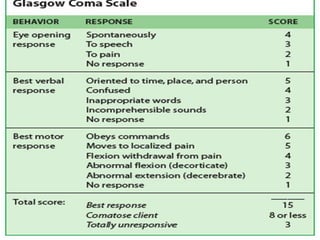
1-Lethargy=sleepy but fully arousable.
2-Drowsiness=light coma+arousable only to severe stimuli.
3-Stupor=moderate coma+unarousable+localize the pain.
4-Coma=deep coma.. unarousable..not localize the pain.
1-Immediate memory………………….. . ‫عد‬6‫متتاليه‬ ‫ارقام‬
‫بايه‬ ‫حاسس‬ ‫انت‬ ‫المريض‬ ‫اسال‬2-Recent memory
‫من‬ ‫اكثر‬ ‫من‬ ‫حصلت‬ ‫حاجه‬ ‫عن‬ ‫اسأله‬5‫سنوات‬3-Remote memory
memory
Delayed speech
=no word up to 18 m.
Or no sentence up to 3yrs.
Causes
-MR
-Deafness
-articulation defect
-bilingolism-physiological .
Slurred speech……………………(pyramidal lesion).
Monotonus speech …………….(extrapyramidal lesion).
Staccato speech…………………(cerebeller lesion)
 3rd & 4th cranial nerves are
located in the mid brain
 5th , 6th , 7th & 8th cranial nerves
are located in the pons
 9th , 10th , 11th & 12th cranial
nerves are located in the medulla
oblongata
Common non irritant odours +to each
nostril+eye closed .
Difficult in children.
Anosmia =loss of smell.
1-visual
acuity 2-Field of vision
3-fundus examination
1-Pupil size+
reaction to light
3-ptosis
2-Ocular
movement
Afferent….. Optic nerve.
Center……..midbrain.(3rd nerve nuclei ).
Efferent……3rd cr. N. to both eyes.
1-Sensory :
ophthalmic-maxillery-mandibuler.
2-motor:
masseter - temporalis –pterigoid.
3-reflexes:
corneal reflex-jaw reflex.
2-motor:
masseter – temporalis
(palpation when clenching).
–pterigoid.
(side to side movement)
3-reflexes:
corneal reflex
,‫عينه‬ ‫فى‬ ‫انفخ‬ ‫تعمله‬ ‫عارف‬ ‫مش‬ ‫ولو‬
3-reflexes:
jaw reflex.‫ال‬ ‫ينفتح‬ ‫حتى‬ ‫ألسفل‬ ‫الضرب‬ ‫اتجاه‬ ‫يكون‬ ‫ان‬ ‫يجب‬‫فك‬
Normally this reflex is absent or very slight.
However in individuals with UMNL the jaw
jerk reflex can be quite pronounced.
1-Sensory-----ant.2/3 of tongue.
2-Motor-----forehead –eye -mouth .
Facial paralysis =
(mouth deviation to healthy side
+weak eye closure
+ absent corrugation of forehead)
Cochlear part(hearing)
*At birth ---moro reflex.
*younger deviate to sound.
*Later Renne s test+ Weber test.
Vestibular part
nystagmus +vertigo
Sensory ……loss of post 2/3 of tongue.
Motor……pharyngeal O/E….
1-gag reflex…absent in bulber palsy UMNL
……exaggarated in pseudo bulber palsy LMNL.
2-Uvula ….normally central & mobile.
In unilateral lesion….uvula deviate to healthy side.
In bilateral lesion…uvula is central but immobile.
Spinal accessory N.
Sternomastoid……ability to
rotate head to healthy
side.
Trapezius…….dropping of
shoulder in affected side
Hypoglossal N. …..
deviation of the tongue to the affected side on
protrusion.
Bulber palsy Pseudo –bulber palsy
It is LMNL of the bulber
cranial nerve 8-9.
Lead to loss of gag reflex
+ flaccid paralysis of
pharynx & larynx.
It is UMNL of the bulber
cranial nerve nuclei
Lead to exaggerated gag
reflex.
Spastic paralysis of the
pharynx & larynx.
Late singes
 Neck stiffness.
 Back stiffness.
 +ve kernig’s sing.
 +veBrudziniski’ neck
sign.
 +veBrudziniski’ leg
sign.
Early singe
 chin-chest test.
 Chin-knee kissing
test.
 Tripod singe
Rapid flexion of the head is
accompanied by brisk flexion of both
knee
Inability to extend
the knee,when the
thigh is flexed at
the hip
1-decubitus.
2-gait.
3-muscle status.
4-muscle power.
5-Muscle tone.
6-involuntery movement.
7-co-ordination.
Facial nerve
Ataxic gait……ataxic CP.
Scissoring gait in spastic CP.
Not able to walk.
pseudo hypertrophy muscle atrophymuscle hypertrophy
1-Young child…….painful stimulation on the
opposite side of the tested muscle.
2-Older child….ask to move against resistance.
3-Test every joint for its muscle group.
4-Grading of muscle power
U.L.
small muscle of hand
‫القميص‬ ‫يزرر‬ ‫بيعرف‬ ‫الولد‬—‫يكتب‬ ‫بيعرف‬.
Muscle of lbow
Flexors…‫الشباك‬ ‫او‬ ‫الدرج‬ ‫يفتح‬ ‫بيعرف‬
extensors= ‫الدرج‬ ‫او‬ ‫الشباك‬ ‫يقفل‬ ‫بيعرف‬.
Shoulder….
Flexor… ‫الكم‬ ‫فى‬ ‫ايده‬ ‫يحط‬ ‫بيعرف‬
Extensor ‫الكم‬ ‫من‬ ‫ايده‬ ‫يشيل‬ ‫بيعرف‬
Adductor ..‫باطه‬ ‫تحت‬ ‫الكشكول‬ ‫يحط‬
L.L.
Small muscle of LL…. ‫وهوماشى‬ ‫الشبشب‬ ‫منه‬ ‫بقع‬ ‫الولد‬
Knee…. ‫ونزوله‬ ‫السلم‬ ‫طلوع‬
Adductor ….‫رجل‬ ‫على‬ ‫رجل‬ ‫يحط‬
Abductor….‫رجل‬ ‫على‬ ‫من‬ ‫رجل‬ ‫يشيل‬
Trunk.
-Flexor…. ‫ظهره‬ ‫على‬ ‫نايم‬ ‫لو‬ ‫الولد‬
‫او‬ ‫يساعده‬ ‫حد‬ ‫ما‬ ‫غير‬ ‫من‬ ‫يقوم‬ ‫يقدر‬
‫زراعه‬ ‫بمساعدة‬
-Extensor…. ‫االرض‬ ‫على‬ ‫قاعد‬ ‫لو‬
‫غير‬ ‫من‬ ‫الجذع‬ ‫بيرفع‬ ‫يقوم‬ ‫بيجى‬
‫يسند‬ ‫ما‬
.
Neck….pulling the child from both UL.
Intercostal m. ……short breath
‫حتى‬ ‫العد‬ ‫اليستطيع‬10......‫بعد‬ ‫على‬ ‫شمعه‬ ‫اطفاء‬ ‫اليستطيع‬30‫سم‬.
m. Of abdomen…….localize bulge of the
abd.(e.g. poliomylitis).
Diaphragm…..paradoxical respiration.
*To detect hypertonia…….passive movement
around big joint.
*To detect hypotonia…….shaking movement wrist
or ankle
1-LMNL
2-UMNL.=pyramidal lesion (shock stage)
3-Extrapyramidal lesion (chorea).
4-cerebeller lesion (ataxia).
5-Down s syndrome.
6-Atonic CP.
UMNL =Pyramidal lesion…..
spasticity(clasp knife) resistance on the
start of movement.
Extrapyramidal lesion…..
rigidity(resistance is all over movement ).
Rigidity may be (cog-weal or lead
pipe)
=usually with extrapyramidal lesion.
*Chorea….sudden irregular purposeless dancing
movement affect big proximal joint.
*Athetosis…slow twisting movement affect distal joint.
*Dystonia….slow twisting movement in trunk.
*Tremors….rapid alternating movement around small
joint.
Athetosis
dystonia
tremorschorea
-1st year ……grasp reflex & object transfer.
-2nd year……button & unbutton.
->3years……U.L.
1- Finger to nose test
2-Finger to finger test
3-Dysdiadochokinesis…inability toperform rapidly
alternating movement(e.g. rapid pronation and supination)
4-Rebound test
L.L.
Heal to shin test
Toe finger test
Foot Tapping test
Inco-ordination = ataxia.
Isolated fibers contraction not all the muscle .
Difficult to see in any muscle
Easily to seen in the tongue?
purly muscle organ coverd by mucosa ,,,,no
submucosa or fat like other muscle.
=LMN
 Superficial sensation….(pain-tough-temp.).
 Deep sensation………(joint sense-vibration
sense-deep pressure sense).
 Cortical sensation(tactile localization-tactile
discrimination-steriogenosis)
Special standpoints:
 Requires good cooperation on the patient`s side.
 Most often we compare different parts of the body.
 The patient should not see the examined part of the
body !
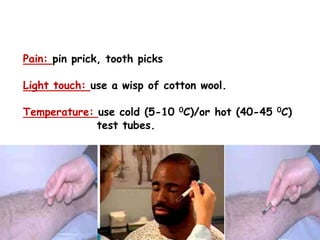
Pain: pin prick, tooth picks
Light touch: use a wisp of cotton wool.
Temperature: use cold (5-10 0C)/or hot (40-45 0C)
test tubes.
Joint position / motion:
-Hold the sides of the patient’s
finger ! Move it up and down at
random ! Ask to specify the
direction of movement !
Vibration:
-Place a vibrating tuning fork
on a bony prominence ( ankle,
knee,processus styloideus
radii and ulnae, elbow,
clavicula)
Two point discrimination:
-The ability to discriminate two blunt points when
applied simultaneously. (3-5 mm on the finger, 4-7
cm on the trunk).
Astereognosis.
-Inability to identify an object by palpation
sudden passive stretchsudden massive
activation of AHCssudden massive
contraction of all muscle fibers
Superficial reflexes-deep –visceral-others
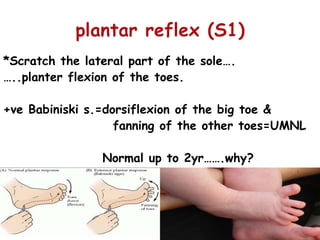
*Scratch the lateral part of the sole….
…..planter flexion of the toes.
+ve Babiniski s.=dorsiflexion of the big toe &
fanning of the other toes=UMNL
Normal up to 2yr…….why?
Scratch abdominal wall by a pin from outward
inward ….contraction of a segment of
abdominal muscles.
T7
T8
T9
T10
T11
T12
Light scratch along the inner aspect of the
upper part of the thigh lead to
elevation of the testicles.
Scratch the peri anal region
lead to contraction of external anal sphincter.
Biceps jerk (c5-6)
Blow upon the thumb on the biceps tendon while
the elbow is slightly extended
Blow upon the triceps tendon while the elbow
is flexed.
Blow upon styloid process of radius….flexion &
supination of elbow… (brachioradialis)
Blow on the qudriceps tendon..
(pateller tendon)
Blow on tendoachilis……
Only done if jerk is exaggerated (UMNL).
‫ايه؟؟؟؟؟؟؟؟‬ ‫شروطها‬
*Ensure that the pt is relaxed.
*Apply sudden and sustained flexion to the ankle……
*normally few oscillatory beats may occur…..
*if persist = +ve clonus.
Knee clonus.. Ankle clonus..
1-physiological < 18m.
2- pathological:
=lesion in the arc
1-afferrent ………...neuritis.
2-posterior horn…..disc protrusion.
3-AHC……………….Poliomylitis.
4-Efferrent………...neuritis.
5-muscle…………...myopathy.
Let us to see?
CNS examination

CNS examination

  • 1.
    BY: Dr, WALAA SALAHMANAA SPECIALEST OF PEDIATRIC & FEVER ‫ـيخ‬‫ش‬‫ال‬‫ـفر‬‫ك‬ ‫ـيات‬‫م‬‫ح‬‫ـستشفى‬‫م‬
  • 2.
    1-mental status. 2-speech 3-cranial nerves. Signof meningeal irritation.-4 5-motor system -posture. -gait. -muscle(status-tone –power). -Involuntary movement-coordination. 6-sensory system. 7-reflexes -superficial. -deep -others
  • 3.
    1-consciousness. 2-emotion.( e.g. apathy) 3-behavior.(calm– irritable) 4-intelligence.I.Q. 5-orientation.(P.P.T). 6-Handness (start to use dominant hemisphere 18m-3yrs). 7-memory.
  • 4.
    1-Lethargy=sleepy but fullyarousable. 2-Drowsiness=light coma+arousable only to severe stimuli. 3-Stupor=moderate coma+unarousable+localize the pain. 4-Coma=deep coma.. unarousable..not localize the pain.
  • 7.
    1-Immediate memory………………….. .‫عد‬6‫متتاليه‬ ‫ارقام‬ ‫بايه‬ ‫حاسس‬ ‫انت‬ ‫المريض‬ ‫اسال‬2-Recent memory ‫من‬ ‫اكثر‬ ‫من‬ ‫حصلت‬ ‫حاجه‬ ‫عن‬ ‫اسأله‬5‫سنوات‬3-Remote memory memory
  • 8.
    Delayed speech =no wordup to 18 m. Or no sentence up to 3yrs. Causes -MR -Deafness -articulation defect -bilingolism-physiological . Slurred speech……………………(pyramidal lesion). Monotonus speech …………….(extrapyramidal lesion). Staccato speech…………………(cerebeller lesion)
  • 10.
     3rd &4th cranial nerves are located in the mid brain  5th , 6th , 7th & 8th cranial nerves are located in the pons  9th , 10th , 11th & 12th cranial nerves are located in the medulla oblongata
  • 11.
    Common non irritantodours +to each nostril+eye closed . Difficult in children. Anosmia =loss of smell.
  • 12.
    1-visual acuity 2-Field ofvision 3-fundus examination
  • 13.
    1-Pupil size+ reaction tolight 3-ptosis 2-Ocular movement
  • 14.
    Afferent….. Optic nerve. Center……..midbrain.(3rdnerve nuclei ). Efferent……3rd cr. N. to both eyes.
  • 15.
    1-Sensory : ophthalmic-maxillery-mandibuler. 2-motor: masseter -temporalis –pterigoid. 3-reflexes: corneal reflex-jaw reflex.
  • 16.
    2-motor: masseter – temporalis (palpationwhen clenching). –pterigoid. (side to side movement)
  • 17.
    3-reflexes: corneal reflex ,‫عينه‬ ‫فى‬‫انفخ‬ ‫تعمله‬ ‫عارف‬ ‫مش‬ ‫ولو‬
  • 18.
    3-reflexes: jaw reflex.‫ال‬ ‫ينفتح‬‫حتى‬ ‫ألسفل‬ ‫الضرب‬ ‫اتجاه‬ ‫يكون‬ ‫ان‬ ‫يجب‬‫فك‬ Normally this reflex is absent or very slight. However in individuals with UMNL the jaw jerk reflex can be quite pronounced.
  • 21.
    1-Sensory-----ant.2/3 of tongue. 2-Motor-----forehead–eye -mouth . Facial paralysis = (mouth deviation to healthy side +weak eye closure + absent corrugation of forehead)
  • 24.
    Cochlear part(hearing) *At birth---moro reflex. *younger deviate to sound. *Later Renne s test+ Weber test. Vestibular part nystagmus +vertigo
  • 29.
    Sensory ……loss ofpost 2/3 of tongue. Motor……pharyngeal O/E…. 1-gag reflex…absent in bulber palsy UMNL ……exaggarated in pseudo bulber palsy LMNL. 2-Uvula ….normally central & mobile. In unilateral lesion….uvula deviate to healthy side. In bilateral lesion…uvula is central but immobile.
  • 34.
    Spinal accessory N. Sternomastoid……abilityto rotate head to healthy side. Trapezius…….dropping of shoulder in affected side
  • 36.
    Hypoglossal N. ….. deviationof the tongue to the affected side on protrusion.
  • 37.
    Bulber palsy Pseudo–bulber palsy It is LMNL of the bulber cranial nerve 8-9. Lead to loss of gag reflex + flaccid paralysis of pharynx & larynx. It is UMNL of the bulber cranial nerve nuclei Lead to exaggerated gag reflex. Spastic paralysis of the pharynx & larynx.
  • 38.
    Late singes  Neckstiffness.  Back stiffness.  +ve kernig’s sing.  +veBrudziniski’ neck sign.  +veBrudziniski’ leg sign. Early singe  chin-chest test.  Chin-knee kissing test.  Tripod singe
  • 39.
    Rapid flexion ofthe head is accompanied by brisk flexion of both knee
  • 40.
    Inability to extend theknee,when the thigh is flexed at the hip
  • 41.
    1-decubitus. 2-gait. 3-muscle status. 4-muscle power. 5-Muscletone. 6-involuntery movement. 7-co-ordination.
  • 43.
  • 46.
    Ataxic gait……ataxic CP. Scissoringgait in spastic CP. Not able to walk.
  • 47.
    pseudo hypertrophy muscleatrophymuscle hypertrophy
  • 48.
    1-Young child…….painful stimulationon the opposite side of the tested muscle. 2-Older child….ask to move against resistance. 3-Test every joint for its muscle group. 4-Grading of muscle power
  • 51.
    U.L. small muscle ofhand ‫القميص‬ ‫يزرر‬ ‫بيعرف‬ ‫الولد‬—‫يكتب‬ ‫بيعرف‬. Muscle of lbow Flexors…‫الشباك‬ ‫او‬ ‫الدرج‬ ‫يفتح‬ ‫بيعرف‬ extensors= ‫الدرج‬ ‫او‬ ‫الشباك‬ ‫يقفل‬ ‫بيعرف‬. Shoulder…. Flexor… ‫الكم‬ ‫فى‬ ‫ايده‬ ‫يحط‬ ‫بيعرف‬ Extensor ‫الكم‬ ‫من‬ ‫ايده‬ ‫يشيل‬ ‫بيعرف‬ Adductor ..‫باطه‬ ‫تحت‬ ‫الكشكول‬ ‫يحط‬
  • 52.
    L.L. Small muscle ofLL…. ‫وهوماشى‬ ‫الشبشب‬ ‫منه‬ ‫بقع‬ ‫الولد‬ Knee…. ‫ونزوله‬ ‫السلم‬ ‫طلوع‬ Adductor ….‫رجل‬ ‫على‬ ‫رجل‬ ‫يحط‬ Abductor….‫رجل‬ ‫على‬ ‫من‬ ‫رجل‬ ‫يشيل‬
  • 53.
    Trunk. -Flexor…. ‫ظهره‬ ‫على‬‫نايم‬ ‫لو‬ ‫الولد‬ ‫او‬ ‫يساعده‬ ‫حد‬ ‫ما‬ ‫غير‬ ‫من‬ ‫يقوم‬ ‫يقدر‬ ‫زراعه‬ ‫بمساعدة‬ -Extensor…. ‫االرض‬ ‫على‬ ‫قاعد‬ ‫لو‬ ‫غير‬ ‫من‬ ‫الجذع‬ ‫بيرفع‬ ‫يقوم‬ ‫بيجى‬ ‫يسند‬ ‫ما‬ .
  • 54.
    Neck….pulling the childfrom both UL. Intercostal m. ……short breath ‫حتى‬ ‫العد‬ ‫اليستطيع‬10......‫بعد‬ ‫على‬ ‫شمعه‬ ‫اطفاء‬ ‫اليستطيع‬30‫سم‬. m. Of abdomen…….localize bulge of the abd.(e.g. poliomylitis). Diaphragm…..paradoxical respiration.
  • 55.
    *To detect hypertonia…….passivemovement around big joint. *To detect hypotonia…….shaking movement wrist or ankle
  • 56.
    1-LMNL 2-UMNL.=pyramidal lesion (shockstage) 3-Extrapyramidal lesion (chorea). 4-cerebeller lesion (ataxia). 5-Down s syndrome. 6-Atonic CP.
  • 57.
    UMNL =Pyramidal lesion….. spasticity(claspknife) resistance on the start of movement. Extrapyramidal lesion….. rigidity(resistance is all over movement ). Rigidity may be (cog-weal or lead pipe)
  • 58.
    =usually with extrapyramidallesion. *Chorea….sudden irregular purposeless dancing movement affect big proximal joint. *Athetosis…slow twisting movement affect distal joint. *Dystonia….slow twisting movement in trunk. *Tremors….rapid alternating movement around small joint.
  • 59.
  • 60.
    -1st year ……graspreflex & object transfer. -2nd year……button & unbutton. ->3years……U.L. 1- Finger to nose test 2-Finger to finger test 3-Dysdiadochokinesis…inability toperform rapidly alternating movement(e.g. rapid pronation and supination) 4-Rebound test L.L. Heal to shin test Toe finger test Foot Tapping test Inco-ordination = ataxia.
  • 61.
    Isolated fibers contractionnot all the muscle . Difficult to see in any muscle Easily to seen in the tongue? purly muscle organ coverd by mucosa ,,,,no submucosa or fat like other muscle. =LMN
  • 62.
     Superficial sensation….(pain-tough-temp.). Deep sensation………(joint sense-vibration sense-deep pressure sense).  Cortical sensation(tactile localization-tactile discrimination-steriogenosis)
  • 63.
    Special standpoints:  Requiresgood cooperation on the patient`s side.  Most often we compare different parts of the body.  The patient should not see the examined part of the body !
  • 64.
    Pain: pin prick,tooth picks Light touch: use a wisp of cotton wool. Temperature: use cold (5-10 0C)/or hot (40-45 0C) test tubes.
  • 65.
    Joint position /motion: -Hold the sides of the patient’s finger ! Move it up and down at random ! Ask to specify the direction of movement ! Vibration: -Place a vibrating tuning fork on a bony prominence ( ankle, knee,processus styloideus radii and ulnae, elbow, clavicula)
  • 66.
    Two point discrimination: -Theability to discriminate two blunt points when applied simultaneously. (3-5 mm on the finger, 4-7 cm on the trunk).
  • 67.
  • 69.
    sudden passive stretchsuddenmassive activation of AHCssudden massive contraction of all muscle fibers Superficial reflexes-deep –visceral-others
  • 70.
    *Scratch the lateralpart of the sole…. …..planter flexion of the toes. +ve Babiniski s.=dorsiflexion of the big toe & fanning of the other toes=UMNL Normal up to 2yr…….why?
  • 71.
    Scratch abdominal wallby a pin from outward inward ….contraction of a segment of abdominal muscles. T7 T8 T9 T10 T11 T12
  • 72.
    Light scratch alongthe inner aspect of the upper part of the thigh lead to elevation of the testicles.
  • 73.
    Scratch the perianal region lead to contraction of external anal sphincter.
  • 74.
    Biceps jerk (c5-6) Blowupon the thumb on the biceps tendon while the elbow is slightly extended
  • 75.
    Blow upon thetriceps tendon while the elbow is flexed.
  • 76.
    Blow upon styloidprocess of radius….flexion & supination of elbow… (brachioradialis)
  • 77.
    Blow on thequdriceps tendon.. (pateller tendon)
  • 78.
  • 79.
    Only done ifjerk is exaggerated (UMNL). ‫ايه؟؟؟؟؟؟؟؟‬ ‫شروطها‬ *Ensure that the pt is relaxed. *Apply sudden and sustained flexion to the ankle…… *normally few oscillatory beats may occur….. *if persist = +ve clonus. Knee clonus.. Ankle clonus..
  • 80.
    1-physiological < 18m. 2-pathological: =lesion in the arc 1-afferrent ………...neuritis. 2-posterior horn…..disc protrusion. 3-AHC……………….Poliomylitis. 4-Efferrent………...neuritis. 5-muscle…………...myopathy.
  • 82.