MARITIME LAW AND
       SOLAS


PRESENTER : MOHD SYAHMI NURUDDIN
          : MOHD ZUELKHAIRI RIDZUAN
          : MOHD FIRDAUS AZIZ
INTRODUCTION

• SOLAS IS GENERALLY REGARDED AS
  THE MOST IMPORTANT CONVENTION
  CONCERNING SAFETY OF MERCHANT
  SHIPS
• 1ST VERSION ADOPTED 1914 IN
  RESPONSE TO THE TITANIC DISASTER
• IT WENT THRO’ A VERY LIVELY
  EVOLUTION PROCESS
• IN 1960 – THE NEW VERSION OF SOLAS
  BECOMES 1ST MAJOR TASK OF IMO
Cont.
• INTENTION TO KEEP SOLAS UP
  TO DATE DIFFICULT SINCE
  AMMENDMENTS PROCEDURES
  PROVED TO BE SLOW
• AS A RESULT SOLAS 1974 WAS
  INTRODUCED WITH A NEW
  CONVENTION AND THE TACIT
  ACCEPTANCE PROCEDURE
OBJECTIVE OF SOLAS


• to specify minimum standards for
  the construction, equipment and
  operation of ships, compatible
  with their safety.
REQUIREMENT OF SOLAS

•       General Provisions
•       Divide by two:
    –      Construction - subdivision and stability, machinery and
           electrical installations
    –      Fire protection , fire detection and fire extinction
•       Life saving appliances and arrangements
•       Radio Communication
•       Safety of Navigation
•       Carriage of Cargoes
•       Carriage of Dangerous Goods
•       Nuclear Ships
•       Management for the Safety Operation of Ships
•       Safety measures for high-speed craft
•       Divide by two:
    –      Special measures to enhance maritime safety
    –      Special measures to enhance maritime security
•       Additional safety measures for bulk carriers
Cont.
• Nevertheless, not all chapters
  are necessary for each ship. It
  is depend on what type of ships
  and what are the cargoes that
  she carries.
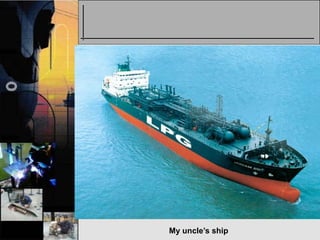
• In my uncle case, he was
  bought 1 ship where designed
  and will operated as LPG
  carrier.
• For LPG carrier, it needs 7
  chapters in SOLAS which are:
  – Chapter 1
  – Chapter 2
  – Chapter 3
  – Chapter 4
  – Chapter 5
  – Chapter 7
  – Chapter 9
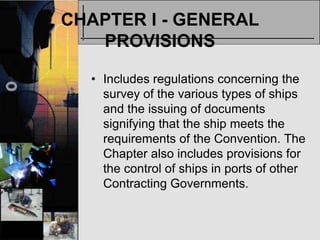
CHAPTER I - GENERAL
   PROVISIONS

  • Includes regulations concerning the
    survey of the various types of ships
    and the issuing of documents
    signifying that the ship meets the
    requirements of the Convention. The
    Chapter also includes provisions for
    the control of ships in ports of other
    Contracting Governments.
• CHAPTER II-1 - CONSTRUCTION -
  SUBDIVISION AND STABILITY,
  MACHINERY AND ELECTRICAL
  INSTALLATIONS

• The subdivision of passenger ships
  into watertight compartments must
  be such that after assumed damage
  to the ship's hull the vessel will
  remain afloat and stable.
  Requirements for watertight integrity
  and bilge pumping arrangements for
  passenger ships are also laid down
  as well as stability requirements for
  both passenger and cargo ships.
CHAPTER II-2 – CONSTRUCTION - FIRE
  PROTECTION, FIRE DETECTION AND
         FIRE EXTINCTION


• Includes detailed fire safety
  provisions for all ships and
  specific measures for
  passenger ships, cargo ships
  and tankers.
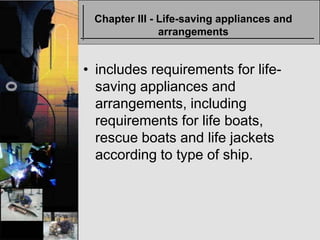
Chapter III - Life-saving appliances and
               arrangements


• includes requirements for life-
  saving appliances and
  arrangements, including
  requirements for life boats,
  rescue boats and life jackets
  according to type of ship.
Chapter IV - Radiocommunications


• incorporates the Global Maritime
  Distress and Safety System
  (GMDSS).
• international voyages are
  required to carry equipment
  designed to improve the
  chances of rescue following an
  accident
Chapter V - Safety of navigation

• identifies certain navigation safety
  services which should be provided
  by Contracting Governments
• includes a general obligation for
  masters to proceed to the
  assistance of those in distress
Chapter VII - Carriage of
  dangerous goods
   • Part A - Carriage of dangerous goods in
     packaged form
   • Part A-1 - Carriage of dangerous goods in
     solid form in bulk
   • Part B covers Construction and equipment
     of ships carrying dangerous liquid
     chemicals in bulk
   • Part C covers Construction and equipment
     of ships carrying liquefied gases in bulk
     and gas carriers
   • Part D includes special requirements for
     the carriage of packaged irradiated nuclear
     fuel, plutonium and high-level radioactive
     wastes on board ship
Cont.
• For my uncle’s LPG ships, the
  regulation must follow in Part C
  of Chapter VII. This regulation is
  special for LNG and LPG
  carrier. It must comply with the
  requirement of the International
  Gas Carrier Code or IGC code.
Chapter IX - Management for the
    Safe Operation of Ships


• makes mandatory the
  International Safety
  Management (ISM) Code
Conclusion
• my uncles need to follow the
  necessary requirement that
  given by SOLAS 1974
  according to vessel type and
  the cargo that she carry.
• All of the information that I’ve
  give to him is not fully detailed,
  it just a basic.
Cont.
• For easier way, he can use ship
  class as the authority that gives
  a standard of construction and
  requirement that follow the IMO.
Cont.
• He must know that this
  requirement is not giving them
  obstacle or difficulty but it will
  protect and secure his ship
  while sailing around the world.
Cont.
• SOLAS really help when the
  ship is under construction and
  also when the ship performs the
  task. Lastly, SOLAS was not
  made to give obstacles to ship
  industry, but made to help and
  improve it.
My uncle’s ship
THE END

Maritime law and solas

  • 1.
    MARITIME LAW AND SOLAS PRESENTER : MOHD SYAHMI NURUDDIN : MOHD ZUELKHAIRI RIDZUAN : MOHD FIRDAUS AZIZ
  • 2.
    INTRODUCTION • SOLAS ISGENERALLY REGARDED AS THE MOST IMPORTANT CONVENTION CONCERNING SAFETY OF MERCHANT SHIPS • 1ST VERSION ADOPTED 1914 IN RESPONSE TO THE TITANIC DISASTER • IT WENT THRO’ A VERY LIVELY EVOLUTION PROCESS • IN 1960 – THE NEW VERSION OF SOLAS BECOMES 1ST MAJOR TASK OF IMO
  • 3.
    Cont. • INTENTION TOKEEP SOLAS UP TO DATE DIFFICULT SINCE AMMENDMENTS PROCEDURES PROVED TO BE SLOW • AS A RESULT SOLAS 1974 WAS INTRODUCED WITH A NEW CONVENTION AND THE TACIT ACCEPTANCE PROCEDURE
  • 4.
    OBJECTIVE OF SOLAS •to specify minimum standards for the construction, equipment and operation of ships, compatible with their safety.
  • 5.
    REQUIREMENT OF SOLAS • General Provisions • Divide by two: – Construction - subdivision and stability, machinery and electrical installations – Fire protection , fire detection and fire extinction • Life saving appliances and arrangements • Radio Communication • Safety of Navigation • Carriage of Cargoes • Carriage of Dangerous Goods • Nuclear Ships • Management for the Safety Operation of Ships • Safety measures for high-speed craft • Divide by two: – Special measures to enhance maritime safety – Special measures to enhance maritime security • Additional safety measures for bulk carriers
  • 6.
    Cont. • Nevertheless, notall chapters are necessary for each ship. It is depend on what type of ships and what are the cargoes that she carries. • In my uncle case, he was bought 1 ship where designed and will operated as LPG carrier.
  • 7.
    • For LPGcarrier, it needs 7 chapters in SOLAS which are: – Chapter 1 – Chapter 2 – Chapter 3 – Chapter 4 – Chapter 5 – Chapter 7 – Chapter 9
  • 8.
    CHAPTER I -GENERAL PROVISIONS • Includes regulations concerning the survey of the various types of ships and the issuing of documents signifying that the ship meets the requirements of the Convention. The Chapter also includes provisions for the control of ships in ports of other Contracting Governments.
  • 9.
    • CHAPTER II-1- CONSTRUCTION - SUBDIVISION AND STABILITY, MACHINERY AND ELECTRICAL INSTALLATIONS • The subdivision of passenger ships into watertight compartments must be such that after assumed damage to the ship's hull the vessel will remain afloat and stable. Requirements for watertight integrity and bilge pumping arrangements for passenger ships are also laid down as well as stability requirements for both passenger and cargo ships.
  • 10.
    CHAPTER II-2 –CONSTRUCTION - FIRE PROTECTION, FIRE DETECTION AND FIRE EXTINCTION • Includes detailed fire safety provisions for all ships and specific measures for passenger ships, cargo ships and tankers.
  • 11.
    Chapter III -Life-saving appliances and arrangements • includes requirements for life- saving appliances and arrangements, including requirements for life boats, rescue boats and life jackets according to type of ship.
  • 12.
    Chapter IV -Radiocommunications • incorporates the Global Maritime Distress and Safety System (GMDSS). • international voyages are required to carry equipment designed to improve the chances of rescue following an accident
  • 13.
    Chapter V -Safety of navigation • identifies certain navigation safety services which should be provided by Contracting Governments • includes a general obligation for masters to proceed to the assistance of those in distress
  • 14.
    Chapter VII -Carriage of dangerous goods • Part A - Carriage of dangerous goods in packaged form • Part A-1 - Carriage of dangerous goods in solid form in bulk • Part B covers Construction and equipment of ships carrying dangerous liquid chemicals in bulk • Part C covers Construction and equipment of ships carrying liquefied gases in bulk and gas carriers • Part D includes special requirements for the carriage of packaged irradiated nuclear fuel, plutonium and high-level radioactive wastes on board ship
  • 15.
    Cont. • For myuncle’s LPG ships, the regulation must follow in Part C of Chapter VII. This regulation is special for LNG and LPG carrier. It must comply with the requirement of the International Gas Carrier Code or IGC code.
  • 16.
    Chapter IX -Management for the Safe Operation of Ships • makes mandatory the International Safety Management (ISM) Code
  • 17.
    Conclusion • my unclesneed to follow the necessary requirement that given by SOLAS 1974 according to vessel type and the cargo that she carry. • All of the information that I’ve give to him is not fully detailed, it just a basic.
  • 18.
    Cont. • For easierway, he can use ship class as the authority that gives a standard of construction and requirement that follow the IMO.
  • 19.
    Cont. • He mustknow that this requirement is not giving them obstacle or difficulty but it will protect and secure his ship while sailing around the world.
  • 20.
    Cont. • SOLAS reallyhelp when the ship is under construction and also when the ship performs the task. Lastly, SOLAS was not made to give obstacles to ship industry, but made to help and improve it.
  • 21.
  • 22.