Dangerous cargos on
     OSV vessels
     Does the crew have enough
     knowledge to handle these
     cargoes in a safe manner?


”Norwegian Sea Health Conference” 18th and 19th of april 2012
Haldor Sæther
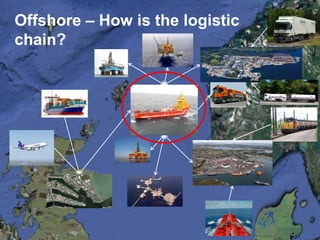
Offshore – How is the logistic
chain?
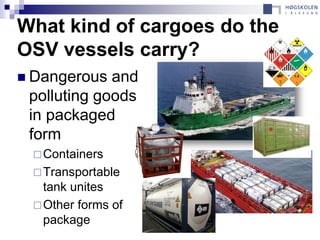
What kind of cargoes do the
OSV vessels carry?
 Dangerous  and
 polluting goods
 in packaged
 form
  Containers
  Transportable
   tank unites
  Other forms of
   package
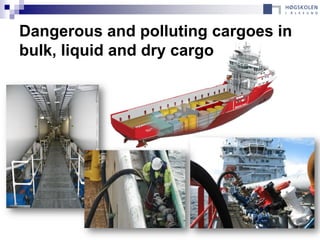
Dangerous and polluting cargoes in
bulk, liquid and dry cargo
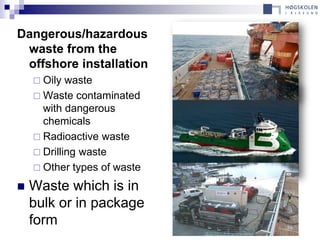
Dangerous/hazardous
 waste from the
 offshore installation
     Oily  waste
     Waste contaminated
      with dangerous
      chemicals
     Radioactive waste
     Drilling waste
     Other types of waste

   Waste which is in
    bulk or in package
    form
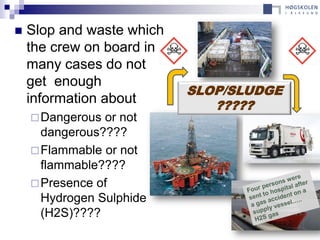
   Slop and waste which
    the crew on board in
    many cases do not
    get enough
                           SLOP/SLUDGE
    information about         ?????
     Dangerous or not
      dangerous????
     Flammable or not
      flammable????
     Presence of
      Hydrogen Sulphide
      (H2S)????
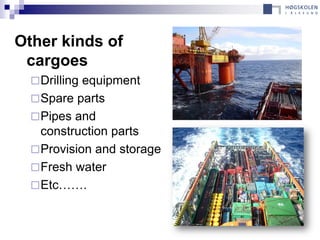
Other kinds of
 cargoes
   Drilling equipment
   Spare parts
   Pipes and
    construction parts
   Provision and storage
   Fresh water
   Etc…….
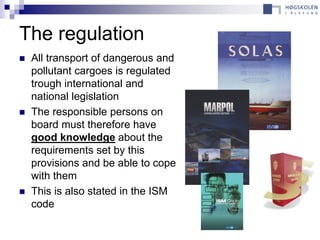
The regulation
   All transport of dangerous and
    pollutant cargoes is regulated
    trough international and
    national legislation
   The responsible persons on
    board must therefore have
    good knowledge about the
    requirements set by this
    provisions and be able to cope
    with them
   This is also stated in the ISM
    code
But why does there often occures
misunderstandings around the legeslatin
on board on offshore support vessels
   IMO regulations handled by
    the flag state authority
     Norwegian     Maritime
      Directorate


   Petroleum Safety Authority
    (Ptil) (on Norwegian sector)
     Have  their own legislations
      which not always are in
      accordance with the IMO
      rules
   The Norwegian Labour
    Inspection Authority (Atil)
    (Norwegian)
     Conducts    more to the land based
      activities and are not always in
      alignment with the IMO regulations


   The Climate and Pollution
    Agency (Klif) (Norwegian)
     Have  also their own regulations
      which in some case can be a
      challenge to cope with when it is
      set up against the IMO rules
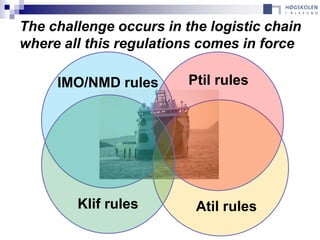
The challenge occurs in the logistic chain
where all this regulations comes in force

     IMO/NMD rules       Ptil rules


        Klif rules        Atil rules
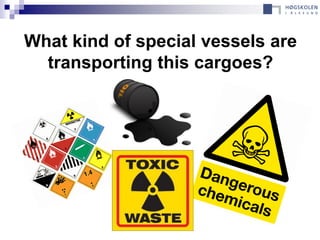
What kind of special vessels are
  transporting this cargoes?
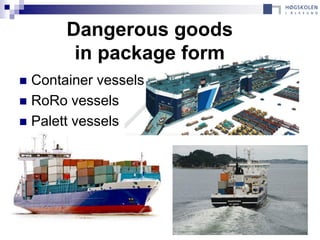
Dangerous goods
        in package form
 Container vessels
 RoRo vessels
 Palett vessels
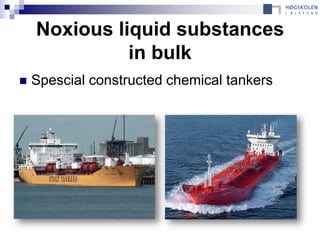
Noxious liquid substances
              in bulk
   Spescial constructed chemical tankers
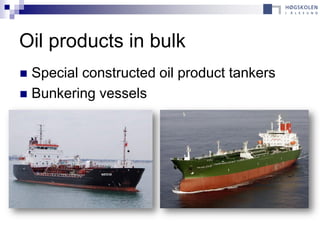
Oil products in bulk
 Special constructed oil product tankers
 Bunkering vessels
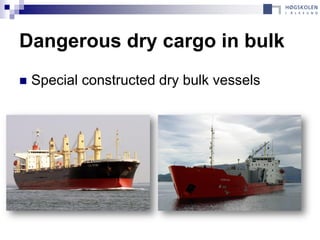
Dangerous dry cargo in bulk
   Special constructed dry bulk vessels
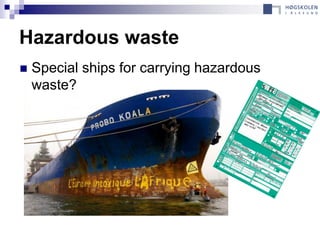
Hazardous waste
   Special ships for carrying hazardous
    waste?
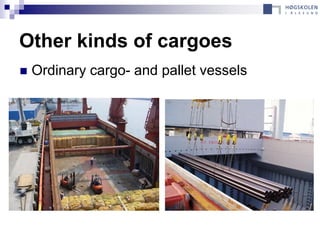
Other kinds of cargoes
   Ordinary cargo- and pallet vessels
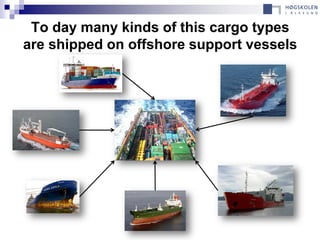
To day many kinds of this cargo types
are shipped on offshore support vessels
Qualification requirements
   For personals serving on this
    special vessels carrying
    dangerous and polluting
    cargoes the STCW code             STCW code chapter V
                                     Obligations and guidelines
    requires special training and     regarding training and
                                      certification on special
    competence                                vessels

   The ISM code requires that
    the crewmembers on board on
    all SOLAS vessels shall be
    fully competent to perform the           ISM code # 6
                                         Resources and Personnel
    jobs they are set to do
Where special training and courses
is required, own certificates normally
are issued
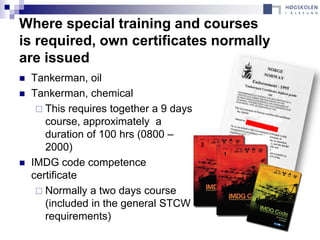
   Tankerman, oil
   Tankerman, chemical
      This requires together a 9 days
       course, approximately a
       duration of 100 hrs (0800 –
       2000)
   IMDG code competence
    certificate
      Normally a two days course
       (included in the general STCW
       requirements)
Special training on offshore support
vessels
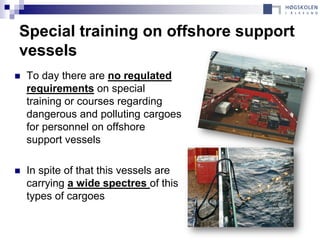
   To day there are no regulated
    requirements on special
    training or courses regarding
    dangerous and polluting cargoes
    for personnel on offshore
    support vessels

   In spite of that this vessels are
    carrying a wide spectres of this
    types of cargoes
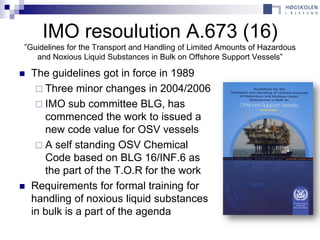
IMO resoulution A.673 (16)
”Guidelines for the Transport and Handling of Limited Amounts of Hazardous
   and Noxious Liquid Substances in Bulk on Offshore Support Vessels”

   The guidelines got in force in 1989
      Three minor changes in 2004/2006
      IMO sub committee BLG, has
       commenced the work to issued a
       new code value for OSV vessels
      A self standing OSV Chemical
       Code based on BLG 16/INF.6 as
       the part of the T.O.R for the work
   Requirements for formal training for
    handling of noxious liquid substances
    in bulk is a part of the agenda
The new OSV chemical code must necessarily be
seen in connection with other IMO codes

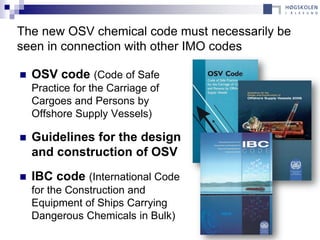
   OSV code (Code of Safe
    Practice for the Carriage of
    Cargoes and Persons by
    Offshore Supply Vessels)

   Guidelines for the design
    and construction of OSV
   IBC code (International Code
    for the Construction and
    Equipment of Ships Carrying
    Dangerous Chemicals in Bulk)
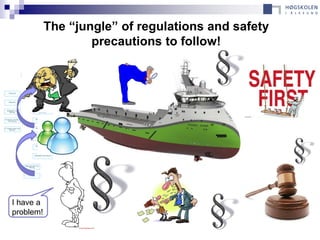
The “jungle” of regulations and safety
                   precautions to follow!


I have a
problem!
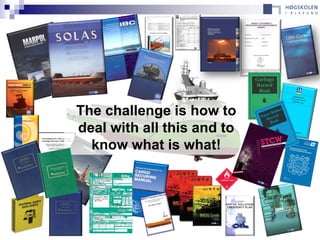
The challenge is how to
deal with all this and to
  know what is what!
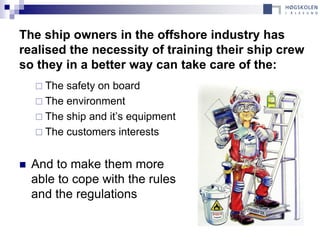
The ship owners in the offshore industry has
realised the necessity of training their ship crew
so they in a better way can take care of the:
     The safety on board
     The environment
     The ship and it’s equipment
     The customers interests


   And to make them more
    able to cope with the rules
    and the regulations
Background for the course
   Aalesund Maritime University College started developing the course
    in the winter of 2010 after being challenged by Bourbon Offshore
    Norway
   The background was that it did not exist any courses that were
    considered as fully relevant for the treatment and carriage of
    dangerous and polluting cargoes on board offshore supply vessels
The purpose of the course
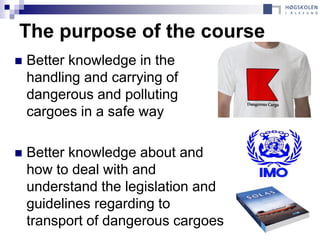
   Better knowledge in the
    handling and carrying of
    dangerous and polluting
    cargoes in a safe way

   Better knowledge about and
    how to deal with and
    understand the legislation and
    guidelines regarding to
    transport of dangerous cargoes
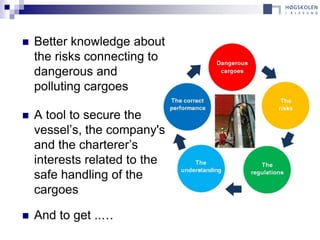
   Better knowledge about
    the risks connecting to
    dangerous and
    polluting cargoes

   A tool to secure the
    vessel’s, the company's
    and the charterer’s
    interests related to the
    safe handling of the
    cargoes

   And to get ..…
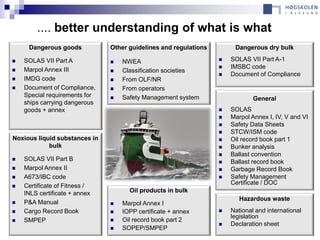
.... better understanding of what is what
     Dangerous goods           Other guidelines and regulations        Dangerous dry bulk

   SOLAS VII Part A              NWEA                              SOLAS VII Part A-1
   Marpol Annex III                                                 IMSBC code
                                  Classification societies
                                                                     Document of Compliance
   IMDG code                     From OLF/NR
   Document of Compliance,       From operators
    Special requirements for      Safety Management system                   General
    ships carrying dangerous
    goods + annex                                                    SOLAS
                                                                     Marpol Annex I, IV, V and VI
                                                                     Safety Data Sheets
                                                                     STCW/ISM code
Noxious liquid substances in                                         Oil record book part 1
            bulk                                                     Bunker analysis
                                                                     Ballast convention
   SOLAS VII Part B                                                 Ballast record book
   Marpol Annex II                                                  Garbage Record Book
   A673/IBC code                                                    Safety Management
                                                                      Certificate / DOC
   Certificate of Fitness /
    INLS certificate + annex         Oil products in bulk
                                                                         Hazardous waste
   P&A Manual                    Marpol Annex I
   Cargo Record Book             IOPP certificate + annex          National and international
                                                                      legislation
   SMPEP                         Oil record book part 2
                                                                     Declaration sheet
                                  SOPEP/SMPEP
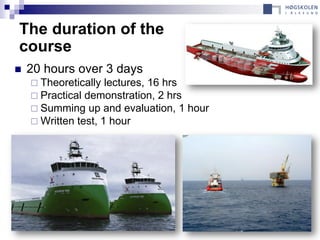
The duration of the
course
   20 hours over 3 days
     Theoretically  lectures, 16 hrs
     Practical demonstration, 2 hrs
     Summing up and evaluation, 1 hour
     Written test, 1 hour
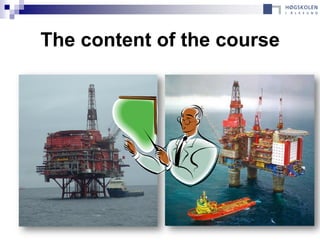
The content of the course
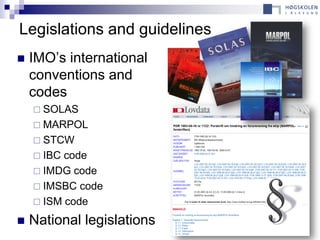
Legislations and guidelines
   IMO’s international
    conventions and
    codes
     SOLAS
     MARPOL
     STCW
     IBC code
     IMDG code
     IMSBC code
     ISM code

   National legislations
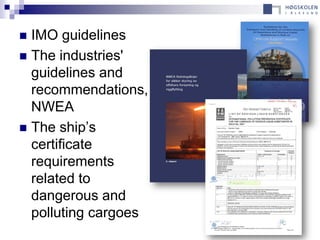
 IMO guidelines
 The industries'
  guidelines and
  recommendations,
  NWEA
 The ship’s
  certificate
  requirements
  related to
  dangerous and
  polluting cargoes
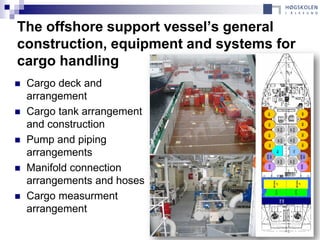
The offshore support vessel’s general
construction, equipment and systems for
cargo handling
   Cargo deck and
    arrangement
   Cargo tank arrangement
    and construction
   Pump and piping
    arrangements
   Manifold connection
    arrangements and hoses
   Cargo measurment
    arrangement
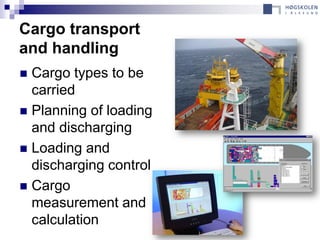
Cargo transport
and handling
 Cargo types to be
  carried
 Planning of loading
  and discharging
 Loading and
  discharging control
 Cargo
  measurement and
  calculation
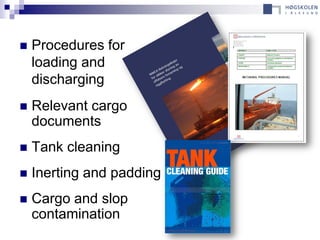
   Procedures for
    loading and
    discharging
   Relevant cargo
    documents
   Tank cleaning
   Inerting and padding
   Cargo and slop
    contamination
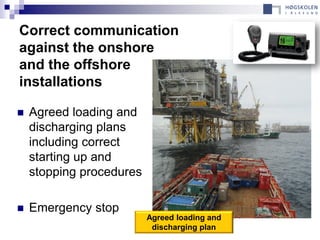
Correct communication
against the onshore
and the offshore
installations

   Agreed loading and
    discharging plans
    including correct
    starting up and
    stopping procedures

   Emergency stop
                          Agreed loading and
                           discharging plan
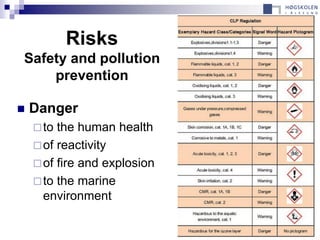
Risks
Safety and pollution
    prevention

   Danger
     to the human health
     of reactivity
     of fire and explosion
     to the marine
      environment
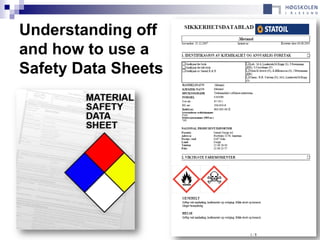
Understanding off
and how to use a
Safety Data Sheets
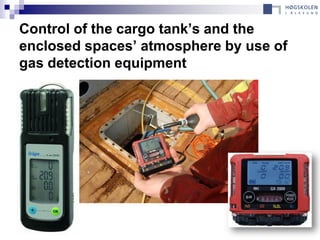
Control of the cargo tank’s and the
enclosed spaces’ atmosphere by use of
gas detection equipment
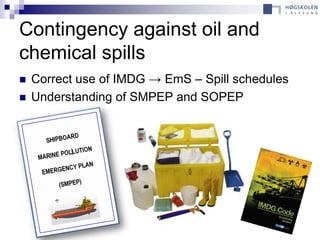
Contingency against oil and
chemical spills
   Correct use of IMDG → EmS – Spill schedules
   Understanding of SMPEP and SOPEP
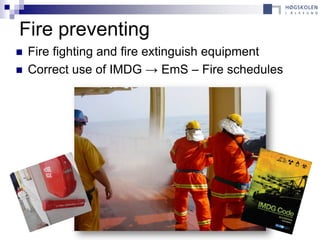
Fire preventing
   Fire fighting and fire extinguish equipment
   Correct use of IMDG → EmS – Fire schedules
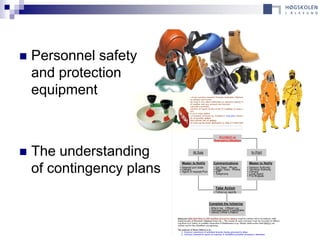
   Personnel safety
    and protection
    equipment


   The understanding
    of contingency plans
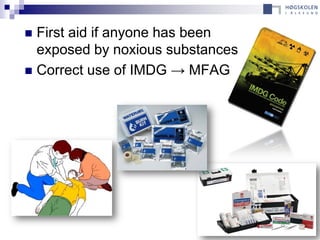
 First aid if anyone has been
  exposed by noxious substances
 Correct use of IMDG → MFAG
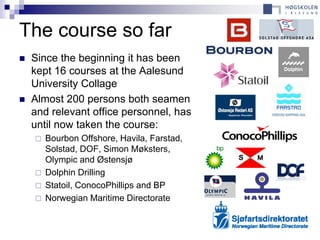
The course so far
   Since the beginning it has been
    kept 16 courses at the Aalesund
    University Collage
   Almost 200 persons both seamen
    and relevant office personnel, has
    until now taken the course:
       Bourbon Offshore, Havila, Farstad,
        Solstad, DOF, Simon Møksters,
        Olympic and Østensjø
       Dolphin Drilling
       Statoil, ConocoPhillips and BP
       Norwegian Maritime Directorate
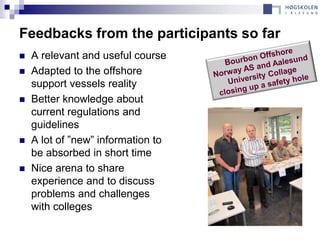
Feedbacks from the participants so far
   A relevant and useful course
   Adapted to the offshore
    support vessels reality
   Better knowledge about
    current regulations and
    guidelines
   A lot of ”new” information to
    be absorbed in short time
   Nice arena to share
    experience and to discuss
    problems and challenges
    with colleges
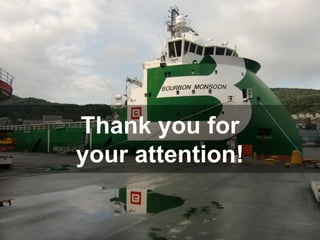
Thank you for
your attention!

Sæter day 2 8_foredrag[1]

  • 1.
    Dangerous cargos on OSV vessels Does the crew have enough knowledge to handle these cargoes in a safe manner? ”Norwegian Sea Health Conference” 18th and 19th of april 2012 Haldor Sæther
  • 2.
    Offshore – Howis the logistic chain?
  • 3.
    What kind ofcargoes do the OSV vessels carry?  Dangerous and polluting goods in packaged form  Containers  Transportable tank unites  Other forms of package
  • 4.
    Dangerous and pollutingcargoes in bulk, liquid and dry cargo
  • 5.
    Dangerous/hazardous waste fromthe offshore installation  Oily waste  Waste contaminated with dangerous chemicals  Radioactive waste  Drilling waste  Other types of waste  Waste which is in bulk or in package form
  • 6.
    Slop and waste which the crew on board in many cases do not get enough SLOP/SLUDGE information about ?????  Dangerous or not dangerous????  Flammable or not flammable????  Presence of Hydrogen Sulphide (H2S)????
  • 7.
    Other kinds of cargoes  Drilling equipment  Spare parts  Pipes and construction parts  Provision and storage  Fresh water  Etc…….
  • 8.
    The regulation  All transport of dangerous and pollutant cargoes is regulated trough international and national legislation  The responsible persons on board must therefore have good knowledge about the requirements set by this provisions and be able to cope with them  This is also stated in the ISM code
  • 9.
    But why doesthere often occures misunderstandings around the legeslatin on board on offshore support vessels  IMO regulations handled by the flag state authority  Norwegian Maritime Directorate  Petroleum Safety Authority (Ptil) (on Norwegian sector)  Have their own legislations which not always are in accordance with the IMO rules
  • 10.
    The Norwegian Labour Inspection Authority (Atil) (Norwegian)  Conducts more to the land based activities and are not always in alignment with the IMO regulations  The Climate and Pollution Agency (Klif) (Norwegian)  Have also their own regulations which in some case can be a challenge to cope with when it is set up against the IMO rules
  • 11.
    The challenge occursin the logistic chain where all this regulations comes in force IMO/NMD rules Ptil rules Klif rules Atil rules
  • 12.
    What kind ofspecial vessels are transporting this cargoes?
  • 13.
    Dangerous goods in package form  Container vessels  RoRo vessels  Palett vessels
  • 14.
    Noxious liquid substances in bulk  Spescial constructed chemical tankers
  • 15.
    Oil products inbulk  Special constructed oil product tankers  Bunkering vessels
  • 16.
    Dangerous dry cargoin bulk  Special constructed dry bulk vessels
  • 17.
    Hazardous waste  Special ships for carrying hazardous waste?
  • 18.
    Other kinds ofcargoes  Ordinary cargo- and pallet vessels
  • 19.
    To day manykinds of this cargo types are shipped on offshore support vessels
  • 20.
    Qualification requirements  For personals serving on this special vessels carrying dangerous and polluting cargoes the STCW code STCW code chapter V Obligations and guidelines requires special training and regarding training and certification on special competence vessels  The ISM code requires that the crewmembers on board on all SOLAS vessels shall be fully competent to perform the ISM code # 6 Resources and Personnel jobs they are set to do
  • 21.
    Where special trainingand courses is required, own certificates normally are issued  Tankerman, oil  Tankerman, chemical  This requires together a 9 days course, approximately a duration of 100 hrs (0800 – 2000)  IMDG code competence certificate  Normally a two days course (included in the general STCW requirements)
  • 22.
    Special training onoffshore support vessels  To day there are no regulated requirements on special training or courses regarding dangerous and polluting cargoes for personnel on offshore support vessels  In spite of that this vessels are carrying a wide spectres of this types of cargoes
  • 23.
    IMO resoulution A.673(16) ”Guidelines for the Transport and Handling of Limited Amounts of Hazardous and Noxious Liquid Substances in Bulk on Offshore Support Vessels”  The guidelines got in force in 1989  Three minor changes in 2004/2006  IMO sub committee BLG, has commenced the work to issued a new code value for OSV vessels  A self standing OSV Chemical Code based on BLG 16/INF.6 as the part of the T.O.R for the work  Requirements for formal training for handling of noxious liquid substances in bulk is a part of the agenda
  • 24.
    The new OSVchemical code must necessarily be seen in connection with other IMO codes  OSV code (Code of Safe Practice for the Carriage of Cargoes and Persons by Offshore Supply Vessels)  Guidelines for the design and construction of OSV  IBC code (International Code for the Construction and Equipment of Ships Carrying Dangerous Chemicals in Bulk)
  • 25.
    The “jungle” ofregulations and safety precautions to follow! I have a problem!
  • 26.
    The challenge ishow to deal with all this and to know what is what!
  • 27.
    The ship ownersin the offshore industry has realised the necessity of training their ship crew so they in a better way can take care of the:  The safety on board  The environment  The ship and it’s equipment  The customers interests  And to make them more able to cope with the rules and the regulations
  • 28.
    Background for thecourse  Aalesund Maritime University College started developing the course in the winter of 2010 after being challenged by Bourbon Offshore Norway  The background was that it did not exist any courses that were considered as fully relevant for the treatment and carriage of dangerous and polluting cargoes on board offshore supply vessels
  • 29.
    The purpose ofthe course  Better knowledge in the handling and carrying of dangerous and polluting cargoes in a safe way  Better knowledge about and how to deal with and understand the legislation and guidelines regarding to transport of dangerous cargoes
  • 30.
    Better knowledge about the risks connecting to dangerous and polluting cargoes  A tool to secure the vessel’s, the company's and the charterer’s interests related to the safe handling of the cargoes  And to get ..…
  • 31.
    .... better understandingof what is what Dangerous goods Other guidelines and regulations Dangerous dry bulk  SOLAS VII Part A  NWEA  SOLAS VII Part A-1  Marpol Annex III  IMSBC code  Classification societies  Document of Compliance  IMDG code  From OLF/NR  Document of Compliance,  From operators Special requirements for  Safety Management system General ships carrying dangerous goods + annex  SOLAS  Marpol Annex I, IV, V and VI  Safety Data Sheets  STCW/ISM code Noxious liquid substances in  Oil record book part 1 bulk  Bunker analysis  Ballast convention  SOLAS VII Part B  Ballast record book  Marpol Annex II  Garbage Record Book  A673/IBC code  Safety Management Certificate / DOC  Certificate of Fitness / INLS certificate + annex Oil products in bulk Hazardous waste  P&A Manual  Marpol Annex I  Cargo Record Book  IOPP certificate + annex  National and international legislation  SMPEP  Oil record book part 2  Declaration sheet  SOPEP/SMPEP
  • 32.
    The duration ofthe course  20 hours over 3 days  Theoretically lectures, 16 hrs  Practical demonstration, 2 hrs  Summing up and evaluation, 1 hour  Written test, 1 hour
  • 33.
    The content ofthe course
  • 34.
    Legislations and guidelines  IMO’s international conventions and codes  SOLAS  MARPOL  STCW  IBC code  IMDG code  IMSBC code  ISM code  National legislations
  • 35.
     IMO guidelines The industries' guidelines and recommendations, NWEA  The ship’s certificate requirements related to dangerous and polluting cargoes
  • 36.
    The offshore supportvessel’s general construction, equipment and systems for cargo handling  Cargo deck and arrangement  Cargo tank arrangement and construction  Pump and piping arrangements  Manifold connection arrangements and hoses  Cargo measurment arrangement
  • 37.
    Cargo transport and handling Cargo types to be carried  Planning of loading and discharging  Loading and discharging control  Cargo measurement and calculation
  • 38.
    Procedures for loading and discharging  Relevant cargo documents  Tank cleaning  Inerting and padding  Cargo and slop contamination
  • 39.
    Correct communication against theonshore and the offshore installations  Agreed loading and discharging plans including correct starting up and stopping procedures  Emergency stop Agreed loading and discharging plan
  • 40.
    Risks Safety and pollution prevention  Danger  to the human health  of reactivity  of fire and explosion  to the marine environment
  • 41.
    Understanding off and howto use a Safety Data Sheets
  • 42.
    Control of thecargo tank’s and the enclosed spaces’ atmosphere by use of gas detection equipment
  • 43.
    Contingency against oiland chemical spills  Correct use of IMDG → EmS – Spill schedules  Understanding of SMPEP and SOPEP
  • 44.
    Fire preventing  Fire fighting and fire extinguish equipment  Correct use of IMDG → EmS – Fire schedules
  • 45.
    Personnel safety and protection equipment  The understanding of contingency plans
  • 46.
     First aidif anyone has been exposed by noxious substances  Correct use of IMDG → MFAG
  • 47.
    The course sofar  Since the beginning it has been kept 16 courses at the Aalesund University Collage  Almost 200 persons both seamen and relevant office personnel, has until now taken the course:  Bourbon Offshore, Havila, Farstad, Solstad, DOF, Simon Møksters, Olympic and Østensjø  Dolphin Drilling  Statoil, ConocoPhillips and BP  Norwegian Maritime Directorate
  • 48.
    Feedbacks from theparticipants so far  A relevant and useful course  Adapted to the offshore support vessels reality  Better knowledge about current regulations and guidelines  A lot of ”new” information to be absorbed in short time  Nice arena to share experience and to discuss problems and challenges with colleges
  • 49.