CONVENTION ON
FACILITATION OF
INTERNATIONAL MARITIME
TRAFFIC
Intro.
 The CONVENTION ON FACILITATION OF

INTERNATIONAL MARITIME TRAFFIC was held
under the ages of IMO and was framed on the
9th April 1965.
Objectives


To facilities maritime traffic by simplifying
and reducing to minimum the formalities,
documentary requirement and procedures
on arrival, stay and departure of ships
engaged in international voyages.



The Governments undertake measures to
ease international maritime traffic and to
prevent unnecessary delays.
APPLICATIONS
 The

convention applies to coastal and non coastal
states.

 Do

not apply to warships and pleasure yachts.

 Nothing

in the convention should be interpreted as
conflicting with Government’s national laws or the
provision of any other international agreement.

 Nothing

in the convention should be interpreted as
precluding a contracting government from applying
temporary measures considered by that government
to be necessary to preserve public morality, order
security or to prevent the introduction or spread of
diseases or pests affecting public health, animals or


The contents of the convention are in
the form of:

1.Standards
 It measure the uniform application of which is
necessary and practicable.
2. Recommended
 Measures the application of which is desirable in
order to facilitate maritime traffic.

Annex B of the convention is
divided into 5 sections
SECTION 1




Deals with definitions-cargo, crew’s effects, crew
members, public authorities, ship-owners, ships
equipment, ship’s spare parts, ship’s stores and
time of arrival.
Forms the ‘General Provisions'. For instance, the
standard is that the public authorities should call
only for essential information and the
recommended practice is that two or more
documents should be combined into one, when an
appreciable degree of facilitation would result.
SECTION 2: ARRIVAL, STAY AND
DEPARTURE OF THE SHIP



1.
2.

3.
4.
5.
6.

7.
8.

The sections deals with the formalities required form shipowners by the public authorities on the arrival, stay and
departure of the ship.
The standard is that the authorities should only call for the
following documents:
General declaration.
Cargo declaration.
Ships stores declaration.
Crews effects declaration.
Crew list.
Passenger list.
The documents required under the universal postal
convention for mail.
Maritime declaration of health.
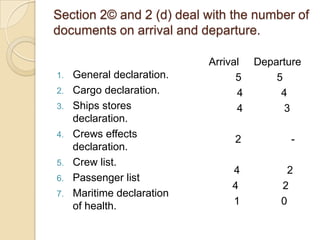
Section 2© and 2 (d) deal with the number of
documents on arrival and departure.

General declaration.
2. Cargo declaration.
3. Ships stores
declaration.
4. Crews effects
declaration.
5. Crew list.
6. Passenger list
7. Maritime declaration
of health.
1.

Arrival
5
4
4

Departure
5
4
3

2

-

4
4
1

2
2
0


Section 2E



It deals with the measures to facilitate clearance of
cargo, passengers, crew, and baggage.




Section 2F
It suggests that if the ports of calls are two or more
in the same state, formalities at the second port
should be kept minimum.
ARRIVAL AND DEPARTURE OF
PERSONS(SECTION 3)








The passport should be taken as the valid document
relating to individuals.
The same should be check once on arrival and once
on departure and handed back immediately after
examination.
The section also provides in details, of information
which the public authorities can at best require in the
embarkation and disembarkation of card.
In case where evidence of protection against cholera,
yellow fever or small pox is required from persons on
board of ship, public authority shall accept the
international certificate of vaccination or revaccination in the forms provided for in the
international sanitary regulations.
PUBLIC HEALTH AND QUARANTINE
INCLUDING SANITARY MEASURES FOR
ANIMALS AND PETS. (Section 4)
Few of the recommended practices includes
a) Simple documents to be widely published,
required in shipments of certain animals, plants
or product thereof.
b) Whenever practicable, pratique should be
granted by radio.
c) As far as possible, health authority should join a
ship prior to entry of ship into port.
d) Public authority should maintain at as many as
ports as possible facilities for administration of
public health, animal and agriculture quarantine
measures.

MISCELLANEOUS PROVISIONS
(Section 5)
Provisions in the section cover the security
and services at ports.
 It also covers the aspects with regard to
facilitation of maritime traffic when cargo is
not discharged at the intended destination.

Section 5(e) deals with the limitation of ship
owners responsibilities. Some of these are:
I. A single comprehensive bond
recommended for security for immigration,
customs, public health, agricultural
quarantine or similar laws.
II. There should be no detection to ships for
errors in documents, which are
inadvertent and the ship should be allow
for sail after correction.
III. Services outside service hours should not
exceed actual cost.


Facilitation Convention of Maritime Traffic

  • 1.
  • 2.
    Intro.  The CONVENTIONON FACILITATION OF INTERNATIONAL MARITIME TRAFFIC was held under the ages of IMO and was framed on the 9th April 1965.
  • 3.
    Objectives  To facilities maritimetraffic by simplifying and reducing to minimum the formalities, documentary requirement and procedures on arrival, stay and departure of ships engaged in international voyages.  The Governments undertake measures to ease international maritime traffic and to prevent unnecessary delays.
  • 4.
    APPLICATIONS  The convention appliesto coastal and non coastal states.  Do not apply to warships and pleasure yachts.  Nothing in the convention should be interpreted as conflicting with Government’s national laws or the provision of any other international agreement.  Nothing in the convention should be interpreted as precluding a contracting government from applying temporary measures considered by that government to be necessary to preserve public morality, order security or to prevent the introduction or spread of diseases or pests affecting public health, animals or
  • 5.
     The contents ofthe convention are in the form of: 1.Standards  It measure the uniform application of which is necessary and practicable. 2. Recommended  Measures the application of which is desirable in order to facilitate maritime traffic. Annex B of the convention is divided into 5 sections
  • 6.
    SECTION 1   Deals withdefinitions-cargo, crew’s effects, crew members, public authorities, ship-owners, ships equipment, ship’s spare parts, ship’s stores and time of arrival. Forms the ‘General Provisions'. For instance, the standard is that the public authorities should call only for essential information and the recommended practice is that two or more documents should be combined into one, when an appreciable degree of facilitation would result.
  • 7.
    SECTION 2: ARRIVAL,STAY AND DEPARTURE OF THE SHIP   1. 2. 3. 4. 5. 6. 7. 8. The sections deals with the formalities required form shipowners by the public authorities on the arrival, stay and departure of the ship. The standard is that the authorities should only call for the following documents: General declaration. Cargo declaration. Ships stores declaration. Crews effects declaration. Crew list. Passenger list. The documents required under the universal postal convention for mail. Maritime declaration of health.
  • 8.
    Section 2© and2 (d) deal with the number of documents on arrival and departure. General declaration. 2. Cargo declaration. 3. Ships stores declaration. 4. Crews effects declaration. 5. Crew list. 6. Passenger list 7. Maritime declaration of health. 1. Arrival 5 4 4 Departure 5 4 3 2 - 4 4 1 2 2 0
  • 9.
     Section 2E  It dealswith the measures to facilitate clearance of cargo, passengers, crew, and baggage.   Section 2F It suggests that if the ports of calls are two or more in the same state, formalities at the second port should be kept minimum.
  • 10.
    ARRIVAL AND DEPARTUREOF PERSONS(SECTION 3)     The passport should be taken as the valid document relating to individuals. The same should be check once on arrival and once on departure and handed back immediately after examination. The section also provides in details, of information which the public authorities can at best require in the embarkation and disembarkation of card. In case where evidence of protection against cholera, yellow fever or small pox is required from persons on board of ship, public authority shall accept the international certificate of vaccination or revaccination in the forms provided for in the international sanitary regulations.
  • 11.
    PUBLIC HEALTH ANDQUARANTINE INCLUDING SANITARY MEASURES FOR ANIMALS AND PETS. (Section 4) Few of the recommended practices includes a) Simple documents to be widely published, required in shipments of certain animals, plants or product thereof. b) Whenever practicable, pratique should be granted by radio. c) As far as possible, health authority should join a ship prior to entry of ship into port. d) Public authority should maintain at as many as ports as possible facilities for administration of public health, animal and agriculture quarantine measures. 
  • 12.
    MISCELLANEOUS PROVISIONS (Section 5) Provisionsin the section cover the security and services at ports.  It also covers the aspects with regard to facilitation of maritime traffic when cargo is not discharged at the intended destination. 
  • 13.
    Section 5(e) dealswith the limitation of ship owners responsibilities. Some of these are: I. A single comprehensive bond recommended for security for immigration, customs, public health, agricultural quarantine or similar laws. II. There should be no detection to ships for errors in documents, which are inadvertent and the ship should be allow for sail after correction. III. Services outside service hours should not exceed actual cost. 