LT JAY TARRIELA PCG
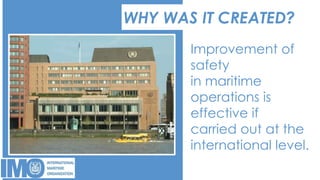
WHY WAS IT CREATED?
Improvement of
safety
in maritime
operations is
effective if
carried out at the
international level.
BRIEF HISTORY
Mid-19th century onwards
1912, Titanic, (SOLAS
Convention)
1948, International conference
in Geneva, formally establishing
Inter-governmental Maritime
Consultative Organization
1958, IMO Convention
was entered into force
1982, renamed as IMO
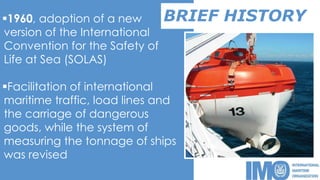
BRIEF HISTORY1960, adoption of a new
version of the International
Convention for the Safety of
Life at Sea (SOLAS)
Facilitation of international
maritime traffic, load lines and
the carriage of dangerous
goods, while the system of
measuring the tonnage of ships
was revised
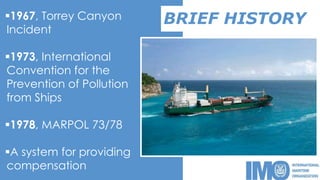
BRIEF HISTORY1967, Torrey Canyon
Incident
1973, International
Convention for the
Prevention of Pollution
from Ships
1978, MARPOL 73/78
A system for providing
compensation
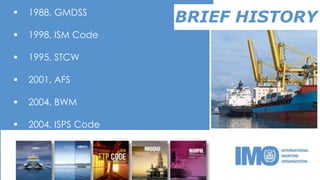
BRIEF HISTORY 1988, GMDSS
 1998, ISM Code
 1995, STCW
 2001, AFS
 2004, BWM
 2004, ISPS Code
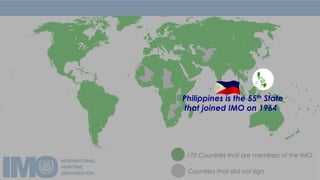
170 Countries that are members of the IMO
Countries that did not sign
Philippines is the 55th State
that joined IMO on 1964
MEMBERSHIPMember States
-170 Member States and
3 Associate Members
Non-Governmental Organizations
-77 NGO’s in consultative status
-have the capability to make a substantial
contribution
Intergovernmental organizations
-63 intergovernmental organizations
which have signed agreements of co-
operation with IMO
COMPOSITIONAssembly
Council
Maritime Safety Committee
Marine Environment Protection Committee
Legal Committee
Technical Co-operation Committee
Facilitation Committee
ASSEMBLYHighest Governing Body
170 Member States
Meets once every two years in regular
session
Approves the work programme
Votes the budget
Determines the financial arrangements
Elects the members of the Council
COUNCILElected by the Assembly for
two-year term
Composed of 40 member states
Supervises the Organization and
performs all the functions of the Assembly
Appoints the Secretary-General
Enters into agreements or arrangements
concerning the relationship of the
Organization with other organizations,
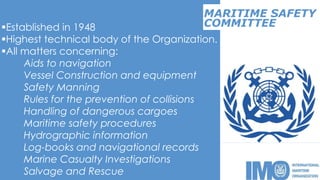
MARITIME SAFETY
Established in 1948
Highest technical body of the Organization.
All matters concerning:
Aids to navigation
Vessel Construction and equipment
Safety Manning
Rules for the prevention of collisions
Handling of dangerous cargoes
Maritime safety procedures
Hydrographic information
Log-books and navigational records
Marine Casualty Investigations
Salvage and Rescue
COMMITTEE
MAR ENV PROTCTN
Any matter within the scope of the
Organization concerned with prevention
and control of pollution from ships
In particular it is concerned with the
adoption and amendment of
conventions and other regulations and
measures to ensure their enforcement.
first established as a subsidiary body of
the Assembly in 1978 and raised to full
constitutional status in 1985
COMMITTEE
Any legal matters within the scope of
the Organization
It was established in 1967 as a
subsidiary body to deal with legal
questions which arose in the
aftermath of the Torrey
Canyon disaster.
LEGAL
COMMITTEE
Acts as the executing or co-
operating agency and any other
matters related to the Organization’s
activities in the technical co-
operation field.
Was established in 1969 as a
subsidiary body of the Council, and
was institutionalized in 1984.
TECH. CO-OPERATION
COMMITTEE
Relates to the facilitation of
international maritime traffic
These are aimed at reducing the
formalities and simplifying the
documentation required of ships
when entering or leaving ports or
other terminals.
FACILITATION
COMMITTEE
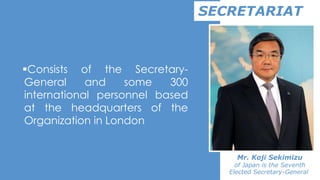
Consists of the Secretary-
General and some 300
international personnel based
at the headquarters of the
Organization in London
SECRETARIAT
Mr. Koji Sekimizu
of Japan is the Seventh
Elected Secretary-General
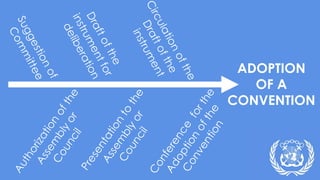
ADOPTION
OF A
CONVENTION
ENTRY INTO FORCE
Each convention includes appropriate provisions
stipulating conditions which have to be met before it
enters into force.
Example:
International Convention for the Safety of Life at Sea, 1974
-Requires acceptance by 25 States whose merchant fleets
comprise not less than 50 percent of the world's gross tonnage
Convention Relating to Civil Liability in the Field of Maritime
Carriage of Nuclear Material, 1971,
-came into force 90 days after being accepted by five States
Signature
-treaty provides that signature shall have that effect
-it is otherwise established that the negotiating
States were agreed that signature should have that
effect
-the intention of the State to give that effect to
signature appears from the full powers of its
representatives or was expressed during the negotiations
SIGNATURE, RATIFICATION, ACCEPTANCE,
APPROVAL AND ACCESSION
Signature Subject to Ratification, Acceptance or
Approval
-signature does not signify the consent of a State to
be bound by the treaty, although it obliges the State to
refrain from acts which would defeat the purpose of the
treaty
SIGNATURE, RATIFICATION, ACCEPTANCE,
APPROVAL AND ACCESSION
ACCESSION
-signature does not signify the consent of a State to
be bound by the treaty, although it obliges the State to
refrain from acts which would defeat the purpose of the
treaty
SIGNATURE, RATIFICATION, ACCEPTANCE,
APPROVAL AND ACCESSION
AMENDMENT
In early conventions, amendments came into force only
after a percentage of Contracting States, usually two
thirds
the “tacit acceptance” procedure provides that an
amendment shall enter into force at a particular time
unless before that date, objections to the amendment are
received from a specified number of Parties.
THANK YOU!

International Maritime Organization

  • 1.
  • 2.
    WHY WAS ITCREATED? Improvement of safety in maritime operations is effective if carried out at the international level.
  • 3.
    BRIEF HISTORY Mid-19th centuryonwards 1912, Titanic, (SOLAS Convention) 1948, International conference in Geneva, formally establishing Inter-governmental Maritime Consultative Organization 1958, IMO Convention was entered into force 1982, renamed as IMO
  • 4.
    BRIEF HISTORY1960, adoptionof a new version of the International Convention for the Safety of Life at Sea (SOLAS) Facilitation of international maritime traffic, load lines and the carriage of dangerous goods, while the system of measuring the tonnage of ships was revised
  • 5.
    BRIEF HISTORY1967, TorreyCanyon Incident 1973, International Convention for the Prevention of Pollution from Ships 1978, MARPOL 73/78 A system for providing compensation
  • 6.
    BRIEF HISTORY 1988,GMDSS  1998, ISM Code  1995, STCW  2001, AFS  2004, BWM  2004, ISPS Code
  • 7.
    170 Countries thatare members of the IMO Countries that did not sign Philippines is the 55th State that joined IMO on 1964
  • 8.
    MEMBERSHIPMember States -170 MemberStates and 3 Associate Members Non-Governmental Organizations -77 NGO’s in consultative status -have the capability to make a substantial contribution Intergovernmental organizations -63 intergovernmental organizations which have signed agreements of co- operation with IMO
  • 9.
    COMPOSITIONAssembly Council Maritime Safety Committee MarineEnvironment Protection Committee Legal Committee Technical Co-operation Committee Facilitation Committee
  • 10.
    ASSEMBLYHighest Governing Body 170Member States Meets once every two years in regular session Approves the work programme Votes the budget Determines the financial arrangements Elects the members of the Council
  • 11.
    COUNCILElected by theAssembly for two-year term Composed of 40 member states Supervises the Organization and performs all the functions of the Assembly Appoints the Secretary-General Enters into agreements or arrangements concerning the relationship of the Organization with other organizations,
  • 12.
    MARITIME SAFETY Established in1948 Highest technical body of the Organization. All matters concerning: Aids to navigation Vessel Construction and equipment Safety Manning Rules for the prevention of collisions Handling of dangerous cargoes Maritime safety procedures Hydrographic information Log-books and navigational records Marine Casualty Investigations Salvage and Rescue COMMITTEE
  • 13.
    MAR ENV PROTCTN Anymatter within the scope of the Organization concerned with prevention and control of pollution from ships In particular it is concerned with the adoption and amendment of conventions and other regulations and measures to ensure their enforcement. first established as a subsidiary body of the Assembly in 1978 and raised to full constitutional status in 1985 COMMITTEE
  • 14.
    Any legal matterswithin the scope of the Organization It was established in 1967 as a subsidiary body to deal with legal questions which arose in the aftermath of the Torrey Canyon disaster. LEGAL COMMITTEE
  • 15.
    Acts as theexecuting or co- operating agency and any other matters related to the Organization’s activities in the technical co- operation field. Was established in 1969 as a subsidiary body of the Council, and was institutionalized in 1984. TECH. CO-OPERATION COMMITTEE
  • 16.
    Relates to thefacilitation of international maritime traffic These are aimed at reducing the formalities and simplifying the documentation required of ships when entering or leaving ports or other terminals. FACILITATION COMMITTEE
  • 17.
    Consists of theSecretary- General and some 300 international personnel based at the headquarters of the Organization in London SECRETARIAT Mr. Koji Sekimizu of Japan is the Seventh Elected Secretary-General
  • 18.
  • 19.
    ENTRY INTO FORCE Eachconvention includes appropriate provisions stipulating conditions which have to be met before it enters into force. Example: International Convention for the Safety of Life at Sea, 1974 -Requires acceptance by 25 States whose merchant fleets comprise not less than 50 percent of the world's gross tonnage Convention Relating to Civil Liability in the Field of Maritime Carriage of Nuclear Material, 1971, -came into force 90 days after being accepted by five States
  • 20.
    Signature -treaty provides thatsignature shall have that effect -it is otherwise established that the negotiating States were agreed that signature should have that effect -the intention of the State to give that effect to signature appears from the full powers of its representatives or was expressed during the negotiations SIGNATURE, RATIFICATION, ACCEPTANCE, APPROVAL AND ACCESSION
  • 21.
    Signature Subject toRatification, Acceptance or Approval -signature does not signify the consent of a State to be bound by the treaty, although it obliges the State to refrain from acts which would defeat the purpose of the treaty SIGNATURE, RATIFICATION, ACCEPTANCE, APPROVAL AND ACCESSION
  • 22.
    ACCESSION -signature does notsignify the consent of a State to be bound by the treaty, although it obliges the State to refrain from acts which would defeat the purpose of the treaty SIGNATURE, RATIFICATION, ACCEPTANCE, APPROVAL AND ACCESSION
  • 23.
    AMENDMENT In early conventions,amendments came into force only after a percentage of Contracting States, usually two thirds the “tacit acceptance” procedure provides that an amendment shall enter into force at a particular time unless before that date, objections to the amendment are received from a specified number of Parties.
  • 24.