INTERNATIONAL MARITIME
CONVENTIONS
INTRODUCTION
The industrial revolution of the
eighteenth and nineteenth centuries
and the upsurge in international
commerce which followed resulted in
the adoption of a number of
international treaties related to
shipping, including safety. The
subjects covered included tonnage
measurement, the prevention of
collisions, signalling and others.
INTRODUCTION
By the end of the nineteenth century
suggestions had even been made for
the creation of a permanent
international maritime body to deal with
these and future measures. The plan
was not put into effect, but
international co-operation continued in
the twentieth century, with the adoption
of still more internationally developed
treaties.
INTRODUCTION
By the time IMO came into existence in
1958, several important international
conventions had already been
developed, including the International
Convention for the Safety of Life at Sea
of 1948, the International Convention
for the Prevention of Pollution of the
Sea by Oil of 1954 and treaties dealing
with load lines and the prevention of
collisions at sea.
INTRODUCTION
IMO was made responsible for ensuring
that the majority of these conventions
were kept up to date. It was also given
the task of developing new
conventions as and when the need
arose.
INTRODUCTION
The creation of IMO coincided with a
period of tremendous change in world
shipping and the Organization was kept
busy from the start developing new
conventions and ensuring that existing
instruments kept pace with changes in
shipping technology. It is now
responsible for more than 40
international conventions and
agreements and has adopted numerous
protocols and amendments.
LIST OF IMO CONVENTIONS
A. Maritime safety
1.International Convention for the Safety
of Life at Sea (SOLAS), 1974
2.International Convention on Load Lines
(LL), 1966
3.International Convention for Safe
Containers (CSC), 1972
LIST OF IMO CONVENTIONS
4.Convention on the International
Regulations for Preventing Collisions
at Sea (COLREG), 1972
5.Convention on the International
Maritime Satellite Organization
(INMARSAT), 1976
6.The Torremolinos International
Convention for the Safety of Fishing
Vessels (SFV), 1977
LIST OF IMO CONVENTIONS
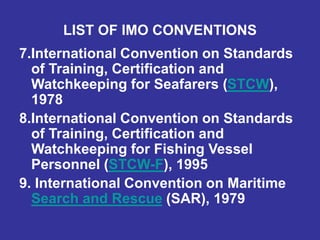
7.International Convention on Standards
of Training, Certification and
Watchkeeping for Seafarers (STCW),
1978
8.International Convention on Standards
of Training, Certification and
Watchkeeping for Fishing Vessel
Personnel (STCW-F), 1995
9. International Convention on Maritime
Search and Rescue (SAR), 1979
LIST OF IMO CONVENTIONS
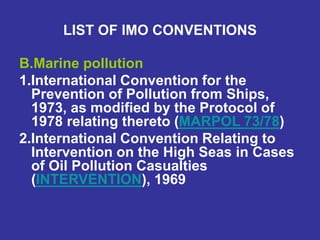
B.Marine pollution
1.International Convention for the
Prevention of Pollution from Ships,
1973, as modified by the Protocol of
1978 relating thereto (MARPOL 73/78)
2.International Convention Relating to
Intervention on the High Seas in Cases
of Oil Pollution Casualties
(INTERVENTION), 1969
LIST OF IMO CONVENTIONS
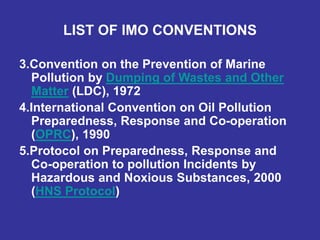
3.Convention on the Prevention of Marine
Pollution by Dumping of Wastes and Other
Matter (LDC), 1972
4.International Convention on Oil Pollution
Preparedness, Response and Co-operation
(OPRC), 1990
5.Protocol on Preparedness, Response and
Co-operation to pollution Incidents by
Hazardous and Noxious Substances, 2000
(HNS Protocol)
LIST OF IMO CONVENTIONS
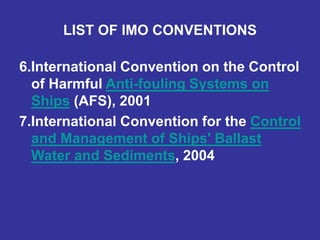
6.International Convention on the Control
of Harmful Anti-fouling Systems on
Ships (AFS), 2001
7.International Convention for the Control
and Management of Ships' Ballast
Water and Sediments, 2004
LIST OF IMO CONVENTIONS
C.Liability and compensation
1.International Convention on Civil
Liability for Oil Pollution Damage
(CLC), 1969
2.International Convention on the
Establishment of an International Fund
for Compensation for Oil Pollution
Damage (FUND), 1971
LIST OF IMO CONVENTIONS
3.Convention relating to Civil Liability in
the Field of Maritime Carriage of
Nuclear Material (NUCLEAR), 1971
4.Athens Convention relating to the
Carriage of Passengers and their
Luggage by Sea (PAL), 1974
5.Convention on Limitation of Liability for
Maritime Claims (LLMC), 1976
LIST OF IMO CONVENTIONS
6.International Convention on Liability
and Compensation for Damage in
Connection with the Carriage of
Hazardous and Noxious Substances by
Sea (HNS), 1996
7.International Convention on Civil
Liability for Bunker Oil Pollution
Damage, 2001
LIST OF IMO CONVENTIONS
D. Other subjects
1.Convention on Facilitation of
International Maritime Traffic (FAL),
1965
2.International Convention on Tonnage
Measurement of Ships (TONNAGE),
1969
3.Convention for the Suppression of
Unlawful Acts Against the Safety of
Maritime Navigation (SUA), 1988
4.International Convention on Salvage
(SALVAGE), 1989
INTERNATIONAL CONVENTION FOR THE
SAFETY OF LIFE AT SEA
Adoptation : 1 November 1974
Entry into force : 25 May 1980
Parts of Convention:
Introduction and history
Amendment Procedure
Technical Provision
Chapter One- General Provisions
INTERNATIONAL CONVENTION FOR THE
SAFETY OF LIFE AT SEA
• Chapter II-1-Construction-subdivision
and stability, machinery and electrical
installation.
• Chapter II-2 Fire protection, fire
detection and fire extinction.
• Chapter III- Life saving appliances and
arrangements.
• Chapter IV- Radio communication.
INTERNATIONAL CONVENTION FOR THE
SAFETY OF LIFE AT SEA
• Chapter V- Safety of navigation.
• Chapter VI- Carriage of cargoes.
• Chapter VII- Carriage of dangerous
goods.
• Chapter VIII- Nuclear ships.
• Chapter IX- Management for the safe
operation of ships.
• Chapter X-Safety measures for high
speed craft
INTERNATIONAL CONVENTION FOR THE
SAFETY OF LIFE AT SEA
• Chapter XI-1- Special measures to
enhance maritime safety.
• Chapter XI-2-Special measures to
enhance maritime security.
• Chapter XII- Additional safety measures
for bulk carriers.
INTERNATIONAL CONVENTION FOR THE
PREVENTION OF POLLUTION FROM THE
SHIPS,1973, AS MODIFIED BY THE
PROTOCOL OF 1978 RELATING
THERETO (MARPOL 73/78)
MARPOL 73/78
• Annex I- Prevention of pollution by oil.
• Annex II-Control of pollution by noxious
liquid substances.
• Annex III-Prevention of pollution by harmfull
substances in packaged form.
• Annex IV- Prevention of pollution by sewage
from ships.
• Annex V-Prevention pollution by garbage
from ship.
• Annex VI-Prevention of air pollution from
ships.
International Convention on Standards of
Training, Certification and Watchkeeping
for Seafarers, 1978
• Adoption : 7 July 1978
• Entry into force: 28 April 1984
• The 1995 amendments, which completely
revised the Convention, entered into force
on 1 February 1997
STCW 1995 AMENDMENTS
• The 1995 amendments, adopted by a
Conference, represented a major
revision of the Convention, in response
to a recognized need to bring the
Convention up to date and to respond
to critics who pointed out the many
vague phrases, such as "to the
satisfaction of the Administration",
which resulted in different
interpretations being made.
STCW 1995 AMENDMENTS
• One of the major features of the revision was
the division of the technical annex into
regulations, divided into Chapters as before,
and a new STCW Code, to which many
technical regulations have been transferred.
Part A of the Code is mandatory while Part B
is recommended.
STCW 1995 AMENDMENTS
• Chapter I- General Provisions.
• Chapter II-Master and deck department
• Chapter III-Engine department
• Chapter IV- Radiocommunication and
radio personnel.
• Chapter V- Special training
requirements for personnel on certain
types of ships.
STCW 1995 AMENDMENTS
Chapter VI- Emergency, occupational
safety, medical care and survival
functions.
Chapter VII-Alternative certification
Chapter VIII: Watchkeeping
STCW 1995 AMENDMENTS
• The STCW Code
The regulations contained in the
Convention are supported by sections
in the STCW Code. Generally speaking,
the Convention contains basic
requirements which are then enlarged
upon and explained in the Code.
STCW 1995 AMENDMENTS
• Part A of the Code is mandatory. The
minimum standards of competence
required for seagoing personnel are
given in detail in a series of tables.
Chapter II of the Code, for example,
deals with standards regarding the
master and deck department.
STCW 1995 AMENDMENTS
• Part B of the Code contains recommended
guidance which is intended to help Parties
implement the Convention. The measures
suggested are not mandatory and the
examples given are only intended to
illustrate how certain Convention
requirements may be complied with.
However, the recommendations in general
represent an approach that has been
harmonized by discussions within IMO and
consultation with other international
organizations.

INTERNATIONAL MARITIME CONVENTIONS.ppt

  • 1.
  • 2.
    INTRODUCTION The industrial revolutionof the eighteenth and nineteenth centuries and the upsurge in international commerce which followed resulted in the adoption of a number of international treaties related to shipping, including safety. The subjects covered included tonnage measurement, the prevention of collisions, signalling and others.
  • 3.
    INTRODUCTION By the endof the nineteenth century suggestions had even been made for the creation of a permanent international maritime body to deal with these and future measures. The plan was not put into effect, but international co-operation continued in the twentieth century, with the adoption of still more internationally developed treaties.
  • 4.
    INTRODUCTION By the timeIMO came into existence in 1958, several important international conventions had already been developed, including the International Convention for the Safety of Life at Sea of 1948, the International Convention for the Prevention of Pollution of the Sea by Oil of 1954 and treaties dealing with load lines and the prevention of collisions at sea.
  • 5.
    INTRODUCTION IMO was maderesponsible for ensuring that the majority of these conventions were kept up to date. It was also given the task of developing new conventions as and when the need arose.
  • 6.
    INTRODUCTION The creation ofIMO coincided with a period of tremendous change in world shipping and the Organization was kept busy from the start developing new conventions and ensuring that existing instruments kept pace with changes in shipping technology. It is now responsible for more than 40 international conventions and agreements and has adopted numerous protocols and amendments.
  • 7.
    LIST OF IMOCONVENTIONS A. Maritime safety 1.International Convention for the Safety of Life at Sea (SOLAS), 1974 2.International Convention on Load Lines (LL), 1966 3.International Convention for Safe Containers (CSC), 1972
  • 8.
    LIST OF IMOCONVENTIONS 4.Convention on the International Regulations for Preventing Collisions at Sea (COLREG), 1972 5.Convention on the International Maritime Satellite Organization (INMARSAT), 1976 6.The Torremolinos International Convention for the Safety of Fishing Vessels (SFV), 1977
  • 9.
    LIST OF IMOCONVENTIONS 7.International Convention on Standards of Training, Certification and Watchkeeping for Seafarers (STCW), 1978 8.International Convention on Standards of Training, Certification and Watchkeeping for Fishing Vessel Personnel (STCW-F), 1995 9. International Convention on Maritime Search and Rescue (SAR), 1979
  • 10.
    LIST OF IMOCONVENTIONS B.Marine pollution 1.International Convention for the Prevention of Pollution from Ships, 1973, as modified by the Protocol of 1978 relating thereto (MARPOL 73/78) 2.International Convention Relating to Intervention on the High Seas in Cases of Oil Pollution Casualties (INTERVENTION), 1969
  • 11.
    LIST OF IMOCONVENTIONS 3.Convention on the Prevention of Marine Pollution by Dumping of Wastes and Other Matter (LDC), 1972 4.International Convention on Oil Pollution Preparedness, Response and Co-operation (OPRC), 1990 5.Protocol on Preparedness, Response and Co-operation to pollution Incidents by Hazardous and Noxious Substances, 2000 (HNS Protocol)
  • 12.
    LIST OF IMOCONVENTIONS 6.International Convention on the Control of Harmful Anti-fouling Systems on Ships (AFS), 2001 7.International Convention for the Control and Management of Ships' Ballast Water and Sediments, 2004
  • 13.
    LIST OF IMOCONVENTIONS C.Liability and compensation 1.International Convention on Civil Liability for Oil Pollution Damage (CLC), 1969 2.International Convention on the Establishment of an International Fund for Compensation for Oil Pollution Damage (FUND), 1971
  • 14.
    LIST OF IMOCONVENTIONS 3.Convention relating to Civil Liability in the Field of Maritime Carriage of Nuclear Material (NUCLEAR), 1971 4.Athens Convention relating to the Carriage of Passengers and their Luggage by Sea (PAL), 1974 5.Convention on Limitation of Liability for Maritime Claims (LLMC), 1976
  • 15.
    LIST OF IMOCONVENTIONS 6.International Convention on Liability and Compensation for Damage in Connection with the Carriage of Hazardous and Noxious Substances by Sea (HNS), 1996 7.International Convention on Civil Liability for Bunker Oil Pollution Damage, 2001
  • 16.
    LIST OF IMOCONVENTIONS D. Other subjects 1.Convention on Facilitation of International Maritime Traffic (FAL), 1965 2.International Convention on Tonnage Measurement of Ships (TONNAGE), 1969 3.Convention for the Suppression of Unlawful Acts Against the Safety of Maritime Navigation (SUA), 1988 4.International Convention on Salvage (SALVAGE), 1989
  • 17.
    INTERNATIONAL CONVENTION FORTHE SAFETY OF LIFE AT SEA Adoptation : 1 November 1974 Entry into force : 25 May 1980 Parts of Convention: Introduction and history Amendment Procedure Technical Provision Chapter One- General Provisions
  • 18.
    INTERNATIONAL CONVENTION FORTHE SAFETY OF LIFE AT SEA • Chapter II-1-Construction-subdivision and stability, machinery and electrical installation. • Chapter II-2 Fire protection, fire detection and fire extinction. • Chapter III- Life saving appliances and arrangements. • Chapter IV- Radio communication.
  • 19.
    INTERNATIONAL CONVENTION FORTHE SAFETY OF LIFE AT SEA • Chapter V- Safety of navigation. • Chapter VI- Carriage of cargoes. • Chapter VII- Carriage of dangerous goods. • Chapter VIII- Nuclear ships. • Chapter IX- Management for the safe operation of ships. • Chapter X-Safety measures for high speed craft
  • 20.
    INTERNATIONAL CONVENTION FORTHE SAFETY OF LIFE AT SEA • Chapter XI-1- Special measures to enhance maritime safety. • Chapter XI-2-Special measures to enhance maritime security. • Chapter XII- Additional safety measures for bulk carriers.
  • 21.
    INTERNATIONAL CONVENTION FORTHE PREVENTION OF POLLUTION FROM THE SHIPS,1973, AS MODIFIED BY THE PROTOCOL OF 1978 RELATING THERETO (MARPOL 73/78)
  • 22.
    MARPOL 73/78 • AnnexI- Prevention of pollution by oil. • Annex II-Control of pollution by noxious liquid substances. • Annex III-Prevention of pollution by harmfull substances in packaged form. • Annex IV- Prevention of pollution by sewage from ships. • Annex V-Prevention pollution by garbage from ship. • Annex VI-Prevention of air pollution from ships.
  • 23.
    International Convention onStandards of Training, Certification and Watchkeeping for Seafarers, 1978 • Adoption : 7 July 1978 • Entry into force: 28 April 1984 • The 1995 amendments, which completely revised the Convention, entered into force on 1 February 1997
  • 24.
    STCW 1995 AMENDMENTS •The 1995 amendments, adopted by a Conference, represented a major revision of the Convention, in response to a recognized need to bring the Convention up to date and to respond to critics who pointed out the many vague phrases, such as "to the satisfaction of the Administration", which resulted in different interpretations being made.
  • 25.
    STCW 1995 AMENDMENTS •One of the major features of the revision was the division of the technical annex into regulations, divided into Chapters as before, and a new STCW Code, to which many technical regulations have been transferred. Part A of the Code is mandatory while Part B is recommended.
  • 26.
    STCW 1995 AMENDMENTS •Chapter I- General Provisions. • Chapter II-Master and deck department • Chapter III-Engine department • Chapter IV- Radiocommunication and radio personnel. • Chapter V- Special training requirements for personnel on certain types of ships.
  • 27.
    STCW 1995 AMENDMENTS ChapterVI- Emergency, occupational safety, medical care and survival functions. Chapter VII-Alternative certification Chapter VIII: Watchkeeping
  • 28.
    STCW 1995 AMENDMENTS •The STCW Code The regulations contained in the Convention are supported by sections in the STCW Code. Generally speaking, the Convention contains basic requirements which are then enlarged upon and explained in the Code.
  • 29.
    STCW 1995 AMENDMENTS •Part A of the Code is mandatory. The minimum standards of competence required for seagoing personnel are given in detail in a series of tables. Chapter II of the Code, for example, deals with standards regarding the master and deck department.
  • 30.
    STCW 1995 AMENDMENTS •Part B of the Code contains recommended guidance which is intended to help Parties implement the Convention. The measures suggested are not mandatory and the examples given are only intended to illustrate how certain Convention requirements may be complied with. However, the recommendations in general represent an approach that has been harmonized by discussions within IMO and consultation with other international organizations.