Facultad de Humanidades 
Escuela de Ciencias del Lenguaje 
Seminario de Lingüística Aplicada 
Language Pedagogy 
Prof. Carlos Mayora 
November 2014
Warm-up 
• List some of the activities that typically take 
place in a language class? 
• What are the stages in a class? 
• What is expected from students?
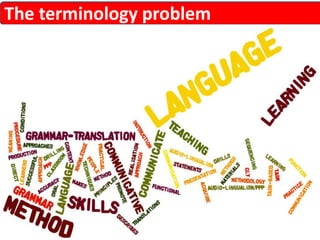
The terminology problem
Basic definitions 
• Method 
• Approach 
• Procedure 
• Technique 
• Task
Approach 
Theory of language and learning underlying a 
method. 
Richards and Rodgers, 2001 
Basic definitions
Approach 
“A set of assumptions dealing with the nature of 
language, learning and teaching.” 
H.D. Brown, 2002, p. 9 
Basic definitions
Approach 
“…is something that reflects a certain model of 
research paradigm-a theory, if you like.” 
Celce-Murcia, 2001, p. 5 
Basic definitions
Approach 
Preconceptions, assumptions and theoretical 
underpinnings teachers have that determine 
what they believe is important for learners to 
learn. 
J. Brown, 1995 
Basic definitions
Method 
“…an overall plan for systematic presentation of 
language based on a selected approach…” 
H.D. Brown, 2002, p. 9 
Basic definitions
Method 
“…a specific set of procedures more or less 
compatible with an approach…” 
Celce-Murcia, 2001, p. 9 
Basic definitions
Basic definitions 
Method 
“A method is theoretically related to an 
approach, is organizationally determined by a 
design, and practically realized in procedure.” 
Richards and Rodgers, 2001, p. 20
Basic definitions 
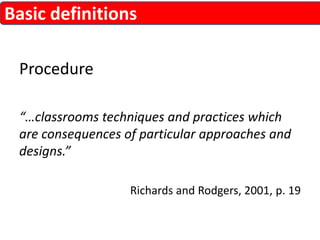
Procedure 
“…classrooms techniques and practices which 
are consequences of particular approaches and 
designs.” 
Richards and Rodgers, 2001, p. 19
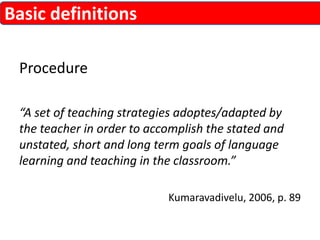
Procedure 
“A set of teaching strategies adoptes/adapted by 
the teacher in order to accomplish the stated and 
unstated, short and long term goals of language 
learning and teaching in the classroom.” 
Kumaravadivelu, 2006, p. 89 
Basic definitions
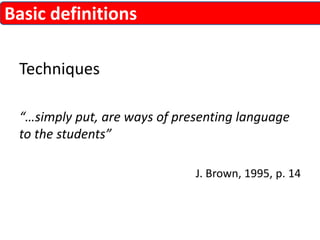
Techniques 
“…simply put, are ways of presenting language 
to the students” 
J. Brown, 1995, p. 14 
Basic definitions
Basic definitions 
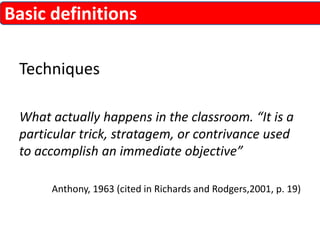
Techniques 
What actually happens in the classroom. “It is a 
particular trick, stratagem, or contrivance used 
to accomplish an immediate objective” 
Anthony, 1963 (cited in Richards and Rodgers,2001, p. 19)
Techniques 
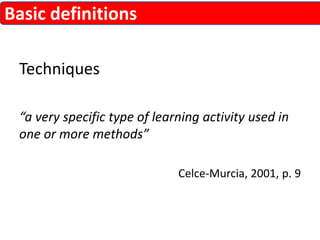
“a very specific type of learning activity used in 
one or more methods” 
Celce-Murcia, 2001, p. 9 
Basic definitions
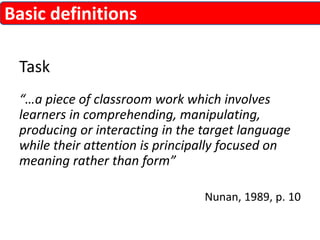
Task 
“…a piece of classroom work which involves 
learners in comprehending, manipulating, 
producing or interacting in the target language 
while their attention is principally focused on 
meaning rather than form” 
Nunan, 1989, p. 10 
Basic definitions
Basic definitions 
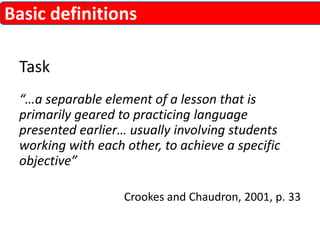
Task 
“…a separable element of a lesson that is 
primarily geared to practicing language 
presented earlier… usually involving students 
working with each other, to achieve a specific 
objective” 
Crookes and Chaudron, 2001, p. 33
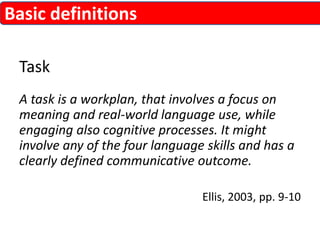
Task 
A task is a workplan, that involves a focus on 
meaning and real-world language use, while 
engaging also cognitive processes. It might 
involve any of the four language skills and has a 
clearly defined communicative outcome. 
Ellis, 2003, pp. 9-10 
Basic definitions
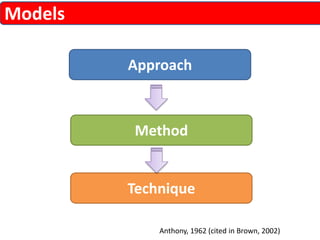
Models 
Approach 
Method 
Technique 
Anthony, 1962 (cited in Brown, 2002)
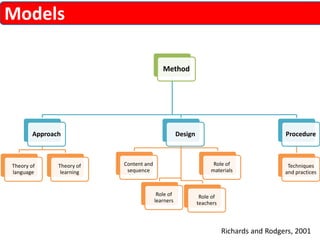
Models 
Method 
Approach 
Theory of 
language 
Theory of 
learning 
Design 
Content and 
sequence 
Role of 
learners 
Role of 
materials 
Role of 
teachers 
Procedure 
Techniques 
and practices 
Richards and Rodgers, 2001
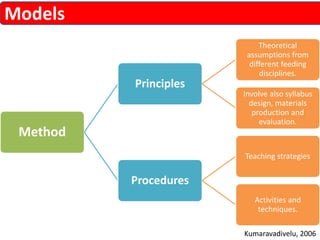
Models 
Method 
Principles 
Theoretical 
assumptions from 
different feeding 
disciplines. 
Involve also syllabus 
design, materials 
production and 
evaluation. 
Procedures 
Teaching strategies 
Activities and 
techniques. 
Kumaravadivelu, 2006
“Both Anthony and Richard and Rodgers’ articles 
created categories that were sequential and 
perhaps static steps in the logical development of 
sound teaching […] The experiences of many 
language teachers are less sequential […] all the 
elements of the teaching and learning process 
might seem to be happening simultaneously, with 
each component interacting with all the others.” 
J. Brown, 1995, p.p. 3-4 
Criticism to models
“The division of labor among the three groups of 
people involved in language learning and 
teaching operations […] is acceptable to some 
extend in a traditional educational system in 
which a centrally planned educational agenda 
was handed down to the teacher. It is inadequate 
in the current pedagogic environment in which 
the teacher is increasingly playing, at the local 
level, multiple roles…” 
Kumaravadivelu, 2006, p.88 
Criticism to models
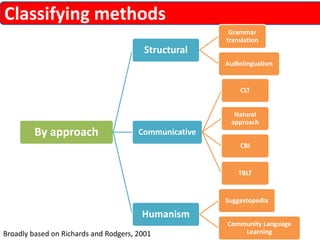
Classifying methods 
By approach 
Structural 
Grammar 
translation 
Audiolingualism 
Communicative 
CLT 
Natural 
approach 
CBI 
TBLT 
Humanism 
Suggestopedia 
Community Language 
Broadly based on Richards and Rodgers, 2001 Learning
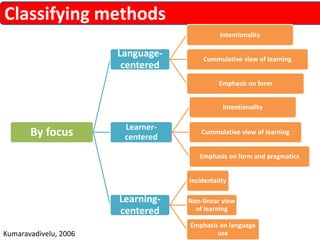
Classifying methods 
By focus 
Language-centered 
Intentionality 
Cummulative view of learning 
Emphasis on form 
Learner-centered 
Intentionality 
Cummulative view of learning 
Emphasis on form and pragmatics 
Learning-centered 
Incidentality 
Non-linear view 
of learning 
Emphasis on language 
Kumaravadivelu, 2006 use
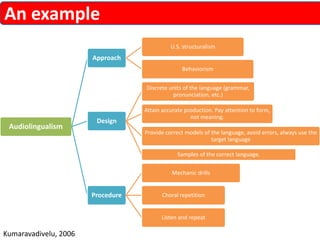
An example 
Audiolingualism 
Kumaravadivelu, 2006 
Approach 
U.S. structuralism 
Behaviorism 
Design 
Discrete units of the language (grammar, 
pronunciation, etc.) 
Attain accurate production. Pay attention to form, 
not meaning. 
Provide correct models of the language, avoid errors, always use the 
target language 
Samples of the correct language. 
Procedure 
Mechanic drills 
Choral repetition 
Listen and repeat
References 
• Brown, H.D. (2002). English language teaching in the “post-method” era: 
Towards better diagnosis, treatment and assessment. . In Richards, J.C. y W.A. 
Renandya (Eds.) Methodology in language teaching. An anthology of current 
practice (pp. 9-18). Cambridge: Cambridge University Press. 
• Brown, J.D. (1995). The elements of Language Curriculum: A Systematic 
Approach to Program Development. Heinle & Heinle Publishers. 
• Celce-Murcia, M. (2001). Language teaching approaches: An overview. In 
Celce-Murcia, M. (Ed.) Teaching English as a second or foreign language (3rd 
ed., pp. 3-11). Boston, MA: Heinle & Heinle. 
• Crookes, G. and Chaudron, C. (2001). Guidelines for language classroom 
instruction. In Celce-Murcia, M. (Ed.) Teaching English as a second or foreign 
language (3rd ed., pp. 29-42). Boston, MA: Heinle & Heinle.
References 
• Ellis, R. (2003). Task-based language learning and 
teaching. Oxford: Oxford University Press. 
• Nunan, D. (1989). Designing tasks for the communicative 
classroom. Cambridge: Cambridge University Press. 
• Kumaravadivelu, B. (2006) Understanding language 
teaching. From method to postmethod. London: 
Lawrence Earlbaum Associates Inc. 
• Richards, J.C. and Rodgers, T. (2001). Approaches and 
methods in language teaching (2nd edition). Cambridge: 
Cambridge University Press.

Language pedagogy

  • 1.
    Facultad de Humanidades Escuela de Ciencias del Lenguaje Seminario de Lingüística Aplicada Language Pedagogy Prof. Carlos Mayora November 2014
  • 2.
    Warm-up • Listsome of the activities that typically take place in a language class? • What are the stages in a class? • What is expected from students?
  • 3.
  • 4.
    Basic definitions •Method • Approach • Procedure • Technique • Task
  • 5.
    Approach Theory oflanguage and learning underlying a method. Richards and Rodgers, 2001 Basic definitions
  • 6.
    Approach “A setof assumptions dealing with the nature of language, learning and teaching.” H.D. Brown, 2002, p. 9 Basic definitions
  • 7.
    Approach “…is somethingthat reflects a certain model of research paradigm-a theory, if you like.” Celce-Murcia, 2001, p. 5 Basic definitions
  • 8.
    Approach Preconceptions, assumptionsand theoretical underpinnings teachers have that determine what they believe is important for learners to learn. J. Brown, 1995 Basic definitions
  • 9.
    Method “…an overallplan for systematic presentation of language based on a selected approach…” H.D. Brown, 2002, p. 9 Basic definitions
  • 10.
    Method “…a specificset of procedures more or less compatible with an approach…” Celce-Murcia, 2001, p. 9 Basic definitions
  • 11.
    Basic definitions Method “A method is theoretically related to an approach, is organizationally determined by a design, and practically realized in procedure.” Richards and Rodgers, 2001, p. 20
  • 12.
    Basic definitions Procedure “…classrooms techniques and practices which are consequences of particular approaches and designs.” Richards and Rodgers, 2001, p. 19
  • 13.
    Procedure “A setof teaching strategies adoptes/adapted by the teacher in order to accomplish the stated and unstated, short and long term goals of language learning and teaching in the classroom.” Kumaravadivelu, 2006, p. 89 Basic definitions
  • 14.
    Techniques “…simply put,are ways of presenting language to the students” J. Brown, 1995, p. 14 Basic definitions
  • 15.
    Basic definitions Techniques What actually happens in the classroom. “It is a particular trick, stratagem, or contrivance used to accomplish an immediate objective” Anthony, 1963 (cited in Richards and Rodgers,2001, p. 19)
  • 16.
    Techniques “a veryspecific type of learning activity used in one or more methods” Celce-Murcia, 2001, p. 9 Basic definitions
  • 17.
    Task “…a pieceof classroom work which involves learners in comprehending, manipulating, producing or interacting in the target language while their attention is principally focused on meaning rather than form” Nunan, 1989, p. 10 Basic definitions
  • 18.
    Basic definitions Task “…a separable element of a lesson that is primarily geared to practicing language presented earlier… usually involving students working with each other, to achieve a specific objective” Crookes and Chaudron, 2001, p. 33
  • 19.
    Task A taskis a workplan, that involves a focus on meaning and real-world language use, while engaging also cognitive processes. It might involve any of the four language skills and has a clearly defined communicative outcome. Ellis, 2003, pp. 9-10 Basic definitions
  • 20.
    Models Approach Method Technique Anthony, 1962 (cited in Brown, 2002)
  • 21.
    Models Method Approach Theory of language Theory of learning Design Content and sequence Role of learners Role of materials Role of teachers Procedure Techniques and practices Richards and Rodgers, 2001
  • 22.
    Models Method Principles Theoretical assumptions from different feeding disciplines. Involve also syllabus design, materials production and evaluation. Procedures Teaching strategies Activities and techniques. Kumaravadivelu, 2006
  • 23.
    “Both Anthony andRichard and Rodgers’ articles created categories that were sequential and perhaps static steps in the logical development of sound teaching […] The experiences of many language teachers are less sequential […] all the elements of the teaching and learning process might seem to be happening simultaneously, with each component interacting with all the others.” J. Brown, 1995, p.p. 3-4 Criticism to models
  • 24.
    “The division oflabor among the three groups of people involved in language learning and teaching operations […] is acceptable to some extend in a traditional educational system in which a centrally planned educational agenda was handed down to the teacher. It is inadequate in the current pedagogic environment in which the teacher is increasingly playing, at the local level, multiple roles…” Kumaravadivelu, 2006, p.88 Criticism to models
  • 25.
    Classifying methods Byapproach Structural Grammar translation Audiolingualism Communicative CLT Natural approach CBI TBLT Humanism Suggestopedia Community Language Broadly based on Richards and Rodgers, 2001 Learning
  • 26.
    Classifying methods Byfocus Language-centered Intentionality Cummulative view of learning Emphasis on form Learner-centered Intentionality Cummulative view of learning Emphasis on form and pragmatics Learning-centered Incidentality Non-linear view of learning Emphasis on language Kumaravadivelu, 2006 use
  • 27.
    An example Audiolingualism Kumaravadivelu, 2006 Approach U.S. structuralism Behaviorism Design Discrete units of the language (grammar, pronunciation, etc.) Attain accurate production. Pay attention to form, not meaning. Provide correct models of the language, avoid errors, always use the target language Samples of the correct language. Procedure Mechanic drills Choral repetition Listen and repeat
  • 28.
    References • Brown,H.D. (2002). English language teaching in the “post-method” era: Towards better diagnosis, treatment and assessment. . In Richards, J.C. y W.A. Renandya (Eds.) Methodology in language teaching. An anthology of current practice (pp. 9-18). Cambridge: Cambridge University Press. • Brown, J.D. (1995). The elements of Language Curriculum: A Systematic Approach to Program Development. Heinle & Heinle Publishers. • Celce-Murcia, M. (2001). Language teaching approaches: An overview. In Celce-Murcia, M. (Ed.) Teaching English as a second or foreign language (3rd ed., pp. 3-11). Boston, MA: Heinle & Heinle. • Crookes, G. and Chaudron, C. (2001). Guidelines for language classroom instruction. In Celce-Murcia, M. (Ed.) Teaching English as a second or foreign language (3rd ed., pp. 29-42). Boston, MA: Heinle & Heinle.
  • 29.
    References • Ellis,R. (2003). Task-based language learning and teaching. Oxford: Oxford University Press. • Nunan, D. (1989). Designing tasks for the communicative classroom. Cambridge: Cambridge University Press. • Kumaravadivelu, B. (2006) Understanding language teaching. From method to postmethod. London: Lawrence Earlbaum Associates Inc. • Richards, J.C. and Rodgers, T. (2001). Approaches and methods in language teaching (2nd edition). Cambridge: Cambridge University Press.