Phys 101-201
Calvin Kemm
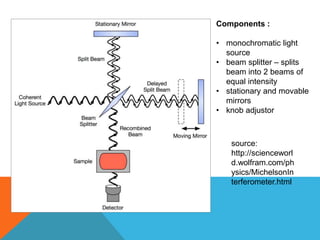
Components :
• monochromatic light
source
• beam splitter – splits
beam into 2 beams of
equal intensity
• stationary and movable
mirrors
• knob adjustor
source:
http://scienceworl
d.wolfram.com/ph
ysics/MichelsonIn
terferometer.html
HOW IT WORKS:
1. beam of monochromatic light is emitted toward a beam splitter
2. the beam splitter separates the incident beam into two separate beams
of equal intensity
3. one beam is sent toward a stationary mirror and the other is sent to a
moveable mirror
4. the incident beams are reflected and sent back toward the beam splitter
5. the beam splitter recombines the waves to produce an interference
pattern
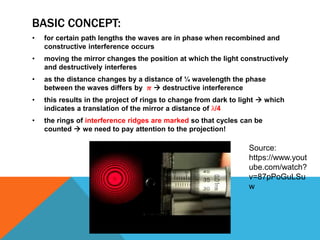
6. the interference pattern is projected onto a surface as a series of
concentric rings of light and dark
7. as the mirror is moved the successive rings of light and dark change
and can be counted (N)
BASIC CONCEPT:
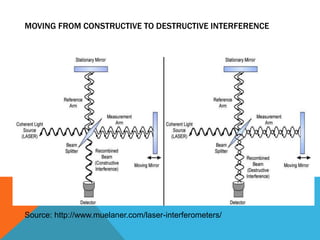
• for certain path lengths the waves are in phase when recombined and
constructive interference occurs
• moving the mirror changes the position at which the light constructively
and destructively interferes
• as the distance changes by a distance of ¼ wavelength the phase
between the waves differs by 𝝅  destructive interference
• this results in the project of rings to change from dark to light  which
indicates a translation of the mirror a distance of λ/4
• the rings of interference ridges are marked so that cycles can be
counted  we need to pay attention to the projection!
Source:
https://www.yout
ube.com/watch?
v=87pPoGuLSu
w
MOVING FROM CONSTRUCTIVE TO DESTRUCTIVE INTERFERENCE
Source: http://www.muelaner.com/laser-interferometers/
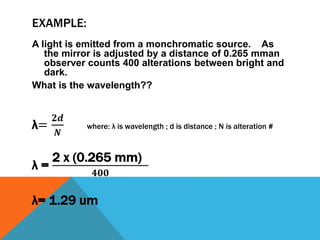
EXAMPLE:
A light is emitted from a monchromatic source. As
the mirror is adjusted by a distance of 0.265 mman
observer counts 400 alterations between bright and
dark.
What is the wavelength??
λ=
𝟐𝒅
𝑵
where: λ is wavelength ; d is distance ; N is alteration #
λ =
2 x (0.265 mm)
𝟒𝟎𝟎
λ= 1.29 um

Michelson interferometer

  • 1.
  • 2.
    Components : • monochromaticlight source • beam splitter – splits beam into 2 beams of equal intensity • stationary and movable mirrors • knob adjustor source: http://scienceworl d.wolfram.com/ph ysics/MichelsonIn terferometer.html
  • 3.
    HOW IT WORKS: 1.beam of monochromatic light is emitted toward a beam splitter 2. the beam splitter separates the incident beam into two separate beams of equal intensity 3. one beam is sent toward a stationary mirror and the other is sent to a moveable mirror 4. the incident beams are reflected and sent back toward the beam splitter 5. the beam splitter recombines the waves to produce an interference pattern 6. the interference pattern is projected onto a surface as a series of concentric rings of light and dark 7. as the mirror is moved the successive rings of light and dark change and can be counted (N)
  • 4.
    BASIC CONCEPT: • forcertain path lengths the waves are in phase when recombined and constructive interference occurs • moving the mirror changes the position at which the light constructively and destructively interferes • as the distance changes by a distance of ¼ wavelength the phase between the waves differs by 𝝅  destructive interference • this results in the project of rings to change from dark to light  which indicates a translation of the mirror a distance of λ/4 • the rings of interference ridges are marked so that cycles can be counted  we need to pay attention to the projection! Source: https://www.yout ube.com/watch? v=87pPoGuLSu w
  • 5.
    MOVING FROM CONSTRUCTIVETO DESTRUCTIVE INTERFERENCE Source: http://www.muelaner.com/laser-interferometers/
  • 6.
    EXAMPLE: A light isemitted from a monchromatic source. As the mirror is adjusted by a distance of 0.265 mman observer counts 400 alterations between bright and dark. What is the wavelength?? λ= 𝟐𝒅 𝑵 where: λ is wavelength ; d is distance ; N is alteration # λ = 2 x (0.265 mm) 𝟒𝟎𝟎 λ= 1.29 um