Applied Physics
Lecture – 4
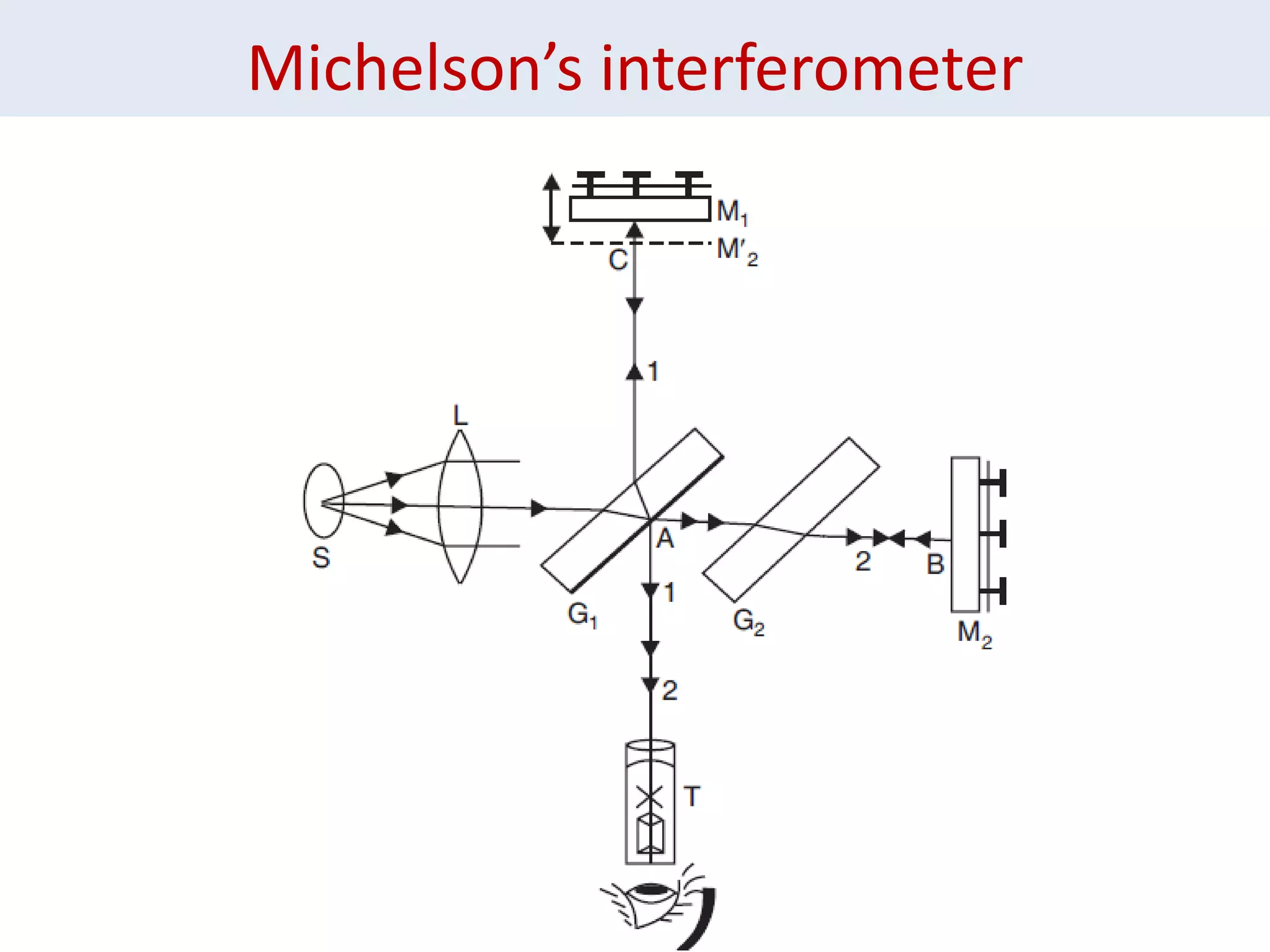
Michelson’s interferometer
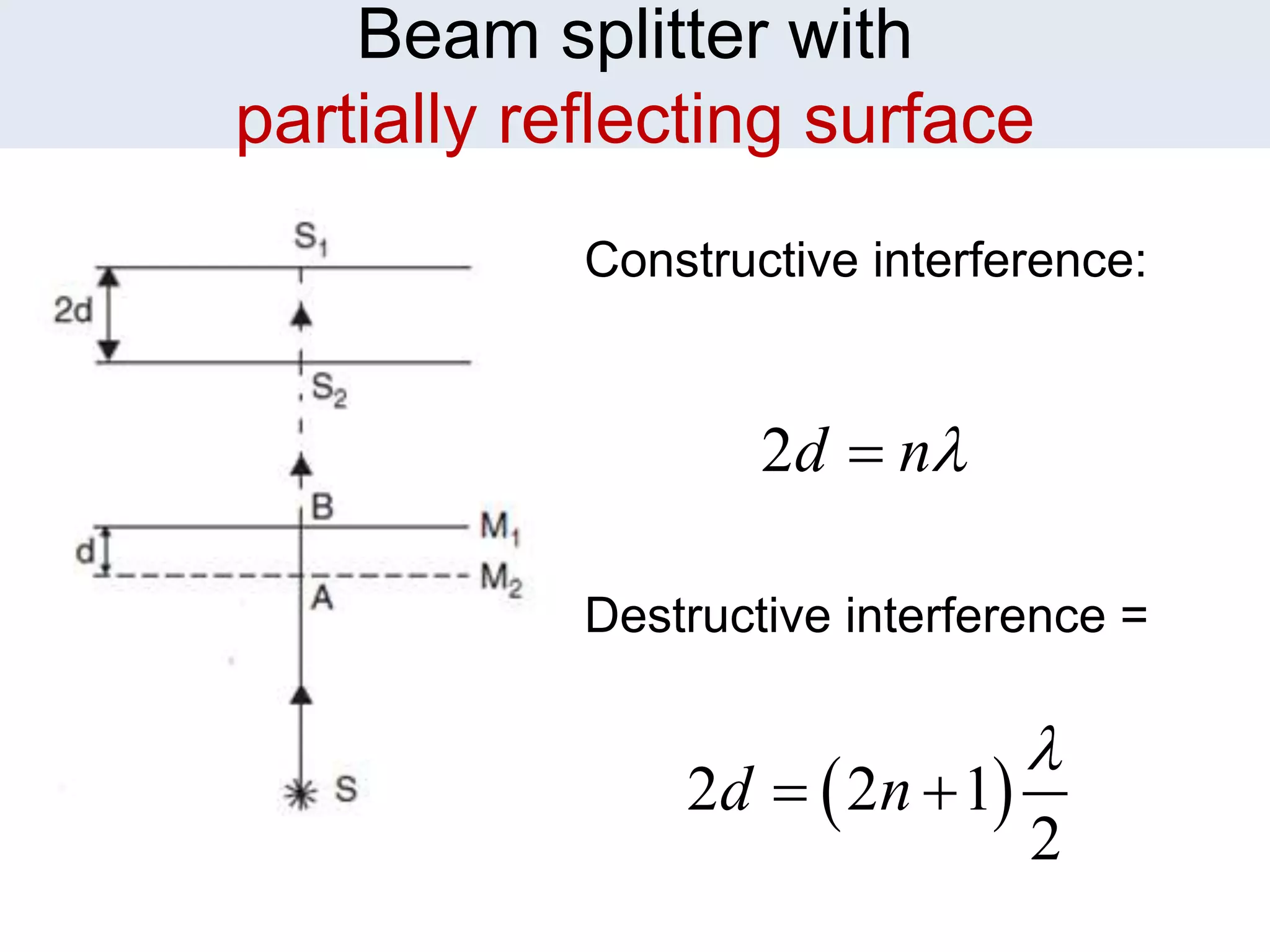
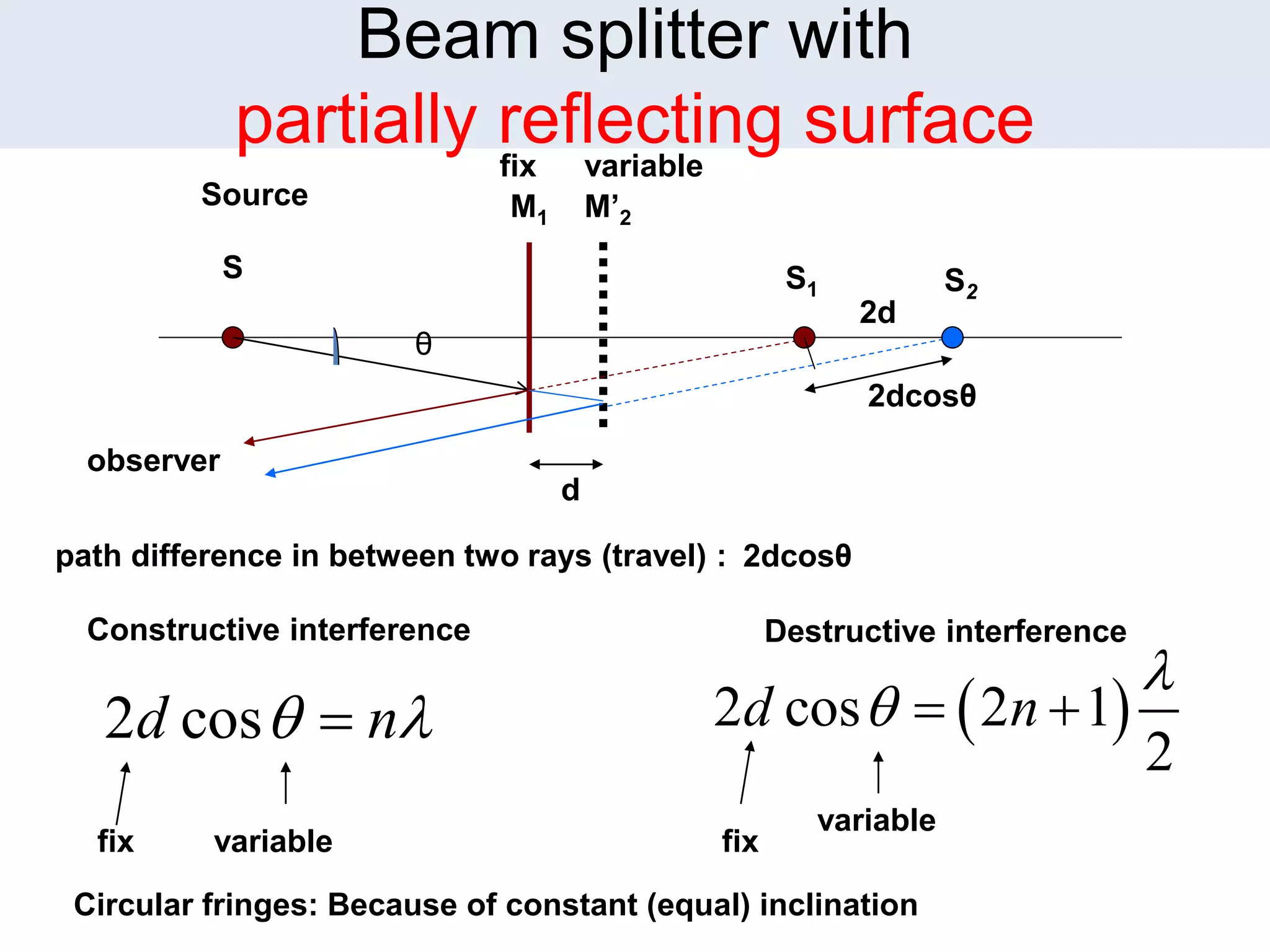
Beam splitter with
partially reflecting surface
Constructive interference:
Destructive interference =
2d n

 
2 2 1
2
d n

 
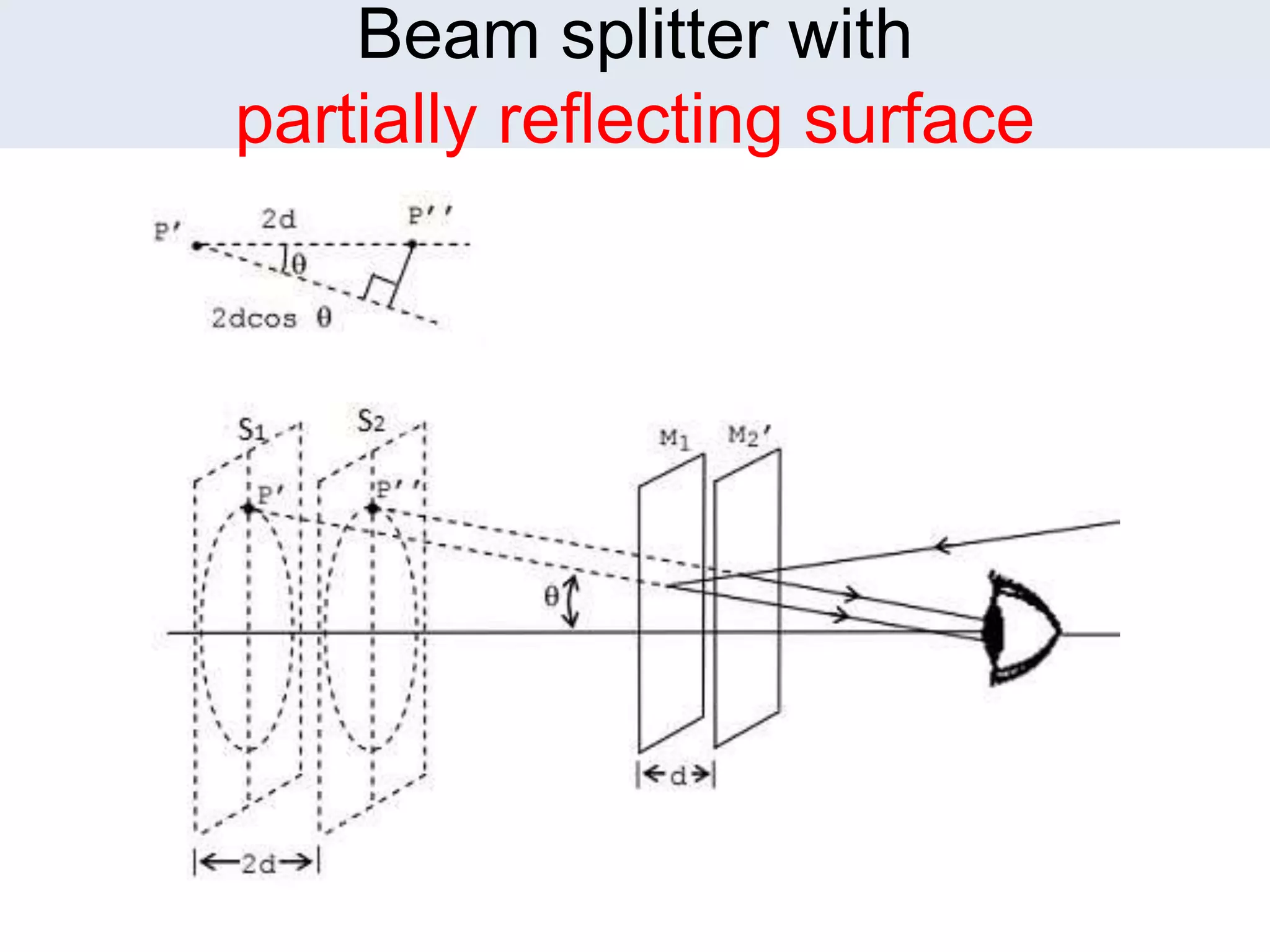
Beam splitter with
partially reflecting surface
M1
S S1
M’2
S2
d
2d
θ
2dcosθ
path difference in between two rays (travel) :
observer
fix variable
Circular fringes: Because of constant (equal) inclination
fix variable
Source
2 cos
d n
 

Beam splitter with
partially reflecting surface
2dcosθ
Constructive interference Destructive interference
 
2 cos 2 1
2
d n

  
fix
variable
Different orientation of the mirrors
When the two mirrors are tilted, the mirror M1 and the virtual
image M′2 are not parallel.
In this case the air path between them is wedge-shaped and the
fringes appear to be straight
Reflection and phase change
Reflected light will experience a 180 degree phase change when it
reflects from a medium of higher refractive index and no phase change
when it reflects from a medium of smaller refractive index
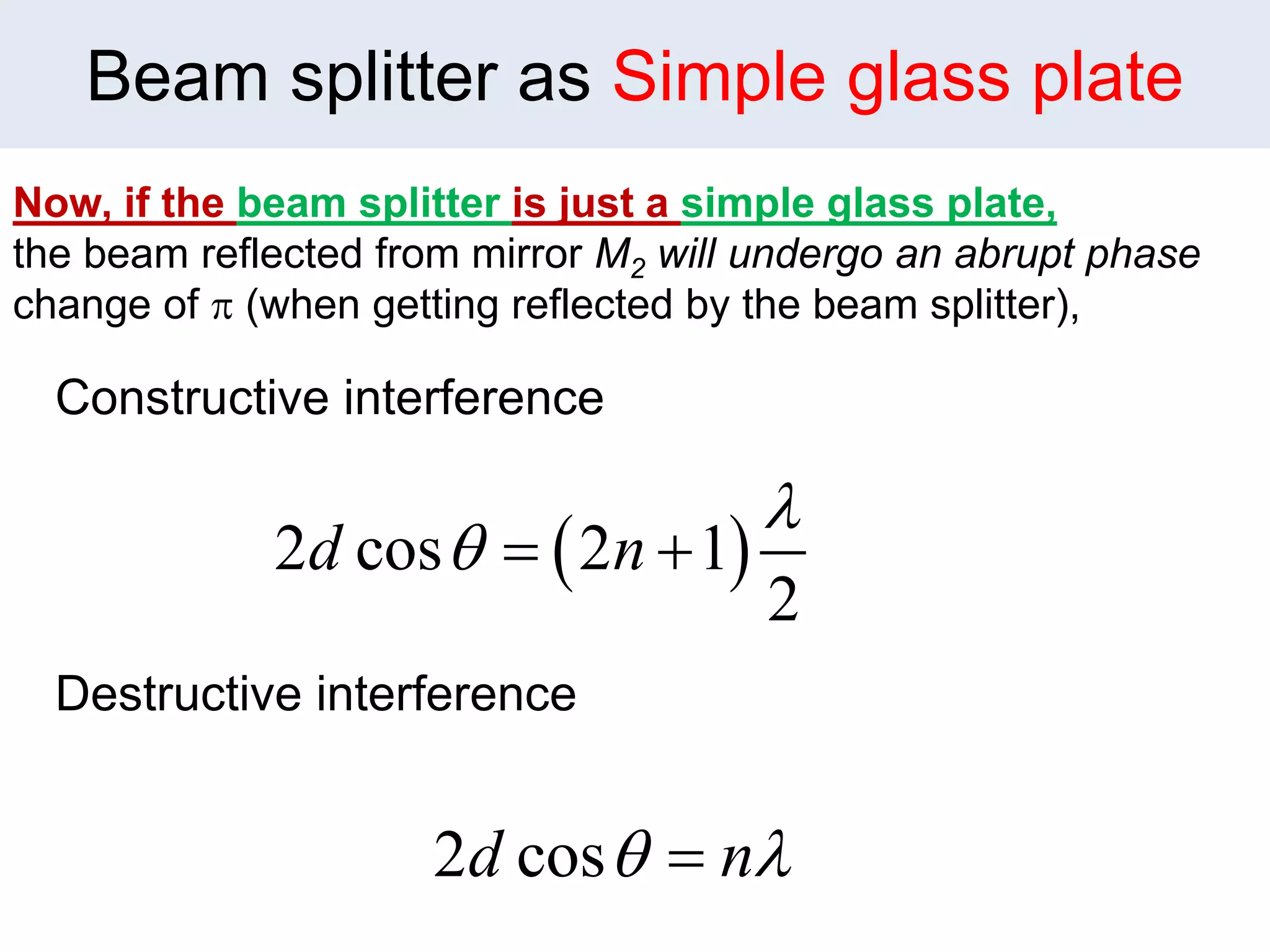
Beam splitter as Simple glass plate
Now, if the beam splitter is just a simple glass plate,
the beam reflected from mirror M2 will undergo an abrupt phase
change of  (when getting reflected by the beam splitter),
Constructive interference
Destructive interference
 
2 cos 2 1
2
d n

  
2 cos
d n
 

Beam splitter as Simple glass plate
Constructive interference when  = 0:
Destructive interference when  = 0
2d n

 
2 2 1
2
d n

 
1. To find the wavelength of a given monochromatic
source of light
   
1 1
2 2
1 2 1 2
2
2
2
2
2
d m
d m
d d m m
x N
x
N







  


2. Determination of the Difference in the Wavelength of
Two Waves
If a source of light consists of two wavelengths 1 and 2, which
differ slightly,
1 1 2 2
1 2 1 2
1 2
1 2 2
1 2 2
2
1 2
2d n n
If and n n, n n 1
2d n (n 1) (1)
n n
n( )
n (2)
( )
   
     
    
     
     


  
Where,
= wavelength
d = separation between two
position of distinctness
1 2
1 2
2
1 2
1 2
Substituting in eq 1
2d
2d 2d
 

  
  
     
3. Determination of refractive index or
thickness of a plate
A transparent sheet of thickness t and refractive index  be
inserted in the path of one of the interfering beams.
The optical path of that beam increases because of the sheet.
It becomes ‘t’ instead of ‘t’.
Since the beam traverses the medium twice, the extra path
difference between the two interfering beams is
 
1
t t t
 
  
 
2 1
t 
 
If m is the number of fringes by which the fringe system is
displaced
 
 
2 1
2 1
t m
m
t
 


 


Diffraction
Diffraction of light is the phenomena bending of light around the
corners of an obstacle when the dimension of the obstacle is
comparable to the wavelength of the light
Diffraction
Difference between interference and
diffraction
Interference Diffraction
Produced from different
wave fronts.
Produced Different parts of
the same wave front
Good contrast between
maxima and minima
Poor contrast between
maxima and minima
width of the fringes may or
may not be equal
width of the fringes always
unequal
Intensity of bright fringes
equal
Intensity of bright fringes
unequal
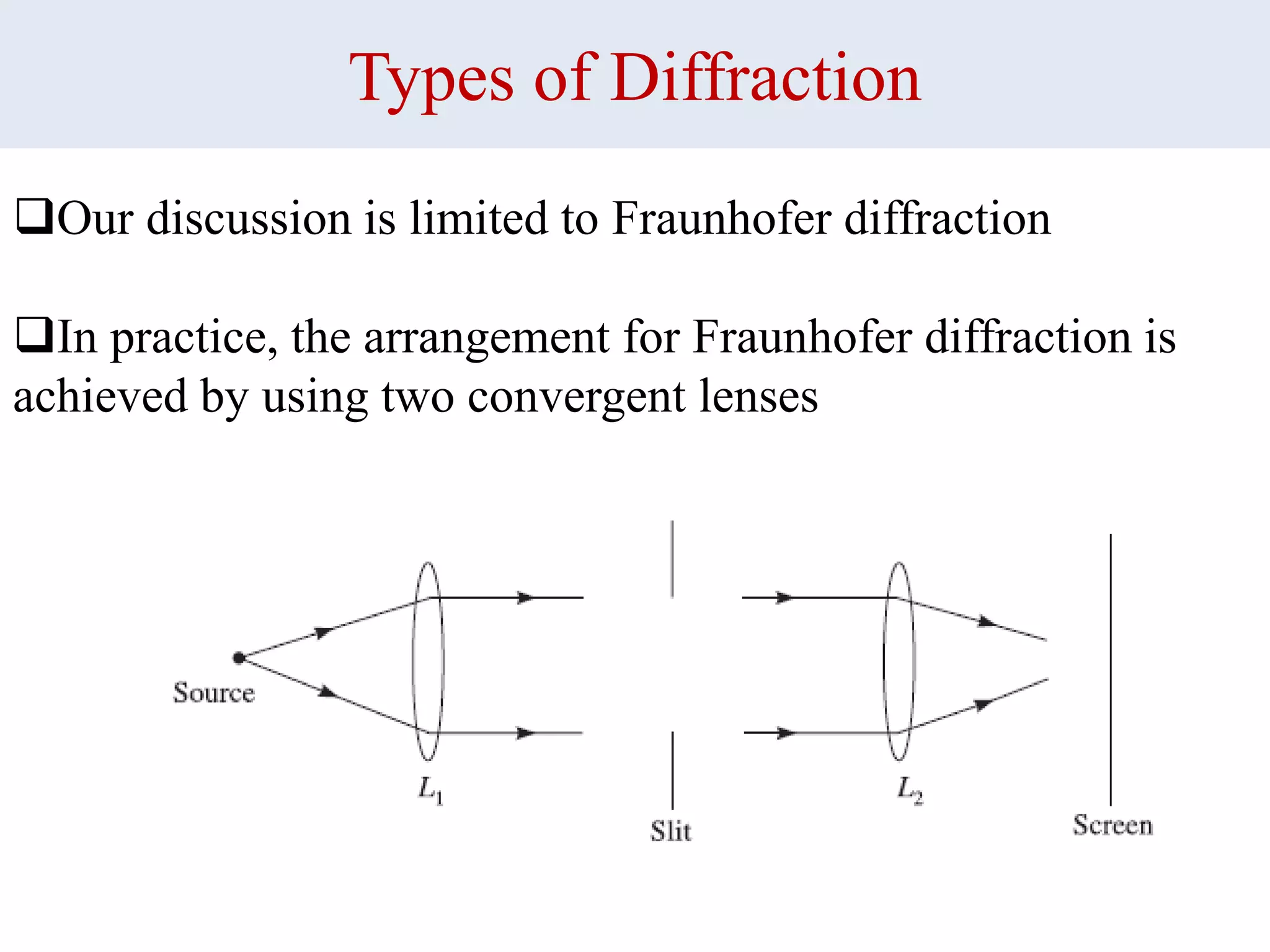
Types of Diffraction
1. Fresnel diffraction:
The source of light or the screen or both at finite distances from
obstacle or aperture causing the diffraction.
Types of Diffraction
2. Fraunhofer diffraction
The source of light and the screen are effectively at infinite distances
from the obstacle or aperture which causes the diffraction
In practice, the arrangement for
Fraunhofer diffraction is achieved
by using two convergent lenses
Types of Diffraction
Our discussion is limited to Fraunhofer diffraction
In practice, the arrangement for Fraunhofer diffraction is
achieved by using two convergent lenses
Fraunhofer diffraction due to single slit
Em, Im
Fraunhofer diffraction due to single slit
Thank you

Two slit diffraction.pptx

  • 1.
  • 2.
  • 3.
    Beam splitter with partiallyreflecting surface Constructive interference: Destructive interference = 2d n    2 2 1 2 d n   
  • 4.
    Beam splitter with partiallyreflecting surface
  • 5.
    M1 S S1 M’2 S2 d 2d θ 2dcosθ path differencein between two rays (travel) : observer fix variable Circular fringes: Because of constant (equal) inclination fix variable Source 2 cos d n    Beam splitter with partially reflecting surface 2dcosθ Constructive interference Destructive interference   2 cos 2 1 2 d n     fix variable
  • 6.
    Different orientation ofthe mirrors When the two mirrors are tilted, the mirror M1 and the virtual image M′2 are not parallel. In this case the air path between them is wedge-shaped and the fringes appear to be straight
  • 7.
    Reflection and phasechange Reflected light will experience a 180 degree phase change when it reflects from a medium of higher refractive index and no phase change when it reflects from a medium of smaller refractive index
  • 8.
    Beam splitter asSimple glass plate Now, if the beam splitter is just a simple glass plate, the beam reflected from mirror M2 will undergo an abrupt phase change of  (when getting reflected by the beam splitter), Constructive interference Destructive interference   2 cos 2 1 2 d n     2 cos d n   
  • 9.
    Beam splitter asSimple glass plate Constructive interference when  = 0: Destructive interference when  = 0 2d n    2 2 1 2 d n   
  • 10.
    1. To findthe wavelength of a given monochromatic source of light     1 1 2 2 1 2 1 2 2 2 2 2 2 d m d m d d m m x N x N            
  • 11.
    2. Determination ofthe Difference in the Wavelength of Two Waves If a source of light consists of two wavelengths 1 and 2, which differ slightly, 1 1 2 2 1 2 1 2 1 2 1 2 2 1 2 2 2 1 2 2d n n If and n n, n n 1 2d n (n 1) (1) n n n( ) n (2) ( )                                 Where, = wavelength d = separation between two position of distinctness 1 2 1 2 2 1 2 1 2 Substituting in eq 1 2d 2d 2d               
  • 12.
    3. Determination ofrefractive index or thickness of a plate A transparent sheet of thickness t and refractive index  be inserted in the path of one of the interfering beams. The optical path of that beam increases because of the sheet. It becomes ‘t’ instead of ‘t’. Since the beam traverses the medium twice, the extra path difference between the two interfering beams is   1 t t t        2 1 t    If m is the number of fringes by which the fringe system is displaced     2 1 2 1 t m m t        
  • 13.
    Diffraction Diffraction of lightis the phenomena bending of light around the corners of an obstacle when the dimension of the obstacle is comparable to the wavelength of the light
  • 14.
  • 15.
    Difference between interferenceand diffraction Interference Diffraction Produced from different wave fronts. Produced Different parts of the same wave front Good contrast between maxima and minima Poor contrast between maxima and minima width of the fringes may or may not be equal width of the fringes always unequal Intensity of bright fringes equal Intensity of bright fringes unequal
  • 16.
    Types of Diffraction 1.Fresnel diffraction: The source of light or the screen or both at finite distances from obstacle or aperture causing the diffraction.
  • 17.
    Types of Diffraction 2.Fraunhofer diffraction The source of light and the screen are effectively at infinite distances from the obstacle or aperture which causes the diffraction In practice, the arrangement for Fraunhofer diffraction is achieved by using two convergent lenses
  • 18.
    Types of Diffraction Ourdiscussion is limited to Fraunhofer diffraction In practice, the arrangement for Fraunhofer diffraction is achieved by using two convergent lenses
  • 19.
    Fraunhofer diffraction dueto single slit Em, Im
  • 20.
  • 21.