EMBRYOLOGY
TOPIC:
LIMB DEFECTS
Congenital Limb Deformities:
Congenital limb deformities are birth defects in which a
fetus’s limbs do not form properly while in uterus
Following are the possibilities
• A baby may be have missing limbs
• A baby may be have extra limb
• Over growth of limb
• Under growth of limb
• fingers or toes may fail to separate
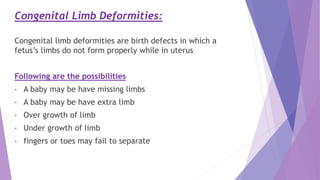
MEROMELIA :
Partial absent on limb
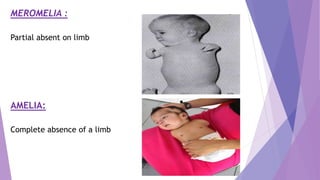
AMELIA:
Complete absence of a limb
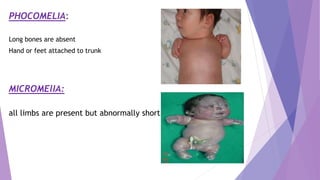
PHOCOMELIA:
Long bones are absent
Hand or feet attached to trunk
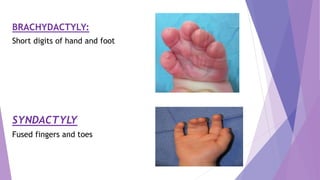
MICROMElIA:
all limbs are present but abnormally short
BRACHYDACTYLY:
Short digits of hand and foot
SYNDACTYLY
Fused fingers and toes
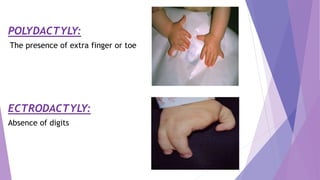
POLYDACTYLY:
The presence of extra finger or toe
ECTRODACTYLY:
Absence of digits
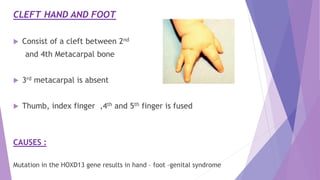
CLEFT HAND AND FOOT
 Consist of a cleft between 2nd
and 4th Metacarpal bone
 3rd metacarpal is absent
 Thumb, index finger ,4th and 5th finger is fused
CAUSES :
Mutation in the HOXD13 gene results in hand – foot –genital syndrome
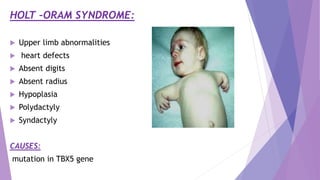
HOLT –ORAM SYNDROME:
 Upper limb abnormalities
 heart defects
 Absent digits
 Absent radius
 Hypoplasia
 Polydactyly
 Syndactyly
CAUSES:
mutation in TBX5 gene
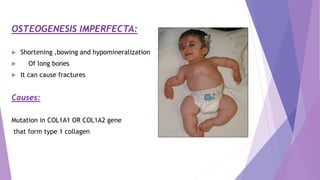
OSTEOGENESIS IMPERFECTA:
 Shortening ,bowing and hypomineralization
 Of long bones
 It can cause fractures
Causes:
Mutation in COL1A1 OR COL1A2 gene
that form type 1 collagen
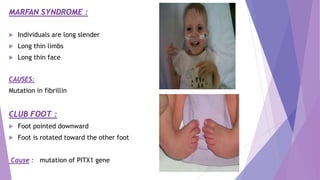
MARFAN SYNDROME :
 Individuals are long slender
 Long thin limbs
 Long thin face
CAUSES:
Mutation in fibrillin
CLUB FOOT :
 Foot pointed downward
 Foot is rotated toward the other foot
Cause : mutation of PITX1 gene
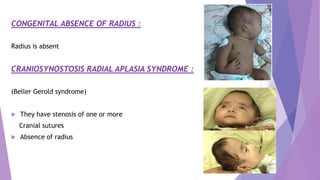
CONGENITAL ABSENCE OF RADIUS :
Radius is absent
CRANIOSYNOSTOSIS RADIAL APLASIA SYNDROME :
(Beller Gerold syndrome)
 They have stenosis of one or more
Cranial sutures
 Absence of radius
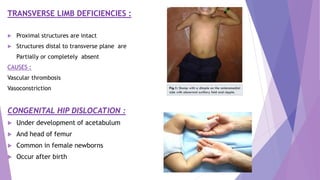
TRANSVERSE LIMB DEFICIENCIES :
 Proximal structures are intact
 Structures distal to transverse plane are
Partially or completely absent
CAUSES :
Vascular thrombosis
Vasoconstriction
CONGENITAL HIP DISLOCATION :
 Under development of acetabulum
 And head of femur
 Common in female newborns
 Occur after birth
Embryology  limb defects

Embryology limb defects

  • 1.
  • 2.
    Congenital Limb Deformities: Congenitallimb deformities are birth defects in which a fetus’s limbs do not form properly while in uterus Following are the possibilities • A baby may be have missing limbs • A baby may be have extra limb • Over growth of limb • Under growth of limb • fingers or toes may fail to separate
  • 3.
    MEROMELIA : Partial absenton limb AMELIA: Complete absence of a limb
  • 4.
    PHOCOMELIA: Long bones areabsent Hand or feet attached to trunk MICROMElIA: all limbs are present but abnormally short
  • 5.
    BRACHYDACTYLY: Short digits ofhand and foot SYNDACTYLY Fused fingers and toes
  • 6.
    POLYDACTYLY: The presence ofextra finger or toe ECTRODACTYLY: Absence of digits
  • 7.
    CLEFT HAND ANDFOOT  Consist of a cleft between 2nd and 4th Metacarpal bone  3rd metacarpal is absent  Thumb, index finger ,4th and 5th finger is fused CAUSES : Mutation in the HOXD13 gene results in hand – foot –genital syndrome
  • 8.
    HOLT –ORAM SYNDROME: Upper limb abnormalities  heart defects  Absent digits  Absent radius  Hypoplasia  Polydactyly  Syndactyly CAUSES: mutation in TBX5 gene
  • 9.
    OSTEOGENESIS IMPERFECTA:  Shortening,bowing and hypomineralization  Of long bones  It can cause fractures Causes: Mutation in COL1A1 OR COL1A2 gene that form type 1 collagen
  • 10.
    MARFAN SYNDROME : Individuals are long slender  Long thin limbs  Long thin face CAUSES: Mutation in fibrillin CLUB FOOT :  Foot pointed downward  Foot is rotated toward the other foot Cause : mutation of PITX1 gene
  • 11.
    CONGENITAL ABSENCE OFRADIUS : Radius is absent CRANIOSYNOSTOSIS RADIAL APLASIA SYNDROME : (Beller Gerold syndrome)  They have stenosis of one or more Cranial sutures  Absence of radius
  • 12.
    TRANSVERSE LIMB DEFICIENCIES:  Proximal structures are intact  Structures distal to transverse plane are Partially or completely absent CAUSES : Vascular thrombosis Vasoconstriction CONGENITAL HIP DISLOCATION :  Under development of acetabulum  And head of femur  Common in female newborns  Occur after birth