Syndactyly
Dr. jaishree
(MPT PEDIATRICS )
Syndactyly
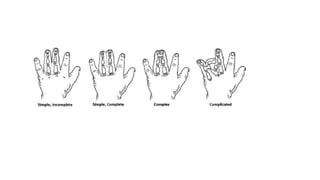
• It is a condition wherein two or more digits are fused together
• Syndactyly classification
Simple or complex
• In simple- Adjacent fingers or toes are joined by soft tissue.
• In complex- The bones of adjacent digits are fused.
Full Partial
classification
Complete or incomplete
• In complete syndactyly, the skin is joined all the way to the tip of
the involved digits.
• In incomplete syndactyly, the skin is only joined part of the
distance to the tip of the involved digits.
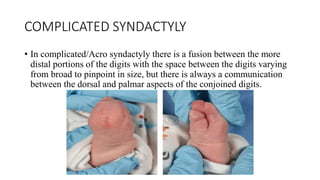
COMPLICATED SYNDACTYLY
• In complicated/Acro syndactyly there is a fusion between the more
distal portions of the digits with the space between the digits varying
from broad to pinpoint in size, but there is always a communication
between the dorsal and palmar aspects of the conjoined digits.
CAUSE
Congenital
• In early human fetal development, webbing (syndactyly) of the
toes and fingers is normal.
• At about 6 weeks of gestation, apoptosis takes place due to a
protein named sonic hedgehog also known as SHH, which
dissolves the tissue between the fingers and toes
• Webbing disappears common genetic conditions are( F-
syndrome, Apert syndrome, Seathre–Chotezen syndrome)
Indication and contraindication of surgery
• Indication to surgery is indicated for nearly all cases of syndactyly, as
the potential for improved functionality outweighs the risks of the
procedure.
• Contraindications to surgical release include a mild, incomplete
syndactyly that does not impair function, medical conditions that
preclude surgery, or complex syndactyly that risks further functional
impairment with attempted separation
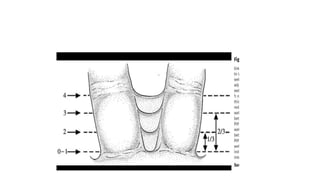
Classification
• Grade 0: soft web, abduction mirrors the adjacent web or
equivalent web on the other hand.
• Grade 1: no web advancement, but thickening of the web with
reduced span.
• Grade 2: creep of web to 1/3 of the distance between base of
the web and PIPJ crease.
• Grade 3: creep of web to 2/3 of the distance between base of
the web and PIPJ crease.
• Grade 4: creep of web to the PIPJ crease. PIPJ indicates
proximal interphalangeal joint
Complication of surgery
Hypertrophic scar
Management
Scar mobilization During the proliferative stage massage has a
beneficial role in collagen synthesis, as it prevents adhesions and
helps in collagen synthesis.
Splinting can be used at all stages of wound healing
Ultrasound therapy It stimulated the synthesis of growth factor
that in turn increase the strength and elasticity of the collagen
fibers formed
Laser: Laser inhibits collagen and improves keloid and
hypertrophic scarring
Lower limb surgery
• Surgery is mostly preferred after 6 to 8 months of age, before the
child start ambulation, able to tolerate the anaesthesia.
• Complication of surgery
- Skin flap slough
• THANK YOU

Syndactyly

  • 1.
  • 2.
    Syndactyly • It isa condition wherein two or more digits are fused together • Syndactyly classification Simple or complex • In simple- Adjacent fingers or toes are joined by soft tissue. • In complex- The bones of adjacent digits are fused. Full Partial
  • 3.
    classification Complete or incomplete •In complete syndactyly, the skin is joined all the way to the tip of the involved digits. • In incomplete syndactyly, the skin is only joined part of the distance to the tip of the involved digits.
  • 4.
    COMPLICATED SYNDACTYLY • Incomplicated/Acro syndactyly there is a fusion between the more distal portions of the digits with the space between the digits varying from broad to pinpoint in size, but there is always a communication between the dorsal and palmar aspects of the conjoined digits.
  • 6.
    CAUSE Congenital • In earlyhuman fetal development, webbing (syndactyly) of the toes and fingers is normal. • At about 6 weeks of gestation, apoptosis takes place due to a protein named sonic hedgehog also known as SHH, which dissolves the tissue between the fingers and toes • Webbing disappears common genetic conditions are( F- syndrome, Apert syndrome, Seathre–Chotezen syndrome)
  • 7.
    Indication and contraindicationof surgery • Indication to surgery is indicated for nearly all cases of syndactyly, as the potential for improved functionality outweighs the risks of the procedure. • Contraindications to surgical release include a mild, incomplete syndactyly that does not impair function, medical conditions that preclude surgery, or complex syndactyly that risks further functional impairment with attempted separation
  • 8.
    Classification • Grade 0:soft web, abduction mirrors the adjacent web or equivalent web on the other hand. • Grade 1: no web advancement, but thickening of the web with reduced span. • Grade 2: creep of web to 1/3 of the distance between base of the web and PIPJ crease. • Grade 3: creep of web to 2/3 of the distance between base of the web and PIPJ crease. • Grade 4: creep of web to the PIPJ crease. PIPJ indicates proximal interphalangeal joint
  • 10.
    Complication of surgery Hypertrophicscar Management Scar mobilization During the proliferative stage massage has a beneficial role in collagen synthesis, as it prevents adhesions and helps in collagen synthesis. Splinting can be used at all stages of wound healing Ultrasound therapy It stimulated the synthesis of growth factor that in turn increase the strength and elasticity of the collagen fibers formed Laser: Laser inhibits collagen and improves keloid and hypertrophic scarring
  • 11.
    Lower limb surgery •Surgery is mostly preferred after 6 to 8 months of age, before the child start ambulation, able to tolerate the anaesthesia. • Complication of surgery - Skin flap slough
  • 12.