RNNs for Timeseries Analysis


www.data4sci.com
github.com/DataForScience/RNN
www.data4sci.com@bgoncalves
The views and opinions expressed in this tutorial are
those of the authors and do not necessarily reflect the
official policy or position of my employer. The
examples provided with this tutorial were chosen for
their didactic value and are not mean to be
representative of my day to day work.
Disclaimer
www.data4sci.com@bgoncalves
References
www.data4sci.com@bgoncalves
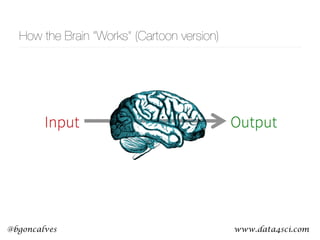
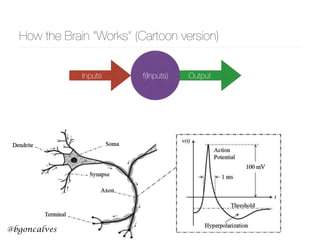
How the Brain “Works” (Cartoon version)
www.data4sci.com@bgoncalves
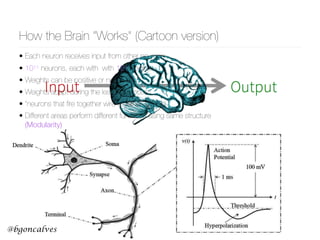
How the Brain “Works” (Cartoon version)
• Each neuron receives input from other neurons
• 1011 neurons, each with with 104 weights
• Weights can be positive or negative
• Weights adapt during the learning process
• “neurons that fire together wire together” (Hebb)
• Different areas perform different functions using same structure
(Modularity)
www.data4sci.com@bgoncalves
How the Brain “Works” (Cartoon version)
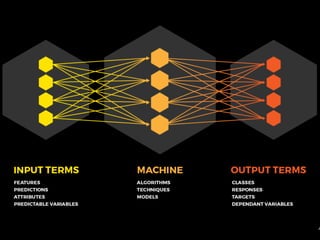
Inputs Outputf(Inputs)
www.data4sci.com@bgoncalves
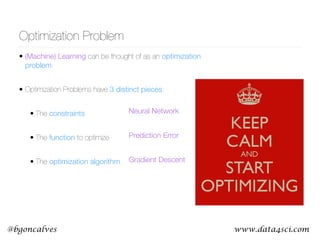
Optimization Problem
• (Machine) Learning can be thought of as an optimization
problem.
• Optimization Problems have 3 distinct pieces:
• The constraints
• The function to optimize
• The optimization algorithm.
Neural Network
Prediction Error
Gradient Descent
www.data4sci.com@bgoncalves
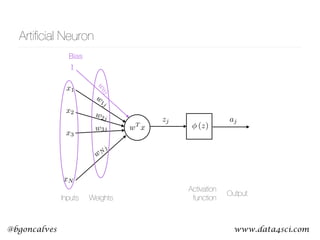
Artificial Neuron
x1
x2
x3
xN
w
1j
w2j
w3j
wN
j
zj
wT
x
aj
(z)
w
0j
1
Inputs Weights
Output
Activation
function
Bias
www.data4sci.com@bgoncalves
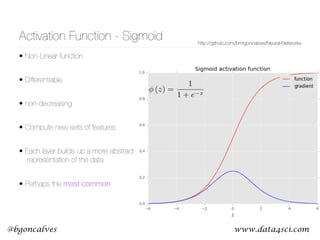
Activation Function - Sigmoid
(z) =
1
1 + e z
• Non-Linear function
• Differentiable
• non-decreasing
• Compute new sets of features
• Each layer builds up a more abstract

representation of the data
• Perhaps the most common
http://github.com/bmtgoncalves/Neural-Networks
www.data4sci.com@bgoncalves
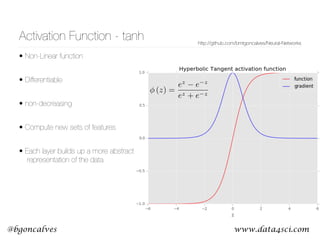
Activation Function - tanh
(z) =
ez
e z
ez + e z
• Non-Linear function
• Differentiable
• non-decreasing
• Compute new sets of features
• Each layer builds up a more abstract

representation of the data
http://github.com/bmtgoncalves/Neural-Networks
www.data4sci.com@bgoncalves
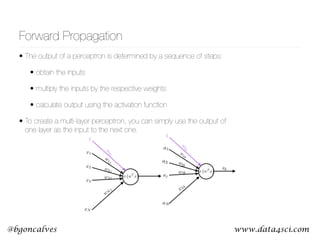
Forward Propagation
• The output of a perceptron is determined by a sequence of steps:
• obtain the inputs
• multiply the inputs by the respective weights
• calculate output using the activation function
• To create a multi-layer perceptron, you can simply use the output of
one layer as the input to the next one.

x1
x2
x3
xN
w
1j
w2j
w3j
wN
j
aj
w
0j
1
wT
x
1
w
0k
w
1k
w2k
w3k
wNk
ak
wT
a
a1
a2
aN
www.data4sci.com@bgoncalves
Backward Propagation of Errors (BackProp)
• BackProp operates in two phases:
• Forward propagate the inputs and calculate the deltas
• Update the weights
• The error at the output is a weighted average difference between
predicted output and the observed one.
• For inner layers there is no “real output”!
www.data4sci.com@bgoncalves
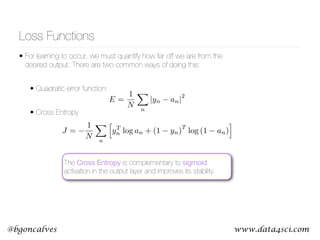
The Cross Entropy is complementary to sigmoid
activation in the output layer and improves its stability.
Loss Functions
• For learning to occur, we must quantify how far off we are from the
desired output. There are two common ways of doing this:
• Quadratic error function:
• Cross Entropy
E =
1
N
X
n
|yn an|
2
J =
1
N
X
n
h
yT
n log an + (1 yn)
T
log (1 an)
i
www.data4sci.com@bgoncalves
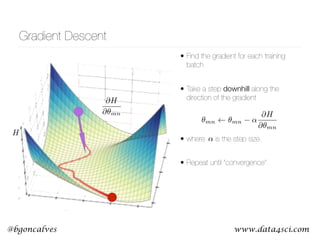
Gradient Descent
• Find the gradient for each training
batch
• Take a step downhill along the
direction of the gradient 


• where is the step size.
• Repeat until “convergence”.
H
✓mn ✓mn ↵
@H
@✓mn
@H
@✓mn
↵
www.data4sci.com@bgoncalves
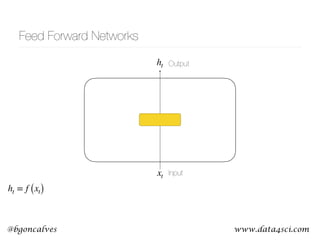
Feed Forward Networks
h t Output
h t = f (xt)
xt Input
www.data4sci.com@bgoncalves
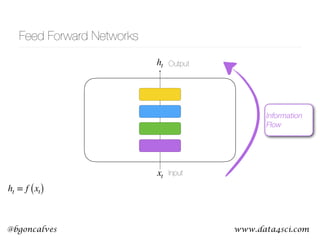
Feed Forward Networks
h t
xt
Information

Flow
Input
Output
h t = f (xt)
www.data4sci.com@bgoncalves
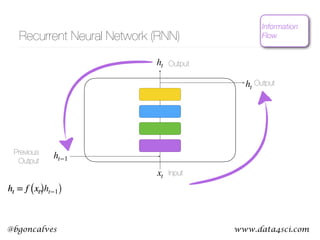
h t = f (xt, h t−1)
Recurrent Neural Network (RNN)
h t Output
h t
Output
Previous
Output
Information

Flow
h t−1
h t = f (xt)
xt Input
www.data4sci.com@bgoncalves
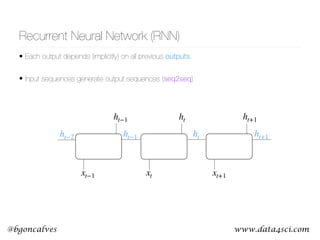
Recurrent Neural Network (RNN)
xt
h t
h t−1 h t
xt+ 1
h t+ 1
h t+ 1
xt−1
h t−1
h t−2
• Each output depends (implicitly) on all previous outputs.
• Input sequences generate output sequences (seq2seq)
www.data4sci.com@bgoncalves
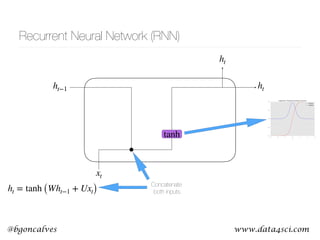
Recurrent Neural Network (RNN)
h t
h t
h t−1
xt
tanh
h t = tanh (Wh t−1 + Uxt)
Concatenate
both inputs.
www.data4sci.com@bgoncalves
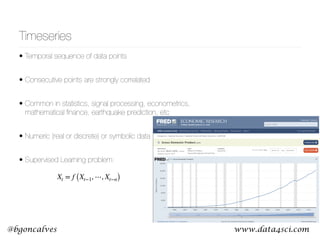
Timeseries
• Temporal sequence of data points
• Consecutive points are strongly correlated
• Common in statistics, signal processing, econometrics,
mathematical finance, earthquake prediction, etc
• Numeric (real or discrete) or symbolic data
• Supervised Learning problem:
Xt = f (Xt−1, ⋯, Xt−n )
github.com/DataForScience/RNN
www.data4sci.com@bgoncalves
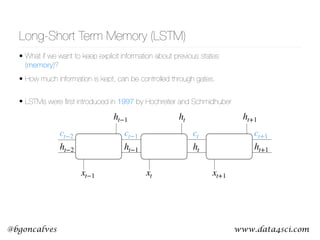
Long-Short Term Memory (LSTM)
xt
h t
ct−1 ct
xt+ 1
h t+ 1
ct+ 1
xt−1
h t−1
ct−2
• What if we want to keep explicit information about previous states
(memory)?
• How much information is kept, can be controlled through gates.
h t−2 h t−1 h t h t+ 1
• LSTMs were first introduced in 1997 by Hochreiter and Schmidhuber
www.data4sci.com@bgoncalves
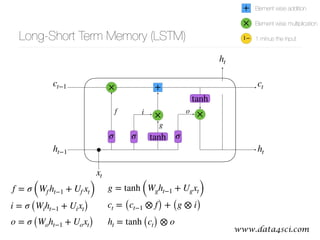
σ σ
f
g
×
σ
×i o
Long-Short Term Memory (LSTM)
h t
h t
h t−1
xt
ct−1 ct
g = tanh (Wg h t−1 + Ug xt)
ct = (ct−1 ⊗ f) + (g ⊗ i)
h t = tanh (ct) ⊗ o
+×
×
+
1−
Element wise addition
Element wise multiplication
1 minus the input
tanh
i = σ (Wih t−1 + Uixt)
f = σ (Wf h t−1 + Uf xt)
o = σ (Wo h t−1 + Uo xt)
tanh
www.data4sci.com@bgoncalves
σ σ
f
g
×
σ
×i o
Long-Short Term Memory (LSTM)
h t
h t
h t−1
xt
ct−1 ct
g = tanh (Wg h t−1 + Ug xt)
ct = (ct−1 ⊗ f) + (g ⊗ i)
h t = tanh (ct) ⊗ o
+×
×
+
1−
Element wise addition
Element wise multiplication
1 minus the input
tanh
i = σ (Wih t−1 + Uixt)
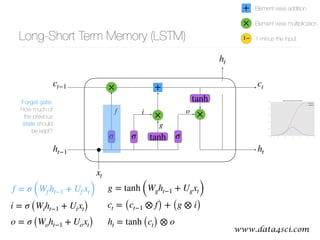
f = σ (Wf h t−1 + Uf xt)
o = σ (Wo h t−1 + Uo xt)
Forget gate:

How much of
the previous
state should
be kept?
tanh
www.data4sci.com@bgoncalves
σ σ
f
g
×
σ
×i o
Long-Short Term Memory (LSTM)
h t
h t
h t−1
xt
ct−1 ct
g = tanh (Wg h t−1 + Ug xt)
ct = (ct−1 ⊗ f) + (g ⊗ i)
h t = tanh (ct) ⊗ o
+×
×
+
1−
Element wise addition
Element wise multiplication
1 minus the input
tanh
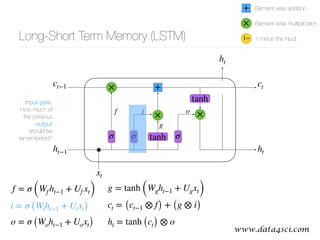
i = σ (Wih t−1 + Uixt)
f = σ (Wf h t−1 + Uf xt)
o = σ (Wo h t−1 + Uo xt)
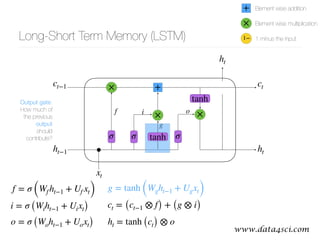
Input gate:

How much of
the previous
output
should be
remembered? tanh
www.data4sci.com@bgoncalves
σ σ
f
g
×
σ
×i o
Long-Short Term Memory (LSTM)
h t
h t
h t−1
xt
ct−1 ct
g = tanh (Wg h t−1 + Ug xt)
ct = (ct−1 ⊗ f) + (g ⊗ i)
h t = tanh (ct) ⊗ o
+×
×
+
1−
Element wise addition
Element wise multiplication
1 minus the input
tanh
i = σ (Wih t−1 + Uixt)
f = σ (Wf h t−1 + Uf xt)
o = σ (Wo h t−1 + Uo xt)
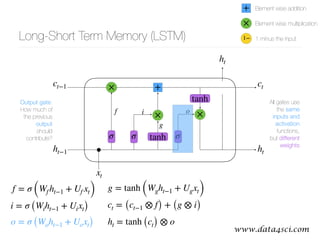
Output gate:

How much of
the previous
output
should
contribute?
All gates use
the same
inputs and
activation
functions,
but different
weights
tanh
www.data4sci.com@bgoncalves
σ σ
f
g
×
σ
×i o
Long-Short Term Memory (LSTM)
h t
h t
h t−1
xt
ct−1 ct
g = tanh (Wg h t−1 + Ug xt)
ct = (ct−1 ⊗ f) + (g ⊗ i)
h t = tanh (ct) ⊗ o
+×
×
+
1−
Element wise addition
Element wise multiplication
1 minus the input
tanh
i = σ (Wih t−1 + Uixt)
f = σ (Wf h t−1 + Uf xt)
o = σ (Wo h t−1 + Uo xt)
Output gate:

How much of
the previous
output
should
contribute? tanh
www.data4sci.com@bgoncalves
σ σ
f
g
×
σ
×i o
Long-Short Term Memory (LSTM)
h t
h t
h t−1
xt
ct−1 ct
g = tanh (Wg h t−1 + Ug xt)
ct = (ct−1 ⊗ f) + (g ⊗ i)
h t = tanh (ct) ⊗ o
+×
×
+
1−
Element wise addition
Element wise multiplication
1 minus the input
tanh
i = σ (Wih t−1 + Uixt)
f = σ (Wf h t−1 + Uf xt)
o = σ (Wo h t−1 + Uo xt)
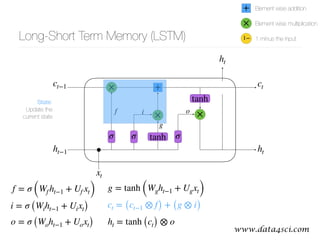
State:

Update the
current state
tanh
www.data4sci.com@bgoncalves
σ σ
f
g
×
σ
×i o
Long-Short Term Memory (LSTM)
h t
h t
h t−1
xt
ct−1 ct
g = tanh (Wg h t−1 + Ug xt)
ct = (ct−1 ⊗ f) + (g ⊗ i)
h t = tanh (ct) ⊗ o
+×
×
+
1−
Element wise addition
Element wise multiplication
1 minus the input
tanh
i = σ (Wih t−1 + Uixt)
f = σ (Wf h t−1 + Uf xt)
o = σ (Wo h t−1 + Uo xt)
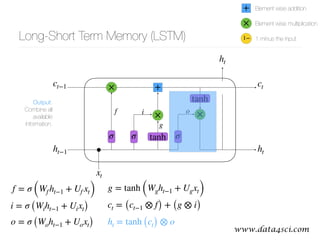
Output:

Combine all
available
information.
tanh
www.data4sci.com@bgoncalves
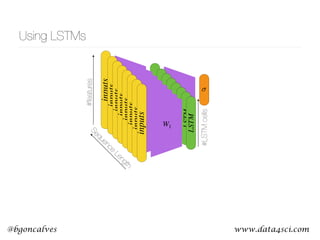
Using LSTMs
inputs
W1
LSTM
W2
Neuron
inputs
W1
LSTM
inputs
W1
LSTM
inputs
W1
LSTM
inputs
W1
LSTM
inputs
W1
LSTM
inputs
W1
LSTM
inputs
W1
LSTM
Sequence
Length
#features
#LSTMcells
github.com/DataForScience/RNN
www.data4sci.com@bgoncalves
Applications
• Language Modeling and Prediction
• Speech Recognition
• Machine Translation
• Part-of-Speech Tagging
• Sentiment Analysis
• Summarization
• Time series forecasting
www.data4sci.com@bgoncalves
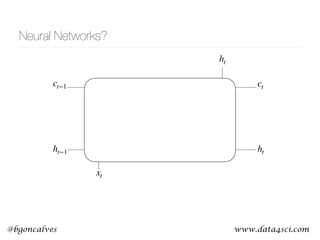
Neural Networks?
h t
h t
h t−1
xt
ct−1 ct
www.data4sci.com@bgoncalves
Or legos? https://keras.io
www.data4sci.com@bgoncalves
Keras
• Open Source neural network library written in Python
• TensorFlow, Microsoft Cognitive Toolkit or Theano backends
• Enables fast experimentation
• Created and maintained by François Chollet, a Google engineer.
• Implements Layers, Objective/Loss functions, Activation
functions, Optimizers, etc…
https://keras.io
www.data4sci.com@bgoncalves
Keras
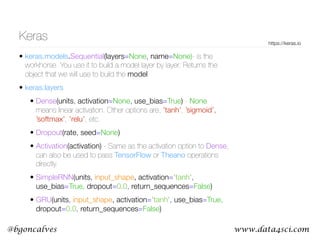
• keras.models.Sequential(layers=None, name=None)- is the
workhorse. You use it to build a model layer by layer. Returns the
object that we will use to build the model
• keras.layers
• Dense(units, activation=None, use_bias=True) - None
means linear activation. Other options are, ’tanh’, ’sigmoid’,
’softmax’, ’relu’, etc.
• Dropout(rate, seed=None)
• Activation(activation) - Same as the activation option to Dense,
can also be used to pass TensorFlow or Theano operations
directly.
• SimpleRNN(units, input_shape, activation='tanh',
use_bias=True, dropout=0.0, return_sequences=False)
• GRU(units, input_shape, activation='tanh', use_bias=True,
dropout=0.0, return_sequences=False)
https://keras.io
www.data4sci.com@bgoncalves
Keras
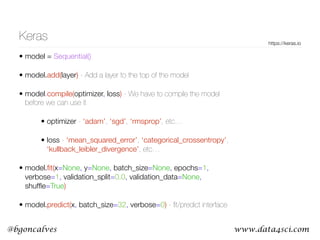
• model = Sequential()
• model.add(layer) - Add a layer to the top of the model
• model.compile(optimizer, loss) - We have to compile the model
before we can use it
• optimizer - ‘adam’, ‘sgd’, ‘rmsprop’, etc…
• loss - ‘mean_squared_error’, ‘categorical_crossentropy’,
‘kullback_leibler_divergence’, etc…
• model.fit(x=None, y=None, batch_size=None, epochs=1,
verbose=1, validation_split=0.0, validation_data=None,
shuffle=True)
• model.predict(x, batch_size=32, verbose=0) - fit/predict interface
https://keras.io
www.data4sci.com@bgoncalves
Gated Recurrent Unit (GRU)
• Introduced in 2014 by K. Cho
• Meant to solve the Vanishing Gradient Problem
• Can be considered as a simplification of LSTMs
• Similar performance to LSTM in some applications, better
performance for smaller datasets.
www.data4sci.com@bgoncalves
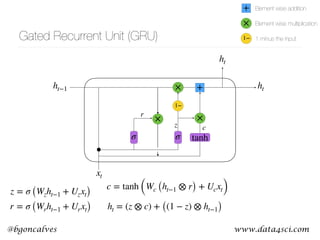
σ tanh
×
σ
×
r
cz
Gated Recurrent Unit (GRU)
h t
h t
h t−1
xt
+×
z = σ (Wzh t−1 + Uzxt)
r = σ (Wrh t−1 + Urxt)
c = tanh (Wc (h t−1 ⊗ r) + Ucxt)
h t = (z ⊗ c) + ((1 − z) ⊗ h t−1)
1−
×
+
1−
Element wise addition
Element wise multiplication
1 minus the input
www.data4sci.com@bgoncalves
σ tanh
×
σ
×
r
cz
Gated Recurrent Unit (GRU)
h t
h t
h t−1
xt
+×
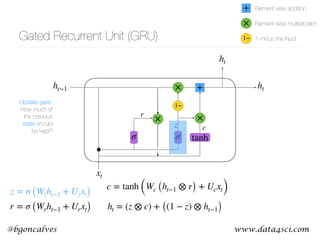
z = σ (Wzh t−1 + Uzxt)
r = σ (Wrh t−1 + Urxt)
c = tanh (Wc (h t−1 ⊗ r) + Ucxt)
h t = (z ⊗ c) + ((1 − z) ⊗ h t−1)
1−
×
+
1−
Element wise addition
Element wise multiplication
1 minus the input
Update gate:

How much of
the previous
state should
be kept?
www.data4sci.com@bgoncalves
σ tanh
×
σ
×
r
cz
Gated Recurrent Unit (GRU)
h t
h t
h t−1
xt
+×
z = σ (Wzh t−1 + Uzxt)
r = σ (Wrh t−1 + Urxt)
c = tanh (Wc (h t−1 ⊗ r) + Ucxt)
h t = (z ⊗ c) + ((1 − z) ⊗ h t−1)
1−
×
+
1−
Element wise addition
Element wise multiplication
1 minus the input
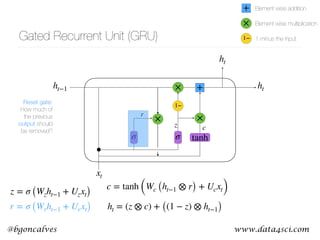
Reset gate:

How much of
the previous
output should
be removed?
www.data4sci.com@bgoncalves
σ tanh
×
σ
×
r
cz
Gated Recurrent Unit (GRU)
h t
h t
h t−1
xt
+×
z = σ (Wzh t−1 + Uzxt)
r = σ (Wrh t−1 + Urxt)
c = tanh (Wc (h t−1 ⊗ r) + Ucxt)
h t = (z ⊗ c) + ((1 − z) ⊗ h t−1)
1−
×
+
1−
Element wise addition
Element wise multiplication
1 minus the input
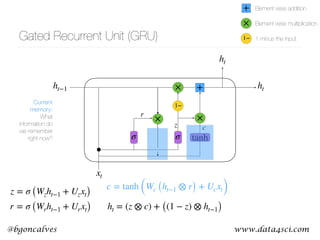
Current
memory:

What
information do
we remember
right now?
www.data4sci.com@bgoncalves
σ tanh
×
σ
×
r
cz
Gated Recurrent Unit (GRU)
h t
h t
h t−1
xt
+×
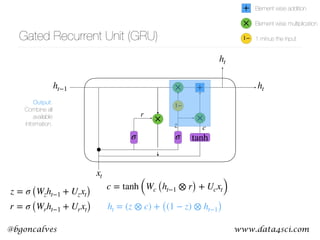
z = σ (Wzh t−1 + Uzxt)
r = σ (Wrh t−1 + Urxt)
c = tanh (Wc (h t−1 ⊗ r) + Ucxt)
h t = (z ⊗ c) + ((1 − z) ⊗ h t−1)
1−
×
+
1−
Element wise addition
Element wise multiplication
1 minus the input
Output:

Combine all
available
information.

RNNs for Timeseries Analysis