Sentiment Analysis in Twitter
Abstract:
These systems introduce a novel approach for automatically classifying the sentiment of Twitter
messages. These messages are classified as positive or neutral or negative with respect to a query
term or the keyword entered by a user. The Social networking and micro blogging services are
enables users to send and read messages. The Messages of length up to 140 characters, known as
"tweets". Tweets contain rich information about people’s preferences. Our project includes
prediction using Twitter data, and analysis of the prediction results. Tweets are frequently used
to express a tweeters emotion on a particular subject. There are firms which poll twitter for
analyzing sentiment on a particular topic. The challenge is to gather all such relevant data, detect
and summarize the overall sentiment on a topic. Sentiment Analysis to determine the attitude of
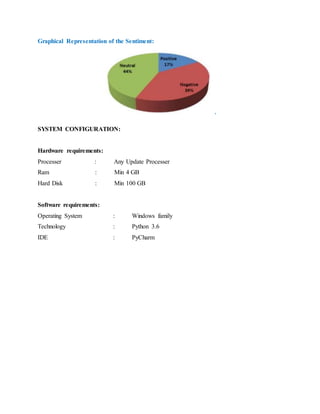
the mass is positive, negative or neutral towards the subject of interest and Graphical
representation of the sentiment in form of Pie-Chart.
Existing System:
A major benefit of social media is that we can see the good and bad things people say about the
particular brand or personality. The bigger your company gets difficult it becomes to keep a
handle on how everyone feels about your brand. For large companies with thousands of daily
mentions on social media, news sites and blogs, it’s extremely difficult to do this manually. To
combat this problem, sentimental analysis software is necessary. This software can be used to
evaluate the people's sentiment about particular brand or personality.
Proposed System:
1. Data Collection:
For performing sentimental analysis we need twitter data consisting of tweets about a particular
keyword or query term. For collecting the data and tweets we have used Twitter public API
available for general public for free. It is the part of Data Collection.
2. Data Pre-Processing:
It is a process to remove the unwanted words from tweets that does not amount to any
sentiments.
 Emotional Icons- 170 emoticons; identified emotional icons and remove them.
 URLs-does not signify any sentiment; replaced it with a word |URL|
 Stop words- words as “a‟, “is”, “the”; does not indicate any sentiment
 Usernames and HashTags- @ symbol before the username and # for topic; both
replaced with AT_USER.
 RepeatedLetters- huuuungry, huuuuuuungry, huuuuuuuuuungry into the token
“huungry".
 Slag Words- Non English words Data
3. Different Ways of Classifications:
Binary Classification: It is a two way categorization i.e. positive or negative.
3-Tier: In this, Tweets are categorized as Positive, Negative and Neutral.
5-Tier: Tweets are bucketed in 5 Classes namely: Extremely Positive, Positive, Neutral,
Negative and Extremely Neutral.
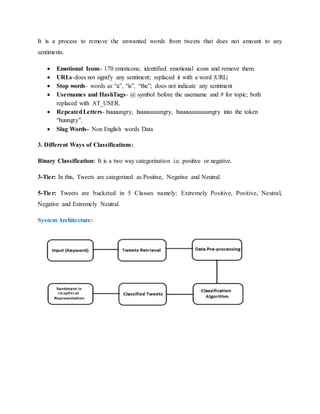
System Architecture:
Graphical Representation of the Sentiment:
’
SYSTEM CONFIGURATION:
Hardware requirements:
Processer : Any Update Processer
Ram : Min 4 GB
Hard Disk : Min 100 GB
Software requirements:
Operating System : Windows family
Technology : Python 3.6
IDE : PyCharm

Sentiment analysis in twitter using python

  • 1.
    Sentiment Analysis inTwitter Abstract: These systems introduce a novel approach for automatically classifying the sentiment of Twitter messages. These messages are classified as positive or neutral or negative with respect to a query term or the keyword entered by a user. The Social networking and micro blogging services are enables users to send and read messages. The Messages of length up to 140 characters, known as "tweets". Tweets contain rich information about people’s preferences. Our project includes prediction using Twitter data, and analysis of the prediction results. Tweets are frequently used to express a tweeters emotion on a particular subject. There are firms which poll twitter for analyzing sentiment on a particular topic. The challenge is to gather all such relevant data, detect and summarize the overall sentiment on a topic. Sentiment Analysis to determine the attitude of the mass is positive, negative or neutral towards the subject of interest and Graphical representation of the sentiment in form of Pie-Chart. Existing System: A major benefit of social media is that we can see the good and bad things people say about the particular brand or personality. The bigger your company gets difficult it becomes to keep a handle on how everyone feels about your brand. For large companies with thousands of daily mentions on social media, news sites and blogs, it’s extremely difficult to do this manually. To combat this problem, sentimental analysis software is necessary. This software can be used to evaluate the people's sentiment about particular brand or personality. Proposed System: 1. Data Collection: For performing sentimental analysis we need twitter data consisting of tweets about a particular keyword or query term. For collecting the data and tweets we have used Twitter public API available for general public for free. It is the part of Data Collection. 2. Data Pre-Processing:
  • 2.
    It is aprocess to remove the unwanted words from tweets that does not amount to any sentiments.  Emotional Icons- 170 emoticons; identified emotional icons and remove them.  URLs-does not signify any sentiment; replaced it with a word |URL|  Stop words- words as “a‟, “is”, “the”; does not indicate any sentiment  Usernames and HashTags- @ symbol before the username and # for topic; both replaced with AT_USER.  RepeatedLetters- huuuungry, huuuuuuungry, huuuuuuuuuungry into the token “huungry".  Slag Words- Non English words Data 3. Different Ways of Classifications: Binary Classification: It is a two way categorization i.e. positive or negative. 3-Tier: In this, Tweets are categorized as Positive, Negative and Neutral. 5-Tier: Tweets are bucketed in 5 Classes namely: Extremely Positive, Positive, Neutral, Negative and Extremely Neutral. System Architecture:
  • 3.
    Graphical Representation ofthe Sentiment: ’ SYSTEM CONFIGURATION: Hardware requirements: Processer : Any Update Processer Ram : Min 4 GB Hard Disk : Min 100 GB Software requirements: Operating System : Windows family Technology : Python 3.6 IDE : PyCharm