
WiMAX
Internet Connections
Three traditional ways to connect Internet:
1)Dial-up access – It is an Internet connection that will be established by
using a modem which act as data transfer medium when user initiates dial
up connection.
2)Broadband access -This refers to high-speed data transmission in
which a single cable(DSL,cable modem) can carry a large amount of data
at once.
3)WiFi access - Wi-Fi refers to wireless networking technology that
allows computers and other devices to communicate over a wireless signal.
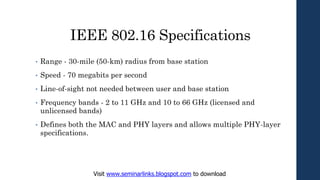
IEEE 802.16 Specifications
• Range - 30-mile (50-km) radius from base station
• Speed - 70 megabits per second
• Line-of-sight not needed between user and base station
• Frequency bands - 2 to 11 GHz and 10 to 66 GHz (licensed and
unlicensed bands)
• Defines both the MAC and PHY layers and allows multiple PHY-layer
specifications.
Visit www.seminarlinks.blogspot.com to download
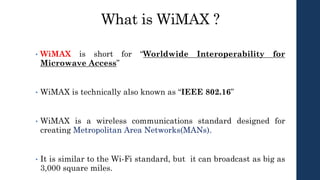
What is WiMAX ?
• WiMAX is short for “Worldwide Interoperability for
Microwave Access”
• WiMAX is technically also known as “IEEE 802.16”
• WiMAX is a wireless communications standard designed for
creating Metropolitan Area Networks(MANs).
• It is similar to the Wi-Fi standard, but it can broadcast as big as
3,000 square miles.
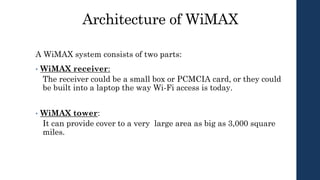
Architecture of WiMAX
A WiMAX system consists of two parts:
• WiMAX receiver:
The receiver could be a small box or PCMCIA card, or they could
be built into a laptop the way Wi-Fi access is today.
• WiMAX tower:
It can provide cover to a very large area as big as 3,000 square
miles.
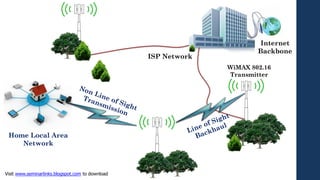
ISP Network
Internet
Backbone
WiMAX 802.16
Transmitter
Home Local Area
Network
Visit www.seminarlinks.blogspot.com to download
Wi-MAX Type 802.16 802.16a/Rev d 802.16e
Completed Dec 2001 802.16a Jan 2003
802.16 Rev d June 2004
Mid 2005
Spectrum 10 – 66 GHz 2 – 11 GHz 2 – 6 GHz
Application Backhaul Wireless DSL and Backhaul Mobile Internet
Channel Conditions Line of Sight only Non – Line of sight Non – Line of Sight
Bit rate 32 – 134 Mbps at 28 MHz
channelization
Up to 75 Mbps at 20 MHz
channelization
Up to 15 Mbps at 5 MHz channelization
Modulation QPSK 16 QAM and 64 QAM OFDM 256 sub carriers
QPSK 16 QAM and 64 QAM
Scalable OFDMA
Mobility Fixed Fixed Pedestrian Mobility / Regional roaming
Channel Bandwidth 20, 25 and 28 MHz Selectable channel between 1.5 and
20MHz
Same as 802.16a with UL sub
channels to conserve power
Typical Cell Radius 1 – 3 miles. 4 – 6 miles. Maximum range 30 Miles
based on tower height, antenna gain
and power transmit.
1 – 3 Miles
Comparison with
other Wireless
Technologies
Maximum Speed Supported
• WiMAX 802.16 - 280Mbps
• 3G - up to 2 Mbps
• Wi-Fi - up to 600 Mbps
• Mobile-Fi -- up to 80 Mbps
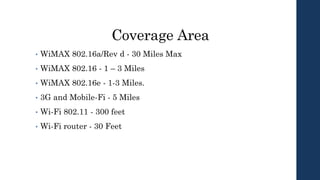
Coverage Area
• WiMAX 802.16a/Rev d - 30 Miles Max
• WiMAX 802.16 - 1 – 3 Miles
• WiMAX 802.16e - 1-3 Miles.
• 3G and Mobile-Fi - 5 Miles
• Wi-Fi 802.11 - 300 feet
• Wi-Fi router - 30 Feet
Airwave
• 3G and Mobile-Fi 802.20 are the licensed ones
• WiMAX 802.16 can be either Licensed or Unlicensed
• Wi-Fi 802.11 is an unlicensed one.
Channel Condition
• The WiMAX 802.16, 3G and Wi-Mobile 802.20 is optimized for
Outdoor Non- Line of Sight
• Wi-Fi 802.11 is Line of Sight based.
Quality of Service
WiMAX 802.16
• Grant request MAC
• Designed to support voice and video from the start
• supports differentiated service levels and centrally enforced QoS
Wi-Fi 802.11
• Contention – based MAC
• No guaranteed QoS
• Standard Cannot guarantee latency for voice or video
• No allowance for differential levels of service on a per user basis
• Proposed 802.11e QoS standard is prioritization only
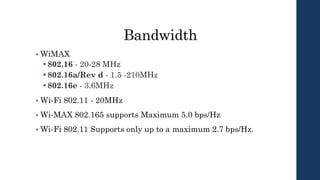
Bandwidth
 WiMAX
802.16 - 20-28 MHz
802.16a/Rev d - 1.5 -210MHz
802.16e - 3.6MHz
 Wi-Fi 802.11 - 20MHz
 Wi-MAX 802.165 supports Maximum 5.0 bps/Hz
 Wi-Fi 802.11 Supports only up to a maximum 2.7 bps/Hz.
Scalability
For WiMAX 802.16
• the channel bandwidths can be chosen by the operator for the
sectorization and scalable independent of bandwidth with
1.5MHz to 20MHz width channels
• MAC also supports thousands of users
where as Wi-Fi 802.11 has only wide 20MHZ channels and MAC
only supports tens of users.
Advantages
• WiMAX 802.16 is surely an advanced technology when compared
with the other technologies with more
 Bandwidth
 Bit rate
 Coverage area
 Performance
 Quality of service and secure too.
Disadvantages
• Interference with Bluetooth wireless communication
• The cost of equipment is really high and it has not yet widely
used.
• Power-consuming technology
• High installation
• Signal interruption in bad weather
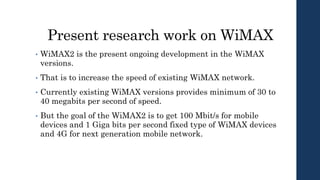
Present research work on WiMAX
• WiMAX2 is the present ongoing development in the WiMAX
versions.
• That is to increase the speed of existing WiMAX network.
• Currently existing WiMAX versions provides minimum of 30 to
40 megabits per second of speed.
• But the goal of the WiMAX2 is to get 100 Mbit/s for mobile
devices and 1 Giga bits per second fixed type of WiMAX devices
and 4G for next generation mobile network.
Thank You
Visit www.seminarlinks.blogspot.com to download

WiMAX

  • 1.
  • 2.
    Internet Connections Three traditionalways to connect Internet: 1)Dial-up access – It is an Internet connection that will be established by using a modem which act as data transfer medium when user initiates dial up connection. 2)Broadband access -This refers to high-speed data transmission in which a single cable(DSL,cable modem) can carry a large amount of data at once. 3)WiFi access - Wi-Fi refers to wireless networking technology that allows computers and other devices to communicate over a wireless signal.
  • 3.
    IEEE 802.16 Specifications •Range - 30-mile (50-km) radius from base station • Speed - 70 megabits per second • Line-of-sight not needed between user and base station • Frequency bands - 2 to 11 GHz and 10 to 66 GHz (licensed and unlicensed bands) • Defines both the MAC and PHY layers and allows multiple PHY-layer specifications. Visit www.seminarlinks.blogspot.com to download
  • 4.
    What is WiMAX? • WiMAX is short for “Worldwide Interoperability for Microwave Access” • WiMAX is technically also known as “IEEE 802.16” • WiMAX is a wireless communications standard designed for creating Metropolitan Area Networks(MANs). • It is similar to the Wi-Fi standard, but it can broadcast as big as 3,000 square miles.
  • 5.
    Architecture of WiMAX AWiMAX system consists of two parts: • WiMAX receiver: The receiver could be a small box or PCMCIA card, or they could be built into a laptop the way Wi-Fi access is today. • WiMAX tower: It can provide cover to a very large area as big as 3,000 square miles.
  • 7.
    ISP Network Internet Backbone WiMAX 802.16 Transmitter HomeLocal Area Network Visit www.seminarlinks.blogspot.com to download
  • 8.
    Wi-MAX Type 802.16802.16a/Rev d 802.16e Completed Dec 2001 802.16a Jan 2003 802.16 Rev d June 2004 Mid 2005 Spectrum 10 – 66 GHz 2 – 11 GHz 2 – 6 GHz Application Backhaul Wireless DSL and Backhaul Mobile Internet Channel Conditions Line of Sight only Non – Line of sight Non – Line of Sight Bit rate 32 – 134 Mbps at 28 MHz channelization Up to 75 Mbps at 20 MHz channelization Up to 15 Mbps at 5 MHz channelization Modulation QPSK 16 QAM and 64 QAM OFDM 256 sub carriers QPSK 16 QAM and 64 QAM Scalable OFDMA Mobility Fixed Fixed Pedestrian Mobility / Regional roaming Channel Bandwidth 20, 25 and 28 MHz Selectable channel between 1.5 and 20MHz Same as 802.16a with UL sub channels to conserve power Typical Cell Radius 1 – 3 miles. 4 – 6 miles. Maximum range 30 Miles based on tower height, antenna gain and power transmit. 1 – 3 Miles
  • 9.
  • 10.
    Maximum Speed Supported •WiMAX 802.16 - 280Mbps • 3G - up to 2 Mbps • Wi-Fi - up to 600 Mbps • Mobile-Fi -- up to 80 Mbps
  • 11.
    Coverage Area • WiMAX802.16a/Rev d - 30 Miles Max • WiMAX 802.16 - 1 – 3 Miles • WiMAX 802.16e - 1-3 Miles. • 3G and Mobile-Fi - 5 Miles • Wi-Fi 802.11 - 300 feet • Wi-Fi router - 30 Feet
  • 12.
    Airwave • 3G andMobile-Fi 802.20 are the licensed ones • WiMAX 802.16 can be either Licensed or Unlicensed • Wi-Fi 802.11 is an unlicensed one. Channel Condition • The WiMAX 802.16, 3G and Wi-Mobile 802.20 is optimized for Outdoor Non- Line of Sight • Wi-Fi 802.11 is Line of Sight based.
  • 13.
    Quality of Service WiMAX802.16 • Grant request MAC • Designed to support voice and video from the start • supports differentiated service levels and centrally enforced QoS Wi-Fi 802.11 • Contention – based MAC • No guaranteed QoS • Standard Cannot guarantee latency for voice or video • No allowance for differential levels of service on a per user basis • Proposed 802.11e QoS standard is prioritization only
  • 14.
    Bandwidth  WiMAX 802.16 -20-28 MHz 802.16a/Rev d - 1.5 -210MHz 802.16e - 3.6MHz  Wi-Fi 802.11 - 20MHz  Wi-MAX 802.165 supports Maximum 5.0 bps/Hz  Wi-Fi 802.11 Supports only up to a maximum 2.7 bps/Hz.
  • 15.
    Scalability For WiMAX 802.16 •the channel bandwidths can be chosen by the operator for the sectorization and scalable independent of bandwidth with 1.5MHz to 20MHz width channels • MAC also supports thousands of users where as Wi-Fi 802.11 has only wide 20MHZ channels and MAC only supports tens of users.
  • 16.
    Advantages • WiMAX 802.16is surely an advanced technology when compared with the other technologies with more  Bandwidth  Bit rate  Coverage area  Performance  Quality of service and secure too.
  • 17.
    Disadvantages • Interference withBluetooth wireless communication • The cost of equipment is really high and it has not yet widely used. • Power-consuming technology • High installation • Signal interruption in bad weather
  • 18.
    Present research workon WiMAX • WiMAX2 is the present ongoing development in the WiMAX versions. • That is to increase the speed of existing WiMAX network. • Currently existing WiMAX versions provides minimum of 30 to 40 megabits per second of speed. • But the goal of the WiMAX2 is to get 100 Mbit/s for mobile devices and 1 Giga bits per second fixed type of WiMAX devices and 4G for next generation mobile network.
  • 19.